Home » Competition » Recent Articles:

Wireless Advocates Want to Poach Frequencies Assigned to Local TV Stations

Phillip Dampier January 6, 2010 Competition, Public Policy & Gov't 2 Comments

Just six months after the transition to digital television in the United States, proponents for the wireless mobile industry are back before the Federal Communications Commission asking the agency to “free up” additional frequencies by forcing major changes to local television stations.

The CTIA – The Wireless Association, a trade group representing big mobile providers like Verizon, Sprint, and AT&T, and the Consumer Electronics Association have suggested high power television broadcasting should be replaced with networks of lower powered regional relay transmitters serving smaller areas.  With considerably reduced power and antenna height, the groups argue, stations can be compacted into a smaller range of available channels, opening up new opportunities for wireless broadband services.

The number of available channels for television broadcasts has been shrinking since the early 1980s, when UHF channels 70-83 were largely reassigned for mobile phone use.  Today’s UHF band ends at channel 51, as channels 52-69 are reassigned to several interests, including first responders and other public safety uses.  With further compacting of the UHF band, up to 100-180 MHz of spectrum may be freed for mobile broadband use across the country.

How can this be done when the FCC believes many large urban regions of the country have used every available channel?  By reducing the coverage area of individual transmitters.  The wireless association claims interference problems come from high powered transmitters using soaring television antennas to give most television stations 30-40 miles of coverage area from a single transmitter site.  By dramatically reducing both the power and antenna height, and instead using a network of relay transmitters serving smaller areas, television stations can cover their local communities and reduce distant signal reception.  It’s these distant signals, and their capacity to interfere with other stations which requires the FCC to keep stations occupying the same or nearby channels far apart.

KATV-TV Little Rock's transmission tower

The CTIA suggests that with proper engineering of a low-powered network of transmitters, the Commission could reallocate UHF channels 28-51 for wireless communications instead, leaving UHF stations sharing channels 14-27.

The wireless lobby is selling this plan as a “win” for broadcasters, even though they will need to construct a network of lower powered transmitters and antennas to serve essentially every town in their existing service areas.  For most, that would involve constructing 15-20 new transmitter sites.  The wireless group says a more localized ‘cell-tower’ like approach to television transmission would serve areas currently not able to receive reception because of obstacles between the main high powered transmitter and a viewer’s set.  Proper placement of transmission antennas would maximize reception for each transmitter.  The wireless industry is even willing to bear the expense of purchasing transmitters, estimated at up to $1.8 billion dollars nationwide, to help broadcasters make the transition.  That’s actually a cheap price to pay considering the frequencies converted for their use are worth tens of billions more.

The plan got a boost of sorts from the Justice Department, who filed their own comments with the FCC suggesting adding frequency spectrum for wireless-based broadband should be a top priority for the Commission.

“Given the potential of wireless services to reach underserved areas and to provide an alternative to wireline broadband providers in other areas, the Commission’s primary tool for promoting broadband competition should be freeing up spectrum,” Justice officials wrote.

The Justice Department believes handing over additional frequency spectrum will promote competition, increase wireless broadband speeds, and lower prices, despite no evidence that wireless broadband competition would suddenly appear on the scene, or that the prevailing wireless carriers would actually reduce pricing and relax usage limits.

Broadcasters are not thrilled with the wireless industry plan.

The National Association of Broadcasters, to paraphrase, knocked the wireless industry for getting too greedy with its spectrum requests.  The NAB believes wireless providers like Verizon, AT&T, Sprint and T-Mobile are sitting on frequencies already allocated, but not yet used, for mobile communications networks, and they should use them before they come knocking looking for more.

Even more concerning to the NAB is the disruption the CTIA plan would cause for Americans still watching over-the-air free television.  Channel numbers would almost certainly have to be reassigned… again, at least for UHF stations.  That created significant confusion for viewers on the final date of the DTV transition in June when many stations either moved their digital signal back to their original analog channel number or relocated somewhere else on the dial.  Many Americans lost reception until they were taught to re-scan their televisions or converters to find the channels gone missing.

The NAB also questions the reception improvement a network of low power television transmitters could provide, particularly for those just on the edge of one relay transmitter and another.  Anyone trying to watch a low power television station today more than a few miles from the transmitter site can testify it’s not a pleasant experience.  Even greater concerns impact those “distant viewers” who may live between two or more cities, each with their own local stations.  Those viewers, using external antennas, can often watch television from several cities depending which direction their rooftop antenna is pointed, but could end up receiving no signals at all if CTIA’s plan is approved.

Broadcasters are also concerned about the impact lower powered transmitters will have on the forthcoming Mobile DTV service, which will bring programming to devices on-the-go.

The war over frequencies continues, as the broadcasters and mobile providers fight over who ultimately controls airwave real estate estimated to be worth $36-65 billion dollars.


DirecTV Directly Reaches Your Bank Account With Rate Hike for 2010

Phillip Dampier January 4, 2010 Competition 6 Comments

Cable companies, U-verse, and FiOS aren’t alone in raising prices in the New Year.  Satellite provider DirecTV has mailed a rate hike notice to its subscribers effective February 9, 2010.  Many of their packages are being streamlined, and some existing subscribers to packages not noted below are also impacted with price increases.  Most will see an increase averaging $3 a month.  Thanks to The Gadgetress at The Orange County Register who put it all in chart form.

DVR fees will also increase, from $5.99 to $7 a month.

Those on promotional price packages or a contract term will see no change in pricing until their promotion or contract expires.

DirecTV service 2009 price 2010 price Increase
Premier $109.99 $114.99 4.5%
Lo Maximo $109.99 $114.99 4.5%
Choice Xtra $60.99 $63.99 4.9%
Choice $55.99 $58.99 5.4%
Preferred Choice $35.99 $38.99 8.3%
Jadeworld $36.99 $39.99 8.1%
Optimo Mas $44.99 $47.99 6.7%
Total Choice Mobile n/a $63.99 n/a
Plus HD DVR $75.99 $79.99 5.3%
Plus DVR $65.99 $69.99 6.1%
Select $48.99 $51.99 6.1%
Basico $32.99 $35.99 9.1%

For those who are curious, the 2010 prices are between 9.5 percent to 60 percent higher than 2008’s prices:

DirecTV service 2008 price 2009 price 2010 price 08-10 increase
Premier $104.99 $109.99 $114.99 9.5%
Lo Maximo $104.99 $109.99 $114.99 9.5%
Plus HD DVR $72.99 $75.99 $79.99 9.6%
Plus DVR $62.99 $65.99 $69.99 11.1%
Choice Xtra $57.99 $60.99 $63.99 10.3%
Familiar Ultra $54.99 $57.99 $60.99 10.9%
Choice $52.99 $55.99 $58.99 11.3%
Preferred Choice $32.99 $35.99 $38.99 18.2%
Select n/a $48.99 $51.99 n/a
Basico $29.99 $32.99 $35.99 20.0%
Basic (international) $9.99 $12.99 $15.99 60.1%

DirecTV E-Mail to Subscribers:

Dear DIRECTV Customer,

Your business is important to us. We want you to know about any changes to your DIRECTV® service as far in advance as possible. That is why we are writing to let you know of a potential change to your DIRECTV bill.

On February 9, 2010, new pricing will be applied to DIRECTV programming packages and services.

DIRECTV is the leader in satellite television and will continue to bring you the best in entertainment:

New Rates for DIRECTV® Service: New prices take effect February 9, 2010, and will appear on billing statements issued after that date. See the detailed information below as it relates to your service. If your current DIRECTV base package price is part of a national promotional 12-month or “Lock in Your Price for 12 Months” offer, you will continue to receive this price for the remainder of your offer period. As of next month’s bill, your promotional price will be shown on your statement as the new price along with a credit. Note: if you change your current base package, you may no longer be eligible for the credit.

Base Packages: Base packages include local channels, where available. Packages and their new prices: CHOICE™ $58.99/mo. CHOICE XTRA™ $63.99/mo. PREFERRED CHOICE™ $38.99/mo. PREMIER™ $114.99/mo. TOTAL CHOICE® MOBILE™ $63.99/mo.

The following legacy base packages* and their new prices: BASIC $15.99/mo. BÁSICO™ $35.99/mo. DIRECTV LIMITED $27.99/mo. FAMILIAR™ $51.99/mo. FAMILIAR ULTRA™ $60.99/mo. OPCIÓN ESPECIAL® $35.99/mo. OPCIÓN EXTRA™ $43.99/mo. OPCIÓN EXTRA ESPECIAL® $52.99/mo. OPCIÓN PREMIER® $108.99/mo. OPCIÓN ULTRA ESPECIAL® $54.99/mo. OPTIMO MÁS PLUS DVR $53.99/mo. PLUS DIRECTV $36.99/mo. PLUS DVR™ $69.99/mo. PLUS HD DVR™ $79.99/mo. SELECT CHOICE® $41.99/mo. TOTAL CHOICE® $57.49/mo. TOTAL CHOICE® LIMITED $48.99/mo. TOTAL CHOICE® PLUS $61.49/mo. SELECT will increase $3.00/mo. DIRECTV® DVR Service fee $7.00/mo.

*These packages are no longer available for sale. Customers who currently subscribe to these packages may maintain them as long as their account is in “good standing”, as determined by DIRECTV in its sole discretion. For complete pricing and packaging information, visit directv.com/packages.

TxtMsg Ripoff: OMG, Cell Phone Provider Sends $500 Bill to Texting Teen’s Dad for Data That Costs Them A Penny to Deliver

Phillip Dampier January 2, 2010 Competition, Data Caps, Public Policy & Gov't, Video 6 Comments

Nothing beats an overcharging scheme like cell phone text messaging.  What originally was envisioned as a small text paging add-on has become a massively lucrative service from America’s cell phone companies who rake in millions from one line messages.  In 2008, 2.5 trillion messages were sent from cell phones worldwide, up 32 percent from the year before, according to the Gartner Group.

Woe to those who send or receive text messages without a special texting plan.  Although the actual cost to send and deliver dozens of text messages is literally a fraction of a penny, almost every carrier charges a uniform 20 cents per message sent or received.  A text-happy teen can rapidly skyrocket your cell phone bill, as one Massachusetts father discovered.

[flv width=”480″ height=”380″]http://www.phillipdampier.com/video/WWLP Springfield Cell Phone Bill Shocker 12-26-09.flv[/flv]

WWLP-TV in Springfield reports on a Massachusetts dad confronted with a $500 text message cell phone bill last year.  (1 minute)

Texting plans typically add a few dollars to your cell phone bill, although unlimited texting can cost you a ten spot every month per phone from some providers.  For those customers receiving unwanted text message spam, most simply pay the bill, which only adds to provider profits.  Carriers promise they will credit customers receiving unwanted text messages, and several will block them altogether for no additional charge.  Carriers claim the popular text messaging service adds value to subscribers, and frankly utilizes less of their network resources than customers making quick voice calls back and forth.

Yet prices for cell phone text messaging keep increasing.  Some carriers originally charged just five cents per message.  Yet since the number of wireless phone companies have shrunk from six to just four today, prices have increased: first to 10 cents per message, then 15 cents, and today a near-uniform 20 cents per message. That generates profits credit card companies can only drool over.  In fact, doing the math, sending 140 bytes of data in a typical text message costs you one cent for every seven bytes of data.  That’s $1,497.97 per megabyte.

Senator Herb Kohl (D-Wisconsin) has had his share of constituent complaints from those who’ve received surprise enormous bills.  Kohl is chairman of the Senate Judiciary Subcommittee on Antitrust, Competition Policy and Consumer Rights.  He began investigating why text messaging costs so much.

“Text messaging files are very small,” Kohl says, “as the size of text messages are generally limited to 160 characters per message, and therefore cost carriers very little to transmit.”

Perhaps even less than Kohl suspects.  Text messages are limited to 160 characters because they ride across barely-utilized control data circuits cell phone companies use to manage calls.  Because these circuits are idle or underutilized, yet still occupy part of the spectrum, riding text messages across these channels costs carriers next to nothing, and don’t bog down wireless networks.  But that staggering bill can sure bog down your budget.

Action Alert For Washington State Residents: Tell The Utility Commission Frontier Must Dump 5GB Acceptable Use Limit

Several staff members working for the Washington Utilities and Transportation Commission (WUTC), the regulatory agency reviewing the proposed Frontier purchase of Verizon territories in Washington state, have reversed their opposition to the Frontier-Verizon deal because of concessions they believe will better serve consumers impacted by the deal.  But the provisions don’t come close to protecting consumer rights and do not sufficiently protect local telephone and broadband service.

The WUTC must be told that broadband expansion from a service provider that insists on a 5 gigabyte usage limit in its Acceptable Use Policy makes such expansion barely worth the effort.  The WUTC must insist on a permanent exemption from any usage limits for Washington state consumers, especially because many may find Frontier DSL to be their only broadband option for years to come.  To allow a company with such a paltry limit to be the monopoly provider of broadband puts Washington residents and small businesses at a serious economic disadvantage in the digital economy.

Would you choose to reside or locate your business in a community with one broadband provider offering a limit so low, your broadband usage will be limited to web page browsing and e-mail?

High Speed Internet Access Service

Customers may not resell High Speed Internet Access Service (“Service”) without a legal and written agency agreement with Frontier. Customers may not retransmit the Service or make the Service available to anyone outside the premises (i.e., wi-fi or other methods of networking). Customers may not use the Service to host any type of commercial server. Customers must comply with all Frontier network, bandwidth, data storage and usage limitations. Frontier may suspend, terminate or apply additional charges to the Service if such usage exceeds a reasonable amount of usage. A reasonable amount of usage is defined as 5GB combined upload and download consumption during the course of a 30-day billing period. The Company has made no decision about potential charges for monthly usage in excess of 5GB.

Frontier will be a part of the lives of almost 500,000 state residents, including those in Wenatchee and other parts of North Central Washington.  That covers a lot of rural residents with no hope of cable competition or other broadband options.  Verizon is the second-largest local telephone service provider in Washington, serving cities such as Redmond, Kirkland, Everett, Bothell, Woodinville, Kennewick, Pullman, Chelan, Richland, Naches, Westport, Lynden, Anacortes, Mount Vernon, Newport, Oakesdale, Republic and Camas-Washougal.  Currently, Verizon has approximately 1,300 employees in Washington, who would be transferred to Frontier once the deal is complete.

Frontier’s concessions don’t come close to assuring residents they can get the kind of broadband service they need in the 21st century, especially from a company that could easily find itself swamped in debt.  Let’s look at what Frontier has offered:

  • Invest $40 million to expand high-speed Internet access in Washington.
  • Submit quarterly financial reports to identify merger savings.
  • Branding and transition costs to be paid by stockholders, not ratepayers.
  • Increase financial incentives to prevent a decline in service quality.
  • Adopt Verizon’s existing rates and contracts for at least three years.

Frontier would also be required to pay residential customers $35 for missed service repairs or installation appointments. That’s $10 more than Verizon now pays. Current Verizon customers would also have 90 days after the transition to choose another provider without incurring a $5 switching fee. Low-income customers who qualify through the Washington Telephone Assistance Program will also receive a one-time $75 credit if the company fails to offer appropriate discounts or deposit waivers.

Our take:

  • Investing $40 million in low speed DSL service with a 5GB usage allowance saddles residents with yesterday’s technology with a usage allowance that rations the Internet.
  • Customers don’t care about merger cost reductions because they’ll never enjoy those savings, but they’ll feel their impact if they include layoffs and reduction in investment.
  • Consumers will be more concerned about what happens to their phone and broadband service when the “transition” results in service and billing problems.  Will stockholders pay inconvenienced customers?
  • Vague promises of increased financial incentives for a company to do… its job, without declines in service quality, exposes just how unnecessary this deal is.  Why not offer incentives for Verizon to stay?
  • Freezing rates for three years doesn’t prevent massive increases to make up the difference in year four and beyond.

The WUTC staff had it right the first time when it opposed the deal.  A healthy, financially secure Verizon is still a better deal than a smaller independent company saddled with debt.  Frontier seals the fate of Washington state residents from the benefits of fiber optics wired to the home, delivering high speed broadband for the future because Frontier doesn’t do fiber to the home on its own.  With a tiny usage allowance, just waiting for the company to decide to enforce it means you won’t be using your broadband account too much anyway.

The WUTC is accepting comments and you need to start calling and writing.  Make sure to tell the Commission it must secure a permanent exemption for Washington from any Internet Overcharging schemes like consumption/usage-based Internet billing and any usage limits Frontier defines in its Acceptable Use Policy.  Better yet, tell them Frontier’s concessions don’t come close to making you feel good about Verizon turning over your phone service to a company that is traveling the same road three other companies took all the way to bankruptcy.

Customers who would like to comment on the provisions can call toll-free: (888) 333-9882 or send e-mail to [email protected]. The deadline for comments is January 10th.

CenturyLink Opposing Broadband Stimulus Applications That Might Overlap Its Person County, NC Limited Service Area

Person County, North Carolina

For north-central North Carolina, it’s often not a matter of how many choices you have for broadband service — it’s whether you can obtain any service at all.

Person County, located just south of the Virginia border, is a good example.  The county’s 36,000 residents technically reside in North Carolina’s Research Triangle, a high-tech growth area.  You wouldn’t know it from the broadband options available in many parts of the county, however.

The dominant phone company, CenturyLink (formerly EMBARQ), offers DSL service in the larger communities in Person County, but wide areas remain without any service at all.

Randy King

A Roxboro-based computer store and Internet Service Provider decided that with CenturyLink unwilling to expand into low population density areas to supply service, they would, with the help of broadband stimulus funding available from the Obama Administration.

Randy King, president of Electronic Solutions, Inc. (ESI), planned to expand broadband into 26 previously unserved Person County areas, and filed a stimulus application requesting $3 million in funding to begin construction.

King believes wireless broadband is the most cost-effective way to reach parts of the 400 square mile county that are simply too rural to upgrade wired service.  Today, that’s nearly 40 percent of the county that still does not have access to broadband service. The Person County High Speed Internet Committee and the County Commissioners endorsed ESI’s proposal.

But CenturyLink would have none of it, despite the fact it was not willing to provide service to those unserved areas either.  The phone company filed an objection with the agency administering the stimulus program claiming ESI would be overbuilding a competing broadband provider in its service area:

CenturyLink can certify that its affiliates currently offer broadband service in some or all of the applicant’s proposed service areas. We attach a representative sample of areas where the application overlaps our existing broadband deployment. This data is not exhaustive; the application may include other areas also currently served with broadband by CenturyLink or other providers. We will provide additional information on request if that will further assist the agency’s review.

CenturyLink also provides data showing broadband availability in local telephone exchanges within the proposed service areas. This includes areas served by CenturyLink and/or other broadband providers. This data further shows the applicant would duplicate and overlap existing broadband services in the proposed service areas.

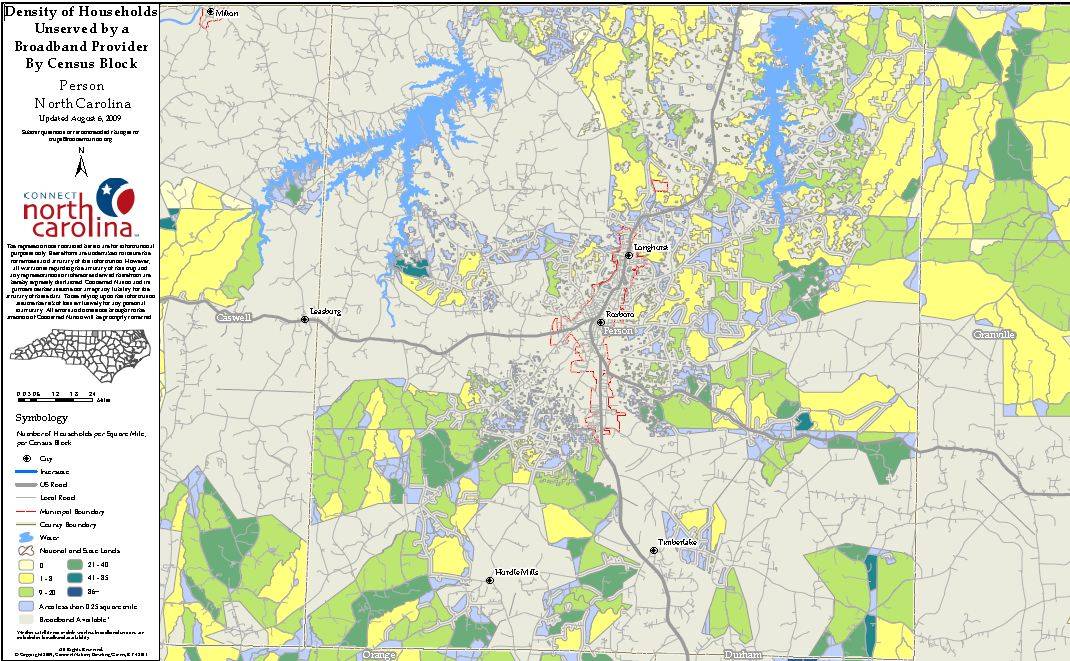
Connected North Carolina's map shows large areas in grey that suggest broadband service is already available. (click to enlarge)

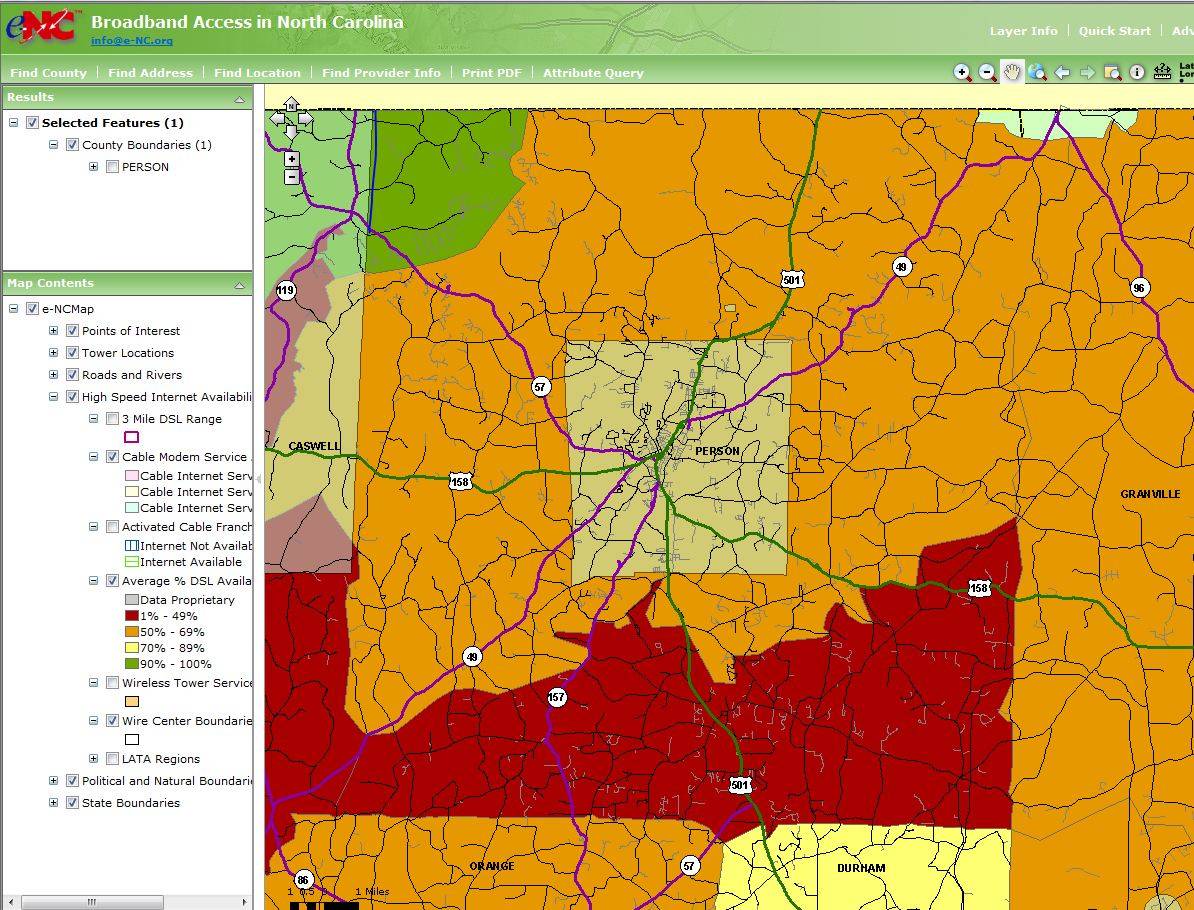
Because the government will judge the merit of applications based, in part, on reaching the unserved, map data purporting to illustrate who does and who does not have access to broadband service is critically important to applicants.  Some providers have used map data produced by a politically well-connected group filled with telecom industry executives that has spent millions of taxpayer dollars and produced maps that are less than illustrative of the true nature of broadband service.  When a map from Connected Nation’s North Carolina chapter can show citizens have access to broadband, even when they do not, what’s a regulator to do but consider that stimulus grant application unnecessary.

Randy King, President of ESI, has responded to the CenturyLink opposition:

“We are extremely disappointed that CenturyLink has opposed the Person County project. The project would provide high speed Internet (broadband) in areas that currently do not have service in our county. CenturyLink as recently as April 2009 met with county officials and members of the public and stated that they did not intend to expand DSL in low density areas which do not make economical sense.  We are now aware that CenturyLink is not only not going to serve these areas but is attempting to block anyone else from serving these areas.”

ESI claims its wireless system could deliver more capacity to Person County’s rural unserved than CenturyLink provides its more urban counterparts.

“It should be noted that the wireless system will have at minimum 50-100Mbps capability at each tower site which far exceeds current DSL speed of 1-10Mbps. This allows customers to have sufficient bandwidth to have services such as VOIP, IPTV and streaming capabilities whereas DSL is not capable,” King writes.

King is also concerned that CenturyLink won’t provide true detailed maps of exactly what service it provides in what areas.

Person County and area residents have been requesting street level coverage maps from CenturyLink and Charter (the city’s cable company) for years without success. King wants the ability to review these maps, preferably in color with speed capabilities identified down to the 911 address location.  That way, he says, he can work on building capacity to areas not getting service at all.

Providers have traditionally been loathe to disclose this information to the public, and even government regulators, claiming it represents proprietary, competitive information.  That leaves everyone but providers guessing about what broadband service really looks like across America.

The more credible e-NC mapping project shows large swaths of southern Person County without any broadband options at all. (click to enlarge)

Kevin McCarter, CenturyLink’s general manager for central North Carolina seems primarily concerned with potential government funding of his competition.  McCarter told The Courier-Times CenturyLink “interpreted that” the towers King proposed to place in order to provide wireless service “would cover 95 percent” of the entire county. King explained that his intent was not to cover the whole county with wireless access, but to place towers so that those living in areas of the county not currently served by DSL lines would have the option of wireless broadband. He said he never intended his service to replace the DSL lines CenturyLink has in place.

That ESI doesn’t seem intent on competing directly with CenturyLink may have resulted in a breakthrough this month.  The two companies met December 15th to discuss their respective broadband plans for Person County, and may have come to an agreement that could divide up the unserved and get them broadband service from one company or the other, but likely not both.

Jamie Averett Mitchell, spokesperson for CenturyLink, issued the following statement Monday:  “On Tuesday, Dec, 15, representatives from CenturyLink met with Randy King, president of Electronic Solutions, Inc., to review broadband coverage for Person County. Maps detailing both existing and planned coverage areas were presented and reviewed by both parties. Areas that were not covered on either company’s maps were discussed and both companies are aware of those sites. CenturyLink and ESI are working together to determine the most efficient way to provide 100 percent of the population in Person County with the best broadband coverage possible.”

So it seems that broadband applications that do not challenge incumbent providers are acceptable, but those that could expand the quality of service to those living with rural, slow speed DSL service are not.

Search This Site:

Contributions:

Recent Comments:

Your Account:

Stop the Cap!