Home » Competition » Recent Articles:

North Carolina: Welcome to the Home of America’s Worst Broadband Service

A new report has found the home of America’s worst broadband service can be found in the state of North Carolina.

The Tar Heel State ranks dead last in the number of homes able to access the Internet at speeds the Federal Communications Commission defines as “broadband” — 4/1Mbps.  The report quotes from FCC figures that show only 10 percent of North Carolina households are receiving broadband service at speeds that equal or exceed 3Mbps downstream and 768 kbps upstream.  States traditionally thought to be bottom-ranked, including Mississippi and Idaho, are now doing better than the home of Research Triangle Park.

The report comes courtesy of the SouthEast Chapter of the National Association of Telecommunications Officers and Advisors (SEATOA), which is attempting to fight off efforts to stop individual communities from delivering the service big cable and phone companies refuse to provide in large parts of the state.

Where Time Warner Cable, AT&T, and CenturyLink do deliver service, customers pay dearly for it.  Broadband.com found most of America’s worst broadband values in North Carolina.  In fact, outside of prohibitively expensive Anchorage, Alaska, seven of the ten most expensive cities were in North Carolina, when measuring cost per megabit (see below for a better understanding of how this figure was computed):
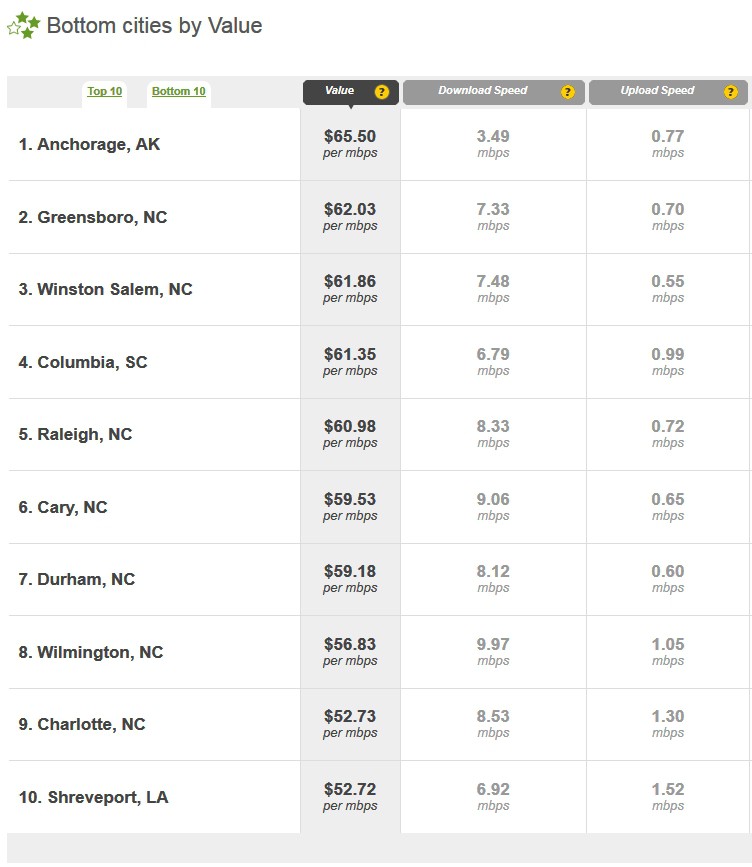
America's Worst Broadband is in North Carolina (source: Broadband.com)

Comparatively, states in the northeast were meccas.  Sixty percent or more of residents in Delaware, Massachusetts and New Jersey have broadband at speeds the FCC now considers bare minimum.  In larger states: New York, 43 percent and Pennsylvania, 44 percent, broadband speed still scored higher despite the large rural sections of both states.  Verizon’s fiber-to-the-home network has compelled upgrades among cable company competitors to keep up with the benefits fiber optics bring.

But in North Carolina, only community-owned networks are delivering service comparable to that found in the increasingly-fiber-wired northeast.  Instead of committing to upgrades, large cable and phone companies are spending plenty lobbying to restrict and banish the improved service these networks provide in communities like Wilson and Salisbury.

SEATOA’s conclusion?  The current inadequate level of service coming from North Carolina’s cable and phone companies allows the state to fall further behind in America’s economic recovery.

More about how Broadband.com calculated the results can be found below the jump.

… Continue Reading

New Zealand Commission Studies Usage Caps as Impediment to Broadband Development

Phillip Dampier April 5, 2011 Broadband Speed, Competition, Data Caps, Net Neutrality, Public Policy & Gov't, Rural Broadband, Wireless Broadband Comments Off on New Zealand Commission Studies Usage Caps as Impediment to Broadband Development

New Zealand’s Commerce Commission is planning to study Internet Overcharging schemes from Internet Service Providers as part of a review of the government’s planned investment of $1.35NZD billion to construct a state-subsidized fiber broadband network.

At issue is whether the government’s investment in broadband will not deliver value for money if broadband providers sell heavily usage-capped broadband services over the country’s new network.

The Commerce Commission serves as New Zealand’s antitrust regulator, charged with finding marketplace abuses and correcting them, especially in the absence of competition.  Included in the wide-ranging review:

  • Network peering: Allowing broadband traffic to flow freely between Internet Service Providers without interference or punitive expense;
  • Data caps: Whether ISPs will continue to limit broadband usage on a network paid for by public funds, pocketing the proceeds;
  • Net Neutrality: Ensuring that content over the network is treated fairly and equally.

“Our aim is to promote competition in telecommunications markets for the long-term benefit of end-users of telecommunications services in New Zealand,” Telecommunications Commissioner Ross Patterson said in a statement. “The study will result in a report which will identify any factors which may inhibit the uptake of ultra-fast broadband services.”

Most of the investigation will likely target New Zealand’s dominant phone company – Telecom New Zealand.  The former state-owned monopoly has rebuilt part of its market dominance pitching broadband service across the country over its landline-based DSL network, by which most New Zealanders obtain broadband.  While the company competes with other providers who resell service over Telecom phone lines, many critics charge the phone company position as the owner of the infrastructure gives it a powerful position in the market.

The New Zealand government hopes to retire its aging copper-wire telephone network and replace it with a combination of fiber optics in cities and towns and fixed wireless service in rural areas.  A discussion paper is expected from the commission by June, with a final report due in December.

Why Verizon’s LTE/4G Network Will Never Replace Cable/DSL Broadband: Usage Caps

Lynch

Verizon’s ambitions to provide 285 million people with the option of ditching their cable or DSL broadband account for its new LTE/4G wireless network is a dream that will never come true with the company’s wireless Internet Overcharging schemes.  With a usage cap of 5-10GB per month and a premium price, only the most casual user is going to give up their landline cable or DSL service for Verizon’s wireless alternative.

Dick Lynch, executive vice president and chief technology officer at Verizon spoke highly of Verizon’s new next generation wireless network as a perfect platform to deliver broadband service to landline customers, including many of those the company sold off to Hawaiian Telcom, FairPoint Communications, or Frontier.

“[LTE] provides a real opportunity for the first time to give a fixed customer in a home, broadband service — wireless — but broadband service,” Lynch said. “In wireless, I see a great opportunity within the LTE plans we have to begin to service the customers who don’t have broadband today … They will be able to have mobile LTE and also to be able to have fixed broadband.”

Unfortunately, Verizon’s LTE network comes with usage limits and a premium price — $50 a month for 5GB or $80 a month for 10GB.  At those prices, rural America will have two bad choices — super slow 1-3Mbps DSL ($30-60) with allowances ranging from 100GB-unlimited or LTE’s 5-12Mbps (assuming the local cell tower is not overloaded with users) with a usage cap that guarantees online video will come at a per-view cost rivaling a matinee movie ticket.

Still, Verizon is likely to test market the service as a home broadband replacement, particularly in territories they no longer serve.  Verizon has done much the same thing pitching a home phone replacement product that works with their wireless network to residents of Rochester, N.Y., and the state of Connecticut, neither currently served with landlines from Verizon.

Despite the pricing and cap challenges, Deutsche Bank — one of the Wall Street players that follows Verizon — thinks the company’s DSL-replacement has merit, if:

  1. If you are a regular traveler that needs a wireless broadband service anyway;
  2. You use broadband exclusively for web browsing, e-mail, and very occasional multimedia access;
  3. You are wealthy enough not to care about the overlimit penalty.

For everyone else, sticking with traditional DSL service will continue to be the most affordable option, assuming usage caps are kept at bay.  Where available, cable broadband service from companies that serve smaller communities, including Comcast Cable, Time Warner Cable, and Cablevision, among others, will probably continue to deliver the most bang for the buck in rural America.


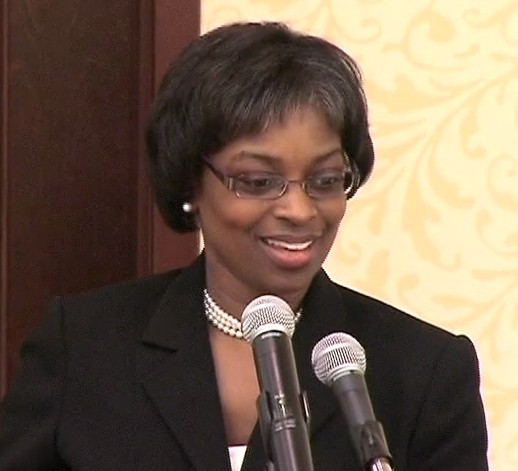
FCC Commissioner Mignon Clyburn Calls North Carolina’s H.129 A “Broadband Barrier”

FCC Commissioner Mignon Clyburn

Federal Communications Commissioner Mignon Clyburn thinks Time Warner Cable-sponsored legislation to regulate community-owned Internet Service Providers in North Carolina is a barrier to broadband improvement and could create economic harm across the state.

The commissioner, who hails from the Carolinas, today issued a statement expressing serious concerns about H.129, Rep. Marilyn Avila’s (R-Time Warner Cable) bill to hamper community-owned competition for large cable and phone companies in the state.

“I have serious concerns that as the Federal Communications Commission continues to address broadband deployment barriers outlined in the National Broadband Plan, new obstacles are being erected that are directly contrary to the Plan’s recommendations and goals,” Clyburn said.

Clyburn called out the legislation starting with the name of the bill – ‘Level Playing Field/Local Government Competition.’

“[…] Do not let the title fool you. This measure, if enacted, will not only fail to level the playing field; it will discourage municipal governments from addressing deployment in communities where the private sector has failed to meet broadband service needs,” Clyburn said. “In other words, it will be a significant barrier to broadband deployment and may impede local efforts to promote economic development.”

Clyburn noticed such legislation delivers benefits to major telecommunications corporations, but doesn’t deliver any improvement or competition in rural and small sized cities that suffer with low speed DSL, or no broadband service at all.  North Carolina currently ranks 41st out of 50 states in broadband delivery and quality.

Clyburn spent time in North Carolina last year defending community-owned broadband developments, commending them for bringing Internet access to communities either without service, or woefully underserved.

H.129 has passed the House of Representatives in the North Carolina legislature and is now pending in the Senate.

Read the entire statement here.

Kansas City Reacts to Google Fiber Project

Party time in Kansas City, Kansas

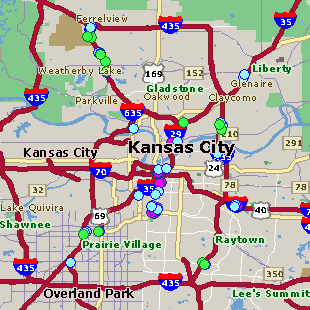
Kansas City, Kansas is creating some jealousy across the river in the much larger Kansas City, Missouri in reaction to Google’s announcement yesterday that it was bringing its 1 gigabit per second fiber to the home network to KCK.

Local bloggers called Google’s announcement “a game changer” for the city’s software developers and health care providers, who represent a large part of the city’s high tech economy. The announcement also thrilled local schools and universities, who will be able to deliver broadband service that rivals world leader South Korea in as little as one year from today.

Speculation about why Google chose the Kansas-based suburb of Kansas City has been rampant.  Among the biggest theories is that the local utilities, with whom Google must negotiate for space to accommodate its fiber cables, are owned by the local municipality, not private corporations.  With local government officials eager to cut red tape and avoid political or economic minefields which could delay the project, having public utilities as a partner may have made a decisive difference in the final decision.

The 'Kansas City' in the smaller type represents the Kansas suburb of the much larger Kansas City, Mo.

Demographics experts suggest Google might have chosen KCK because it represents classic middle-America with a growing digital economy — a perfect laboratory to watch what comes from ultra high speed Internet access.

The presentation by Google rivaled a glowing Hollywood production, one TV news team remarked.  Live-streamed on the web to a global audience, company officials vaguely promised the choice of KCK was the beginning of a potentially broader fiber network not just limited to a single Kansas city, although company officials seemed to restrain themselves out in the parking after the event, suggesting the network could be expanded regionally, saying nothing about other cities further afield.

Local newscasts told the Google story to Kansas City viewers in varying degrees of intensity, often relegated to pointless outdoor live stand up shots scattered around the city.  There isn’t much to show for a network that exists only in the form of a website.

A Silicon Valley expert echoed the sentiment that faster broadband can bring dramatic development to the communities that have it, sometimes in surprising ways.  It’s less about what one can do with 1Gbps service today and more about the possibilities for tomorrow.  But CNBC’s Jon Fortt added some applications may have only limited national appeal if the rest of the country lives with slower broadband service than cannot support the latest online innovations.

Still, excitement is easy to find among the journalists, local politicians, and other community members across the range of local news coverage.

It brings to mind just how ironic it is that a city like KCK will soon have some of the fastest broadband connections in the country while states like North Carolina are on the cusp of enacting legislation that will guarantee they will never be a part of the transformative broadband revolution — at least those who don’t live in Wilson or Salisbury.  Every member of the legislature in that state should watch and learn.

[flv width=”480″ height=”380″]http://www.phillipdampier.com/video/KSHB Kansas City Google to KCK 3-30-11.flv[/flv]

KSHB-TV Kansas City’s NBC station devoted the most time to Google’s arrival, including a special interview by satellite with CNBC reporter Jon Fortt, discussing the implications of 1Gbps broadband for KCK.  (11 minutes)

[flv width=”640″ height=”380″]http://www.phillipdampier.com/video/KCTV Kansas City Google to KCK 3-30-11.flv[/flv]

KCTV-TV Kansas City’s CBS affiliate spent more than five minutes in their newscast covering Google’s gigabit network, including interviews with a local blogger and health care expert.  (7 minutes)

[flv width=”512″ height=”308″]http://www.phillipdampier.com/video/WDAF Kansas City Google to KCK 3-30-11.flv[/flv]

WDAF-TV, the Fox station for Kansas City, emphasized what Google will do for area students in bringing faster, more reliable broadband to the region.  (7 minutes)

[flv width=”640″ height=”380″]http://www.phillipdampier.com/video/KMBC Kansas City Google to KCK 3-30-11.flv[/flv]

KMBC-TV, Kansas City’s ABC station, tries to explain what 1Gbps broadband represents with a water faucet.  The station’s coverage continues with the impact fiber broadband will have on local health care.  (4 minutes)

Search This Site:

Contributions:

Recent Comments:

Your Account:

Stop the Cap!