Home » Competition » Recent Articles:

North Carolina Finance Committee Meeting Brings Out Lobbyists and Angry Consumers

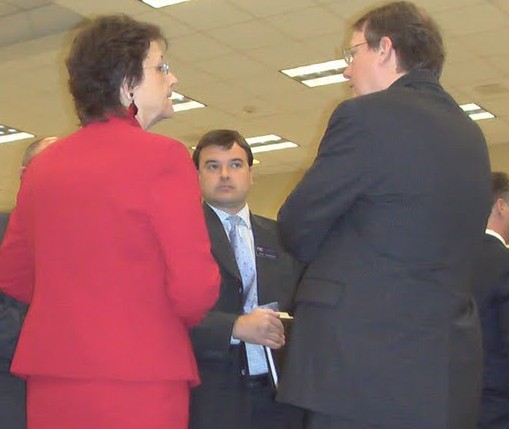
Rep. Avila with Marc Trathen, Time Warner Cable's top lobbyist (right) Photo by: Bob Sepe of Action Audits

Over the course of an hour this afternoon, North Carolina’s Senate Finance Committee discussed the implications of H.129, legislation proposed, written, and lobbied by Time Warner Cable and some of their phone friends across the state.

On hand was Rep. Marilyn Avila (R-Time Warner Cable), who tried to turn her competition-busting bill into an emotional epiphany about jobs and the benefits private providers bring to a state now ranked dead last in broadband.

Pass me a tissue.

Nobody doubts Ms. Avila is looking out for the interests of the state’s big cable and phone companies.  Unfortunately for her district, she isn’t looking out for the broadband interests of her constituents, forced to pay some of America’s highest prices for low end service.

As Avila pals around with lobbyists from Time Warner Cable and the state’s cable trade group (more lobbyists), consumers in places like Orange County in north-central North Carolina see themselves on broadband maps but find they cannot actually get service from any providers.

As the hearing progressed into two-minute statements from parties interested in the outcome, the disconnect between well-paid lobbyists and corporate front groups like Americans for Prosperity with elected officials and consumers on the ground surveying a bleak broadband landscape said a lot.

Cable companies and their lobbyist friends sought to portray community broadband projects as fiscal failures — one suggested that was a global reality, despite the fact many countries have embarked on nationwide broadband plans that directly involve government to help build infrastructure.  The global leader in broadband, South Korea, is a perfect example.  With collaboration between the government and the private sector, Korea will have 1 gigabit broadband service across much of the country within a few years.  That’s because South Korea does not believe broadband is simply a convenience, they see it as a social and economic necessity.

The other side sees it as a private moneymaker that can charge rapacious prices because it’s not an essential service.

Shining a bright light on this reality was Americans for Prosperity, who delivered their own speaker at today’s hearing.  As the group complained about government ‘overreach’ providing incentives in the 1930s for rural power and phone service, it quickly became apparent there are some in this debate willing to let rural Americans sit in darkness, without a phone line (much less broadband), to make a free market point: if private companies can’t or won’t deliver the service, you don’t deserve it and shouldn’t have it.

One wonders where this thinking will ultimately take us.  Will community gardens be opposed for taking vegetable profits away from private corporate farms?  Flea markets on public fairgrounds should be banned because they unfairly compete with eBay, Dollar Tree or a supermarket?  The irony is these “small government conservatives” are all for big government legislation to keep potential competitors at bay.  For them, broadband cannot be a locally-determined community project — just something you buy from a company that may or may not have an interest in serving you.

Just ask the gentleman from Orange County, who appeared as the final speaker.  He spent his two minutes complaining about faulty cable and phone company-provided broadband coverage maps that claim service where none exists.  After spending money on equipment, he learned CenturyLink had no interest in actually providing him with DSL.  In fact, when he asked both the phone and cable company when that might change, the impression he was left with was “never.”

Whether members of the state legislature understand the irony of CenturyLink spending a fortune making sure Orange County never delivers the broadband service the company won’t provide itself is something voters across the state will need to impress on them.

They should be told, in no uncertain terms, to oppose H.129 and leave community broadband alone in North Carolina.

 

Jersey Shore Motels Bail on Comcast: ‘They Don’t Want Our Business,’ Owners Claim

Phillip Dampier April 11, 2011 Comcast/Xfinity, Competition, Consumer News 1 Comment

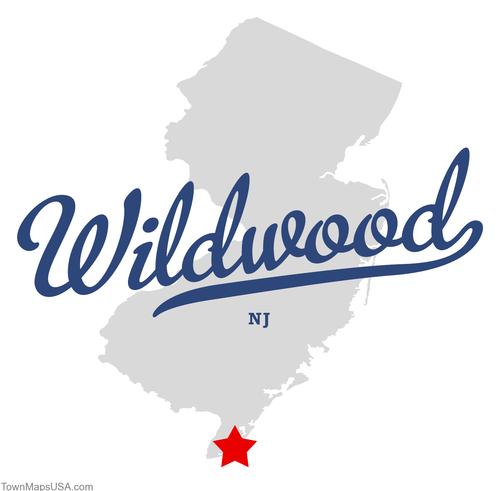
Resort communities like Wildwood, N.J. become near ghost-towns when the lucrative summer season comes to an end.  But Comcast expects motel owners to keep paying for cable service even after they lock their doors and shut down during the winter.

Now more than three dozen area independent hotel owners have told Comcast to take a hike — they are switching to satellite.

For owners, Comcast has added insult to financial injury with higher rates and new requirements for year-round service that nobody watches from October-April.

It wasn’t always this way.  Comcast formerly grandfathered seasonal service into contracts for area resorts.  No converter boxes were required either, making it easy to install in hotel rooms.

But no more.

The cable company claims it needed “rate consistency” in the region and raised prices.  Plus, Comcast has notified hotel owners they’ll need to accommodate digital set top boxes — one to a television, something owners considered the final straw.

James “Jimmy” Johnson, owner of the 48-room Imperial 500 told the Philadelphia Inquirer he invested almost $60,000 for flat panel televisions in his rooms that Comcast now wants to slap cable boxes on.  Johnson is not happy about that, because guests could walk off with them and their accompanying remote controls.

“I go through remotes like you go through underwear,” Johnson told the newspaper.  Comcast charges substantial fees for lost or stolen cable equipment.

Comcast also sought pricing changes that would charge motel owners for service per-television, instead of per-room.  Several motels have multiple televisions in each room, substantially raising prices.

As a result of the rate increases and what many owners have called the cable operator’s intransigence, they are kicking Comcast out, installing satellite television from DirecTV instead.

After an initial investment of $6,400 for the satellite equipment, many owners expect significant savings from DirecTV’s seasonal service contracts, although some guests may find regional sporting events exclusive to Comcast unavailable in their satellite-TV equipped rooms.

But for Johnson, the savings are worth it.

“I’m renting rooms; I’m not running a sports bar. . . . With computers now, you can get a lot of games on your computer, or your phone,” Johnson told the Inquirer.

Salisbury’s Fibrant Faces Unprecedented Demand for Service Legislators Want to Restrict

The Faith Baptist Church was told to live with Windstream's slow speed DSL or pay Time Warner Cable a $20,000 installation fee.

Despite claims from some in the state legislature that restricting fiber optic broadband development in communities like Salisbury is good for consumers and businesses, an increasing number of both are telling reporters a different story.

Faith Baptist Church, in the aptly-named community of Faith, N.C., can’t wait to sign up for Salisbury’s community fiber network — Fibrant.  They believe in a faster broadband experience the local phone company cannot deliver.

Casey Mahoney, a church member, told the Salisbury Post the church wants to ditch its slow speed DSL service from Windstream and cannot afford the $20,000 installation fee Time Warner Cable wants to charge the congregation to extend its broadband service to the church building.

If some in the state legislature have their way, the church will have a long, perhaps infinite wait for a fiber optic future.  A large number of legislators in the Republican-controlled state Senate are leaning towards voting for a bill custom-written by and for the state’s largest cable company — Time Warner Cable.  The legislation would micromanage community-owned broadband networks right down to the streets they would be allowed to deliver service.  Those terms, perhaps unsurprisingly, would not apply to the state’s largest cable and phone companies.

H.129, moving towards a hearing in the Senate Finance Committee Wednesday, would cement today’s marketplace for years to come — a duopoly Mahoney thinks makes Time Warner Cable’s $20,000 installation fee feasible.

He told the Post, “When you only have one company available in an area, that’s when they can say, ‘It will cost you $20,000 — take it or leave it.’ ”

Not everyone supports the cable industry’s efforts to lock down competition from community-owned providers.  Several local officials who represent underserved communities across the state are upset the legislation is being railroaded through the legislature with almost no discussion.

Misenheimer

“I am disappointed that the General Assembly is giving consideration to taking this right away from us without a single conversation taking place,” Kannapolis Mayor Bob Misenheimer complained to Sen. Andrew Brock (R), who serves Davie and Rowan counties.

Misenheimer is particularly upset cable operators want the right to restrict the service areas Fibrant can serve, and not allow the fiber network to expand service into Kannapolis.  In fact, Brock’s office has received similar communications from the Faith town board and mayors from Rockwell, Landis, China Grove, Granite Quarry, Spencer, Cleveland, and Concord — all who want to be included in the Fibrant service area.

“Isn’t it simply amazing that Fibrant is being bashed as a failure-waiting-to-happen by the sponsors of this bill while mayors across two counties are absolutely clamoring to get the service to their residents,” said Stop the Cap! reader Andy Brown who lives near Landis.  “How can Marilyn Avila and Tom Apodaca have the slightest bit of credibility on this issue when you see town leaders literally falling all over each coveting a service that these legislative-Friends-of-Time-Warner-Cable have predicted is a certain failure?”

“I want Fibrant in Landis myself, if only for the competition,” Andy shares.  “You know, the kind of competition legislators are supposed to support.”

Andy describes efforts underway to distort the record on H.129 in hopes of whipping up consumer support for it.

“There are some silly stories being told attacking community networks like Fibrant on local media websites, including the ridiculous claim communities will be required to sign up for the service if it comes to town,” Andy reports.  “These come from some of the same people who also claim fiber optic cables suffer from rot problems, wireless broadband is faster than fiber optics, and that Fibrant is part of the Obama Administration’s plan to socialize the Internet.”

“If these people want Windstream DSL or are happy paying annual rate increases far beyond the rate of inflation year after year, don’t sign up for Fibrant — but don’t dictate away that option for me,” Andy said.  “The only ‘takeover of the Internet’ I see is by Time Warner and CenturyLink.”

Action Alert! Bill to Stop Community Broadband Being Rushed Through NC Senate

[Important Update — 7:53am ET 4/7 — Because of a technicality, it is important for everyone to reference H.129 when calling your state senators.  Members of the Senate Finance Committee are still evaluating the House version of the bill — H.129, so senators will more readily identify the bill we are opposing when we reference the House version (and not S.87).  You can also call it the “Level Playing Field” bill, but with disgust.  Include the fact you found the name highly ironic, since the only thing it will “level” are the state’s community broadband networks — right to the ground.  If you already called, why not just send a follow-up e-mail opposing H.129.]

Stop the Cap! has learned lobbyists for North Carolina’s cable and phone companies are growing concerned over increasing opposition to their custom-written duopoly protection bill that will ruin community broadband developments across the state and threaten ones already up and running.  Now they’re in a mad dash to push S.87 (the Senate version of H.129) through the Senate Tuesday before you have a chance to call and express outrage over this corporate protectionism.

Our sources tell us the bill has been yanked from the Senate Commerce Committee and is moving faster than North Carolina’s cable and DSL broadband to the Finance Committee, where bill sponsors hope for a quick voice vote and no public comment allowed.

The engineer of the legislative railroad in the Senate is Sen. Tom Apodaca (R) who serves the western North Carolina counties of Buncombe, Henderson, and Polk — areas with broadband challenges of their own.  Apodaca’s lead role pushing an anti-broadband bill is ironic considering his campaign website lists his priorities as:

  • “Great schools for our children.” Western N.C. residents without broadband service at home are forced to resort to sitting in their cars in school parking lots or spend hours at overburdened public libraries to access Wi-Fi networks to complete homework assignments.  Great schools in a digital economy require great broadband – both in school and at home
  • “Better paying jobs.” Digital economy jobs are always in demand and bring good salaries.  But those with inadequate broadband will find the kind of entrepreneurial experience and independent study required to excel in these fields hampered by satellite fraudband service or dial-up that limits possibilities and leaves North Carolina behind.
  • “Let people keep more of the money they earn.” It’s a great idea, and competition for big cable and phone companies guarantees it.  In Wilson, consumers don’t face annual rate hikes for their cable service.  Can your community say that?  When their network is paid off, Wilson’s GreenLight will start paying off for local residents as well, keeping money in the community.
  • “And access to quality health care.” As Google intends to prove in Kansas City, Kansas — great health care and excellent broadband go hand-in-hand to deliver better patient outcomes at a cheaper price.  Every health care provider wants faster broadband to increase efficiency and reduce costs and medical care errors.  S.87 delivers the equivalent of just another metal filing cabinet and fax machine to the back office.  Allowing communities to build fiber broadband changes everything.

What has proven so perplexing to consumers across the state is how a bill written by and for the cable and phone companies that does not deliver a single new broadband connection is getting such love and care from a legislature that is supposed to represent the interests of voters, not multi-billion dollar out of state corporations.  It confuses some of America’s high tech companies as well, including Google, Alcatel-Lucent, and Intel.  They’ve all signed a joint letter opposing H.129/S.87.

In fact, one of the reasons Google picked Kansas City, Kansas for its 1Gbps network is the friendly working relationship it has established with local utilities, which are all owned by the community of Kansas City.  It no doubt speaks volumes to Google that the North Carolina legislature would rather be at war with their towns and cities for the benefit of Time Warner Cable, AT&T and CenturyLink, than allowing communities to build their own broadband networks.  At a time when the FCC has ranked North Carolina worst in the nation, members of the Senate are being asked to guarantee that will remain so for years to come.

So What Should I Do?

Get on the phone -and- e-mail your state senator and demand a NO vote on S.87. If you are shy, you can call before or after business hours and leave a message on their voicemail. It takes less than five minutes.  Your calls make a huge difference because so few constituents ever call state legislators.  Here are your talking points:

Apodaca

1.  At a time when we need all the broadband improvements this state can muster, S.87 destroys those efforts for the benefit of a handful of out of state phone and cable companies. It’s classic protectionism — the same companies that helped write this bill are fully exempted from its onerous requirements.  The practical reality for rural North Carolina is either waiting for existing companies to deliver service they were always free to provide (and won’t), or allowing communities to do it themselves where appropriate.  Why should rural North Carolina have to depend on out of state corporations for basic broadband service many still don’t have?

2.  Not a single company has been harmed by community broadband projects in North Carolina.  In fact, it has created incentive to improve products and services while keeping prices stable, a welcome relief for consumers enduring annual rate increases far outpacing inflation.  Why is the state Senate trying to pass legislation that will guarantee higher bills and worse service?

3.  North Carolina’s fiber networks are not economic failures risking taxpayer dollars.  In fact, protections for taxpayers are already a part of the state code.  The General Assembly has already established: (1) rules governing Public Enterprises (NCGS Chapter 160A, Article 16); (2) strict rules in the Budget and Fiscal Control Act governing all municipal budgets and expenditures, including hearing and disclosure requirements (NCGS Chapter 159, Article 3); and (3) strict oversight of municipal borrowing by the Local Government Commission (NCGS Chapter 159).  S.87 attempts to micromanage public projects to the point where they simply cannot function and pay off bondholders and will, for future projects, ensure they never get off the ground.

4.  Now that the FCC ranks North Carolina dead last in broadband, isn’t it be time to allow new entrants to shake up the market and deliver some competition? Since when is legislating for less broadband better for this state?  The communities of Wilson and Salisbury now have the tools to compete with any wired city in America to attract new digital economy business and jobs.  S.87 sends exactly the wrong message — telling business the state wants to wait for the cable or phone company to eventually (if ever), deliver service other states now take for granted.  Businesses cannot wait.  We cannot wait.

5.  Provisions of this bill are unconstitutional.  By placing illegal regulatory burdens on only public providers of communications services (defined broadly) H.129/S.87 will harm municipal convention centers, public safety networks, smart grid systems, tower leasing contracts, and even make seemingly free public Wi-Fi networks vulnerable to lawsuits if the large incumbents want in on those services.

6.  The only real level playing field in broadband is the one that already exists without S.87.  Tell your senator you are tired of seeing these cable company-written bills come up in the Legislature year after year when the state has more important matters to worry about.  Time Warner Cable will do just fine without S.87, just as they do well in every other state where these kinds of bills would never get passed into law (or even proposed).

Senate Representation By County

2011-2012 Session

(click on your member’s name for contact information)

County District: Members
Alamance 24: Rick Gunn;
Alexander 45: Dan Soucek;
Alleghany 30: Don East;
Anson 25: William R. Purcell;
Ashe 45: Dan Soucek;
Avery 47: Ralph Hise;
Beaufort 1: Stan White;
Bertie 4: Ed Jones;
Bladen 19: Wesley Meredith;
Brunswick 8: Bill Rabon;
Buncombe 49: Martin L. Nesbitt, Jr.; 48: Tom Apodaca;
Burke 44: Warren Daniel;
Cabarrus 36: Fletcher L. Hartsell, Jr.;
Caldwell 44: Warren Daniel;
Camden 1: Stan White;
Carteret 2: Jean Preston;
Caswell 24: Rick Gunn;
Catawba 42: Austin M. Allran;
Chatham 18: Bob Atwater;
Cherokee 50: Jim Davis;
Chowan 4: Ed Jones;
Clay 50: Jim Davis;
Cleveland 46: Debbie A. Clary;
Columbus 8: Bill Rabon;
Craven 2: Jean Preston;
Cumberland 19: Wesley Meredith; 21: Eric Mansfield;
Currituck 1: Stan White;
Dare 1: Stan White;
Davidson 33: Stan Bingham;
Davie 34: Andrew C. Brock;
Duplin 10: Brent Jackson;
Durham 20: Floyd B. McKissick, Jr.; 18: Bob Atwater;
Edgecombe 3: Clark Jenkins;
Forsyth 31: Peter S. Brunstetter; 32: Linda Garrou;
Franklin 7: Doug Berger;
Gaston 41: James Forrester; 43: Kathy Harrington;
Gates 4: Ed Jones;
Graham 50: Jim Davis;
Granville 7: Doug Berger;
Greene 5: Louis Pate;
Guilford 33: Stan Bingham; 26: Phil Berger; 27: Don Vaughan; 28: Gladys A. Robinson;
Halifax 4: Ed Jones;
Harnett 22: Harris Blake;
Haywood 50: Jim Davis; 47: Ralph Hise;
Henderson 48: Tom Apodaca;
Hertford 4: Ed Jones;
Hoke 13: Michael P. Walters;
Hyde 1: Stan White;
Iredell 41: James Forrester; 42: Austin M. Allran; 36: Fletcher L. Hartsell, Jr.;
Jackson 50: Jim Davis;
Johnston 12: David Rouzer;
Jones 6: Harry Brown;
Lee 18: Bob Atwater;
Lenoir 10: Brent Jackson;
Lincoln 41: James Forrester;
Macon 50: Jim Davis;
Madison 47: Ralph Hise;
Martin 3: Clark Jenkins;
McDowell 47: Ralph Hise;
Mecklenburg 37: Daniel G. Clodfelter; 38: Charlie Smith Dannelly; 39: Bob Rucho; 40: Malcolm Graham; 35: Tommy Tucker;
Mitchell 47: Ralph Hise;
Montgomery 29: Jerry W. Tillman;
Moore 22: Harris Blake;
Nash 11: E. S. (Buck) Newton;
New Hanover 9: Thom Goolsby;
Northampton 4: Ed Jones;
Onslow 6: Harry Brown;
Orange 23: Eleanor Kinnaird;
Pamlico 2: Jean Preston;
Pasquotank 1: Stan White;
Pender 8: Bill Rabon;
Perquimans 4: Ed Jones;
Person 23: Eleanor Kinnaird;
Pitt 3: Clark Jenkins; 5: Louis Pate;
Polk 48: Tom Apodaca;
Randolph 29: Jerry W. Tillman;
Richmond 25: William R. Purcell;
Robeson 13: Michael P. Walters;
Rockingham 26: Phil Berger;
Rowan 34: Andrew C. Brock;
Rutherford 46: Debbie A. Clary;
Sampson 10: Brent Jackson;
Scotland 25: William R. Purcell;
Stanly 25: William R. Purcell;
Stokes 30: Don East;
Surry 30: Don East;
Swain 50: Jim Davis;
Transylvania 50: Jim Davis;
Tyrrell 1: Stan White;
Union 35: Tommy Tucker;
Vance 7: Doug Berger;
Wake 14: Dan Blue; 15: Neal Hunt; 16: Josh Stein; 17: Richard Stevens;
Warren 7: Doug Berger;
Washington 1: Stan White;
Watauga 45: Dan Soucek;
Wayne 5: Louis Pate; 12: David Rouzer;
Wilkes 45: Dan Soucek;
Wilson 11: E. S. (Buck) Newton;
Yadkin 30: Don East;
Yancey 47: Ralph Hise;

Upstate New York Broadband Rankings Out: Rochester Ranks Last in Speed and Value

Phillip Dampier April 6, 2011 Broadband Speed, Competition, Consumer News, Frontier, Verizon Comments Off on Upstate New York Broadband Rankings Out: Rochester Ranks Last in Speed and Value

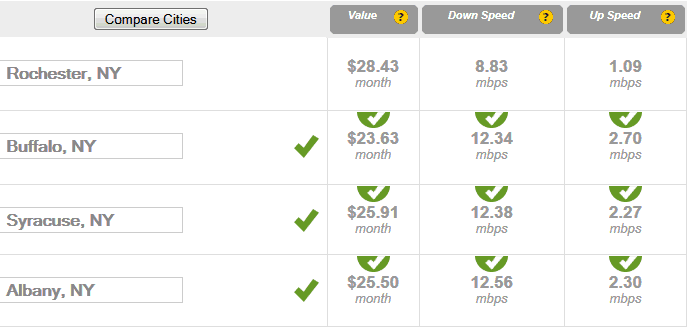
In an upstate New York match-up, the Rochester/Finger Lakes region scored dead last in broadband speed and value, according to data from Broadband.com.

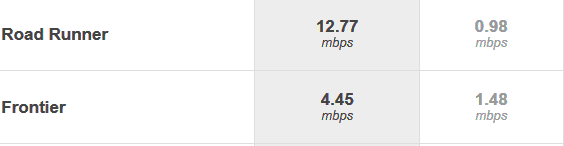
Why are broadband speeds so much lower in the Flower City?  Blame Frontier Communications, which continues to pitch its decade-old DSL product, delivering an average speed of 4.45Mbps, while other upstate cities enjoy access and competition from Verizon’s fiber to the home network FiOS.  Frontier DSL actually often costs more, after taxes and fees, than Time Warner Cable’s much-faster cable broadband product, Road Runner, which rates an average download speed of 12.77Mbps in Rochester.  Frontier does manage to pull one win — higher upload speed DSL providers can often achieve in cities where cable operators keep upstream speeds as low as possible.

Time Warner Cable has dragged its feet upgrading broadband service in the area to its DOCSIS 3 platform other upstate cities have had since last year.  DOCSIS 3 should arrive within the next 4-8 weeks, which should boost broadband speeds, but may not deliver lower broadband prices because of Frontier’s uncompetitiveness in the area.


(Source: Broadband.com)

The top city in upstate New York for download speed is the state capital, Albany.  But Buffalo wins the contest for upload speed thanks to aggressive competition for Time Warner from Verizon in the Queen City.  Buffalo also pays the least for service — nearly $5 less per month than residents in Rochester pay on average.  Syracuse scores in the middle — but closer in terms of speed and value to other Verizon-served cities.

Slow and expensive broadband service can hamper economic development and costs consumers more.  Unfortunately, there are no signs Frontier Communications has plans to do anything differently in its largest service area — a classic driver of the accelerating number of customers calling to pull the plug on their landline service.

Time Warner Cable's Road Runner vs. Frontier Communications' DSL (Speeds are downstream/upstream; Source: Broadband.com)

Search This Site:

Contributions:

Recent Comments:

Your Account:

Stop the Cap!