Home » Competition » Recent Articles:

Comcast Informally Marketing Unlimited 12/2 Business Class Service to AT&T Residential Customers

Phillip Dampier April 20, 2011 AT&T, Comcast/Xfinity, Competition, Data Caps 5 Comments

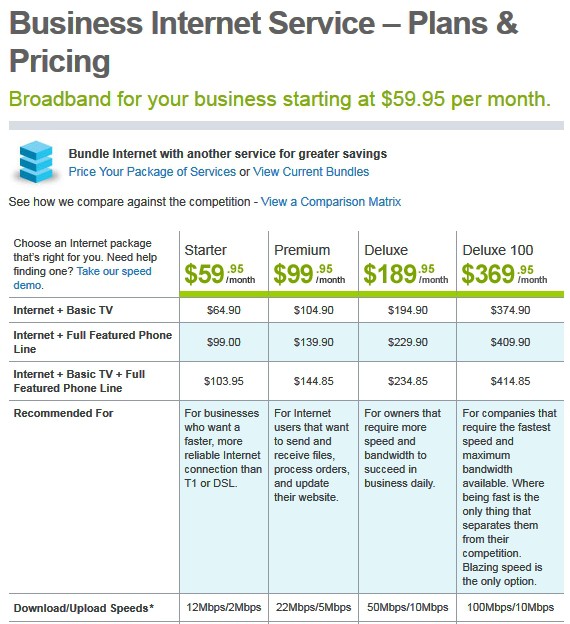
Some AT&T customers unhappy about the company’s forthcoming implementation of usage caps are being offered an uncapped alternative from Comcast — Business Class service.

More than a few customers facing AT&T’s imminent 150/250GB usage caps who live in a Comcast service area are informally being pitched cap-free Business Class service as an alternative.  Jim, a Stop the Cap! reader near Chicago, tells us Comcast sales representatives are rushing to sign up customers coming back to the cable company.  Although he is not served by U-verse, he points us to messages on AT&T’s own message boards from customers sharing their experiences as they pull the plug on the phone company.

“Comcast is offering us unlimited access at 12/2Mbps speeds for $59.95 per month, which is more expensive than the company’s residential broadband service, but potentially cheaper than getting a bill from AT&T with overlimit fees on it,” Jim says.

For now, Jim is heading back to Comcast residential service because he doesn’t use more than the cable company’s current limit – 250GB per month.  But he appreciates there is an alternative service available that comes without a usage limit, something he’ll keep in mind for the future.

“I feel sorry for AT&T customers stuck with them as their only broadband provider, and I think customers should continue to call and complain about the unjustified limits,” Jim offers.  “The best way AT&T customers can tell the company it has gone too far is to take their business somewhere else.”

Comcast does not normally market business products to residential customers, but many sales representatives will offer the service if a consumer expresses concern about the residential service’s usage limit.

Commentary: Plans to Expand EPB’s 1 Gigabit Fiber Network Shelved After a Festival of Lies

Commercial providers and their pals in the legislature will go to any length — even lie — to protect their cozy duopoly, charging high rates for poor quality service.

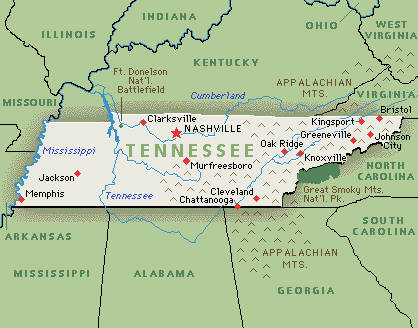
That fact of life has been proven once again in the state of Tennessee, where an effort to expand EPB Fiber — a community owned fiber network — to nearby communities outside of Chattanooga, was killed thanks to a lobbying blitzkrieg by Big Telecom interests.

The “Broadband Infrastructure for Regional Economic Development Act of 2011,” supported by chief sponsor House Majority Leader Gerald McCormick, (R-Chattanooga), is dead after telecom industry lobbyists unleashed a full court press to stop the legislation from passing into Tennessee law.

The bill would have permitted EPB and five other municipal electric services that have or are developing broadband infrastructure to expand service up to 30 miles outside of their service area, where appropriate, to meet the needs of businesses or consumers.

With the legislation, EPB could bring its 1 gigabit fiber broadband service to Bradley County, home to a future Amazon.com distribution center.  Amazon already operates a huge warehouse in Hamilton County, where it was able to obtain EPB’s super-fast broadband service.  According to Harold DePriest, EPB President and CEO, Chattanooga’s fiber network is helping sell the city as a high-tech mecca for business, where broadband connectivity is never a problem.

DePriest says EPB’s network has been a proven job-creator, and Amazon.com’s ongoing expansion in the region is just one example.

Chattanooga residents and businesses now have the fastest broadband service in the southern United States, at prices often far less than what the competition charges.  Expanding EPB’s success to other parts of Tennessee represents a major threat to the likes of Comcast and AT&T, the state’s dominant telecom companies.

EPB provides municipal power, broadband, television, and telephone service for residents in Chattanooga, Tennessee

Lobbyists fought the bill off with some whopper tall tales about the “horrors” of community broadband.

Some Republican lawmakers friendly to Comcast and AT&T’s point of view have bent their philosophical positions on government and regulation into logic pretzels.  One has even called for EPB to be regulated by Tennessee’s Regulatory Authority, a body many state Republicans feel is about as helpful as a tax increase.

Despite that, there was Rep. Curry Todd (R-Collierville) at a recent hearing telling fellow lawmakers EPB and other community providers should be regulated by the TRA to protect ratepayers from the “loss of tremendous amounts of money coming out of taxpayers’ pockets.”

Does Todd think Comcast and AT&T should also be regulated?  Of course not.  Nobody should protect consumers from AT&T’s and Comcast’s relentless rate hikes.  Todd cannot even get his facts straight.

After 19 months, EPB has 25,500 customers — far ahead of its projections, and is well ahead of its financial plan, according to DePriest.  So much for being a “financial failure.”

Rep. Curry Todd has trouble with the facts, but has no problem counting campaign contributions amounting to more than $12,000 from Comcast, AT&T, the state cable lobby and other telecom companies

On cue, the same cable industry that tried to sue EPB Fiber out of existence is now comparing the Chattanooga fiber network to Memphis Networx, a disastrous effort by that city to build a public-private wholesale fiber optic network only business and institutions could directly access.  It’s hard to earn critical revenue from consumers when you run a wholesale network.  Even harder when you build it just before the dot.com crash.

EPB sells its service directly to business and consumers, so it gets to keep the revenue it earns, paying back bondholders and delivering earning power.

Stop the Cap! reader John Lenoir notes some of the local tea party groups are also being encouraged to oppose EPB’s efforts to expand.

“Just as Americans for (Corporate) Prosperity is lying about North Carolina’s community broadband, these corporate front groups are also engaged in demagoguery over EPB in Tennessee,” Lenoir says.  “In addition to the usual claims EPB represents ‘socialism,’ the locals are also being told EPB wants to use their fiber network to run smart meters, which some of these people suspect are spying on them or will tell people when they can and can’t use their electric appliances.”

Lenoir in unimpressed with the telecom industry arguments.

“AT&T’s opposition is downright laughable, considering this company raised its rates on U-verse and will slap usage limits on every broadband customer in a few weeks,” Lenoir adds.  “We thank God EPB is here because it means we can tell AT&T to stick their usage limits and Comcast can take their overpriced (and usage limited) broadband somewhere else.”

Lenoir thinks EPB should embarrass both AT&T and Comcast, but since neither company feels any shame in his view, it’s more about business reality.

“Why do business with AT&T or Comcast and their gouging ways when you can sign up for something far better and support the local community,” Lenoir asks.

AT&T spokesman Chris Walker complains that the phone company is somehow faced with an unlevel playing field in Tennessee, despite the legislature’s repeated acquiescence to nearly every AT&T-sponsored deregulatory initiative brought before it.  The company wants a “level playing-field” statute like the very-provider-friendly (it should be — it was written by them) one currently before the North Carolina state Senate.

Comcast questions whether anyone needs 1 gigabit service, but the cable company’s Chattanooga vice president and general manager Jim Weigert told the Times Free Press it could deliver 1 gigabit service… to business customers… assuming any asked.

DePriest questions that, noting Comcast tops out its broadband service at 105Mbps, and only for downstream speeds.  Comcast upload speeds top out at 5Mbps.  EPB can deliver the same upstream and downstream speeds to customers and do it today.

Don’t Meet Me in St. Louis — AT&T and Charter’s Internet Overcharging

One of America’s largest midwestern cities is being victimized by not one, but two major Internet Service Providers with Internet Overcharging schemes that will limit broadband use by customers.

Charter Communications, which calls St. Louis home, delivers cable service to much of the city, and has lightly enforced arbitrary usage limits on its cable broadband customers since last November.  AT&T, the major telephone provider, plans to limit its DSL and U-verse customers starting in early May.

“Now we get to choose between Charter’s usage cap or AT&T’s,” says Reginald, a Stop the Cap! reader in St. Louis.  “As usual, AT&T is always the bigger ripoff — this company hasn’t done one consumer-friendly thing in at least a decade.”

Reginald is currently a U-verse customer who fled Charter around the time the cable company went bankrupt.

“Charter was, is, and will always be abysmal in providing good service and accurate bills, and I was not about to pay for their business mistakes,” Reginald writes.  “When U-verse became available I told AT&T I was signing up because they were offering unlimited use plans and Charter was playing games with their usage cap.”

When AT&T’s cap is in place, St. Louis residents will get to choose between the lesser of two evils:

Usage Limits

  • AT&T DSL Customers:  150GB per month
  • AT&T U-verse Customers:  250GB per month
  • Charter Lite/Express: 100GB per month
  • Charter Plus/Max: 250GB per month
  • Charter Ultra 60: 500GB per month

AT&T will deliver three warnings and then a higher bill — $10 for each 50GB of “excess usage.”  Charter sends out occasional warnings, then reserves the right to terminate your service.

“It stinks, and if I had my way I would not do business with any provider who has a usage cap,” Reginald says.  “I would rather pay a few dollars more a month and not have to worry, and I can’t imagine I’ve ever used over 100GB in a month.”

Jess, another St. Louis resident, pulls the plug on AT&T U-verse May 2nd.

“I almost wanted them to charge me an early cancellation fee so I could pound them with their sudden change of terms,” Jess says.  “I am switching back to Charter on May 2nd, the day AT&T starts their crap.  AT&T acted all surprised about why I would possibly ever not do business with them over this issue.”

Jess says she would rather deal with warning letters from Charter than a higher AT&T bill.

“Every penny more AT&T gets from us goes right into their lobbying to screw consumers more, and here are the results for everyone to see,” Jess says.  “If Charter wants to pull their games with me and my family, the next step is to declare war on the politicians who let this stuff happen.”

Bill says AT&T offered him a discount to stay with the company — he is canceling his U-Verse service May 1st.  But he refused, telling AT&T he will not do business with a company that engages in Internet Overcharging.

“I’m not too worried about Charter,” Bill writes Stop the Cap! “If they try and threaten me, I’ll let them cut me off and then we’ll sign up under my wife’s name, and bounce from account to account.”

Your money = Their Money

For all three of our readers, none of whom claim they will exceed the allowance, it’s a matter of principle.

Reginald, Jess, and Bill all feel strongly usage caps and overlimit fees are unjustified, and are more about protecting video packages than “unclogging” providers’ networks.

Bob Zimmermann, an AT&T customer in Richmond Heights, tells the Post-Dispatch he doesn’t like the new limit either. He watches an occasional Internet movie, and sometimes downloads video to his iPad. He doubts he’ll exceed the cap, but he doesn’t want to worry about it.

He is shopping for alternatives.

“I’ll see if I can negotiate a better deal,” he told the newspaper.

Jess wishes him luck finding someone else in St. Louis.  She suggests customers like Zimmermann play AT&T and Charter off each other to get a lower bill, at least temporarily.

“What is most important right now is to tell AT&T you are leaving them because they are abusive, and then sign up with a new customer discount with Charter,” Jess suggests.  “Then if and when Charter cuts you off, go back to AT&T and see if you can get them to waive any fees after the third warning or else you are switching back to Charter.”

Another alternative is to sign up for Charter’s business service, which has no usage cap, but comes at a significantly higher price than residential service.  Their starter package includes unlimited Internet at 16/2Mbps speeds, a domain name, and a business phone line with unlimited long distance and calling features.  It runs a steep $120 a month.

“If Charter didn’t offer a 500GB allowance on their 60Mbps tier, I might consider a business package if I used my connection a lot,” admits Bill.  “Isn’t it ridiculous when someone wants to sell you a super fast package you cannot really use because of usage limits?”

Bill partly blames the state legislature for letting AT&T get abusive with customers.

“AT&T shows up with a lot of cash to dole out in the Missouri legislature and in return they get to abuse customers,” Bill notes.  “You notice Verizon cannot get away with this in the more consumer-protection-friendly northeast.”

Jess says the whole thing is a mess.

“It really shows how the midwest is getting screwed once again — this time for Internet access,” she notes. “There is no Verizon fiber here, and even Google showing up in Kansas City won’t be enough to shame the likes of AT&T.”


Verizon’s Discount DSL Arrives: $14.99 up to 1Mbps/$29.99 up to 15Mbps

Phillip Dampier April 18, 2011 Broadband Speed, Competition, Data Caps, Rural Broadband, Verizon Comments Off on Verizon’s Discount DSL Arrives: $14.99 up to 1Mbps/$29.99 up to 15Mbps

Source: The ConsumeristIt has been some time since major carriers like Verizon have promoted “unlimited use” plans for broadband.  Not too many years ago, providers used “unlimited” as a major selling point for those looking to escape slower, time-limited, dial-up access.  Today, Verizon is back pitching unlimited DSL at prices as low as $14.99 per month, if you still happen to have your Verizon landline.

Verizon’s DSL pricing changes include two new price tiers for current landline customers and for those who don’t want landline service.  No annual plan contracts are required, and prices are good for one year.

For Verizon landline customers:
500 Kbps to 1.0 Mbps – $19.99 ($14.99 when ordered online)
Either 1.1-3 Mbps, 3.1-7 Mbps or 7.1-15 Mbps (speed level will depend on line quality) – $34.99 ($29.99 when ordered online)

For those who only want broadband service, prices are considerably higher:
500 Kbps to 1.0 Mbps – $29.99 ($24.99 when ordered online)
Either 1.1-3 Mbps, 3.1-7 Mbps or 7.1-15 Mbps (speed level will depend on line quality) – $44.99 ($39.99 when ordered online)

Verizon really wants customers to order service online, and will throw in a free wireless router when you do.  Activation and shipping charges may apply.  Customers also get free access at Verizon Wi-Fi locations.

Verizon is pitching these services to customers who don’t want to deal with “clogged networks or exceeding monthly dial-up time limits.”

These prices are similar to discounts AT&T offered its DSL customers last year.  It’s an effort to maintain revenue and attract price-sensitive rural holdouts who avoid more expensive broadband plans.  Verizon simultaneously announced a new pseudo-“triple play” package for areas without its FiOS fiber to the home service that uses Verizon’s network for phone and broadband service, and DirecTV for television.

“We’ve enhanced the value and simplified our HSI bundles by pricing them aggressively and removing any contract requirements and early termination fees for Verizon services going forward,” said Eric Bruno, Verizon vice president of product management.  “With these refinements, our High Speed Internet service offers the best value in broadband.”

Bruno forgets when adding new DirecTV services to a Verizon phone and broadband bundle, a two-year agreement and early cancellation fees with the satellite company will apply.

Customers contemplating service who disconnected their Verizon landline can sign up for Verizon’s least expensive landline service — the one with no local calling allowance.  Outgoing calls are billed on a per-call basis in most areas, and the monthly charge for the service can be under $10, depending on the size of your calling area.

You Can’t Have This: Wyoming’s Fight for Better Broadband Mired in Politics and Business Interests

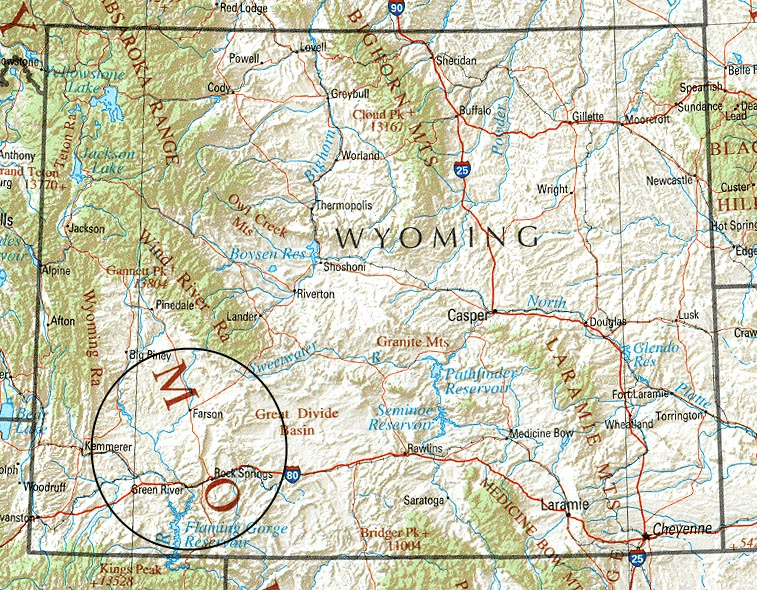
Green River, Rock Springs, and other communities served by Wyoming.com

Wyoming is one of America’s most broadband-challenged, least populated states.  With just over 560,000 residents spread across its often mountainous terrain, broadband service is nothing to take for granted.  Larger communities have limited access to Qwest DSL and cable broadband, but large sections of the state rely on independent wireless providers as their only choice, or they find no broadband service at all.

In this spartan digital world, many residents are surprised Wyoming is criss-crossed by national fiber-optic lines moving traffic across the country.  It’s just that in most instances, individuals are not allowed to access it.

Wyoming.com, a privately-owned Wireless ISP, wants to expand service to Farson and South Pass City — two communities further north that have no hope of getting anything beyond dial-up or satellite fraudband service.  The commercial provider, working with the administrators of the fiber network, has access to federal grant money to expand service to unserved communities, and improve it in underserved areas like Rock Springs.  But that cannot happen if the venture is refused access to a 48-strand “middle-mile” fiber-optic line financed by public dollars and managed by the Joint Powers Telecommunications Board — a partnership between the Green River City Council and Rock Springs local government.

The notion Wyoming.com could get access to a taxpayer-financed network ruffles Tom McCullough, the city’s liaison to the Joint Powers board.  He’s opposed to allowing any government resource to benefit the public at the expense of the local cable monopoly — Sweetwater Cable TV, which doesn’t even serve most of the areas that would benefit from enhanced Internet access.  McCullough argues it violates a 2007 Wyoming law that prohibits public broadband projects when private providers provide access to similar services anywhere within the boundaries of a city or town.  The law came in response to a public broadband project undertaken in Powell that upset the state’s cable and phone companies.

If residents want access to the fiber network they paid for, they have to visit Western Wyoming Community College or the Sweetwater County Library System and use public terminals there.

McCullough so dislikes the fiber project, he has tried to disband the Joint Powers Board that manages it twice, suggesting he has enough support to sell off the entire network to anyone interested (presumably at a substantial discount.)

Shea

Local residents who remain stuck with dial-up or who live outside of Sweetwater Cable’s service area are furious.

“There are some types around here who can’t see past Rush Limbaugh — anything the government does is automatically bad and must be taken down, even if taxpayers paid to build it in the first place,” complains Stop the Cap! reader Sue who lives in Farson.  “Farson has nothing to do with Sweetwater Cable, but because a handful of politicians are looking out for the cable company, worried Wyoming.com is going to get one-up on them, that means we can’t have broadband.”

Steve Shea, chairman of the telecommunications board, is unimpressed with McCullough’s arguments as well, and accused him of allowing his personal friendship with Sweetwater Cable TV’s owner — Al Carollo — to cloud his judgment.

Shea says Wyoming’s local governments are often fiercely protective of locally-owned businesses, and told the Green River Star the Board has historically faced the attitude that “local business deserves a monopoly, no matter what.”  Sweetwater Cable TV is locally owned and operated.

In fact, Shea says original designs for the fiber network were to provide fiber-to-the-home service in the area.  Since a national fiber optic cable was already running adjacent to the community, getting a connection to it was relatively simple.  Extending service to individual homeowners was another matter.  Political opposition to “government broadband” and demagoguery about its cost and implications from private providers ultimately killed the project.

Shea documented his experience as commercial providers and their dollar-a-holler industry-connected supporters fought the fiber project:

  • Opposition comes from everyone in the Telecom business;
  • Opposition will be in your face constantly;
  • Opposition will never run out of lies;
  • Opposition is ready to strike at any time and at any place;
  • Opposition will engage in back-room politics against you;
  • Opposition will try to get Power Brokers and Influentials on their side;
  • Opposition will spend as much money as needed to defeat you.

Local cable and wireless providers engage in a tangle in southwestern Wyoming

As Wyoming’s broadband rankings slip further and further behind much of the rest of the country, Shea hopes attitudes about the fiber network have changed, especially when residents learn Sweetwater Cable was offered access to the network as well, and they declined.

Shea shared that the long history of opposition to the project started with suggestions wireless broadband was better than fiber, or that broadband over power lines could do the same or better than fiber networks.  He even battled contentions that existing broadband networks provided “fast enough” service for Wyoming.  Today, it has extended to allowing a private company to engage in a public-private partnership.  The other providers are still opposed.

“You have to refute these arguments over, and over, and over again. Your opposition will oppose you at every corner, and will call in all of their political favors to derail your fiber project,” Shea writes.

“It’s Wyoming’s version of North Carolina,” Sue writes from her Hughes Satellite address.  “Sweetwater Cable doesn’t want access to the fiber themselves, and they want to make sure you don’t access it either, even though the family I have down there tells me their cable Internet service sucks because the cable company can’t handle the traffic.”

Sweetwater Cable gets their access from Qwest.

What bothers Sue and some other local residents about the squabble is that it is inherently political and allows an existing, underutilized fiber line to sit mostly unused when expanded broadband is desperately needed in Wyoming.  In fact, some consider it a scandal among special interests.

“They don’t care about better broadband — they only care about their political and industry friends,” Sue complains.  “When will people wake up and realize that whether it is North Carolina or Wyoming, these policies and laws don’t give anyone broadband — they keep us from getting it.”

Shea’s observation that opponents’ use of backroom politics seems to have been right on point.  On Tuesday, as the Board met to discuss Wyoming.com’s proposal, Shea was effectively forced out and announced his resignation after the owner of Sweetwater Cable TV said he contacted an attorney to look at whether Shea’s tenure on the board was legal.

Search This Site:

Contributions:

Recent Comments:

Your Account:

Stop the Cap!