Home » Competition » Recent Articles:

Boston’s Cable Conundrum: Mayor Upset With Comcast Rate Hikes, But Did Little to Bring Competition

Menino

Boston Mayor Thomas Menino has problems with Comcast.  The cable operator, long a dominant player in the city of Boston, has been raising basic cable prices for the last several years, and the mayor’s office has had enough.  This week Menino filed a petition asking the Federal Communications Commission to give the city “emergency control” over the price of basic cable service in Boston — the only control permitted in the largely deregulated cable television marketplace.

Menino waved a study done at the behest of the city showing residents were paying substantially higher prices for the lowest level of service from Comcast.  Basic Service, which includes 37 local over the air stations and a handful of shopping and public access channels costs $15.80 inside city limits — up from $9.05 in 2009.  In nearby Cambridge, the same service costs $7.30 a month.  What’s the difference?  Cable rates are completely deregulated in the city, but smaller communities around Boston lack sufficient meaningful competition, so they are permitted by law to continue regulating rates for the lowest tier: Basic Service.

Now Menino wants those rates brought back under control for the benefit of seniors and low income residents, among the 10,000-15,000 local homes that subscribe to the economy service.

It’s just the latest challenge for Boston, which is among a few cities along the coast of the northeastern United States not benefiting from aggressive broadband and video competition between the phone and cable company.  Just over 200 miles away, metropolitan New York and the bedroom communities in that state, as well as New Jersey and Connecticut, have access to super fast broadband from Verizon FiOS, Time Warner Cable, Cablevision, and Comcast — the latter predominately serving greater Philadelphia.

Boston has been bypassed for Verizon FiOS, is ignored by other potential cable competitors, and is stuck with poor-performing cable overbuilder – RCN, which has focused most of its efforts on multi-dwelling apartment and condo units in the city.  The rest of Boston gets ‘take it or leave it’ service from Comcast or DSL from Verizon.

Comcast was quick to respond to Menino’s call for reregulation, noting they provide $5 senior discounts for their cable customers and offer cheaper service than the alternatives — $17.50 a month from RCN or between $30-35 for promotions from DirecTV and DISH Satellite.

Menino’s dealings with telecommunications companies in Boston have run hot and cold for years.  In February, Menino appeared with Comcast senior vice president Steve Hackley to celebrate the opening of a Digital Connectors program for up to 2,800 low income households, paid for by federal stimulus grant money.  Under the program, students who complete computer training courses receive discounted Comcast Internet service for $10.95 a month for the first year and $15.95 for the second year.

Boston

Menino’s office has often been a watchdog when it comes to Comcast fulfilling its franchise obligations, and the city had high hopes competition from RCN would extend a choice of cable providers to most city residents.  That has not happened.

The city’s other telecommunications provider, Verizon, has been in contention with the city for several years.  The trouble began in 2007 when Menino declared war on property tax exemptions for utility poles dating back to 1915, granted to telecom companies like Verizon.  Four years later, that battle has culminated in Verizon literally wiring its fiber optic FiOS service around the city of Boston, refusing to deliver service inside it.

The promise of Verizon fiber has often gone unfulfilled or delayed in many larger cities, subject to bureaucratic delays not experienced in smaller communities.  Some towns and villages in Massachusetts signed franchise agreements just a few months after the company came knocking.

One local official, not authorized to speak publicly on the matter, told Stop the Cap! many communities welcomed Verizon’s fiber optic initiative with open arms.

“You have to understand there is a different mentality among government officials in smaller towns than there is among larger cities,” the official tells us. “In our town of 35,000 when Verizon offered to wire competitive service in our area, we wanted to know where to sign and when they could get started.”

The official says the local government was concerned about making sure Verizon repaired any damage to local infrastructure, abided by local zoning rules, and guaranteed they would not bypass parts of the town.  Negotiators also fought for funding to upgrade equipment for the community’s public access channels, but never went into the negotiations thinking about how much they could extract from the phone company.

“In larger cities in this state, there is a definite mentality that Verizon represents a golden goose ready and willing to lay golden eggs in return for franchise agreements,” the official told us.  “Maybe that is true, but when you are in a smaller town, you recognize the degree of willingness to invest capital to tear out old wires and replace them with fiber is far less here than a city like Boston, which has the potential of many more customers.”

Boston, like other large cities, prepared for protracted negotiations with the phone company over the new fiber service.  At the same time, Mayor Menino infuriated Verizon when he won his property tax lawsuit against the company, collecting $5 million in tax payments that one city official rubbed in.

Ronald W. Rakow, Boston’s commissioner of assessing, told the Boston Globe at the time: “We will actually be sending a bill to them for that later today,’’ Rakow said. “Don’t want to let the ink dry.’’

No Verizon FiOS for Boston

The argument over property taxes may have been the final straw for Verizon FiOS in Boston.  Menino suspected as much, telling the Globe “they insinuated that we weren’t going to get it because of my position on telecommunications.’’

Even then-Verizon CEO Ivan Seidenberg warned the city during a speech at the Boston College Chief Executives’ Club of Boston “to be careful when considering new taxes or regulations.”

Verizon has since stopped expanding its FiOS service to new cities.

“We knew as the financial crisis grew we were smart to sign up earlier rather than later, because if we didn’t, we would never have the service today,” the local official tells us.  “I have sympathy with local officials in every city trying to do what is best for their residents, but anyone who understands wired telecommunications should know these kinds of projects are exceedingly rare — grab them when you have the chance.”

Just a few years later, the impact of earlier decisions not to hurry competition into the city of Boston and the city’s tax policies have become clear:

  • Comcast may be forced to reduce their Basic Service rate, but nothing prevents them from increasing Digital Service cable rates to make up the difference;
  • RCN’s network has languished, providing competitive choice to just 15,000 local residents.  Comcast serves at least 170,000;
  • Verizon has no plans to offer FiOS in the city indefinitely;
  • Menino’s victory claim that Verizon should pay its fair share in property taxes seems less victorious today as the phone company began passing on the new taxes to ratepayers as a “Massachusetts Property Tax Recovery Surcharge” in March, 2010.
  • No other competitor has appeared on the horizon willing to take on Comcast in the city of Boston.


Getting the Best Rate for Broadband-Only Service from Time Warner Cable

With Time Warner Cable’s broadband now running as high as $50 a month for standard, stand-alone service, getting the best deal possible can save you as much as $20 a month off those prices.  Time Warner Cable has been repricing their services to deliver the most value to customers who bundle all of the company’s products into a single package.  But if you don’t want television or telephone service from the cable company, you are going to pay a lot more than your service-bundled-neighbors for Road Runner High Speed Internet.

Stop the Cap! presents our strategy to help broadband-only customers get the best possible prices from Time Warner Cable:

Choose Earthlink

Customers paying Time Warner Cable’s regular prices for broadband service are paying too much.  Time Warner currently charges just short of $50 a month for Standard 10/1Mbps service (speeds are slower in some areas).  That’s up from years of charging $40 a month, slightly higher if you were a broadband-only customer.  But with the help of Earthlink, you can cut that broadband bill to $29.99 a month for the first six months.  Earthlink co-exists with Road Runner, Time Warner Cable’s own broadband service.  With just a few mouse clicks and a quick phone call, Time Warner can switch your regular price Road Runner to Earthlink without any equipment changes.  Billing and service will continue to be provided by Time Warner and the change literally takes less than five minutes by phone.

You can escape Time Warner Cable's Road Runner rate hike by switching to Earthlink service at a substantial discount.

Earthlink’s broadband service is indistinguishable from Road Runner — same speeds, same level of service, with two exceptions:

  • Earthlink does not benefit from PowerBoost, which delivers temporary speed increases during file downloads
  • You will forfeit your rr.com e-mail address

We recommend you avoid using ISP-provided e-mail addresses when possible, because they help tie you down to an existing provider.  Instead, sign up for a free e-mail account from Google’s Gmail, or Yahoo! Mail, or any of the dozens of other web-based e-mail providers.  Or, purchase your own domain name from GoDaddy or 1and1, which includes e-mail, and either read it on those sites or forward it to a web-based e-mail provider.  Domain names can be had for under $10 a year and deliver maximum flexibility for those who want the freedom to change Internet providers.

After Six Months, Switch Back to Road Runner

When your Earthlink promotion expires at the end of six months, your price will increase to $41.95 per month.  Just before that happens, switch back to Time Warner Cable’s Road Runner service.  You qualify for new customer pricing promotions.  As of this week, Time Warner Cable in western New York is offering one year at $29.99 per month for 10/1Mbps service.  Other areas may have different pricing promotions.

After the year is up, you can start all over again, heading back to Earthlink for another six month promotional term.  Earthlink has offered its promotional plan for more than two years, and it shows no signs of ending anytime soon.

Promotional Half-Truths

Promotions come and go from Time Warner Cable, so it is wise to check with them often if the $29.99 deal is not currently running in your area.  Start by checking Time Warner Cable’s website, and remember if you are using Earthlink, you will want to select pricing for new customers.  If you find a good price on the website, you may be able to complete your order online.  Otherwise, call your local office and ask about currently running promotions.  Some common ones:

  • Road Runner Turbo at 50% off for the first year;
  • Road Runner Turbo free for six months;
  • Road Runner with wireless router/modem free for six months to one year;
  • Road Runner with free installation (especially useful if you want Road Runner Extreme/Wideband service, which carries a pricey installation fee);
  • Road Runner for $29.99 for six months;
  • Bundled promotions — $99 for all three services, $79 for broadband/cable or broadband/phone

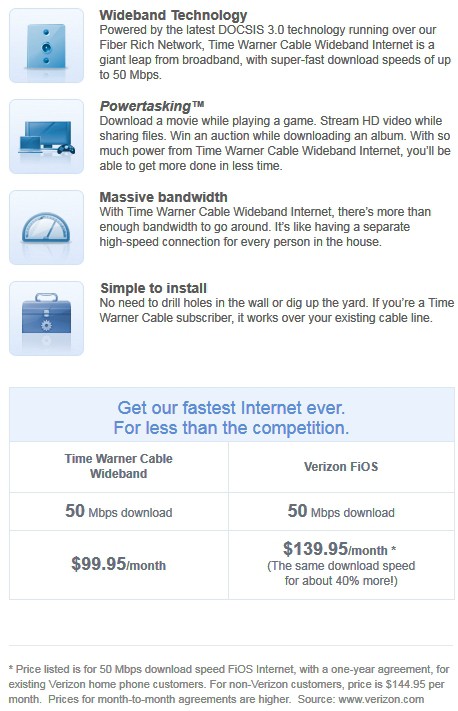
Not every promotion delivers the best deal for customers, and some have been slightly deceptive, such as this speed comparison we found on the cable company’s website this morning:

Our View:

  1. Time Warner Cable has been spanked before for their claims about running a “fiber network.”  In fact, their “Fiber Rich Network” is a marketing stretch.  All modern cable systems use fiber optics to help distribute their service into various communities, but coaxial copper cable delivers the signal through neighborhoods to your individual home.  Cable companies still cannot match the broadband speeds available on an all-fiber network.
  2. “Powertasking” is a meaningless marketing claim.  Any high speed network will allow the entire family to effectively share a broadband connection.
  3. We’re glad to know Time Warner Cable has “massive bandwidth” — more than enough to go around.  We’ll remember that if and when the company ever entertains bringing back their experimental Internet Overcharging scheme they claimed was necessary to pay for equipment upgrades to cope with broadband traffic growth.
  4. It would be simpler to install Time Warner’s DOCSIS 3 upgrade if we could do it ourselves, but the cable company currently requires a mandatory service call ($67.98 fee) to install it.
  5. Time Warner is being cute comparing their broadband speed with Verizon FiOS.  In fact, FiOS is faster because of what isn’t mentioned here — upstream speeds.  Time Warner tops out at 5Mbps, Verizon offers 20Mbps for uploads.  But Time Warner’s pricing is better at that download speed.  Verizon is more aggressively priced when they bundle services together.  For example, Time Warner’s $99 triple play bundle only offers 10/1Mbps service.  Verizon offers up to 25/25Mbps service for the same price.  Both include phone and television service.

Where’s Our Refund? Two Months and $26.09 Later, Frontier Finally Sends A Check

Phillip Dampier May 9, 2011 Competition, Consumer News, Editorial & Site News, Frontier Comments Off on Where’s Our Refund? Two Months and $26.09 Later, Frontier Finally Sends A Check

Stop the Cap! readers will recall we pulled the plug on Frontier Communications with the disconnection of our landline back in early February.  After at least 25 years doing business with Rochester Telephone Corporation, later Frontier-Global Crossing, later Frontier-Citizens Communications, we had enough.  Frontier Communications has done nothing of merit for the metropolitan Rochester, N.Y., area since the late 1990s.  Their DSL broadband service is handily beaten in quality, reliability, and price by cable competitor Time Warner Cable, and Frontier’s lack of willingness to invest in something better for their largest service area of nearly one million people in western New York has left us cold.  After a one week experiment with Frontier’s DSL service in 2009, we dropped the service like a hot potato after it achieved an underwhelming 3.1Mbps in the town of Brighton, less than one mile from the Rochester city line.

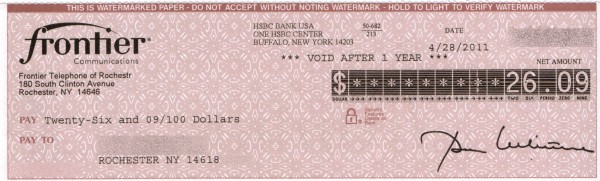
In early February, our last remaining service — the landline — was transferred to Time Warner Cable.  But even on the way out the door, Frontier continued to disappoint.  After more than two months (and two invoices later), Frontier had still not refunded our credit balance of $26.09.  We’re a long way from Rochester Telephone, a well-regarded predecessor to Frontier which traditionally enclosed a refund check with the final bill.  Frontier makes you wait, and wait, and wait some more, reminding you they owe you money with repetitious “do not pay – credit balance” invoices for long-terminated service.

More than two months after disconnecting service, our refund check finally arrives!

On Monday, the refund check finally arrived, in an obscure envelope resembling one of those PIN reminders banks send you.  After tearing away three sides of perforated strips, there it was — $26.09 from Frontier Communications.

The long wait is hardly a random glitch.  Stop the Cap! covered the story of a Frontier customer in California who waited several months for the phone company to refund her just over $15, and just this evening we heard from one of our regular readers in Rochester disappointed by Frontier’s hardly-rapid refund policy.

The only good news is that we weren’t overbilled on the way out the door, as one Elk Grove, Calif. customer was — to the tune of $680.

To Frontier we say goodbye and good luck (and we’ll be cashing that check faster than you sent it).

Loud Critic of North Carolina Community Broadband Exposed As Time Warner Cable Employee

Phillip "Not a Time Warner Cable Employee" Dampier

One of the most vociferous critics of the publicly-owned cable system serving the communities of Mooresville, Cornelius and Davidson, N.C. has been exposed as an employee of Time Warner Cable.

MI-Connection, the community-owned cable system, has been subjected to withering criticism since town leaders purchased it from bankrupt Adelphia Cable in 2007.  The efforts to rebuild the system to current standards has proved time-consuming and expensive, and ongoing expenses will require an investment of at least $17 million over the next three years to keep the cable system up and running.  Despite the fact Time Warner Cable has run into larger, more expensive headaches rebuilding similar rundown Adelphia systems they purchased in Ft. Worth, Texas and Los Angeles, critics of community cable have pounced on the costly rebuild to attack public involvement in private enterprise and suggest city officials have not competently run the operation.

Some of the loudest criticism has come in the comment sections of local newspapers and media sites.  Just as Fibrant has faced similar attacks in the comment section of the Salisbury Post, critics of MI-Connection have piled on in newspapers like the Davidson News and Hunterville’s Herald Weekly.  One of the loudest critics of all, Andy Stevens, even started a blog devoted to attacking what he calls “Government Cable.”

David Boraks, editor of the Davidson News, has reported extensively on MI-Connection, and he reads the comments that follow his articles published online, including those written by Stevens.

In a story written today by Boraks, the Davidson News revealed a fact that consumers, the media, and local officials deserved to know — Stevens works for Time Warner Cable.  That revelation comes despite repeated earlier denials from Stevens when asked by reporters and local officials if he worked for the cable company.

Mooresville, North Carolina

How did the newspaper find out about Mr. Stevens’ day job?

MI-Connection board chair John Venzon has gotten fed up reading unrelenting, and often fact-free attacks on the publicly owned cable system he oversees.  Venzon told the Herald Weekly he used to ignore the often anonymous critics of the local cable system, but he’s changing tactics.  Venzon and some other MI-Connection supporters have jumped into the online debate, correcting false information and taking on some of the cable system’s loudest critics, including Stevens.

As part of that effort, Venzon decided to publicly disclose a recent encounter with Stevens at a local shopping center.  Venzon was especially interested to find Stevens wearing a Time Warner Cable uniform, driving a Time Warner Cable truck.

Venzon went public on the Davidson News website Friday:

I would like to point out that today we confirmed that Andy Stevens, a frequent attendee at our board meetings and vocal community critic works for Time Warner Cable. He was greeted by one of our employees while in a TWC uniform and driving one of their logo-ed vehicles. He has been active in using our publicly available information to turn our potential customers against us and to stir up fear, uncertainty and doubt about MI-Connection while hiding his motives. He does not live in our town or service area, so he does not ‘have a dog in the fight’ unless you consider who signs his paycheck. Could I attend competitors’ regular board meetings to see what they are doing?

To make matters worse, he has used the Freedom of Information Act to gain access to every communication between the towns, the board and management. So Time Warner does in fact sit in our meetings … and we are required to provide the meeting notes.

In corporate America, this would constitute espionage. In our situation, it is free and legal. I find it deplorable. I hope you agree.

I believe we should be required to report information just as publicly traded companies do and would adhere to all such requirement. That system promotes transparency to shareholders on a quarterly basis. In addition, we would continue to attend town board meetings and community roundtables to disclose information to citizens.

In another setting, I would be happy to debate the merits of public ownership of a utility that promotes the well being of its citizens and businesses within their community. However, we are in the midst of executing a decision that was made several years ago and are responsible to grow the business.

I do not mind a fair fight, and we must win based on the value of our products and services. However, don’t unfairly give advantage to our competitors and put our citizens at greater risk.

Boraks

Boraks has gotten an admission from Stevens he does, in fact, work for Time Warner Cable, a pertinent detail omitted from Stevens’ anti-MI-Connection blog.  Before deleting about a dozen articles attacking the community cable system, Stevens even noted on the home page of his website, “As I have a full time job, this effort will be accomplished during my free time (evenings and weekends),” without bothering to disclose what that job was.  His “About” section didn’t make mention of his employer either.

The now-defunct blog of secret Time Warner Cable employee Andy Stevens

Now that Time Warner Cable, a regular critic of community-owned broadband, has been put in the embarrassing position of having an employee indirectly do its dirty work, a company spokesman was reduced to telling Boraks they cannot control what their employees do.

But apparently behind closed doors, all is not sweetness and light between Stevens and his employer.  Stevens’ highly active blog suddenly was deprived of all its content after revelations about his employer made the newspaper.  Bing’s cache of Stevens’ site (which Stop the Cap! has captured) shows he had plenty to say about the cable system — none of it good.  That all changed today.

Boraks opined in his piece in the News that Stevens ongoing denials of involvement with Time Warner Cable and his lack of disclosure left him concerned.

Indeed, Stevens’ efforts to hide his employer’s identity and his subsequent decision to bring his blog down after the cat was let out of the bag suggests there is nothing for Stevens or Time Warner Cable to be proud of in their relentless, often sneaky efforts to bring community-owned competition to its knees.  When it comes to protecting duopoly profits of local cable and phone companies in North Carolina, it’s total war on all fronts.

Public Knowledge Dips Its Toe Into Fight Against Internet Overcharging – Learn From Canada

Phillip Dampier May 9, 2011 AT&T, Bell (Canada), Broadband "Shortage", Canada, Competition, Data Caps, Editorial & Site News, Public Policy & Gov't, Video, Wireless Broadband Comments Off on Public Knowledge Dips Its Toe Into Fight Against Internet Overcharging – Learn From Canada

Among the public interest groups that have historically steered clear of the fight against usage caps and usage based billing is Public Knowledge.

Stop the Cap! took them to task more than a year ago for defending the implementation of these unjustified hidden rate hikes and usage limits.  Since then, we welcome the fact the group has increasingly been trending towards the pro-consumer, anti-cap position, but they still have some road to travel.

Public Knowledge, joined by New America Foundation’s Open Technology Initiative, has sent a letter to the Federal Communications Commission expressing concern over AT&T’s implementation of usage caps and asking for an investigation:

[…] Public Knowledge and New America Foundation’s Open Technology Initiative urge the Bureau to exercise its statutory authority to fully investigate the nature, purpose, impact of those caps upon consumers. The need to fully understand the nature of broadband caps is made all the more urgent by the recent decision by AT&T to break with past industry practice and convert its data cap into a revenue source.

[…] Caps on broadband usage imposed by Internet Service Providers (ISPs) can undermine the very goals that the Commission has committed itself to championing. While broadband caps are not inherently problematic, they carry the omnipresent temptation to act in anticompetitive and monopolistic ways. Unless they are clearly and transparently justified to address legitimate network capacity concerns, caps can work directly against the promise of broadband access.

The groups call out AT&T for its usage cap and overlimit fee model, and ponder whether these are more about revenue enhancement than network management.  The answer to that question has been clear for more than two years now: it’s all about the money.

The two groups are to be commended for raising the issue with the FCC, but they are dead wrong about caps not being inherently problematic.  Usage caps have no place in the North American wired broadband market.  Even in Canada, providers like Bell have failed to make a case justifying their implementation.  What began as an argument about congestion has evolved into one about charging heavy users more to invest in upgrades that are simply not happening on a widespread basis.  The specific argument used is tailored to the audience: complaints about congestion to government officials, denials of congestion issues to shareholders coupled with promotion of usage pricing as a revenue enhancer.

If Bell can’t sell the Canadian government on its arguments for usage caps in a country that has a far lower population density and a much larger rural expanse to wire, AT&T certainly isn’t going to have a case in the United States, and they don’t.

The history of these schemes is clear:

  1. Providers historically conflate their wireless broadband platforms with wired broadband when arguing for Internet Overcharging schemes.  When regulators agree to arguments that wireless capacity problems justify usage limits, extending those limits to wired broadband gets carried along for the ride.  Dollar-a-holler groups supporting the industry love to use charts showing wireless data growth, and claim a similar problem afflicts wired broadband, even though the costs to cope with congestion are very different on the two platforms.
  2. Providers argue one thing while implementing another.  Most make the claim pricing changes allow them to introduce discounted “light user” plans.  But few save because true “pay only for what you use” usage-based billing is not on offer.  Instead, worry-free flat use plans are taken off the menu, replaced with tiered plans that force subscribers to guess their usage.  If they guess too little, a stiff overlimit fee applies.  If they guess too much, they overpay.  Heads AT&T wins, tails you lose.  That’s a clear warning providers are addressing revenue enhancement, not network enhancement.
  3. Claims of network congestion backed up with raw data, average usage per user, and the costs to address it are all labeled proprietary business information and are not available for independent inspection.

There are a few other issues:

In the world of broadband data caps, the caps recently implemented by AT&T are particularly aggressive. Unlike competitors whose caps appear to be at least nominally linked to congestions during peak-use periods, AT&T seeks to convert caps into a profit center by charging additional fees to customers who exceed the cap. In addition to concerns raised by broadband caps generally, such a practice produces a perverse incentive for AT&T to avoid raising its cap even as its own capacity expands.

In North America, only a handful of providers use peak-usage pricing for wired broadband.  Cable One, America’s 10th largest cable operator is among the largest, and they serve fewer than one million customers.  Virtually all providers with usage caps count both upstream and downstream data traffic 24 hours a day against a fixed usage allowance.  The largest — Comcast — does not charge an excessive usage fee.  AT&T does.

Furthermore, it remains unclear why AT&T’s recently announced caps are, at best, equal to those imposed by Comcast over two years ago.  The caps for residential DSL customers are a full 100GB lower than those Comcast saw fit to offer in mid-2008. The lower caps for DSL customers is especially worrying because one of the traditional selling points of DSL networks is that their dedicated circuit design helps to mitigate the impacts of heavy users on the rest of the network. Together, these caps suggest either that AT&T’s current network compares poorly to that of a major competitor circa 2008 or that there are non-network management motivations behind their creation.

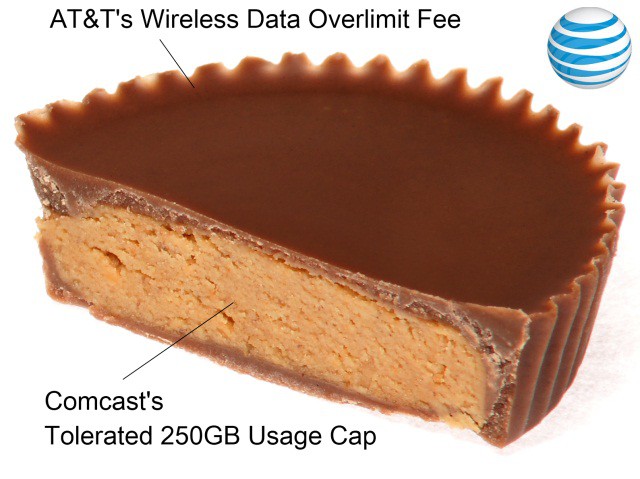
AT&T has managed to create the first Internet version of the Reese's Peanut Butter Cup, combining Comcast's 'tolerated' 250GB cap with AT&T's style of slapping overlimit fees on data plans from their wireless business.

As Stop the Cap! has always argued, usage caps are highly arbitrary.  Providers always believe their usage caps are the best and most fair around, whether it was Frontier’s 5GB usage limit or Comcast’s 250GB limit.

AT&T experimented with usage limits in Reno, Nevada and Beaumont, Texas and found customers loathed them.  Comcast’s customers tolerate the cable company’s 250GB usage cap because it is not strictly enforced — only the top few violators are issued warning letters.  AT&T has established America’s first Internet pricing version of the Reese’s Peanut Butter Cup: getting Comcast’s tolerated usage cap into AT&T’s wireless-side overlimit fee.  The bitter aftertaste arrives in the mail at the end of the month.

Why establish different usage caps for DSL and U-verse?  Marketing, of course.  This is about money, remember?

AT&T DSL delivers far less average revenue per customer than its triple-play U-verse service.  To give U-verse a higher value proposition, AT&T supplies a more generous usage allowance.  Message: upgrade from DSL for a better broadband experience.

Technically, there is no reason to enforce either usage allowance, as AT&T DSL offers a dedicated connection to the central office or D-SLAM, from where fiber traditionally carries the signal to AT&T’s enormous backbone connection.  U-verse delivers fiber to the neighborhood and a much fatter dedicated pipeline into individual subscriber homes to deliver its phone, Internet, and video services.

A usage cap on U-verse makes as much sense as putting a coin meter on the television or charging for every phone call, something AT&T abandoned with their flat rate local and long distance plans.

Before partly granting AT&T’s premise that usage limits are a prophylactic for congestion and then advocate they be administered with oversight, why not demand proof that such pricing and usage schemes are necessary in the first place.  With independent verification of the raw data, providers like AT&T will find that an insurmountable challenge, especially if they have to open their books.

[flv width=”640″ height=”368″]http://www.phillipdampier.com/video/Bell’s Arguments for UBB 2-2011.flv[/flv]

Canada’s experience with Usage-Based Billing has all of the hallmarks of the kind of consumer ripoff AT&T wants Americans to endure:

  • A provider (Bell), whose spokesman argues for these pricing schemes to address congestion and “fairness,” even as that same spokesman admits there is no congestion problem;
  • Would-be competitors being priced out of the marketplace because they lack the infrastructure, access, or fair pricing to compete;
  • Big bankers and investors who applaud price gouging and are appalled at government checks and balances.

Watch Mirko Bibic try to rationalize why Bell’s Fibe TV (equivalent to AT&T U-verse) needs Internet Overcharging schemes for broadband, but suffers no capacity issues delivering video and phone calls over the exact same line.  Then watch the company try and spin this pricing as an issue of fairness, even as an investor applauds the company: “I love this policy because I am a shareholder.  That’s all I care about.  If you can suck every last cent out of users, I’m happy for you.”  Finally, watch a company buying wholesale access from Bell let the cat out of the bag — broadband usage costs pennies per gigabyte, not the several dollars many providers want to charge.  (11 minutes)

Search This Site:

Contributions:

Recent Comments:

Your Account:

Stop the Cap!