Home » Competition » Recent Articles:

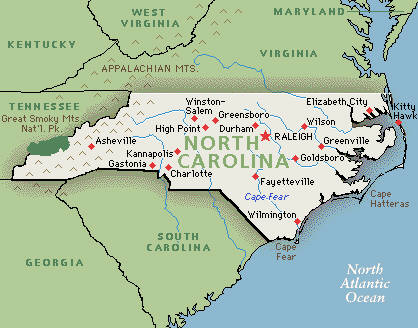
National Call to Action: Insist That North Carolina Gov. Bev Purdue Veto H.129

It’s time for every consumer across the country to help our friends in North Carolina, who are now facing the prospect of a Broadband Dark Age with the passage of a cable-industry-written bill designed to protect their monopoly prices and deliver America’s worst broadband experience.

The grand lie that is the Level Playing Field/Local Government Competition Bill (H.129) claims it will protect broadband competition in the state.  It will, if you are Time Warner Cable facing top-rated, super-fast service from community broadband networks that compete with them in communities like Salisbury and Wilson.

The power to protect North Carolina’s broadband future is now in the hands of Gov. Bev Purdue.

The North Carolina Senate abdicated their responsibility to serve the interests of state residents.  On Tuesday, they voted 39-10 for this consumer atrocity:

Ayes: Senator(s): Allran; Apodaca; Atwater; Berger, D.; Berger, P.; Bingham; Blake; Blue; Brock; Brown; Brunstetter; Clary; Daniel; Davis; East; Forrester; Garrou; Goolsby; Gunn; Harrington; Hartsell; Hise; Hunt; Jackson; Jenkins; Jones; McKissick; Nesbitt; Pate; Preston; Rabon; Rouzer; Rucho; Soucek; Stein; Stevens; Tillman; Tucker; Walters
Noes: Senator(s): Dannelly; Graham; Kinnaird; Mansfield; Meredith; Newton; Purcell; Robinson; Vaughan; White

Yesterday, the House added insult to injury voting 84-32 for the bill custom written by and for Time Warner Cable:

Democrat Republican
Ayes: Representative(s): Adams; Brisson; Carney; Crawford; Earle; Hamilton; Hill; McLawhorn; Michaux; Mobley; Moore, R.; Owens; Parmon; Pierce; Spear; Wainwright; Warren, E.; Wilkins; Wray Representative(s): Avila; Barnhart; Blackwell; Blust; Boles; Bradley; Brawley; Brown, L.; Brown, R.; Brubaker; Burr; Cleveland; Collins; Cook; Daughtry; Dixon; Dockham; Dollar; Faircloth; Folwell; Frye; Gillespie; Guice; Hager; Hastings; Hilton; Hollo; Holloway; Horn; Howard; Hurley; Iler; Ingle; Johnson; Jones; Jordan; Justice; Langdon; LaRoque; Lewis; McComas; McCormick; McElraft; McGee; McGrady; Mills; Moffitt; Moore, T.; Murry; Pridgen; Randleman; Rhyne; Sager; Samuelson; Sanderson; Setzer; Shepard; Stam; Starnes; Steen; Stevens; Stone; Torbett; Warren, H.; West
Noes: Representative(s): Alexander, K.; Alexander, M.; Bordsen; Brandon; Bryant; Cotham; Faison; Farmer-Butterfield; Fisher; Floyd; Gill; Glazier; Goodman; Graham; Hackney; Haire; Hall; Harrison; Insko; Jackson; Jeffus; Keever; Lucas; Luebke; Martin; McGuirt; Parfitt; Rapp; Ross; Tolson; Weiss; Womble

Not a single Republican in the House stood up for you.

Faison

Several legislators that still remember they represent the interests of voters and not out of state big cable and phone companies were appalled.

Rep. Bill Faison (D-Caswell, Orange), who has been a champion of better broadband across North Carolina, reminded the Assembly the bill should have been named the Time Warner Cable Anti-Competition Bill, written by a New York City-based company that will prevent cities from using their collective buying authority to provide themselves (finally) with the broadband service the private sector has steadfastly refused to deliver.

Faison noted Time Warner Cable CEO Glenn Britt made $27 million in compensation last year — the same as the entire cost of Wilson’s GreenLight fiber-to-the-home cable system.

Faison openly pondered what the cable company has been paying to employ the six full time lobbyists who have been trolling the halls of the state legislature for months, and exactly how much next year’s rate increase will be to pay for their services.

Even the former chairman of the state Republican party called H.129 an enormously arrogant piece of legislation.

Luebke

Another hero for consumers, Rep. Paul Luebke (D-Durham), noted the bill’s immediate impact will be to keep rural North Carolina a broadband desert.  Luebke called H.129 a bad bill that denies service even to communities where no broadband service exists.

But Rep. Marilyn Avila (R-Time Warner Cable) wanted to ensure no one could say there was a broadband problem in North Carolina, so she supported an amendment that allows areas to be declared served if even a single home has broadband service in a particular census block.  That provision delivers beneficial protection to CenturyLink, who can spend their time, money, and attention on a merger with Qwest, the last remaining independent Baby Bell.  While they focus on making themselves bigger through mergers and acquisitions, the phone company faces no competitive pressure to expand service in rural North Carolina, and will face no meaningful competition for the indefinite future.

While Gov. Purdue’s office has made noises about vetoing this bad legislation, it is essential that we let the governor know we need an absolute commitment on her part to veto H.129.  We’ve seen how Big Telecom plays their dirty pool, so we cannot afford to sit back and allow their lobbyists to wear the governor down.

Gov. Purdue

When Time Warner Cable tried to slap an Internet Overcharging scheme on consumers in New York, North Carolina, and Texas in 2009, Stop the Cap! made a commitment to join forces with all of the impacted communities to present a united consumer front against provider abuses.  H.129 qualifies.  That’s why we urge everyone to contact Gov. Purdue and let her know she must veto H.129, an anti-consumer, anti-broadband bill.

Please call -and- e-mail her office:


Minor Correction Made 5/6 – 5pm ET: We made an error referring to a census tract instead of a census block in the original piece.  One of our readers dropped us a note correcting us, which we are happy to do.  A “tract” actually has many “blocks” in it.

Understanding Customer Defections: The Value Perception of Cable Television

Phillip Dampier May 5, 2011 Competition, Consumer News, Data Caps, Online Video 2 Comments

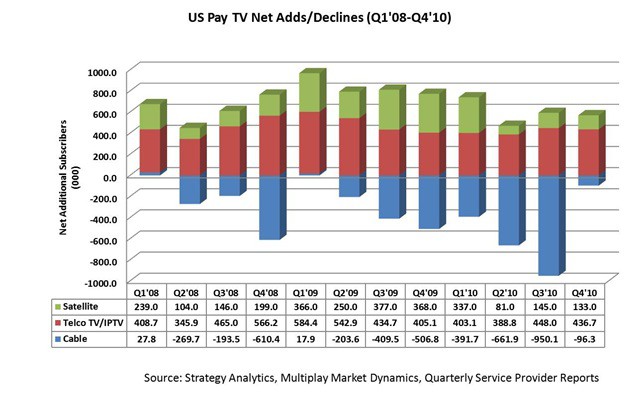
Click to enlarge

Your cable company has a problem.  Collectively, the cable industry has lost more than 2 million video customers over the past year, and the problem may be getting worse.  Some of the largest cable companies in the United States are making excuses for the historic losses:

  • The bad economy
  • Housing and foreclosure crisis
  • High unemployment
  • Family budget-cutting

But cable companies should be rethinking their excuses, according to a new report from Strategy Analytics.

“Throughout the past seven consecutive quarters of subscriber losses, the inclination of cable has been to point the finger at various external factors,” said Ben Piper, Director of the Strategy Analytics Multiplay Market Dynamics service. “Our analysis shows that neither the economy nor the housing market is to blame for these subscriber defections. The problem is one of value perception.”

Value perception.  That’s a measurement of whether or not one feels they are getting good value for the money they pay for a product or service.  Value comes in several different forms, starting with emotional — do I feel good, safe, secure, or nostalgic using the service?  Can I imagine life without it?  What about my friends and family — will I stand out if I am not buying this product?  It’s also practical — Can I afford this?  Can I find a cheaper or better alternative?  Do I really need this service anymore?

Tied into value perception is customer goodwill.  If you have an excellent experience with a company, letting go of their products comes much harder.  If you feel forced to deal with a company that has delivered poor and expensive service for years, pent up frustration will make it much easier (and satisfying) to cut them loose at the first opportunity.

Embarq used to be Sprint's pathway to prosperity in the local landline business, until cord cutting put landlines into a death spiral.

In the telecommunications industry, value perception is a proven fact of life.  It began with phone companies.  Formerly a monopoly, landline providers have been forced to try and reinvent themselves and become more customer-friendly.  First long distance companies like Sprint and MCI moved in to deliver cheaper (and often better quality) long distance service.  Sprint even got into the landline business themselves, forming EMBARQ, which at its peak was the largest independent phone company in the United States.  When Voice Over IP providers like Vonage and the cable industry’s “digital phone” products arrived, they promised phone bills cut in half, and introduced the concept of unlimited long distance calling.

The value perception among consumers became clear as they began disconnecting their landlines.  The alternative providers offered cheaper, unlimited calling services, often bundled with phone features the local phone company charged considerably more to receive.  Even though VOIP is technically inferior in call quality in many instances, the value the services provided made the decision to cut the phone cord easier.

But local phone company landline losses would only accelerate with the ubiquity of the cell phone, but for different reasons.  What began with high per-minute charges for wireless calls evolved into larger packages of calling allowances, with plenty of free minutes during nights and weekends, and often free calling to those called the most.  Most Americans end the month with unused calling minutes.  As smartphones gradually take a larger share of the cell phone market, the accompanying higher bills have forced a value perception of a different kind — ‘I can’t afford to keep my landline –and– my cell phone, so I’ll disconnect the landline.’

The cable industry has traditionally faced fewer competitive threats and regularly alienates a considerable number of customers, but still keep their business despite annual rate increases and unwanted channels shoveled into ever-growing packages few people want.

This pent up frustration with the cable company has led to perennial calls for additional competition.  That originally came from satellite television, which involved hardware customers didn’t necessarily like, and no option for a triple play package of phone and broadband service.  The cable industry offers both, and by effectively repricing their products to discourage defections from bundled packages, customers soon discovered the resulting savings from satellite TV were often less than toughing it out with the cable company.

As a result, satellite television has never achieved a share of more than 1/3rd of the video market.  Many satellite customers are in non-cable areas, signed up because of a deeply discounted price promotion, were annoyed with the cable company, or didn’t care about the availability of broadband or phone service.  When the price promotion ends or technical issues arise, many customers switch back to cable.

More recently, researchers like Strategy Analytics have discovered some potential game-changers in the paid video marketplace:

  • The impact of broadband-delivered video content
  • The Redbox phenomena
  • Competition from Telco TV
  • The digital television conversion

Strategy Analytics studied consumer perceptions and found customers braver than ever before about their plans to cut cable’s cord.  According to the consumers surveyed, nobody scores lower in value perception than cable companies.  Citing “low value for money,” over half of the cable subscribers surveyed told the research firm they intended to disconnect their cable TV package in the near future.

While other researchers dismiss those high numbers as bravado, there are clear warnings for the industry.

“Much ink has been spilled on the topic of cord cutting and even skeptics are now admitting that it can’t be ignored,” said Piper.

Indeed, Craig Moffett, an analyst with Sanford Bernstein who almost never says a discouraging word about his beloved cable industry, told Ad Age Mediaworks the issue of cord-cutting was real.

“It’s hard to pretend that cord cutting simply isn’t happening,” Moffett said.

Craig E. Moffett, perennial cable stock booster, even admits cord-cutting is real.

The most dramatic impact on the cable industry has been in the ongoing erosion of the number of premium channel subscribers, those willing to pay up to $14 a month for HBO, Cinemax, Showtime, or Starz!.  The reason?  Low value for money.  As HBO loses subscribers, Netflix and Redbox gain many of them.  Netflix still delivers a considerable number of movies by mail, but has an increasingly large library of instant viewing options over broadband connections.  Strategically placed Redbox kiosks deliver a convenient, and budget-minded alternative.

The loss of real wage growth, the housing collapse, and the down-turned economy do put pricing pressures on the industry, but some cable executives hope the time-honored tradition of customers howling about rate increases without ever actually dropping cable service continues.

But as new platforms emerge, some delivering actual pricing competition to the cable TV package, increasing numbers of customers are willing to take their video business somewhere else.  Some are stopped at the last minute with a heavily discounted customer retention pricing package, but that doesn’t keep them from sampling alternative online video options.  Among those who actually do leave, some are satisfied with the increased number of channels they get for free over-the-air after America’s digital television conversion.

Many others are switching to new offerings from telephone companies.  Both AT&T and Verizon deliver video packages to many of their customers, often at introductory prices dramatically lower than their current cable TV bill.  When considering a bill for $160 for phone, video, and broadband from the cable company or $99 for the same services from the phone company, $60 a month in savings for the first year or two is quite a value perception, and the inevitable disconnect order is placed with the cable company.

Ad Age‘s own survey, more skeptical about cord-cutting, confirmed that many former cable TV customers left for budgetary reasons, but many also kept their triple play packages.  They just bought them from someone else.

Also confirmed: a dramatic upswing in online viewing, sometimes paid but often ad-supported or free.

Strategy Analysts concludes in its report, available for $1,999, that the ongoing erosion of cable TV subscribers isn’t irreversible, but it requires urgency among providers to become more customer-friendly and increase the all-important value perception.

In other words: respecting the needs and wishes of your customers.

Thankfully, the cable industry is dealing with competitors like AT&T, who are willing to assassinate their current lead in value perception by slapping Internet Overcharging pricing schemes on their broadband service.  That will certainly raise the ire of their DSL and U-verse customers, many who are treating the customer unfriendly usage limits as an invitation to leave.  Their former cable companies are waiting to welcome them back.  The real question remains, will cable customers now be treated better?

Less is More? AT&T’s Fanciful Claim That T-Mobile Merger ‘Increases Competition’

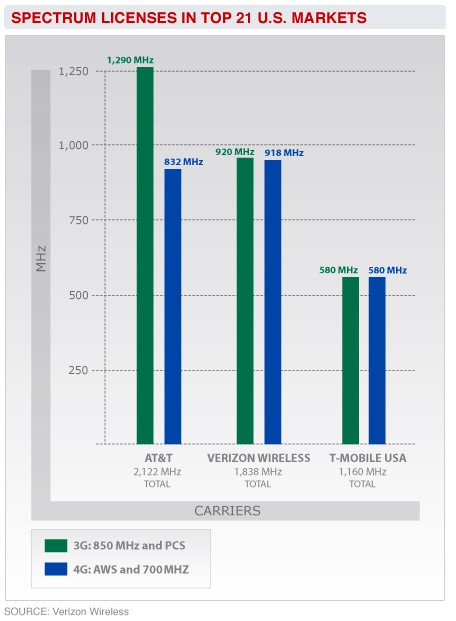
Verizon Wireless provides evidence AT&T already has more spectrum than any other carrier -- spectrum they are not using.

AT&T’s alternate reality of the wireless universe is on full display as the company makes statements promoting its proposed merger with T-Mobile that, in some cases, retreat from the facts or otherwise distort them.

AT&T CEO Randall Stephenson has been visiting with journalists, often from the business press, to talk up the merger’s potential.  The company has supplemented those PR tours with a 400-page filing with the Federal Communications Commission that has won converts among some non-profit groups, many of which receive direct funding from AT&T.

Stop the Cap! felt a fact check was in order, so we reviewed Stephenson’s recent claims made in an interview with USA Today:

Claim:  In the last four years, the volume of (traffic on) these (wireless broadband) networks is up 8,000%. We believe that we’re going to go up, in five years, eight to 10 times from where we are today. We don’t have the spectrum position to accomplish that.  T-Mobile’s spectrum is very compatible with ours. In cities like New York, we put the two companies together, and we get a very quick lift in capacity of about 30%. That means fewer dropped calls, better service quality, and it gives us a path to do something that neither one of us could do independently, and that is deploy fourth-generation mobile broadband to 95% of the U.S.

Fact: Although wireless broadband traffic is up, AT&T holds more wireless spectrum than any other carrier, a good deal of it unused.  In fact, some of AT&T’s competitors and critics suggest the company is hoarding spectrum, and its insatiable appetite for more could get fulfilled if the company can sell Congress on its “shortage theory.”  Although some of that spectrum is being reserved for the company’s future LTE network, critics contend AT&T spent a lower percentage of its revenue on network expansion (despite being the exclusive holder of the Apple iPhone during the period) than its competitors.

Between 2008 and 2010, AT&T’s FCC filing said it spent $21.1 billion in capital expenditures to upgrade its wireless network. That’s less than the $22.1 billion spent by Verizon Wireless over the same period. As a percentage of revenue, AT&T’s total was a little higher, at 13%, to Verizon’s 12.8%. Even so, given its congestion problems, AT&T should have spent significantly more. Complaints about congestion were apparent at least two years ago, yet in 2009 AT&T increased wireless capital expenditures by only 1% to Verizon’s 10%.

AT&T has admitted it has faced congestion issues in several large cities — an especially serious problem for a company using GSM technology, which combines voice and data traffic onto a single wireless pipe.  When the network gets overcongested, data sessions fail and voice calls drop.  CDMA networks like Verizon and Sprint have two virtual pipes, one for data and one for calls.  If one gets congested, it doesn’t necessarily harm the other.

Additionally, although T-Mobile will provide some additional capacity in selected urban markets, some of their towers are remarkably close to AT&T’s own towers, effectively making them redundant.  Because T-Mobile uses different spectrum, in some cases AT&T customers will see no benefit from the combination of the two networks, unless they buy new equipment capable of accessing both.

AT&T using T-Mobile as the key to deploying fourth-generation mobile broadband is more than a little hard to believe, considering the German-owned carrier is dwarfed by AT&T.

Claim: Anybody who opens the newspaper or watches TV sees this as a fiercely competitive industry — maybe the most competitive in the United States.  The large majority of Americans, when they go to buy cellphone service, have a choice of at least five providers. In 18 of the top 20 markets, the customer has a choice of five different competitors. It’s a fiercely competitive market today. It will be a fiercely competitive market after this deal is done. We don’t see that changing.

Free Press characterizes AT&T's claims of more competition by absorbing a competitor to be the equivalent of chucking your smartphone down the rabbit hole.

Fact: If ad purchases were evidence of a robust, competitive market, we could say phone and cable companies were hot competitors.  Both advertise heavily, but charge similar prices for similar service — a classic case of duopoly market pricing power. In the cell phone business, the overwhelming majority of Americans subscribe to either AT&T or Verizon Wireless.  Sprint is a distant third at around 12%.  After T-Mobile, all other carriers represent just 1-2% of the remaining market share.  Many cities don’t have access to smaller providers like Cricket, US Cellular, or MetroPCS, either.  In those areas, the choices are usually AT&T, Verizon, and perhaps Sprint.

How does this marketplace concentration impact customers?  Loss of innovation.  Typically, smaller carriers have to innovate to attract attention and compete successfully with larger providers.  AT&T and Verizon have long track records of locking up access to the most innovative phones, so smaller providers have to create unique service plans, offer lower prices, or provide attractive bundles.  Sprint sells unlimited access in a marketplace full of restrictive data caps or calling minute allowances.  T-Mobile provided some of the least expensive plans around, especially for families.  Cricket offers pay-per-day prepaid calling plans that can make a wireless phone affordable for anyone.  US Cellular has stellar customer service.

All competitors are not equal.  Anyone who lives or visits rural areas understands the implications of relying on Cricket, MetroPCS, or even Sprint for cell phone service well off the main highway.  With coverage being a major factor, many quickly decide there are only two realistic choices for robust service — AT&T and Verizon.

AT&T’s myopia aside, eliminating T-Mobile, one of the market’s most fiercely innovative providers, will do nothing to benefit consumers.

Q&A Claims:

Q: There are small companies in the market, but one commentator said that they’re like grocery stores trying to compete with Walmart.

A: Everybody has their analysis. We can evaluate the numbers nine ways to Sunday. At the end of the day, the Justice Department will do the fact gathering and data gathering and will evaluate it market by market, then make those determinations. Based on our analyses, this is a deal that should be approved.

Q: If the market is so competitive, why might two companies have 70% of the business?

A: We all make technology decisions. We all put marketing plans into place. We all make decisions that drive how effective we are in the marketplace. I think we’ve done pretty well. I think Sprint has done a remarkable job over the last couple of years and will do very well tomorrow.

Q: Consumers only have two places where they can get an iPhone.

A: But there are RIM (BlackBerry) devices. There are Windows (Phone) 7 devices. Android devices tend to be doing very well throughout the market — in fact, we are having a lot of success with Android. Metro PCSand a lot of our competitors are having a lot of success there. So there are plenty of options for the customer.

Q&A Facts:

  1. AT&T’s in-house analysis decides what is best for AT&T, not for individual American consumers.  The Justice Department and the Federal Communications Commission are subject to political pressure and are not independent arbiters of competitive fairness.
  2. Sprint has lost customers for years and is only now attracting some of them back.  While charitable to Sprint, Stephenson’s remarks are not welcomed by them.  They consider this deal anti-consumer and anti-competitive.
  3. Perhaps with the exception of the Evo, available first from Sprint, almost every other cutting-edge phone launches exclusively with AT&T and/or Verizon.  Other carriers get to sell these popular phones much later, or sell stripped down models that don’t deliver the same features.  Just review the phones available to Cricket and MetroPCS customers and compare them with what is on offer from Verizon and AT&T.

Claim:  History tells you that prices in this industry have come down for 10 years. In the last 10 years, there’s been a significant number of business combinations in this industry, and prices have come down by 50%. And prices continue to come down. We have a history, when we acquire one of these companies, we map their rate plans into AT&T. So if somebody chooses to stay on that rate plan, those rate plans are available. I don’t see why we would change it for this case. It’s just a customer-friendly thing to do.
Fact: More and more customers are no longer simply buying voice plans, on which Stephenson’s claims are based.  Instead, they are upgrading to smartphones, where they discover carriers’ mandatory add-on fees for data services.  Although prices for voice plans have not increased, rates for text messaging, data, and other add-ons have.  That can add $25 a month or more per phone.  Many carriers are reducing their discounts on new phones while adding new “junk fees” to their bills to cover “regulatory costs” as well.

AT&T also doesn’t specifically promise to retain T-Mobile’s innovative rate plans.  Instead, they propose to grandfather existing customers on those plans until they purchase new phones or switch carriers.  That does not mean existing AT&T customers can jump to a T-Mobile plan.  It also doesn’t mean those plans will still be available for new customers.

AT&T has a track record of not being particularly customer-friendly, either.

Claim: T-Mobile will continue to operate their business exactly like they have. They’ve demonstrated that they’ve had a lot of success. They market directly against AT&T. I envision them to continue marketing against AT&T in the marketplace.

Fact: T-Mobile is so successful, they have been shopping around for a buyer for some time to allow them to exit the business.  A success story that is not.

Claim: Q. If the deal goes through, would you offer all of the AT&T handsets to T-Mobile? A: Of course. If you’re a T-Mobile customer, that’s one of the great advantages. The handset selection that AT&T offers would become available to T-Mobile customers.

Fact: This proves our point T-Mobile customers do not have access to the latest and greatest equipment available to AT&T customers.

AT&T has also claimed the deal will create new jobs and stimulate economic growth.  Tell that to the T-Mobile employees who will be collecting unemployment shortly after being deemed redundant by AT&T.  Virtually all of T-Mobile’s current service areas overlap AT&T.

Free Press’ Tim Karr compares the consolidation of the cellular industry to the railroad mergers of the 19th century.  By locking up competition, carriers can raise prices and call the shots in the marketplace.  While a handful of competitors could eke out their 1-2% market share in such a duopoly, all will be starved for capital and considered a risky bet in light of the domination by AT&T and Verizon.

Karr is asking Americans to put their elected officials on notice they don’t want this anti-consumer merger:

So should it be left to Washington and one exceedingly powerful company to decide the fate of our communications? (If you’re thinking “no,” you can help stop this merger by contacting the members of the Antitrust Subcommittee and urging them to grill AT&T next Wednesday.)

If Congress, the FCC and Department of Justice hear from enough people like you and me, they can muster the courage to ask the right questions of AT&T.

Next Wednesday’s hearing on the Hill is our first chance to expose this merger for the nightmare that it is, and save our smartphones from following AT&T down the rabbit hole.


North Carolina Update: Porn Debate Temporarily Derails Marilyn Avila’s Anti-Broadband Bill

Rep. Marilyn Avila (R-Time Warner Cable)

After passing through the Republican-dominated Finance Committee, Rep. Marilyn Avila’s (R-Time Warner Cable) cable company-written, anti-consumer legislation arrived in the North Carolina Senate this afternoon, where it was promptly, if temporarily, derailed over whether residents have the right to watch adult entertainment on community-owned broadband/cable networks.

That’s right… porn has thrown the state legislature into such silliness, the entire bill had to be pulled from consideration until Monday.

Here’s a quick rundown how things played out today:

♥ — H.129, Avila’s anti-broadband bill, has proved to be the first serious piece of legislation that has divided the normally lock-step Republican-controlled legislature this session.  That is entirely because YOU are putting the pressure on with your calls and e-mails to Senate members.  We have it on good authority the overwhelming amount of response to this bill from constituents has been downright hostile to the idea it should ever pass.  Consumers in North Carolina want more choices for broadband, not less.  They want increased competition, lower prices, and most importantly — better service (or at least s0me service from someone).  H.129 does none of those things.  It doesn’t deliver a single new broadband connection anywhere in the state.

♥ — Several amendments helpful to broadband development managed to win a place in the bill.  The communities of Wilson and Salisbury will get to expand their systems to cover larger areas, including the town of Faith Stop the Cap! covered earlier.  We also won a victory changing the terms of the “mandatory referendum” provision to strip away the loaded, misleading ballot question about whether cities should ‘take on more public debt’ to finance the construction of community broadband, replacing it with a fairer alternative — do you favor your community building its own broadband system. 

↓ — But we also lost a few battles. Yesterday, the industry covertly changed the definition of an unserved area from “an area where 50% don’t receive FCC basic broadband service” to a Census block, where 50% of the households don’t receive 768/200Kbps. That change annihilates the unserved area exemption. As confirmed by the highly credible e-NC authority, the industry provides its broadband data by Census block, not by household, and if a census block has just one home that receives Internet service, the entire census block is labelled as having Internet service.

Today, Senator Atwater (D-Chatham) tried to modify that definition with a much better measurement standard: “homes per square mile.”  The federal government has established that the least dense areas of the country are the most costly to serve, which explains why these areas traditionally lack broadband service or receive low speed DSL.  Atwater’s amendment targeted the 38% of the most rural areas in North Carolina to keep the door open for community broadband, but Senator Tom Apodaca (R-Hendersonville) would have none of it, despite the fact his district covers the rural expanse of the western mountains of North Carolina.  Stop the Cap! readers have shared stories with us about hanging out in parking lots using motel Wi-Fi to pay their bills online or complete homework.  In Apodaca’s world-view, that means those areas have broadband.

Now our readers will understand why we have stressed it is so important to have accurate, in-depth broadband map data.  Instead, industry-connected groups like Connected Nation conjure up maps created by unverified, provider-supplied data.  This map data is a critical part of H.129’s tragic terms and conditions.  If the maps say service exists, industry lobbyists use that to browbeat elected officials into believing there is no broadband problem, and there is no reason to allow communities to build their own broadband services.

Of course, the reality is very different.  We’ve received hundreds of messages from Americans who say these maps show broadband as being widely available in their communities, but in reality is not.  Some legislators in North Carolina have confronted this reality personally. For those that haven’t, it’s easy to accept provider arguments, cash those campaign contribution checks, and throw constituents under the bus.

We Saved the Most Ridiculous Part of Today’s Events for Last

Sen. Apodaca's obsession with adult entertainment derailed a scheduled vote on H.129 this afternoon.

When the city of Fayetteville wanted protection for their investment in fiber optics, at risk from H.129, the aforementioned Sen. Apodaca lost his mind.  Instead of protecting city funds already spent on next generation fiber, he substituted his own new amendment — to strip adult programming off community-owned broadband/cable systems instead.

You read that right. In case you didn’t, here it is again:

Sen. Apodaca would rather be the arbiter of what you can watch in the privacy of your own home than protecting community investments in broadband improvements.

So much for the “level playing field” title of Avila’s original bill.  Apodaca’s anti-porn crusade does not apply to Time Warner Cable or other private providers, so he has no problem at all if you want to pop some popcorn and settle down to some movies like “Suck It Sunrise,” “Boning Black Beauty 8” (to answer those lingering questions that went unanswered in part 7), or “Dripping Wet Lesbians,” all currently running on TWC’s adult channels.

No matter that Apodaca’s amendment is completely against federal law, which should signal how clueless some legislators are about these issues.  The Cable Act provides settled law on this subject.  Government cannot engage in cable content regulation — particularly the state and federal government.  The cable industry lobbied hard for that protection in the 1980s in part because of controversy over MTV and other “explicit” programming.  Only the local franchising authority can make decisions about the content they carry — and that means local communities get to make those decisions for themselves (47 USC 544(d)(1)).  That means Sen. Apodaca should worry about his own television viewing habits and stay out other peoples’ lives.

We’re helpers here at Stop the Cap!, so we’d point the senator to 47 USC 544(f)(1):

(f) Limitation on regulatory powers of Federal agencies, States, or franchising authorities

(1) Any Federal agency, State, or franchising authority may not impose requirements regarding the provision or content of cable services, except as expressly provided in this subchapter.

Those exceptions, by the way, have to do with changes in federal law, not the individual whims of one state senator.

Sen. Mansfield, who introduced the original amendment to protect Fayetteville, was naturally disturbed to find Apodaca’s non-germane substitute.  That promoted Apodaca to suggest Mansfield allowed his children to watch pornography, and from there the debate spiraled out of control.  After a brief recess, Apodaca returned to apologize to Mansfield, before killing the amendment to protect Fayetteville’s fiber investment for a second time.

Reviewing today’s events provides us with another edition of Legislators Out of Their League.  Apodaca’s naive amendment was not the only telling example (we know more about telecommunications law than he does.)  Yesterday in the Senate Finance Committee, Ms. Avila was utterly lost at sea as discussion ensued on amendments to the bill with her name on it.  Reduced to muttering at times, confused about the discussions dealing with the definition of underserved, her usual reaction was to oppose what she didn’t understand.  None of this is surprising considering the cable industry wrote the majority of her bill she introduced as her own.  She continues to protect their interests while ignoring yours.

This is why we continue to oppose H.129 and you should too.  We have until Monday to continue to drive the message home to state senators.  If you called or wrote before, it’s time to write and call again.  Tell your state senator H.129 is a bill written by and for the cable and phone companies.  It does not deliver any new broadband service to anyone, risks the investments communities across the state have already made, and allows a handful of big telecom companies to control North Carolina’s broadband destiny.  Considering the state achieves dead last ratings in broadband, that is the kind of control they should never be allowed to have.

Senate Representation By County

2011-2012 Session

(click on your member’s name for contact information)

County District: Members
Alamance 24: Rick Gunn;
Alexander 45: Dan Soucek;
Alleghany 30: Don East;
Anson 25: William R. Purcell;
Ashe 45: Dan Soucek;
Avery 47: Ralph Hise;
Beaufort 1: Stan White;
Bertie 4: Ed Jones;
Bladen 19: Wesley Meredith;
Brunswick 8: Bill Rabon;
Buncombe 49: Martin L. Nesbitt, Jr.; 48: Tom Apodaca;
Burke 44: Warren Daniel;
Cabarrus 36: Fletcher L. Hartsell, Jr.;
Caldwell 44: Warren Daniel;
Camden 1: Stan White;
Carteret 2: Jean Preston;
Caswell 24: Rick Gunn;
Catawba 42: Austin M. Allran;
Chatham 18: Bob Atwater;
Cherokee 50: Jim Davis;
Chowan 4: Ed Jones;
Clay 50: Jim Davis;
Cleveland 46: Debbie A. Clary;
Columbus 8: Bill Rabon;
Craven 2: Jean Preston;
Cumberland 19: Wesley Meredith; 21: Eric Mansfield;
Currituck 1: Stan White;
Dare 1: Stan White;
Davidson 33: Stan Bingham;
Davie 34: Andrew C. Brock;
Duplin 10: Brent Jackson;
Durham 20: Floyd B. McKissick, Jr.; 18: Bob Atwater;
Edgecombe 3: Clark Jenkins;
Forsyth 31: Peter S. Brunstetter; 32: Linda Garrou;
Franklin 7: Doug Berger;
Gaston 41: James Forrester; 43: Kathy Harrington;
Gates 4: Ed Jones;
Graham 50: Jim Davis;
Granville 7: Doug Berger;
Greene 5: Louis Pate;
Guilford 33: Stan Bingham; 26: Phil Berger; 27: Don Vaughan; 28: Gladys A. Robinson;
Halifax 4: Ed Jones;
Harnett 22: Harris Blake;
Haywood 50: Jim Davis; 47: Ralph Hise;
Henderson 48: Tom Apodaca;
Hertford 4: Ed Jones;
Hoke 13: Michael P. Walters;
Hyde 1: Stan White;
Iredell 41: James Forrester; 42: Austin M. Allran; 36: Fletcher L. Hartsell, Jr.;
Jackson 50: Jim Davis;
Johnston 12: David Rouzer;
Jones 6: Harry Brown;
Lee 18: Bob Atwater;
Lenoir 10: Brent Jackson;
Lincoln 41: James Forrester;
Macon 50: Jim Davis;
Madison 47: Ralph Hise;
Martin 3: Clark Jenkins;
McDowell 47: Ralph Hise;
Mecklenburg 37: Daniel G. Clodfelter; 38: Charlie Smith Dannelly; 39: Bob Rucho; 40: Malcolm Graham; 35: Tommy Tucker;
Mitchell 47: Ralph Hise;
Montgomery 29: Jerry W. Tillman;
Moore 22: Harris Blake;
Nash 11: E. S. (Buck) Newton;
New Hanover 9: Thom Goolsby;
Northampton 4: Ed Jones;
Onslow 6: Harry Brown;
Orange 23: Eleanor Kinnaird;
Pamlico 2: Jean Preston;
Pasquotank 1: Stan White;
Pender 8: Bill Rabon;
Perquimans 4: Ed Jones;
Person 23: Eleanor Kinnaird;
Pitt 3: Clark Jenkins; 5: Louis Pate;
Polk 48: Tom Apodaca;
Randolph 29: Jerry W. Tillman;
Richmond 25: William R. Purcell;
Robeson 13: Michael P. Walters;
Rockingham 26: Phil Berger;
Rowan 34: Andrew C. Brock;
Rutherford 46: Debbie A. Clary;
Sampson 10: Brent Jackson;
Scotland 25: William R. Purcell;
Stanly 25: William R. Purcell;
Stokes 30: Don East;
Surry 30: Don East;
Swain 50: Jim Davis;
Transylvania 50: Jim Davis;
Tyrrell 1: Stan White;
Union 35: Tommy Tucker;
Vance 7: Doug Berger;
Wake 14: Dan Blue; 15: Neal Hunt; 16: Josh Stein; 17: Richard Stevens;
Warren 7: Doug Berger;
Washington 1: Stan White;
Watauga 45: Dan Soucek;
Wayne 5: Louis Pate; 12: David Rouzer;
Wilkes 45: Dan Soucek;
Wilson 11: E. S. (Buck) Newton;
Yadkin 30: Don East;
Yancey 47: Ralph Hise;

Western Canada’s Internet Overcharging Two-Step: Shaw and Telus Plan to Gouge You

One of Canada’s largest phone companies is willing to admit it is prepared to launch an Internet Overcharging scheme on its broadband customers now, while western Canada’s largest cable company would prefer to wait until after the next election to spring higher prices on consumers.

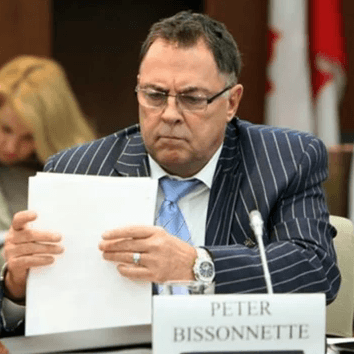
When Shaw’s president Peter Bissonnette told investors and the media he believes users who use more should pay more, all that needs to be put in place is exactly how much more Shaw customers will pay for already-expensive Internet access.  With Shaw making noises about usage-based billing, Telus felt it was safe enough to dive right into their own usage cap and overlimit fee pricing scheme.

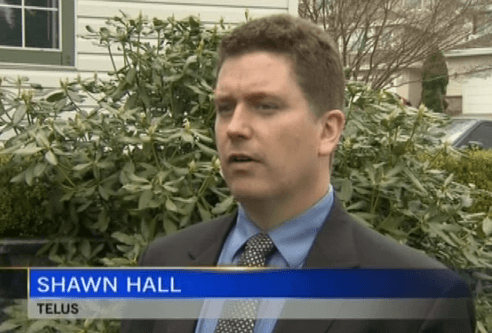
Shawn Hall, a spokesperson for Telus, told CTV News that the phone company was ready to begin overcharging customers as soon as this summer.

Shawn Hall (CTV BC)

“It’s only fair that people pay for how much Internet capacity they use,” Hall told CTV.

Telus doesn’t seem to be too worried about the fact usage-based billing has become a major issue in the upcoming elections.  A review of the pricing scheme by the Canadian Radio-television and Telecommunications Commission is due within months, but the phone company isn’t going to wait.

Shaw is being more cautious.  After the pretense of a “listening tour,” and with federal officials breathing down their necks, Shaw wants to wait until the elections are over before moving forward on their own price gouging, according to Openmedia.ca.

As Stop the Cap! has told our readers repeatedly, corporate “listening tours” about Internet Overcharging are about as useful as lipstick on a pig.  Providers don’t actually listen to their customers who are completely against these pricing schemes — and every survey done tells us that represents the majority of customers.  Instead, they only hear what they want to hear, cherry-picking a handful of useful statements in order to make it appear they are responsive to customer needs.

Shaw heavily redacted their own meeting minutes on their website, completely ignoring a large number of customers unalterably opposed to usage-based billing of any kind.  Instead, statements that fit their agenda were repeated in detail, especially those that suggested average users don’t want to pay for heavy users.

Shaw executives discuss with investors how they will stick customers with usage-based billing, despite customers telling them they don’t want these schemes. April 13, 2011. (7 minutes)
You must remain on this page to hear the clip, or you can download the clip and listen later.

It’s like arguing marathon runners should pay extra for the oxygen they consume because others don’t breathe as much.  It’s all a lot of hot air.

Broadband traffic costs providers only a small percentage of the amount they charge customers, and that number is dropping.  Yet providers want to raise prices, restrict usage, and charge punitive fees for those who exceed their arbitrary usage limits.

The power of the duopoly in place across most of western Canada has given providers little to fear from overcharging consumers.

Shaw CEO Bradley Shaw told investors they know few customers will switch providers if usage-based billing is imposed.

“We are of the mind that we still have a tremendous upside in terms of pricing power on our Internet services,” Shaw said.

The fact many Shaw customers have no other choice other than Telus does not escape Shaw’s notice either.

Telus’ Hall even had the nerve to call their Internet Overcharging pro-consumer.

Bissonnette

“It’s going to be really customer friendly,” he said. “You’d be forgiven for the first month you go over. You’d get lots of warning, lots of notice that you were going over with options of moving to other plans.”

Except an unlimited one — that is not available.

Openmedia.ca is trying to hold politicians’ feet to the fire on the issue of Internet Overcharging, demanding answers from every major party in Canada about how they will keep providers from imposing these pricing schemes.

Every major party, with one exception — the Conservative Party of Canada, has answered.  That’s the party currently in power.

Liberal Leader Michael Ignatieff has spoken out against usage-based billing, while NDP Leader Jack Layton has promised to ban it outright if elected to power.

Nearly a half-million Canadians have signed a petition opposing usage-based billing, and providers are showing once again they are not open to listening to anyone but their bean counters, intent on extracting as much cash as possible from Canadian customers’ wallets.

[flv width=”640″ height=”380″]http://www.phillipdampier.com/video/CTV British Columbia – Shaw planning to revive metered internet billing critics 4-25-11.flv[/flv]

CTV in British Columbia covers Shaw’s plans to revive metered Internet billing later this year.  (2 minutes)


Search This Site:

Contributions:

Recent Comments:

Your Account:

Stop the Cap!