Home » Competition » Recent Articles:

AT&T’s U-verse a Flop in Chattanooga — Only 821 Signed Up; EPB Wins Comcast Customers

Phillip Dampier December 27, 2011 AT&T, Broadband Speed, Comcast/Xfinity, Community Networks, Competition, Consumer News, Data Caps, EPB Fiber Comments Off on AT&T’s U-verse a Flop in Chattanooga — Only 821 Signed Up; EPB Wins Comcast Customers

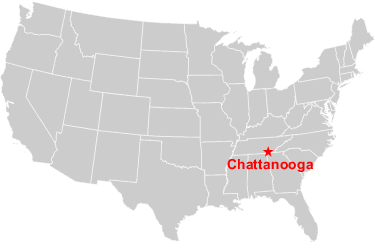
AT&T’s fiber to the neighborhood service is not exactly winning consumers over in Chattanooga, Tenn.  As of this past spring, AT&T only managed to convince 821 local customers to sign up for U-verse service, in part because the competition delivers faster service, and one doesn’t slap broadband customers with an Internet Overcharging scheme.

While Comcast remains the dominant cable company in the city with more than 100,000 customers, community-owned EPB Fiber has made major advances, primarily against Comcast, picking up at least 33,000 customers in the city since the summer of 2010.

EPB is turning into a major success story for community-owned broadband, typically maligned as a financial failure by cable and phone company competitors.  EPB offers residential customers usage cap free gigabit broadband, television, and telephone service and is competing effectively against the nation’s largest cable operator.

EPB has been raking in more than $3.8 million a month in telecommunications revenue from residential customers alone.  In less than two years, EPB, which also delivers electricity in Chattanooga, has built a $45 million a year telecommunications business.  As a community-owned utility, most of that revenue stays in Chattanooga, benefiting the local economy and allowing EPB to reinvest in its network and improve service.
Comcast, in contrast, has seen its revenue drop by 8.4 percent during the first six months of 2011, primarily because of departing customers. That has forced the dominant cable company to become more aggressive in its efforts to retain those calling to cancel, primarily by slashing prices if wavering customers agree to stay.

Remarkably, AT&T’s U-verse has merited also-ran third place status — the victim of limited availability, the ongoing trend of customers dropping landline service, and the far-superior broadband speeds available from the competition.  AT&T’s Internet Overcharging scheme is also the stingiest, limiting broadband customers to just 150GB for its DSL service, 250GB for U-verse broadband, charging overlimit fees when the caps are exceeded.  Comcast has a usage cap of 250GB with no overlimit fee.  EPB has no limits.

The Chattanooga Times Free Press compares all three providers’ strengths and weaknesses:

EPB Broadband speeds are the fastest in the nation.

AT&T — Very aggressively priced introductory offers, more HD channels than its competitors, plus a “quad-play” bundle that includes AT&T wireless service.  But AT&T’s landline network is still the least equipped to compete on broadband speed, an increasing number of residents continue to turn their back on AT&T when they cut landline service, and U-verse’s usage caps come with overlimit fees.

Comcast — Has a substantial number of on-demand programs to access, can be cheaper than EPB during the initial year of service, and is testing home security and automation services.  Also offers two-hour service call windows and aggressively priced retention deals.  But Comcast’s regular prices are high, its broadband service usage-limited, and its reputation questionable after more than a decade of rate hikes and service complaints.

EPB — The fastest broadband speeds anywhere, EPB runs an advanced fiber to the home network, and maintains a very aggressive attitude about expanding and improving service.  EPB is a formidable competitor.  Community-0wned, its service benefits local residents with a locally-staffed call center, revenues that stay in Chattanooga, and management that answers to customers, not Wall Street.  No caps either.  But EPB can be a harder initial sell for price-sensitive customers because it doesn’t offer heavily discounted service to attract new customers.  But EPB prices don’t rise dramatically after the first year, either.  EPB’s television lineup is less robust than others, in part because it lacks a nationwide presence that brings the kind of volume discounts AT&T and Comcast receive.

The Fat Lady Sings: What Happens Next Now That AT&T-Mobile Merger Deal is Dead

FAIL

AT&T announced Monday it has officially dropped its bid for Deutsche Telekom’s T-Mobile USA.

The company blamed regulator opposition for the failure of the merger, underestimating the Obama Administration’s tolerance for super-sized acquisition deals that could reduce competition and raise prices for consumers.

The real challenge for AT&T initially came not from the Federal Communications Commission, but from the U.S. Department of Justice which filed suit against the merger in August. FCC Chairman Julius Genachowski soon followed with statements that suggested the merger would have a difficult time at the Commission as well, and after a scathing report from FCC staffers was made public, Wall Street began to reduce the chances of the merger getting through to the single digits.

Had AT&T successfully merged with fourth-place T-Mobile, it would have easily become the nation’s largest and most powerful wireless provider, advancing beyond current leader Verizon Wireless.

The failure for AT&T will cost the company at least $4 billion in cash and spectrum it earlier agreed to give T-Mobile if the merger failed to complete.  Industry analysts say the real winner this year will easily be Verizon Wireless, which successfully accomplished its own spectrum acquisition by quietly buying unused spectrum from some of the nation’s largest cable companies.  With that spectrum now under Verizon’s control, AT&T has been reduced to signing new roaming agreements with an independent T-Mobile to share their GSM technology networks.  That will do little to alleviate AT&T’s dropped call problem in large cities, analysts say, because most roaming agreements specify sharing network resources only in areas where one carrier does not provide service.

Where U.S. Cell Phone Companies Stand Today

AT&T: AT&T still retains a considerable amount of unused wireless spectrum, but some of it is located on frequency bands that provide a lower quality of service indoors.  AT&T may have a difficult time finding new spectrum, because other carriers have signed partnership deals with most of the companies still holding unused frequencies. One of the largest holders of unused, warehoused spectrum is DISH Networks, and they’ve indicated no interest in selling.  DISH may partner with T-Mobile now that AT&T has exited.  That leaves AT&T with lobbying the government to speed up new spectrum auctions and working internally to expand their cell tower network to divide the traffic load.  It’s an expensive proposition, and several Wall Street analysts are advising their clients to dump AT&T stock.  Kevin Smithen, a Macquarie Capital USA Inc. analyst who downgraded AT&T to “sell” from “hold” last week advised AT&T was running out of options.

Verizon Wireless: Big Red remains in excellent shape to maintain its current market leadership position, particularly as it uses recently-acquired spectrum to bolster its 4G LTE network.  A UBS analyst was more direct: It will have 56 percent more 4G spectrum than AT&T in the top 10 markets and 46 percent more in the top 100, giving it a “meaningful competitive advantage.” Verizon has also cut a deal with cable operators that could reduce competitive pressure on Verizon’s landline/FiOS network from cable companies.  That fringe benefit comes courtesy of an agreement to market each others’ products to consumers.

Sprint: In addition to building its own 4G network, the company still has an agreement with Clearwire that allows Sprint to purchase the former company’s spectrum if it ever becomes available for sale.  With T-Mobile still obviously up for sale, Sprint could attempt its own merger, although it may be wary of stirring the same regulatory pot that got AT&T into trouble.  That leaves T-Mobile’s next buyer likely to be a regional cell phone company, a foreign firm entering the U.S. market, or an existing telecommunications company that decides a wireless division would be of benefit.

Extended Video Coverage

News of AT&T/T-Mobile Merger Failure Breaks

[flv width=”480″ height=”290″]http://www.phillipdampier.com/video/AP T-Mobile Merger Dead 12-19-11.mp4[/flv]

This report from the Associated Press informs consumers of the basics — the merger is no-go, leaving AT&T and T-Mobile as competitors, at least for now.  (1 minute)

[flv width=”360″ height=”290″]http://www.phillipdampier.com/video/Bloomberg ATT Pulls T-Mobile Bid After Regulator Opposition 12-19-11.mp4[/flv]

AT&T Inc. abandoned a $39 billion takeover bid for T-Mobile USA after underestimating opposition from regulators, thwarting its ambitions to become the biggest U.S. wireless carrier. AT&T will take a pretax charge of $4 billion to reflect cash payments and other considerations due to T-Mobile-owner Deutsche Telekom AG, the Dallas-based company said in a statement today. Peter Cook, Lisa Murphy, Adam Johnson and Sheila Dharmarajan report on Bloomberg Television’s “Street Smart.” (7 minutes)

[flv width=”360″ height=”290″]http://www.phillipdampier.com/video/Bloomberg Blair Says ATT’s T-Mobile Bid Was All About Spectrum 12-19-11.mp4[/flv]

Brian Blair, an analyst at Wedge Partners Corp., talks about AT&T Inc.’s decision to abandon a $39 billion takeover bid for T-Mobile USA and Apple Inc.’s victory in a final patent-infringement ruling that bans some HTC Corp. smartphones from the U.S. Blair speaks with Emily Chang on Bloomberg Television’s “Bloomberg West.”  (11 minutes)

[flv]http://www.phillipdampier.com/video/CNBC Baird on ATT T-Mobile Failure 12-20-11.mp4[/flv]

Apologists for AT&T on CNBC wring their hands over how wireless networks will get built out into rural areas now that the T-Mobile deal is dead. Will Power, R.W. Baird & Co, weighs in with a host who clearly cheerleads AT&T’s world-view.  (5 minutes)

[flv]http://www.phillipdampier.com/video/CNBC ATT Drops Bid for T-Mobile 12-20-11.mp4[/flv]

AT&T drops its $39 billion bid for T-Mobile USA, with Todd Rethemeier, Hudson Square Research.  AT&T’s talking points don’t fly with Rethemeier.  (4 minutes)

T-Mobile’s CEO Speaks About the Merger Failure

[flv]http://www.phillipdampier.com/video/CNBC Deutsche Telekom CEO on Failed T-Mobile Merger 12-20-11.mp4[/flv]

Rene Obermann, Deutsche Telekom CEO, explains why the merger between AT&T and T-Mobile USA should have gone through. “This transaction would have solved a number of industry issues,” he says.  Obermann is in friendly territory on CNBC.  (8 minutes)

The Impact on Sprint

[flv width=”360″ height=”290″]http://www.phillipdampier.com/video/Bloomberg Horan Sees T-Mobile Eventually Merging With Sprint 12-19-11.mp4[/flv]

Tim Horan, an analyst with Oppenheimer & Co., talks about AT&T Inc.’s decision to abandon a $39 billion takeover bid for T-Mobile USA, thwarting its ambitions to become the biggest U.S. wireless carrier. Horan speaks with Adam Johnson and Lisa Murphy on Bloomberg Television’s “Street Smart.” (3 minutes)

[flv width=”640″ height=”500″]http://www.phillipdampier.com/video/Bloomberg Gamcos Haverty Says Sprint an Endangered Species 12-19-11.flv[/flv]

Larry Haverty, portfolio manager at Gamco Investors Inc., talks about AT&T Inc.’s decision to abandon a $39 billion takeover bid for T-Mobile USA, and the outlook for Sprint Nextel Corp. and the wireless industry. Haverty speaks with Cory Johnson on Bloomberg Television’s “Bloomberg West.” (6 minutes)

 Will DISH Network Be AT&T’s Next Acquisition Target?

[flv]http://www.phillipdampier.com/video/CNBC Trading on ATT’s Failed T-Mobile Bid 12-20-11.mp4[/flv]

Shares of Dish Network up 9% in the aftermath of AT&T’s failed bid to acquire T-Mobile. Michael McCormack, Nomura telecom analyst, weighs in on whether Dish is the next target for AT&T.  (2 minutes)

Cablevision Executives Head for the Hills: Rumors of Dolan Family Takeover or Buyout Emerge

Phillip Dampier December 19, 2011 Cablevision (see Altice USA), Competition, Video Comments Off on Cablevision Executives Head for the Hills: Rumors of Dolan Family Takeover or Buyout Emerge

Cablevision's top executives head on out. Tom Rutledge (left) and John Bickham (right) left within weeks of each other.

The unexpected and sudden departure of two senior executives at Bethpage, N.Y.-based Cablevision has pushed the rumor mill into overdrive the cable company is about to be sold or taken private.

John Bickham, president of cable communications and chief operating officer Tom Rutledge will both be spending more quality time with their respective families after departing Cablevision.  Last Thursday’s announcement that Rutledge would resign caused Cablevision’s stock price to drop by nearly 14% during trading Friday.

The inevitable conclusion on Wall Street: Cablevision is about to be sold or taken private.

Major shareholders and investment firms have criticized Cablevision over the years for being “too successful” signing customers to fixed price double or triple-play packages that provide a full suite of products and services, but deliver few growth opportunities shareholders demand. With heavy competition from Verizon FiOS in most of their service areas, Cablevision’s ability to simply raise rates is limited, especially when customers bounce between promotional offers from the phone and cable companies.

Rutledge’s departure, in particular, has been seen as a major negative on Wall Street because he was responsible for many of Cablevision’s most innovative products, including streamed video, his advocacy for boosting broadband speeds, and the company’s aggressive move into home security.

Craig Moffett, a Wall Street analyst from Sanford Bernstein, thinks Comcast and Time Warner Cable are set to divide the spoils in a shared buyout — Comcast grabbing northern New Jersey and Connecticut and Time Warner Cable assuming control of Cablevision’s systems in New York.  But other analysts don’t think that scenario is so likely, especially when considering the Dolan family’s long history in the cable business.

ISI Group Inc. analyst Vijay Jayant told Light Reading Cable he believes the more likely scenario would have the Dolan family buying out shareholders and taking the cable company private.

Time Warner Cable has repeatedly informed shareholders the company will not engage in bidding wars or overpay to win new acquisitions, and the Dolan family’s selling price for Cablevision is likely far higher than Time Warner would be willing to pay.  Comcast might have a political problem assuming control of more cable systems after its recent merger with NBC-Universal.  Shareholders may also rebel, as they did in a 2007 effort to take Cablevision private.  Investors felt they were offered too low a price to compensate them for their shares.

Moffett believes Cablevision’s days of high earnings and rapid growth are behind them, because just about everyone who wants cable service already has it, either from Verizon FiOS or Cablevision.

“No, we don’t think [Cablevision] can grow. And, no, we don’t think the rest of cable is doomed to the same fate,” Bernstein’s Moffett wrote in a report in late November. “The cause of [Cablevision’s] growth decline is straightforward: it has been so successful in achieving high product penetrations that growing further is quite challenging.”

[flv width=”360″ height=”290″]http://www.phillipdampier.com/video/Bloomberg Joyce Says Cablevision May Be a Takeover Target 12-16-11.mp4[/flv]

David Joyce, media analyst at Miller Tabak & Co., talks about Cablevision Systems Corp. Chief Operating Officer Tom Rutledge’s resignation and the outlook for the company.  Bloomberg News.  (5 minutes)

Independent Gigabit Broadband for San Francisco, While AT&T Struggles to Provide U-verse

Phillip Dampier December 15, 2011 AT&T, Broadband Speed, Competition, Data Caps, Sonic.net Comments Off on Independent Gigabit Broadband for San Francisco, While AT&T Struggles to Provide U-verse

While AT&T endures zoning-related delays to build out its fiber-to-the-neighborhood service U-verse, a scrappy anti-cap, pro-speed Internet provider in Santa Rosa has announced its intention to deliver gigabit speeds to San Franciscans over a fiber-to-the-home network that will begin construction early next year.

Sonic.net has been providing broadband services for years in northern California, using AT&T’s network of phone lines to deliver unlimited 20Mbps DSL service (including a phone line) for $40 a month.

Sunset District, San Francisco, Calif. (Courtesy: Stilfehler)

Now the company is branching beyond traditional DSL into fiber optics.  Sonic.net has already completed the first phase of its gigabit fiber network in Sebastopol, where it advertises 100Mbps service for $40 a month and 1000Mbps for $70 a month, both including phone service at no extra charge (two lines for the 1Gbps plan).

In San Francisco, Sonic plans to start with 2000 homes in the Sunset District, expanding its network to fully cover the city within five years.

Such a network could deliver serious competition to Comcast and AT&T, the currently-dominant providers.  AT&T’s U-verse buildout has been stalled over the need to install 768 large, unsightly metal cabinets on San Francisco street corners.  The company, as late as this summer, remains mired in zoning disputes and public protests.  Sonic’s fiber network will require similar equipment, and the San Francisco Chronicle reports Sonic filed its own application with the city Department of Public Works to install 188 cabinets, measuring 5 feet tall, starting next year.

Sonic may have a better chance if only because it does not have AT&T’s less-than-stellar reputation among some residents and customers who have been upset with the company’s wireless performance, and ongoing battles over cell tower placement.  Sonic.net CEO Dane Jasper tells the Chronicle:

“There is a huge demand in San Francisco for higher bandwidth services, and fiber is the only long-term way to meet this demand,” he said.

Given the fact that the company’s all-fiber network will bring “the fastest and cheapest” broadband service to the city, Jasper says he thinks the chances of overcoming the obstacles experienced by his larger rival are “pretty good.”

Sonic.net has gained a reputation for excellent customer service and vociferously opposes usage caps and other Internet Overcharging schemes.  The company has attracted the support of Google, which is using Sonic to manage its gigabit fiber network on the campus grounds of Stanford University in Palo Alto.

AT&T has previously dismissed fiber to the home service as too costly to provide, and has adopted in its place a fiber-to-the-neighborhood system that relies on traditional home phone wiring for the last part of its network.

Verizon is Not Buying Netflix; Wild Rumors Swirl Around Netflix Acquisition

Phillip Dampier December 14, 2011 Competition, Consumer News, Online Video, Verizon, Video Comments Off on Verizon is Not Buying Netflix; Wild Rumors Swirl Around Netflix Acquisition

Verizon Communications has held no talks with Netflix about a possible acquisition, despite frenzied media reports to the contrary.

Deal Reporter, a trade publication, was the source of the original rumor, but Bloomberg News reports the story is premature after talking with two sources who should know.

The rumored takeover did wonders for Netflix stock, which jumped more than six percent on the news.  That’s a boost the streaming and DVD-rental service needed after a year of public relations missteps and subscriber losses.

Verizon’s recent move towards launching its own streaming entertainment service outside of its FiOS fiber-to-the-home service areas made the rumor more credible, but other analysts think Verizon’s interest is on different company that shares Netflix’s love of the color red.

“Verizon’s not interested in Netflix, they see Redbox as a much better fit,” Sam Greenholtz, an analyst with Telecom Pragmatics in Westminster, Maryland, who has consulted for Verizon and was briefed by its employees about its plan, told Bloomberg.

It’s not the ubiquitous network of Redbox kiosks Verizon is after, it is the content distribution deals the company has with Hollywood studios.  Those deals are becoming quite lucrative for production companies — so lucrative in fact Time Warner’s chief entertainment mogul has cut back on his personal bashing of Netflix.  With Amazon, Time Warner’s own HBO Go, and Verizon entering the online video fray, Netflix CEO Reed Hastings declared there is now an “arms race” among the behemoths to dominate online viewing, and jack up licensing fees.

Hastings sees only the deepest-pocketed players as having a chance to make a stand in the online streaming marketplace, because content costs are increasing dramatically.  Hastings says Verizon and Amazon are bit players because they don’t offer a deep catalog of content and their offerings are more difficult to view on the family television set.

“The competitor we fear most is HBO Go,” Hastings said. “HBO is becoming more Netflix-like and we’re becoming more HBO-like. The two of us will compete for a very long time.”

HBO Go is part of the cable industry’s TV Everywhere project, delivering online video services to authenticated cable-TV subscribers.  Although HBO Go is typically included for free with an HBO subscription, the premium movie channel’s price has increased dramatically in the last three years.  In many areas, a monthly subscription for HBO now runs just shy of $15 a month.

CNN Money pondered whether Netflix can ultimately stay independent in a country where vertically and horizontally integrated super-sized entertainment companies control programming, distribution, and the Internet providers consumers use to access the content.  Netflix may still be an acquisition target:

Verizon. On the one hand, Verizon appears to be showing stronger interest in Redbox, which is planning to launch a streaming-video service in May 2012. On the other hand, Redbox is likely to face the same onerous licensing costs that plague Netflix, and Verizon might be better off buying a company experienced in licensing streaming rights. And besides, by hinting of a Redbox deal, Verizon can push down Netflix’ price – making a deal that much cheaper.

But if a Verizon deal makes sense on the face of it, it could become problematic over time. The two companies’ cultures are incompatible. Netflix takes risks that often (but not always) pay off, and builds its products around the customer’s experience. Verizon is risk-averse and builds its strategies on wringing fees from customers. If Netflix members staged a revolt over of the subscription fiasco, imagine how they’d react if Verizon raised fees further or demanded Netflix users sign up with its Internet service.

Microsoft. Netflix could give Microsoft the popular online service it’s never been able to build on its own. The Xbox has gone from gaming console to a well-received smart TV device, and integrating Netflix’ streaming-video service could put it ahead of Apple and Google. Plus, Reed Hastings could bring Microsoft a seasoned executive who instinctively understands where digital content is going.

Google. If the search giant can buy a phone maker, why not a video service? At $42.6 billion Google’s cash stockpile is 116 times the size of Netflix’s. Google already owns the only other digital-video property that has been embraced by the masses: YouTube. Combining the best features of both could lead to the only site you’d need to visit to get your video fix. Google’s recent comments on a controversial anti-piracy bill, however, could strain relations with studios that Netflix must license from.

Apple. As with Google, Apple’s $45 billion in cash will not only buy Netflix but sign many content deals and still leave tens of billions in the coffers. Thanks to iTunes, Apple has longstanding relationships with TV and movie studios, which could secure better terms for Netflix. And like iTunes, Netflix could spur enough sales of Apple devices that Apple doesn’t need to worry about making the profit that Netflix investors expect today.

Amazon. For as long as Netflix has been around, someone has been suggesting a merger with Amazon. Consumers have been buying DVDs from Amazon for years, and with IMDB, the best single film database on the planet, finding and researching movies to watch would be a cinch. The catch has been that owning Netflix’s mailing facilities would open it up to taxes in many states. But that may change now that Netflix seems ready to sell off its shrinking DVD-rental business.

[flv width=”640″ height=”380″]http://www.phillipdampier.com/video/Bloomberg Bibb on Verizons Possible Bid for Netflix 12-12-11.flv[/flv]

Porter Bibb, managing partner at Mediatech Capital Partners LLC, talks about Verizon Communications Inc.’s possible offer for Neflix Inc. and the outlook for the streaming video industry. He was widely cited as one of the primary sources of the Verizon acquisition rumor.  He speaks with Jon Erlichman on Bloomberg Television’s “Bloomberg West.”  (5 minutes)

Search This Site:

Contributions:

Recent Comments:

Your Account:

Stop the Cap!