Home » Competition » Recent Articles:

Inside Rogers’ Pick and Pay TV Pilot Project: A-la-carte It Isn’t, Say Annoyed Subscribers

Phillip Dampier December 13, 2011 Canada, Competition, Consumer News, Public Policy & Gov't, Rogers 1 Comment

A-la-carte cable: Still not on Rogers' menu

Carol Jameson simply can’t afford to spend $70 a month for cable television any longer.  Although Canada’s economy is doing better than some, Jameson’s husband recently had to endure a pay cut, and the costs of raising their two teenage children are not getting any lower.  The London, Ont. Rogers Cable customer ran several kitchen table meetings to discuss what expenses could be cut from the family budget.  Her teenage son and daughter targeted the family’s landline telephone — an archaic curiosity of the past for today’s cell-phone-obsessed youth, and cable-TV, which they saw as increasingly irrelevant.

“Just don’t touch the Internet connection,” Carol was advised.

Despite concerns from her sports-addicted husband, Jameson decided to start shopping around, and definitely decided the days of their landline was over.  In her neighborhood, “shopping around” meant choosing from Rogers Cable or a satellite TV provider.  Bell’s Fibe — fiber to the neighborhood — service was not up and running in her part of London.

“I had settled on a basic satellite package and keeping Rogers’ broadband and called the cable company to share the bad news,” Carol tells Stop the Cap! “But when I tried to cancel, I was transferred to someone who said I could stay and pick and choose only the channels I wanted to watch and pay for.”

Carol was shocked Rogers had a solution for her high cable bill that it never bothered to share until she tried to cancel.

“You can’t find a thing about this deal online or even on the phone with Rogers’ customer service, and who would think to ask after years of getting dozens of channels we never watch,” Jameson says.

Carol was being pitched Rogers’ new “Pick and Pay” service, currently undergoing a five month trial in the London area.

“I was offered the service until March 2012, after which I was advised to call Rogers back and discuss my options after the trial ends, if it ends,” Jameson tells us.

Rogers’ “Pick and Pay” is a modified a-la-carte suite of offerings.  It does not allow customers to pick and choose only the channels they wish.  It instead asks customers to sign up for a $20 basic cable package containing local broadcasters and certain other channels Canadian telecommunications regulators want all Canadians to have access to, and several channels Rogers wants their customers to have (home shopping, The Fireplace, Aquarium, and Sunset Channels, etc.)  Beyond that, customers can choose from mini-packages of Canadian superstations, U.S. broadcast stations, and digital music.  Customers then select 15, 20, or 30 channels of their choosing ranging in price from $26.38-$33.48 per month.

“It’s better than $70 a month, but not by too much,” Carol says.

Carol and her husband decided to consider the offer, but found an exact list of channels hard to come by.

“That’s not a problem limited to me,” Carol reports. “The Globe & Mail featured Rogers’ new cable package and the customer in that case had to obtain a photocopied list of channel choices because Rogers didn’t have one online.”

Carol ended up with the 20 channel add-on package and the U.S. network station suite, which runs $28.41 and $3, respectively.  That means her cable TV bill dropped to $52 a month, just over $22 a month less.
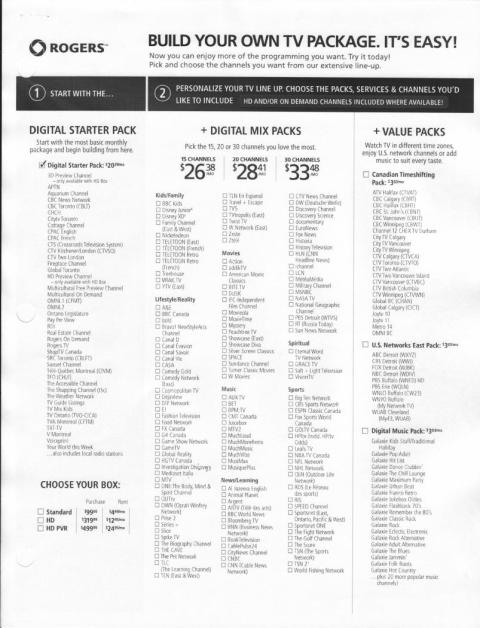
Rogers' scarce photocopied channel listing for their "Pick and Pay" package, obviously removed from an employee's three-ring binder.

“But here is where Rogers gets you by your pocketbook,” Carol warns. “You have to take Rogers’ phone service with the deal, so now the landline is back, although they charge less than Bell.”

Jameson also notes these prices do not include mandatory extras:

  • $4.49 – Digital terminal rental (per TV)
  • $2.99 – Digital service fee
  • $0.70 – Local Programming Improvement Fund Fee
  • + G.S.T. (taxes)

“So much for the savings,” Carol says.

The Globe & Mail speculates the Rogers’ trial is rigged to convince Canadian regulators there is little interest in a-la-carte cable, at least the way Rogers has packaged it (and kept it hidden from public view):

In September, the Canadian Radio-television and Telecommunications Commission said that it had received complaints from consumers about being forced to pay for too many channels they do not watch, and that it expects cable and satellite companies to change that. The CRTC ordered all TV providers to report back by April on what actions they have taken to give subscribers more choice.

But cable and satellite executives have told the CRTC in hearings that there is no consumer demand for cheaper, “skinny basic” packages that offer fewer channels at lower cost than today’s basic TV packages. And some think that Rogers will use the London example to tell the CRTC that there isn’t much demand for the product.

Customers like the Jameson family might end up unwittingly proving Rogers’ point.

“After all of the extras, we rejected the plan and were all ready to switch to satellite and keep the broadband, but at the last minute Rogers offered us new customer pricing on their standard package for a year if we agreed to stay, and we did,” Carol tells us.  “A-la-carte cable is exactly what we need, but this isn’t it.  Maybe that is why Rogers keeps it a secret.”

Western Massachusetts Fiber Network Underway, But Who Will Sell Service to Consumers?

If they build it, will Verizon, Time Warner Cable, or Comcast come?

The Massachusetts Broadband Institute (MBI) has just received a major shipment of cable it will use to construct part of its 1,300-mile fiber optic network, designed to provide better-than-dialup service to over 120 communities in western and north central Massachusetts.  That is, if providers show any interest in selling access to it.

The news that the broadband blockade in the western half of the state may finally come to an end is being trumpeted by local newspapers and TV newscasts from Springfield.  WSHM used the occasion to celebrate with current AOL dial-up user Ryan Newhouser, of Worthington:

A high-speed informational highway will be set up with thousands of miles of high-speed fiber optic cables. Those fibers will now be installed on utility polls across Western Mass.

Now residents sitting at their computers in frustration can finally look forward to high-speed internet access.

Perhaps.

As Stop the Cap! first explored earlier this year, the new fiber network is good news for western Massachusetts.  But it alone will not deliver service to the masses who desperately want faster Internet access.

The incumbent phone and cable companies have certainly not shown much interest.  Verizon treats western Massachusetts much the same way it served its landline customers in the rest of northern New England (Maine, New Hampshire, and Vermont.)  The company’s landline network was allowed to deteriorate along with Verizon’s interest in providing service in the largely rural states.  Eventually, it sold its operations north of Massachusetts to FairPoint Communications.  Comcast and Time Warner Cable are missing in action in many parts of the region as well.  As big phone and cable companies concentrate investments in more urban areas like Boston, many residents in places like Worthington can’t buy broadband service at any price.

MBI optimistically hopes the presence of its new fiber backbone and middle-mile network will change all that.  But outside of AT&T’s apparent interest it to provide service to its cell towers, there has been no publicly-expressed enthusiasm by Verizon or cable operators to begin serious investment in broadband expansion across the region.

The Last Mile Network Challenge

So what is holding western Massachusetts back?  The same thing that keeps broadband out of rural areas everywhere — the “last-mile” problem.  Traditionally, operators target urban and suburban areas for their investments because the construction costs — wiring up your street/home/business — can be recouped more easily when divided between a pool of potential customers.  Every provider has their own “return on investment” formula — how long it will take for a project to pay for itself and begin to return profit.  If your street has 100 homes on it, the chances of recouping costs are much higher than in places where your nearest neighbor needs binoculars to see your house.  Pass the ROI challenge and providers will invest capital to wire your street.  Fail it and you go without (or pay $10,000 or more to subsidize construction costs yourself.)

That is why eastern Massachusetts has plentiful broadband and the comparatively rural western half often does not.

MassBroadband 123 is the state’s solution to the pervasive lack of access across the western half of The Bay State.  It will consist of a fiber backbone and “middle mile” network, solving two parts of a three-part broadband problem.  The project’s commitment to deliver open access to institutions and commercial ISPs across the region is partly thanks to the availability of broadband grant money, particularly from the federal government.

Projects similar to MBI’s MassBroadband 123 typically include the hoped-for-outcome that private companies will step up and invest to ultimately make service available to end users.  Unfortunately, large incumbent providers often remain uncommitted to wiring the last-mile, and communities promised ubiquitous broadband end up with an expensive institutional network that only serves local government, public safety, schools, libraries, and health care facilities.

Thankfully, it does not appear MBI is depending on Verizon, which has shown no interest in spending significant capital on its legacy landline network or cable operators that are unlikely to break ground in new areas.

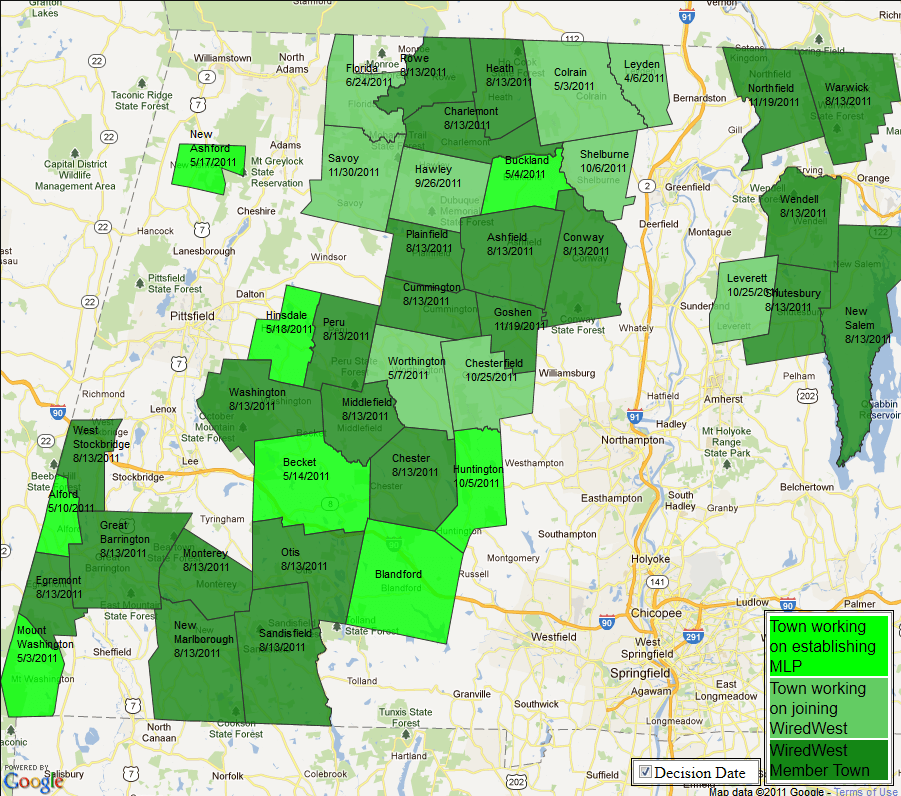
Communities are increasingly learning if they don’t have service today, the only real guarantee they will get it is by providing it themselves.  That is where WiredWest comes in.  It is a community-powered partnership — a co-op for broadband — pooling resources from 22 independent towns (with 18 more expected to join) to build out that challenging last mile, and deliver future-proof fiber to the home service.  No last generation DSL, slow and expensive fixed wireless, or limited capacity coaxial cable networks are involved.

WiredWest Members

Founding member towns span four counties, including Berkshire County towns of Egremont, Great Barrington, Monterey, New Marlborough, Otis, Peru, Sandisfield, Washington and West Stockbridge; Franklin County towns of Ashfield, Charlemont, Conway, Heath, New Salem, Rowe, Shutesbury, Warwick and Wendell; Hampshire County towns of Cummington, Heath, Middlefield and Plainfield; and the Hampden County town of Chester.

Most of the construction costs for the new network will likely come from municipal bonds, because government grants typically exclude last mile network funding.  Commercial providers often lobby against municipal-funded networks as “unfair competition,” a laughable concept in long-ignored western Massachusetts, where Verizon pitches slow speed DSL, if anything at all.

WiredWest compares rural broadband with rural electrification.  Community-owned co-ops provide service where few private companies bothered to show interest:

Think back to the rural electrification of America. Then, as now, it wasn’t profitable enough for private companies to build out electrical service to rural communities. Imagine where those communities would be today if the government hadn’t stepped in to help fund this essential service – which over time has sustained itself and become a profitable enterprise.

Rural fiber-to-the-home is affordable when you use an appropriate financing and business model that isn’t subject to the same short-term measures of profitability as a private company. A municipal model for example, allows capital investment that can be written off over a longer period of time.

This type of business model isn’t limited to community-owned broadband.  Other countries that treat broadband as an essential utility have, in some cases, boosted broadband beyond a simple cost/benefit “ROI” analysis.

Constructing a broadband network for western Massachusetts still presents some formidable challenges, however:

  1. There is a serious imbalance in government grant programs.  A largesse of government funding for institutional broadband has delivered scandalously underused Cadillac-priced networks communities, libraries and schools cannot afford to operate themselves once the grant money ends.  Meanwhile, funding to cushion the cost of wiring individual homes and businesses is extremely scarce.  Isn’t it time to divert some of that money towards the most difficult problem to overcome — wiring the last mile?
  2. Government impediments to community broadband must be eliminated.  Repeal laws that restrict public broadband development.  Early experiments in municipal telecom networks have taught valuable lessons on how to operate networks efficiently and effectively.  But the broadband industry engages in scare tactics that highlight failures of older public projects like community Wi-Fi in an effort to keep superior publicly-owned fiber-to-the-home networks out of their markets.
  3. The public is not always engaged on the broadband issue and accepts media reports that misunderstand institutional broadband as a solution for those stuck using dial-up.  No matter how good a network is, if the “last mile” problem remains unsolved, the closest consumers like Mr. Newhouser will get to fiber service is looking at the wiring on a nearby telephone pole.  In many communities, fiber broadband paid for by public tax dollars is only accessible at the local public library.  Taxpayers must demand more access to networks they ultimately paid for out of their own pockets, and should support existing public broadband initiatives wherever practical.

[flv width=”640″ height=”380″]http://www.phillipdampier.com/video/WSHM Springfield Broadband internet coming to western Mass 12-8-11.mp4[/flv]

WSHM in Springfield says if you don’t have broadband in western Massachusetts now, it should be coming to your area soon.  But will it?  (3 minutes)

Time Warner Cable’s Broadband Pricing Game: Special Wall-Street-At-Home Edition

Phillip Dampier December 12, 2011 Competition, Data Caps, Editorial & Site News 3 Comments

Time Warner Cable’s ruminations about charging usage-based pricing in 2012 has Wall Street all excited about the fatter profits made possible by nickle-and-diming broadband customers for their Internet use.  Forbes magazine tells investors the easy money earned from Internet Overcharging could boost the company’s profits and stock price:

We estimate that Time Warner Cable’s broadband business is single-most important business for the company, constituting about 42% to its value. The company’s management’s words essentially echo our estimates.

The company sees itself primarily as a broadband provider, bundling some extra services such as pay-TV for customer convenience. That said, any change to the pricing is likely to have notable impact on the company’s value, and therefore to its stock. Assuming that a tiered pricing is implemented and brings in more revenue per broadband subscriber, the company’s results could improve.

We believe that our fee per broadband subscriber forecast incorporate increasing penetration of high speed packages, but it could change if the company was to charge higher or implement a tiered pricing for high usage.

These kinds of earning estimates are what makes raising prices for Internet service so popular among the Wall Street crowd.  It fattens their portfolios, even if it increases cable bills which already routinely rise well beyond the national inflation rate.  The only caveat?  Customers could leave for other providers or eventually find the service too expensive to make it worthwhile.  Trefis, a business analysis firm, created an analysis tool (seen above) that allows readers to raise and lower the current estimates for Time Warner’s broadband pricing, add and remove competitors, and check out the impact on the company’s predicted stock price.  The results couldn’t be clearer.  The more you gouge consumers for expensive broadband, the bigger the Money Party, particularly if you live in an area with anemic DSL competition.

America’s Broadband Ranking Declines Again: #19 and Falling

"Hey, we're #19!"

The United States may be a leader in many things, but broadband isn’t one of them. The country has now fallen two more positions — to 19th place, behind South Korea, Sweden, Denmark, the United Kingdom, and even Iceland, since the Berkman Center for Internet and Society released its last rankings in 2009.

In 2004, President George W. Bush complained about the U.S. falling to 10th place, which he declared was “ten spots too low.”

Now eastern Europe and former Soviet Republics in the Baltics threaten to overtake the United States, and countries in southeast Asia already have.  Innovation in the United Kingdom, Australia and New Zealand means deploying fiber to the home service to the vast majority of the population.  Innovation in North America means conjuring up new pricing schemes to raise prices on broadband service and engage in competition-busting mergers and acquisitions.

But a USA Today editorial this week also places much of the blame on corporate influence inside Washington, which has promulgated legislative policies that favor telecommunications companies and throw customers under the bus.

“The simple answer is that other countries have policies that promote competition and innovation,” the editors write. “In contrast, policies here have allowed a few dominant players that control the least interesting parts of the broadband landscape (the cables and the wireless spectrum) to dominate.”

Indeed, a series of telecommunications laws enacted by Congress, combined with short-sighted policies at the Federal Communications Commission, have allowed a handful of super-sized players to own and control broadband service in America, resulting in providers establishing non-competing fiefdoms that avoid head-on competition.

The worst policy of all allowed broadband providers to keep competitors from reaching customers over existing broadband networks.  During the days of dial-up, you could purchase Internet access from the phone company, a large provider like MSN or AOL, or thousands of smaller regional and local service providers.  Simply dial a local access number and you were connected to the provider of your choice.  Now, U.S. law gives broadband network operators the right to restrict these independents from selling service over their networks.  Comcast need not sell anything other than Comcast Internet.  Frontier Communications can make a killing selling its own DSL service, while protecting that revenue from other Internet Service Providers who might sell the service over Frontier’s network for half the price.  Time Warner Cable voluntarily allows Earthlink and a handful of other companies to sell cable broadband service over its infrastructure, but at prices equal to or higher than what Time Warner charges itself.

Broadband providers argue that allowing competitors to sell service on their network would discourage future investment and rob shareholders a return on investments already made.  Today, major cable operators and phone companies are falling all over themselves denying they are in anything but the broadband business.  It has become an enormously lucrative enterprise, more profitable than television or telephone service.

USA Today compares the broadband landscape back home with that in South Korea — perennially the world’s fastest, and considerably less expensive than what North Americans pay for service:

South Korea has made broadband a national priority, mandating deployment and in some cases giving private companies incentives to build out. It has also prevented major players from monopolizing their businesses, encouraging competition and innovation. In South Korea, consumers can get broadband service from a cable or telecom company. But they may also choose among myriad independent providers that are given access to the physical infrastructure. This competition keeps prices down and the quality of service high.

[…] But over time, cable and telecom companies worked the courts and Congress to make sure that this competitive world would never come to be [in the United States]. […] Wireless is a bit better. But the market has remained a near duopoly, with none of the smaller players emerging as a strong competitor to AT&T and Verizon.

The same open network concept has fought its way forward in Canada (where Bell has worked furiously to sabotage the business plans of independent providers) and in the United Kingdom, Australia and New Zealand where all three governments have decided the best solution would be to scrap the ancient landline network and start fresh with an open-to-all-comers fiber to the home service.

Back home in the States it is business as usual with increasing broadband prices and the looming prospect of usage-limiting schemes designed to cut capital costs, monetize broadband usage, and stop cord-cutting.

The opposing point of view comes courtesy of dollar-a-holler, corporate-backed think tank The Heartland Institute, who is stuck quoting notorious industry-funded studies and think tanks like the Discovery Institute and the Technology Policy Institute:

The idea that European and Asian countries are lapping America in the race for broadband speed and penetration is a fallacy created with statistics comparing “persons” instead of “households.” Once you make that correction, the USA is firmly planted among the top of industrialized nations, as economist Scott Wallsten pointed out when he was a staffer at the Federal Communications Commission in 2009.

And as tech researcher Bret Swanson of Entropy Economics points out, if you measure Internet usage by gigabytes used per month — a better measure of the speed and utility of networks — the USA has nearly lapped Western Europe once and Asia twice.

Heartland Institute: "By not disclosing our donors, we keep the focus on the issue."

If you measure how many mouse clicks customers in New York make on a Thursday afternoon, we could be number one as well!  Gigabytes used per month does not measure the speed or price of service on broadband networks, considerations that actually do impact broadband rankings.

Mr. Wallsten is a familiar favorite go-to-guy for The Heartland Institute.  He’s also the choice of Time Warner Cable, who paid him $20,000 for a 2010 essay: “The Future of Digital Communications Research and Policy.”

There is big money to be made writing corporate-funded research reports.  Bret Swanson knows that very well, having been involved with the Discovery Institute, a “research group” that delivers paid, “credentialed” reports to telecommunications company clients who waive them before Congress to support their positions.  Swanson is also a “Visiting Fellow” at Arts+Labs/Digital Society, which counted as its “partners” AT&T and Verizon.

The gentleman from Heartland also quotes from the misnamed “Progressive Policy Institute,” which counts among its funding partners, AT&T.

It would have been probably easier (but ineffectively transparent) to simply quote from AT&T and Comcast directly.

The Heartland Institute, unsurprisingly, believes letting existing broadband providers deliver service exactly the way they want is the best option:

The digital economy — one of the only vibrant economic sectors left — doesn’t need more government “investment” or regulation. It needs only for government to butt out and let the market work the magic that continues to bring us the marvels of the modern age.

That magic will cost you $50 a month and rising.  If some providers have their way, while the rest of the world abandons usage caps, American providers can’t wait to slap them on, reducing the value of your service even further.

The Wall Street Journal’s Revisionist History: AT&T Isn’t the Problem, the Government Is?

Phillip Dampier December 8, 2011 Astroturf, AT&T, Competition, Editorial & Site News, HissyFitWatch, History, Public Policy & Gov't, Rural Broadband, T-Mobile, Wireless Broadband Comments Off on The Wall Street Journal’s Revisionist History: AT&T Isn’t the Problem, the Government Is?

Haven't we been here before?

History is best ignored when a Wall Street Journal columnist frames an argument in favor of strengthening the hegemony of Ma Bell, and darn ‘ole past precedent gets in the way of the writer’s “facts.”

Gordon Crovitz is a media and information industry adviser and executive, including former publisher of The Wall Street Journal, executive vice president of Dow Jones and president of its Consumer Media Group.  But today he’s unofficially, unabashedly AT&T.

In a column published this week, Crovitz hosts a whine and cheese festival on behalf of poor and abused AT&T, whose multi-billion dollar takeover of T-Mobile is in tatters. Crovitz places the blame squarely on the government for ruining everything:

How soon we forget the risks of overregulation: Last week, the Federal Communications Commission flexed the same muscle it once used to quash market forces in the phone industry to quash market forces in the wireless industry.

Today’s AT&T, a spinoff from the original, needs more spectrum to catch up with market leader Verizon, also a Ma Bell descendant, to support iPhones, Androids and other devices that feature video and sophisticated apps. It wants to buy T-Mobile, a division of a German company, which doesn’t have the resources to compete in the United States on its own. But the FCC decided to apply antitrust theory from the industrial era and claims to know better than wireless companies how they should operate their businesses.

AT&T’s proposed acquisition is best understood as a private-sector solution to a government-created problem. The FCC has not been able to get Congress to approve auctions to reallocate spectrum to wireless from less valuable uses. AT&T wants T-Mobile’s bandwidth so it can extend the latest fourth-generation network to 97% of the country from 80% and improve its spotty service in congested areas.

Under laws dating to the 1920s, the FCC gets to decide if a merger is in the “public interest,” a vague standard for top-down decision making. Government is the last institution in this era of fast technological innovation to act as if it has the information and power to dictate how change happens.

Crovitz apparently prefers AT&T and its phone pal Verizon Wireless dictate how “change happens,” because the two companies control the vast majority of wireless telecommunications in the United States.  Both also charge near-identical prices for near-identical levels of service.  AT&T & VZW are completely comfortable with that status quo, especially if disruptive competitor T-Mobile is dealt with in the usual industry manner (merger/buyout).

There is nothing vague about the FCC report that condemns the merger of AT&T and T-Mobile for the anti-competitive monstrosity it represents.  In hundreds of pages Crovitz evidently never read, a careful and credible argument against the deal was laid out for all to examine.  That evidence is far more persuasive than AT&T’s heavily-redacted filings the public was not authorized to see (for ‘competitive reasons’), and a multi-million-dollar-a-holler public relations distortion strategy based on hollow promises.

Playing Catch-Up With Verizon Wireless?  Hardly.

AT&T hardly needs to “catch up” with Verizon Wireless.  Both companies own wireless spectrum they have warehoused for “future use.”  As a backdrop to the merger, FCC Chairman Julius Genachowski has already indicated the agency is hard at work carefully re-allocating spectrum to make more room for wireless services.  The “bandwidth crisis” AT&T talks about is a convenient argument for a merger, until you realize T-Mobile’s mostly-urban wireless network won’t help AT&T achieve its goal of rural wireless expansion.  T-Mobile has never provided service in rural America and never will.

Crovitz attempts to leverage Verizon Wireless’ recent deal with America’s largest cable companies as an argument for the AT&T and T-Mobile merger, suggesting that deal was a game changer.  What goes unsaid is the fact AT&T could have pursued that deal for themselves.  Did they?  No.  Despite AT&T’s public relations spin, the proposed merger with T-Mobile is much more than a spectrum acquisition. As the FCC and the Justice Department have argued, this merger is about ridding AT&T of a competitor willing to offer more services at lower prices.  That forces AT&T to respond in kind to compete, and consumers have benefited greatly from that competition. Verizon Wireless is hardly competition at all considering both companies price services nearly identically.  Beyond that is Sprint, already saddled with the financial albatross Clearwire and questions about its long term viability in a duopolistic wireless market.

Crovitz is wrong on his other “facts” as well:

Deutsche Telekom is hardly short on cash.  The company has plenty of resources and could bolster T-Mobile USA to compete if it saw fit.  It doesn’t, preferring to focus on its more lucrative European markets.  Instead of selling the operation on the open market to other players, which could include foreign providers interested in competing in the high-priced American market, it elected to be courted by AT&T.

Overconfident AT&T

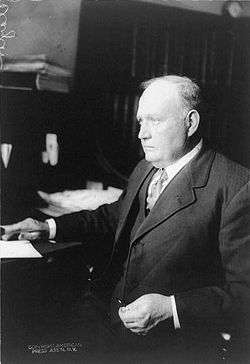
Henry De Lamar Clayton, Jr.: Author of the Clayton Act

The merger illustrates AT&T’s unparalleled level of overconfidence it could deal with regulators and consumer groups who would certainly object to the deal.  The company has since spent millions it could have used to improve its network on campaign-contribution-fueled support building on Capitol Hill, a shameless dollar-a-holler astroturf campaign that pays off non-profit groups to sing the deal’s praises, and an expensive ad campaign to sucker Americans into thinking reduced competition will somehow deliver lower prices and better service.

Even former Republican FCC Chairman Kevin Martin would have likely paused over such an obvious monopoly-building operation.  The Obama Administration’s FCC chairman — Julius Genachowski —  while often too timid for our tastes, at least knows when it is time to join the chorus of opposition.

The FCC doesn’t pretend to tell AT&T how to run its business.  It does, however, serve the public interest by providing checks and balances to unfettered corporate power.  While the Wall Street Journal‘s world view of capitalism would have been favored by the most egregious robber barons, history has taught us that when big corporations get a stranglehold on vital industries, the entire economy can suffer.

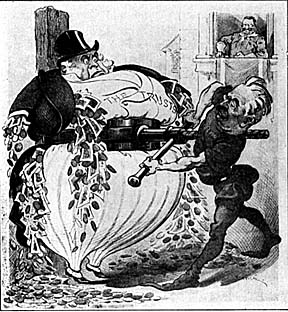
Crovitz would have us ignore the massive corporate abuses of 100 years ago that eventually provoked Congress into trust-busting legislative reform, breaking up the monopolies and oligopolies that presided over the railways, early telecommunications networks, and industrial raw materials like oil and steel.  Restrained competition brought monopoly prices and blockades against would-be competitors.  What was true then is still true now, only the technology has changed.

In 1911, the economy was powered in part by railroads, which transported goods and raw materials.  Telecommunications networks like the telegraph and early telephone helped conduct business and coordinated the movement of goods.  In 2011’s growing digital economy, telecommunications increasingly represents the railroads, telegraph, and telephone all combined-into-one.  Some of America’s richest tech companies depend on broadband and communications to fuel demand for their products.  Allowing AT&T to control the largest part of that pipeline could be disastrous to everyone but that company and their shareholders.

History Repeats Itself

In 1914, the Clayton Act was passed to put a stop to increasing anti-competitive activity and abusive market tactics.  Amazingly, the problems being solved a century ago are back with a vengeance today, all thanks to the endless drumbeat for deregulation, which has fueled mergers, acquisitions, and increased concentration of market power.  That Act cracked down on:

  • Price discrimination: selling products and services at different prices to similarly situated buyers;
  • Tying and exclusive-dealing contracts: sales on condition that the buyer sign exclusive contracts that force an end to dealing with the seller’s competitors;
  • Corporate mergers: acquisitions of competing companies to reduce competition; and
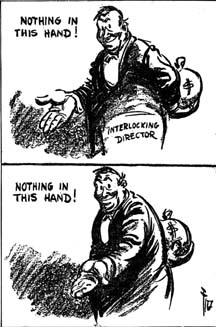
  • Interlocking directorates: Boards of directors of competing companies, packed with common members.

Today’s laissez-faire attitude towards government checks and balances helped provoke the Great Recession, corporate scandals of epic proportions, and a revolving door in Washington where regulators end up working for the companies they used to regulate. Just ask former FCC chairman Michael Powell. Three years ago he worked for us.  Today he works for Big Cable’s largest lobbying group — the National Cable & Telecommunications Association.  FCC Commissioner Meredith Attwell Baker went to work for Comcast shortly after green-lighting their super-merger with NBC-Universal.

It’s All About the Money. Always.

The only thing stopping AT&T from providing wireless nirvana to rural America is its own unwillingness to spend money on behalf of customers to upgrade its network.  The company claims it didn’t see the value of spending nearly $4 billion needed to deliver expansive 4G service, but suddenly had no trouble at all finding nearly ten times that amount to purchase T-Mobile USA.

Did AT&T suddenly win PowerBall?

AT&T saw crushing a competitor Job #1.  Central Idaho’s 4G service could wait.

Crovitz later notes AT&T “was unusually blunt” criticizing the FCC report, a classic case of protesting too much.  The company got caught with its rhetorical pants down, with a series of evolving arguments for a deal that never made the first bit of sense once you began to dig deeper into their case.

In the end, Mr. Crovitz wants you to blame Big Government for AT&T’s pervasive dropped-call problem that its competitors don’t seem to have.

It’s not the company that owns and runs the network, it is that Obama and his nasty henchmen at the FCC who are responsible!  Who knew?

[flv width=”360″ height=”290″]http://www.phillipdampier.com/video/Bloomberg FCC Says ATT Failed to Show Public Benefit of Merger 11-30-11.mp4[/flv]

Bloomberg News reports the FCC found AT&T failed to demonstrate any real public benefit of its merger with T-Mobile USA.  (2 minutes)

Search This Site:

Contributions:

Recent Comments:

Your Account:

Stop the Cap!