

 Subscribe
 Comcast is now giving Xfinity Mobile customers access to Verizon’s 5G network, if a customer owns a suitable 5G-capable device and is willing to pay more in certain cases.
“From day one, Xfinity Mobile has been proud to be the only provider to empower customers to design a mobile plan that fits their needs, as well as have the flexibility to seamlessly switch between unlimited or per gig to save money,” said Rui Costa, Comcast’s senior vice president of innovation and customer value propositions. “We’re excited to now extend that benefit with 5G data plans.”
Comcast has diverged from Charter Communications, which has been offering access to Verizon’s 5G network to Spectrum Mobile customers since March. Xfinity Mobile customers paying “by the gig” or subscribed to unlimited service will both have access to 5G service. In contrast, Spectrum Mobile customers must have an unlimited plan to access 5G.
Existing Xfinity Mobile customers will need to opt in to 5G service through the Xfinity Mobile app, which will also raise your rates from $12/GB to $15/GB. If you don’t want 5G access and prefer paying $12 per gigabyte as you have all along, do not opt in to the new plan:
Xfinity Mobile Pricing (Effective May 18, 2020)
- Discontinued By the Gig 4G-LTE: $12 per gigabyte (includes unlimited voice and texting)

- New By the Gig 5G/4G-LTE: $15 per gigabyte (includes unlimited voice and texting)

- Unlimited 5G/4G-LTE: $45 per month (includes unlimited voice and texting)
Comcast and Charter’s wireless offerings have seen substantial subscriber gains as customers discover they can access Verizon Wireless’ extensive network and pay substantially lower prices as well. Verizon’s own customers will eventually face a $10 surcharge per month for access to 5G.
Is Xfinity’s 5G “By the Gig” plan worth an extra $3 per gigabyte? Only if you live in one of 35 U.S. cities where Verizon offers millimeter wave 5G service in select neighborhoods. Verizon’s current 5G network is extremely limited, with most living and working outside of a Verizon 5G coverage area. That could mean upgrading to Xfinity’s 5G plan will only result in paying more money for the same level of service you already had.
 Spectrum internet customers in parts of Central Florida and South Texas are getting twice the download speed they used to receive thanks to a series of quiet service upgrades still in progress.
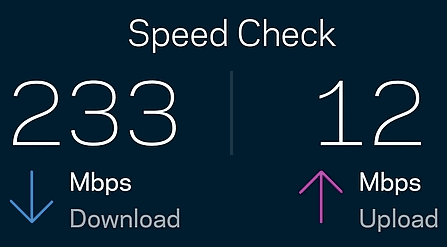 In South Texas, San Benito is one of the communities between Brownsville and McAllen seeing Spectrum’s usual download speed doubled from 100 to 200 Mbps.
 One of America’s internet service providers managed to achieve a customer satisfaction score of 94%, an unprecedented vote of approval from consumers that typically loathe their cable or phone company.
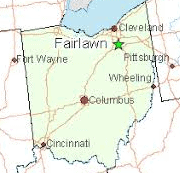 FairlawnGig offers two plans to residents: 300/300 Mbps service for $55 a month or 1,000/1,000 Mbps service for $75. Landline phone service is an extra $25 a month, and the municipal provider has pointed its customers to online cable TV alternatives like Hulu and YouTube TV for television service. Incumbent cable and phone companies usually respond to this kind of competition with cut-rate promotions to keep the customers they have and lure others back. Spectrum has countered with promotions offering 400 Mbps internet for as little as $30/mo for two years. Despite the potential savings, most people in Fairlawn won’t go back to Spectrum regardless of the price. FairlawnGig’s loyalty score is 80, with 85% of those not only sticking with FairlawnGig but also actively recommending it to others.
 Windstream Communications lost between $3.2-5.1 million in lost profits because of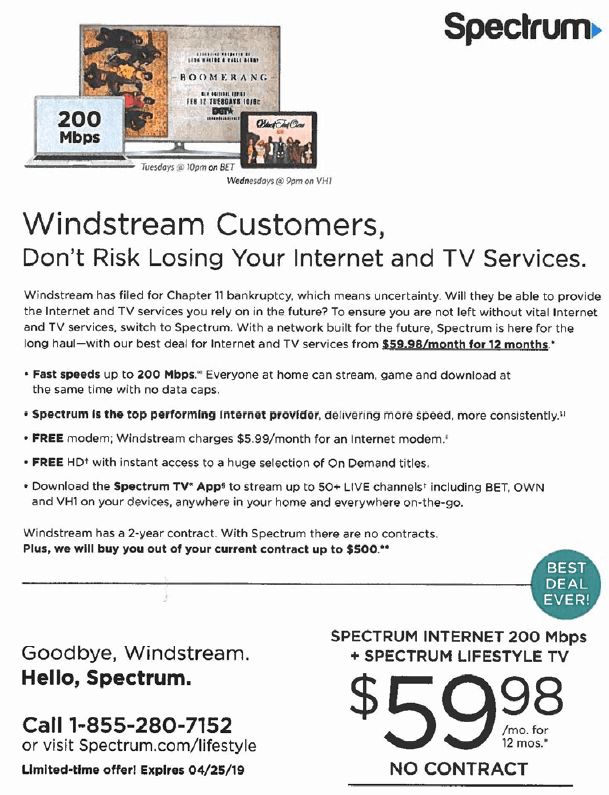
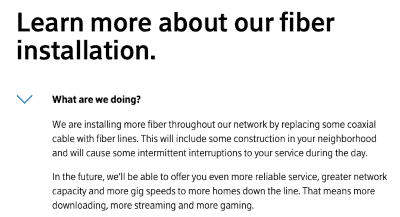 Some Comcast customers are receiving notifications their service may be briefly interrupted as a result of ongoing network enhancements:
 Comcast is currently preparing its network for full duplex DOCSIS 4.0 service by adopting “node plus zero” network architecture, which in plainer terms means removing signal amplifiers from existing lines and replacing a significant percentage of its copper coaxial cable infrastructure with fiber optics. The fiber network upgrades are reportedly bringing more consistent and faster internet speed on a more reliable network as soon as the switch is complete. Most customers won’t see fiber cables replacing the current cable line coming into their homes, however. The upgrade is mostly taking place on utility poles and, in some places, underground as Comcast replaces copper wiring with optical fiber cables.