Home » Broadband Speed » Recent Articles:

Verizon Will Cease Selling Standalone DSL Service May 6th; Voice With DSL Only, Please

Verizon Communications will stop selling DSL broadband-only service to its customers May 6th in what the company is calling an effort to control costs “enabling us to continue providing competitively priced services to existing and new customers.”

Broadband Reports readers first reported receiving written notice of Verizon’s plans to discard “naked DSL” service, although existing customers who don’t move or make any changes to their account will be able to keep the broadband-only service for now.

Verizon provides the details:

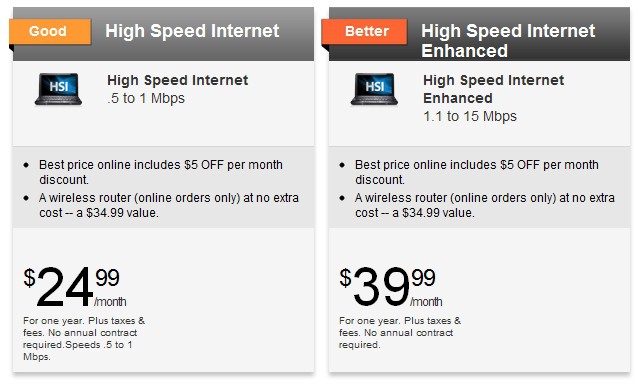
Beginning May 6, 2012, we will no longer offer High Speed Internet without local voice service on the same account.

What does this mean for you?

  • If you currently have High Speed Internet without local voice service on the same account, there is no action required on your part to continue enjoying your internet service. You will not experience any disruption of service.
  • Prior to May 6, 2012, you can still make speed upgrades or downgrades to your existing service.
  • Prior to May 6, 2012, you can receive bundle discounts by adding DIRECTV service or Verizon Wireless service to your current internet service.

What this means if you change or disconnect your High Speed Internet Service as of May 6, 2012 or after:

  • You can make changes to and retain your Verizon High Speed Internet Service on or after the above date, by adding Verizon’s local voice service to the same account.
  • If you are moving your service from one location to another on or after the above date, you may subscribe to internet service at your new location if you also subscribe to Verizon’s local voice service on the same account.
  • If you choose to subscribe to additional Verizon services you could be eligible for a bundled discount when you also subscribe to Verizon’s local voice service on the same account.
There is speculation Verizon is eliminating its DSL-only service in an effort to boost revenue and push subscribers in FiOS-enabled areas to Verizon’s fiber optic network.  A decade earlier, many phone companies fought to avoid selling “broadband-only” DSL service without a voice landline because of revenue losses.  Landline customers continue to drop voice service from traditional phone companies at an alarming rate — choosing competing cable or Voice over IP service or a cell phone.  By requiring voice service, Verizon can boost average revenue from each customer, whether those customers want the service or not.

Customers who currently subscribe to broadband-only DSL service from Verizon are advised that virtually any account change of significance can disqualify them from continuing with the service.  That includes address changes and speed adjustments.  Stop the Cap! recommends customers make any changes prior to May 6th.

Large sections of Verizon’s service area are not FiOS-eligible,  so current DSL customers with no other broadband choices may find themselves stuck with adding voice service. Verizon sells Basic Home Telephone Service with no local calling allowance at prices ranging from $7 in some communities to $16 or higher in others, excluding the FCC-mandated line fee, which runs an extra $6.50 a month.

One thing Verizon’s higher bills will accomplish is making Verizon Wireless’ new 4G LTE Home Fusion wireless broadband service look slightly more price competitive.  If a Verizon landline customer has to pay for both voice and data service, paying $60 a month for 10GB of wireless broadband may not seem that expensive in comparison.

Exclusive: Frontier Communications Has Plans for AT&T U-verse for Landline Customers

Stop the Cap! has learned Frontier Communications is laying the groundwork to upgrade selected areas of its network to deliver fiber-to-the-neighborhood service to some of its customers, perhaps as early as the last quarter of 2012.  Documents obtained by Stop the Cap! indicate the company is negotiating with AT&T to license U-verse technology to deliver the service.

The documents suggest Frontier’s 2011 negotiations with AT&T to resell mobile phone service to Frontier customers have now expanded to include the development of improved broadband at a cost less likely to antagonize Wall Street and the company’s investors.

Sources familiar with Frontier’s operations tell Stop the Cap! although the company will continue to support Verizon-acquired FiOS fiber-to-the-home networks in Indiana and the Pacific Northwest, Frontier plans to rely on less-expensive alternatives for the rest of its service areas and has no plans to further expand the FiOS branded fiber-to-the-home service.

For the most rural customers, Frontier appears ready to partner with HughesNet to resell a satellite broadband product to customers considered unsuitable for basic DSL service.  Frontier will continue to invest and upgrade its traditional 1-3Mbps ADSL service in rural states like West Virginia, Idaho, Nevada, and South Carolina.  The company is also planning to upgrade selected cities to VDSL — a more advanced form of DSL needed to support a U-verse offering.  Perhaps one major target for such an upgrade is Frontier’s largest service area — Rochester, N.Y., where Time Warner Cable has systematically picked off Frontier’s landline customers for years with offers of faster broadband speeds and better package pricing.

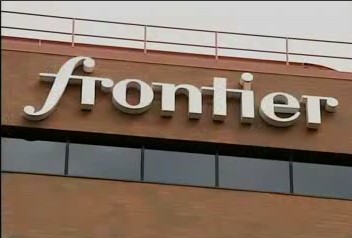
Frontier's headquarters in Rochester, N.Y.

Frontier’s insistence customers don’t need faster broadband speeds, a statement made repeatedly by Frontier Rochester general manager Ann Burr, has cost the company market share, especially for high speed Internet service.  Although Frontier claims to offer speeds up to 10Mbps in Rochester, the company only manages to deliver 3Mbps in some of the city’s nearest suburbs.

An upgrade to U-verse, while not as technologically advanced as fiber to the home service, would help Frontier defend its position in more urban markets, especially as cable companies upgrade their own infrastructure to market faster broadband speeds.

AT&T U-verse sells broadband at speeds of 3, 6, 12, 18, and 24Mbps.  Time Warner Cable, Frontier’s largest competitor in upstate New York, sells speeds of 3, 10, 20, 30, and 50Mbps.

Frontier Communications has been preoccupied integrating its newest customers, acquired from Verizon Communications in 2009, with their existing IT and operations systems.  The company recently touted it completed transitioning former Verizon operations, financing, and human resources with its own information technology network nine months ahead of schedule.

Frontier has been reorganizing some of its internal departments in preparation to launch several aggressive initiatives in 2012, especially in its efforts to roll-0ut more competitive broadband — considered a landline lifesaver —  in areas where the company has lost a lot of business to its cable competitors.  The company also intends to spend tens of millions upgrading its regional and national broadband infrastructure and continue extending DSL service to presently unserved rural areas.

Another planned improvement is an overhaul of Frontier’s website, which has brought complaints from customers for delivering inaccurate information, making online bill payment cumbersome, and being difficult to navigate.

Documents obtained by Stop the Cap! also reveal the company has made progress on its plans to pitch AT&T cell phone service to Frontier customers.

Frontier signed a resale agreement with AT&T last fall and is on track to begin limited trial offers of AT&T cell phones, smartphones, and tablets — with full access to AT&T’s network of 29,000 Wi-Fi hotspots during 2012 with a more widespread rollout in 2013.  Frontier plans to offer customers the option of a single bill for Frontier and AT&T services.

Frontier’s Karen Miller told Stop the Cap! the company had no comment about today’s story.

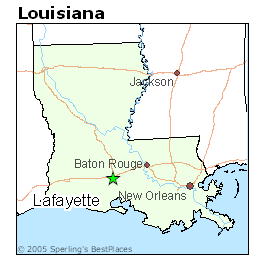
Publicly Owned LUS Fiber Launching Gigabit Broadband for Lafayette, Louisiana

Your Internet Service Provider keeps telling you there is no need for faster broadband speeds, but no matter how many times they say it, you still don’t believe them.

Neither do the folks at LUS Fiber — Lafayette, Louisiana’s publicly-owned fiber to the home broadband network.

In a state dominated by AT&T and cable companies like Cox, Louisiana has never experienced super-fast broadband.  But now they will.  LUS Fiber today announced 1Gbps broadband is now available in the Hub City.

Businesses will now have access to affordable broadband at speeds 20,000 times faster than dial-up.  Residential customers used to getting 1-12Mbps from phone company DSL or up to 50Mbps from Cox can put the slow lane behind them forever.  LUS Fiber can deliver upload and download speeds as fast as 1,000Mbps.

“Gigabit service from LUS Fiber is one of the most robust Internet offerings on the market today,” says Terry Huval, Director of Lafayette Utilities System and LUS Fiber. “We built this community network with a promise to the people of Lafayette that we will work hard to provide them with new opportunities through this unique, state-of-the-art fiber technology, and that’s just what we’ve done.”

That puts Lafayette on the map with Chattanooga, Tenn., as the two fastest operating fiber broadband networks in the country selling to both residential and business customers.  Both are publicly-owned networks private companies like AT&T have lobbied hard to banish.

In fact, Louisiana’s record on broadband outside of Lafayette is decidedly poor.

An $80 million federal grant to fund much-needed improvements to the state’s Internet infrastructure was returned in what one public official called Gov. Bobby Jindal’s special favor to Big Telecom companies like AT&T.

Public Service Commissioner Foster Campbell publicly berated the Republican governor for intentionally interfering with the project until time ran out and the government withdrew its funding.

The cancellation of the project has proved embarrassing because it was the first time a state lost federal broadband grant money.

The state’s Division of Administration eventually scrapped plans for the public broadband network and replaced it with a proposal to use grant dollars to purchase long term institutional broadband contracts from private providers.  AT&T is the dominant local phone company in Louisiana — the same company that has steadfastly refused to provide DSL service across rural Louisiana. The new proposal would have not delivered any broadband access to individual Louisiana homes, only to institutions like schools, libraries, and local government agencies.

Time Warner Cable Lowers Promotional Price on 50/5Mbps “Ultimate Tier” to $79.95

Phillip Dampier April 4, 2012 Broadband Speed, Consumer News 21 Comments

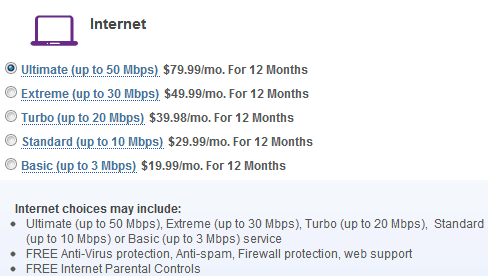
Time Warner Cable’s spring promotion for broadband service has gotten more aggressive on pricing, particularly for the company’s fastest tiers.

In the northeast, we noted new, year-long deals that bring the price of the cable company’s fastest tier — now dubbed “Ultimate 50/5Mbps” to $79.99, down $20 from the regular price.

Time Warner’s “Extreme” 30/5Mbps service is now promotionally priced at $49.99.

The rest of the company’s speed tiers maintain the usual promotional pricing we’ve seen for several years.

All prices are supposed to be for new customers only, but we found them easy to obtain from the cable company’s customer retention department when customers demand the lower price.

Time Warner Cable is likely to charge their new $2.50 monthly cable modem rental fee if you open a new account, beginning in the seventh month of service.

Time Warner Cable has also been advising customers its CA Anti-Virus protection agreement has expired and the company is moving customers to McAfee’s “Family Protection” Suite instead.  The software comes free with your Time Warner Cable broadband subscription.

Even the 1%’ers Have to Deal With 1Mbps DSL: FairPoint & Comcast Say No to Wealthy Enclave

Phillip Dampier April 4, 2012 Broadband Speed, Comcast/Xfinity, Competition, Consumer News, Data Caps, FairPoint, Public Policy & Gov't, Rural Broadband Comments Off on Even the 1%’ers Have to Deal With 1Mbps DSL: FairPoint & Comcast Say No to Wealthy Enclave

No broadband for you...

Sometimes even money doesn’t talk… or buy you faster broadband service.

That is a lesson some of New Hampshire’s wealthiest residents — company presidents, top-dollar lawyers, and the trust-fund endowed — in Rindge and Grafton County are learning only too well.

It seems neither Comcast or FairPoint Communications has shown much interest in extending today’s definition of “broadband” to the multi-million dollar homes on Hubbard Road.

“Every year, I start working up the telephone chain, calling people at Comcast. I’m looking for the vice president, or whatever, in charge of infrastructure so I can call him, bribe him, plead with him to connect me,” said Leigh Eichel, who moved to the ritzy cul-de-sac in 2005. “I’ll pay anything!”

Eichel and his friends told their story to David Brooks of the Nashua Telegraph, who used the plight of the 1%’ers to ponder whether broadband should be a universal right.

A century ago, the government decided that mail service to all American homes was necessary and launched Rural Free Delivery. Then it decided electricity was necessary and created regulated utilities that guaranteed connection. It did the same with telephones, creating the universal access fund that collects money from all phone bills to subsidize land lines to the remotest home.

But nothing similar has happened with Internet service, which is mostly unregulated by government. The market has been largely left to its own.

The result is scattered empty spots like Hubbard Road, which should be broadband heaven.

... or you.

Comcast continues, for the seventh year running, to show zero interest in wiring the wealthy enclave.  That left residents trying to make do with satellite broadband, which they cried was too slow and usage-capped.

Eichel finally managed to cajole FairPoint Communications, the bankrupt phone company that bought out Verizon landlines in northern New England, to extend DSL to the neighborhood, but they did it on-the-cheap, leaving residents with sub-par service barely capable of breaking 1Mbps, when they’re lucky.

Welcome to broadband equality of a different kind, whether you are fighting AT&T from a family farm in Wisconsin for better-than-1Mbps DSL or a super-wealthy executive in New Hampshire suffering with FairPoint’s alleged broadband and utterly rejected by Comcast.

Particularly appalling for the well-traveled Hubbard Road residents: the realization that Singapore’s equivalent of a seedy Motel 6 has basic broadband service that beats the pants off New England’s dominant phone company.

Even Money Won't Talk

“I was staying in a budget hotel; there weren’t even windows in the room. Hey, I was spending my own money,” Eichel’s neighbor Rick Slocum told the newspaper. “[They had] 12Mbps broadband — the connection [was] 10 times as fast as my home.”

Brooks concludes New England wants the same thing most of the rest of the country wants — universal fiber-to-the-home access, which delivers 100-1000Mbps, depending on the provider.

They, like most everyone else, will have to wait.  Like AT&T U-verse and Verizon FiOS, FairPoint’s very-limited fiber offering FAST has reached a limit of its own — the amount the phone company is willing to spend rebuilding their network.  Future expansion plans are now on hold.

Slocum ponders the speed needs America will have in the future, and wonders if even fiber optics will one day need to be replaced for something even faster.

Brooks responds with a prediction.  As long as Comcast and FairPoint are in charge, whatever it is, Hubbard Road probably won’t have it.

Search This Site:

Contributions:

Recent Comments:

Your Account:

Stop the Cap!