Home » Broadband Speed » Recent Articles:

Time Warner Cable Reintroduces Usage Caps in Austin; Tell Them ‘No Thanks!’

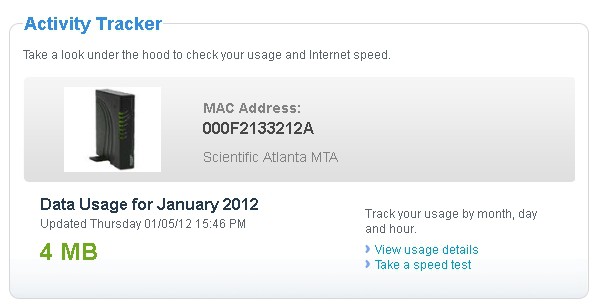
Time Warner Cable has a usage meter up for some customers.

Time Warner Cable has reintroduced usage-limited broadband plans in Austin, Tex., three years after shelving an earlier market test that drew protests from local residents and civic leaders.

Time Warner Cable is offering three tiers of what it calls “Internet Essentials,” each offering different speeds of service, all with a 5GB usage allowance for a $5 monthly discount.

“It’s clear that one-size-fits-all pricing is not working for many consumers, particularly in a challenging economy,” regional vice president of operations in Texas Gordon Harp said. “We believe the choice and flexibility of Essentials will enhance value for lighter users, help us retain existing customers in a competitive marketplace and attract new customers to our superior Internet experience.”

But Stop the Cap! disagrees, noting the three variations of Internet Essentials all offer a tiny discount and come with a ridiculously low usage allowance.

With usage overlimit fees of $1/GB, currently limited to a maximum of $25, customers are playing Russian Roulette with their wallets. Just exceeding the allowance by 5GB a month eliminates any prospects of savings, and going beyond that will actually cost customers more than what they would have paid for unlimited Internet.

The company has added a usage tracker for Texas customers qualified to get the plan. It can be found under the My Services section of Time Warner Cable’s website.

Customers in Texas can choose from Grande Communications, AT&T or Verizon if they want to say goodbye to Time Warner’s endless interest in Internet Overcharging.  Image courtesy: Jacobson

Stop the Cap! recommends consumers strongly reject these plans. If customers are looking for a better deal on broadband, it is wiser to call Time Warner and threaten to take your broadband business to the competition. The savings that will result on a retention plan are sure to be better than the Internet Essentials discount, and no one will have to think twice about how they use their broadband account. Customers on an extremely tight budget can also downgrade to a slower speed plan that offers unlimited access, essential in any home with multiple broadband users.

Time Warner Cable does not help their position by significantly distorting the truth about their last experiment trying to limit customer broadband usage. In 2009, the company proposed changing the price for unlimited broadband to an enormous $150 a month. Customers protested in front of the company’s offices in several cities. Despite that, and the intense negative media coverage the company endured, Time Warner still believes its customers are itching to have their broadband usage limited:

Previous Experience with Usage-based Pricing

Time Warner Cable began testing usage-based pricing in 2009. Although many customers were interested in the plan, many others were not and we decided to not proceed with implementation of the plan. Over the past few years, we consulted with our customers and other interested parties to ensure that community needs are being met and in late 2011 we began testing meters which will calculate Internet usage.

We’d be interested to know what customers in the Austin area were consulted about the desire for usage-limited plans. Nobody consulted us either. We can imagine the “other interested parties” are actually Wall Street analysts and fellow industry insiders. We’re confident the overwhelming number of Time Warner Cable customers have no interest in seeing their unlimited use plans changed and company customer service representatives have told us there has been very little interest in the plans to date. For now, the company claims it won’t force people to take usage limited plans, but as we’ve seen in the wireless industry, yesterday’s promises are all too quickly forgotten.

With a usage meter now established, all it takes is an announcement Time Warner is doing away with unlimited broadband (or raising the price of it to the levels the company proposed in 2009), and customers are ripe for a broadband ripoff.

Time Warner Cable says it is “listening” to customers on its TWC Conversations website. We suggest you visit, click the tab marked Essentials Internet Plans, and let Time Warner Cable know you have no interest in these usage-limited plans and are prepared to go to war to keep affordable, unlimited Internet. With your voice, perhaps Time Warner Cable will finally realize that usage caps and consumption billing just don’t work for you or your family.

EPB Faces Blizzard of Bull from Comcast, Tennessee “Watchdog” Group

Comcast is running “welcome back” ads in Chattanooga that still claim they run America’s fastest ISP, when they don’t.

EPB, Chattanooga’s publicly-owned utility that operates the nation’s fastest gigabit broadband network, has already won the speed war, delivering consistently faster broadband service than any of its Tennessee competitors. So when facts are not on their side, competitors like Comcast and a conservative “watchdog” group simply make them up as they go along.

Comcast is running tear-jerker ads in Chattanooga featuring professional actors pretending to be ex-customers looking to own up to their “mistake” of turning their back on Comcast’s 250GB usage cap (now temporarily paroled), high prices, and questionable service.

“It turns out that the speeds I was looking for, Xfinity Internet had all along,” says the actor, before hugging an “Xfinity service technician” in the pouring rain. “But you knew that, didn’t you?”

The ad closes repeating the demonstrably false claim Comcast operates “the nation’s fastest Internet Service Provider.”

“I see those commercials on television and I’m thinking, I wonder how much did they pay you to say that,” says an actual EPB customer in a response ad from the public utility.

It turns out quite a lot. The high-priced campaign is just the latest work from professional advertising agency Goodby Silverstein & Partners of San Francisco, which is quite a distance from Tennessee. Goodby has produced Comcast ads for years. The ad campaign also targets the cable company’s other rival that consistently beats its broadband speeds — Verizon FiOS.

EPB provides municipal power, broadband, television, and telephone service for residents in Chattanooga, Tennessee

Comcast tried to ram their “welcome back” message home further in a newspaper interview with the Times Free Press, claiming “a lot of customers are coming back to Xfinity” because Comcast has a larger OnDemand library, “integrated applications and greater array of choices.”

Comcast does not provide any statistics or evidence to back up its claims, but EPB president and CEO Harold DePriest has already seen enough deception from the cable company to call the latest claims “totally false.”

In fact, DePriest notes, customers come and go from EPB just as they do with Comcast. The real story, in his view, is how many more customers arrive at EPB’s door than leave, and DePriest says they are keeping more customers than they lose.

EPB fully launched in Chattanooga in 2010, and despite Comcast and AT&T’s best customer retention efforts, EPB has signed up 37,000 customers so far, with about 20 new ones arriving every day. (Comcast still has more than 100,000 customers in the area.)

Many come for the EPB’s far superior broadband speeds, made possible on the utility’s fiber to the home network. EPB also does not use Internet Overcharging schemes like usage caps, which Charter, AT&T, and Comcast have all adopted to varying degrees. Although the utility avoids cut-rate promotional offers that its competitors hand out to new customers (EPB needs to responsibly pay off its fiber network’s construction costs), its pricing is lower than what the cable and phone companies offer at their usual prices.

Comcast claims customers really don’t need super high speed Internet service, underlined by the fact they don’t offer it. But some businesses (including home-based entrepreneurs) do care about the fact they can grow their broadband speeds as needed with EPB’s fiber network. Large business clients receiving quotes from EPB are often shocked by how much lower the utility charges for service that AT&T and Comcast price much higher. It costs EPB next to nothing to offer higher speeds on its fiber network, designed to accommodate the speed needs of customers today and tomorrow.

The competition is less able. AT&T cannot compete on its U-verse platform, which tops out shy of 30Mbps. Comcast has to move most of its analog TV channels to digital, inconveniencing customers with extra-cost set top boxes to boost speeds further.

The fact EPB built Chattanooga’s best network, designed for the present and future, seems to bother some conservative “watchdog” groups. The Beacon Center of Tennesee, a group partially funded by conservative activists like Richard Mellon Scaife through a network of umbrella organizations, considers the entire fiber project a giant waste of money. They agree with Comcast, suggesting nobody needs fast broadband speeds:

EPB also offers something called ultra high-speed Internet. Consumers have to pay more than seven times what they would pay for the traditional service — $350 a month. Right now, only residents of a select few cities worldwide (such as Hong Kong) even use this technology, and that is because most consumers will likely not demand it for another 10 years.

Actually, residents in Hong Kong, Japan, and Korea do expect the faster broadband speeds they receive from their broadband providers. Americans have settled for what they can get (and afford). DePriest openly admits he does not expect a lot of his customers to pay $350 a month for any kind of broadband, but the gigabit-capable network proves a point — the faster speeds are available today on EPB at a fraction of price other providers would charge, if they could supply the service at all. Most EPB customers choose lower speed packages that still deliver better performance at a lower price than either Comcast or AT&T offer.

The Beacon Center doesn’t have a lot of facts to help them make their case. But that does not stop them:

  • They claim EPB’s network is paid for at taxpayer expense. It is not.
  • They quote an “academic study” that claims 75 percent of “government-run” broadband networks lose money, without disclosing the fact the study was bought and paid for by the same industry that wants to keep communities from running broadband networks. Its author, Ron Rizzuto, was inducted into the Cable TV Pioneers in 2004 for service to the cable industry. The study threw in failed Wi-Fi networks built years ago with modern fiber broadband networks to help sour readers on the concept of community broadband.
  • Beacon bizarrely claims the fiber network cannot operate without a $300 million Smart Grid. (Did someone inform Verizon of this before they wasted all that money on FiOS? Who knew fiber broadband providers were also in the electricity business?)

The “watchdog” group even claims big, bad EPB is going to drive AT&T, Comcast, and Charter Cable out of business in Chattanooga (apparently they missed those Comcast/Xfinity ads with customers returning to Kabletown in droves):

Fewer and fewer private companies wish to compete against EPB, which will soon have a monopoly in the Chattanooga market, according to private Internet Service Provider David Snyder. “They have built a solution looking for a problem. It makes for great marketing, but there is no demand for this service. By the time service is needed, the private sector will have established this for pennies on the dollar.”

Ironically, Snyder’s claim there is no demand for EPB’s service fall flat when one considers his company, VolState, has been trying to do business with EPB for two years. He needs EPB because he is having trouble affording the “pennies on the dollar” his suppliers are (not) charging.

Snyder tells “Nooganomics” his company wants an interconnection agreement with EPB, because the private companies he is forced to buy service from — including presumably AT&T, want to charge him a wholesale rate twice as much as EPB currently bills consumers. Snyder calls EPB’s competition “disruptive.”

Nooganomics calls EPB’s low priced service a “charity” in comparison to what AT&T and Comcast charge local residents, and the free market can do no wrong-website seems upset consumers are enjoying the benefits of lower priced service, now that the local phone company and cable operator can’t get away with charging their usual high prices any longer.

Deborah Dwyer, an EPB spokeswoman, told the website the company got into the business with state and city approval, followed the rules for obtaining capital and pays the taxes or payments-in-lieu of taxes as the same rate as corporate players. “We believe that public utilities like EPB exist to help improve the quality of life in our community, and the fiber optic network was built to do just that. One of government’s key responsibilities is to provide communities with infrastructure, and fiber to the home is a key infrastructure much like roads, sewer systems and the electric system.”

Snyder can’t dispute EPB delivers great service. He also walks away from the competition-is-good-for-the-free-market rhetoric that should allow the best company with the lowest rates to win, instead declaring customers should only do business with his company to support free market economics (?):

“If you are a free market capitalist and you believe in free markets, you need to do business with VolState,” Mr. Snyder says. “And if you’re highly principled, every time you buy from a government competitor, what you’re voting for with your dollars is, you’re saying, ‘It’s OK for the government come in to private enterprise and start to take over a vast part of what we used to operate in as a free market.’”

Perhaps Snyder and his friends at the Beacon Center have a future in the vinegar business. They certainly have experience with sour grapes.

[flv width=”640″ height=”500″]http://www.phillipdampier.com/video/Comcast Ad Welcome Back.flv[/flv]

Comcast’s emotionally charged ad, using paid actors, was produced by advertising firm Goodby Silverstein & Partners. The commercial running in Chattanooga is a slight variation on this one, which targets Verizon FiOS. (1 minute)

[flv width=”640″ height=”500″]http://www.phillipdampier.com/video/EPB Ad.flv[/flv]

EPB uses actual customers, not paid actors, in its own advertising that calls out Comcast’s false advertising.  (1 minute)

Scottish Community Gives Up On DSL, Switches to Smoke Signals, Pony Express for Better Service

Phillip Dampier June 26, 2012 Broadband Speed, Consumer News, Public Policy & Gov't, Rural Broadband, Video Comments Off on Scottish Community Gives Up On DSL, Switches to Smoke Signals, Pony Express for Better Service

Smoke signals achieve a faster transmission rate than DSL can manage in the Scottish village of Kettleholm.

The village of Kettleholm, near Lockerbie in Scotland has effectively given up on DSL service from British Telecom and has upgraded the community’s telecommunications service to technologies including smoke signals, messages inserted into bottles and thrown into nearby streams, carrier pigeons, and for urgent communications — the village’s pony express.

All of these communications methods have proven much more effective than the area’s copper wire-based DSL service, which villagers report is often less than useless. In fact, it can take at least 10 minutes to load Google’s home page in Kettleholm on a bad day, and Apple software updates require additional patience — more than 4,525 hours worth (that is more than 188 days) for the latest version of iMovie to arrive.

BT engineers sent to the area to investigate found nothing wrong with the service, which they initially said was operating within normal expectations for DSL “broadband.” But at least 150 local residents strongly disagree, and several made their point producing a video demonstrating how two yogurt cups attached by string provide more reliable communications than BT was managing in their part of Scotland.

The problem, according to local residents, is the decrepit state of the copper-wire based telephone exchange, installed just after World War 2. Broadband advocates say the solution is rubbishing the ancient copper wiring and replacing it with optical fiber that is spreading across the rest of Great Britain. But neither BT or Virgin Media consider Kettleholm worth the investment, placing the village squarely in the undistinguished category of last priority — the one-third of the United Kingdom deemed economically unsuitable for fiber broadband.

UK residents are paying for broadband improvements as part of their TV License Fee, and the government has amassed at least £800 million for upgrades. It irritates some residents that their portion of the license fee is paying for someone else’s broadband upgrades, and salt is rubbed in those wounds when viewers see BT — the largest recipient of government money — spending it on advertisements mailed to Kettleholm residents for services they can never get.

Even worse, the BBC recently learned the phone company isn’t exactly spending every resource on better broadband in the UK. BT recently found £738 million laying around to pay for the rights to Premier League football games for the next three years.

Where there is smoke (signals) there is fire, especially after the BBC picked up the story. BT suddenly had a change of heart about the state of their network in Dumfries and Galloway:

“Kettleholm telephone exchange is a modern digital exchange, System X and offers broadband speeds of up to 8mb/s. We were not initially aware of a problem with broadband in Kettleholm as only a small number of the 120 end users reported problems with their service. The service appears to have gradually degraded over time without triggering any of our alarms. Engineers recently reset equipment in the exchange and tests show that broadband speeds have risen. We will continue to monitor the situation and would like to apologise to everyone for the frustration and inconvenience they have experienced.”

Kettleholm residents appreciate the new attention BT is paying to their network, but the village has been reminding everyone they can find that BT is their sole provider and when they stop paying attention to their DSL facilities, the entire community suffers.

[flv width=”640″ height=”380″]http://www.phillipdampier.com/video/Kettleholm Poor Broadband 6-2012.flv[/flv]

The village of Kettleholm shows off their new telecommunications systems: smoke signals, carrier pigeons, messages inserted into bottles, semaphores, the pony express, and yogurt cups attached by string.  All perform better than BT’s DSL service.  (2 minutes)

Bright House Says It Isn’t Concerned About Verizon FiOS Speed Upgrades

Phillip Dampier June 21, 2012 Broadband Speed, Competition, Verizon Comments Off on Bright House Says It Isn’t Concerned About Verizon FiOS Speed Upgrades

Customers don’t care who wins, because they don’t need faster broadband, claims Bright House Networks.

Bright House Networks thinks customers do not need or want faster broadband speeds and have no plans to match newly-announced speed increases offered by its competitor Verizon FiOS.

The cable operator, which serves central Florida, is downplaying the importance of Verizon’s upgraded service which will bring 300Mbps broadband to cities like Orlando and Tampa.

“Research indicates that the vast majority of customers do not have interest in these types of speeds for their homes, not to mention the potential expense,” Bright House spokesman Joe Durkin told the Tampa Bay Times. “Our network can deliver these speeds if we felt there was a residential market for it.”

Bright House speeds currently max out at 40Mbps. The cable operator says customers seeking faster service won’t face the sticker shock Verizon delivers for their fastest speed package, which comes in at $200 a month. Bright House sells its fastest package at “an additional $15 or $30 a month,” Durkin said.

Durkin believes most consumers can survive just fine with a slower speed package, even with multiple wireless devices sharing the connection.

“Whether you are downloading music or streaming video to your laptop or iPad, you can do it all with Road Runner Lightning,” he said.

Bright House retains the Road Runner brand for its broadband service that Time Warner Cable retired earlier this year. Bright House has partnered with Time Warner to handle programming and certain other contract negotiations.

Competition Breather: Verizon FiOS Rate Hikes Ease Pressure on Cablevision, TWC

Phillip Dampier June 20, 2012 Broadband Speed, Cablevision (see Altice USA), Comcast/Xfinity, Competition, Consumer News, Verizon Comments Off on Competition Breather: Verizon FiOS Rate Hikes Ease Pressure on Cablevision, TWC

Verizon customers can expect to pay more for the company’s fiber to the home service, FiOS, even as promised higher speeds arrive.

Most customers off contract can expect to pay $10-15 more a month under the new pricing regime, or cut back on selected television channels to keep their price the same. Verizon customers currently on a promotional offer will not see any price changes until their promotion expires.

Wall Street analysts call Verizon’s rate hikes a return to “pricing rationality.” The phone company has engaged in years of aggressive pricing, promotions, and rebate offers, especially in the northeast. At one point, Verizon was offering New York-area customers up to $500 in rebates when signing up for a triple play Verizon FiOS package. As Verizon pulls back from aggressive promotions, some analysts predict cable competitors Time Warner Cable and Cablevision will be able to resume more typical rate increases common before Verizon FiOS launched. Cablevision previously announced it would not increase rates during 2012, mostly in response to Verizon’s aggressive pricing.

Verizon has significantly boosted speeds on most of its broadband offerings, with the exception of its standard entry-level 15/5Mbps package, which remains unchanged. Verizon is hoping customers will find that entry level package less and less attractive and be amenable to upgrading to faster speed service at a higher price.

“We’re expecting that 80 percent of customers will want more than 15 megabits per second,” Arturo Picicci, Verizon’s director of product management told Reuters.

Under Verizon’s new pricing, triple play customers with unlimited calling, 15/5Mbps broadband, and 290 television channels pay $109.99. The next step up, for $15 more a month, would upgrade broadband to 50/25Mbps service.

Verizon is also shaming New York area cable operators with speed increases that Time Warner and Cablevision currently cannot match.

The company’s 150/65Mbps service is now priced at $99.99 a month, down from $209.99. Customers in some areas can also sign up for 300/65Mbps service for as low as $204.99 with a two-year contract.

In contrast, Comcast charges $200 a month for 105Mbps, Cablevision prices its 101Mbps service at $104.95 a month.

Search This Site:

Contributions:

Recent Comments:

Your Account:

Stop the Cap!