Home » Broadband Speed » Recent Articles:

Latest FCC Report on Broadband Speeds: Good for Verizon, Cablevision; Bad for Frontier

The Federal Communications Commission’s July report on America’s broadband speeds shows virtually every major national provider, with the exception of Frontier Communications, made significant improvements in delivering the broadband service and speeds they advertise to customers.

Utilizing thousands of volunteer testers agreeing to host a router that performs automated speed tests and other sampling measurements (full disclosure: your editor is a volunteer participant), the FCC speed measurement program is one of the most comprehensive independent broadband assessments in the country.
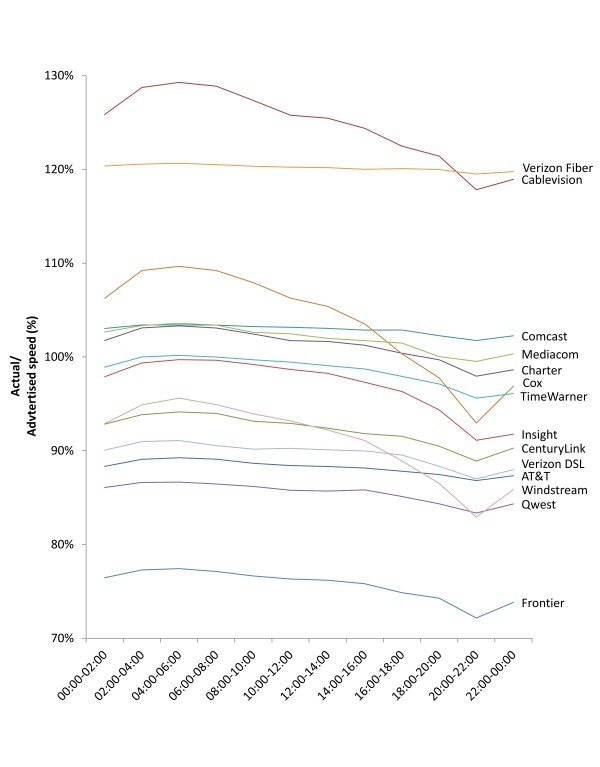
Hourly Sustained Download Speeds as a Percentage of Advertised, by Provider—April 2012 Test Data

The FCC found Cablevision’s improvements last year paid off handsomely for the company, which now effectively ties with Verizon Communication’s FiOS fiber-to-the-home service for delivering promised speeds during peak usage times. The cable operator was embarrassed in 2011 when the FCC found Cablevision broadband customers’ speeds plummeted during Internet use prime time. Those problems have since been corrected with infrastructure upgrades — particularly important for a cable operator that features near-ubiquitous competition from Verizon’s fiber network.

“This report demonstrates our commitment to delivering more than 100 percent of the speeds we advertise to our broadband customers – over the entire day and during peak hours – in addition to free access to the nation’s largest Wi-Fi network and other valuable product features and enhancements,” said Amalia O’Sullivan, Cablevision’s vice president of broadband operations.

Verizon also blew its own horn in a press statement released this afternoon.

“Verizon’s FiOS service continues to demonstrate its mastery of broadband speed, reliability and consistency for consumers as represented in today’s FCC-SamKnows residential broadband report,” said Mike Ritter, chief marketing officer for Verizon’s consumer and mass market business unit. “The FCC’s findings reaffirm the results from the 2011 report, which found that FiOS provides blazing-fast and sustained upstream and downstream speeds even during peak usage periods. This year’s results also show once again that FiOS Internet customers are receiving speeds that meet or exceed those we advertise, adding even more value to the customer experience.”
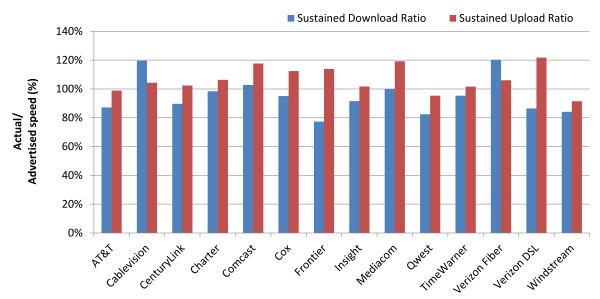
Average Peak Period Sustained Download and Upload Speeds as a Percentage of Advertised, by Provider—April 2012 Test Data

Cable operators’ investments in DOCSIS 3 technology also allowed their broadband networks to perform well even as broadband usage continues to grow. Comcast delivered 103% of promised speeds during peak usage, Time Warner Cable – 96%, and Cox – 95%.

Just one nationwide provider lost ground in the last year — Frontier Communications, whose DSL service has grown more congested than ever, with insufficient investment in network upgrades apparent by the company’s dead-last results.

Frontier managed 81% of promised speeds in 2011, partly thanks to its inherited fiber to the home network. This year, it managed only 79%.

Frontier performed adequately for customers choosing its lowest 1Mbps speed tier. It also performed well in areas where its fiber network can sustain much faster speeds. The biggest problems show up for Frontier’s DSL customers buying service at speeds of 3-10Mbps. At peak times, network congestion brings those speeds down.

On average, the FCC found fiber to the home service delivers the best broadband performance, followed by cable broadband, and then telephone company DSL. Five ISPs now routinely deliver nearly one hundred percent or greater of the speed advertised to the consumer even during time periods when bandwidth demand is at its peak. In the August 2011 Report, only two ISPs met this level of performance. In 2011, the average ISP delivered 87 percent of advertised download speed during peak usage periods; in 2012, that jumped to 96 percent. In other words, consumers today are experiencing performance more closely aligned with what is advertised than they experienced one year ago.

The FCC report also found that outlier performers in the 2011 study, with the exception of Frontier, worked hard to make their differences in performance disappear. Last year, the standard deviation from promised broadband speeds was 14.4 percent. This year it is 12.2 percent.
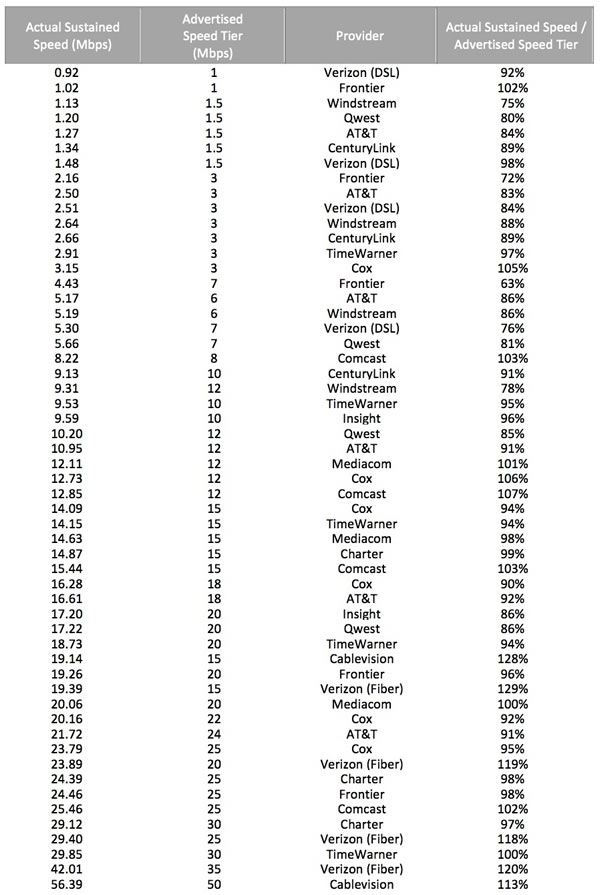
Peak Period Sustained Download Performance, by Provider—April 2012 Test Data

The FCC also found consumers are gravitating towards higher-priced, higher-speed broadband service. Last year’s average broadband speed tier was 11.1Mbps. This year it is 14.3Mbps, almost 30% higher. Along with faster speeds comes more usage. Customers paying for more speed expect to use their broadband connections more, and the FCC found they do.

Overall, the FCC was encouraged to see broadband speed tiers on the increase, some to 100Mbps or higher.

Highlights from the report:

  • Actual versus advertised speeds. The August 2011 Report showed that the ISPs included in the Report were, on average, delivering 87 percent of advertised speeds during the peak consumer usage hours of weekdays from 7:00 pm to 11:00 pm local time. The July 2012 Report finds that ISP performance has improved overall, with ISPs delivering on average 96 percent of advertised speeds during peak intervals, and with five ISPs routinely meeting or exceeding advertised rates.
  • Sustained download speeds as a percentage of advertised speeds. The average actual sustained download speed during the peak period was calculated as a percentage of the ISP’s advertised speed. This calculation was done for each speed tier offered by each ISP.
    • Results by technology:
      • On average, during peak periods DSL-based services delivered download speeds that were 84 percent of advertised speeds, cable-based services delivered 99 percent of advertised speeds, and fiber-to-the-home services delivered 117 percent of advertised speeds. This compared with 2011 results showing performance levels of 82 percent for DSL, 93 percent for cable, and 114 percent for fiber. All technologies improved in 2012.
      • Peak period speeds decreased from 24-hour average speeds by 0.8 percent for fiber-to-the-home services, 3.4 percent for DSL-based services and 4.1 percent for cable-based services. This compared with 0.4 percent for fiber services, 5.5 percent for DSL services and 7.3 percent for cable services in 2011.
    • Results by ISP:
      • Average peak period download speeds varied from a high of 120 percent of advertised speed to a low of 77 percent of advertised speed. This is a dramatic improvement from last year where these numbers ranged from a high of 114 percent to a low of 54 percent.
      • In 2011, on average, ISPs had a 6 percent decrease in delivered versus advertised download speed between their 24 hour average and their peak period average. In 2012, average performance improved, and there was only a 3 percent decrease in performance between 24 hour and peak averages.
  • Sustained upload speeds as a percentage of advertised speeds. With the exception of one provider, upload speeds during peak periods were 95 percent or better of advertised speeds. On average, across all ISPs, upload speed was 107 percent of advertised speed. While this represents improvement over the 103 percent measured for 2011, upload speeds have not been a limiting factor in performance and most ISPs last year met or exceeded their advertised upload speeds. Upload speeds showed little evidence of congestion with little variance between 24 hour averages and peak period averages.
    • Results by technology: On average, fiber-to-the-home services delivered 106 percent, DSL-based services delivered 103 percent, and cable-based services delivered 110 percent of advertised upload speeds. These compare with figures from 2011 of 112 percent for fiber, 95 percent for DSL, and 108 percent for cable.
    • Results by ISP: Average upload speeds among ISPs ranged from a low of 91 percent of advertised speed to a high of 122 percent of advertised speed. In 2011, this range was from a low of 85 percent to a high of 125 percent.
  • Latency. Latency is the time it takes for a packet of data to travel from one designated point to another in a network, commonly expressed in terms of milliseconds (ms). Latency can be a major controlling factor in overall performance of Internet services. In our tests, latency is defined as the round-trip time from the consumer’s home to the closest server used for speed measurement within the provider’s network. We were not surprised to find latency largely unchanged from last year, as it primarily depends upon factors intrinsic to a specific architecture and is largely outside the scope of improvement if networks are appropriately engineered. In 2012, across all technologies, latency averaged 31 milliseconds (ms), as opposed to 33 ms measured in 2011.
    • During peak periods, latency increased across all technologies by 6.5 percent, which represents a modest drop in performance. In 2011 this figure was 8.7 percent.
      • Results by technology:
        • Latency was lowest in fiber-to-the-home services, and this finding was true across all fiber-to-the-home speed tiers.
        • Fiber-to-the-home services provided 18 ms round-trip latency on average, while cable-based services averaged 26 ms, and DSL-based services averaged 43 ms. This compares to 2011 figures of 17 ms for fiber, 28 ms for cable and 44 ms for DSL.
      • Results by ISP: The highest average round-trip latency for an individual service tier among ISPs was 70.2 ms, while the lowest average latency within a single service tier was 12.6 ms. This compares to last year’s maximum latency of 74.8 ms and minimum of 14.5 ms.
  • Effect of burst speed techniques. Some cable-based services offer burst speed techniques, marketed under names such as “PowerBoost,” which temporarily allocate more bandwidth to a consumer’s service. The effect of burst speed techniques is temporary—it usually lasts less than 15 to 20 seconds—and may be reduced by other broadband activities occurring within the consumer household. Burst speed is not equivalent to sustained speed. Sustained speed is a measure of long-term performance. Activities such as large file transfers, video streaming, and video chat require the transfer of large amounts of information over long periods of time. Sustained speed is a better measure of how well such activities may be supported. However, other activities such as web browsing or gaming often require the transfer of moderate amounts of information in a short interval of time. For example, a transfer of a web page typically begins with a consumer clicking on the page reference and ceases when the page is fully downloaded. Such services may benefit from burst speed techniques, which for a period of seconds will increase the transfer speed. The actual effect of burst speed depends on a number of factors explained more fully below.
    • Burst speed techniques increased short-term download performance by as much as 112 percent during peak periods for some speed tiers. The benefits of burst techniques are most evident at intermediate speeds of around 8 to 15 Mbps and appear to tail off at much higher speeds. This compares to 2011 results with maximum performance increases of approximately 50 percent at rates of 6 to 7 Mbps with tail offs in performance beyond this.
  • Web Browsing, Voice over Internet Protocol (VoIP), and Streaming Video.
    • Web browsing. In specific tests designed to mimic basic web browsing—accessing a series of web pages, but not streaming video or using video chat sites or applications—the total time needed to load a page decreased with higher speeds, but only up to about 10 Mbps. Latency and other factors limited response time starting around speed tiers of 10 Mbps and higher. For these high speed tiers, consumers are unlikely to experience much if any improvement in basic web browsing from increased speed–i.e., moving from a 10 Mbps broadband offering to a 25 Mbps offering. This is comparable to results obtained in 2011 and suggests intrinsic factors (e.g. effects of latency, protocol limitations) limit overall performance at higher speeds. It should be noted that this is from the perspective of a single user with a browser and that higher speeds may provide significant advantages in a multi-user household or where a consumer is using a specific application that may be able to benefit from a higher speed tier.
    • VoIP. VoIP services, which can be used with a data rate as low as 100 kilobits per second (kbps) but require relatively low latency, were adequately supported by all of the service tiers discussed in this Report. However, VoIP quality may suffer during times when household bandwidth is shared by other services. The VoIP measurements utilized for this Report were not designed to detect such effects.
    • Streaming Video. 2012 test results suggest that video streaming will work across all technologies tested, though the quality of the video that can be streamed will depend upon the speed tier. For example, standard definition video is currently commonly transmitted at speeds from 1 Mbps to 2 Mbps. High quality video can demand faster speeds, with full HD (1080p) demanding 5 Mbps or more for a single stream. Consumers should understand the requirements of the streaming video they want to use and ensure that their chosen broadband service tier will meet those requirements, including when multiple members of a household simultaneously want to watch streaming video on separate devices. For the future, video content delivery companies are researching ultra high definition video services (e.g. 4K technology which has a resolution of 12 Megapixels per frame versus present day 1080p High Definition television with a 2 Megapixel resolution), which would require higher transmission speeds.
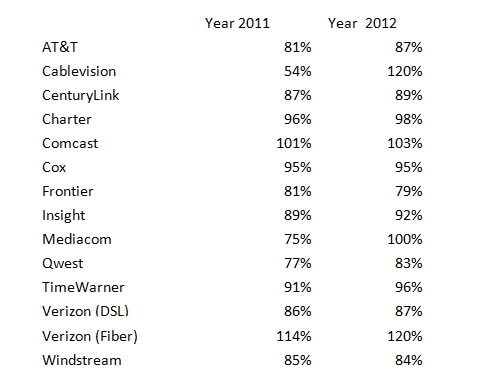
Year by Year Comparison of Sustained Actual Download Speed as a Percentage of Advertised Speed (2011/2012)

 

Google Fiber Launches Next Week in Kansas City

A Stop the Cap! reader working for a Kansas City non-profit group dropped us a note this morning indicating she has received an invitation from Google to join the company at a special event Thursday, July 26 which will be Google Fiber’s formal launch announcement.

“There is buzz all over town about Google launching the fiber service on a limited basis in certain Kansas City neighborhoods next week,” Cathy writes us. “The local media has definitely been invited and encouraged to attend and several non-profit groups are going together in a group to also informally meet with some Google officials at the conclusion of the event regarding access and pricing issues. We have already been told this will be a formal launch event.”

Google has kept its pricing and exact service availability information tightly under wraps, but the company is inviting local residents to sign up for e-mail invitations and additional information as it is released.

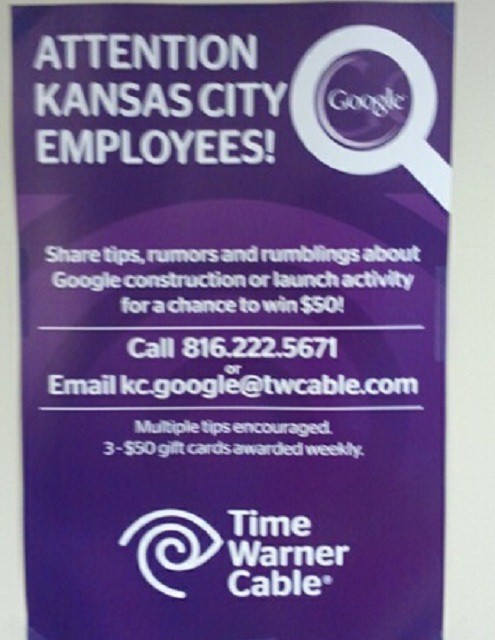
The anticipated launch has not been missed by Time Warner Cable, which has taken to placing signs around the workplace offering $50 “rewards” for insider tips about Google Fiber’s launch and marketing plans. Although some in the tech press have characterized this as “fear” of Google Fiber, a Time Warner employee tells Stop the Cap! the “reward” program is not unprecedented and the cable company has occasionally offered goodies to employees who can deliver tips about competitors like Verizon FiOS and community fiber broadband networks for years.

Courtesy: Gigaom

Kansas City residents will certainly have a choice when Google Fiber launches its gigabit network. In addition to fiber broadband from the search engine giant, customers in different parts of the area can also get cable from Time Warner Cable or Charter and U-verse from AT&T.

Google will join Chattanooga’s EPB Fiber as America’s gigabit residential broadband providers. Cable operators and phone companies are expected to downplay Google’s fiber introduction — likely telling customers they do not need gigabit speeds and chastising its likely monthly cost.

Google’s competitors may have to prepare to deliver that message beyond Kansas City, however.

Dow Drukker, senior vice president of CapStone Investments, believes Google is in the mood to grow:

Initial Indications Google Fiber Is Likely Expanding Beyond Kansas City.

We saw an ad for an Inside Sales position in Mountain View, CA for selling Google Fiber to small businesses. The ad said the position would be tasked to build a team to sell a national broadband network indicating Google likely plans to build a fiber-optic network in additional cities.

This was the ad Drukker saw, which can be vaguely interpreted to indicate the company has plans to place Google Fiber in more cities (underlining ours), although we see nothing that specifically mentions a “national” broadband network:

The area: New Business Development

At Google, we set ourselves goals we know we can’t reach yet. Our New Business Development team works on game-changing ideas, from technological experiments to the expansion of existing businesses into new territories. We’re a team of technologists, entrepreneurs and leaders with an eye for what’s next, working across Google to develop products and ideas that revolutionize the way people connect with information.

The role: Sales Manager, Inside Sales, Google Fiber

Does winning new business get your adrenaline pumping? Drive growth for Google’s Online Sales Group as part of the Inside Sales Organization, the sole acquisition engine at Google. You collaborate with our Account Management teams to devise strategies to acquire specific segments of your market. Work independently, travel to trade shows, visit large prospective clients–it’s all part of this role. Be rewarded for being an overachiever while driving incremental growth in your market. You prescribe the right marketing mix based on Google’s core advertising products through acquisition of predefined mid-and up-market clients. You are product-and industry-savvy, and your energetic drive propels you toward new acquisitions and building and managing your own book of business.

If you want the opportunity to work on a state-of-the-art high-profile program, look no further than the opportunity to frame the future of broadband. The Fiber Sales Manager will build a team to evangelizes Google Fiber services to small and medium business and multi unit dwellings. Fiber Sales manager will develop a plan for our approach in the market including multi unit dwellings, small business, restaurants, and hotels. Inside Sales Representative, you reach out proactively to both small businesses, while articulating how Google Fiber Solutions can help make their work more productive. (And then, you seal the deal!) You excel at product pitching, cultivating a strong base of new clients and working with fellow technical Googlers to devise solutions and support for your clients.

One of the most potentially valuable lessons Google may teach with its new gigabit broadband network is one for Washington lawmakers. To date, cable and telephone companies have portrayed gigabit fiber broadband as unnecessary, unwanted, and too difficult and expensive to offer residential customers. Google’s performance in Kansas City could prove those arguments wrong.

W.V. Does Broadband Mapping With Volunteers; No More Well-Connected Nation Money Flush

Phillip Dampier July 12, 2012 Broadband Speed, Competition, Consumer News, Editorial & Site News, Public Policy & Gov't, Rural Broadband Comments Off on W.V. Does Broadband Mapping With Volunteers; No More Well-Connected Nation Money Flush

West Virginia has returned to broadband mapping the old-fashioned way, with local volunteers fanning out across various areas of the Eastern Panhandle to get a true picture of what broadband service is like on the ground.

The Region 9 Planning and Development Council is helping coordinate the project, currently surveying residents in Berkeley, Jefferson, and Morgan counties. Residents and area businesses can complete a 22-question survey online or on paper, with copies available at most area public libraries.

The Council is trying to ascertain what specific neighborhoods still lack broadband service and also asks current broadband customers to rate the performance of their current provider — like Frontier Communications or a local cable operator. GIS analyst Matthew Mullenax told the Herald-Mail the survey gives a chance for customers to express their views about the speed of their connection, how reliable the service is, and how much it costs.

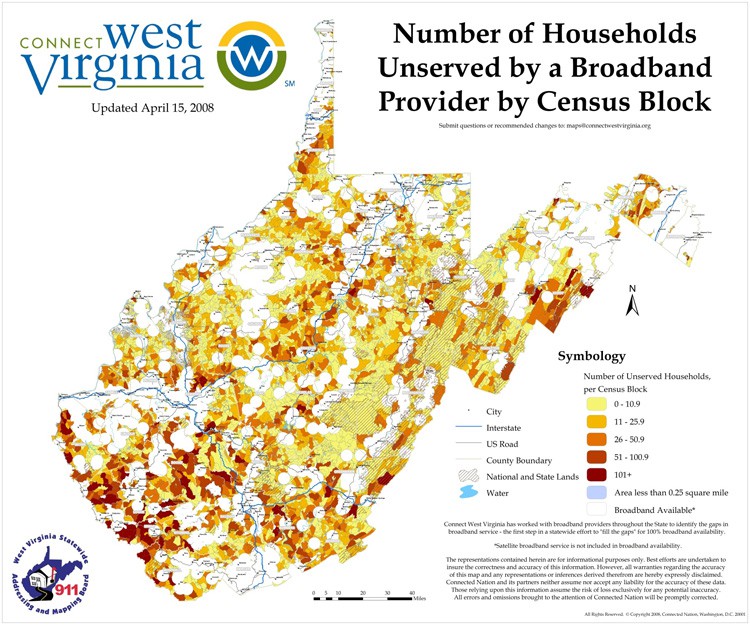
The West Virginia Broadband Deployment Council is effectively running a mapping “do-over,” to replace the highly-criticized broadband map originally drawn by Connect West Virginia, a state chapter of Connected Nation, that suggested 90-95% of the state had access to broadband when it was produced over three years ago.

Connected Nation’s 2008 map has been criticized for being over-optimistic about broadband availability in West Virginia.

Connected Nation has direct ties to some of the nation’s largest telecommunications companies, and despite its non-profit status, heavily lobbies legislators on broadband-related issues. The group largely relies on data voluntarily supplied by providers themselves, and critics accuse the group of doing little to verify the accuracy of that data. As a result, states are left with inaccurate, over-optimistic maps that suggest broadband availability is not a problem.

Broadband mapping projects can cost taxpayers millions, paid for by federal grants earmarked for mapping projects. But in communities like Paw Paw, W.V., the costs of not having broadband are just as high for local residents who find good-paying technology jobs largely unavailable in the community, which lacks adequate broadband service.

Mullenex hopes once an accurate map can be drawn, the state can create a strategic plan to push for broadband expansion in areas where service is lacking. The Council hopes its efforts will help pinpoint the areas of greatest need, and direct federal and state grant funding to improve broadband service for affected communities.


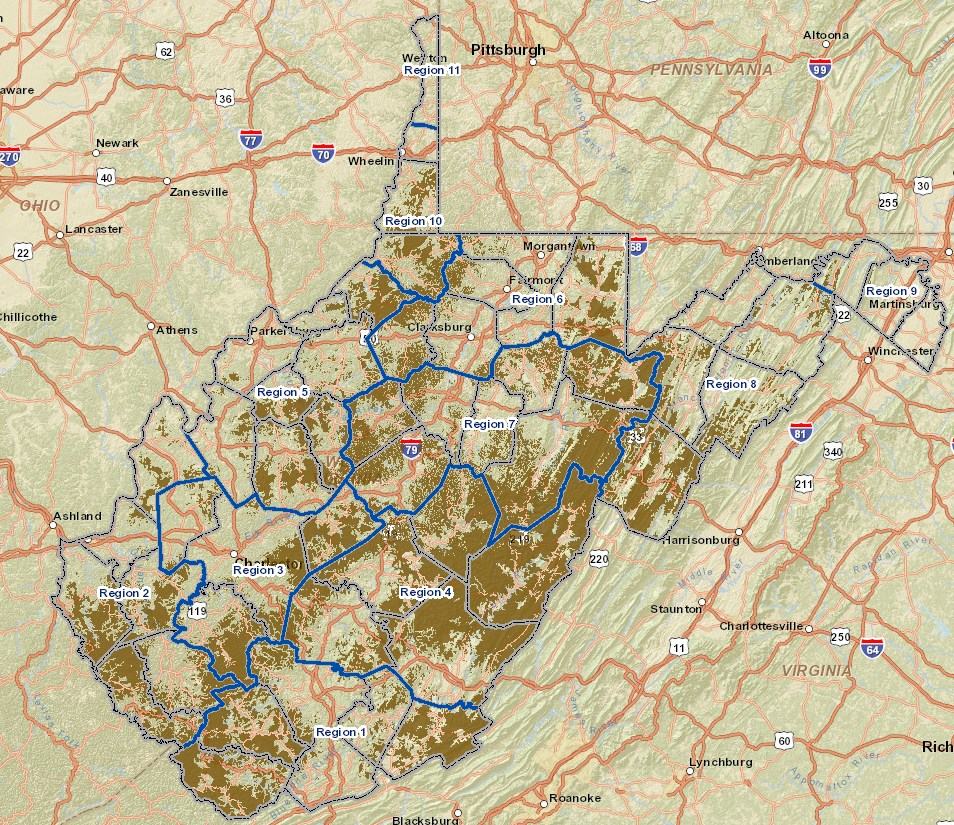
The West Virginia Broadband Deployment Council released this 2012 map. Areas marked in dark green have no broadband service of any kind, including wireless mobile broadband.

Frontier Promises to Make DSL Available to More of Their Rural Customers

Phillip Dampier July 10, 2012 Broadband Speed, Consumer News, Frontier, Public Policy & Gov't, Rural Broadband Comments Off on Frontier Promises to Make DSL Available to More of Their Rural Customers

Frontier Communications has agreed to bring ADSL broadband service to more of its rural customers, in return for collecting $775 per impacted household from the FCC’s new Connect America Fund, designed to help defray expenses associated with expanding broadband access.

Frontier appears to be the first major phone company in the country to sign on to the new broadband subsidy program funded by telephone ratepayers through a surcharge on their monthly bills.

“Today’s announcement by Frontier Communications represents the beginning of that new deployment: approximately 200,000 unserved rural Americans will get broadband for the first time,” said FCC chairman Julius Genachowski. “I applaud Frontier Communications for stepping up to the plate with its commitment to accelerate broadband build-out by increasing private investment in rural communities, in partnership with the Connect America Fund.”

The FCC will hand Frontier nearly $72 million in subsidies to help the company deploy DSL broadband in areas currently deemed not profitable enough to serve. Frontier says it expects to bring service to 92,876 new households across their national service area that never had broadband service before. The company specifically mentions expansions in Michigan, Oregon, Washington and West Virginia, but says customers in at least half of the states where it provides service will benefit from the broadband expansion funding.

Frontier claims it currently offers 80 percent of its customers broadband service, in part thanks to an investment of more than $1.5 billion by the company over the last two years, according to Kathleen Quinn Abernathy, executive vice president of external affairs.

Genachowski

Frontier is a major provider of traditional ADSL broadband service in its rural service areas, typically offering customers 1-3Mbps service. Customers in larger communities can purchase DSL service at speeds closer to 10Mbps, and the company also sells fiber to the home broadband over its acquired FiOS network in parts of the Pacific Northwest and Fort Wayne, Ind.

Under the terms of the Connect America Fund, participating providers must offer customers at least 4/1Mbps service, which means Frontier will need to make some upgrades in its rural network — most likely reducing the length of copper wiring between its central offices and customers.

Frontier has faced challenges maintaining broadband service in some areas, especially in states where the company acquired aging infrastructure from Verizon Communications. West Virginia, where Frontier is the dominant telephone company after Verizon left the state, is still suffering the after-effects of a derecho windstorm nearly two weeks ago. Frontier has brought in repair crews from as far away as New York to assist in clearing thousands of outage reports.

The company has also gotten some justice after Boone County authorities arrested two men for generator thefts. Frontier has been using generators to keep phone service up and running in areas without electricity, but has been victimized by generator thefts across the state. At least six other generators were stolen in New Martinsville in Wetzel County yesterday.

Frontier has a tip line for anyone with information about stolen equipment or copper theft: 1-800-590-6605.

Other telephone companies expecting to apply for broadband funding from the Connect America Fund include: Alaska Communications Systems, AT&T, CenturyLink, Consolidated Communications, FairPoint Communications, Hawaiian Telcom, Virgin Islands Telephone, Verizon Communications and Windstream.

The Illusory Savings of “Usage Based Billing”: Your Bill Will Get Higher, Not Lower

Phillip Dampier July 2, 2012 Broadband "Shortage", Broadband Speed, Competition, Consumer News, Data Caps, Editorial & Site News, Online Video Comments Off on The Illusory Savings of “Usage Based Billing”: Your Bill Will Get Higher, Not Lower

Phillip “They Want to Save You Money By Charging You More” Dampier

The pro-Internet Overcharging forces’ meme of “pay for what you use” sounds good in theory, but no broadband provider in the country would dare switch to a true consumption-based billing system for broadband, because it would destroy predictable profits for a service large cable and phone companies hope you cannot live without.

Twenty years ago, the cable industry could raise rates on television packages with almost no fear consumers would cancel service. When I produced a weekly radio show about the cable and satellite television industry, cable companies candidly told me they expected vocal backlashes from customers every time a rate increase notice was mailed out, but only a handful would actually follow through on threats to cut the cord. Now that competition for your video dollar is at an all-time-high, providers are shocked (and some remain in denial) that customers are actually following through on their threats to cut the cord. Goodbye Comcast, Hello Netflix!

Some Wall Street analysts have begun warning their investor clients that the days of guaranteed revenue growth from video subscribers are over, risking profits as customers start to depart when the bill gets too high. Cable companies have always increased rates faster than the rate of inflation, and investors have grown to expect those reliable profits, so the pressure to make up the difference elsewhere has never been higher.

With broadband, cable and phone companies may have found a new way to bring back the Money Party, and ride the wave of broadband usage to the stratosphere, earning money at rates never thought possible from cable-TV. The ticket to OPEC-like rivers of black gold? Usage-based billing.

Since the early days of broadband, most Americans have enjoyed flat rate access through a cable or phone company at prices that remained remarkably stable for a decade — usually around $40 a month for standard speed service.

In the last five years, as cord-cutting has grown beyond a phenomena limited to Luddites and satellite dish owners, the cable industry has responded. As they learned customers’ love of broadband has now made the service indispensable in most American homes, providers have been jacking up the price.

Time Warner Cable, for example, has increased prices for broadband annually for the last three years, especially for customers who do not subscribe to any other services.

Customers dissatisfaction with rate hikes has not led to broadband cord cutting, and in fact might prove useful on quarterly financial reports -and- for advocating changes in the way broadband service is priced:

  1. Enhance revenue and profits, replacing lost ground from departing video customers and the slowing growth of new customers signing up for video and phone services (and keeping average revenue per user ((ARPU)) on the increase);
  2. Using higher prices to provoke an argument about changing the way broadband service is sold.

Pouring over quarterly financial reports from most major providers shows remarkable consistency:

  • The costs to provide broadband service are declining, even with broadband usage growth;
  • Revenue and profits enjoy a healthy growth curve, especially as increased prices on existing customers make up for fewer new customer additions;
  • Earnings from broadband are now so important, a cable company like Time Warner Cable now refers to itself as a broadband company. It is not alone.

Still, it is not enough. As usage continues to grow in the current monopoly/duopoly market, providers are drooling with anticipation over the possibility of scrapping the concept of “flat rate” broadband, which limits the endless ARPU growth Wall Street demands. If a company charges a fixed rate for a service, it cannot grow revenue from that service unless it increases the price, sells more expensive tiers of service, or innovates new products and services to sell.

Providers have enjoyed moderate success selling customers more expensive, faster service, also on a flat rate basis. But that still leaves money on the table, according to Wall Street-based “usage billing” advocates like Craig Moffett, who see major ARPU growth charging customers more and more money for service as their usage grows.

Moffett has a few accidental allies in the blogger world who seem to share his belief in “usage-based” billing. Lou Mazzucchelli, reading the recent New York Times piece on Time Warner’s gradual move towards usage pricing, frames his support for consumption billing around the issue of affordability. In his view, usage pricing is better for consumers and the industry:

It costs real money to upgrade networks to keep pace with this demand, and those costs are ultimately borne by the subscriber. So in the US, we have carriers trying to raise their rates to offset increases in capital and operating expenses to the point where consumers are beginning to push back, and the shoving has come to the attention of the Federal Communications Commission, which has raised the possibility of treating Internet network providers as common communications carriers subject to regulation.

I believe that flat-rate pricing is a major source of problems for network carriers and consumers. In the carrier world, the economics are known but ignored because marketers believe that flat rates are the only plans consumers will accept. But in the consumer world, flat rates are rising to incomprehensible levels for indecipherable reasons, with little recourse except disconnection. Consumer dissatisfaction is rising, in part because consumers feel they have no control over the price they have to pay. This is driven by their sense of pricing inequity that is hard to visualize but comes from implicit subsidies in the current environment. The irony is that pay-per-use pricing solves the problem for carriers and consumers.

Mazzucchelli reposted his blog piece originally written in 2010 for the benefit of Times readers. Two years ago, he measured his usage at 11GB a month. His provider Verizon Communications was charging him $64.99 a month for 25Mbps service, which identifies him as a FiOS fiber to the home customer.  Mazzucchelli argues the effective price he was paying for Internet access was $5.85 for each of the 11GB he consumed, which seemed steep at the time. (Not anymore, if you look at wireless company penalty rates which range from $10-15/GB or more.)

Mazzucchelli theorized that if he paid on a per-packet basis, instead of flat rate service based on Internet speed, he could pay something like $0.0000025 per packet, which would result in a bill of $31.91 for his 11GB instead of $65. For him, that’s money saved with usage billing.

On its face, it might seem to make sense, especially for light users who could pay less under a true usage-based pricing scenario like the one he proposes.

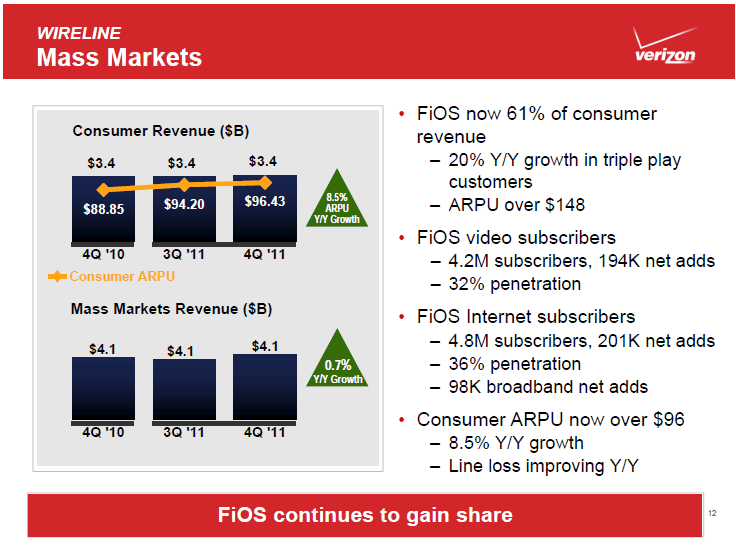
Verizon Communications is earning more average revenue per customer than ever with its fiber to the home network. That’s about the only bright spot Wall Street recognizes from Verizon’s fiber network, which some analysts deride as “too expensive.”

Unfortunately for Mazzucchelli, and others who claim usage-based pricing will prove a money-saver, the broadband industry has some bad news for you. Usage pricing simply cannot be allowed to save you, and other current customers money. Why? Because Wall Street will never tolerate pricing that threatens the all-important ARPU. In the monopoly/duopoly home broadband marketplace most Americans endure, it would be the equivalent of unilaterally disarming in the war for revenue and profits.

That is why broadband providers will never adopt a true usage-based billing system for customers. It would cannibalize earnings for a service that already enjoys massive markups above true cost. In 2009, Comcast was spending under $10 a month to sell broadband service priced above $40.

Mazzucchelli

Instead, providers design “usage-based” billing around rates comparable to today’s flat rate pricing, only they slap arbitrary maximum usage allowances on each tier of service, above which consumers pay an overlimit fee penalty. That would leave Mazzucchelli choosing a lower speed, lower usage allowance plan to maximize his savings, if his use of the Internet didn’t grow much. On a typical light use plan suitable for his usage, he would subscribe to 1-3Mbps service with a 10GB allowance, and pay the overlimit fee for one extra gigabyte if he wanted to maximize his broadband dollar.

But his usage experience would be dramatically different, both because he would be encouraged to use less, fearing he might exceed his usage allowance, and he would be “enjoying” the Internet at vastly slower speeds. If Mazzucchelli went with higher speed service, he would still pay prices comparable for flat rate service, and receive a usage allowance he personally would find unnecessarily large. The result for him would be little to no savings and a usage allowance he did not need.

Mazzucchelli’s usage pattern is probably different today than it was in 2010. Is he still using 11GB a month? If he uses double the amount he did two years ago, under his own pricing formula, the savings he sought would now be virtually wiped out, with a broadband bill for 22GB of consumption running $63.82. By the following year, usage-based pricing would cost even more than Verizon’s unlimited pricing, as average use of the Internet continues to grow.

That helps the broadband industry plenty but does nothing for consumers. Mazzucchelli might be surprised to learn that the “real money to upgrade networks to keep pace with this demand,” is actually more than covered under today’s profit margins for flat-rate broadband. In fact, if he examines financial reports over the last five years and the statements company executives make to shareholders, virtually all of them speak in terms of reducing capital investments and the declining costs to deliver broadband, even as usage grows.

Verizon’s fiber network, while expensive to construct, is already earning the company enormous boosts in ARPU over traditional copper wire phone service. While Wall Street howled about short term capital costs to construct the network, then-CEO Ivan Seidenberg said fiber optics was the vehicle that will drive Verizon earnings for decades selling new products and services that its old network could never deliver.

Still, is Mazzucchelli paying too much for his broadband at both 2010 and 2012 prices? Yes he is. But that is not a function of the cost to deliver broadband service. It is the result of a barely competitive marketplace that has an absence of price-moderating competitors. Usage-based pricing in today’s broadband market assures lower costs for providers by retarding usage. It also brings even higher profits from bigger broadband bills as Internet usage grows, with no real relationship to the actual costs to provide the service. It also protects companies from video package cord-cutting, as customers will find online viewing prohibitively expensive.

One need only look at pricing abroad to see how much Americans are gouged for Internet service. Unlimited high speed Internet is available in a growing number of countries for $20-40 a month.

Usage-based billing is a dead end that might deliver temporary savings now, but considerably higher broadband bills soon after. It is not too late to turn the car around and join us in the fight to keep unlimited broadband, enhance competition, and win the lower prices users like Mazzucchelli crave.

Search This Site:

Contributions:

Recent Comments:

Your Account:

Stop the Cap!