Home » Broadband Speed » Recent Articles:

Time Warner Cable Maxx Provides Superior, Cheaper Broadband Than Comcast (+ No Caps!)

Phillip Dampier August 11, 2014 Broadband Speed, Comcast/Xfinity, Competition, Consumer News, Data Caps, Editorial & Site News, Public Policy & Gov't Comments Off on Time Warner Cable Maxx Provides Superior, Cheaper Broadband Than Comcast (+ No Caps!)

psctest

Despite claims from Comcast that it will improve broadband speeds for Time Warner Cable customers, Time Warner has managed to do that without any help from Comcast. Through its TWC Maxx upgrade program, Time Warner now delivers faster broadband speeds than most Comcast customers receive, at a lower price, and without the threat of usage caps.[1]

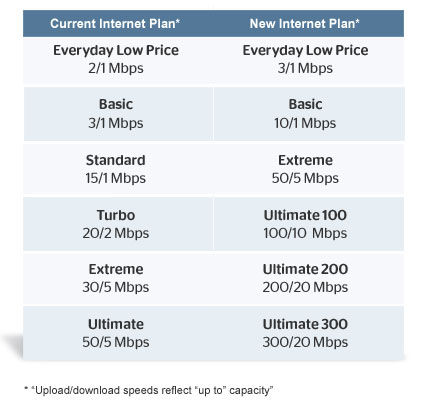
twcmaxResidents in parts of New York City are already getting more than triple the broadband speeds they used to receive without any additional charges. A customer in Queens that used to pay $57.99 a month for 15Mbps broadband service now receives 50Mbps from Time Warner. In contrast, Comcast’s Performance plan delivers half that speed and costs $66.95 a month.[2]

Time Warner’s 300Mbps service now costs $107.99. For $114.95, Comcast customers only get 150Mbps.

The public interest is not served replacing Time Warner Cable’s broadband with Comcast’s Internet which charges higher prices and delivers less speed and brings the extremely high likelihood of usage limits on broadband service in the near future.

Time Warner Cable has already announced eight new cities targeted for Maxx upgrades with plans to accelerate upgrades across their service areas over the next two years.[3] It appears to be well worth the wait.

After selecting your broadband plan, customers of both Comcast and Time Warner Cable are confronted with modem rental fees. The vast majority of customers of both companies still pay to rent their cable broadband modem.[4] They pay less renting it from Time Warner Cable at $5.99 a month.[5] Comcast customers pay one of the highest equipment lease rates in the country – $8 a month.[6]

speed-plan-chart-2014

Time Warner Cable Maxx brings these broadband speed upgrades when it reaches your area.

[1]http://ir.timewarnercable.com/investor-relations/investor-news/financial-release-details/2014/Time-Warner-Cable-to-Transform-TV-and-Internet-Experience-in-New-York-City-and-Los-Angeles/default.aspx
[2]All Comcast and Time Warner Cable broadband prices reflect regular retail rates (not promo rates) obtained from: http://www.comcast.com/internet-service.html (Comcast) and http://www.timewarnercable.com/en/support/account-and-billing/topics/retail-rates.html (Time Warner Cable).
[3]https://newsroom.charter.com/
[4]http://stopthecap.com/2013/07/29/time-warner-cable-raising-modem-rental-fee-again-5-99month-starting-next-month/
[5]https://gizmodo.com/time-warner-cable-is-once-again-increasing-its-modem-re-964861165
[6]http://www.dslreports.com/shownews/Comcast-Bumping-Modem-Rental-Fee-to-8-126117

Surprise Bid for T-Mobile USA from Iliad’s Free Mobile Has Wireless Competitors, Wall Street Unnerved

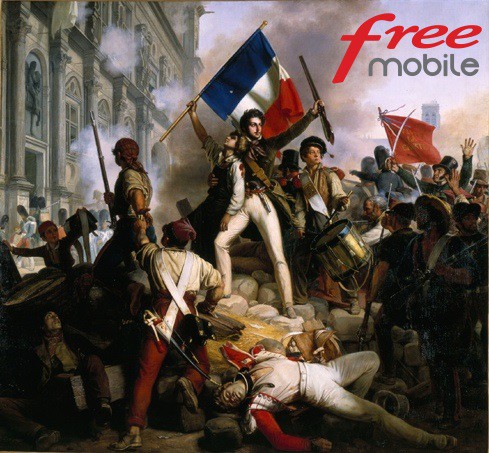
french revolutionThe French Revolution in wireless could be spreading across the United States if Paris-based Iliad is successful in its surprise $15 billion bid to acquire T-Mobile USA (right out from under Sprint and Japan-based Softbank). Wall Street hopes it isn’t true.

If you named one wireless carrier in the world guaranteed to provoke groans, sweat, and Excedrin headaches from powerful wireless industry executives living high on 40%+ annual margins, Iliad and its notorious Free Mobile would be the chief provocateur. Initially dismissed as an irrelevant upstart (much like T-Mobile itself) when it announced service on a less-robust network in 2012, as soon as Free Mobile announced its groundbreaking prices, panic was rife in the boardrooms and executive suites of competitors Orange, SFR and Bouygues Telecom, who couldn’t slash their own prices fast enough.

As one wireless executive in Paris put it, when Free Mobile launched, “the tsunami hit.”

In short order, Free Mobile has taken nearly five million of their competitors’ very profitable customers in France, mostly from its vicious price-cutting that results in rates half that of any other competitor.

Orange and other carriers promptly announced slashed shareholder dividend payouts and implemented cost-saving measures after being forced to cut pricing.

American wireless executives visiting Europe were aghast at the prices charged by the French upstart, suggesting they were reckless and would eliminate necessary investment in upgrades. Although France has been behind the United States in launching 4G service upgrades, French customer satisfaction with their wireless service is higher than in the U.S., and Free Mobile has the lowest customer loss (churn) rate of any carrier in France.

Iliad’s reputation as a nasty competitor is fine with self-made billionaire CEO Xavier Niel, who has become extremely wealthy selling cutting edge, yet affordable, telecommunications products without losing touch of his more modest roots. But he is reviled by most of his competitors for disrupting the comfortable wireless service business models his competitors have maintained for years. Niel has thrown marketing bombs into every sector of the French telecom market, ruthlessly cutting prices for customers while relying on in-house innovations to keep costs low.

[flv]http://www.phillipdampier.com/video/Euronews Telecoms turmoil in France 2012.mp4[/flv]

Euronews reported on the turmoil Iliad caused incumbent wireless carriers when it forced them to respond with major price-cuts to stay competitive. (0:44)
freemobileFree’s customer care center is run on Ubuntu-based, inexpensive notebook and desktop computers. Free’s wired broadband, television, and phone service is powered by set-top boxes and network devices custom-developed inside Iliad to keep costs down. Its creative spirit has been compared to Google, much to the chagrin of its “business by the book” competitors.

“It’s not done like this,” is a common refrain heard when Free Mobile announces more price cuts, an easing of usage caps, or completely free add-ons.

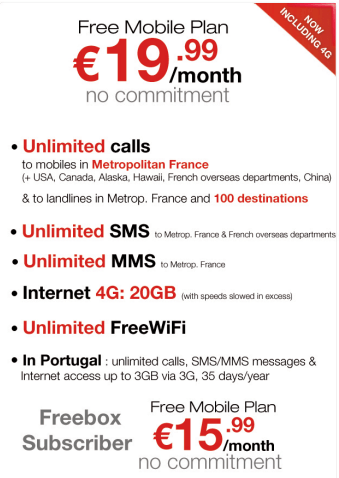
Today, a typical Free Mobile customer pays $26.75US a month for wireless service which includes:

  • Unlimited calls to France and 100 other destinations, including the U.S., Canada, China, and all French overseas departments (eg. Guadeloupe, Tahiti, Mayotte, etc.);
  • Unlimited SMS/text messages;
  • Unlimited MMS messages to French numbers;
  • 20GB of 4G access before the speed throttle kicks in;
  • Unlimited free Wi-Fi on Free’s extensive Wi-Fi network.

A Free Mobile customer that also subscribes to Free’s wired broadband or television service gets an even bigger discount. Their monthly wireless bill for the same features? $21.40US a month.

Niel said the reason he has not brought the Free Mobile brand to the United States is because the wireless industry here is highly anti-competitive. The fact T-Mobile USA is now up for sale represents ‘the opportunity of a lifetime,’ a “one-time opportunity to enter the world’s-largest telecoms market,” a person familiar with the matter said prior to the announcement.

“The competitive landscape in the U.S. is a lot less aggressive than what we are used to in France,” added Niel. “There is enormous potential. It is almost too good to be true.”

A number of Wall Street analysts who prefer the current business model of high cost/high profits are keeping their fingers crossed the Iliad offer is just a pipe dream. Some, including analysts on Bloomberg TV, dismissed Niel as a former pornographer and suggested “for the guppies, it is whale season,” a reference to Iliad’s small size relative to T-Mobile USA.

“To say this is surprising is something of an understatement; it is one of the most bizarre bits of potential M&A we have ever witnessed in the sector,” said analysts from Espirito Santo in a note to investors.

[flv]http://www.phillipdampier.com/video/Bloomberg Who Is T-Mobiles New French Suitor 8-1-14.flv[/flv]

Some on Wall Street are mocking the deal as a guppy hoping to swallow a whale. T-Mobile is considerably larger than Iliad, says CNBC. “It’s preposterous. Who put them up to it?” (6:18)

“Iliad is about a third of the size of T-Mobile US, and we don’t think there would be synergies from the deal,” said Jonathan Chaplin, an analyst at New Street Research, in a note. “It would be tough to finance without Xavier Neil relinquishing control. Sprint and anyone else with synergies should be able to outbid them.”

Should Free Mobile enter the United States, its cutthroat pricing would make CEO John Legere’s “bad wireless boy” campaign to make T-Mobile the “uncarrier” quaint in comparison. Every wireless carrier in the U.S. could be forced to cut rates by one-third or more to stay competitive should Niel adopt a similar business model for Free Mobile in the U.S. market.

Some worry that Softbank’s bid to merge Sprint and T-Mobile together has just become even less likely with the possibility of a new player in the U.S. market, competing against three other carriers, not two as the Softbank deal proposes.

[flv]http://www.phillipdampier.com/video/CNBC Sprint Deal with T-Mobile Has Little Chance 8-1-14.flv[/flv]

CNBC spoke with Nik Stanojevic, equity analyst at Brewin Dolphin, who was surprised Iliad threw in a bid for T-Mobile, but believes Softbank/Sprint’s deal to acquire T-Mobile has very little chance getting by regulators. (2:40)


Time Warner Cable Announces Eight New Cities for Maxx Upgrades; Northeast Can Forget It

Phillip Dampier July 31, 2014 Broadband Speed, Competition, Consumer News 3 Comments

twcmaxYou have to live in a warmer climate to be on the list of the next eight cities to get Time Warner Cable’s massive Maxx upgrade.

This afternoon, Time Warner announced it would more than triple the broadband speeds of customers in Austin, Charlotte, Dallas, Hawaii, Kansas City, Raleigh, San Antonio and San Diego at no extra charge.

“We are committed to reinventing the TWC service experience market-by-market,” said Time Warner Cable CEO Rob Marcus. “We want our customers to know a new experience is coming that brings them super-fast Internet speeds and a more advanced TV product.”

Most of the cities on the upgrade list either have or are at least facing the threat of fiber-based competition from AT&T or Hawaiian Telcom. With Verizon’s long-suspended FiOS project and Frontier’s ‘DSL or Die’-philosophy, Time Warner Cable has so far avoided spending money on upgrades where its only significant competition comes from DSL. Outside of New York City, Time Warner has yet to announce any upgrades within its northeast division, which dominates cable service in Maine, western Massachusetts, New York, and parts of Ohio.

With both Google and AT&T promising fiber service in Austin, Time Warner wasted no time beginning upgrades in the capital city of Texas, which have already delivered faster Internet speeds across large sections of the city. By the end of this week, more than half of Time Warner’s broadband customers in Austin will have access to free upgraded speeds.

TWC customers in these communities who subscribe to the Standard Internet plan, formerly up to 15Mbps, will now receive up to 50Mbps, and customers who subscribe to the Ultimate plan, formerly up to 100Mbps, will receive up to 300Mbps – more than three times their current speeds, at no extra charge. In non-upgraded areas, Time Warner’s maximum speed remains 50/5Mbps.

More Proof of Comcast’s Monopoly Tendencies: Spending Big to Kill Community Broadband Competition

When the community of Batavia, Ill., a distant suburb of Chicago, decided they wanted something better than the poor broadband offered by Comcast and what is today AT&T, it decided to hold a public referendum on whether the town should construct and run its own fiber to the home network for the benefit of area residents and businesses. A local community group, Fiber for Our Future, put up $4,325 to promote the initiative back in 2004, if only because the town obviously couldn’t spend tax dollars to advertise or promote the idea itself.

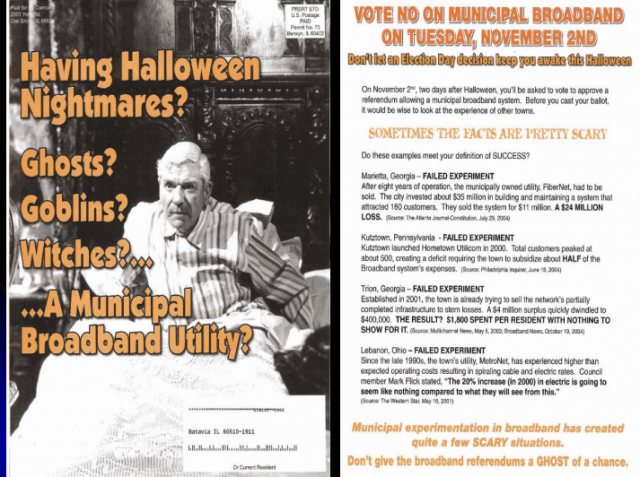
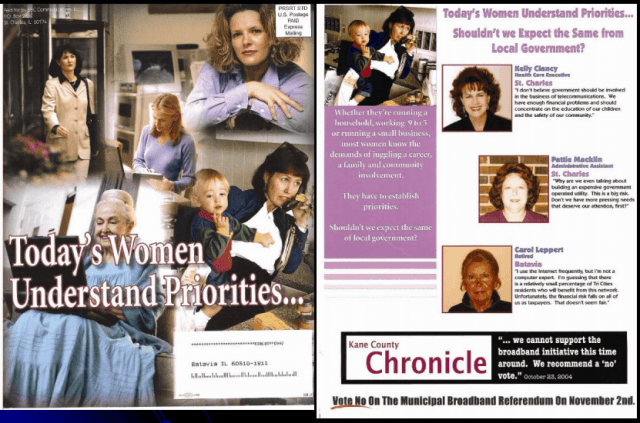
Within weeks of the announced proposal, both Comcast and SBC Communications (which later acquired AT&T) launched an all-out war on the idea of fiber to the home service, mass mailing flyers attacking the proposal to area residents and paying for push polling operations that asked area residents questions like, “should tax money be allowed to provide pornographic movies for residents?” The predictable opposition measured in response to questions like that later appeared in mysterious opinion pieces published in area newspapers submitted by the incumbent companies and their allies.

no comm broadband

Comcast spent $89,740 trying to defeat the measure in a community of just 26,000 people. SBC spent $192,324 — almost $3.50 per resident by Comcast and just shy of $7.50 per resident by SBC. Much the same happened in the neighboring communities of St. Charles and Geneva. 

According to Motherboard, the scare tactics worked, cutting support for the fiber network from over 72 percent to its eventual defeat in two separate referendums, leaving most of Batavia with 3Mbps DSL from SBC or an average of 6Mbps from Comcast.

Much of the blizzard of mailers and brochures Comcast and SBC mailed out were part of a coordinated disinformation campaign. Both companies also knew their claims would go largely unchallenged because Fiber for Our Future and other fiber proponents lacked the funding to respond with fact check pieces of their own mailed to residents to expose the distortions.

When it was all over, it was back to business as usual with Comcast and SBC. The latter defended its reputation after complaints soared about its inadequate broadband speeds.

Kirk Brannock, then midwest networking president for SBC, told city council members in the area that “fiber is an unproven technology.”

“What are you going to do with 20Mbps? It’s like having an Indy race car and you don’t have the racetrack to drive it on. We are going to be offering 3Mbps. Most users won’t use that,” he said.

risky

“All the subscribers got these extraordinary fliers. Ghosts, goblins, witches. I mean, this is about a broadband utility. Very scary stuff. This is real. This is comical, but this is very real,” Catharine Rice of the Coalition for Local Internet Choice said of the fliers at an event discussing municipal fiber earlier this year. “They have this amazing picture, and then they lie about what happened. They’re piling in facts that aren’t true.”

In communities that won approval for construction of publicly-owned fiber networks, the battle wasn’t over. Tennessee’s large state cable lobbying group unsuccessfully sued EPB to keep it out of the fiber business. In North Carolina, Time Warner Cable effectively wrote legislation introduced and passed by the Republican-dominated General Assembly that forbade community broadband expansion and made constructing new networks nearly impossible. In Ohio, another cable industry-sponsored piece of legislation destroyed the business plan of Lebanon’s fiber network, forcing the community to eventually sell the network at a loss to Cincinnati Bell.

The larger Comcast grows, the more financial resources it can bring to bare against any would-be competitors. Even in 2004, the company was large enough to force would-be community competitors to steer clear and stay out of its territory.

women


Miss. Taxpayers Pay for “Sweetheart Deal” With AT&T; Competitive Bids and Public Scrutiny Prohibited

Phillip Dampier July 29, 2014 AT&T, Broadband Speed, C Spire, Competition, Consumer News, Data Caps, Public Policy & Gov't, Rural Broadband Comments Off on Miss. Taxpayers Pay for “Sweetheart Deal” With AT&T; Competitive Bids and Public Scrutiny Prohibited

att loveAT&T couldn’t have gotten a better deal for itself if it tried.
Mississippi state officials that awarded AT&T a 10-year State Master Contract, compelling the majority of state government offices to do business only with AT&T, have just given the phone company an early two-year extension without allowing for any public discussion or competitive bidding.

In 2005, when the contract with AT&T was first signed, it was unlikely most government offices, schools, and libraries would be able to find any bidder other than AT&T. The state contract spells out a series of requirements that critics contend were tailor-written with the full knowledge only AT&T could offer the full menu of required services. Nearly 10 years later, and more than a year before the contract was up for renewal, the state suddenly granted AT&T a two-year contract extension, potentially exposing taxpayers to overpriced, taxpayer-funded broadband services.

Interested members of the public who want to examine the state contract for telecommunications with AT&T have run headlong into a roadblock erected by a Hinds County judge who ruled it was off-limits for public inspection and has since been sealed under court order. To this day, only government customers of Mississippi’s Department of Information Technology Services, the agency in charge of the state government’s broadband, are allowed to see the document.

Mississippi-welcomeThe state contract comes at a significant cost to taxpayers if Marvin Adams’ figures are correct. Adams, who works for the Columbia School District, suspects a lot of money has been frittered away because of the lack of competitive bidding. Only the state’s schools and libraries have the option of either securing a contract with AT&T or requesting bids from competitors like Ridgeland-based C-Spire, which supplies fiber and wireless connectivity.

Adams says AT&T’s contract with the state costs taxpayers $5 per Mbps. But AT&T also charges a “transport circuit charge” of between $10-45 per Mbps. Adams said his colleagues have seen competitive bids averaging $6 per Mbps and the transport circuit charge is included in that price.

The Mississippi Watchdog delivered the understatement of the year when it called AT&T’s contract with Mississippi “lucrative.” Attempts to modify the contract have met with fierce opposition in Jackson, the state capital. Senate Bill 2741, a modest measure that would have compelled school districts to seek competitive bids before signing a multi-year contract with a provider, died in committee earlier this year.

AT&T has close political ties in several southern states. The company co-authored an article with Gov. Phil Bryant and donated at least $42,500 to his various campaigns for political office. In 2012, Bryant signed a bill into law removing most of Mississippi’s remaining regulatory authority over AT&T.

Mississippi Governor Phil Bryant

Next door in Louisiana, Gov. Bobby Jindal also maintains close ties with AT&T. The company has funneled more than $250,000 to his wife’s charitable foundation – the Supriya Jindal Foundation for Louisiana’s Children, which also takes substantial contributions from oil and chemical companies, the insurance industry and defense contractors. The New York Times reported back in 2011 that telecom companies like AT&T were increasingly contributing to politically connected charities they could use in campaigns to influence legislation and regulation. Companies can write off their unlimited charitable giving while politicians take credit for the work done by the non-profit groups while also quietly understanding exactly where the money is coming from.

Search This Site:

Contributions:

Recent Comments:

Your Account:

Stop the Cap!