Home » Broadband Speed » Recent Articles:

Your Unlimited, Off-Contract Verizon Wireless Web Experience Will Be “Optimized” (Throttled) Oct. 1

throttleVerizon Wireless’ ongoing campaign to get rid of its grandfathered unlimited data customers continues this week with news the carrier will begin throttling speeds of off-contract customers still hanging on to their uncapped data plans starting Oct 1.

Verizon doesn’t call the enforcement of speed reductions a “throttle,” but rather “Network Optimization”:

Verizon Wireless strives to provide its customers with the best wireless experience when using our network. In 2011, Verizon Wireless launched Network Optimization, which slows the data speeds of its unlimited data subscribers with 3G devices who are in the top 5% of data users when they connect to a cell site experiencing high demand.

Effective October 1, Verizon Wireless will expand its existing Network Optimization policy to include its unlimited data subscribers using 4G LTE devices who have fulfilled their minimum contract term. Based on your plan and recent data usage, one or more lines on your account may experience a reduction in data speeds when connected to a cell site experiencing high demand. Customers on MORE Everything or other usage-based data plans are not subject to Network Optimization. For more information about our Network Optimization, please refer to www.verizonwireless.com/networkoptimization.

Verizon Wireless customers on the company’s 3G network have been subject to speed throttling for several years if Verizon deems them a “heavy user,” but the company’s 4G LTE network avoided the speed noose until now. Customers who find themselves subjected to Verizon’s speed limiter report it is a very unpleasant experience.

610px-Verizon-Wireless-Logo_svg“My phone has been throttled and is now essentially unusable for the very things it is marketed for,” reports one customer sentenced by Verizon’s “Network Optimization.”  “I can send texts, emails, and view basic websites but any sort of streaming is now out of the question for the remainder of the billing cycle and possibly the next cycle as well.”

The throttle effectively limits speeds to well under 300kbps, and in most urban areas where cell tower usage is higher, punished customers have to live with speeds of around 50kbps — the same as dial-up.

Verizon’s logic and consistency about its “Network Optimization” faced customer scrutiny as well.

“This is not about equal opportunity bandwidth, it’s about Verizon realizing they can increase their revenue stream, otherwise, wouldn’t those tiered folks be getting throttled as well if they ‘abused’ and used ‘inordinate’ amounts of data?  Oh no, of course not, Verizon just bills them more.  This scenario is as ridiculous as charging $20/month for text messaging, which, by the way, is also data.”

What makes you speed-throttling-worthy? According to Droid Life, which broke the story, anyone using more than 4.7GB of data per month on a busy cell tower is likely to end up on a speed diet.

Verizon claims its “Network Optimization” is designed to protect the usage experience among all of its customers, and suggests the speed reductions will only occur when a heavy user is connected to a “high demand” cell site.

“Once you leave that site and attach to a new cell site without high demand, your speeds return to normal,” claims Verizon. “Other carriers often throttle you no matter what throughout the end of a billing cycle.”

But Verizon’s gesture isn’t as generous as it first suggests.

Once a customer is suspected of being a data hog and forced to endure Verizon’s speed throttle, they can stay in Verizon’s speed prison for up to 60 days after being sentenced. The result is dramatically reduced data speeds when a customer happens to travel through a busy cell site area, regardless of whether they are using a lot of data at the time or not.

Network congestion problems may be a result of too many customers connected to a single cell site at any one time, several customers concurrently engaged in high bandwidth traffic exchanges through a cell site, or Verizon’s inadequate capacity to meet even the reasonable needs of its wireless customers.

But regardless of the cause, only one group will be punished for their usage-excess: unlimited data plan customers who are now mostly off-contract (Verizon requires most customers signing a contract renewal that includes equipment discounts to migrate off their unlimited plan, which stopped being sold to new customers in June, 2012.)

Customers can get out of speed jail permanently simply by agreeing to give up their unlimited data plan. Then they can use (and abuse) Verizon’s limited wireless bandwidth, whether it slows every other customer down or not.
Omitted from AT&T’s GigaPower Fiber to the Press Release: 1Gbps for 1%, <100Mbps for 99%

Phillip Dampier July 24, 2014 AT&T, Broadband Speed, Competition, Consumer News Comments Off on Omitted from AT&T’s GigaPower Fiber to the Press Release: 1Gbps for 1%, <100Mbps for 99%
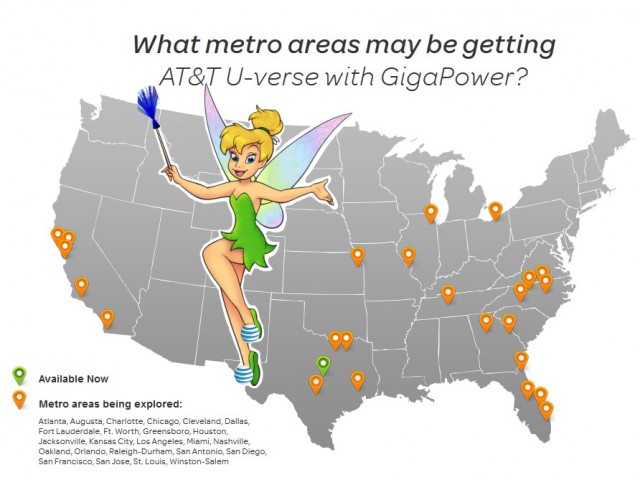
Notice the word "may"

AT&T’s Fiber Fairy Tale

Holding your breath waiting for AT&T’s GigaPower 1Gbps U-verse upgrade to arrive in a town near you is hazardous to your health.

Despite a blizzard of press releases promoting the forthcoming arrival of gigabit Internet access from AT&T, the fine print reveals as little as one percent of some communities will actually get the upgrades.

In Winston-Salem, N.C., city officials cannot even get a firm commitment from AT&T that it will deliver the faster service to the 63 businesses the city chose as early candidates for the fiber upgrade.

In June, the city and AT&T signed an agreement for gigabit broadband expansion using AT&T’s GigaPower U-verse platform. But AT&T largely gets to decide where, when and even if it will invest in upgraded service. The city did not impose many conditions beyond a requirement that AT&T provide up to 20 free Internet connections to community sites with a one-time installation cost of $300 to $500. Another 20 connections would be provided to small to mid-size businesses, with no obligation to buy services.

In response, AT&T said it would only commit to reviewing the city’s list and “make an effort to serve the proposed locations if they are in the vicinity of where service will be available.”

If those locations fall outside of AT&T’s plans, no gigabit fiber.

A significant indicator of the true extent of AT&T’s expansion plans is whether the company is allocating capital spending commensurate with the costs of running fiber optic cable to individual homes and businesses. So far, AT&T has not. With no obligation to deliver the service AT&T is implying it will offer, the company is free to wire a handful of technology parks, businesses, and new housing developments and claim to have met its commitment, despite the fact 99 percent of area residents have no access to the faster speeds.

For the benefit of low-income residents who lack affordable Internet access, AT&T also promised it would offer some lower-speed Internet connections in a limited number of apartment complexes in low-income areas.
Here are the sites nominated by the city of Winston-Salem for AT&T gigabit broadband. AT&T’s response: ‘Maybe.’

Community sites: Aids Care Service; Boys & Girls Clubs at New Walkertown Road and Reynolds Park; Brown & Douglas Neighborhood Center; Russell Recreation Center; Liberty CDC; Community Care Center; ElBuen Pastor; Forsyth Technical Community College’s Woodruff Center; Gateway YWCA; Knollwood Baptist Church; Little Creek Neighborhood Center; Malloy/Jordan East Winston Heritage Center; MLK Jr. Center; Reynolda Branch library; S.G. Atkins CDC; SciWorks; Sedge Garden Center; Shepherd’s Center; South Fork Center; Southside Library; United Metropolitan Church; Winston Lake YMCA.

Small- to mid-size businesses: Bellomy Research; Campus Partners; Carolina Liquid Chemistries Corp.; Center for Design Innovation; CML Microcircuits (USA); Computer Credit Inc.; Computing Solutions Group Inc.; COR365 Innovation Solutions; Dairy Fresh Inc.; DataChambers LLC; Davenport Transportation Consulting; Debbie’s Staffing Service; Eastridge Technology Inc.; Exhibit Works; Flywheel; IMG College; Interact 911; KeraNetics LLC; Key Services Inc.; Kings Plaza; MissionMode; Ocular Systems; Odigia; OnceLogix LLC; Out of Our Minds Animation Studios Inc.; Page’s Sporting Goods; PhoneTree; Piedmont Propulsion; Segmented Marketing Solutions Inc.; Small Footprint Inc.; SolidSpace LLC; Special Event Services; Sunrise Technologies Inc.; The Clearing House Payment Center; Triad Semiconductor; TrueLook; Voyss Solutions; Washington Perk site at Washington Park; West 3rd Street Media; West End Mill Works.

Source: City of Winston-Salem

New York City Comptroller Unimpressed With Comcast/Time Warner Cable Merger

one mbps

“Hey look, is that the Verizon FiOS truck?”

New York City comptroller Scott Stringer is lukewarm at best about the idea of Comcast taking over for Time Warner Cable. In a letter to the New York Public Service Commission released today, Stringer says the deal needs major changes before it comes close to serving the public interest.

“As New York City residents know all too well, our city is stuck in an Internet stone age, at least when compared to other municipalities across the country and around the world,” Stringer wrote. “According to a study by the Open Technology Institute at the New America Foundation, New Yorkers not only endure slower Internet service than similar cities in other parts of the world, but they also pay higher prices for that substandard service. Tokyo residents enjoy speeds that are eight times faster than New York City’s, for a lower price. And Hong Kong residents enjoy speeds that are 20 times faster, for the equivalent price.”

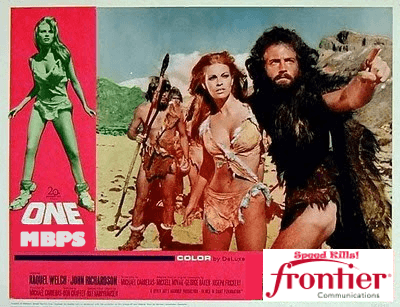
Stringer should visit upstate New York some time. While the Big Apple is moving to a Verizon FiOS and Time Warner Cable Maxx or Cablevision/Optimum future, upstate New York is, in comparison, Raquel Welch-prehistoric, especially if your only choice is Verizon “No, We Won’t Expand DSL to Your House,” or Frontier “3.1Mbps is Plenty” Communications. If New York City’s speeds are slow, upstate New York speeds are glacial.

“The latest data from the FCC shows that, as of June 30, 2013, over 40 percent of connections in New York State are below 3Mbps,” Springer added.

Come for the Finger Lakes, but don’t stay for the broadband.

Should the merger be approved, Comcast would be obligated to comply with the existing franchise agreement between Time Warner Cable and the City of New York. However, in order for the proposed merger to truly be in the public interest, Comcast must have a more detailed plan to address these ongoing challenges and to further close the digital divide that leaves so many low-income New Yorkers cut off from the information superhighway. To date, Comcast’s efforts to close the digital divide have focused on its “Internet Essentials” program, which was launched in 2012.iii The program offers a 5 megabit/second connection for $9.95/month (plus tax) to families matching all of the following criteria:

• Located within an area where Comcast offers Internet service
• Have at least one child eligible to participate in the National School Lunch Program
• Have not subscribed to Comcast Internet service within the last 90 days
• Does not have an overdue Comcast bill or unreturned equipment

While the aim of the program is laudatory, its slow speed, limited eligibility, and inadequate outreach have kept high-quality connectivity beyond the reach of millions of low-income Americans. Not only are the eligibility rules for Internet Essentials far too narrow, but the company has done a poor job of signing up those who do meet the criteria. In fact, only 300,000 (12 percent) of eligible households nationwide have actually signed up since the program was launched in 2011.

It is critical that the PSC not only press Comcast to significantly expand the reach of Internet Essentials, but also that it engage in appropriate oversight to ensure that the company is meeting its commitments to low-income residents of the Empire State.

Phillip "Comcast isn't the answer to the problem, it's the problem itself" Dampier

Phillip “Comcast isn’t the answer, it’s the problem” Dampier

In fact, the best way New York can protect its low-income residents is to keep Comcast out of the state. Time Warner Cable offers everyday $14.99 Internet access to anyone who wants it as long as they want it. No complicated pre-qualification conditions, annoying forms, or gotcha terms and conditions.

When a representative from the PSC asked a Comcast representative if the company would keep Time Warner’s discount Internet offer, a non-answer answer was the response. That usually means the answer is no.

“We have seen how telecommunications companies will promise to expand access as a condition of a merger, only to shirk their commitments once the merger has been approved,” Springer complained. “For instance, as part of its 2006 purchase of BellSouth, AT&T told Congress that it would work to provide customers ‘greater access and more choices for broadband, no matter where they live or work.’ However, later reports found that the FCC relied on the companies themselves to report their own merger compliance and did not conduct independent audits to verify their claims.”

Big Telecom promises are like getting commitments from a cheating spouse. Never trust… do verify or throw them out. Comcast still has not met all the conditions it promised to meet after its recent merger with NBCUniversal, according to Sen. Al Franken (D-Minn.).

Stringer also blasted Comcast for its Net Neutrality roughhousing:

While the FCC has not declared internet providers to be “common carriers”, state law has effectively done so within the Empire State. Under 16 NYCRR Part 605, a common carrier is defined as “a corporation that holds itself out to provide service to the public for hire to provide conduit services including voice, data, or video by electrical, electronic, electromagnetic or photonic means.”

Importantly, the law requires these carriers to “provide publicly offered conduit services on demand to any similarly situated user on substantially similar terms, subject to the availability of facilities and capacity.”

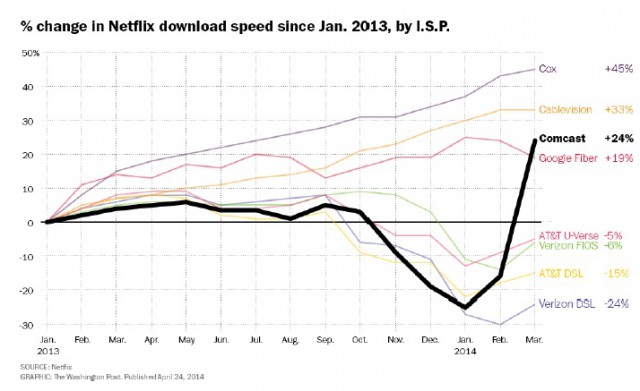
In recent months, Comcast has shown that it is willing to sacrifice net neutrality in order to squeeze additional payment out of content providers, such as Netflix. As shown in the chart below, Netflix download speeds on the Comcast network deteriorated rapidly prior to an agreement whereby Netflix now pays Comcast for preferential access.

speed changes

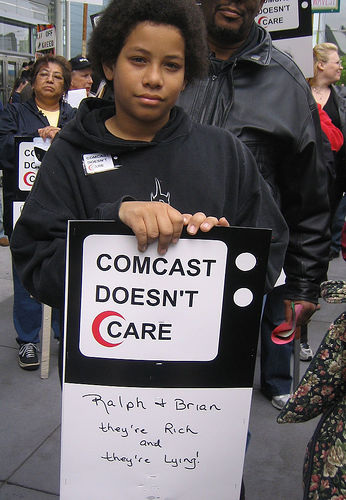
concast careConsumers have a legitimate fear that if access to fiber-optic networks is eventually for sale to the highest bidder, then not only will it stifle the entrepreneurial energy unleashed by the democratizing forces of the Internet, but will also potentially lead to higher prices for consumers in accessing content. Under that scenario, consumers are hit twice—first by paying for Internet access to their home and second by paying for certain content providers’ preferred access.
Internet neutrality has been a core principle of the web since its founding and the PSC must examine whether Comcast’s recent deal with Netflix is a sign that the company is eroding this principle in a manner that conflicts with the public interest.

Stringer may not realize Comcast also has an end run around Net Neutrality in the form of usage caps that will deter customers from accessing competitors’ content if it could put them over their monthly usage allowance and subject to penalty rates. Comcast could voluntarily agree to Net Neutrality and still win by slapping usage limits on all of their broadband customers. Either causes great harm for competitors like Netflix.

“I urge the Commission to hold Comcast to that burden and to ensure that the merger is in the best interest of the approximately 2.6 million Time Warner Cable subscribers in New York State and many more for whom quality, affordable Internet access remains unavailable,” Stringer writes. “And I urge Comcast to view this as an opportunity to do the right thing by introducing itself to the New York market as a company that values equitable access and understands that its product—the fourth utility of the modern age—must be available to all New Yorkers.”

If Comcast’s existing enormous customer base has already voted them the Worst Company in America, it is unlikely Comcast will turn on a dime for the benefit of New York.

The best way to ensure quality, affordable Internet access in New York is to keep Comcast out of New York.

No cable company has ever resolved the rural broadband problem. Their for-profit business model depends on a Return on Investment formula that prohibits expanding service into unprofitable service areas.

These rural service problems remain pervasive in Comcast areas as well, and always have since the company took over for AT&T Cable in the early 2000s. Little has changed over the last dozen years and little will change in the next dozen if we depend entirely on companies like Comcast to handle the rural broadband problem.

A more thoughtful solution is encouraging the development of community co-ops and similar broadband enterprises that need not answer to shareholders and strict ROI formulas.

In the meantime, for the good of all New York, let’s keep Comcast south (and north) of the border, thank you very much.


Rogers Harrasses Downgrading Customers With Browser Injection Messages

Phillip Dampier July 22, 2014 Broadband Speed, Canada, Competition, Consumer News, Data Caps, Rogers Comments Off on Rogers Harrasses Downgrading Customers With Browser Injection Messages

Plan on downgrading your Rogers cable, phone or Internet service? Be ready for messages injected into your web browsing sessions by the cable company trying to win back your business.

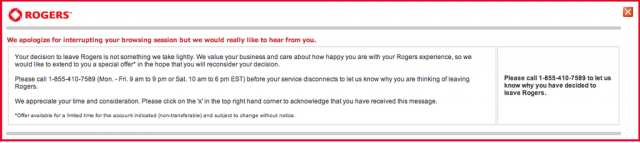
Daryl Fritz from Toronto decided to cancel his Rogers’ home phone and television service and downgrade his Internet service. Fritz soon found this banner intruding on every web page he tried to visit:

rogers

Your decision to leave Rogers is not something we take lightly. We value your business and care about how happy you are with your Rogers experience, so we would like to extend a special offer* in the hope that you will reconsider your decision. Please call 1-855-410-7589 (M-F 9am-9pm/Sat 10am-6pm ET) before your service disconnects to let us know why you are thinking of leaving Rogers. We appreciate your time and consideration. Please click on the “X” in the top right hand corner to acknowledge that you have received this message.

*-Offer available for a limited time for the account indicated (non-transferable) and subject to change without notice.

rogersThe banner usually disappears after the customer acknowledges receiving it. Stop the Cap! has learned the number directs callers to Rogers’ customer retention department where customers are pitched special discounts to change their mind. The prices are comparable, if not better, than new customer promotions found on Rogers’ website. Rogers is far less annoying than Comcast is when it faces losing a customer. If a customer rejects the offer (or never calls in to hear one), they are not bothered any longer and the representative thanks them for their time.
Rogers retention offers are often extremely aggressively priced, especially if mentioning you are leaving for a competitor (especially Bell). Rogers reps can slash prices, put you on a high usage broadband plan at prices lower than what regular customers pay for slower speeds, waive usage caps for a few dollars more, lock in rates for up to eight years, and offer heavy discounts off almost everything.

One current example for cable television:

  • 30% off basic cable ($28/mo instead of $40)
  • TFC ($15/mo)
  • NextBox 2.0 set-top (free) NextBox 3.0 ($2.50/mo)
  • Digital Services Fee (eliminated)
  • CRTC LPIF (it’s the government — $0.50/mo)

rogersThis can knock your Rogers cable bill down to $46/month before GST and other taxes.

Broadband customers can grab a 50% discount off plans like Hybrid Fibre 150 (GTA), normally $86 a month, but $43 on a retention plan. Customers get 150Mbps and 350GB of usage. If you don’t want a cap, demand a deal to remove it (it regularly costs $25/month extra for unlimited). The modem rental is included.

If you still want Rogers Home Phone, you are paying too much if it costs over $20 a month. Home Phone Favourites, including Call Display and one other calling feature of your choice is $15/month on retention. Add 500 long distance minutes for $5/month extra.

All three services combined should cost no more than about $104 a month before GST, which adds $13.52 in Ontario. Provincial taxes vary.

New Rogers customers can also get very aggressively priced deals. This week Rogers is selling 30/5Mbps Internet service (includes 270GB allowance and free modem) for $54.95. Regularly, it’s $61.99 with only a 70GB monthly usage allowance. That is still outrageously high by American standards, but isn’t bad for Rogers. New customers should call 1-800-605-6678 to ask about current offers.

Bright House Introduces “Echo”; Extended Range for Your In-Home Wi-Fi Using MoCA Technology

bright house echo

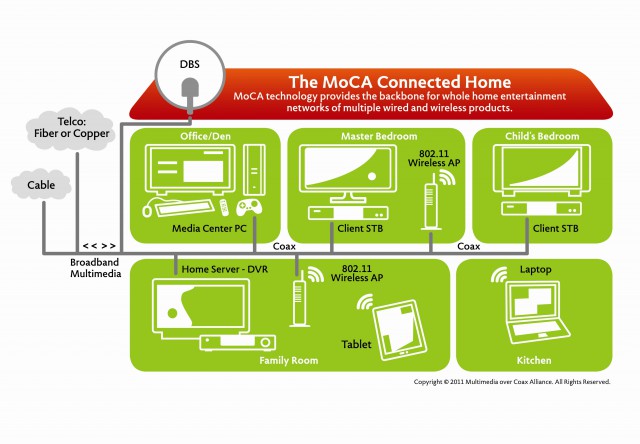
Bright House Networks is leveraging their partnership with the Multimedia over Coax Alliance (MoCA) to bring an end to Wi-Fi dead spots with the introduction of Echo, a scalable in-home Wi-Fi network.

Echo expands the coverage of a traditional in-home wireless router by adding wireless access points in areas where Wi-Fi reception is poor. All a customer needs is a nearby Bright House cable connection. The new service isn’t a traditional wireless repeater. Echo relies on a wired connection between the access point and your cable modem/router using Bright House’s existing coaxial cable inside your home.  The result is faster, more reliable Wi-Fi.

Moca-connected-home2“This is an Advanced Wireless Gateway, a next generation, dual-band modem/router that delivers more range and signal strength,” says Bright House. “From there, Echo Access Points can be used anywhere there is a cable outlet. An access point is a small device that works in conjunction with the modem to extend the home network. Connecting an access point extends the wired network because each access point has two Ethernet ports. Echo turns your existing coaxial cable network into a robust Ethernet network which means that if you have Lightning 90, you should receive speeds up to 90Mbps from the modem and each access point. Connecting an access point also extends the wireless network because each access point is its own Wi-Fi hotspot.”

MoCA is a compelling technology for customers who do not want multiple cable runs installed in their home or business. Originally designed primarily to transport video from “whole house” master DVR’s to remote set-top boxes and other devices, the technology is evolving into an a comprehensive in-home wired coax network capable of moving high-speed data, video, audio, and other traffic concurrently. Everything moves across the same cable TV wiring already in many homes.

Cable, telephone and satellite companies are contemplating introducing a number of MoCA-enabled features, some similar to Bright House’s Echo. Every cable outlet can potentially be a Wi-Fi hotspot as well as the source for IPTV services like Roku, Apple TV, or even cable television without the need of a traditional set-top box.

Bright House will initially market Echo to less technically proficient customers uncomfortable configuring wireless repeaters or remote access points.

Early reports indicate Bright House will charge a $29.95 mandatory trip charge to install and configure the service. Return visits to add extra access points run $29.95 per visit. Echo’s monthly cost starts at $10 — $6 for the service and $4 for the equipment. There is an extra charge of $3 a month for each access point.

The service was expected to launch this week, starting in Florida.

Search This Site:

Contributions:

Recent Comments:

Your Account:

Stop the Cap!