 A group largely funded by the telecommunications industry is among the latest to call on Congress to pass net neutrality legislation, just as long as the cable and phone companies that have fiercely opposed net neutrality as we know it get the chance to effectively write the law defining their vision of a free and open internet.
Broadband for America (BfA) has long pretended to represent the interests of consumers. It has tried to steer clear of partisan politics by representing itself as a bipartisan organization, claiming that since its formation in 2009, the Broadband for America coalition “has included members ranging from consumer groups, to content and application providers, to the companies that build and maintain the internet. Together these organizations represent the hundreds of millions of Americans who are literally connected through broadband.”
In this spirit, BfA has given top priority to adopting a new, bipartisan, federal net neutrality law that would eliminate the regulatory uncertainty changing administrations have introduced through agencies like the FCC.
The telecom industry shuddered under the Obama Administration’s FCC with Thomas Wheeler as chairman. Wheeler pushed for bright line net neutrality rules that cut off the industry’s ability to toy with paid fast lanes on the internet, potentially costing telecom companies billions in future revenue opportunities. Wheeler backed his regulatory authority by using Title II regulations that have withstood corporate court challenges since the 1930s, and made clear that authority also extended to blocking or banning future creative monetization schemes that unfairly favored some internet traffic at the expense of other traffic.
The incoming Trump Administration discarded almost every regulatory policy introduced by Wheeler through its appointed FCC chairman, Ajit Pai. With Republicans in firm control at the FCC, in the White House, and in Congress, the broadband industry and its political allies feel safe to draft and pass a new federal law that will give companies regulatory certainty. One proposal could potentially permanently remove the FCC’s future ability to flexibly manage changing broadband industry practices.
BfA’s “pro net neutrality” campaign directly targets consumers through its website while also pretending to represent their interests. It is a classic D.C. astroturfing operation — fooling unwitting consumers into pushing for policies against their best interests. BfA claims it supports “policies that align with the core principles of an open internet: no blocking, no throttling, no discrimination and most importantly, ensuring all consumers have access to internet. Further, despite state efforts, only Congress maintains the power to regulate the internet.”
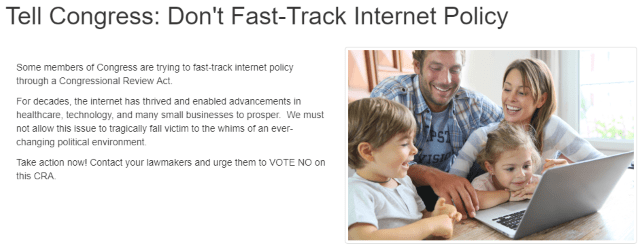
Broadband for America’s campaign to block this legislative maneuver actually helps net neutrality opponents.
Since no phone or cable company in the country is seeking to block, throttle, or discriminate against certain websites, passing a law that prohibits this is not controversial. But BfA does not mention other, more threatening practices ISPs have toyed with in recent years that would be banned by robust net neutrality rules. At the top of the list is “paid fast lanes,” allowing preferred content partners to get preferential treatment on sometimes clogged internet pipes. As past controversies between Netflix and Google over interconnection agreements illustrate, if an internet provider refuses to continually upgrade traffic pipelines, all traffic can suffer. With paid prioritization, some traffic will suffer even more because of preferential treatment given to sponsored traffic. The industry does not call this throttling, and some ISPs have blamed content providers for the problem, suggesting Netflix and YouTube traffic unfairly takes a toll on their networks.
BfA also objects to state efforts to bring back net neutrality, claiming such regulatory powers only belong in the hands of the federal government (especially the current one). It is no coincidence BfA’s beliefs and policies mirror their benefactors. While claiming to represent the interests of consumers, BfA is almost entirely funded by: AT&T, CenturyLink, Charter, CTIA – The Wireless Association, Comcast, Cox, NCTA – The Internet & Television Association, Telecommunications Industry Association (TIA), and USTelecom-The Broadband Association. The only major American telecom company not on this list is Verizon, but their interests are represented by USTelecom, an industry-funded lobbying group that backs America’s top telephone companies.
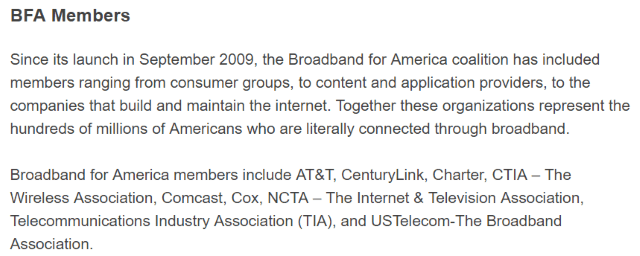
Broadband for America shares a list of some of its members — all a part of the cable, wireless, and telephone industry.
Under the guise of the midterm elections, BfA issued a new call for federal legislation enforcing the telecom industry’s definition of net neutrality, and not just on telecom companies. BfA also wants regulation of “edge providers,” a wonky term that means any website, web service, web application, online content hosting or online content delivery service that customers access over the internet. In reality, the only edge providers the industry is concerned with are Apple, Amazon, Google, Microsoft, and Facebook — companies that often directly compete against telecom company-backed content ventures and lucrative online advertising. Ironically, many Republicans that have strongly argued for deregulation have supported imposing new laws and regulatory oversight on some of these companies — notably Google and Facebook. Amazon joined the list as a result of President Trump’s ongoing feud with Jeff Bezos, Amazon’s CEO and owner of the Washington Post.
 Backing the BfA’s lobbying push for a new net neutrality law are results from a suspect BfA-commissioned (and paid for) study by a polling firm that claims “87 percent of voters ‘react positively to arguments for a new legislative approach that sets one clear set of rules to protect consumer privacy that applies to all internet companies, websites, devices and applications.’” A full copy of the study, the exact questions asked during polling, and more information about the sampling process was not available to review. Instead, the conclusions were posted as an opinion piece by Inside Sources, a website that provides D.C. strategy, public relations, and lobbying firms with a free home to publish OpEds on behalf of their clients. Newspapers are allowed to reprint Inside Sources wire service content for free, sometimes without full disclosure of the financial arrangements behind the studies or author(s) involved.
The BfA campaign for a federal net neutrality law is not in isolation. The telecom industry has been on an all-out push for a new net neutrality law since Ajit Pai led the campaign to repeal the FCC rules. The industry’s campaign for pseudo-net neutrality has even won over some in the media like the editorial board of the Washington Post, that published its own OpEd in early October calling Wheeler’s use of Title II authority a regulatory overreach. The Post also has no patience for lawsuits being filed by telecom companies and the Justice Department against the state of California after passing its own statewide net neutrality law. The industry pushback in court is part of the Post’s argument for a new national law to ‘end confusion’:
The fight over net neutrality today can be reduced to a single sentence: Everyone is suing everyone else. Congress should step in.
The Justice Department said Sunday it will take California to court over its law requiring Internet service providers to treat all traffic equally. Those ISPs were already primed to sue states on their own. And California is one of more than 20 states suing the Federal Communications Commission over its repeal of the Obama administration’s rules. “We’re not out to protect the robber barons. We want to protect the people,” California Attorney General Xavier Becerra (D) told us.
The FCC abdicated its responsibility on net neutrality when it repealed the old rules with no adequate replacement. Now, without setting forth its own rules, the federal government is seeking to block states from creating their own. That may be frustrating to Americans who want an Internet where providers do not dictate what information reaches them and how fast. But a nationwide framework governing net neutrality would be preferable to a patchwork of state regulations establishing local regimes for systems that transcend borders. And creating that framework is up to Congress.
But not all are confused. California resident Bob Jacobson defended his state’s interests in a rebuttal to the Post’s editorial:
Absurd reasoning emanating from the nation’s capital of corruption, Washington, DC. California has always led the nation — including the Federal government — in the sensible, productive regulation and consequent growth of its telecom and information economy, now the world’s largest. The Moore Universal Telecom Services Act, passed in reaction to the breakup of the old AT&T, is still the nation’s only comprehensive, progressive telecom policy, its success reflected in California’s robust technological and social infrastructure. Rather than supersede California’s policies, our national and other state legislature’s and regulatory agencies should learn from and adapt them to better serve equally all the American people. (And get rid of that mockery known as the Trump FCC.)


 Subscribe
 WASHINGTON (Reuters) – The U.S. Supreme Court on Monday refused a request by the Trump administration and the telecommunications industry to wipe away a lower court decision that had upheld Obama-era net neutrality rules aimed at ensuring a free and open internet, though the justices’ action does not undo the 2017 repeal of the policy.
 WASHINGTON (Reuters) – Four industry groups representing major internet providers and cable companies filed suit on Wednesday seeking to block California’s new law to mandate net neutrality rules.
 U.S. Attorney General Jeff Sessions said on Sunday in a statement that the “the California legislature has enacted an extreme and illegal state law attempting to frustrate federal policy.”
 California Attorney General Xavier Becerra said on Sunday the Trump Administration was ignoring “millions of Americans who voiced strong support for net neutrality rules.”
 Charter Communications’ takeover of Time Warner Cable and Bright House Networks has not proved popular, according to a new survey from Temkin Group.
 This marks the eighth year Temkin has published its Temkin Experience Ratings, generated from compiling the results of a survey of 10,000 U.S. consumers about their recent interactions with 318 significant U.S. companies. Temkin measures three dimensions of a customer’s experience: