Subscribe
House Energy & Commerce Committee
Democrats serving on the House Energy & Commerce Committee today blasted the nation’s largest internet service providers for price increases and data caps placed on consumer broadband services at the height of a global pandemic, questioning the industry’s commitment to keeping Americans connected.
“Over the last ten months, internet service became even more essential as many Americans were forced to transition to remote work and online school. Broadband networks seem to have largely withstood these massive shifts in usage,” wrote Democratic Reps. Frank Pallone, Jr (N.J.), Mike Doyle (Penn.) and Jerry McNerney (Calif.). “Unfortunately, what cannot be overlooked or underestimated is the extent to which families without home internet service — particularly those with school-aged children at home — have been left out and left behind.”

Pallone
The congressmen questioned nine providers after reading media coverage of rate hikes and the implementation of data caps by Comcast and the potential for Charter Spectrum to impose data caps as early as May 2021.
“This is an egregious action at a time when households and small businesses across the country need high-speed, reliable broadband more than ever but are struggling to make ends meet,” the three Democrats wrote.
In March 2020, many cable and phone companies relaxed a number of restrictions on customers in response to the emerging COVID-19 pandemic. Many volunteered to suspend data cap overlimit fees, provide affordable broadband options to the economically disadvantaged, offer free months of service, open restricted Wi-Fi hotspots, and discontinue collection efforts or service disconnects on customers falling behind on bills.
Despite the pledge, consumers filed a significant number of complaints with the Federal Communications Commission alleging the companies broke their promises, by far most often for not following through on free service offers or continuing aggressive collections of past due bills and shutting off service.
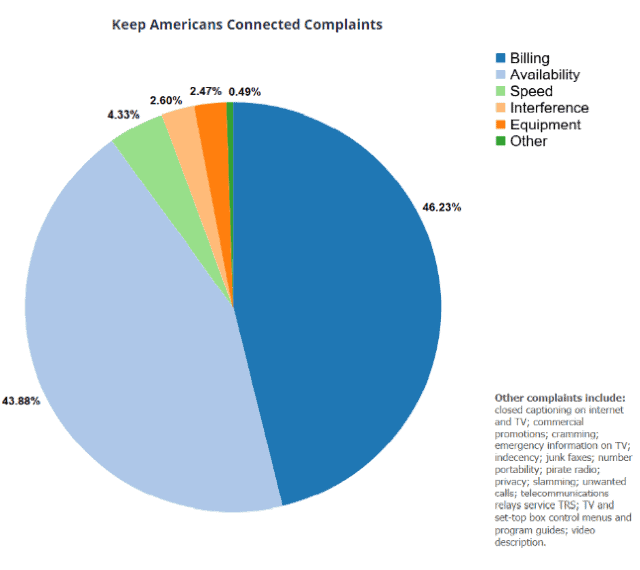
Consumer complaints filed with the FCC regarding the “Keep America Connected” pledge, received from March-November 2020. (Source: FCC)
The Energy and Commerce Committee has now sent letters to the CEOs of many providers, seeking answers to these questions as part of ongoing oversight of the industry:
- Did the company participate in the FCC’s “Keep Americans Connected” pledge?
- Has the company increased prices for fixed or mobile consumer internet and fixed or phone service since the start of the pandemic, or do they plan to raise prices on such plans within the next six months?
- Prior to March 2020, did any of the company’s service plans impose a maximum data consumption threshold on its subscribers?
- Since March 2020, has the company modified or imposed any new maximum data consumption thresholds on service plans, or do they plan to do so within the next six months?
- Did the company stop disconnecting customers’ internet or telephone service due to their inability to pay during the pandemic?
- Does the company offer a plan designed for low-income households, or a plan established in March or later to help students and families with connectivity during the pandemic?
- Beyond service offerings for low-income customers, what steps is the company currently taking to assist individuals and families facing financial hardship due to circumstances related to COVID-19?
The full letters are available below:
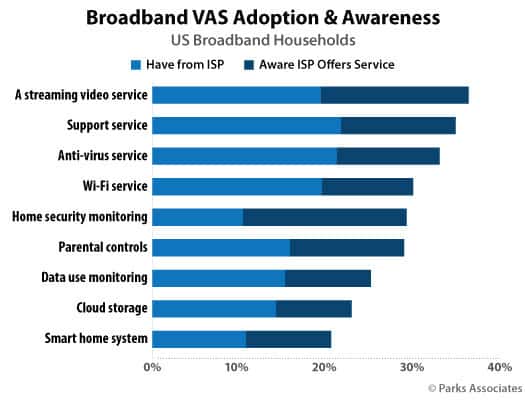
 Currently, only a few providers aggressively promote value-added services. Many already provide anti-virus/malware software as part of their broadband service offering. Others, like Charter/Spectrum, have soured on selling value-added services in favor of a simplified menu of services and options. Spectrum ceased supporting Time Warner Cable and Bright House Networks’ legacy home security/automation services in early 2020. Some phone companies, notably Frontier Communications, have long depended on value-added services to bolster revenue for its increasingly beleaguered DSL internet service. Frontier heavily markets anti-virus, enhanced tech support, and wiring maintenance services to customers, which can add a considerable amount to a customer’s bill.
 With the average speed of DSL service under 10 Mbps in rural counties across the United States, this legacy technology is disenfranchising a growing number of rural Americans and is largely responsible for dragging down overall U.S. internet speed scores. Only satellite internet offers overall lower speed and poor customer satisfaction, according to consumer surveys.

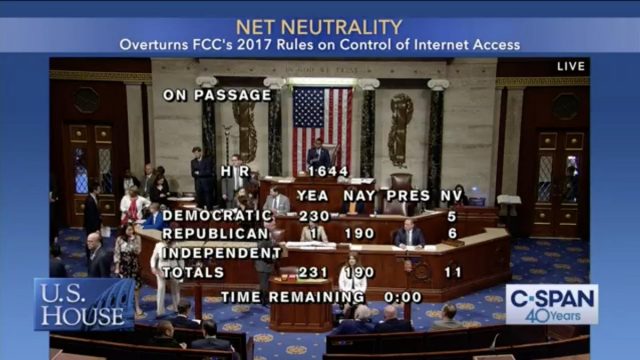 The House on Wednesday approved a bill on a 232 to 190 vote along party lines to restore net neutrality protections first adopted in 2015, but repealed in 2018 by the Republican majority serving the Trump Administration’s Federal Communications Commission under the leadership of Chairman Ajit Pai.