Home » rate increases » Recent Articles:

Time Warner Cable Customers in Upstate New York Howling About Broadband Rate Hikes

frontier offer

Frontier is enticing Rochester-area customers to “say goodbye to Time Warner Cable.”

Time Warner Cable’s relentless rate increases, particularly on its broadband service, are leading to calls for more competition in the upstate New York cities of Buffalo and Rochester, now dominated by Time Warner, Verizon Communications (Buffalo), and Frontier Communications (Rochester).

“Bloodsuckers,” came the terse reply of Cathy Slocum.

Frontier Communications is making the most out of the cable company rate increases with a new “Goodbye Time Warner” ad campaign (that incidentally includes a link to Stop the Cap!’s coverage of TWC’s modem fee). It is pitching $19.99 broadband price-locked for two years — an improvement over its earlier offers thanks to a major reduction in sneaky fine print.

Customers can get up to 6Mbps service (up to 12Mbps available in limited areas) at the special offer price as long as they keep a Frontier landline active with a qualifying calling package. There are no contracts with this promotion, but Frontier’s pesky $9.99 “Broadband Processing Fee” applies if customers ever choose to disconnect Internet service. A free Wi-Fi Internet router is included and the company claims it offers “free Internet activation.” But an installation fee still applies, discounted if customers choose the self-install option. Taxes, governmental and other Frontier-imposed surcharges also apply and new Frontier customers are subject to credit approval, which will show up as an inquiry on your credit report.

In the past, we have taken Frontier to task for its expensive early termination and modem rental fees, as well as its bundling requirements, but the company has since ditched most of these as part of its new self-proclaimed reputation as “BS free.”

Unfortunately, Frontier’s DSL speeds can wildly vary, so if you take advantage of their offer, be sure to verify the speed actually get at your home or office. If the service proves too slow to your liking after installation, you can negotiate canceling within the first two weeks without any termination fees.

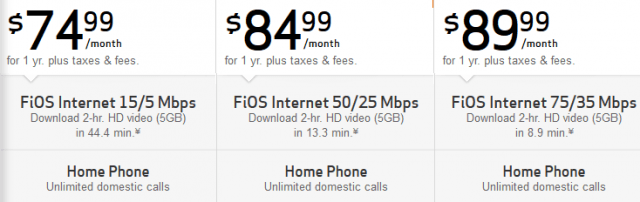
Where FiOS is available in Buffalo, Verizon is offering promotional pricing on its bundled services, including an $84.99 offer including 50/25Mbps Internet with a Verizon landline offering unlimited calling. This is cheaper than Time Warner’s offer with considerably faster upload speeds and no modem fees. In parts of Buffalo, Verizon is authorized to offer broadband and phone service only, although several suburbs have franchise agreements that allow the phone company to also sell television service. A large part of the city and other suburbs are still stuck with Verizon’s copper network, however, which means DSL is the best they can offer.

Time Warner Cable’s new customer promotions, useful when negotiating a customer retention deal, have resumed bundling Standard tier (15/1Mbps service) Internet speeds into most offers. Previously, the company bundled 3Mbps service in many of its promotions. Broadband-only customers can pay as little as $34.99 a month for a year of Internet service at 15/1Mbps speeds, assuming one buys their own cable modem. A double play offer of broadband basic television (around 20 channels, mostly local over-the-air) with 30/5Mbps Internet service is now priced at $94.97 a month after a $5.99 mandatory modem rental fee is included (not optional with this package).

Time Warner Cable executives have repeatedly told investors its higher priced promotions are intentional to increase revenue and profits even if the company loses customers by charging higher prices.
fios offers

Verizon FiOS offers in the Buffalo area.

“I moved here from the New York City area a year ago where we had two cable companies — Cablevision and Verizon FiOS,” noted Stephen O’Brien. “Competition changes everything. Not only were the rates much lower than here, the companies would offer you all kinds of incentives to switch from one to the other. One time we switched and got a free iPod Touch. The argument that the rate increase is needed to cover investment is the biggest red herring of all — Cablevision and FiOS spent many times more on infrastructure, yet their rates were much lower.”

Stop the Cap! recommends Time Warner Cable customers check out our guide to getting the best deal possible from TWC.

[flv width=”640″ height=”380″]http://www.phillipdampier.com/video/WGRZ Buffalo Time Warner Rate Hikes 8-6-13.flv[/flv]

WGRZ in Buffalo reports upstate New York residents are upset about two recently announced broadband rate hikes. Time Warner Cable says it needs the money to keep up its broadband service’s reliability. What alternatives do customers have?  (2 minutes)

Comcast Has ‘Plenty of Broadband Capacity,’ Reserves the Right to Acquire Others

Phillip Dampier August 1, 2013 Broadband "Shortage", Broadband Speed, Comcast/Xfinity, Competition, Consumer News, Online Video, Public Policy & Gov't, Video, Wireless Broadband Comments Off on Comcast Has ‘Plenty of Broadband Capacity,’ Reserves the Right to Acquire Others
Big, Bigger, Biggest, Still Bigger

Big, Bigger, Biggest… Bigger Still

Comcast has plenty of available bandwidth to indefinitely expand its High Speed Internet services at speeds up to 3Gbps and believes it has won the legal right to grow its cable business as large as it likes.

Comcast executives admitted Wednesday they have more than enough network capacity to meet the demands of customers, both now and well into the future.

“With regard to usage and capacity, we feel the network is flexible and has plenty of opportunity to grow in capacity,” said Neil Smit, president and CEO of Comcast Cable Communications. Smit was responding to a Wall Street analyst asking about future capacity during a quarterly financial results conference call.

Smit noted that some of the biggest bandwidth users served by Comcast are businesses, and the cable operator was well-positioned to service them by extending fiber or deploying its Metro Ethernet product. Residential customers get increased bandwidth through neighborhood node splitting or DOCSIS 3 channel bonding that combines several channels together to increase speed and capacity.

Brian Roberts, CEO of Comcast Corporation, agreed with Smit, adding, “the more the consumer desires speed, the better that is for our company.”

Roberts noted DOCSIS 3.1 — the next generation of cable broadband — was “promising technology.”

“At the cable convention, we demonstrated 3Gbps” over Comcast’s existing cable infrastructure, said Roberts.

Smit

Smit

Comcast is easily the country’s largest cable operator, but many believe it is restrained from growing larger through mergers and acquisitions because of antitrust concerns. But thanks to a number of lawsuits initiated by Comcast, the company believes it can now grow as large as it likes.

Roberts admits the question of cable industry consolidation remains a gray area, particularly for Comcast. But he told investors he does not believe there are any remaining legal hurdles preventing Comcast from buying out other cable operators, despite earlier FCC rulemakings limiting the maximum size a cable company can grow through buyouts.

Comcast yesterday announced its last buyout — NBCUniversal — helped fuel a 29% increase in net income in the second quarter, thanks in part to strong results from film and television.

But many of Comcast’s largest gains came from its cable business.

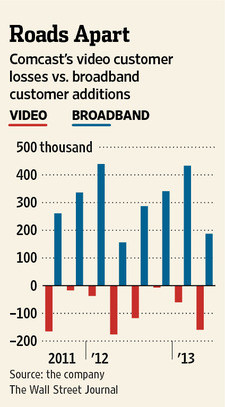
Despite continued losses of video subscribers (159,000 in the second quarter), Comcast’s cable revenue increased 5.8% to $10.47 billion, and operating cash flow grew 5.7% to $4.3 billion. Comcast, which also owns several NBC broadcast affiliates, is playing for both sides of the retransmission consent wars. Its owned and operated television stations have demanded higher fees to be carried on cable systems, many owned by Comcast itself. The increased programming costs fuel subscriber rate increases, which also boost revenue.

Broadband way up, although the company keeps losing video customers to cord-cutting.

Broadband is way up, although the company keeps losing video customers to cord-cutting.

Comcast’s broadband revenue has continued to grow dramatically. Customer additions for High Speed Internet access were up more than 20% in the quarter — the best second-quarter growth in five years — even as subscribers paid more for the service because of rate increases. Customer growth and price hikes delivered 8% growth in broadband revenue. In the last quarter alone, Comcast earned $2.6 billion from its broadband business.

Comcast is not spending a significant percentage of that revenue on enhanced broadband network upgrades. Instead, the company has increased investments to wire office parks and businesses to entice commercial customers, which account for a substantial amount of new customer growth. Comcast is also investing in research and development of new products and services, such as set-top boxes. The company also expects to pay 10% more in programming costs than it did a year earlier.

Year-to-date cable communications capital expenditures have increased 7.1% to $2.3 billion representing 11.3% of cable revenue. Comcast expects that for the full-year of 2013, cable capital expenditures will increase by about 10% over 2012.

Some other highlights from the quarter:

  • In the last six months, Comcast completed broadband speed increases for 70 percent of its customers;
  • High Speed Internet revenue was again the largest contributor to Comcast’s cable revenue growth;
  • At the end of the quarter, 33% of Comcast’s residential high-speed customers take a higher speed tier above its primary service;
  • Comcast has pushed Wi-Fi hard, installing more than four million wireless gateways and boosted Wi-Fi coverage to 250,000 hotspots through both cable partnerships and its home hotspot initiative;
  • Comcast’s new X1 cloud-based set-top platform has been introduced to more than half of its national service area and will be available everywhere by the end of 2013. By the end of the year, Comcast also expects to push a firmware update to installed boxes to upgrade them to its new X2 platform;
  • The average Comcast subscriber now pays the company $160 per month, up 7.4% from last year. Rate hikes, speed upgrades and growing programming packages account for the higher price;
  • 77% of Comcast video customers took at least two products and among those, 42% took phone, broadband and television service.

[flv width=”640″ height=”380″]http://www.phillipdampier.com/video/Bloomberg Comcasts Cable and Media Units Grow 7-31-13.flv[/flv]

Bloomberg reports Comcast is still having trouble holding on to its video-only customers, but broadband customer growth continues to explode. Comcast also does well because it owns a number of cable networks and entertainment properties. Expect Comcast to continue evolving its products to bring them closer to the things people do online.  (3 minutes)

Rogers Admits Charging More for Your Internet Access/Usage is Where The Big Money Is

Phillip Dampier July 25, 2013 Canada, Competition, Data Caps, Rogers 1 Comment
Bruce

Bruce

Charging usage-based pricing and monetizing your use of the Internet is key to enhanced profits and higher earnings as broadband becomes the key product for cable operators.

That is the view of Robert Bruce, president of the communications division of Rogers Communications, eastern Canada’s largest cable operator.

“[The Internet] is the key to the future of our business, hence monetizing the increased bandwidth usage will rapidly become the future across all our businesses, whether it is wireless or wireline,” Bruce told a financial analyst in response to a question about ongoing Internet rate increases from the cable company. “There are clearly some unlimited offers out there and we think they are fairly shortsighted as the Internet is the future of the business.”

Bruce believes there is plenty of room for future rate increases, especially as the cable company boosts Internet speeds and ends network traffic management, improving the perceived quality of Rogers’ Internet service.

“We have significantly enhanced the value of this product and over time it is our plan to monetize it accordingly,” Bruce explained to the analyst. “The price increase that you receive in the mail would have just been one step in the monetization that we think will continue as Internet service becomes the backbone product in the home.”

Rogers admits it will continue to lower the bar on customers with usage caps and higher broadband pricing.

Rogers admits it will continue to lower the bar on customers with usage caps and higher broadband pricing.

Ironically, Rogers is currently offering its own unlimited use plans, primarily in response to a competing offer from Bell.

Dr. Michael Geist, a broadband industry observer and law professor at the University of Ottawa notes competition is the only thing keeping Rogers’ pricing and usage caps in check.

“If the Bell offer disappears, so will the Rogers plan,” Geist predicts. “With limited competition, favorable pricing plans will come and go, with executives anxious to increase prices and implement usage caps. The only solution is sufficiently robust competition that all players are continually forced to improve service and keep pricing in check to retain and attract customers.”

Rogers may tell the public Canadian broadband is robustly competitive but the company signals something very different to the investor community. With OECD data already showing Canada among the ten most expensive countries for broadband service in the developed world, Rogers is primed to raise prices even higher as it further tightens Internet usage caps.

Rogers’ improvements in its broadband service do not necessarily correspond with the company’s pricing power. As consumers increasingly consider Internet access an essential utility in the digital economy, Rogers is finding it can set prices as it likes and regularly increase them without effective subscriber backlash. With most Canadians buying service from the cable or phone company, if both providers avoid a pricing war, investors will be able to extract OPEC-like earnings from the barely regulated service.

Providers routinely claim rate increases are tied to costly upgrades, but Rogers’ own financial statements and comments to shareholders say otherwise. The cost to deliver broadband service in Canada is dropping, but the price charged for Internet access and the overlimit fees collected when customers exceed their usage limit will continue to rise as a growing percentage of company revenue now depends on broadband service.

Time Warner Cable Raising Broadband Prices Again; $54.99/Month for Standard 15/1Mbps Service

Phillip Dampier July 25, 2013 Consumer News, Data Caps 3 Comments

timewarner twcTime Warner Cable is once again raising its broadband prices, reflecting the fact Internet access continues to be a “must-have” product with room to raise the cost without driving customers away.

On average Time Warner Cable customers in the northeast with broadband-only service will pay $3 more a month starting Aug. 9, according to public relations manager Joli Plucknette-Farmen. Customers now pay $51 a month for 15/1Mbps service. After the increase, customers will pay $54.99, not including the modem rental fee. In early 2010, customers were paying $39.95, around $15 less.

Time Warner Cable’s new broadband prices will range from $34.99 a month for Lite 1/1Mbps service to $104.99 a month for 50/5Mbps service.

The rate hike will likely spread across the rest of Time Warner Cable’s systems around the country over the summer and fall.

Plucknette-Farmen said the increase will help the company offer the best possible broadband service.

Not every customer will immediately face higher pricing. Customers on promotional pricing packages will remain unaffected until those offers expire.

Because Time Warner Cable increasingly prices its services on a customer-by-customer basis, assessing the full impact of rate changes is extremely difficult because customers can pay dramatically different rates for the same services. A Time Warner Cable customer paying regular prices for standalone Internet service will find their neighbors with bundled service packages paying much less and those with promotional/customer retention deals paying the lowest rates of all.

In 2012, Stop the Cap! wrote a guide for Time Warner Cable customers to negotiate a better deal for themselves. Readers report the method still works.

John Malone’s New Plans for Your Broadband: ISP Surcharges for Netflix, Online Video Use

Again with the domination thing.

Again with the domination and control thing.

Dr. John Malone is wasting no time reacquainting the cable industry with the kinds of classic power plays he used while running Tele-Communications, Inc. (TCI), then America’s largest and most powerful cable operator. Malone’s latest salvo: proposing new broadband pricing schemes that run afoul of Net Neutrality by charging consumers higher broadband prices if they watch online video services like Netflix.

Malone, increasing his influence over Charter Communications before launching the next wave of cable company consolidation, implied the industry is hurting from the lack of power and dominance it used to enjoy when it had an unfettered, territorial monopoly back in the 1980s. Malone told an audience at the annual shareholder meeting of Liberty Global he advocates getting the industry’s mojo back by returning to “value creation” pricing models — code language for new ways to charge customers higher prices or add-on fees.

Malone sees raising prices for Internet service key to bringing the industry back to the golden profits it used to enjoy selling television subscriptions, even as customers faced massive rate increases that doubled, tripled, or even quintupled rates for certain services.

Malone’s assessment of the eight current largest cable operators wiring the country: Snow White (Comcast) and the Seven Dwarfs (Everyone Else). The disorganized agendas of various cable operators are troublesome to Malone, who wants the industry to act in lock step with a unified, cooperating voice. Consumer groups call this kind of friendly cooperation “collusion.”

netflixpaywallMalone also thinks it is time to discard reliance on cable television to bring home the revenue and profits Wall Street expects. The industry should instead turn its earning attention to broadband, a product few Americans can live without. Malone believes the cable industry is not only positioned to control content distributed on its TV Everywhere online video platform for authenticated cable subscribers, but also have a say in competing content from Netflix, among others, which are totally reliant on the broadband pipes provided by ISPs.

With Netflix consuming a growing percentage of cable broadband resources, and possibly contributing to cable TV cord cutting, Malone does not advocate crushing its competition. Instead, he wants a piece of the action. How? By demanding online video providers pay for using cable broadband infrastructure. Consumers also face surcharges on their broadband accounts if they watch online video services like Netflix, Amazon, YouTube and other over-the-top-video. Malone also advocates the implementation of Internet Overcharging schemes like consumption billing and usage caps.

Malone’s “world of the future,” is, in reality, not much different from AT&T’s 2005 proclamation that use of AT&T’s broadband pipes should come at a cost to content producers.

Then-CEO Ed Whitacre’s public statements fueled support for Net Neutrality, which forbids broadband providers from traffic discrimination techniques like charging extra for certain content or artificially degrading service for producers who refuse to pay.

Malone’s incendiary ideas may be letting too much of the cat out of the bag, say some observers worried Malone’s rhetoric will remind people he was once labeled “the Darth Vader of Cable.” His statements could attract unnecessary attention that could be used to organize opposition.

Last week, the Wall Street Journal reported that broadband providers and content producers were already secretly cutting deals to exchange bandwidth for money without the public scrutiny Malone’s comments will generate.

The newspaper reports some of the biggest Net Neutrality proponents around, particularly Google, are quietly paying millions to large cable companies to guarantee their content reaches customers as quickly and smoothly as possible.

internettollAmong the top recipients: Comcast, which collects $25-30 million a year and Time Warner Cable, which nets “tens of millions of dollars” from Google, Microsoft, and Facebook.

The payments are buried in the murky world of “interconnection agreements” governing the backbone pipes carrying huge amounts of web traffic from popular websites and those owned by large telecom providers. Originally, content and broadband providers agreed to peering arrangements that would trade traffic without payment to each other. But as bandwidth-heavy online video began to turn those shared connections into lopsided floods of movies and TV shows headed into subscriber homes against a trickle of content coming back from broadband customers, the cable and phone companies began crying foul.

Netflix has so far navigated around paying Internet Service Providers directly to support their video content. Instead, it is building its own specialized content distribution network intended for ISPs to more effectively and efficiently deliver high bandwidth video. Connections to the Netflix network are free of charge to participating providers, but many ISPs are demanding to be paid.

Some content providers are fearful if they don’t pay, the free “peering” links will become hopelessly overcongested and slow web pages and services to a crawl.

For Verizon customers, that may have already happened as Netflix streams began stuttering and buffering earlier this month.

Cogent, which supplies Verizon with a considerable amount of Netflix traffic, immediately pointed the finger at the phone company for artificially degrading the Netflix viewing experience. Verizon promptly shot back:

Cogent is not compliant with one of the basic and long-standing requirements for most settlement-free peering arrangements: that traffic between the providers be roughly in balance. When the traffic loads are not symmetric, the provider with the heavier load typically pays the other for transit. This isn’t a story about Netflix, or about Verizon “letting” anybody’s traffic deteriorate. This is a fairly boring story about a bandwidth provider that is unhappy that they are out of balance and will have to make alternative arrangements for capacity enhancements, just like any other interconnecting ISP.

Cable giants like Malone see the battle as one the cable industry will have a hard time losing, because it is the only technology present in most communities that can handle the traffic and the growing demand for faster speeds.

Cable operators think content companies have a license to print money, especially since their success is built partly on broadband networks they don’t own or pay for delivering content to customers. At the same time, content companies fear they could be forced out of business if the cable industry decides to give itself preferential treatment.

[flv width=”504″ height=”300″]http://www.phillipdampier.com/video/WSJ Paying ISPs to Move Content 6-20-13.flv[/flv]

Reporters from The Wall Street Journal discuss the secret payment arrangements between content producers and some of America’s largest ISPs. (4 minutes)

Search This Site:

Contributions:

Recent Comments:

Your Account:

Stop the Cap!