Home » rate increases » Recent Articles:

Spectrum Raising Price & Speed Of Legacy ‘Everyday Low Price’ Internet

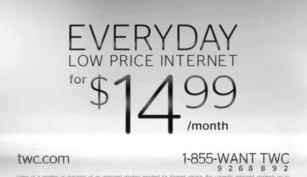
Time Warner Cable used to sell $14.99/mo slow speed internet. Spectrum agreed to grandfather the program for existing enrolled customers.

Charter Spectrum is raising both the speed and price of its legacy Everyday Low Price Internet package (ELP), formerly sold by Time Warner Cable.

Customers grandfathered on an existing Time Warner Cable ELP plan will see the following changes, reported by several of our readers, likely already in effect in some areas:

  • NY/NJ Customers: Speeds increased from 3/1 Mbps to 20/2 Mbps. Price increasing from $14.99/mo to $19.99/mo.
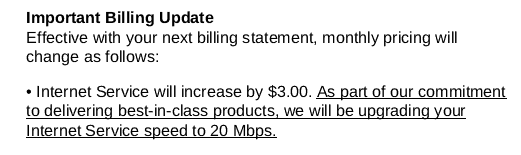
  • Other States: Speed increase to 20/2 Mbps. Customers will be notified of a $3 rate hike, bringing the new price to $27.99/mo.

A modem rental fee may also apply in most states, unless you use your own cable modem. Outside of New York and New Jersey, most legacy ELP customers have already experienced several gradual rate increases on this plan, which was originally sold nationwide for $14.99/mo. The first rate increase took most customers to $19.99/mo, followed by a rate increase last fall to $24.99/mo. Now Charter Spectrum has notified customers of another $3/mo rate hike, bringing the monthly rate to $27.99.

Stop the Cap! fought for and won a special concession for New York State residents as a consequence of the approval of the Time Warner Cable-Charter Communications merger. We requested the New York State Public Service Commission make the continued availability of price fixed ELP service a condition of the 2016 merger approval. The PSC agreed with us and made continued availability of the $14.99 service for at least three years part of the deal. That deal condition recently expired and Charter Spectrum is ready to raise the price of the service in New York and New Jersey, but also dramatically boost its download speed. New York and New Jersey residents will continue getting a substantial discount off the price Charter Spectrum charges elsewhere, at least for now.

Charter Spectrum Planning Major Fall Rate Increase: $70 Internet, $94 Cable TV

Phillip Dampier August 26, 2019 Charter Spectrum, Competition, Consumer News 44 Comments

Charter Spectrum TV customers will pay at least $94 a month for cable television starting this October, thanks to a sweeping rate increase that will hike the cost of TV packages, internet service, equipment, and fees. Internet customers will soon face a base price for internet service of just under $70 a month.

Cord Cutters News quotes an anonymous source that claims the rate increases will begin in October, and will impact just about every plan except phone service.

The most striking increase is the Broadcast TV Fee, charged to recover the costs imposed by local TV channels. After increasing the price by $2 earlier this year to $11.99, Spectrum customers will now be required to pay $13.50 a month — almost $1.50 more. The Broadcast TV Fee alone will soon amount to $162 a year, just to watch TV stations you can receive over the air for free. Just a year ago, the average Spectrum customer paid a Broadcast TV Fee of $8.75 a month.

A Spectrum receiver is considered required by most customers, and starting this fall, it will cost $7.99 a month to lease one (up about $0.50 a month).

Cable TV packages are also getting more expensive:

  • Spectrum TV Select: $72.49 a month (was $64.99 a month)
  • Spectrum TV Silver: $92.49 (was $84.99)
  • Spectrum TV Gold: $112.49 (was $104.99)

Internet customers will not escape Charter’s rate hikes either. The entry-level package — Spectrum Standard Internet (100 or 200 Mbps in some areas), will increase $4 a month to $69.99. If you use Spectrum’s equipment for Wi-Fi service, your price is increasing $5 a month to $75.99.

Although the rate increases are significant, they are not outlandish when compared with the regular internet-only prices charged by other cable providers:

  • Comcast: 150 Mbps (a 1 TB cap applied in most areas) costs $80 plus $13 gateway rental fee = $93/mo
  • Cox:  150 Mbps (a 1 TB cap applies in most areas) is priced at $84 a month plus $11 modem rental fee = $95/mo
  • Mediacom: 100 Mbps (a 1 TB cap applies) costs $95 a month plus $11.50 modem rental fee = $106.50/mo

Note: Gateway/Modem Rental Fee can be waived if you purchase your own equipment. Prices are lower when bundling, and you may get a better deal threatening to cancel or agreeing to a term plan.

One Wall Street analyst, New Street’s Jonathan Chaplin, predicted in 2017 that the cable industry would use its market power to nearly double rates consumers paid just a few years ago, which for most would mean an internet bill of at least $100 a month.

“We have argued that broadband is underpriced, given that pricing has barely increased over the past decade while broadband utility has exploded,” the researcher said in 2017.

Customers should watch their September bills for Charter Spectrum’s official rate increase notification. Customers on promotional or retention plans are exempt from increases except the Broadcast TV Fee and equipment charges until their promotion expires.

Customers that bundle multiple services will pay slightly lower prices as a result of bundling discounts, but the overall price increase will still be noticeable to most customers.

Cord-cutting is likely to accelerate dramatically because of Spectrum’s TV rate hikes, as customers reassess the value of a basic cable television package that is nearing $100 a month.

The Drumbeat for Netflix to Start Running Ads Grows Louder

Phillip Dampier July 10, 2019 Competition, Consumer News, Netflix, Online Video 2 Comments

Could this be the Netflix of the future?

Investors concerned about the increasing costs of developing new original content for Netflix have caused a drumbeat for the world’s largest on-demand video streaming company to start running advertising inside TV shows and movies.

A new study finds that almost one-third of Netflix customers claim they would not mind seeing advertising if it meant paying a lower price for Netflix.

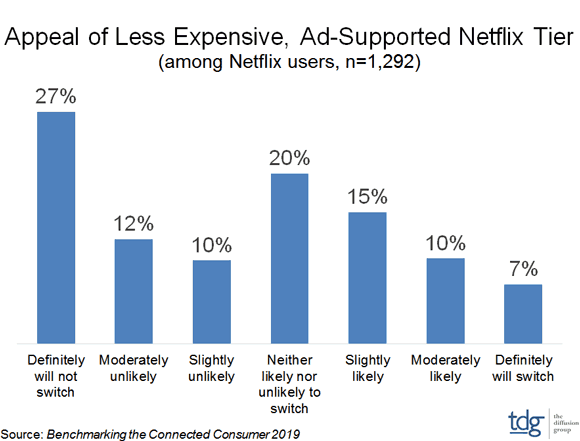
The Diffusion Group, based in Los Angeles, asked 1,292 current Netflix subscribers if they would switch to a new, lower-priced Netflix tier that included commercial advertising. Nearly 32% of respondents expressed confidence they would make that switch, with 49% opposed and 20% undecided.

A recent streaming conference in Europe seems to have stoked interest in the concept of an ad-supported Netflix, although the company has repeatedly claimed it has no plans for an advertiser-supported tier, dismissing the idea as a concept dreamed up by their competitors, notably Comcast/NBC and Hulu.

TDG Research president Michael Greeson believes advertising on Netflix is inevitable however, driven by a backlash from Wall Street over how much Netflix is spending on content as it continues to lose access to some of its most popular licensed content, being pulled off Netflix by its competitors Disney and AT&T/WarnerMedia.

“Given the rising costs of programming and growing debt, so goes the argument, it is just a matter of time before the company makes a move,” TDG said in its report.

Netflix’s early days of streaming depended on a deep library of popular movies and TV shows that were readily licensed to the company by major Hollywood studios. But in the last five years, those studios have demanded dramatically higher licensing fees, and in the last year they have ended some contract renewals altogether to reserve content for the launch of their own affiliated streaming services, including Disney+ and HBO Max.

“Netflix’s response to its thinning third-party library is to spend more on originals, which it’s gambling will keep subscribers from jumping ship,” Greeson said. “But with half or more of its most-viewed shows being owned by three studios, each of which is launching their own direct-to-consumer services, how long can you convince 55+ million US consumers that your service is worth paying a premium price, especially compared with Hulu (offers an ad-based option), Amazon Prime Video (free with Prime), and Disney+ (coming in a $6.99/month)?”

Greeson

Netflix has faced growing pressure from investors to reduce the level of debt it has accumulated financing those original productions, including pushes for rate increases and advertising. Netflix raised prices, but has publicly opposed advertising. Some investors now want another rate increase, which Greeson warns would be perilous for Netflix’s subscriber count, because their research found the last price increase “strained the limit of the service’s value.” That research was done before subscribers start to discover their favorite shows will increasingly be pulled off the platform. Greeson believes another rate increase will cause at least some customers to flee, stalling Netflix’s growth.

The happy medium in Greeson’s view is the introduction of an ad-supported tier for price-sensitive subscribers, and he predicts Netflix will introduce it in the next 18 months.

“Ads will become an important part of a comprehensive tiering strategy that helps bullet-proof Netflix for years to come,” Greeson said.

Netflix Rivals Claim It Will Eventually Have to Bow to Advertising

Phillip Dampier June 25, 2019 Competition, Consumer News, Hulu, Netflix, Online Video Comments Off on Netflix Rivals Claim It Will Eventually Have to Bow to Advertising

As some Netflix shareholders grumble about the company’s massive investment in developing original content, some of Netflix’s smaller rivals claim the streaming service cannot forever depend on subscription fees alone to cover the billions being spent on new series and movies.

NBCUniversal’s Linda Yaccarino and Hulu’s Peter Naylor both believe Netflix will eventually have to begin inserting advertising into shows if it wishes to continue its spending spree on content while avoiding steep rate increases.

At a Cannes Lions panel held last week, content companies discussed the evolution of streaming services and their embrace of traditional advertising.

“When you have to make more programming that’s not guaranteed to be a hit, you have to spend more money, you have to build your brand, you have to help the consumer discover your stuff — the price will go up for the subscription, and it would be logical to mitigate those increases to take ads,” Yaccarino said.

Hulu remains the biggest and best-known example of a streaming service built on a traditional advertising model. Customers pay $5.99 a month for advertiser-sponsored content, similar to traditional linear television. Customers can buy their way out of advertising interruptions by paying $11.99 a month for a commercial-free plan that is roughly double the usual price. Just under 30% of Hulu subscribers currently select the commercial-free option.

Hulu’s bathroom break ad, displayed when a video is paused.

Naylor claims traditional advertising need not continue to resemble commercial broadcast television, despite the fact Hulu is still mimicking that experience.

“The future of ad-supported media does not resemble what we’re doing today in terms of ad load or even ad shape,” Naylor said. “It can be interactive advertising or nonintrusive advertising. I think you’re going to see a lot of innovation from all of these new OTT providers because we’re allowed to. We’re not married to the clock. Fifteen and 30-second ads were a product of linear TV. When everything’s on demand and served through an IP address, the ad experience is going to dramatically improve.”

Hulu has been experimenting with different ad formats to gauge subscriber acceptance. Interactive advertising, viewer-selected ads, and banner ads that appear when programming is paused are all being tested. A 2 feet by 6 feet banner is perfect for making a big impression.

Although Hulu is dabbling in original content, NBCUniversal spent more than $28 billion on content acquisition and development last year. In contrast, Netflix spent $12 billion. Yaccarino said that as more streaming services launch, particularly those from Disney and WarnerMedia, Netflix will have to further increase its spending to keep up.

A Netflix spokesperson told CNBC all this talk was “wishful thinking from an advertising conference.” Netflix is not currently focused on incorporating ads into any of its shows, the spokesperson confirmed.

N.Y. and California Head 10-State Lawsuit to Block T-Mobile/Sprint Merger

Phillip Dampier June 11, 2019 Competition, Consumer News, Public Policy & Gov't, Sprint, T-Mobile, Wireless Broadband Comments Off on N.Y. and California Head 10-State Lawsuit to Block T-Mobile/Sprint Merger

 James

New York Attorney General Letitia James and California Attorney General Xavier Becerra today filed an unusual multi-state lawsuit, along with eight other State Attorneys General to halt the proposed merger of telecom giants T-Mobile and Sprint, deciding not to wait for a decision from the Department of Justice, which is also reviewing the merger. The complaint, filed in the federal Southern District of New York court in coordination with Colorado, Connecticut, the District of Columbia, Maryland, Michigan, Mississippi, Virginia, and Wisconsin alleges that the merger of two of the four largest national mobile network operators would deprive consumers of the benefits of competition and drive up prices for cellphone services.

“When it comes to corporate power, bigger isn’t always better,” said Attorney General Letitia James. “The T-Mobile and Sprint merger would not only cause irreparable harm to mobile subscribers nationwide by cutting access to affordable, reliable wireless service for millions of Americans, but would particularly affect lower-income and minority communities here in New York and in urban areas across the country. That’s why we are going to court to stop this merger and protect our consumers, because this is exactly the sort of consumer-harming, job-killing megamerger our antitrust laws were designed to prevent.”

“Although T-Mobile and Sprint may be promising faster, better, and cheaper service with this merger, the evidence weighs against it,” said Attorney General Xavier Becerra. “This merger would hurt the most vulnerable Californians and result in a compressed market with fewer choices and higher prices. Today, along with New York and eight other partner states, we’ve filed a lawsuit to block this merger and protect the residents of our state.”

The states departed from traditional courtesies in the case, deciding to launch a pre-emptive legal challenge to the transaction without providing Justice Department officials advance notice of their decision to sue. That decision may have come after FCC Chairman Ajit Pai gave his full support for the merger, with indications the Republican majority on the FCC would also vote in favor of approving the deal. Staffers in the Antitrust Division of the Justice Department object to the merger, and are recommending it be rejected. But the Justice Department’s unpredictability, and its poor track record trying to block the AT&T-Time Warner (Entertainment) merger in court may have pushed the state attorneys general to also act on their own.

T-Mobile USA and Sprint are the third and fourth largest mobile wireless networks in the U.S., and are the lower-cost carriers among the “Big Four” — with market leaders Verizon Wireless and AT&T controlling the larest share of the wireless market. Intense competition, spurred in particular by T-Mobile and Sprint, has delivered declining prices, increased coverage, and better quality for all mobile phone subscribers. According to the Labor Department, the average cost of mobile service has fallen by roughly 28 percent over the last decade, while mobile data consumption has grown rapidly. The merger, however, would put an end to that fierce competition, argue the attorneys general, which has delivered a great number of benefits to consumers.
States with large urban poor communities are particularly sensitive to the merger, because both T-Mobile and Sprint focus their coverage on urban areas. With the average U.S. household spending $1,100 annually on wireless phone service, even small rate increases can dramatically increase service suspensions or disconnections due to late or non-payment.

“Low-and moderate-income (LMI) New Yorkers put a greater share of their household income toward their phone bill, and when you are looking at a budget that is already stretched thin, every dollar counts,” said Mae Grote, CEO of the Financial Clinic. “Cellphones now not only give us the ability to communicate with friends and family, here and abroad, but are increasingly the way we engage with many critical services. Our customers use cellphone apps to access public information, send and receive money, manage their SNAP benefits, look for a job, and even communicate with their doctors, and maintaining competition in the market for this critical service ensures LMI consumers have the same access to quality, affordable service as the more financially secure. The Clinic is proud to advocate on behalf of the communities we serve to protect their inclusion in the modern economy.”

The attorneys general investigation laid bare many of the alleged merger benefits offered by T-Mobile and Sprint to win approval of the merger. The group found many of the claimed benefits were completely unverifiable and were likely to be delivered years into the future, if ever. But within weeks of approving such a merger, the companies would have an immediate incentive to raise prices and reduce service quality. Sprint’s network, in particular, was scheduled to be largely mothballed as a result of the merger, even though Sprint provides coverage in some areas that T-Mobile does not. Although the two companies could identify several self-serving deal efficiencies that would reduce their costs and staffing needs, there is no evidence the merger would deliver consumers lower prices and were outweighed by the merger’s immediate harm to competition and consumers.

Additionally, the merger would harm thousands of hard-working mobile wireless independent dealers in New York and across the nation. The ten states are concerned that further consolidation at the carrier level would lead to a substantial loss of retail jobs, as well as lower pay for these workers in the near future.

Becerra

“CWA applauds the Attorneys General and especially General Letitia James’ leadership in taking decisive action today to prevent T-Mobile and Sprint from gaining anti-competitive power at the expense of workers, customers, and communities,” added Chris Shelton, president of the Communications Workers of America (CWA). “Reducing the number of national wireless carriers from four to three would mean higher prices for consumers, job loss for retail wireless workers, and downward pressure on all wireless workers’ wages. The states’ action today is a welcome development for American workers and consumers, and a reminder that regulators must take labor market concerns seriously when evaluating mergers.”

Before filing suit, the states gave significant consideration to T-Mobile and Sprint’s claims of increased coverage in rural areas. However, T-Mobile has yet to provide plans to build any new cell sites in areas that would not otherwise be served by either T-Mobile or Sprint. As stated in the complaint, the U.S. previously won the “race to LTE” as a direct result of vigorous competition among wireless carriers. Finally, continued competition, not concentration, is most likely to spur rapid development of a nationwide 5G network and other innovations.

“This merger is bad for competition, and it is bad for consumers, especially those living in or traveling through rural areas, who will experience fewer choices, price increases, and substandard service,” stated Carri Bennet, general counsel for the Rural Wireless Association. “We are pleased that the New York Attorney General, along with nine states have filed their lawsuit to block the merger. The process at the FCC has not been transparent and the FCC appears to be blindly accepting New T-Mobile’s words as truth.”

The complaint was filed under seal, because it contains unredacted confidential information, in United States District Court for the Southern District of New York.  A redacted copy of the lawsuit is likely to be made available later.

T-Mobile currently has more than 79 million subscribers, and is a majority-owned subsidiary of Germany’s Deutsche Telekom AG. Sprint Corp. currently has more than 54 million subscribers, and is a majority-owned subsidiary of Japan’s SoftBank Group Corp.


Search This Site:

Contributions:

Recent Comments:

Your Account:

Stop the Cap!