Home » rate hike » Recent Articles:

CommSpeed: Yesterday’s Internet, Tomorrow — Another Internet Overcharging Scheme

Stop the Cap! reader Davey in Arizona was displeased to receive notification his Internet Service Provider, CommSpeed, suddenly announced an Internet Overcharging scheme that limits customers to two levels of service: a basic $40 plan with a ridiculously stingy 10GB monthly usage allowance, or a more generous (and double the price) $60 plan that comes with a 200GB usage cap.

Davey is particularly upset the company plans to punish customers who exceed the allowance with a stinging $2/GB overlimit fee.  It will not be difficult for customers to blow past  CommSpeed’s standard 10GB plan limit if they discover file backup, online video, or downloading.  If they do, CommSpeed’s overlimit fee will be coming soon to a bill in their mailbox. For those who use the Internet to watch television and movies, the only real options are to watch less or upgrade to a more expensive plan with a more realistic usage allowance that can accommodate high bandwidth applications.

CommSpeed claims their “advanced 4G network combines the best features of cellular, cable modem & DSL, and Wi-Fi networks, without the inherent limitations associated with these legacy systems.”  The company brands itself as “Tomorrow’s Internet Today.”

What they don’t mention is today’s wireless ISP’s are increasingly challenged by the growing usage demands consumers place on providers.  CommSpeed’s claim that their network “was designed and built, from inception, to deliver a full range of broadband content and applications” flies in the face of their 10GB usage limit. Fiber, cable broadband and even telephone company DSL has a better track record handling increasing usage demands, as long as providers maintain investments in their respective networks.

CommSpeed’s usage cap tells the real story — their network may not be able to handle the growing traffic from customers in their northern Arizona service area.

“The Internet has seen tremendous growth in total usage over the last year. New applications are being developed everyday and these applications are causing an ever increasing demand for bandwidth. Quite simply, the content of the Internet has evolved,” CommSpeed explains on a page dedicated to explaining their new caps.

Unfortunately for wireless, until more spectrum and better technology is available, usage limitations are an increasing reality for customers stuck using these networks. It’s why Stop the Cap! rarely recommends wireless broadband as a primary Internet service except as a last resort, when other choices simply are not available.

Still, we’ve seen much worse from other Wireless ISPs.  CommSpeed’s 200GB limit on their $60 tier is more generous than average.  Plus, the company takes the limits off during the overnight hours of midnight to 6AM.

We also think the company’s usage guestimates are a more honest approximation of real-world usage, not the ridiculous “send 10,000,000 e-mails and download 500,000 songs” reassurances we usually see from Internet Overcharging ISPs:

Average user with a 10GB allowance
Total Gigabytes Used = 9.9GB
Actual internet consumption may vary.
Per Month Total Bandwidth Consumed
General Internet Browsing 100 hours 500MB
Email Communication (total sent/received) 400 emails 20MB
Internet Phone Service 500 minutes 1.1GB
Music Downloads 100 Tracks 600MB
Movie Streaming 3 movies 6GB
Online Gaming 100 hours 1.5GB

CommSpeed’s old plans ranged in price from $34.95 for basic 768kbps-1.5Mbps service to $54.90 for 1.5-6Mbps service, depending on the technology in use in the area. The new plans bring a $5 rate hike and usage caps — just two reasons why customers like Davey are so upset. They’ll be even more upset if their bill also include overlimit fees. Stay tuned.

[flv width=”608″ height=”380″]http://www.phillipdampier.com/video/CommSpeed 4G – Tomorrow’s Internet Today.flv[/flv]

CommSpeed heavily promotes its newer 4G wireless broadband service, claiming its great for online video, downloading, gaming, and more, as long as you don’t use it too much.  In 2012, CommSpeed throws up limits on their wireless experience.  (3 minutes)

Dear Valued Time Warner Cable Customer: Pay Us More… Or Not — Here’s How

Phillip Dampier November 29, 2011 Competition, Consumer News, Editorial & Site News 1 Comment

Pay $160 a month... or $89.99

Time Warner Cable attached their new rate schedule to my November cable bill which arrived in the mail last week.  It’s the second major rate increase in western New York this year, and it means customers who just want to watch standard basic cable television will now pay $80.50 a month to do so.  We’re a long, LONG way from the $20 cable TV package the industry used to advertise as “less expensive than a cup of coffee a day.”  This is Starbucks’ coffee pricing, with no end in sight.

Time Warner Cable’s Triple-Play package of phone, Internet, and television service will now run $160.49 a month here in Rochester.  It wasn’t too long ago that a bill that size was reserved for the gas and electric company, or perhaps for a used car payment.  That’s before taxes, franchise fees, and other pad-ons, too.  Need that extra set top box?  Add another $7 a month each with remote control.  Want to speed up your broadband?  $10 a month for that.  HBO?  Time Warner Cable’s premium channel-pricing completely ignores today’s economic and marketplace (Netflix/Redbox) realities.

The cable company does have competition in the television business. In the same day’s mail was the latest offer from DirecTV, which has nearly as many sneaky extra fees as local phone company Frontier Communications.  That $24.99 a month “amazing deal” starts to snowball as you build a package, and it also means a satellite dish on your roof, which some people just don’t want.

Assuming you stick with the cable company’s triple play package, the sobering truth is that doing business with Time Warner at their everyday-high-pricing will cost you at least $1,920 a year.  But you don’t always have to pay them the asking price.

So with rate increase notice in hand, what can you do?

  1. Call them up and tell them the relationship is over unless changes are made.  Good things come to those who wait for the other side of the relationship to start sacrificing for a change.  You’ve coped with rate hikes for years and cable companies keep shoveling more channels you never watch and then raise rates because of “increased programming costs.” This time, let the cable company give a little.  Call and tell them you want to disconnect your service two weeks from today.  A retention specialist will attempt to negotiate with you (starting with efforts to pare down your package, leaving you still paying regular price for fewer services).  Be non-committal,  because better deals will start to arrive by phone as early as a few hours after telling them you’re leaving.  (But you have to answer those unfamiliar Caller-ID calls to hear about them.)  The worst that will happen is you don’t win a significantly better deal. You still have two weeks to rescind the cancel request with no interruption in service and at least get something for your efforts.  Consolation prizes to sweeten a mediocre retention deal: free sample of premium channels, a free Turbo-class upgrade for Road Runner, and/or a break on DVR service.

  2. Compare prices.  If you live in an area with telephone company-delivered TV, offer to stay with the cable company if they will match the new customer offers you are probably already getting pelted with in your mailbox.  Most will.  There are customers who literally bounce back and forth between AT&T/Verizon and Comcast/Time Warner Cable year after year just to keep the $89-99 triple-play promotional price that effectively never expires.  Getting your existing provider to match it saves you and your provider the time and hassle of switching.

  3. Demand a new customer price.  Do a Google search for “Time Warner Cable deals” (or for your respective cable company) and at least a dozen offers will appear, mostly from third-party, authorized resellers.  Double-play offers for broadband and cable-TV often range between $75-85.  A triple play offer which adds phone service is usually just a few dollars more.  Some resellers pitch combo offers that deliver a discounted rate and a substantial rebate ($150), like the one below:

TURBO INTERNET, TV+HD, VOICE


  • Free DVR Service for 12 months
  • You Get $150 in Rebates!
  • No Fee HD
Features:

  • Digital Cable with Free On Demand Programming
  • On-Screen Program Guide
  • Parental Controls
  • Blazing High Speed Internet
  • Unlimited Calling anywhere in the US
  • No-Hassle standard Installation
  • Call Waiting, Caller ID, Call Forwarding and more are included at no extra charge
  • Plus You Get A 3 Month Free Trial of HD Service!
only
$99.99/mo
for 12 month

Ask Time Warner to match the price of these offers (you likely won’t get the rebate, however).  They certainly can come close on retention deals — in fact they will go as low as $85 a month for an annual triple play deal in some areas.

Some customers deal with intransigent retention agents by canceling service and quickly signing up as a new customer soon after.  That is more of a hassle, and some areas require a waiting period before they’ll offer a new customer promotion again, but the usual trick around this is to sign up under a spouse’s name.

It pays to shop around and read the fine print carefully.

For example, in the deal above, I highlighted three important features — the $150 rebate, which is important for reasons I’ll explain in a moment, the free DVR service, and “standard installation.”  In some cases, promotional offers for new customers do not include free installation or equipment, so it is always important to ask exactly what is included.  The $150 rebate will help defray those expenses, but some competing deals omit the rebate and knock $10 off the $99 monthly price for the same bouquet of services and installation is free.

  1. Drop services you don’t need.  Still paying for premium channels?  Why?  Also check your bill for extra mini-pay tiers for certain HD channels Time Warner Cable dropped a few years ago.  You may still be paying $5 a month or more for channels like HDNet Time Warner replaced with the hardly-comparable RFD-TV.  Some customers who signed up for a discounted promotional offer for Time Warner phone service are now paying upwards of $30 a month for the company’s regular-priced unlimited long distance plan.  Consider switching to the $20 “local calling only” plan.  You can make those long distance calls on your cell phone or Google Voice and save $120 a year.

Time Warner, like every other cable company, understands the word “cancel” very well.  The best way to put an end to endless rate increases is to refuse to pay them and being willing to cut the cord until they get the message.

Time Warner Cable’s Latest Rate Hikes Infuriate Upstate New York; One City Retaliates

Phillip Dampier November 22, 2011 Consumer News, Public Policy & Gov't 4 Comments

Time Warner Cable’s latest series of rate increases and perceived snubs has rubbed some New York residents the wrong way, and one upstate city has retaliated by extending the cable operator’s franchise by just one year.

Cable customers from Lowville to Massena, adjacent to the Canadian border, have been venting about the cable company’s decision to increase cable rates for the second time this year across the region.  The anger is nearly universal, whether one is a conservative tea party member in Norwood or a liberal Democrat in Watertown.

But the strongest message heard by Time Warner officials was delivered by Massena Deputy Supervisor Albert N. Nicola, who helped shoot down the cable company’s request for a 15-year franchise renewal, and approved a one year renewal in its place.  The vote was 5-0.

“They’re asking for a 15-year extension, which is absolutely totally outrageous,” Mr. Nicola told the Watertown Daily Times. “We’ve got to be crazy for even thinking about that.”

That is no Christmas present for Time Warner, whose cable franchise agreement in Massena expires this year on Dec. 25.

Town board members noted the cable company didn’t bother show up for franchise renegotiation discussions and were reportedly not in attendance for this week’s vote.

“It’s tough to ask questions of a group that isn’t here,” Nicola said.

Massena wants some changes in the local cable lineup, more responsiveness to local residents, and more involvement in the community by the cable company.

Residents want lower rates.

Wayne D. Mihalyi of Lowville called Time Warner the poster child of corporate greed.  Tim Donahue of Lowville wondered how much more he and his neighbors would take from the cable operator:

How long are we going to continue having Time Warner Cable increase their rates without hesitation? Isn’t anybody out there looking out for us?

We just had all our rates increase 7.5 percent in January 2011. They cried poverty and increases in dealing with the networks. Yet another small increase occurred (because of taxes) somewhere between June’s bill and October’s.

And now we just received yet another 8 percent increase within the same year? They must have seen how Netflix did it and said, “What the heck, if they can do it so can we.”

This time we’re supposed to believe it is because of their significantly increased cost of programming. Don’t forget, we also got socked a whopping 16.5 percent increase in January of 2010. When is this nonsense going to end? I am beginning to understand the reason for some of the protesting going on. This is outright greed. There is no other explanation or words for it. They have to know that seniors haven’t even had a 1 percent raise in three years.

Time Warner Cable’s Rate Hikes Reach the Carolinas: Still $58/mo for Standalone Broadband

Winston-Salem Time Warner Cable customers can expect to pay around 4% more for cable service in 2012.

Time Warner Cable’s annual rate increases have now reached the Carolinas.

The company is mailing letters to customers that announce rate hikes for off-contract clients in the $2-4 a month range, including price increases for Road Runner broadband that will now cost between $49.45-$57.95 a month.

“Our new prices reflect dramatically higher programming costs, additional programming and features, and continued investment in our network and customer service,” said Time Warner spokesman Scott Pryzwansky. “Time Warner Cable invested more than $350 million in capital in the Carolinas over the past year to make our network even more robust and to enable our customers to get the services and features they want.”

The company also invested heavily in lobbying lawmakers to keep community-owned broadband competition at bay, helping pass a measure through the Republican-controlled legislature that makes municipal broadband competition much more unlikely.

The result is another year of unfettered rate increases for customers in cities like Winston-Salem:

  • Cable TV increases from $10.23 to $11.49 for broadcast basic, $64.99-$69.49 for standard analog service, $80.99-$85.49 for digital cable;
  • Broadband increases from $47.95 to $49.45 for customers who also have digital cable, $52.95 to $55.95 for customers with any other tier of cable TV, $57.95 for standalone broadband service;
  • Telephone rates are unchanged.

Customers can avoid some of the price increases through creative bundling, threatening to take your business elsewhere, or by signing up for alternative providers:

  1. Customers on discounted promotional packages, retention deals, and term contracts will not face the rate increases until their promotional rates or contract expires;
  2. If you are unhappy with the rate increase, consider calling Time Warner and telling them to cancel your service 1-2 weeks from today’s date.  Then wait for them to start calling you with promotional “win-back” offers that deliver at least a year of substantial savings off regular rates;
  3. If you are a broadband standalone customer, consider signing up for Earthlink under their six-month promotion for just under $30 a month.  You will continue to be billed by Time Warner Cable and receive the same speeds and service with two exceptions: no PowerBoost (a temporary speed increase during the first few seconds of downloading), and you lose your Road Runner e-mail address (which you are not actually still using, are you?)  Get a Gmail account, don’t worry about speed gimmicks, and save $28 a month.  At the end of six months, sign up for Time Warner’s Road Runner service under their promotional rate, which is around $30 a month for a year.  Total savings over the 18 month combined promotional rate term: $504!

More than two years after Time Warner introduced DOCSIS 3 speed upgrades in New York, Time Warner is finally completing broadband upgrades for their customers in the Carolinas.  The latest cities scheduled to get the company’s Wideband (50/5Mbps) and Road Runner Extreme (30/5Mbps) services are Wilmington, Jacksonville and Morehead City. The new services will be available by early 2012.

Most customers in eastern North Carolina and parts of South Carolina still get Standard service speeds of 10Mbps download, 512kbps upload.  After the upgrade, a boost in upstream speeds to 1Mbps for Standard service customers is expected.

CRTC Splits the Difference on Usage Based Billing; Consumers Will Pay More

Phillip Dampier November 16, 2011 Bell (Canada), Broadband Speed, Canada, Competition, Data Caps, Public Policy & Gov't Comments Off on CRTC Splits the Difference on Usage Based Billing; Consumers Will Pay More

The Canadian Radio-television and Telecommunications Commission late Tuesday ruled against a revised proposal from Bell that could have effectively ended flat rate Internet service across the country, but also allows the phone company to raise wholesale prices for independent Internet Service Providers (ISPs).

The Commission ruled Bell and cable companies like Rogers must sell access to third party providers at a flat rate or priced on speed and the number of users sharing the connection.  The CRTC rejected a Bell-proposed usage-based pricing scheme that would have charged independent ISPs $0.178/GB.

Ultimately, the CRTC came down closest to adopting a proposal from Manitoba-based MTS Allstream, which suggested a variant on speed-based pricing, steering clear of charging based on usage.  Under the CRTC ruling, independent ISPs can purchase unlimited wholesale access based on different speed tiers.  The new pricing formula requires independent providers to carefully gauge their usage when choosing an appropriate amount of bandwidth.  If an independent ISP misjudges how much usage their collective customer base consumes during the month, they could overpay for unused capacity or underestimate usage, leaving customers with congested-related slowdowns.  ISPs will be able to purchase regular capacity upgrades in 100Mbps increments to keep up with demand.  They can also implement network management techniques which may discourage heavy use during peak usage.

The CRTC decision underscores that Internet pricing should be based on speed, not on the volume of data consumed by customers.  That’s a model Stop the Cap! strongly approves because it does not allow providers to monetize broadband usage.

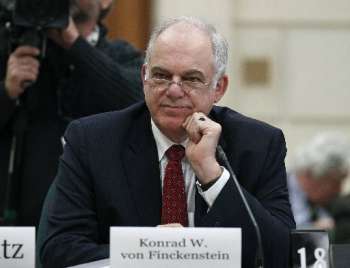
Finkenstein

But that is where the good news ends.  Nothing in the CRTC ruling changes the Internet Overcharging regime already in place at the country’s leading service providers.  Companies like Bell and Rogers are free to continue setting arbitrary limits on usage and charging overlimit fees for those who exceed them.

Konrad von Finckenstein, chair of the CRTC, says the regulator made a mistake in deciding last year to allow Bell to raise its prices for independent service providers.

“Our original decision was clearly not the best one. It was wrong and it was pointed out by a lot of people, including Minister Clement. He was right. We have today fixed it, we have made this new decision,” von Finckenstein said. “The bottom line is that you as a consumer will not face a cap or limitation of use because of anything mandated by the CRTC. Any kind of cap or limit, payment per use, that you will have to pay is because your ISP decides to charge you, not because we mandate it.”

But many independent providers are unhappy with the CRTC ruling because it also allows wholesale providers like Bell to raise prices, sometimes substantially, on the bandwidth they sell.

One independent ISP — TekSavvy, said it faced increased connectivity costs in eastern Canada.

“The CRTC decision is a step back for consumers. The rates approved by the Commission today will make it much harder for independent ISPs to compete”, said TekSavvy CEO Marc Gaudrault. “This is an unfortunate development for telecommunications competition in Canada,” he added.

“Rates are going up,” added Bill Sandiford, president of Telnet Communications and of the Canadian Network Operators Consortium, an independent ISP association.

In addition to whatever rate increases eventually make their way to consumers, some independent providers may end up adopting network management and usage cap policies that attempt to slow down the rate at which they are forced to commit to bandwidth upgrades.  That’s because providers purchase capacity based on what they believe their peak usage rate is likely to be.  Providers will be free to upgrade service in 100Mbps increments.  But with the new, higher prices, providers could overspend on capacity that goes unused or find themselves underestimating usage, creating congestion-related slowdowns for all of their customers.

Angus

Some network management techniques that could reduce peak usage — and the need for upgrades — include speed throttles for heavy users during peak usage times or usage caps that fall away during off-peak hours when network traffic is lower.

Yesterday’s decision will provide some small relief to wholesale buyers of bandwidth in Quebec, where’s Videotron’s sky-high wholesale prices are set to be reduced.  But the unusual divide in Internet pricing between eastern and western Canada will remain.  Western Canadians will continue to enjoy much larger usage allowances, and lower wholesale pricing, than their eastern neighbors in Ontario and Quebec.

The CRTC’s ruling did not go far enough for NDP Digital Issues critic Charlie Angus. Angus notes only 6 percent of Canadians purchase Internet service from independent providers.  The rest will still be stuck with what he calls “unfair billing practices and bandwidth caps.”

Angus is convinced the CRTC just gave the green light to force rate hikes for the minority of consumers who found a way around companies like Bell, Shaw, Videotron, and Rogers.

“Allowing big telecom companies to reach into the pockets of struggling families and ask for even more money is just plain wrong,” Angus said.

Bell’s senior vice-president for regulatory and government affairs, Mirko Bibic, still believes the company’s proposal to charge just under 20c per gigabyte to wholesale users was appropriate, but the CRTC’s permission to allow Bell to increase wholesale rates was a nice consolation prize.  Bibic tried to frame the decision as forcing ‘independent ISPs to pay their fair share.’

Independent ISPs “are going to have to lease more traffic lanes,” he told CTV News. “I think the philosophy is [to] put the independent ISP in a position of responsibility. If usage goes up, you’re going to have to buy more lanes – it’s the same decision that we have to make.”

Search This Site:

Contributions:

Recent Comments:

Your Account:

Stop the Cap!