Home » rate hike » Recent Articles:

Your Cable TV Bill in 2020: $200/Month — Just for Television Shows, Says New Report

Phillip Dampier April 10, 2012 Competition, Consumer News, Online Video Comments Off on Your Cable TV Bill in 2020: $200/Month — Just for Television Shows, Says New Report

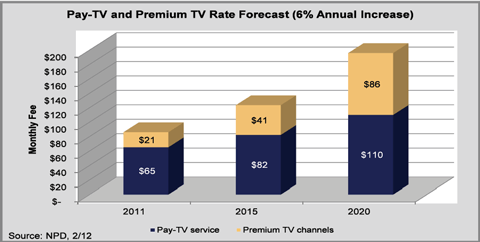
If you thought paying an average of $86 a month for basic pay television and premium movie channels in 2011 was out of line, just wait.  A new report predicts you could pay $123 by the year 2015 and $200 by 2020 — and that only includes the TV portion of your bill.

That is in keeping with typical annual rate increases, typically blamed on “increased programming costs,” which currently run an average of six percent a year.

The NPD Group, who published the findings, predicts consumers may not sit still for that kind of monthly cable television bill, especially as household incomes for the middle class continue to remain stagnant, even as high fuel and health care prices continue to march higher.

The pay television industry isn’t entirely responsible for the annual rate hikes that nearly always outpace the rate of inflation.  The real money is in programming production and distribution, which is why giant companies like Comcast, Bell, Rogers, and Viacom are buying up programming studios, distributors, and networks at a rapid pace.

With new players like Netflix, Amazon, and Redbox joining traditional pay television and broadcast network bidders, auctions for exclusive licensing agreements bring higher and higher bids.  Ultimately, consumers pay the price in the form of higher bills.  Even cable networks, sensing an increase in the value of their programming, are extracting higher monthly fees at contract renewal time.

The last to arrive at the programming money party?  Local over-the-air broadcasters that used to beg cable companies to carry their channels on the local lineup.  Now some are demanding as much as $5 or more per month per subscriber to allow the cable operator to keep carrying the stations.

“As pay-TV costs rise and consumers’ spending power stays flat, the traditional affiliate-fee business model for pay-TV companies appears to be unsustainable in the long term,” said Keith Nissen, research director for The NPD Group. “Much needed structural changes to the pay-TV industry will not happen quickly or easily; however, the emerging competition between video on demand and premium-TV suppliers might be the spark that ignites the necessary business-model transformation of the pay-TV industry.”

In other words, the more consumers cut cable’s cord and go find other ways to watch their favorite shows, the more unsustainable the traditional pay television business model will become.  Some industry watchers believe cord-cutting is not a major issue.  Others believe continued rate increases will drive customers to cancel service, particularly when alternatives are available. But NPD believes economic factors are the biggest reason for cable cord-cutting.  Those ex-customers are switching back to free “over the air” television, which now delivers better picture quality and often includes additional channels that increase the number of viewing options.

NPD Group research shows most consumers don’t want to exert too much effort to hunt down online programming. Most will put up with their current provider as long as they deliver the shows they want at a price they can afford.  What could change that?  Easy-to-access to a-la-carte programming, perhaps available from services that may soon come built-in with the newest television sets.

“Pay-TV providers offer a convenient, one-stop shop for subscribers, and the majority of customers like it that way,” said Russ Crupnick, senior vice president of industry analysis for The NPD Group. “There is an open window for the industry to meet consumer needs and become to television what iTunes is to music; however, there is also a definite risk if pay-TV providers don’t capitalize on the opportunity — and soon.”

Canadian Telecom Giants Outwit Would-Be Cord Cutters; Alternatives Also Under Pressure

Canadian cable, phone, and satellite providers have done a better job stymieing would-be “cord-cutters” than their counterparts further south in the United States.

The Canadian Radio-television and Telecommunications Commission’s (CRTC) annual report on the country’s telecom companies shows all of them remain exceptionally profitable, keeping pay TV customers far more effectively than American providers. Total revenues climbed from $12.5 billion to $13.5 billion in just one year, as price hikes, Internet Overcharging schemes like usage-based billing, and lack of competition continue to takes its toll on Canadian wallets.

The biggest winners were the biggest telecom companies in Canada — Rogers Communications, Bell Canada (BCE), and Shaw Communications, which all saw profits soar 8.2% to $11 billion.  Costs increased about 10.7% in 2011, fueled by network upgrades and rampant hikes in programming costs — an interesting state of affairs considering Rogers and Bell own or control a substantial number of the programmers demanding higher payments.  Most of those increases were passed on to customers in the form of rate hikes.

Although Canadians are increasingly interested in streaming online video, virtually every major Internet Service Provider in the country has effectively prevented customers from dropping cable television service in favor of broadband-only access.  They manage it with usage caps and usage billing on their broadband products.  With streamed video accounting for a substantial drain on customers’ monthly usage allowances, Canadians are unlikely to cancel cable TV in favor of watching all of their favorite shows online.

In fact, the number of Canadian households that subscribed to a cable company’s basic television service actually increased by 2.8% in 2011 to reach 8.5 million.  Experts say the country’s transition to digital over the air television may account for some of that increase, but a few high broadband bills with overlimit fees for “excessive Internet use” can effectively drive online video fans back to traditional cable TV as well.

Satellite television in Canada remained flat,  with a virtually unchanged 2.9 million Canadians relying on Bell and Shaw satellite service for television entertainment.

But everyone is paying more to watch.

In 2011, cable companies paid $2.1 billion in wholesale fees to the pay and specialty services they distribute, an increase of 10.2% over the $1.9 billion paid the previous year. The fees paid by satellite companies rose by 2.8% in one year, going from $894.4 million to $919 million.

That leaves vertically and horizontally-integrated conglomerates like Bell in the perfect position to extract higher programming payments.  Those costs are passed down to Canadian consumers and blamed on “greedy programmers,” despite the fact those programmers are owned in part or outright by Bell.

A Rogers retail rental store

Rogers is also well-suited to remain a part of the Canadian entertainment experience.  The company owns cable systems, wireless phone networks, programmers, and even home video stores. However Stop the Cap! reader Alex notes Rogers has been closing a number of those video stores over the past few months.

“This gives customers one less choice for renting movies, basically forcing them to use Rogers On Demand instead,” writes Alex.

Rogers On Demand comes with a higher price, too.  In-store rentals from Rogers are priced at 2 for $9 or 3 for $15.  A recent look at Rogers’ video on demand website, Rogers Anyplace TV, shows most movie titles priced at $4.99 each.  With Rogers closing 40 percent of their retail rental outlets, movie fans have had fewer competitive choices for movie rentals.

One potential new contender coming to Canada – kiosk video rentals.  Although services like Redbox are now commonplace in the States, they are virtually unknown in the north.  Jim Gormley, former owner of Jumbo Video is back with Planet DVD.  With just 2% of Canadians renting movies from kiosks, Gormley believes there is plenty of room to grow, especially as Rogers scales back its video rental business.

Planet DVD has a pilot project running with supermarket chain Sobeys to place kiosks in front of nine store locations.  The first kiosk was erected in early March in front of a Sobeys store in Mississauga, Ont.

A new release at a Planet DVD kiosk is priced at $3 for a one-day rental.  That’s less than what most video stores charge, but more than double what Americans pay at a Redbox kiosk.

AT&T, Colorado Lawmakers Target Landline Subsidy; Collateral Damage: CenturyLink, Public Broadband

Phillip Dampier April 3, 2012 AT&T, Broadband Speed, CenturyLink, Community Networks, Competition, Consumer News, Editorial & Site News, Public Policy & Gov't, Rural Broadband, Wireless Broadband Comments Off on AT&T, Colorado Lawmakers Target Landline Subsidy; Collateral Damage: CenturyLink, Public Broadband

AT&T’s ongoing efforts to win deregulation and an end to universal landline service have now reached Colorado, where state lawmakers are reacting favorably to an AT&T-sponsored bill that would strip away rural landline subsidies and deregulate basic phone rates, much to the consternation of incumbent provider CenturyLink.

The long-winded bill,  SB 157 – Concerning the Regulation of Telecommunications Service and, in Connection Therewith, Enacting the “Telecommunications Modernization Act of 2012,” is just the latest in a series of deregulation measures co-authored by AT&T that would let phone companies off the hook for guaranteeing affordable, universal landline service to every American.  Instead, AT&T is happy to sell rural consumers pricey mobile phone service.

Ironically, AT&T’s bill would deliver the worst blows to fellow landline provider CenturyLink, the largest phone company in the state. Consumers pay 2.9 percent of their phone bill toward a rural landline subsidy fund, or 87 cents for a $30 bill. It is no surprise CenturyLink is adamantly opposed to the measure, declaring the loss of rural phone service subsidies a guarantee of future rate hikes and discriminatory pricing, if not the end of basic telephone service in rural Colorado.  The company also receives more than 90 percent of the annual proceeds collected from Colorado ratepayers.

“The bill continues to legislate discrimination of one very large group of consumers. It allows a consumer living on one side of the street in rural Colorado to continue to receive High Cost Fund support while his neighbor on the other side of the street will not, simply because of the logo at the top of their telephone bills” said Jim Campbell, CenturyLink regional vice president for regulatory and legislative affairs. “We continue to be baffled that lawmakers voting in favor of this bill feel it is good public policy to write consumer discrimination into Colorado law.”

As with other AT&T-written deregulation bills, the “sufficient competition” test to prove consumers have plenty of choices for phone service is notoriously easy to meet.  SB 157 defines a market competitive when 90 percent of customers in a geographic area have a choice of at least five providers.  While that sounds like competition, in fact the bill defines just about anything resembling a phone company as “competition.”  That includes traditional landline service, mobile phones, satellite telephony, Voice Over IP providers like Skype, and cable company phone service.

Back for More....

A provider declaring service to any particular geographic area on a coverage map is sufficient evidence that competition exists, even if that provider does not deliver a consistently suitable signal, charges extraordinarily high prices, or only markets service in selected areas or in a package that includes other services.  In rural Colorado, wireless companies maintaining roaming agreements with other providers would count as multiple competitors, even though they rely on the same infrastructure to handle calls.  Poor reception? That’s your problem.

The bill also allows phone companies to charge whatever they like for traditional phone service, and only requires one day’s notice of pricing changes.  The bill would also strip away the right of regulators to demand justification for the inevitable rate increases and takes away their right to reject, modify or suspend rate hikes they deem unacceptably unfair.

That could force CenturyLink prices way up in rural Colorado, perhaps to a level that makes AT&T cell phone pricing not that bad after all.
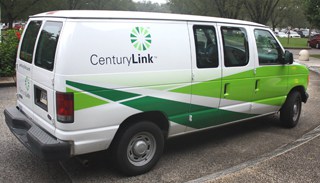
CenturyLink: Victim of Friendly Fire from AT&T?

That suits AT&T’s Colorado president William Soards just fine, as AT&T is willing to sell rural Colorado lots of wireless phones.

“There’s plenty of competition out there that will be very excited to take their business, and AT&T will be one of them,” Soards told the Denver Post.

Colorado’s Rural Broadband Fund: The Fix Is In

One of the boldest provisions of SB 157 is the establishment of a rural broadband fund that delivers up to $25 million of ratepayer money to a select group of telecommunications companies to underwrite the costs of building  non-competitive broadband networks in the most distant, unwired corners of the state.  They wrote the rules, so it comes as no surprise they are, by definition, the intended recipients — often the very same companies that have refused to provide service in rural communities in the past.  Among those they’ve made certain are prohibited from accessing the broadband fund:

  • Broadcasters experimenting with sub-channel broadband data service;
  • Government agencies;
  • Local municipalities;
  • Public-private partnerships;
  • Any organization, including non-profits, controlled in whole or part by a public entity;
  • Electric utilities;
  • Electric co-ops;
  • Non-profit electric companies or associations;
  • Every other supplier of electrical energy.

Who can access the broadband fund?  Why, the backers of the bill of course, especially AT&T:

  • Wireless companies like AT&T;
  • Telephone companies;
  • Cable operators;
  • Wireless ISPs (meeting certain conditions).

Padgett: Let local communities solve their broadband challenges themselves.

The bill is written to require a minimum level of 4/1Mbps service, which may lock out many rural telephone companies unable to deliver those speeds over traditional DSL as well as congestion and distance-sensitive wireless ISPs.  Cable operators are unlikely to provide any service in the most rural areas qualified to receive broadband funding. CenturyLink’s ongoing opposition to the bill suggests they don’t see much broadband funding in their immediate future either. That leaves just one technology most suitable to receive ratepayer funding: heavily capped and expensive wireless 4G broadband from companies like AT&T.

That may leave rural (but potentially not rural enough) Ouray County up the broadband creek without a paddle.

CenturyLink has shown minimal interest in providing ubiquitous broadband across the area dubbed the “Switzerland of America” for its rugged mountainous topography.  With just 4,450 residents, Ouray County is not the phone company’s highest priority.  But the company serves just enough of the county that it might fail the “unserved area” test — a ludicrous notion for broadband-starved Colona, Eldredge, Dallas, Ridgway, Ouray, Thistledown and Camp Bird.

Long-term residents have been through something like this before.  Some remember having to fight for basic electric service as well.  The San Miguel Power Association, a non-profit, member-owned rural electric cooperative established back in 1938, finally brought electric service to the San Miguel Basin area after residents were denied service for years by Western Colorado Power.  The region ultimately had to fend for itself, and did so successfully.

That same electric co-op may just have the best broadband solution for Ouray County — fiber infrastructure already in place, but prohibited from being funded to completion by AT&T’s corporate welfare bill.

Many rural legislators understand the rural broadband problem and see community-owned co-ops as their best chance of getting broadband service in rural Colorado.  They want to amend the bill to strip out the anti-competitive, anti-public broadband language.

Ouray County Commissioner Lynn Padgett is convinced her county’s broadband problems will never be solved by the Colorado Legislature or AT&T.

“Fundamentally, I believe that we need to let those closest to the areas with the rural broadband challenges, and those most accountable, help their communities,” Padgett said.


Cox Cable Raises Rates 18% in Virginia – Local TV Fees Blamed for 2nd Hike in 10 Months

Phillip Dampier March 29, 2012 Consumer News, Cox, Video Comments Off on Cox Cable Raises Rates 18% in Virginia – Local TV Fees Blamed for 2nd Hike in 10 Months

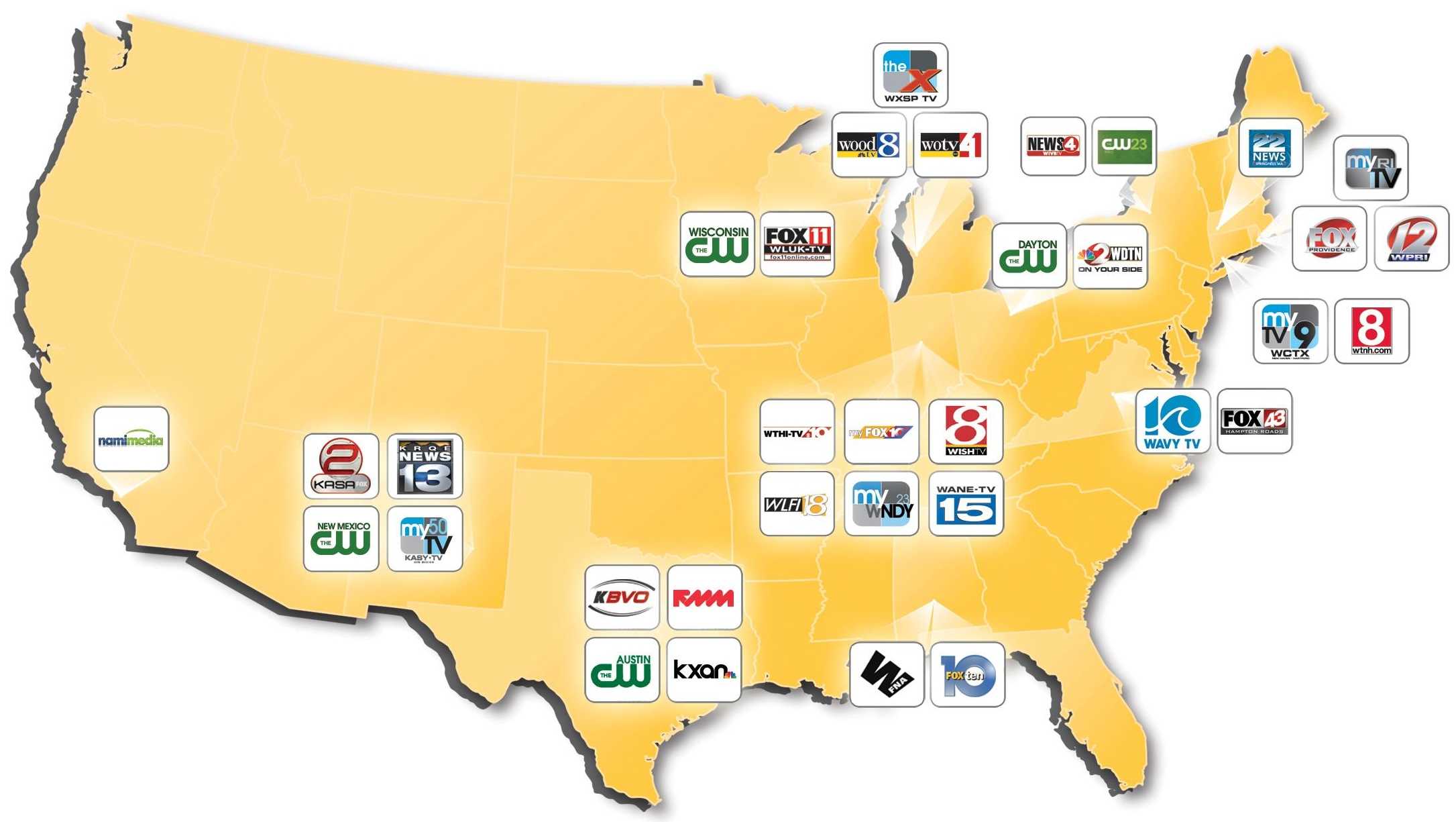
In late February, LIN Television, owner of Norfolk’s NBC affiliate WAVY and Hampton Roads’ Fox station WVBT was engaged in a high profile battle with Cox Cable over retransmission consent fees — the price the cable company pays to put over the air broadcast stations on the cable dial.  While neither side would say exactly how much money was involved, Cox Cable customers will foot the bill starting April 2nd, when the Virginia cable operator raises rates up to 18.3% for basic cable — the fourth rate hike since 2009 and the second in 10 months.

A breakdown:

  • TV Starter (broadcast basic + a handful of basic cable networks) up 18.3% — was $18, now $21.30
  • TV Essential (local stations + 40 popular basic cable networks) up 5.5% — was $59.99, now $63.29
  • Digital set top box rental up $1 to $6.99
  • Cox Internet Essential (3Mbps) up 16% — was $24.99, now $28.99

LIN Media owns local stations around the country.

Cox officials blamed the rate increases on the cost of programming, notably for local stations.

“Programming costs are rising much faster than the rate of inflation,” Felicia Blow, a Cox spokeswoman, wrote in an email to the Virginian Pilot. “While we absorb much of the increase incurred […] we must pass on a portion of the increases to our customers.”

Local broadcasters across the country are aggressively pursuing retransmission consent fees as the traditional advertising model for free, over the air television, has been challenged by the soft economy and poor ad sales.  Parent companies that own clusters of local stations also see the fees as a lucrative new revenue stream for themselves and their investors.

Over the past decade, Cox generally has raised its prices about once a year, notes the Virginian Pilot. The company began speeding up the timetable in 2010. With the latest change coming in April, Cox will have boosted rates for at least some parts of its service – particularly the cost of its most popular package – four times since November 2009.  Approximately 90 percent of 416,000 Hampton Roads-area Cox customers will be paying more for cable service this spring as a result.

[flv width=”360″ height=”290″]http://www.phillipdampier.com/video/WAVY Norfolk Attention COX Communications Subscribers 2-29-12.mp4[/flv]

WAVY in February reported on its parent company’s battle with Cox Cable in this self-serving story aired on its evening newscast.  (3 minutes)

Cablevision’s Rate Freeze A Lesson for Cable Operators Trying to Raise Rates

Phillip Dampier March 5, 2012 Cablevision (see Altice USA), Comcast/Xfinity, Consumer News, Editorial & Site News, Public Policy & Gov't Comments Off on Cablevision’s Rate Freeze A Lesson for Cable Operators Trying to Raise Rates

Last week’s shocking development that Cablevision, a major cable operator in greater New York City, New Jersey and Connecticut is not going to raise rates in 2012 is bad news for other cable operators itching to raise rates once again this year.

Cablevision’s decision was made as the company continues to battle Verizon FiOS, the phone company’s fiber-to-home-service across its service area.  Verizon has been playing hardball with Time Warner Cable, Comcast, and Cablevision in its metro New York service area, offering up to $500 in rebates to sign new customers.  That level of vicious competition has been great for consumers, but lousy for Wall Street.

Investors were not pleased with Cablevision’s pass on rate hikes and its intention to invest a lot more in system upgrades than originally planned.  Wall Street loves increased revenue and hates it when companies spend it on their customers.

With all of this competition breaking out, Comcast and Time Warner Cable may be more than a little uncomfortable sitting down at an antitrust hearing later this month to discuss their new agreement with Verizon to cross-market cable and mobile service.  In return for the cable industry signaling they will never compete with Verizon’s mobile phone offering, Verizon has generously purchased the cable industry’s leftover spectrum and agreed to pitch cable TV subscriptions to Verizon Wireless customers.  With this new “non-aggression treaty,” will there still be a need to offer $500 gift cards and cut-rate prices to attract new customers?  Consumer groups think not.

A greater percentage of Cablevision’s service area is served by Verizon’s fiber network than either Time Warner Cable or Comcast.  Competition is forcing Cablevision to rethink the usual cable industry plan for financial success — force channels customers don’t want and raise rates up to 5% a year to pay for the “increased costs of doing business.”  Consumers are fed up with $150 monthly cable bills and will take Verizon up on an offer than cuts rates $50 a month and hands over up to $500 just for saying “yes” to FiOS.

Search This Site:

Contributions:

Recent Comments:

Your Account:

Stop the Cap!