Home » rate hike » Recent Articles:

Corrected: Massachusetts Mad: Comcast Blasted for Rate Increases from Springfield to Boston

Courtesy: WCVB Boston

Correction: In an effort to concatenate two stories regarding Springfield, we erred in reporting about Springfield’s move to sell its municipal cable operation to Knology.  That story referred to Springfield, Fla., not Springfield, Mass.  We appreciate one of our readers bringing this to our attention, and we regret the error. –PMD

Comcast customers in Massachusetts are hopping mad over the latest round of rate increases from the state’s largest cable operator — the second in 10 months in some areas.  Higher cable bills for customers will start arriving by early spring.

City officials in Boston expect eastern Massachusetts customers will face up to 2.9% more for basic service this spring.  In western Massachusetts, Springfield city officials finally resolved a prolonged legal battle with the cable operator and granted the company a 10-year franchise renewal that preserves senior discounts for existing customers.

Boston mayor Thomas M. Menino said an examination of Comcast’s cable rates over the past few years proves deregulation “has failed” consumers across greater Boston.  Menino says basic cable rates have increased by 80 percent in the three years since the city’s rate control agreement expired.

Menino wants restored authority to regulate cable rates, and has asked the FCC for permission to bring back the city’s oversight powers.

[flv width=”480″ height=”290″]http://www.phillipdampier.com/video/WCVB Boston Cable Rates Going Up For Some Customers 1-17-12.mp4[/flv]

WCVB in Boston talks with city mayor Tom Menino about the latest round of rate increases for Comcast customers.  Some Boston locals are responding by dumping cable television altogether.  (2 minutes)

Comcast basic service will rise another 4.9 percent this spring, bringing the mostly local-broadcast-channel cable service to $16.58 a month.

The only other major cable provider in Boston, RCN, which serves mostly apartment buildings and other multi-dwelling units, is not planning to increase its prices on the lowest price tier. However, RCN already charges more than Comcast — $17.50 — for comparable service.  Other RCN customers face general rate increases this spring.

Verizon says it has no plans to increase prices in Boston either.  That statement was deemed ironic by some, considering the fact the phone company has never provided FiOS fiber-to-the-home cable service inside the city of Boston.

All affected providers blame increasing programming costs for the rate hikes.

[flv width=”480″ height=”290″]http://www.phillipdampier.com/video/WGGB Springfield Cable Rates Going Up 1-18-12.mp4[/flv]

WGGB in Springfield led a recent evening newscast with news Comcast and competing satellite providers are increasing rates in western Massachusetts, with local residents increasingly questioning the value of their cable-TV services.  (2 minutes)

The Internet Overcharger’s Numbers Game: AT&T Raises Prices on Smartphone Data Plans

Phillip Dampier January 19, 2012 AT&T, Competition, Data Caps, Wireless Broadband 4 Comments

AT&T has announced an across-the-board rate increase for smartphone and tablet data plans, raising prices $5 Sunday for most plans while including incrementally larger usage allowances:

  • Lite Usage: 200MB for $15 is now 300MB for $20;
  • Average Usage: 2GB for $25 is now 3GB for $30;
  • Higher Usage: 4GB for $45 is now 5GB for $50.
  • Regular Tablet Plan:  2GB for $25 is now 3GB for $30.
  • A new, higher use tablet plan will offer 5GB for $50.
  • Overlimit fees are now $20 for 300MB of additional usage on the lite usage plan, $10/GB on all other plans.

AT&T originally charged $29.99 for unlimited-use data plans.  The company claimed in the summer of 2010 its new limited-use plans would save most customers money, but except for very light users, that is no longer true.

AT&T's throttles are engaged.

AT&T says the new usage allowances reflect customer resistance to paying overlimit fees when they exceed AT&T’s existing caps.  But the company has also previously said the vast majority of its customers never exceed the old allowances. According to AT&T, 65 percent of its customers use less than 200MB per month and 98 percent of its smartphone customers use less than 2GB of data per month. That effectively means every customer will now face a $5 rate hike for increased usage allowances most will not currently use.

Existing customers can hang on to their old data plans indefinitely, but those who bounce between carriers will be forced to choose from a more limited, and expensive, menu of options.

Considering that AT&T’s most significant rival Verizon Wireless currently charges $30 for just 2GB per month, AT&T officials are still able to claim their new prices represent a “great value.”

Customers grandfathered under AT&T’s old unlimited-use plans are also discovering they are anything but unlimited.  So-called “heavy users” who exceed 2GB of use per month are first warned by AT&T they are in the “top 5%” of usage-hungry users, after which their wireless connection is throttled to as little as 15kbps for the remainder of the billing cycle.

AT&T Gouges Californians With 25% Telephone Rate Increase

Phillip Dampier January 17, 2012 AT&T, Consumer News, Public Policy & Gov't 3 Comments

Years ago, phone companies could not simply raise rates willy-nilly.  They had to justify rate increases before an oversight body, usually on the state level.  But after spending millions to lobby state lawmakers to deregulate the phone business, AT&T is set to recoup their investment with a dramatic 25 percent rate increase for landline phone service in the state of California.

Some residential customers have kept basic landline service as a last resort, switching to “measured service,” where customers pay a small charge for every call they make or receive a calling allowance that covers several calls a day.  Measured service can deliver substantial savings over traditional flat rate service.  But now AT&T is targeting these “budget customers” for some stunning rate hikes.

Starting March 1st, AT&T is raising rates by nearly 25% for measured service — from $12.37 to $15.37 a month — a $3 increase.  After your calling allowance is exhausted, each additional local call will cost three cents per minute.

Customers with flat rate service will also pay AT&T $1.05 more — $21 a month (before taxes, fees, and surcharges) for basic flat rate, unlimited local calling.

Best of all (for AT&T), the company does not have to explain or justify the rate increase.  That attitude was evident when reading the Los Angeles Timesaccount of the rate hike, complete with an arrogant, shoulder-shrugging AT&T spokesman:

Lane Kasselman, an AT&T spokesman, said fees for measured and flat-rate calling plans are going up because, well, because.

“Goods and services go up,” he told me. “That’s how our economy works.”

The increase is expected to hit seniors and low income consumers the hardest — they are the biggest constituency of the 10 percent of AT&T customers who choose measured-rate, budget service.  They are also the least likely to have cut the cord on their traditional landline service in favor of a cell phone or competing Voice Over IP provider.

AT&T hints that the rate increase is partly to push customers into multi-service bundles that include phone, Internet, and television service.  By hiking the price of individual services, the bundled price suddenly seems to deliver the best “savings” for customers.

Critics call that price pumping — artificially raising the price of a-la-carte services to create phantom savings for the company’s higher-revenue bundled service packages.

A San Francisco advocacy group calls it something else.

“It’s extortion, pure and simple,” said Regina Costa, telecom research director for the Utility Reform Network, or TURN, a consumer group. “There’s no proof that these price increases are justified.”

Thanks to California’s deregulation of the landline phone business, no proof is required.

Netflix Investors Sue Movie Rental Firm for Not Sharing the News Content Will Cost More

Phillip Dampier January 17, 2012 Online Video Comments Off on Netflix Investors Sue Movie Rental Firm for Not Sharing the News Content Will Cost More

Angry Netflix investors upset that they did not receive advance warning the online and DVD rental movie service was facing the expiration of several important content contracts and would have to pay substantially more to renew them have launched a class action lawsuit against the company.

The City of Royal Oak Retirement System, which holds a substantial number of shares in the company, hired Robbins, Geller, Rudman & Dowd LLP, who filed the suit in U.S. District Court Friday on behalf of the pension fund and similarly situated investors.

The suit claims Netflix management misled investors with plans to grow the business while the company was actually preparing to significantly increase prices to cope with the increased licensing costs to stream content.

Netflix management in July announced it was effectively separating its streaming and DVD-by-mail businesses by charging individual subscription rates for each, resulting in a 60 percent rate hike for some subscribers.  Then it suggested it would spinoff its DVD rental business to its own division, to be called Qwikster.  Neither plan impressed customers, and led many to downgrade or discontinue service.  It did nothing for Netflix’s stock price either.  The stock tumbled from a July price of $291.27 to $94.79 last week.

The suit charges:

“At the beginning of the class period, Netflix was facing increasing competition for streaming business, and content providers were exploring new ways to distribute their content and/or maximize their licensing fees. Rather than fully disclose the devastating cost increases which were then threatening Netflix’s entire business, the defendants talked about [their] ability to grow.”

Several Netflix executives’ personal portfolios have grown as a result of selling their personal shares in the company, netting more than $90 million before the rate increase was announced, a fact the lawsuit also prominently mentions.

Rogers Hiking Prices on Broadband by $2/Month; Blames Service “Enhancements”

Phillip Dampier January 16, 2012 Canada, Competition, Data Caps, Rogers 1 Comment

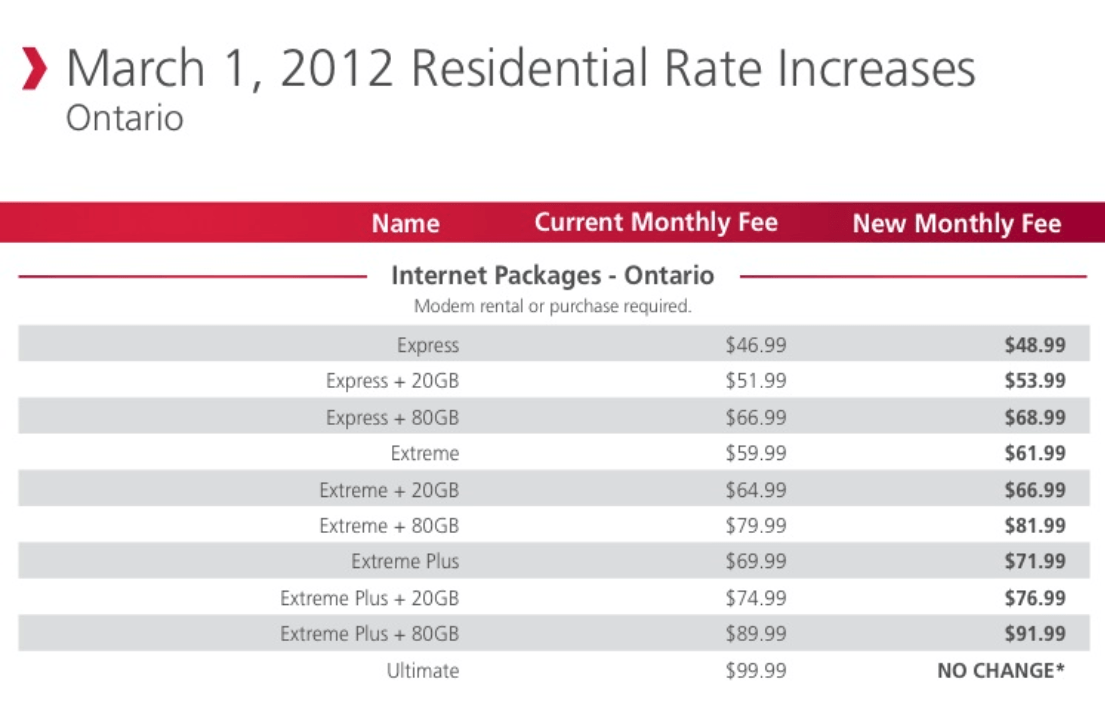
Citing “the many enhancements they have launched” in the past year, Rogers Cable has announced an across-the-board broadband rate increase that will cost subscribers an additional $2 a month for Internet service effective March 1, 2012.

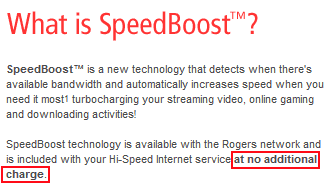
Rogers claims the rate increases come as a result of investments in their broadband network and the introduction of SpeedBoost, which delivers a temporary speed increase during the first few seconds of file transfers.

Rogers also claims they have increased monthly usage allowances and download speeds on many of the company’s broadband packages.

The rate increase is not going over well with subscribers, however.

Stop the Cap! reader Nick in Markham, Ontario is one of them.

"No additional charge," except for the $2 rate increase Rogers suggests comes after the addition of "service enhancements" like SpeedBoost.

“Rogers introduced ‘SpeedBoost’ as a ‘free’ feature which we are now apparently/effectively going to pay more for,” Nick writes. “I am really unimpressed with Rogers’ ‘generosity,’ especially respecting bitcaps, considering they are totally arbitrary.”

Nick notes customers in Quebec and western Canada have more generous usage allowances, and often lower bills.

“Shaw customers are getting a much better deal than Rogers’ customers these days,” Nick says. “If Rogers increased prices by $2 and took the caps completely off, I’d gladly pay a little more just to end years of headaches over watching my Internet usage.”

“I am so tired of feeling like my Internet connection is being rationed, and considering my choices have been Bell or Rogers, I think I’ll sacrifice some of the higher speeds and just consider switching to TekSavvy DSL, because it costs less and doesn’t come with Rogers’ stingy caps.”

A Montreal Gazette piece on the Canadian telecommunications industry says stockholders and company executives are doing much better, enjoying major boosts in telecom industry dividends.  The industry enjoyed a 25% boost in stock price + dividend yield over other Canadian stocks over the past 12 months.  The industry also enjoys the benefits a barely-competitive marketplace that offers opportunities for unfettered rate increases:

Canada remains a heavily protected market in telecommunications, which is one reason why consumers don’t get the kind of deals available in other countries.

But in the absence of such [competitive] changes, there’s a strong case to be made that telecom and cable companies will post solid profit growth this year and next.

Search This Site:

Contributions:

Recent Comments:

Your Account:

Stop the Cap!