Home » rate hike » Recent Articles:

Deregulation Savings? CenturyLink Wins Right to Raise Phone Rates in Arizona

Deregulation likely means higher phone bills for CenturyLink customers in Arizona.

CenturyLink has convinced Arizona state regulators local phone service is now competitive throughout the state, allowing the company to raise rates with less regulatory oversight. But some consumers are wondering how deregulation benefits them.

“Once again the phone company has sold us another bill of goods in Arizona,” says Tucson ex-CenturyLink customer Miguel Gonzalez. “First Qwest and now CenturyLink told us that deregulation would bring rates down for phone service, yet both companies fought for years to raise, not lower prices.”

Under the plan approved by the Arizona Corporation Commission, CenturyLink will be able to raise its residential rates up to 10 percent per year, so long as the rate increases do not exceed 25 percent over three years.

Arizona residential landline customers have paid roughly $13.18 for standard urban phone service since the 1990s, when Qwest was the local phone company. Now CenturyLink is free to raise those prices $1.30 a month in any of the next three years or up to $3.30 overall, even as customers continue to disconnect service across the state. Business customers face potentially higher rate hikes — 15 percent annually or 25 percent over three years.

Regulators expect the company to file for a rate increase before you finish reading this article.

Oddly, both CenturyLink and some members of the commission called the change a victory for consumers, despite the likely higher rates to follow. The plan won approval in the Republican-controlled body in a 4-1 vote.

“It should be a win-win for the consumer (and the company),” said Democrat commissioner Paul Newman, who represents southern Arizona and voted for the plan with reservations. “That’s yet to be seen, but I hope it will be.”

The Arizona Daily Star reports CenturyLink will not be able to charge different rates in competitive and less-competitive areas, which consumer advocates say will protect ratepayers in areas where wireless coverage is poor and cable companies do not compete.

CenturyLink said it needs “rate flexibility” to compete as people disconnect landlines and head for cell phones and cable company “digital phone” products. Although the company did not elaborate, it argues the right to raise rates will allow it to compete more effectively with dominant cable operators Cox and Comcast.

Prior to deregulation, CenturyLink was allowed a guaranteed rate of return based on the true cost of providing landline phone service. The company also guaranteed to provide phone service to any Arizona resident inside of its service territory who asked. Under the terms of the new agreement, CenturyLink will now enjoy more rate flexibility, but will continue serving as the phone company of last resort.

“I’m still scratching my head about how the pointy-heads in Phoenix believe that raising rates makes you more competitive with cable and cell phone companies and not less,” Gonzalez says. “I guess it’s the same kind of New Phone Math that CenturyLink uses to try and keep the customers that are slipping away from them faster than ever.”

Gonzalez says he pulled the plug on CenturyLink last August.

“They offer nothing compelling to me when I can get a better price and better service with more calling features from the cable company, and now they offer even less.”

Fox News Channel – Time Warner Cable Deal Will Increase Cable Rates for Millions

Phillip Dampier August 8, 2012 Consumer News 7 Comments

While Time Warner Cable will pull local channels off its cable lineup when contract negotiations fail, the company was less aggressive fighting demands from Fox News Channel parent company News Corp., and caved in to higher fees for the cable news network.

People familiar with the talks said News Corp. won a major rate increase from the cable operator for its Fox News Channel which could reset the bar when other cable companies negotiate renewal contracts.

Sources told the Los Angeles Times Fox News Channel will now cost each cable subscriber more than $1 a month, up from 89 cents. Time Warner Cable will likely bundle that increase into the next round of customer rate hikes. Fox News Channel’s new price puts them among top tier cable networks like TNT and USA.

Last year,  News Corp. President Chase Carey told Wall Street contract renewals for the channel “will take subscription fees to a whole new level.”

The only concession Time Warner Cable seemed to win was a more limited renewal agreement that only covered the Fox News Channel, Fox Movie Channel, and the barely-watched Fox Business Network. Time Warner Cable officials refused to renegotiate earlier, yet to expire deals with less popular Fox-owned cable networks.

The Times noted Fox News Channel did not want to lose more than 10 million cable subscribers at the height of election season, and the cable company did not want to deal with loyal Fox News viewers likely to complain or leave over the loss of the network.

With the renewal, every Time Warner Cable subscriber will pay even more for the channels whether they watch them or not.


Retransmission Consent Wars: Time Warner Restores Hearst, Prepares to Lose Meredith

Phillip Dampier July 25, 2012 Consumer News, Public Policy & Gov't, Video 2 Comments

Time Warner Cable customers in Kansas City are ground zero for the cable operator’s retransmission consent battles with over-the-air stations that leave cable viewers without a full lineup of local channels.

Just hours after Time Warner customers got back two local stations owned by Hearst Corporation, Meredith Corporation’s KCTV and KSMO are preparing to pull the plug at midnight tonight.

“Please know that we have tried very hard to reach an agreement with Time Warner Cable, so that our viewers would not have to miss any of our stations’ around-the-clock reporting of news, politics, traffic, weather emergencies, public service announcements, and favorite local and national programming,” reads a statement from the two stations. “We are disappointed in the outcome of our negotiations especially since we have successfully reached agreements with every major cable and satellite company that recognizes our fair market value. The fact is that we are only asking Time Warner Cable for pennies a day from your cable bill for our programming.”

They did not elaborate on exactly how many pennies more a day they were asking to receive. Time Warner Cable suggested they wanted a 200% rate hike.

Should negotiations fail, viewers in Kansas City will lose their local CBS and CW affiliates. Time Warner Cable’s recent response to these disputes is to replace missing local stations with out-of-area stations, in this case most likely Nexstar’s WROC-TV in Rochester, N.Y., a CBS affiliate. Time Warner has not bothered to find a fill-in CW station to date.

But Nexstar last week sued Time Warner Cable in U.S. District Court in the northern district of Texas alleging copyright infringement and breach of contract for importing its TV stations without permission. Nexstar wants a temporary restraining order and damages. If the judge hearing the case issues the restraining order, Kansas City will have to do without a CBS station on Time Warner’s lineup until the dispute is settled.

So far this year, there have 69 instances of local stations withholding their signals from either a cable, phone, or satellite operator in disputes over retransmission rights fees.

In a hearing held yesterday in Washington, several senators attacked the disputes that deprive paying subscribers of broadcast stations.

Sen. Jim DeMint (R-S.C.) wants to repeal the 1992 law that allows broadcasters to require pay television operators to get permission and, in an increasing number of cases, payment to carry local broadcast stations.

DeMint argues the law has outlived its usefulness.

But Sen. John Kerry (D-Mass.) and others note the law also enacted several consumer protections and pro-competition policies that stopped programmers from withholding programming from competing pay television providers.

Kerry called demands to repeal the law altogether “radical” and suggested such moves could destroy local broadcasting. Cable operators want the power to negotiate contracts with out-of-area stations to leverage lower retransmission consent fees from broadcasters and provide customers with replacement stations when the two sides can’t or won’t agree to terms.

Broadcasters have suggested that could leave cable viewers with stations from distant cities, depriving viewers of important local news and emergency information.

For now, no action in Washington is anticipated. Broadcasters have leveraged their popularity to demand increasing payments for permission to carry their signals, and cable and other pay television operators, despite protests, usually agree to slightly lower fee increases and pass them right along to paying subscribers in the form of a rate increase.

Yesterday’s hearing, chaired by Sen. Jay Rockefeller (D-WV), discussed changes in television technologies over the past two decades. It focused on examining the effectiveness of the Must-Carry law, a 1992 law currently in place for the cable industry. The Must-Carry law requires a variety of local broadcast stations to be viewed on pay-TV platforms. Today’s Must-Carry rights were enacted by Congress in the 1992 Cable Act, which the Supreme court upheld in 1997. Congress then found that cable systems have an “economic incentive” to alter their local broadcast signals and that, without Must-Carry rules, broadcasters’ viability is jeopardized.

Although Chairman Rockefeller sought to not have the hearing derailed by retransmission consent disputes, a significant portion of the hearing dealt with that specific issue.

Top cable and broadcasting executives, as well as law experts testify. Witnesses include Melinda Witmer from Time Warner Cable; Martin Franks of CBS; the National Association of Broadcasters’ Gordon Smith; Colleen Abdoulah from Wide Open West!; Gordon Smith from the American Cable Association; law professor and former Disney Washington executive Preston Padden; along with Mark Cooper from the Consumer Federation of America. Courtesy: C-SPAN (1 Hour, 41 Minutes)

Special Report — Retransmission Consent Wars 2012: Disputes Becoming Daily Nuisance

Customers sitting down to watch the local news in Louisville, Ky. on Time Warner Cable (formerly Insight) now get to see stories about ongoing bankruptcy woes at Eastman Kodak, house fires in Irondequoit, road work in Greece, and Scott Hetsko’s local forecast… for Rochester, N.Y.

[flv width=”640″ height=”380″]http://www.phillipdampier.com/video/WLKY Louisville WLKY Remains Off the Air 7-16-12.flv[/flv]

WLKY in Louisville is no longer seen on former Insight cable systems (now owned by Time Warner Cable). In its place, Louisville viewers are watching WROC-TV in Rochester, N.Y.  Here is why. (3 minutes)

No, it is not some weird sunspot reception and nobody transported you from Kentucky to western New York while you were sleeping. It’s simply another epic battle waged in:

RETRANSMISSION CARRIAGE CONSENT WARS: 2012

“Not getting the channels you are paying for does not necessarily entitle you to a refund, but does require you to pay more when a deal is eventually struck.”
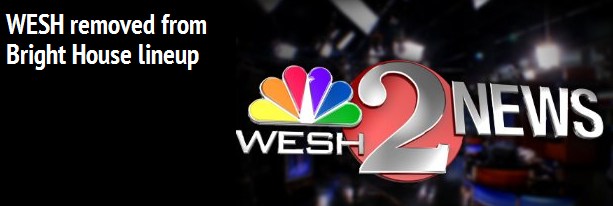
WESH-TV in Daytona Beach/Orlando, Fla. is one of the Hearst-owned stations affected in the dispute with Insight/Time Warner Cable/Bright House Networks.

These skirmishes used to be commonplace around the end of the year, when carriage agreements between cable, satellite, and telephone companies with cable networks and local stations came up for renewal. When the programmer passed a figure written on a folded up piece of paper across the table to your pay television provider, the shock and awe of that number, occasionally 100-300 percent more than the year before, was the opening shot in a battle that now increasingly leads to favorite local stations or cable channels being stripped from your lineup.

In Louisville, that is precisely what happened to WLKY-TV, one of 15 stations owned by Hearst Television, taken off the lineup when Time Warner Cable/Insight/Bright House Networks could not successfully negotiate a renewal agreement. Time Warner complained Hearst wanted 300% more for each of the affected stations, an increase sure to be passed along to cable customers already long weary of endless annual rate increases. That was the same story told in other cities affected by what is now a week-long blackout. In Greensboro/Winston-Salem, N.C., Time Warner customers are doing without WXII-TV. Kansas City customers lost two local stations owned by Hearst — KMBC and KCWE. Two stations are also missing from Bright House’s lineup in Orlando: WESH and WKCF.

[haiku url=”http://www.phillipdampier.com/audio/WHAS Louisville Interview with WLKY GM 7-16-12.mp3″ defaultpath=disabled]

Hearst Television’s general manager and president of WLKY has stopped referring to those watching the station simply as “viewers.” Glenn Haygood now calls them “subscribers.” Haygood talks with WHAS Radio about the dispute and what he thinks about Insight/Time Warner Cable. (10 minutes)

Insight/Time Warner Cable customers in Louisville, Ky. are now watching CBS shows on WROC-TV from Rochester, N.Y.

But why are Louisville viewers now watching the boating forecast for Lake Ontario, several hundred miles away? Because Time Warner Cable thinks it has a signed contract with Nexstar Broadcasting Group that lets them turn several Nexstar-owned stations into “superstations,” importing them in cities where contract disputes have knocked the local station off the cable lineup. In Louisville, WLKY, a CBS affiliate, has been replaced by WROC, the CBS affiliate in Rochester. In Greensboro and several other cities, WXII, an NBC affiliate, has been replaced with WBRE in Wilkes Barre, Penn. Some other Time Warner customers are instead watching WTWO out of Terre Haute, Ind., for NBC shows.

It represents a half-measure that Time Warner Cable’s Jeff Simmermon tells Stop the Cap! is “making the best of a tough situation.”

Viewers are naturally outraged.

“I’ve always wanted to know the weather and news in Rochester, Buffalo, Ontario and Caribou,” Kelly Grether teased. “Louisville did make [WROC’s weather] map believe it or not.”

Others are simply confused and engaged in must-flee TV.

“I saw the news coming on,” Greensboro resident Mona Wright told the News & Record. “It didn’t take me but one minute to figure out that these counties were nowhere around us; I changed the channel.”

Some Louisville viewers are even assuming the sales and discounts being advertised on WROC are good in Kentucky as well (often, they are not).

For now, it is difficult for Kentucky viewers to know what WROC is airing because the local on-screen program guide has not been updated to include listings for the Rochester station. Time Warner is pushing a lot of viewers to WROC’s website for program information.

Viewers hoping to practice their Jeopardy and Wheel of Fortune skills during the dinner hour lost that opportunity altogether in some cities, while in the Triad of North Carolina, viewers discovered the two shows on two different channels at the same time.

For now, WROC has completely ignored its new Kentucky audience, but WBRE’s morning anchors now regularly acknowledge and welcome their viewers from several states away.

[flv width=”640″ height=”380″]http://www.phillipdampier.com/video/WFTV Orlando WESH Disappears from Bright House 7-10-12.flv[/flv]

WFTV in Orlando reports on Bright House Networks’ customers being shut out of WESH-TV in Daytona Beach after the cable operator failed to meet Hearst Television’s demands for an increase in carriage payments.  (2 minutes)

The dispute has since enlarged to bring in side players who are unimpressed with Time Warner’s creative problem-solving:

  • Impacted stations now off Time Warner’s lineup think the “new” stations on the lineup are about as honorable as employing scab workers during a union strike;
  • Nexstar, for the second time, declares Time Warner is illegally importing their stations to unauthorized places. They are threatening to complain to the FCC and possibly sue to stop the practice. Nexstar earlier complained about a similar dispute in upstate New York which left viewers in northern New York watching WBRE in Wilkes-Barre. But the carriage dispute was settled quickly enough for WBRE to go back to being  viewable only in Pennsylvania, ending the dispute;
  • Syndicated program owners sell shows like Wheel of Fortune on a “market exclusive” basis, which means competing local stations already paying for syndicated shows do not want out of area stations also carrying those shows to local audiences, diluting their audience.
  • Advertisers on stations now off the lineup paid ad rates based on tens of thousands of cable viewers who are now probably watching another station. Some are demanding “make goods” or outright refunds to get the value for money they were originally promised.

But nobody is more caught in the middle than consumers, especially those paying for channels they are no longer getting.
“I want my money back,” says Orlando Bright House customer Luis Fernandez. “I have lost two stations on my lineup and my bill should be going down to compensate, but Bright House is refusing to credit me.”

Time Warner Cable does not usually give refunds either, arguing that its customers pay for a package of channels and the technology that delivers those networks to customers. Giving a refund for the loss of one or two stations would be tantamount to the industry’s worst nightmare: getting customers used to the idea of paying individually for every channel.

One customer willing to make himself a major nuisance in Wauwatosa, near Milwaukee, Wis., finally wore Time Warner down and secured a $5 a month discount on his bill for the length of the dispute that knocked Milwaukee’s WISN off his lineup.

“[I called] Time Warner to voice my disgust in them putting me (the paying customer) in the middle of their negotiation failures, and after reaching a ‘supervisor,’ I was able to get a discount on my monthly bill,” the reader told the Journal-Sentinel. “It wasn’t easy, but I did it.”

Hearst is encouraging viewers to drop Time Warner like a hot potato and switch to AT&T U-verse or a satellite provider like DirecTV. Negotiations seem to be continuing on a sporadic basis, but one week later, customers heading for the door have already left or are simply watching the local news on another channel.

Satellite Showdown — DirecTV vs. Viacom: Playing Down and Dirty With Everyone

[flv width=”426″ height=”260″]http://www.phillipdampier.com/video/Viacom Ad.mp4[/flv]

Viacom turns the tables on DirecTV’s clever ads to lambaste the satellite provider for cutting off more than two dozen cable channels owned by Viacom.  (1 minute)

If a customer took Hearst’s advice, they might find themselves out of the frying pan and into the fire. Newly arriving DirecTV customers can join the Anger Party 20 million satellite customers are now throwing over a much larger, higher profile dispute between the satellite provider and Viacom. Collateral damage: the loss of networks including Palladia, Centric, Tr3s, CMT, Logo, NickToons, VH1 Classic, TeenNick, Nick Jr., Nick@Nite, Spike, BET, VH1, TV Land, Comedy Central, Nickelodeon and MTV.

Some financial analysts are calling the dispute the mother-of-all-program-fee-battles, and as they watch both sides dig in, some warn it could mean DirecTV customers won’t be watching The Daily Show with Jon Stewart until August.

DirecTV says Viacom wants a 30% rate increase to renew its contract to carry the company’s networks. That is comparatively cheap contrasted with the prices Hearst wants Time Warner Cable to now pay. Analysts expect DirecTV and Viacom will eventually settle their dispute by agreeing to a 27% rate increase, but nobody knows how long the two will battle it out before an inevitable agreement is reached.

Regardless of the timing, customers will likely pay the price. Nomura analyst Michael Nathanson informed his Wall Street clients DirecTV will end up paying Viacom $2.85 per subscriber — about 60 cents more per month than it pays today. That’s tough for DirecTV to swallow, and probably even harder to pass along to customers. Satellite TV providers have some of the country’s most-frugal pay television customers who are especially resistant to rate increases.

The dispute is so high profile, both companies are bringing out high-powered executives and show talent to argue their respective cases.

Millions of dollars are at stake, and both Viacom and DirecTV are willing to fight to the death, even leaving customers on the battlefield.

[flv width=”640″ height=”380″]http://www.phillipdampier.com/video/DirecTV Viacom Dispute 7-12-12.mp4[/flv]

Not so fast, says DirecTV CEO Michael White, seen here presenting DirecTV’s position in the Viacom dispute for the benefit of concerned customers.  (1 minute)

“All we are trying to get is a fair deal for our customers and I’m sorry our customers are being forced into the middle of this,” DirecTV’s Michael White said. “We just think we pay a half a billion dollars a year and a billion dollar increase over five years, over 30 percent, is not justified by the marketplace or fair relative to our largest competitors or by their ratings.”

Viacom CEO Philippe Dauman counters, “In the last seven years since we did the last DirecTV deal, we have successfully and peacefully concluded affiliate agreements with every major distributor in the U.S. We are prepared to move forward. It’s unfortunate consumers for the first time are not able to enjoy our channels,” said Dauman, adding, “I don’t want to negotiate in public.”

DirecTV was telling its customers it can watch many of the missing shows for free online, until Viacom reportedly began removing that direct viewing option last week. That hardball tactic could impact everyone trying to stream Viacom’s shows — DirecTV customer or not.

“We’ve temporarily slimmed down our offerings, as DirecTV markets them as an alternative to having our networks,” a Viacom spokesman told CNNMoney. “The online content is intended to serve as a complimentary marketing tool for our partners.”

“At least they were honest about the reasons why they pulled this,” said Stop the Cap! reader Dick Armlo, a DirecTV customer in Idaho. “But fortunately, you can still find a lot of the shows on Amazon’s video on demand and Hulu.”

Customers threatening to switch providers often discover the new neighborhood they move to is just as bad as the one they left.

Dish Network customers are currently enduring a long-standing dispute with Cablevision-owned AMC Networks. The result is no AMC, IFC, Sundance Channel and WeTV on Dish. AMC is telling Dish customers to turn their dish into a birdbath and head elsewhere… perhaps to AT&T U-verse which just recently averted its own blackout with AMC over the same channels. AT&T customers can expect part of their next rate increase to cover the negotiated rate hike AMC won for itself — the one AT&T agreed to on your behalf. After all, it’s your money at stake, not theirs.

[flv]http://www.phillipdampier.com/video/CNBC Viacom CEO on Dispute 7-12-12.flv[/flv]

CNBC talks with Viacom CEO Philippe Dauman to get his views about the dispute with one of his best customers — DirecTV.  (2 minutes)

The Illusory Savings of “Usage Based Billing”: Your Bill Will Get Higher, Not Lower

Phillip Dampier July 2, 2012 Broadband "Shortage", Broadband Speed, Competition, Consumer News, Data Caps, Editorial & Site News, Online Video Comments Off on The Illusory Savings of “Usage Based Billing”: Your Bill Will Get Higher, Not Lower

Phillip “They Want to Save You Money By Charging You More” Dampier

The pro-Internet Overcharging forces’ meme of “pay for what you use” sounds good in theory, but no broadband provider in the country would dare switch to a true consumption-based billing system for broadband, because it would destroy predictable profits for a service large cable and phone companies hope you cannot live without.

Twenty years ago, the cable industry could raise rates on television packages with almost no fear consumers would cancel service. When I produced a weekly radio show about the cable and satellite television industry, cable companies candidly told me they expected vocal backlashes from customers every time a rate increase notice was mailed out, but only a handful would actually follow through on threats to cut the cord. Now that competition for your video dollar is at an all-time-high, providers are shocked (and some remain in denial) that customers are actually following through on their threats to cut the cord. Goodbye Comcast, Hello Netflix!

Some Wall Street analysts have begun warning their investor clients that the days of guaranteed revenue growth from video subscribers are over, risking profits as customers start to depart when the bill gets too high. Cable companies have always increased rates faster than the rate of inflation, and investors have grown to expect those reliable profits, so the pressure to make up the difference elsewhere has never been higher.

With broadband, cable and phone companies may have found a new way to bring back the Money Party, and ride the wave of broadband usage to the stratosphere, earning money at rates never thought possible from cable-TV. The ticket to OPEC-like rivers of black gold? Usage-based billing.

Since the early days of broadband, most Americans have enjoyed flat rate access through a cable or phone company at prices that remained remarkably stable for a decade — usually around $40 a month for standard speed service.

In the last five years, as cord-cutting has grown beyond a phenomena limited to Luddites and satellite dish owners, the cable industry has responded. As they learned customers’ love of broadband has now made the service indispensable in most American homes, providers have been jacking up the price.

Time Warner Cable, for example, has increased prices for broadband annually for the last three years, especially for customers who do not subscribe to any other services.

Customers dissatisfaction with rate hikes has not led to broadband cord cutting, and in fact might prove useful on quarterly financial reports -and- for advocating changes in the way broadband service is priced:

  1. Enhance revenue and profits, replacing lost ground from departing video customers and the slowing growth of new customers signing up for video and phone services (and keeping average revenue per user ((ARPU)) on the increase);
  2. Using higher prices to provoke an argument about changing the way broadband service is sold.

Pouring over quarterly financial reports from most major providers shows remarkable consistency:

  • The costs to provide broadband service are declining, even with broadband usage growth;
  • Revenue and profits enjoy a healthy growth curve, especially as increased prices on existing customers make up for fewer new customer additions;
  • Earnings from broadband are now so important, a cable company like Time Warner Cable now refers to itself as a broadband company. It is not alone.

Still, it is not enough. As usage continues to grow in the current monopoly/duopoly market, providers are drooling with anticipation over the possibility of scrapping the concept of “flat rate” broadband, which limits the endless ARPU growth Wall Street demands. If a company charges a fixed rate for a service, it cannot grow revenue from that service unless it increases the price, sells more expensive tiers of service, or innovates new products and services to sell.

Providers have enjoyed moderate success selling customers more expensive, faster service, also on a flat rate basis. But that still leaves money on the table, according to Wall Street-based “usage billing” advocates like Craig Moffett, who see major ARPU growth charging customers more and more money for service as their usage grows.

Moffett has a few accidental allies in the blogger world who seem to share his belief in “usage-based” billing. Lou Mazzucchelli, reading the recent New York Times piece on Time Warner’s gradual move towards usage pricing, frames his support for consumption billing around the issue of affordability. In his view, usage pricing is better for consumers and the industry:

It costs real money to upgrade networks to keep pace with this demand, and those costs are ultimately borne by the subscriber. So in the US, we have carriers trying to raise their rates to offset increases in capital and operating expenses to the point where consumers are beginning to push back, and the shoving has come to the attention of the Federal Communications Commission, which has raised the possibility of treating Internet network providers as common communications carriers subject to regulation.

I believe that flat-rate pricing is a major source of problems for network carriers and consumers. In the carrier world, the economics are known but ignored because marketers believe that flat rates are the only plans consumers will accept. But in the consumer world, flat rates are rising to incomprehensible levels for indecipherable reasons, with little recourse except disconnection. Consumer dissatisfaction is rising, in part because consumers feel they have no control over the price they have to pay. This is driven by their sense of pricing inequity that is hard to visualize but comes from implicit subsidies in the current environment. The irony is that pay-per-use pricing solves the problem for carriers and consumers.

Mazzucchelli reposted his blog piece originally written in 2010 for the benefit of Times readers. Two years ago, he measured his usage at 11GB a month. His provider Verizon Communications was charging him $64.99 a month for 25Mbps service, which identifies him as a FiOS fiber to the home customer.  Mazzucchelli argues the effective price he was paying for Internet access was $5.85 for each of the 11GB he consumed, which seemed steep at the time. (Not anymore, if you look at wireless company penalty rates which range from $10-15/GB or more.)

Mazzucchelli theorized that if he paid on a per-packet basis, instead of flat rate service based on Internet speed, he could pay something like $0.0000025 per packet, which would result in a bill of $31.91 for his 11GB instead of $65. For him, that’s money saved with usage billing.

On its face, it might seem to make sense, especially for light users who could pay less under a true usage-based pricing scenario like the one he proposes.

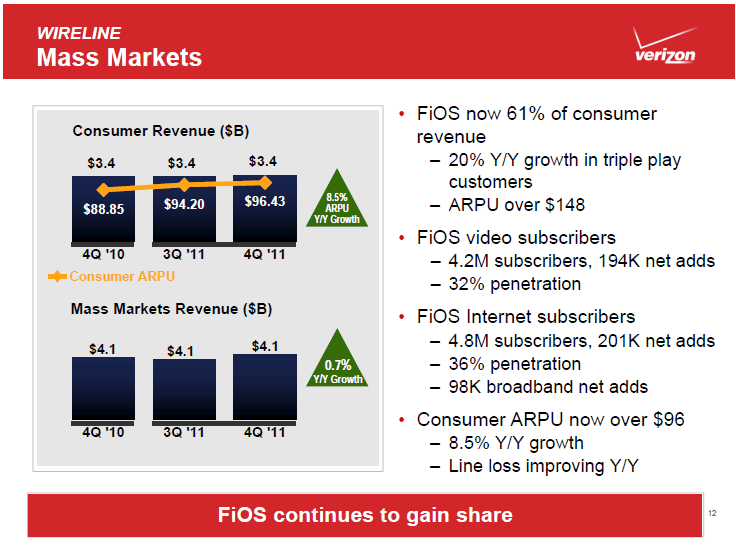
Verizon Communications is earning more average revenue per customer than ever with its fiber to the home network. That’s about the only bright spot Wall Street recognizes from Verizon’s fiber network, which some analysts deride as “too expensive.”

Unfortunately for Mazzucchelli, and others who claim usage-based pricing will prove a money-saver, the broadband industry has some bad news for you. Usage pricing simply cannot be allowed to save you, and other current customers money. Why? Because Wall Street will never tolerate pricing that threatens the all-important ARPU. In the monopoly/duopoly home broadband marketplace most Americans endure, it would be the equivalent of unilaterally disarming in the war for revenue and profits.

That is why broadband providers will never adopt a true usage-based billing system for customers. It would cannibalize earnings for a service that already enjoys massive markups above true cost. In 2009, Comcast was spending under $10 a month to sell broadband service priced above $40.

Mazzucchelli

Instead, providers design “usage-based” billing around rates comparable to today’s flat rate pricing, only they slap arbitrary maximum usage allowances on each tier of service, above which consumers pay an overlimit fee penalty. That would leave Mazzucchelli choosing a lower speed, lower usage allowance plan to maximize his savings, if his use of the Internet didn’t grow much. On a typical light use plan suitable for his usage, he would subscribe to 1-3Mbps service with a 10GB allowance, and pay the overlimit fee for one extra gigabyte if he wanted to maximize his broadband dollar.

But his usage experience would be dramatically different, both because he would be encouraged to use less, fearing he might exceed his usage allowance, and he would be “enjoying” the Internet at vastly slower speeds. If Mazzucchelli went with higher speed service, he would still pay prices comparable for flat rate service, and receive a usage allowance he personally would find unnecessarily large. The result for him would be little to no savings and a usage allowance he did not need.

Mazzucchelli’s usage pattern is probably different today than it was in 2010. Is he still using 11GB a month? If he uses double the amount he did two years ago, under his own pricing formula, the savings he sought would now be virtually wiped out, with a broadband bill for 22GB of consumption running $63.82. By the following year, usage-based pricing would cost even more than Verizon’s unlimited pricing, as average use of the Internet continues to grow.

That helps the broadband industry plenty but does nothing for consumers. Mazzucchelli might be surprised to learn that the “real money to upgrade networks to keep pace with this demand,” is actually more than covered under today’s profit margins for flat-rate broadband. In fact, if he examines financial reports over the last five years and the statements company executives make to shareholders, virtually all of them speak in terms of reducing capital investments and the declining costs to deliver broadband, even as usage grows.

Verizon’s fiber network, while expensive to construct, is already earning the company enormous boosts in ARPU over traditional copper wire phone service. While Wall Street howled about short term capital costs to construct the network, then-CEO Ivan Seidenberg said fiber optics was the vehicle that will drive Verizon earnings for decades selling new products and services that its old network could never deliver.

Still, is Mazzucchelli paying too much for his broadband at both 2010 and 2012 prices? Yes he is. But that is not a function of the cost to deliver broadband service. It is the result of a barely competitive marketplace that has an absence of price-moderating competitors. Usage-based pricing in today’s broadband market assures lower costs for providers by retarding usage. It also brings even higher profits from bigger broadband bills as Internet usage grows, with no real relationship to the actual costs to provide the service. It also protects companies from video package cord-cutting, as customers will find online viewing prohibitively expensive.

One need only look at pricing abroad to see how much Americans are gouged for Internet service. Unlimited high speed Internet is available in a growing number of countries for $20-40 a month.

Usage-based billing is a dead end that might deliver temporary savings now, but considerably higher broadband bills soon after. It is not too late to turn the car around and join us in the fight to keep unlimited broadband, enhance competition, and win the lower prices users like Mazzucchelli crave.

Search This Site:

Contributions:

Recent Comments:

Your Account:

Stop the Cap!