Home » public policy » Recent Articles:

Time Warner Cable Adds Free Calls to Mexico to its Nationwide Calling Plan; Sock Puppets Approve

Phillip Dampier March 3, 2014 Astroturf, Consumer News, Editorial & Site News Comments Off on Time Warner Cable Adds Free Calls to Mexico to its Nationwide Calling Plan; Sock Puppets Approve

MexicoPhoneTime Warner Cable phone customers with Unlimited Home Phone calling can now place toll-free calls to Mexico, the company announced today.

Most Time Warner Cable phone customers are already signed up with the Unlimited Home Phone plan, which provides free-calling to the U.S., Canada, Puerto Rico, Guam, and the U.S. Virgin Islands.

“The expansion of our most popular Phone plan to include unlimited calls to Mexico will bring huge value to the millions of TWC Home Phone users who have friends and family in Mexico,” said Jeff Lindsay, general manager for Home Phone at TWC. “We’re excited to offer truly unlimited calling to Mexico as part of our main calling plan.”

Customers can make unlimited toll-free calls to both Mexican landline and cellular numbers.

The cable company also gave room in its press release to congratulatory comments from the League of United Latin American Citizens (LULAC) and The National Hispanic Caucus of State Legislators (NHCSL) — two Latino organizations that receive financial support from large cable and phone companies and often appeal to regulators on behalf of the telecom industry.

LULAC counts Time Warner Cable as a member of its Corporate Alliance and partner organization.

The NHCSL receives support and assistance from a variety of cable and phone companies including Comcast, Verizon, and AT&T and regularly appeals to federal regulators advocating the public policy agenda of Big Telecom companies.

[flv]http://www.phillipdampier.com/video/TWC TWC Free Calls to Mexico 3-3-14.mp4[/flv]

Ray de los Santos, director of LULAC in Dallas delivered this jumbled word salad about Time Warner Cable’s addition of free-calling to Mexico. (0:36)

More Hackery on Broadband Regulation from the AT&T-Funded Progressive Policy Institute

Phillip "Follow the Money" Dampier

Phillip “Follow the Money” Dampier

“In the 1990s, U.S. policymakers faced critical choices about who should build the Internet, how it should be governed, and to what extent it should be regulated and taxed. For the most part, they chose wisely to open a regulated telecommunications market to competition, stimulate private investment in broadband and digital technologies, and democratize access.” — Will Marshall, guest columnist

Is competition in Internet access robust enough for you? Has your provider been sufficiently stimulated to invest in the latest broadband technologies to keep America at the top of broadband speed and availability rankings? Is Net Neutrality the law of the land or the latest victim of a Verizon lawsuit to overturn the concept of democratizing access to online content?

I’m not certain what country Will Marshall lives in, but for most Americans, Internet access is provided by a duopoly of providers that must be dragged kicking and screaming to upgrade their networks without jacking up prices and limiting usage.

Marshall is president and founder of the Progressive Policy Institute, a so-called “third way” group inspired by centrist Democrats led by President Bill Clinton in the 1990s. Unlike traditional liberals suspicious of corporate agendas, these Democrats were friendly to big business and welcomed the largess of corporate cash to keep them competitive in election races. It was under this atmosphere that Clinton signed the bought-and-paid-for 1996 Telecom Act, ghostwritten by lobbyists for big broadcasters, phone and cable companies, and other big media interests. Long on rhetoric about self-governing, free market competition but short on specifics, the ’96 law transformed the media landscape in ways that still impact us today.

ppiMedia ownership laws were relaxed, allowing massive buyouts of radio stations under a handful of giant corporations like Clear Channel, which promptly dispensed with large numbers of employees that provided locally produced programming. In their place, we now get cookie-cutter radio that sounds the same from Maine to Oregon. Television stations eagerly began lobbying for a similar framework for relaxing ownership limits in their business. Phone companies won their own freedoms from regulation, including largely toothless broadband regulations that allowed Internet providers to declare victory regardless of how good or bad broadband has gotten in the United States.

Marshall’s views appeared in a guest column this week in The Orlando Sentinel, which is open to publishing opinion pieces from writers hailing from Washington, D.C., without bothering to offer readers with some full disclosure.

Marshall

Marshall

While Marshall’s opinions may be his own, readers should be aware that PPI would likely not exist without its corporate sponsors — among them AT&T, hardly a disinterested player in the telecommunications policy debate.

Marshall’s column suggests competition is doing a great job at keeping prices low and allows you – the consumer – to decide which technologies and services thrive. There must be another reason my Time Warner Cable bill keeps increasing and my choice for broadband technology — fiber optics — is nowhere in sight. I don’t have a choice of Verizon FiOS, in part because phone and cable companies maintain fiefdoms where other phone and cable companies don’t dare to tread. That leaves me with one other option: Frontier Communications, which is still encouraging me to sign up for their 3.1Mbps DSL.

“The broadband Internet also is a powerful magnet for private investment,” Marshall writes. “In 2013, telecom and tech companies topped PPI’s ranking of the companies investing the most in the U.S. economy. And America is moving at warp speed toward the ‘Internet of Everything,’ which promises to spread the productivity-raising potential of digital technology across the entire economy.”

Nothing about AT&T or the cable companies is about “warp speed.” In reality, AT&T and Verizon plan to pour their enormous profits into corporate set-asides to repurchase their own stock, pay dividends to shareholders, and continue to richly compensate their executives. It’s good to know that PPI offers rankings that place telecom companies on top. Unfortunately, those without a financial connection to AT&T are less optimistic. The U.S. continues its long slide away from broadband leadership as even developing countries in the former Eastern Bloc race ahead of us. Verizon’s biggest single investment of 2013 wasn’t in the U.S. economy — it was to spend $130 billion to buyout U.K.-based Vodafone’s 45% ownership interest in Verizon Wireless. Verizon’s customers get stalled FiOS expansion, Cadillac-priced wireless service, and a plan to ditch rural landlines and push those customers to cell service instead.

AT&T financially supports the Progressive Policy Institute

AT&T financially supports the Progressive Policy Institute

“A recent federal court decision regarding the FCC’s Open Internet Order has prompted pro-regulatory advocates from the ’90s to demand a rewrite of the legal framework that allowed today’s Internet to flourish,” Marshall writes in a section that also includes insidious NSA wiretapping and Internet censorship in Russia and China.

Marshall’s AT&T public policy agenda is showing.

Net Neutrality proponents don’t advocate an open Internet for no reason. It was AT&T’s former CEO Ed Whitacre that threw down the gauntlet declaring Google and other content providers would not be allowed to use AT&T’s pipes for free. AT&T has since patented technology that will allow it to discriminate in favor of preferred web traffic while artificially slowing down content it doesn’t like on its network.

“Pro-regulatory advocates” are not the ones advocating change — it is AT&T, Verizon, and Comcast, among others, that want to monetize Internet usage and web traffic for even higher profits. Net Neutrality as law protects the Internet experience Marshall celebrates. He just can’t see past AT&T’s money to realize that.

New FCC Chairman Denies He’s an Industry Shill: “My Client is the American People”

Phillip Dampier November 14, 2013 Competition, Consumer News, History, Public Policy & Gov't, Video 2 Comments
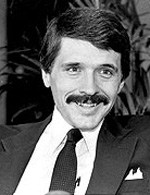
Tom Wheeler circa 1983, when he represented the cable industry.

Tom Wheeler circa 1983, when he represented the cable industry. (Image: The Cable Center)

Skepticism persists over whether new FCC chairman Tom Wheeler, a former cable and telco lobbyist and venture capitalist, will have the interests of an industry he was a part of for decades ahead of the people he is supposed to represent.

The doubts are so significant, The Wall Street Journal’s ‘All Things D’ devoted an entire piece on the subject, interviewing Wheeler about his plans for the federal agency.

“My client today is the American people, and I am going to be the most effective advocate they could hope for,” Wheeler told AllThingsD in a phone interview on Wednesday. “I was (involved in) the early days of cable television when everybody was trying to squash it; I was a was champion for a diversity of voices and the competition that represented. I’m very proud of that period, but it was 30 years ago that I was in in cable, and 10 years ago that I was in wireless.”

Both periods were extremely important for both industries. When Wheeler was president of the National Cable TV Association (now the NCTA), his leadership helped enact the 1984 nationwide deregulation of the cable television industry. Wheeler promised the single national “hands-off” policy for cable television would put control “back in the hands of customers” instead of the local, state, and federal government. The cable lobby pushed hard for extra provisions in the law that would prohibit local or state governments or franchising authorities from reimposing controls the federal government eliminated.

The 1984 Cable Act contained three major provisions to strip away regulatory/rate oversight:

  1. “Basic Cable” rate regulation was removed in any community where a cable company faced “effective competition” from at least three unduplicated over the air television stations. If your community received two fuzzy network affiliates and one local religious station, that was considered effective competition.
  2. Local franchise authorities and cable TV commissions, often citizen-run, had most of their oversight and enforcement powers stripped away, including the most important power to deny a franchise renewal to a bad-acting local cable company, except in the most extreme cases. Cable operators effectively used this provision to launch costly lawsuits burying local communities in litigation expenses when they tried to find a different provider.
  3. Granted local franchise authorities to right to demand cable systems set aside a few channels for Public, Educational, and Government (PEG) use.

The cable industry carefully lobbied for an effective definition of “competition” that made it into the final version of the bill. Estimates from congressional researchers predicted that 97 percent of the country’s cable systems would be deregulated when the law took effect Dec. 29, 1986.

In a 1984 C-SPAN call-in program, Wheeler noted that before deregulation, “the cities were in the driver’s seat” controlling the franchising process. Wheeler claimed cable operators competing for franchise agreements were forced to promise services and technology that ultimately proved too burdensome or expensive to actually deliver. Deregulation, Wheeler promised, would “keep cable rates low because you are not going to be paying for services that [the government says] have to be provided that nobody watches.”

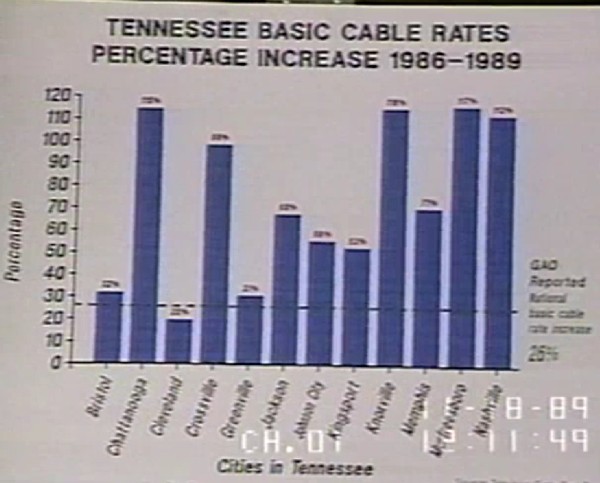
In reality, after the passage of the 1984 Cable Act, cable systems were bought and sold in a frenzy that left control ultimately in the hands of a handful of operators. Soon after, cable rates skyrocketed and cable-industry-owned networks and channels were shoveled on to cable lineups. With every sale and every new channel addition, rates were raised even higher, whether customers wanted the extra programming or not.

Without oversight, cable service itself deteriorated in quality. In some cities, cable operators ignored rights-of-way and often refused to hang or bury cable lines left scattered on lawns. Customer complaints often went unresolved for days or weeks. Cable operators also rolled out new charges for monthly programming magazines and equipment, even as they continued to boost rates for basic cable itself. Prior to deregulation, customers usually paid less than $10 a month for basic cable. After, rates rapidly pushed towards the $20 a month mark. Today’s cable TV prices are much higher.

In the summer of 1984, Wheeler left the NCTA to pursue a new business – The NABU Network, a precursor to cable broadband that turned out to be a commercial failure. The NABU Network coupled a home computer system with a cable-based data service. The only significant North American trial of NABU was in Ottawa, Canada and required significant subsidies from the Canadian government. Wheeler said the NABU system would offer subscribers a mountain of software at a monthly subscription price. Canadians had to buy the NABU PC for around $950 and pay around $10 a month for software access.

The venture fell apart because cable systems in that era lacked two-way capability, making it cumbersome for users to interact with the NABU platform or manage applications. Ottawa Cablevision and Skyline Cablevision introduced NABU in 1983 and discontinued it in 1985.

In 1992, Wheeler went on to become president of CTIA – The Wireless Association, the nation’s biggest cell phone industry trade group. Wheeler beefed up the association’s lobbying forces after joining, turning CTIA into “one of the most influential lobbying forces on Capitol Hill,” according to Connected Planet.

Once there, Wheeler presided over efforts to get government spectrum policies relaxed and keep cancer questions about RF energy leaking from cellphones under wraps:

In a 1994 memo, Wheeler raised objections to a draft of a mobile-phone manual that, among other things, advised consumers how to limit radio-frequency radiation from mobile phones. The book says Wheeler succeeded in getting the industry consumer safety document watered down.

In a September 1994 memo, Wheeler mapped out “a pre-emptive strike” on Rep. Edward Markey (D-Mass.) by highlighting to Markey the involvement of Harvard University. Wheeler, according to the book, even had a backup plan to curry favor with Markey that, if necessary, would “send all cash through Harvard.”

By 2000, Wheeler was being questioned about conflict of interest charges about his lucrative investments in businesses represented under the CTIA’s public policy umbrella, according to RTR Wireless:

But conflict-of-interest issues-real, perceived and otherwise-that flow from Wheeler’s lucrative ties to Aether, OmniSky and now, Metrocall, could have long-term consequences that CTIA and the wireless industry would rather not consider in these halcyon days of soaring stocks, consolidation and deregulation.

The unorthodox arrangement Wheeler has with outside wireless firms begs closer scrutiny by CTIA’s board. Do Wheeler’s money and management ties to firms he advocates set a bad precedent? Could it diminish CTIA’s credibility as an organization?

Wheeler claims to be committed to three principles that will govern how he looks at issues before the FCC:

  1. Is it good for competition? “You can’t have economic growth if you don’t have competition. You can put me down as rabidly pro-competition,” Wheeler said.
  2. Trust between those who run networks and those who use them must be maintained.
  3. Opening up high-speed networks must include guarantees that content will be open and accessible to all. “I am pro-the ability of individuals to access an open network,” he said.

Wheeler asked for a review of all proposals before the FCC and expects that in two months.

Tom Wheeler, then retiring president of the National Cable TV Association (NCTA), appeared on this fascinating 1984 C-SPAN call-in program at the NCTA Convention with future president Tom Mooney. The NCTA promised deregulation would deliver many benefits to cable subscribers. They got higher bills and declining service instead. (June 5, 1984 – 39:00)

Wisconsin’s “Video Competition Act” Leaves Municipalities Impotent Over Channel Losses

Phillip Dampier September 10, 2013 Astroturf, AT&T, Broadband Speed, Competition, Consumer News, Public Policy & Gov't Comments Off on Wisconsin’s “Video Competition Act” Leaves Municipalities Impotent Over Channel Losses

twctv_WebMilwaukee’s Public, Educational, and Government (PEG) channels will soon be off Time Warner Cable’s analog basic cable lineup with little recourse for city officials upset about the channel losses.

Time Warner Cable is notifying analog cable subscribers in several Wisconsin cities about an upcoming digital conversion that will cut an average of a dozen channels from the analog lineup this fall. In Wisconsin, Time Warner is targeting several well-known cable networks like The Weather Channel and CNBC for the digital switch, as well as Ion TV over the air affiliates and several independent/religious broadcast stations.

The loss of PEG channels without any discussion with local officials has some Wisconsin community leaders upset, fearing significant viewing losses. Communities across Wisconsin lost their right to compel the carriage of the public interest channels after a 2007 deregulation bill essentially written by AT&T became law.

“It has been brought to our attention that a number of channels in the local Time Warner Cable ‘basic’ package will be shifted to the digital tier next month, meaning that most Milwaukeeans without a newer model television will need to obtain a digital to analog converter box in order to continue to view the entire basic cable package. We are both frustrated and perturbed by this news,” said Milwaukee Council members Jim Bohl, Robert Bauman, and Tony Zielinski. “Let’s not minimize who it is that will be most impacted by this move on Time Warner’s part either — people with older model televisions who only subscribe to a basic cable package. In short, this cut in service will have a disproportionate effect on residents within the city of Milwaukee.”
twcTime Warner Cable spokesman Michael Hogan made it clear the transition is something subscribers will have to get used to, because Time Warner is gradually moving all of its cable systems to digital only service.

“We are moving towards a higher-quality, digital-only experience by making channels that had been available in both analog and digital formats available in a digital format only,” said Hogan. “Delivering channels digitally frees up capacity in our network to deliver faster Internet speeds, more HD channels and On Demand choices, and other new services in the future. We began the process several years ago of moving towards a digital-only experience. All of our direct video competitors – including direct broadcast satellite providers and phone companies – already take advantage of the efficiencies of digital delivery and deliver all of their programming solely in digital format.”

The Sordid History of “Video Competition” in Wisconsin

The race to digital service to keep up with satellite providers and AT&T U-verse is not exactly the type of competition Wisconsin residents thought they would get from the passage of a 2007 statewide video franchise law advocated by AT&T.

According to the Center for Media and Democracy, the Wisconsin law is modeled on the American Legislative Exchange Council’s “Cable and Video Competition Act,” a model bill ghostwritten by AT&T for use in statehouses around the country. AT&T provided more funding for ALEC’s activities in Wisconsin from 2008-2012 ($55,735) than any other corporation. Supporters of the legislation promised it would lead to more competition, better customer service and lower cable rates.

Bohl

Bohl

Instead, it leaves Wisconsin communities with no recourse when cable operators decide to digitize or encrypt cable channels that city officials believe should be widely available to the public. Provisions in the law no longer permit local communities to have any say in a provider’s channel lineup, placement, or technology used to deliver the service.

Milwaukee Alderman Jim Bohl called the channel conversion a Time Warner bait-and-switch maneuver that will cut off residents’ access to city government. As for those promises of lower cable rates, Bohl rolled his eyes.

“I can only tell you it’s gotten worse,” Bohl told the Milwaukee Express. “This change would not have been looked at real happily by the council. I don’t think they ever would have done that if they were still accountable for their franchise agreement with the city of Milwaukee.”

Time Warner Cable subscribers without converter boxes who directly attach coaxial cable to the back of older television sets will be affected by the switch and will need to pay extra for a standard set-top box on each affected television in the home (roughly $7 a month each), or take advantage of a temporary offer from the cable company to supply a small digital to analog converter box that will be available for free for one year. After that, the smaller converter boxes will cost $0.99 a month each with no purchase option.

Without the boxes, Time Warner Cable subscribers will find themselves increasingly out of luck as the company gradually eliminates analog channels from the lineup.

Being AT&T’s Best Friend Can Be Rewarding
Montgomery

Montgomery

Supporters of AT&T’s video competition bill have been luckier than most Wisconsin cable subscribers.

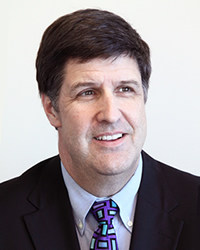
Former Republican state Rep. Phil Montgomery, lead sponsor and claimed author of the 2007 video competition bill, was well compensated with a sudden $2,250 campaign contribution from AT&T the year the bill was introduced. Another $1,500 arrived from AT&T executives and one of their spouses in Texas and $1,500 from a senior AT&T executive in Wisconsin.

Before AT&T’s bill was written, the company barely knew Montgomery existed, donating a total of only $300 to his campaigns from 1998-2005.

After the bill became law, Montgomery spent his remaining years in the Wisconsin Assembly building a solid record avidly supporting AT&T’s public policy maneuvers, including a measure to deregulate basic phone rates and end oversight of telephone service quality by the state’s Public Service Commission.

Despite revelations Montgomery served as an ALEC board member and received contributions amounting to $10,800 from telecom companies, in 2011 Gov. Scott Walker appointed him to chair the PSC — very same agency Montgomery worked for years to disempower.

“He was very friendly to industry when he was a legislator, and was seen as carrying water for the telecommunications industry and the utilities,” said Mike McCabe, executive director of the Democracy Campaign. “Consumer advocates would naturally have concerns about somebody who seemed so supportive of industry now being in a position of overseeing those industries.”

Sen. Jeff Plale Takes Marching Orders from AT&T, His Chief of Staff’s Rap Sheet, a Freezer Full of Steaks and a Country Club for Cronies
Plale

Plale

AT&T’s biggest ally in the Wisconsin Senate was Jeff Plale, one of only a handful of Democrats — all pro-business conservatives — belonging to ALEC.

The patience of his district was tested after Plale began openly advocating for his corporate donors and claimed he could not understand why questions about his integrity were being raised by his opponents. Plale, after introducing AT&T’s companion video franchising bill in the Senate expressed he was shocked, shocked to discover he received more campaign contributions from AT&T and the cable industry than any other legislative Democrat. He added he did not know why AT&T’s Political Action Committee had suddenly maxed out on its campaign contribution two years before the next election.

Plale’s close working relationship with AT&T evolved inside of his office.

In 2003, Plale hired Katy Venskus, a charged felon, to raise funds for his election campaign. Despite pleading no contest to siphoning off more than $12,000 from an abortion rights organization and being caught up in a scandal over illegal campaign work for another Democrat, Venskus was appointed Plale’s chief of staff and would quickly become the point person for AT&T’s video competition bill in Plale’s office, working closely with AT&T to adjust the bill’s language to the company’s liking and help coordinate its movement through the Senate.

The successful passage of the bill would prove personally lucrative to Venskus when she left Plale’s office to join lobbying firm Public Affairs Co., of Minneapolis just one month after AT&T’s bill was signed into law. One year later, she took on AT&T as a lobbying client.

Venskus

Venskus

In 2009, Plale and AT&T closely collaborated to write another deregulation measure to be introduced in the Wisconsin legislature, this time deregulating phone rates, making provision of landline service optional, and gutting service oversight. By then, AT&T Wisconsin considered Venskus an on-contract lobbyist.

The irony of a felon serving as the chief of staff for a Wisconsin state senator or as a registered lobbyist was not lost on the Milwaukee Express’ Lisa Kaiser.

“Despite being a felon, Venskus can affect public policy at the highest levels as a registered lobbyist,” observed Kaiser. “Yet she couldn’t be licensed to become a day care provider.”

According to e-mails and draft copies of the telephone deregulation bill obtained from the Legislative Reference Bureau and interviews conducted by The Capital Times, a number of meetings —  “too numerous to count,” according to Plale’s chief of staff, Summer Shannon-Bradley — occurred with AT&T lawyers and executives and several other key industry stakeholders to work on the bill.

One important meeting in November 2009 included this attendance list: Andrew Petersen, director of external affairs and communications with telephone company TDS; William Esbeck, executive director of the Wisconsin State Telecommunications Association (WSTA) – a telecom industry lobbying group; that group’s attorney, Judd Genda; and AT&T attorney David Chorzempa.

E-mails and other correspondence between those at the meeting and Plale’s staff show slashes or check marks next to sections of the proposal that attorneys for AT&T and the WSTA suggested should be changed.

“It’s like lawmakers looked around and said, ‘These are the companies affected. So sit down with the drafters and make a bill,’ ” Barry Orton, a UW-Madison telecommunications professor told the Times. “The public interest isn’t represented. How could it be? Nobody was there to represent them.”

Life got tougher for Ms. Venskus a few months later when she was charged with felony theft and felony identity theft on suspicion of making $11,451 in improper purchases with her Public Affairs credit card, including a freezer full of steaks, according to the criminal complaint filed in Dane County court. She repaid the charges, but her contract to work for AT&T’s interests was suspended.

That September, Plale wore out his welcome in the 7th District serving southern Milwaukee and lost to primary challenger Chris Larson, who contended Plale was far too conservative and cozy with AT&T for his district.
walker

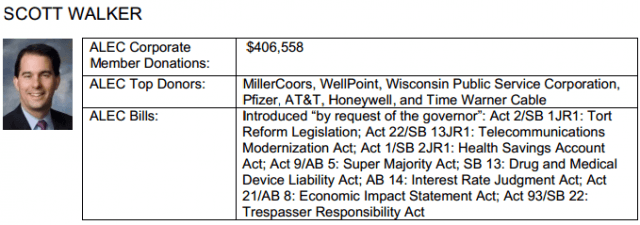
Gov. Scott Walker is also a close friend of ALEC, supporting a number of corporate-sponsored initiatives to deregulate the telecommunications industry. (Source: ALEC Exposed)

Plale would land on his feet when, after siding with Republicans on a lame duck session vote to stick it to the state’s unions, he joined the administration of Republican Gov. Scott Walker as the administrator of the Division of State Facilities — a $90,000 a year job.

“Instead of seeking out the best and brightest, this governor is busy creating a country club for cronies,” Marty Beil, executive director of the Wisconsin State Employees Union, told the Wisconsin State Journal. “When he says ‘open for business’ and then appoints people like Plale, he’s obviously saying that he doesn’t draw the line at the world’s oldest profession.”


AT&T Doesn’t Like T-Mobile’s Idea to Distribute Best Wireless Spectrum More Equitably

Phillip Dampier August 13, 2013 AT&T, Broadband "Shortage", Competition, Editorial & Site News, Public Policy & Gov't, Rural Broadband, Wireless Broadband Comments Off on AT&T Doesn’t Like T-Mobile’s Idea to Distribute Best Wireless Spectrum More Equitably
Phillip "Every other 2008 spectrum bidder except U.S. Cellular has since sold its winnings to AT&T or Verizon Wireless or has never provided competitive service" Dampier

Phillip “Every other 2008 spectrum bidder except U.S. Cellular has since sold its winnings to AT&T or Verizon Wireless or has never provided competitive service” Dampier

AT&T is unhappy with a proposal from a wireless competitor it originally tried to buy in 2011 that would offer smaller competitors a more realistic chance of winning favored 600MHz spectrum vacated by UHF television stations at a forthcoming FCC auction.

T-Mobile’s “Dynamic Market Rule” proposal would establish a cap on the amount of spectrum market leaders AT&T and Verizon Wireless, flush with financial resources for the auction, could win.

“Imposing modest constraints on excessive low-band spectrum aggregation will promote competition, increase consumer choice, encourage innovation, and accelerate broadband deployment,” T-Mobile offered in its proposal to the FCC.

Without some limits, wireless competitors Sprint and T-Mobile, among other smaller carriers, could find themselves outbid for the prime spectrum, well-suited for penetrating buildings and requiring a smaller network of cell towers to deliver blanket coverage.

In a public policy blog post today, AT&T argues T-Mobile is behind the times and its proposal is unfair and unworkable:

First, the purported advantage of low band spectrum – that it allows more coverage and better building penetration with fewer cell sites – has been overtaken by marketplace realities under which capacity not coverage drives network deployment.  Carriers deploying low band and high band spectrum alike must squeeze as many cell sites as they can into their networks to meet exploding demand for data services.  Second, to the extent this is less the case in rural areas, those areas are not spectrum-constrained and the lower cost of building out low band spectrum in such areas is offset by the higher cost of the spectrum itself.

[…] But this is not the only point that should concern policymakers.  Such caps will also suppress auction revenues, potentially to the point of auction failure, ultimately reducing the amount of spectrum freed up for mobile broadband use and undermining the auction’s ability to meet critical statutory goals.

[…] Even if T-Mobile’s proposal did not result in complete auction failure, its proposed caps would suppress auction revenues, reducing the amount of spectrum freed up for mobile broadband use as well as funds generated for FirstNet and to pay down the national debt.  That is because strict limits on participation by otherwise qualified bidders will make the auction less competitive and will yield less revenue.  Indeed, if T-Mobile’s proposed spectrum cap was strictly enforced, Verizon estimates it would be barred from bidding in 7 of the top 10 markets.  AT&T would face similar bidding limitations, as noted in our filing.

AT&T suggests the last major auction in 2008 attracted 214 qualified bidders and 101 bidders won licenses, including carriers of all sizes and new entrants.

But an analysis by Stop the Cap! shows the breakaway winners of the 2008 auction were none other than AT&T and Verizon Wireless, which paid a combined $16.3 billion of the total $19.592 billion raised. For that money, they acquired:

  • Block A – Verizon Wireless and U.S. Cellular both bought 25 licenses each. In this block, Verizon targeted urban areas, while U.S. Cellular bought licenses primarily in the northern part of the U.S., where it provides regional cellular service. Cavalier Telephone and CenturyTel also bought 23 and 21 licenses, respectively. Cavalier Telephone is now wholly owned by Windstream, which does not provide cell service and was selling its 700MHz spectrum to none other than AT&T. So is CenturyLink (formerly CenturyTel).
  • Block B – AT&T Mobility was the biggest buyer in the B block, with 227 licenses totaling $6.6 billion. U.S. Cellular and Verizon bought 127 and 77 licenses, respectively. AT&T Mobility and Verizon Wireless bought licenses around the country, while U.S. Cellular continued with its strategy to buy licenses in its home network northern regions.
  • Block C – Of the 10 licenses in the C Block, Verizon Wireless bought the 7 that cover the contiguous 48 states (and Hawaii). Those seven licenses cost Verizon roughly $4.7 billion. Of the other three, Triad Communications — a wireless spectrum speculator — bought the two covering Alaska, Puerto Rico and the U.S. Virgin Islands through its Triad 700, LLC investor partnership, while Small Ventures USA, L.P. bought the one covering the Gulf of Mexico. Triad 700, LLC sold its spectrum last fall to AT&T while Small Ventures USA sold theirs to Verizon Wireless.
  • Block E – EchoStar spent $711 million to buy 168 of the 176 available Block E licenses. This block, made up of unpaired spectrum, will likely be used to stream television shows. Qualcomm also bought 5 licenses. Neither company has used its spectrum to offer any services five years after the auction ended.

So much for improving the competitive landscape of wireless. Other than U.S. Cellular, which is rumored to be on AT&T and Verizon Wireless’ acquisitions wish list, every auction winner has either sold its spectrum to the wireless giants or has done nothing with it.

If “highest bidder wins”-rules apply at the forthcoming auction, expect more of the same.

AT&T and Verizon Wireless have significant financial resources to outbid Sprint, T-Mobile and smaller carriers and will likely win the bulk of the available spectrum whether they actually need it or not. Smaller victories may be won by smaller competitors, but only in rural areas and sections of the country disfavored by the largest two.

Search This Site:

Contributions:

Recent Comments:

Your Account:

Stop the Cap!