Home » public policy » Recent Articles:

Wall Street Analyst Tells Congress Broadband Needs to Be More Than Just “Profitable” to Spur Investment

greedUnless a broadband provider can deliver the same kind of profitability earned by U.S. cable operators, don’t expect significant private investment in broadband expansion even if the company can easily turn a profit.

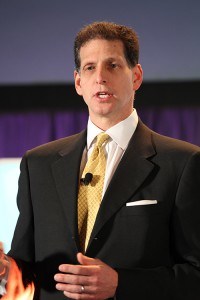
That was the argument brought to a House hearing on funding broadband infrastructure expansion by Craig Moffett, a Wall Street analyst at Moffett Nathanson.

“Infrastructure deployment requires the expectation of a healthy return on capital,” Moffett told the House Communications and Technology Subcommittee in a hearing this afternoon. “That should be taken as a given, but all too often, in my experience, the issue of return on capital is either ignored or misunderstood in policy forums. It is not a matter of whether a business is or isn’t profitable, it is instead a matter of whether it is sufficiently profitable to warrant the high levels of capital investment required for the deployment of infrastructure.”

Moffett pointed to the massive profits earned by cable operators Comcast, Time Warner Cable, Charter and Cablevision, all of which earned returns well in excess of their cost of capital, ranging from 13-33 percent. Moffett argued Wall Street has come to expect those kinds of returns, and investors will take a hard look at companies deploying new expensive networks against those that have largely paid back much of the capital costs incurred when their networks were built decades ago.

Moffett continued to criticize the broadband expansion being undertaken by large incumbent telephone companies that he claims does not earn attractive returns for their wireline businesses, even as they have introduced new services like faster broadband and television.

“For example, a decade after first undertaking their FiOS fiber-to-the-home buildout to 18 million homes, Verizon has not yet come close to earning a return in excess of their cost of capital,” said Moffett. “In 2014 their aggregate wired telecommunications business earned a paltry 1.2% return, against a cost of capital of roughly 5%. For the non-financial types in the room, that’s the equivalent of borrowing money at 5% interest in order to earn interest of 1%. That’s a good way to go bankrupt.”

analysisMoffett was also critical of AT&T’s planned expansion of gigabit fiber broadband.

“AT&T has committed to the FCC to make fiber available to a total of 11.7 million locations in their footprint in order to make their acquisition of DirecTV more palatable to policy-makers, but it is hard to be optimistic that they will do much better this time around,” Moffett argued.

Moffett believes competition is bad for the profitable broadband business.
Moffett

Moffett

“The broader take-away here is that the returns to be had from overbuilding – that is, being the second or third broadband provider in a given market – are generally poor,” Moffett said. “Let that sink in for a moment. Stated simply, it means that market forces are unlikely to yield a competitive broadband market. Neither, by the way, does wireless appear to offer the promise of imminent competition for incumbent broadband providers. Wireless networks simply aren’t engineered for the kind of sustained throughput required for a wired-broadband-replacement service.”

As a result, investors prefer that the broadband marketplace remain a monopoly or duopoly to guarantee the kinds of healthy returns they have earned for years, especially from the cable stocks Moffett has always favored in reports to his clients. Additional competition drives prices down, reducing profits, which in turn discourages investors who have high expectations their money will make them a lot more money.

Moffett’s arguments are largely based on broadband being a for-profit private enterprise, not a public infrastructure effort. But it does explain why there is a willingness to compete in large cities where network construction costs are lower and rural communities remain relatively unserved. As with electrification 100 years ago, investor-owned utilities were willing to wire large communities while ignoring rural farms and communities. Only after electricity was deemed a necessary utility did alternative means of funding, including member-owned co-ops and community-owned utilities finish electrifying areas private capital ignored.

Moffett’s guide to better broadband is based entirely on profitability — delivering enough profits and other returns to attract investors that will look elsewhere if costs become too high. Community-owned broadband avoids this dilemma by advocating for break-even or modestly profitable networks that focus on service, not investor-attractive profits.

Several members of Congress commented Moffett’s vision of broadband was discouraging, even depressing, because it seemed to be locked in a for-profit, private sector model that had few answers to offer for communities left behind. Moffett even warned against oversight and regulation of incumbent cable and phone companies, claiming it would further drive away private investment.

But broadband customers, Moffett admitted, will still pay the price for investor expectations.
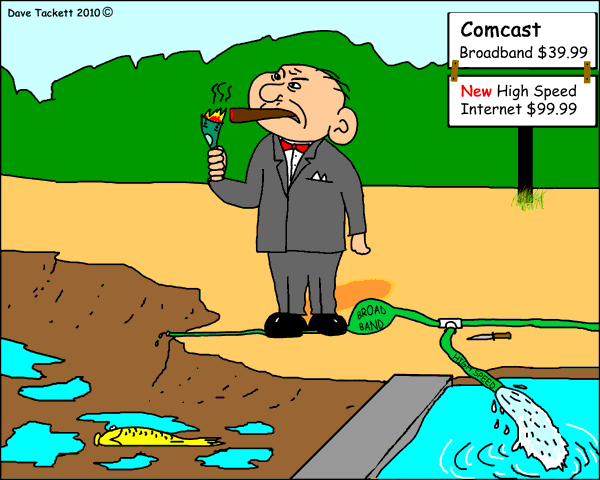
comcast cartoon“As everyone understands, the cable video business is facing unprecedented pressure,” Moffett testified. “Cord cutting has been talked about for years but is finally starting to show up in a meaningful way in the numbers. And soaring programming costs are eating away at video profit margins. From a cable operator’s perspective, the video business and the broadband business are opposite sides of the same coin. It is, after all, all one infrastructure. Pressure on the video profit pool will therefore naturally trigger a pricing response in broadband, where cable operators will have greater pricing leverage.”

Moffett said the kinds of rate hikes consumers used to pay for cable television now increasingly transferred to broadband customers is nothing nefarious. To keep investors happy, the kind of returns once earned from cable television will now have be delivered on the backs of broadband customers if Congress expects cable companies to continue upgrading and expanding their networks.

“All else being equal, that will mean that even new builds of broadband will become increasingly economically challenged and therefore will become less and less likely,” said Moffett. “Or they will simply have to sharply raise broadband prices.”

Moffett’s comments do come with some baggage, however. His clients pay for his advice and Moffett has been a long-time supporter of cable industry stocks. He has been a strong and natural advocate for a cable industry that faces only token opposition. He has browbeaten executives to start broadband usage caps and usage-based billing to further boost broadband profits, slammed telephone company competition in the cable business as financially reckless and unwarranted, and dismissed Google Fiber as a project designed to help Google’s public policy aims more than earn the search giant profits from the broadband business.

But Moffett has also been wrong in the past, particularly with respect to cord-cutting which he used to downplay as an urban legend and on the ease cable companies would be able to acquire and merge with each other.

Beyond all that, Moffett and his clients have a proverbial dog in the fight. After years of pumping cable stocks, suggestions that more competition for the cable industry is a good thing would simply be bad for business.

AT&T Introduces U-verse GigaPower Gigabit Service in Nashville, If You Can Find It

In Search Of... AT&T U-verse with GigaPower

In Search Of… AT&T U-verse with GigaPower

AT&T’s gigabit broadband project has appeared in the greater Nashville area, but Stop the Cap! volunteers in the country music capital report you have a better chance getting struck by lightning than finding the service available to your home or business.

AT&T officially unveiled the upgrade in “parts of Clarksville, Lebanon, Murfreesboro, Nashville, Smyrna and surrounding communities located throughout the metro area,” but quickly warned with three asterisks the service was “not available in all areas.”

“That is the understatement of the year,” said Nashville resident Chris Jensen who can’t wait to ditch Comcast for 15 years of bad service and billing errors. “Unless you live in an upscale apartment complex, a new housing development, Walmart or have a country album on the charts you are probably going to be stuck with traditional U-verse speeds from AT&T.”

Jensen is part of Stop the Cap!’s In Search Of… AT&T GigaPower, our new project using volunteers to pelt AT&T’s qualification tool with addresses (and follow-up phone calls) looking for AT&T’s elusive gigabit speeds in the cities where the service has been introduced.

“Forget it Nashville, it’s another AT&T fiber to the press release and payback to the very friendly state politicians that rubber stamp AT&T’s agenda,” said Jensen.

Despite GigaPower’s rarity, AT&T is the first company to bring gigabit speeds to the Nashville residential market.

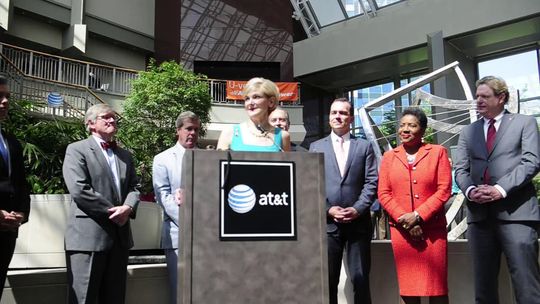
AT&T Tennessee president Joelle Phillips is surrounded by her political friends from around the state. (Photo: The Tennessean)

AT&T Tennessee president Joelle Phillips is surrounded by AT&T’s political friends from around the state. (Photo: The Tennessean)

Joelle Phillips, president of AT&T Tennessee, used a news release to share the company’s spotlight with a number of local and state politicians identified as supporters of AT&T’s public policy advocacy effort, which includes deregulating AT&T’s business in the state and attempting to keep restrictions on the books to block competing public broadband network expansion in Tennessee.

“We were able to deploy network enhancements fast – in less than a year since we announced our U-verse with AT&T GigaPower plans for Nashville,” said Phillips. “Smart, pro-investment policies, championed at the state level by Governor Haslam and legislative leaders like Speaker Harwell and Lt. Governor Ramsey – as well as streamlined local permitting processes that Mayor Dean and our Metro Council members have embraced – were key in speeding our work.”

Nonsense, says Jensen.

“Tennessee is about as friendly a state AT&T can find — our legislature allows AT&T to basically write its own pieces of legislation, yet the fastest way to get gigabit speeds is to move to Chattanooga where EPB is providing the service without asking to gut consumer protection laws or wait for AT&T to get around to bringing faster service to your home,” said Jensen.

Critics contend AT&T maintains ties with state and local politicians that are too close for comfort, potentially hurting consumers in Tennessee.

uverse gigapowerAccording to the National Institute of Money in Politics, telecommunications industry interests wrote at least $643,000 in campaign contribution checks to Tennessee politicians during the two-year 2014 election cycle. AT&T alone put $211,000 into the pockets of legislators. The Tennessee Registry of Election Finance reports AT&T contributed $20,000 during the last election cycle to Republican Lt. Gov. Ron Ramsey’s leadership political action committee, RAAMPAC. AT&T President Joelle Phillips personally gave another $2,000.

House Speaker Beth Harwell benefited from at least $17,000 in AT&T money over the last two years. AT&T spends another $1.3 million on as many as 13 full time lobbyists that devote all of their attention to Tennessee.

Gov. Bill Haslam doesn’t really need AT&T’s money. He is now worth an estimated $2 billion, making him the richest elected official in the country, according to an analysis by Forbes.

In return for this largesse, AT&T is routinely praised by all three state officials, which is returned when AT&T sends out press releases gushing over Tennessee’s ‘AT&T-Friendly’ deregulation policies.

AT&T will charge a range of prices for U-verse GigaPower service in Nashville, which all include AT&T’s right-to-spy on your browsing behavior. If you want to opt out of AT&T’s “Internet Preferences” customer monitoring program, add $29 a month to these prices:

  • U-verse High Speed Internet Premier: Internet speeds up to 1Gbps starting at $120 a month, or speeds at 100Mbps as low as $90 a month, with one-year contract required;
  • U-verse High Speed Internet Premier + TV: Internet speeds up to 1Gbps and qualifying TV service starting at $150 a month, or speeds at 100Mbps and qualifying TV service as low as $120 a month, with a one year contract;
  • U-verse High Speed Internet Premier + TV + Voice: Internet speeds up to 1Gbps with qualifying TV service and Unlimited U-verse Voice starting at $180 a month, or speeds at 100Mbps with qualifying TV service and Unlimited U-verse Voice as low as $150 a month, with a two-year term commitment.

AT&T imposes a 1TB monthly usage cap on its gigabit broadband service. Overlimit fees of $10 per 50GB will apply to customers exceeding that usage allowance.

N.Y. Broadband Improvement Fund to Public Broadband Networks: Don’t Call Us, We’ll Never Call You

A $500 million New York State broadband improvement fund is effectively off-limits for would-be community-owned broadband networks trying to deliver broadband service in areas for-profit providers have deemed unprofitable.

New York Gov. Andrew Cuomo’s ambitious plan to revolutionize Internet access for New Yorkers depends almost exclusively on for-profit providers and the state’s largest cable operator, Time Warner Cable – the company that has so far received the largest share of state funds earmarked for better broadband.

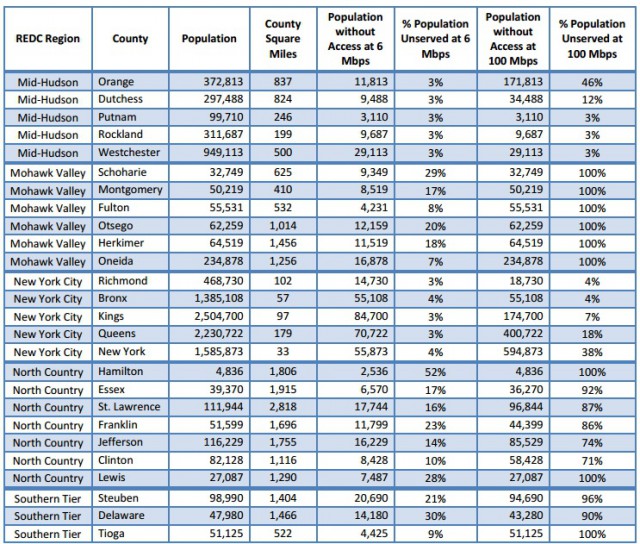
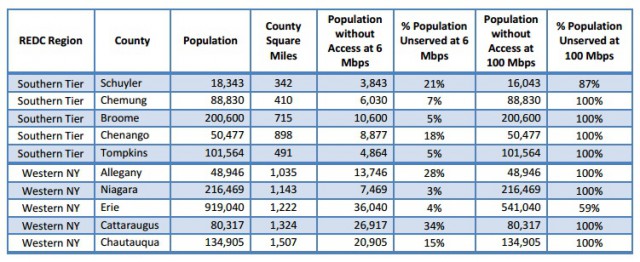
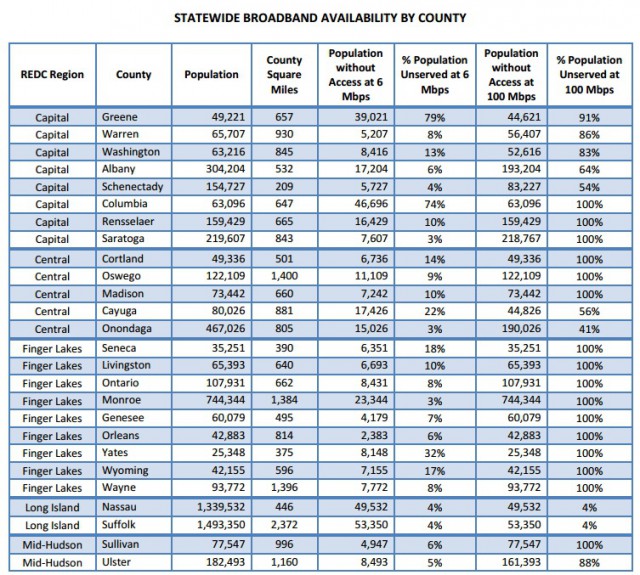
Cuomo wants all of New York wired for 100Mbps service no later than 2018. His goal is ambitious because the overwhelming majority of upstate New York barely now receives a maximum of 50Mbps from Time Warner Cable, the only significant cable operator in the region.

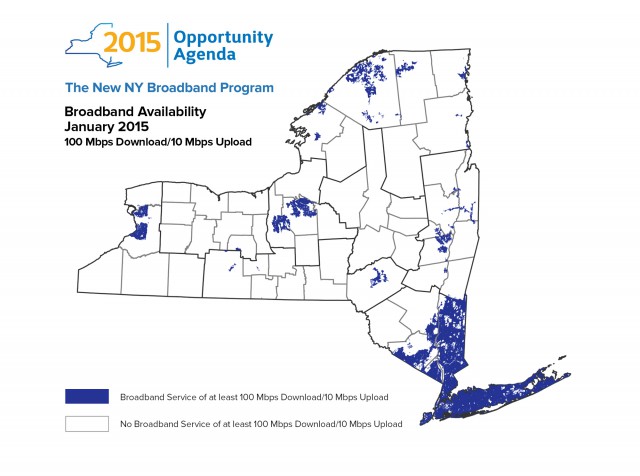
The broadband map from N.Y. State shows 100Mbps service is available to most New Yorkers from Verizon FiOS, Cablevision, and a handful of municipal/co-op operators. Time Warner Cable only provides a maximum of 50Mbps service across upstate New York.

The broadband map from N.Y. State shows 100Mbps service is available only from Verizon FiOS, Cablevision, and a handful of municipal/co-op operators. Time Warner Cable only provides a maximum of 50Mbps service across upstate New York. Cablevision and FiOS compete on Long Island, Time Warner Cable Maxx competes with Verizon in New York City, and most of upstate New York is served by Verizon or Frontier DSL competing with Time Warner Cable.

Six months after the program was announced, Capital magazine reports the “New NY Broadband” plan is languishing with no defined guidelines, rules, or any clear sense about how the program will be implemented and the money spent.

Salway

Salway

In fact, one of the only clear statements coming from David Salway, a former telecommunications consultant who now administers the program, is that local governments should not bother applying because he doesn’t want them competing with Time Warner Cable, Verizon, and Frontier. It’s private enterprise only:

“The primary focus of our program is that we’re not going to be in the building business,” Salway said. He emphasized that municipal governments won’t be specifically precluded from receiving funds under the program, but said that the state is “wary” of “the government building and competing with the private sector. We see this as a provider partnership process where an incumbent provider or maybe a new entrant comes in.”

Local government leaders can read between the lines and most will not bother applying for funding if Salway’s vision guides the grant-making process. Instead, Salway wants to funnel money that effectively belongs to New York taxpayers into the pockets of for-profit providers like Verizon, Frontier, Windstream, Time Warner Cable and other providers that have consistently refused to expand their networks into rural areas on their own dime. The money earmarked for broadband is part of a $6 billion legal settlement the New York Attorney General’s office negotiated with Wall Street and commercial banks that helped plunge the country into The Great Recession.

statewide availability 1

statewide availability 2

statewide availability 3

Broadband advocates across the political spectrum are slamming the broadband program for different reasons. Christopher Mitchell from the Institute for Local Self Reliance predicts providers will deliver bait and switch broadband on the taxpayer’s dime and send the proceeds out of the area.

“When you subsidize the private sector, you don’t really know what kind of services they’re going to provide in the future,” Mitchell said. “There’s a fair number that basically rip off consumers,” and they “basically extract resources from the community they serve.”

Mitchell

Mitchell

“The only clear beneficiaries of this program will be cable and Internet providers, who will have a new state subsidy to expand their footprints into areas in which their competitors have demonstrated an inability to operate profitably,” said Ken Girardin of the conservative Empire Center for Public Policy, in a scathing review of the New NY plan.

So far, Verizon has shown no interest in the program. It’s eventual intent is to decommission rural landline service and push existing customers to wireless service, so applying for wired broadband expansion funding isn’t a priority. The most likely applicants include Windstream, which serves a small percentage of rural New York telephone exchanges, Frontier Communications, which dominates Rochester and parts of the Finger Lakes region, and Time Warner Cable, which used earlier funding to connect two rural communities to its cable service. But all three companies are waiting for the program and its grant terms to be better defined.

With incumbent cable and phone companies reluctant to take part, there are several wired and wireless broadband initiatives in rural areas around New York starved of resources to expand their networks. The “white space” wireless broadband project in Thurman, for example, will be seeking funding to expand its wireless high-speed network into other parts of the community. Other initiatives could allow existing middle mile fiber networks in the Southern Tier and Finger Lakes region to explore building out “last mile” service to homes and businesses that now receive only DSL or no Internet access at all.

Salway promises he’ll consider funding networks that deliver the best broadband speeds for the lowest relative price in similarly sized communities. But all the money in the world won’t help if an existing phone or cable company shows no interest in serving unprofitable rural areas even after the state defrays the initial cost of placing the infrastructure to provide the service.

Mitchell believes local communities are best positioned to know what their residents want and many support publicly funded fiber technology rollouts. He points to Longmont, Col., a community that fought off propaganda mailers and a $300,000 marketing effort by CenturyLink and Comcast to defeat public fiber broadband in the city. The residents voted in favor of building their own network to move beyond the “good enough for you” broadband coming from the phone and cable company.

“The Longmonts of the country can decide to wait until these private sector companies decide its in their interest to finally build these fiber networks out, or they can say, ‘You know, we’re always going to be behind the greater technological curve of the nation,’ and do it themselves,” Tom Roiniotis, Longmont’s general manager, told Capital.

Enjoy Better: Maine Lawmakers Slumming in the Off-Season at Maine Resort, Sponsored by Time Warner Cable

Phillip Dampier February 16, 2015 Astroturf, Broadband Speed, Community Networks, Competition, Consumer News, Public Policy & Gov't, Rural Broadband Comments Off on Enjoy Better: Maine Lawmakers Slumming in the Off-Season at Maine Resort, Sponsored by Time Warner Cable

inn by the sea

Welcome to Inn by the Sea, where relaxed coastal luxury comes naturally.

Come for the unpretentious elegance, but don’t stay for the broadband.

Time Warner Cable’s war on competitive broadband in the state of Maine tastes delicious, if you are a lawmaker who enjoys a $26 herb marinated skirt steak with roasted mushrooms, chimichurri, piquillo aioli, and herbed hand cut steak fries in the dining room of the Cape Elizabeth seaside resort Inn by the Sea. Time Warner Cable (and you) picked up the tab, and for those lawmakers too full to drive, the cable company was ready with complimentary rooms at the Inn that retail off-season for $205-355 a night.

twcWelcome to the 2015 Time Warner Cable Winter Policy Conference, held Jan 22-23 at the remodeled resort and spa where a stay during the summer can cost $500 a day.

Thursday night’s dinner was followed by an all-day information lobbying event Friday — a workday when Maine lawmakers would normally be expected to serve the public interest, but served Time Warner Cable’s instead.

The overall theme of the conference: Defending Time Warner Cable’s performance in Maine and why letting community-owned providers compete with them is a really bad idea.

While lawmakers enjoyed complimentary access to the Inn by Sea’s high-speed Wi-Fi connection, Internet service around the rest of Cape Elizabeth is considerably less sublime, with Angie’s List reporting only 23 percent of the locals consider their broadband provider reliable. Maine itself is ranked 49th out of 50 states for quality of service and availability and no steak dinner will convince honest lawmakers the state is prepared with robust broadband required for the 21st century digital economy. Several members have introduced various measures to aid communities trying to move beyond DSL provided by FairPoint Communications and up to 50Mbps broadband from Time Warner Cable.

SWFIMG_080723_15590228_5EG1FThe thought of competition is enough to give any cable lobbyist indigestion, especially if the new entrant provides fiber to the home service, something almost unknown among commercial providers in Maine.

Lawmakers caught attending the shindig claimed they attended the “educational forum” to become informed.

But a review of the presenter list suggests this was hardly a 60 Minutes/Edward R. Murrow moment. Lawmakers may not have been aware the presentations were about as balanced as a program length commercial:

  • Moderator (Session 1): Jadz Janucik, National Cable & Telecommunication Association – The NCTA is the nation’s largest cable industry lobbying group;
  • Dave Thomas, Sheppard Mullin Richter & Hampton LLP: A corporate attorney representing cable companies, particularly when they face competitive threats;
  • Lisa Schoenthaler, National Cable & Telecommunication Association;
  • Moderator (Session 2): Charlie Williams, Time Warner Cable;
  • Charles Davidson and Michael Santorelli from the Advanced Communications Law and Policy Institute at New York Law School. Both have received direct compensation from Time Warner Cable for their  “research” reports and are very active and frequent defenders of Time Warner Cable’s public policy agenda;
  • Joe Gillan, Gillan Associates – an economist working under paid contract with the cable industry;
  • Moderator (Session 3): Tom Federle, Federle Law: Chief lobbyist for Time Warner Cable in Maine for over seven years;
  • Robin Casey, Enockever LLP: Casey is one of the nation’s pre-eminent cable industry lawyers, called by the Texas Cable Association “the authority on the telecom industry;”
  • Mary Ellen Fitzgerald, Critical Insights: A Maine pollster hired by Time Warner Cable to carry out the company’s carefully worded survey on broadband issues;
  • Moderator (Session 5): Melinda Poore, senior vice president of governmental relations, Time Warner Cable Maine.

spa lobby“If we want good public policy, there’s reason for all of us to be worried,” utilities expert Gordon Weil, the state’s first Public Advocate, who represented the interests of ratepayers before regulators, told the Maine Center for Public Integrity. Such treatment of legislators is “obviously intended to persuade them by more than the validity of the arguments; it’s intended to persuade by the reception they’re given.”

That sentiment was echoed in a glowing review from a Time Warner colleague given to Tom Federle, the company’s top lobbyist.

“Tom has been the primary lobbyist for Time Warner Cable’s Maine operations for the past seven years,” said Melinda Poole, an executive vice president for governmental relations at Time Warner Cable. “He has a real knack for distilling complex issues for policy makers, has always been able to advance our positions effectively, and consistently has outperformed for us. Tom is well respected by legislators on both sides of the aisle.”

Lawmakers contacted by the Maine Center for Public Integrity seemed to sidestep or downplay the ethical issues of attending the company-sponsored event.

“I think this idea of meals and conversations is how Augusta functions on some level,” said Rep. Mark Dion (D-Portland), who attended the event in Cape Elizabeth, did not stay overnight but was provided dinner and breakfast by Time Warner.

Sen. Andre Cushing (R-Hampden), for whom Time Warner paid the cost of meals and the room, said he thought “about a dozen” legislators attended the Thursday night dinner. Dion said “30 or 35″ attended the second day’s sessions.

Partying-ExecsScott Pryzwansky, Time Warner Cable’s director of public relations for the eastern U.S., declined to answer any specific questions but replied by email: “As one of Maine’s leading employers and telecommunications companies, we designed this second biannual educational forum to help policymakers and others better understand some of the complex telecommunications issues confronting Maine and the nation.”

Critics contend such “educational” meetings held at posh locations where company lobbyists hand out free meals and room keys do more to obfuscate than clarify issues for lawmakers, who are likely to remember the accommodations and who provided them more than the seminar.

“I would have said, ‘Fine, if you want to meet with me, come meet on state facilities, no steak dinner,’ said Weil. “If steak dinners didn’t work, they wouldn’t give them steak dinners.”

Time Warner Cable’s two-day event included a packet of handouts, obtained by Stop the Cap!, that illustrate exactly how one-sided the affair was:

  • sock puppetA highly slanted (refuted here) presentation opposing “Government Operated Networks” (or GONs – a favorite acronym used by industry-funded think tanks to oppose municipal broadband) produced by the Advanced Communications Law and Policy Institute;
  • an NCTA-produced sheet opposing taxes on Internet access;
  • a Time Warner Cable-written summary of recent Maine Public Utility Commission conclusions about the availability of affordable telephone service;
  • a guest letter to the editor from Fred Campbell, who has a long history running industry-funded groups that are supposed to advocate for competition, except when an industry friend’s merger deal is on the line;
  • and a blog post from the Koch Brothers-funded corporate-friendly Reason.com.

The slanted push-poll part of the presentation was also unsurprisingly predictable.

“Do you approve or disapprove of the current practice of Maine’s government using tax dollars and fees on consumers to subsidize public entities to compete with private businesses?” asked one question.

Another asked if residents would favor “using taxpayer supported debt to build government-owned broadband networks,” ignoring the fact many projects are covered by bonds that carry little or no risk to taxpayers. Some profitable projects could even return money to local communities.

At least one lawmaker was quickly skeptical of the veracity of the company-sponsored poll.

State Rep. Sarah Gideon (D- Freeport) said some of the questions were “leading.”

“Nobody’s going to say ‘Yes, I want my state to incur debt,’” said Gideon. “We see lots of surveys as policymakers and we have to be smart enough to look at what questions are asked.”

Since 2008, Time Warner has donated more than $240,000 to Maine politicians: $127,360 to Democrats and Democratic PACs, and $113,250 to Republicans and Republican PACs. Most of the minor improvements in the state’s broadband rankings since 2013 come from community providers providing a quantum speed leap over traditional DSL and cable broadband services most Maine residents receive.

Tip for Reporters – Always Follow the Money: Comcast/Time Warner Cable Merger Supporters

Phillip Dampier January 27, 2015 Astroturf, Comcast/Xfinity, Consumer News, Editorial & Site News, Public Policy & Gov't Comments Off on Tip for Reporters – Always Follow the Money: Comcast/Time Warner Cable Merger Supporters
Buy a vocal supporter for your merger deal.

Buy a vocal supporter for your merger deal.

The Los Angeles Times published a piece this week noting that the Comcast/Time Warner Cable merger does have its supporters:

To be sure, dozens of groups also support the proposed Comcast merger, including the Los Angeles Area Chamber of Commerce, Orange County Business Council, the L.A. County Economic Development Council and the National Urban League. Television networks including Ovation, Hallmark Channel and Starz also support the deal.

But the article never informs readers the groups in support of the transaction all have direct financial ties to Comcast, Time Warner Cable, or both cable companies. It would only be news if these groups opposed the merger.

Stop the Cap! has found almost no support for the merger deal among independent organizations that are not on the payroll of either merger partner. The myriad of civil rights organizations, trade associations, and non-profit groups penning letters to regulators supporting the deal are nearly all recipients of contributions from Comcast or Time Warner.

Comcast is notorious for capitalizing on their charitable corporate giving by mailing advocacy packages to donor recipients that urge support for the company’s public policy and corporate agendas. Comcast even includes sample letters a group can use to create their own letter of support, which explains why so many are nearly identical.

Although Comcast never threatens to cut off groups that don’t follow through, the company does know who sent letters and who did not, as they all become part of the public record.

In less than 30 minutes, Stop the Cap! was able to trace direct economic ties between Comcast and/or Time Warner Cable and the groups the LA Times story mentions. Readers deserve to know this information and it should have been included in the story.

comcast twcLet us review:

The LA Chamber of Commerce: Time Warner Cable is a “Diamond Club Member,” which the Chamber claims represents the “largest member investors.”

The Orange County Business Council includes a Time Warner Cable executive on its Board of Directors and is a major “investor” in the group.

Not only is Time Warner Cable on the executive committee of the LA Economic Development Council, it also serves on the group’s board of governors. Comcast is also a member.

The National Urban League advocates in favor of almost everything Comcast wants, no doubt because the organization that sold out to big corporate donors long ago is also on Comcast’s payroll. The group has received at least $12 million in in-kind contributions from Comcast, as well as receiving checks for more than 70 local chapter projects. Comcast’s executive vice president David Cohen has sat on the Urban League’s board of trustees since 2008. In addition, the Comcast Foundation, headed by Cohen, gave the National Urban League and some of its more than 100 affiliates almost $2 million from 2012 to 2013, according to an analysis of IRS tax filings by the Center for Public Integrity.

As for Ovation, Hallmark Channel and Starz — they are all cable networks dependent on carriage agreements with the nation’s first (Comcast) and second-largest (Time Warner Cable) cable operators for their economic survival.

Search This Site:

Contributions:

Recent Comments:

Your Account:

Stop the Cap!