
Home » public policy » Recent Articles:

AT&T’s Top Super Lobbyist Retiring This Fall; But Where Does Jim Cicconi Head Next?

Phillip Dampier August 11, 2016 AT&T, Public Policy & Gov't Comments Off on AT&T’s Top Super Lobbyist Retiring This Fall; But Where Does Jim Cicconi Head Next?
Cicconi

Cicconi

Jim Cicconi, AT&T’s well-known top lobbyist, has announced he intends to retire at the end of September, after 18 years of service to the phone company.

Cicconi’s role at AT&T began as general counsel and the executive vice president of law and government affairs at AT&T. Cicconi assumed his current role at a super-sized AT&T in 2005, after SBC (formerly Southwestern Bell) acquired AT&T and kept its name intact.

Few corporate entities spend as much on campaign contributions and other lobbying-related activities, including a starring role at the American Legislative Exchange Council (ALEC), than AT&T.

His replacement will be Bob Quinn, currently the senior vice president of federal regulatory at AT&T Services. Quinn will stay in Washington and report directly to AT&T CEO Randall Stephenson.

att“Jim is one of the best and brightest around when it comes to politics and public policy. He is respected by everyone, regardless of political party or viewpoint, as a big thinker, a master strategist and someone able to bridge divides to get things done,” Stephenson said, in a statement. “I greatly appreciate his leadership, wise counsel and countless contributions to AT&T over the years. He’s a great friend and we’ll miss him. I want to wish Jim and his wife, Trisha, all my best as they begin a new chapter in their lives.”

Where Cicconi heads next is anyone’s guess, but Beltway watchers note Cicconi endorsed Hillary Clinton for president. The Wall Street Journal reported Cicconi has joined several other Republican corporate executives signing up for Team Hillary this election cycle. Cicconi is voting Democratic this year, despite supporting every Republican presidential candidate since President Gerald Ford’s run against Jimmy Carter in 1976.

Could there be a role for Jim Cicconi in the Hillary Clinton administration? It would not be unprecedented. Cicconi served in the White House as deputy to the chief of staff for President George H. W. Bush for two years, and four years as special assistant to President Ronald Reagan.

The N.Y. Times Exposes Corporate-Backed Think Tanks

Phillip Dampier August 9, 2016 Astroturf, Consumer News, Net Neutrality, Public Policy & Gov't Comments Off on The N.Y. Times Exposes Corporate-Backed Think Tanks
Sock Puppets: Ostensibly "independent" people quietly on the payroll of Big Telecom companies and advocating their positions.

Sock Puppets: Ostensibly “independent” people quietly on the payroll of Big Telecom companies and advocating their positions.

“Net Neutrality would not improve consumer welfare or protect the public interest,” came the considered view of one Jeffrey A. Eisenach, testifying before the Senate Judiciary Committee in September 2014. “The potential costs of Net Neutrality regulation are both sweeping and severe. It is best understood as an effort by one set of private interests to enrich itself by using the power of the state.”

Mr. Eisenach was introduced on the printed formal agenda as a “visiting scholar at the American Enterprise Institute.” If one looked at a transcript of his written testimony, they would find he also co-served as “co-chair of NERA Economic Consulting’s Communications, Media and Internet Practice.” But his views could have effectively represented all the above and more.

The New York Times this week published a two-part article examining the thin lines between public policy scholars, lobbyists, researchers, advocates, corporations, and private citizens. It is an important piece that details the shady world of bought and paid for research, academia, corporate lawyers and lobbyists, and Washington lawmakers that too often accept what they are told without following the money.

On that September day back in 2014 Eisenach wanted his views to be attributed only to him.

Eisenach

Eisenach

“While I am here in my capacity as a visiting scholar at the American Enterprise Institute, the views I express are my own, should not be attributed to A.E.I. or to any of the organizations with which I am affiliated,” Eisenach told the Senate committee.

What was considerably less clear is the name of the client (or an affiliated trade organization) that has underwritten almost every one of a dozen studies he has published on internet-related issues from 2007-2016 — Verizon, the same company that shares his hostile views towards Net Neutrality.

Over the years, it has become difficult to tell whether Eisenach’s views, articles, and study findings are his own, those of his study sponsor, and/or those of his employer. Just tracking Eisenach’s ever-changing employment record was no easy task. In the fall of 2013, Eisenach was the director of the American Enterprise Institute’s new “Center on Media and Internet Policy.” Just a few months later, he joined NERA, one of the country’s oldest economic consultancy firms, as a senior vice president in its telecommunications practice.

From each of these positions, Eisenach can pen the views of some of America’s largest telecommunications companies under the guise of an “independent” study, an invaluable cover tool for a member of Congress confronted with voting on behalf of corporate friends at the cost of consumers in the district.

“A report authored by an academic is going to have more credibility in the eyes of the regulator who is reading it,” Michael J. Copps, a former FCC commissioner who is now a special adviser for the Media and Democracy Reform Initiative at Common Cause, told the newspaper. “They are seeking to build credibility where none exists.”

A former Verizon employee who still does some consulting of his told the Times how the game is played.

aei“Let’s say you’re in legal and you want to have a paper that says what you want it to say,” said ex-Verizon economist Dennis Weller. “You could have a bunch of economists in house and ask them if they agree with you. How much easier would it be to go to an outside economist and say, ‘How about if I pay you $100,000 to write this?’”

With appropriate disclosure that a company like Verizon paid $100,000 for a report that exactly matches Verizon’s public policy agenda might raise questions on Capitol Hill as to its veracity and independence. If that disclosure goes missing or is hidden under a third-party like a trade association, a lawmaker might assume the report was produced independently and the strong corroboration of Verizon’s views is just a coincidence. That kind of credibility can be worth millions to any company confronting a debate over regulatory policy.

“[Eisenach] is good at linking big theoretical ideas to policy, and he’s been good at making money doing that,” added Weller. “He’s been good at moving from think tank to think tank and company to company, and I don’t think he’s ever lost money doing it.”

The New York Times investigation found while Eisenach testified before Congress ostensibly as a private citizen, he was also filing formal comments to the FCC as a “scholar” with the American Enterprise Institute, was meeting privately with FCC commissioners, organized public briefings that featured powerful senators like John Thune (R-S.D.), who happens to be the chairman of the Senate Commerce Committee. That committee also has direct oversight over the FCC and has spent the last three years scrutinizing FCC chairman Thomas Wheeler. Eisenach even briefed the two Republican FCC commissioners about what AEI’s general counsel had to say about Wheeler’s efforts to get Net Neutrality in place at the FCC. Eisenach offered both commissioners speaking time at AEI events, urging at least one of them to attack Net Neutrality.

“Net Neutrality is obviously top of mind,” he said in an email to that commissioner, Michael O’Rielly. “I’d be delighted if you would use the opportunity to lay out the case against.”
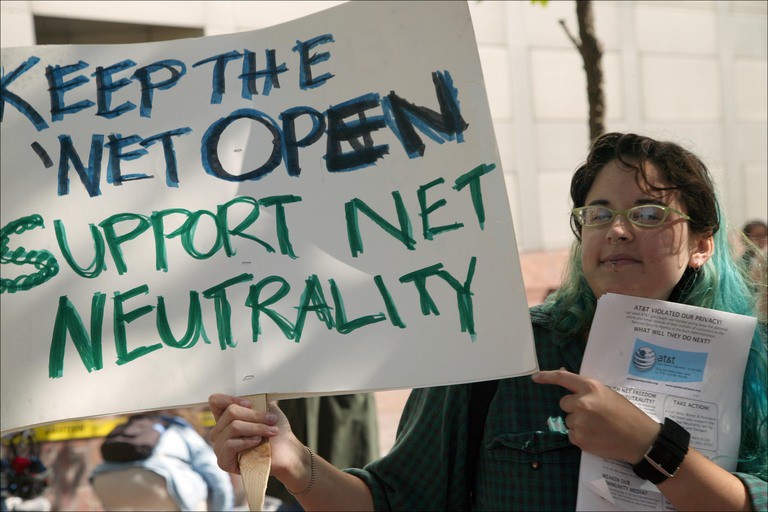
net_neutralityThe Times reported Eisenach was hardly alone opposing Net Neutrality. Just weeks after becoming chairman, Wheeler received a letter signed by more than a dozen prominent economists and scholars affiliated with various Washington think tanks or academic institutions. They wanted Wheeler to reject Net Neutrality regulations. The letter attempted to distance the signers from any corporate agenda, noting in a footnote that nobody was compensated for their signature on the letter.

On the other hand, of the dozen studies that were included or referenced in their letter as “evidence,” more than half were entirely funded by giant telecom companies that oppose Net Neutrality. Mr. Wheeler would need a magnifying glass and plenty of free time to ferret out the industry funding disclosures in those attached studies, which were buried in footnotes.

When the industry took the FCC to court over broadband regulation or Net Neutrality, it was more of the same. Verizon was successful opposing an earlier FCC rule on Net Neutrality by trotting out almost two dozen studies and declarations that opposed regulatory oversight — more than half sponsored entirely by the telecommunications companies or trade associations that despise Net Neutrality. Many other studies were written by think tanks and scholars that also had direct financial ties to the companies.

Litan

Litan

Another key factor in the debate about Net Neutrality was the cost of implementing it. Again, the incestuous ties between the telecom industry, think tanks, and academia would serve up the “right answers” for Big Telecom’s case against Neutrality when two economists issued a controversial “policy brief” that claimed Net Neutrality would cost $15 billion in new fees and retard broadband expansion and upgrades. (The $15 billion figure came under immediate ridicule by consumer groups that effectively suggested the study authors ‘made it up,’ a case that may have been proven to some degree when the authors suddenly revised it down to $11 billion.)

Robert Litan, then a senior fellow at Brookings and Hal Singer, who used to work at the Progressive Policy Institute, would quickly come under greater scrutiny than Eisenach, probably because their report became central to the industry’s battle against Net Neutrality. The National Cable and Telecommunications Association (NCTA) even built an advertising campaign against Net Neutrality around their study. Politicians opposed to Net Neutrality also regularly quoted from Litan and Singer’s findings to explain their strong opposition to the net policy.

Lost in the debate is who paid Mr. Litan and Mr. Singer for their work. Their employer, Economists Inc., yet another inside-the-Beltway consulting firm, didn’t exactly publicize their “select clients” included AT&T and Verizon — two of the largest opponents of Net Neutrality.

Using think tanks to bolster corporate lobbying has become so common, it has attracted the attention of some members of Congress.

Litan collided with one of the Senate’s fiercest consumer advocates and watchdogs — Sen. Elizabeth Warren (D-Mass.) in a September 2015 hearing about a rules change fiercely opposed by investment bankers that would require financial advisers recommending retirement-associated investments to put their clients’ interests ahead of their own personal gain. Warren has championed the cause of ending high bank and investment-related fees that eat away investor returns. Some of the worst offenders convinced financial advisers to recommend their funds by kicking back large bonus commissions, which enriched the adviser and the investment bank but left seniors hit hard by lost potential earnings.

Sen. Elizabeth Warren (D-Mass.)

Sen. Elizabeth Warren (D-Mass.)

Litan’s research questioned the potential benefits of upping ethical standards. He wrote the costs to the banking and investment community to implement the rules would far outweigh any benefits to investors. Litan casually mentioned his affiliation with Brookings, a think tank, to promote his research’s credibility. He didn’t call attention to the fact his 28-page study was produced for a client: Capital Group — a massive financial services company with $1.39 trillion in assets. It would be directly impacted by the imposition of the new rules, which it strongly opposed.

Capital Group paid Economists, Inc. $85,000 for the study. Litan’s cut of the action was $38,800 — or $1,386 per page.

Warren complained Litan was not exactly forthcoming in disclosing his personal gain and his ties to a major opponent of the new rules under consideration.

“These disclosures are problematic: they raise significant questions about the impartiality of the study and its conclusions, and about why a Brookings-affiliated expert is allowed to use that affiliation to lend credibility to work that is…editorially compromised,” Sen. Warren wrote in a letter to Brookings President Strobe Talbott.

The embarrassment to Brookings, which has increasingly relied on corporate-funded research to fund its work, led to rumors Litan was asked to leave, and he resigned shortly thereafter. Litan downplayed the event, calling it a “minor technical violation” of Brookings’ ethics policy, which prohibits those associated with the think tank from using their affiliation with Brookings in any research report or testimony.

The incident fueled consumer groups’ arguments that cozy arrangements between purportedly independent scholars and academics and corporate entities too often results in bought-and-paid-for- research not worth the paper it is printed on. A clear conflict of interest and the lack of prominent funding disclosures makes such reports suspect at best and worthless in many other cases, because no company paying for a report is going to make it public if it conflicts with their agenda.

Singer

Singer

Remarkably, other economists, many also engaged in producing reports for corporate clients, rushed to the defense of… Mr. Litan, calling his removal from Brookings the result of a witch hunt.

A letter signed by former Clinton economic advisers W. Bowman Cutter and Everett Ehrlich; Harvard University international trade and investment professor Robert Z. Lawrence; former Clinton chief budget economist Joseph Minarik; and former Clinton economic adviser Hal Singer, who co-authored the report that got Litan in hot water with Sen. Warren, claimed as a result of Litan’s forced resignation, critics of their reports could threaten the credibility of their work with an “ad hominem attack on any author who may be associated with an industry or interest whose views are contrary to [Sen. Warren].”

“Businesses sometimes finance policy research much as advocacy groups or other interests do,” the economists wrote. “A reader can question the source of the financing on all sides, but ultimately the quality of the work and the integrity of the author are paramount.”

Singer has since left the Progressive Policy Institute.

D.C.’s revolving door has also provided lucrative work for those out of government jobs and now working in the private sector, often lobbying those still in government.

Rep. Greg Walden (R-Ore.) had no problem introducing a Wall Street Journal op-ed piece into the Congressional Record written by Robert McDowell, who wears several hats at the Hudson Institute. He’s a “scholar,” a “telecommunications industry lawyer” at a firm retained by AT&T to fight Net Neutrality, and a lobbyist. If his name is familiar to you, that might be because McDowell used to be a commissioner of the Federal Communications Commission from June 1, 2006 to May 17, 2013. Now he is paid to kill Net Neutrality for AT&T.

None of that seem to faze Walden or raise questions about the credibility of the opinion piece he sought to have added to the official record.

“Everyone’s got their point of view,” Walden said last year. “And some of them get paid to have that point of view.”


Spring 2016: An Update and Progress Report for Our Members

stcDear Members,

We have had a very busy winter and spring here at Stop the Cap! and we thought it important to update you on our efforts.

You may have noticed a drop in new content online over the last few months, and we’ve had some inquiries about it. The primary reason for this is the additional time and energy being spent to directly connect with legislators and regulators about the issues we are concerned about. Someone recently asked me why we spend a lot of time and energy writing exposés to an audience that almost certainly already agrees with us. If supporters were the only readers here, they would have a point. Stop the Cap! is followed regularly by legislators, regulators, public policy lobbyists, consumer groups, telecom executives, and members of the media. Our content is regularly cited in books, articles, regulatory filings, and in media reports. That is why we spend a lot of time and energy documenting our positions about data caps, usage billing, Net Neutrality, and the state of broadband in the United States and Canada.

A lengthy piece appearing here can easily take more than eight hours (sometimes longer) to put together from research to final publication. We feel it is critical to make sure this information gets into the hands of those that can help make a difference, whether they visit us on the web or not. So we have made an extra effort to inform, educate, and persuade decision-makers and reporters towards our point of view, helping to counter the well-funded propaganda campaigns of Big Telecom companies that regularly distort the issues and defend the indefensible.

Four issues have gotten most of our attention over the last six months:

  1. The Charter/Time Warner Cable/Bright House merger;
  2. Data cap traps and trials (especially those from Comcast, Blue Ridge, Cox, and Suddenlink);
  3. Cablevision/Altice merger;
  4. Frontier’s acquisition of Verizon landlines and that phone company’s upgrade plans for existing customers.

We’ve been successful raising important issues about the scarcity of benefits from telecom company mergers. In short, there are none of significance, unless you happen to be a Wall Street banker, a shareholder, or a company executive. The last thing an already-concentrated marketplace needs is more telecom mergers. We’re also continuing to expose just how nonsensical data caps and usage-based billing is for 21st century broadband providers. Despite claims of “fairness,” data caps are nothing more than cable-TV protectionism and the further exploitation of a broadband duopoly that makes it easy for Wall Street analysts to argue “there is room for broadband rate hikes” in North America. Stop the Cap! will continue to coordinate with other consumer groups to fight this issue, and we’ve successfully convinced at least some at the FCC that the excuses offered for data caps don’t hold water.

Dampier

Dampier

FCC chairman Tom Wheeler’s broadening of Charter’s voluntary three-year moratorium on data caps to a compulsory term as long as seven years sent a clear message to broadband providers that the jig is up — data caps are a direct threat to the emerging online video marketplace that might finally deliver serious competition to the current bloated and overpriced cable television package.

Wheeler’s actions were directly responsible for Comcast’s sudden generosity in more than tripling the usage allowance it has imposed on several markets across the south and midwest. But we won’t be happy until those compulsory data caps are gone for good.

More than 10,000 Comcast customers have already told the FCC in customer complaints that Comcast’s data caps are egregious and unfair. Considering how unresponsive Comcast has been towards its own customers that despise data caps of any kind, Comcast obviously doesn’t care what their customers think. But they care very much about what the FCC thinks about regulatory issues like data caps and set-top box monopolies. How do we know this? Because Comcast’s chief financial officer this week told the audience attending the JPMorgan Technology, Media and Telecom Broker Conference Comcast always pays attention to regulator headwinds.

“I think it’s our job to make sure we pivot and react accordingly and make sure the company thrives whatever the outcome is on some of the regulatory proposals that are out there,” said Comcast’s Mike Cavanagh. We suspect if Chairman Wheeler goes just one step further and calls on ISPs to permanently ditch data caps and usage billing, many would. We will continue to press him to do exactly that.

Stop the Cap! supports municipal and community-owned broadband providers.

Stop the Cap! supports municipal and community-owned broadband providers.

Other companies are also still making bad decisions for their customers. Besides Comcast’s ongoing abusive data cap experiment, Cox’s ongoing data cap trial in Cleveland, Ohio is completely unacceptable and has no justification. The usage allowances provided are also unacceptably stingy. Suddenlink, now owned by Altice, should not even attempt to alienate their customers, particularly as the cable conglomerate seeks new acquisition opportunities in the United States in the future. We find it telling that Altice feels justified retaining usage caps on customers in smaller communities served by Suddenlink while denying they would even think of doing the same in Cablevision territory in suburban New York City. Both Suddenlink and Cablevision have upgraded their networks to deliver faster speed service. What is Altice’s excuse about why it treats its urban and rural customers so differently? It frankly doesn’t have one. We’ll be working to convince Altice it is time for Suddenlink’s data caps to be retired for good.

We will also be turning more attention back on the issue of community broadband, which continues to be the only competitive alternative to the phone and cable companies most Americans will likely ever see. The dollar-a-holler lobbyists are still writing editorials and articles claiming “government-owned networks” are risky and/or a failure, without bothering to disclose the authors have a direct financial relationship to the phone and cable companies that don’t want the competition. We will be pressing state lawmakers to ditch municipal broadband bans and not to enact any new ones.

We will also continue to watch AT&T and Verizon — two large phone companies that continue to seek opportunities to neglect or ditch their wired services either by decommissioning rural landlines or selling parts of their service areas to companies like Frontier. AT&T specializes in bait-n-switch bills in state legislatures that promise “upgrades” in return for further deregulation and permission to switch off rural service in favor of wireless alternatives. That’s great for AT&T, but a potential life-threatening disaster for rural America.

We continue to abide by our mandate: fighting data caps and consumption billing and promoting better broadband, regardless of what company or community supplies it.

As always, thank you so much for your financial support (the donate button that sustains us entirely is to your right) and for your engagement in the fight against unfair broadband pricing and policies. Broadband is not just a nice thing to have. It is an essential utility just as important as clean water, electricity, natural gas, and telephone service.

Phillip M. Dampier
Founder & President, Stop the Cap!

Did the Paris Terrorists Really Use an Internet-Connected PlayStation 4 to Coordinate Attack?

Phillip Dampier November 17, 2015 Editorial & Site News, Public Policy & Gov't 1 Comment

analysisLess than a week after ISIS-connected terrorists is Paris allegedly killed at least 129 people in a coordinated attack, false reports continue to be spread through news services and social media. It’s enough to make you cringe.



On Sunday, media outlets began turning their attention to a “contributor” piece appearing on Forbes‘ website that suggested terrorists may have used a popular game console connected to the Internet to discuss and plan the attack:

The hunt for those responsible (eight terrorists were killed Saturday night, but accomplices may still be at large) led to a number of raids in nearby Brussels. Evidence reportedly turned up included at least one PlayStation 4 console.

Belgian federal home affairs minister Jan Jambon said outright that the PS4 is used by ISIS agents to communicate, and was selected due to the fact that it’s notoriously hard to monitor. “PlayStation 4 is even more difficult to keep track of than WhatsApp,” he said.

After nearly 500,000 views of the Forbes article, the author admitted to a gaming publication that he got his story wrong. It has since been edited to remove several serious factual errors. How could Forbes have gotten the story so wrong?

Phillip Dampier

Phillip Dampier

Forbes does not strictly edit the content of its large base of online contributors, which increasingly resembles the publishing model of the Huffington Post. As a result, Forbes‘ disavows (in small print) any editorial connection to their writers, claiming their opinions do not represent the venerable business publication. But few in the media seemed to pick up that disclaimer suggested some skepticism might be appropriate. Instead, the story spread unquestioned like wildfire.

By Monday, Kotaku attempted to set the record straight, verifying Jambon’s comments were actually delivered on Nov. 10, three days before the Paris attack and only from the context of Belgium’s generally perceived security weaknesses. Claims that a PlayStation 4 was allegedly seized from an attacker’s apartment have now been declared “an editing error,” and the author has backed even further away from his inference it was used to help coordinate the attack. That is a charitable way of saying the central thesis of the Forbes‘ story about the events in Paris was entirely wrong.

“This was actually a mistake that I’ve had to edit and correct,” Forbes‘ writer Paul Tassi told Kotaku on Monday. “I misread the minister’s statement, because even though he was specifically saying that PS4 was being used by ISIS to communicate, there is no public list of evidence list of what was found in the specific recent raids. I’ve edited the post to reflect that, and it was more meant to be about discussing why or how groups like ISIS can use consoles. It’s my fault, as I misinterpreted his statement.”

The idea that ordinary Internet-connected game consoles can be used to quietly coordinate major terror attacks proved irresistible catnip for cable news. CNN and MSNBC both discussed the implications of terrorists enabled with game consoles, while Fox News further amplified the claim to suggest government agencies might not be monitoring these communications, opening a national security risk. Fox News even coined the Paris attack a “Joystick Jihad,” removing one sentence from its initial report to correct claims of a seizure of the game console, but left the rest of its story intact:

“There is no doubt that terrorists and other underground networks are using PlayStation and other non-traditional means to communicate with each other,” said Paul Martini, CEO of cyber security specialist iboss Cybersecurity, in a statement emailed to FoxNews.com. The CEO noted that the languages and protocols that PlayStation uses to communicate over the Internet are much different from those used in web browsers and other apps. “They are typically encrypted communication channels that are built on custom-designed languages built for speed and security – since PlayStation involves multi-player Internet connected users, it’s very distributed, high speed and difficult to track and monitor,” Martini added.

Videogame network or terrorist digital playground.

Videogame network or terrorist digital meeting spot?

Friday evening’s attacks are being used by a variety of interest groups to push various agendas, ranging from promoting military intervention in Syria to stopping Syrian refugees from entering the United States. But privacy groups also fear Forbes‘ story will be used to argue for extended government surveillance beyond telephone calls, text messaging, and Internet traffic, into third-party private encrypted networks like Sony’s PlayStation Network. In 2013, whistleblower Edward Snowden claimed the NSA and CIA were already there.

British newspaper The Telegraph suggested Sony’s private network has hardly proven itself an impenetrable digital Fort Knox:

Sony doesn’t exactly have a great reputation for security. A hack of PSN in 2011 saw 77 million users affected by personal data theft, and a hack emerged in December last year that saw many personal details of celebrities and other public figures leaked.

Media critics complain there is a danger that the demand for immediate news results in reporting information before it can be sufficiently sourced and verified. Elements of stories later proven wrong can remain a part of a story’s narrative, even when quickly discredited or changed as a result of newly obtained information. Examples of this are especially common on social media. Less serious examples include sharing photographs on Twitter and Facebook purporting to be from Paris that were actually taken months earlier. In other cases, depictions of solidarity with Paris from around the world were often misconstrued from other unrelated events. More serious are the false narratives that can damage a brand’s reputation, prod policy changes, or even fuel new laws, such as efforts to further extend surveillance.

While the corrections are helpful and appropriate, the rush to print first and verify later is becoming more common than ever. The Forbes’ author claimed he made a “reporting mistake” because he rushed to judgment connecting Jambon’s earlier statements to the Paris attacks. But that does not explain or justify his more important claim that a PlayStation 4 console was found as a result of the raid and his suggestion it was used to plan and coordinate a terrorist attack.

So our advice to Forbes‘ authors is simple. A story about a game console being used by terrorists was never just going to be treated as an interesting story angle. It would be used by the media, pundits, and officials to debate and discuss whether national security is at risk unless surveillance improves. Some will go as far to suggest controls on game consoles or new government authority to monitor the games and those playing them. Before we have that debate, let’s at least get the story right. We’ve seen the results of public policy changes based on flawed intelligence and erroneous media reports too often. Let’s not do that again.

Correction: Original story referenced “Kontaku,” which has been corrected to reflect the site’s actual name – Kotaku. Thanks to Mark E. for spotting the error.

Sen. Elizabeth Warren Calls Out Bought-and-Paid-For Research; One Paid Author Resigns

Phillip Dampier October 6, 2015 Editorial & Site News, Public Policy & Gov't Comments Off on Sen. Elizabeth Warren Calls Out Bought-and-Paid-For Research; One Paid Author Resigns
Warren

Sen. Warren

Sen. Elizabeth Warren (D-Mass.) has sent a shockwave across the D.C. Beltway and academia after complaining a Brookings Institution scholar co-authored a research report that was paid for by a corporation that used it to lobby Congress to reject consumer protections for retirees.

Warren’s encounter with paid research is nothing new for Stop the Cap! readers. We have been documenting Big Telecom’s “Phoney” research advocating against consumer protections for broadband and for usage caps and usage-based billing since 2009.

In our view, it is nothing short of unethical for a researcher to accept funding for a corporate-backed research study, bury that fact in a footnote, and leave out the dollar amounts involved. But with tens of thousands of dollars ready for the taking per “study,” a cottage industry of academia and “independent” researchers has sprung up to supply customized findings that “coincidentally” mirror that company’s public policy agenda.

Warren followed the money after reviewing a report written by Robert Litan and co-authored by Hal Singer, who often writes about broadband issues for the Progressive Policy Institute, which itself receives significant funding from Big Telecom companies.

Hire your own economist to write you a research report. Economists, Inc.'s "selected client list" is a Who's Who of America's top corporations.

Hire your own economist to write you a research report. Economists, Inc.’s “selected client list” is a Who’s Who of America’s top corporations.

Litan’s report advocated against a proposed rule written by the Labor Department that would prohibit retirement plan brokers from receiving financial commissions, bonuses and other quiet incentives from giant investment banks that could potentially influence the advice brokers give consumers. During the housing bust of the Great Recession, similar financial conflicts of interest occurred when realtors and loan officers were accused of steering consumers into loan/mortgage products that paid substantial commissions to both, despite the fact those products may not have been in the best interests of homebuyers.

Litan concluded the new rule would “be too costly” to manage, a claim dismissed as ridiculous by Barbara Roper, director of investor protection for the Consumer Federation of America.

What could have made an economist with ties to the prestigious Brookings Institution reach a conclusion that would, in the words of Roper, leave “millions of working families and retirees without meaningful protections when they turn to financial professionals for retirement investment advice?”

It might be the $85,000 paid by the study’s sponsor — the Capital Group, a leading mutual fund manager with an obvious interest in the outcome.

Brookings promotes "quality, independence, and impact."

Brookings promotes “quality, independence, and impact.”

Warren’s staff noticed a tiny footnote on the first page of Litan and Singer’s report acknowledging the study was sponsored by the firm, but did not disclose the amount paid or the conditions under which the study was written.

Warren complained the report was little more than a “highly compensated and editorially compromised work on behalf of an industry player seeking a specific conclusion.” Warren also notified both the Brookings Institution and the Obama Administration that using these types of reports to “independently” bolster a corporation’s lobbying was little more than influence peddling, and implied it threatened Brooking’s reputation.

The practice of writing corporate-sponsored research is well-established, usually dependent on the names and reputations of well-respected think tanks and policy institutes to provide cover for the more blatant practice of direct corporate lobbying. Most corporations avoid drawing attention to their direct financial relationship with study authors. Litan’s money connection was revealed in follow-up written questions from Warren. The answers conflicted with the study authors’ original claims they were “solely responsible” for the study’s conclusions, finally revealing Capital Group had paid $85,000 for the study, and Litan’s share was $38,800.

Recognize that logo? Your retirement fund may already be handled by a Capital Group subsidiary like American Funds.

Recognize that logo? Your retirement fund may already be handled by a Capital Group subsidiary like American Funds.

Tom Joyce, a spokesman for the Capital Group, said his company was following standard practice. “It is typical for organizations to sponsor academic studies,” Joyce said, noting that in this case, “no preconditions or predetermined conclusions were imposed.”

Few D.C. insiders believe Joyce, noting they have never seen a corporate-sponsored report that concluded anything markedly different from the corporate sponsors’ own positions.

In the end, Litan resigned his “non-resident scholar” position at the Brookings Institution, not because of his association with corporate-sponsored research, but rather his violation of a new think-tank rule prohibiting researchers from citing their affiliation with Brookings when testifying before Congress.

After that, the D.C. establishment and a threatened coterie of fellow pay-for-research writers went on the warpath, realizing a lucrative revenue stream was at risk if the public knew the independence of corporate-funded research is often suspect.

“This is McCarthyism of the left,” Hal Singer, a senior fellow at the Progressive Policy Institute and co-author of the research Warren criticized told Politico. “What Warren is doing is suppressing scholars [who] speak independently through her threats.”

An editorial in the Wall Street Journal accused Warren of launching an inquisition against ideas and used the names of several former officials in the Clinton Administration to defend the bipartisan practice of corporate writing on spec.

The National Review (seeing a trend yet?) also blistered Warren for having a double standard in a piece Bloomberg News dismissed as “interesting though a bit breathless.” The fact pro-regulation lobbying group Better Markets often agrees with Sen. Warren’s political views was enough for the conservative magazine to indict her for essentially doing the same thing Litan did. Only Bloomberg concluded Warren was more of a bystander than a participant.

[The National Review piece] accuses Better Markets of “failing to adequately disclose its relationship” with its hedge-fund-manager founder Michael Masters, even though that relationship seems to be fully disclosed, and it insinuates that Masters was shorting Prudential and MetLife while Better Markets was arguing to have them regulated as “systemically important,” even though the only evidence for that is that Masters [had] long call options on Pru and Met.

Warren has made a point of publicly exposing the cozy relationships corporations have with lobbyists, paid consultants, and academia in her one-woman war to protect consumer interests and punish big banks and corporations for anti-consumer behavior. Her practice of tearing the lid off D.C.’s revolving door of lobbying and public service has made Democrats and Republicans nervous, and more than few are looking for revenge.

As far as we’re concerned, Warren’s isn’t the issue. The problem rests with those that willingly choose to risk their credibility for cash, writing reports with glaring conflicts of interest.

Search This Site:

Contributions:

Recent Comments:

Your Account:

Stop the Cap!