
Home » public policy » Recent Articles:

Virginia Being Scammed With Industry-Ghostwritten Broadband Ban Bill

Del. Kathy Byron (R-Big Telecom)

What is one of the most effective ways to stop competition in its tracks before it can even get off the ground? Reward a state legislator with generous campaign contributions who introduces a bill banning your would-be competitor and get back to business as usual.

Delegate Kathy Byron (R-Campbell County) has broadband, but many of the people who live and work in central and western Virginia near her district don’t. Located in south-central Virginia, the county of 55,000 endures similar broadband availability and quality problems other communities in the western half of the state experience. Located near the Blue Ridge Mountains, the county seat of Rustburg has areas served by DSL, and many other areas that are not. For telecom companies serving mountainous and rural communities in this part of the state, broadband is often not economically viable enough to meet Return On Investment formulas. In fact, the problems are so significant, the southwestern Virginia community of Claudville was selected as the nation’s first testing ground for “white space” wireless broadband, designed to serve sparsely populated rural areas.

Byron’s district in Campbell County is neither wealthy or rich in internet options. Like other communities in the region, the decline of manufacturing and the transition away from tobacco production has created enormous economic challenges. Campbell County is continuing to rely heavily on agriculture while other communities in Virginia and the Carolinas are reinventing themselves to participate in the 21st century knowledge economy. That requires 21st century broadband service, which Campbell County lacks.

Last fall, Campbell County Public Schools assistant superintendent Robert Arnold provided a frank assessment of the area’s broadband problems, telling The News & Advance schoolchildren in his district suffer from a “homework gap,” unable to complete assignments requiring the internet at home because those homes lacked access. A recent trial of “white space” broadband in the area proved unsatisfactory because, in Arnold’s view, it was unreliable.

“We’re not seeing it as a reliable solution to our problems to get internet more readily available to kids that don’t have it in the different parts of our county where there are a lot of dead spots,” Arnold said.

Even wireless providers have not stepped up. Efforts to encourage cellular companies to place antennas on the same towers used for the “white space” broadband experiment have failed as well. The newspaper reports the lack of population makes private providers “squeamish about expanding there.”

The Campbell County school system managed to switch to a fiber optic network, but the only chance students will have that option at home is if local communities choose to offer it themselves and that will never happen if Ms. Byron’s bill becomes law.

Despite the broadband challenges in her district and the failure of private providers to correct them, Byron went ahead this month and introduced the ironically-named “Virginia Broadband Deployment Act,” another bought-and-paid-for industry-ghostwritten municipal broadband ban bill that would grant near-monopoly control to the same providers that have steadfastly refused to improve rural broadband in Virginia.

Her bill, according to The Roanoke Times, is the height of hypocrisy for a Republican claiming to be pro-business development:

Byron’s bill would make it difficult for existing municipal broadband authorities to expand and new ones to get started. Curiously, for a bill sponsored by a Republican, it would create more regulation, by requiring that the state authorize any creation or expansion of a broadband authority (plus lays on other regulations, as well.) For a bill that purports to protect the free market, it actually distrusts the free market: If telecommunications companies were already providing the service the rest of the business community wanted, the business community wouldn’t be clamoring for local governments to step in.

Spent lavishly on Byron – her second largest contributor.

The newspaper shouldn’t be surprised. Politicians willing to introduce these lovingly hand-crafted turf protection bills ask themselves only one question: are the generous corporate campaign contributions that usually accompany these “model bills” still worth it if the voters find out? Even if they do, a well-funded propaganda campaign sponsored by Big Telecom companies slamming municipal broadband as a government internet takeover or a guaranteed economic failure can help give politicians enough cover to avoid being exposed for selling constituents down the river.

It will therefore come as no surprise to regular Stop the Cap! readers that Virginia’s largest telecom companies have spent lavishly on Ms. Byron over the years. Her second largest contributor (next to the Republican Party of Virginia) is Verizon, which spent considerably more on her campaign than other well-heeled companies including Anthem and the Virginia banking lobby. Another major contributor is the Virginia Cable Telecommunications Association (more on that organization later). Others bringing checks include: AT&T, Sprint, CenturyLink, Comcast and the Virginia Telecommunications Association.

The pattern is all too familiar. Politicians take a sudden interest in telecommunications public policy and almost by magic produce a very detailed (and suspiciously similar) piece of legislation designed to make life impossible for public and community broadband projects, while claiming their bill will improve broadband.

In many cases, the politicians introducing these broadband ban bills are surprisingly unprepared to answer detailed questions about their own legislation, counting on local media to not scrutinize their logic too closely. But every so often, the blank stares and subject-changing that occurs when challenges are put to the alleged authors make us question if they actually read their own bill.

We have.

Byron is on ALEC’s Communications and Technology Task Force

Also of concern, Ms. Byron and her bill expose several conflicts of interest she has elected to ignore and hope nobody notices, like her membership on the American Legislative Exchange Council’s Communications and Technology Task Force, notorious for promulgating state bills restricting or banning public broadband. ALEC funding comes, in part, from some of the nation’s largest telecom companies.

We noticed.

The backlash Ms. Byron is now receiving from unhappy rural Virginia communities and local media that have read her bill has apparently surprised her, and in subsequent newspaper letters to the editor, she has taken to playing the victim card. But that has not stopped her from maligning municipal broadband projects, hoping that shaking those shiny keys will distract enough people from focusing on what is actually in her bill.

We put her keys away.

Stop the Cap! has reviewed her bill, also known as House Bill 2108, and what we found astonished us more than usual, and we’ve seen just about every kind of shilling imaginable:

§ 56-484.28. Provision of broadband expansion services.

Notwithstanding any provision of the Virginia Wireless Service Authorities Act (§ 15.2-5431.1 et seq.) or any other provision of law, a locality or any affiliate may own and operate a broadband or Internet communications system, including ownership or lease of fiber optic or other communications lines and facilities, to provide broadband expansion services only if the following conditions are met:

1. The locality or its affiliate has obtained a comprehensive broadband assessment by report or study, by the Center for Innovative Technology, or an independent consulting firm knowledgeable and experienced in analyzing broadband deployment, which report or study is made available to the public and specifically identifies any unserved areas.  The locality or its affiliate shall be responsible for all fees charged by the Center for Innovative Technology or an independent consulting firm for the preparation of such comprehensive broadband assessment report or study.

2. Based upon the comprehensive broadband assessment, the locality or its affiliate formally adopts and publishes specific broadband goals regarding capacity, geography and documented demand for Internet services in the specific unserved areas which the locality or its affiliate desires to address.

3. The locality or its affiliate has issued a request or solicitation for proposals, consistent with the specific broadband goals of the locality previously identified, requesting the capital cost which an existing for-profit local Internet service provider offering communications services with broadband speeds would incur to meet the locality’s specific broadband goals by extending or upgrading such services with broadband speeds to any specific unserved areas of the locality identified in the comprehensive broadband assessment.  Copies of such request or solicitation shall be sent to any franchised cable operator and other known Internet service providers with local facilities offering communications services in the locality at least 180 days in advance of the deadline for the response to the request or solicitation for proposals. The governing body of the locality or its affiliate shall analyze any responses it receives to determine if capital grants or subsidies by the locality to pay for such extension by an existing provider would be more cost effective than construction and operation of a new distribution system by the locality or its affiliate.

4. If no incumbent broadband provider advises the governing body of the locality within six months after the release of the request or solicitation for proposal that it is willing or able to meet the local goals, either without a capital grant or subsidy, or with the capital grant or subsidy or portion thereof proposed by the locality, then the governing body of the locality or its affiliate, after a public hearing, may vote to authorize one or more projects, consistent with the specific broadband goals of the locality previously identified,  to provide broadband expansion services to unserved areas within the locality identified by the comprehensive broadband assessment report or study described above, which report or study shall not be more than one year old at the time of the public hearing.  The chief executive officer of the locality or its affiliate shall certify that the comprehensive broadband assessment report or study identification of unserved areas is still correct based upon information presented at the hearing.

5. Any locality or affiliate project to provide broadband expansion services shall be designed and built or otherwise implemented so that at the time of authorization, the project (i) does not duplicate existing broadband facilities offering broadband speeds to customers, within 90 percent of the geographic area of the project, and (ii) does not duplicate service to customers who already are in a position to connect to an Internet service offering broadband speeds, for 90 percent of the projected residential and commercial customers who will be served by the project or otherwise are within the service area of the project.

6. Any locality or its affiliates seeking to offer or offering broadband expansion services shall, at least 120 days prior to commencement of construction of any project, file with the Virginia Broadband Advisory Council, (i) copies of its report or study from the Center for Innovative Technology, including any updates or supplements thereto, (ii) copies of the minutes of the meeting at which it voted to authorize the offering of broadband expansion services, (iii) a map or description of each project and projected area in which it plans to offer broadband expansion services, (iv) an annual certification by July 1 of each year that any expansion to or changes in its projects or system since the preceding July 1 still qualify as broadband expansion services, and (v) an annual certification that its provision of services meets or in the case of a prospective or an incomplete project shall meet, the requirements of subdivisions 1 through 6 of § 56-484.30.  Any person who believes that any part of such filings is incomplete, incorrect or false and who is in the business of providing Internet services within the locality shall have standing to bring an action in the circuit court for the locality to seek to require the locality to either comply with the substantive and procedural content of the filings required by this section, or cease to provide services, and no bond shall be required for injunctive relief against the locality.

In condensed form, this section claims to help facilitate municipal broadband service in “unserved areas,” but then hamstrings local communities to an extent that makes offering such a service next to impossible. The irony of a Republican legislator advocating detailed and burdensome regulations for a publicly owned provider while concurrently supporting “hands-off” policies for her campaign contributor-provider pals should not be lost on her constituents.

The bill could have been called the “Virginia Duopoly Protection Act,” because it only really allows public broadband development in unserved areas, and only after a community pays for a “broadband assessment” that the bill also mandates be sent to its potential competitors — private cable and telephone companies. Imagine if AT&T was required to send copies of their business plans to Comcast and Charter.

Even worse, phone and cable companies are guaranteed a “heads-up” when a community provider is thinking about providing service, exactly where that service will go, and how much it will cost the community to offer it. Companies on the wrong side of the law used to hire spies to get that information from competitors. Byron’s bill makes Virginia communities pay for the postage required to mail those plans to telecom companies serving their area.

Being given access to what even cable and phone companies would consider highly confidential information isn’t enough. Ms. Byron’s bill allows them to take their time reading it. In fact, her bill gives incumbent providers up to six months to stall, sabotage, or undercut the community effort. They are given the right to underbid the community’s proposal and ironically deliver service in places they have previously refused to serve.

“While it’s good to be specific about what a community plans to do, incumbent providers don’t have to adhere to the same level of transparency,” noted Lisa Gonzalez at the Institute for Local Self-Reliance. “As a result, publicly owned networks are at a disadvantage under such requirements when an incumbent knows where, what, when, and how much a municipality intends to invest to bring service to its community. When incumbents build or upgrade, they are not subject to the same level of exposure. Potential private partners who may consider leasing infrastructure or working with a community in some other capacity could also be put off by drastic transparency rules.”

Any of Virginia’s phone and cable companies could end the demand for municipal broadband tomorrow by simply providing the level of service communities need to participate in the digital economy. That requires connected education and high quality broadband for entrepreneurs and established businesses. Instead of providing that, companies write large campaign contribution checks to state politicians like Ms. Byron to slow down or sabotage any emerging competition. While stalling germinating broadband projects, providers will spend millions to demagogue them in the local media, throw every obstacle in their path, and then point to the delays and cost overruns as evidence municipal broadband is a failure.

In Tennessee, EPB had to face down a deep-pocketed cable industry lawsuit before it could begin offering gigabit internet broadband and television service. EPB eventually won the lawsuit and the service now attracts a substantial market share in Chattanooga, but critics carp it was only successful because it got a federal grant. They ignore the fact it has paid substantial dividends in job growth and enhanced the lives of local citizens, who vote for the service with their wallets.

The fact critical cable and phone companies risk charges of hypocrisy doesn’t seem to move them, even though they are not averse to accepting tax breaks and other government goodies as well. That is why providers instead use well-funded third-party astroturf groups and legislators to do their dirty work. Byron’s bill is more obvious than most, with obstructive sections mandating very short windows for public hearings, blatant protectionism, and a thicket of bureaucratic regulations designed to give ample opportunities for industry mischief with the filing of frivolous motions to run out the clock and run up costs.

§ 56-484.29. Provision of overbuild broadband services.

Any locality or its affiliate that is providing overbuild broadband services as of July 1, 2017, may continue to serve customers within the geographic service area within which it is actually providing such services as of that date; however, except as hereafter provided such locality or its affiliate shall not subsequently expand the geographic scope of its services or expand the nature of the service being offered.  Any locality or its affiliate that is not actually providing overbuild broadband services as of July 1, 2017, or if providing such services, subsequently seeks to expand the geographic territory or nature of services being offered, shall submit a proposal to the Virginia Broadband Advisory Council with a full explanation of the proposed overbuild broadband services, and if recommended by the Virginia Broadband Advisory Council, shall then require the express approval of the General Assembly through legislation approving the offering or expansion of such services by the locality or its affiliate.

Since 2008, Stop the Cap! has reviewed industry-sponsored municipal broadband ban bills, and none to date have illustrated the level of conflict of interest we see here. We call on Virginian officials to carefully investigate the ties Ms. Byron has to cable and phone companies and the ethical concerns raised from her involvement in key state bodies that can make or break rural broadband in Virginia. Byron increasingly exposes an agenda favoring incumbent phone and cable companies that just happen to contribute to her campaign — companies she seems willing to protect at any cost.

In our investigation, we uncovered several disturbing details that suggest questionable behavior from Ms. Byron, primarily from her failure to disclose materially important facts about her bill to fellow elected officials and, more importantly, the public. So far, her only defense to questions raised by the media about her bill is to play the “misunderstood victim” card:

This may be yet another example of media arrogance manifesting itself as a lack of common courtesy. But, I believe the real culprit to be something far more dangerous: the editorial’s author was not going to risk being confused by the facts.

[…] Had someone contacted me, I would have told them about my years of experience serving on Virginia’s Broadband Advisory Council, which I currently serve as chairman. The purpose of the Council is “to advise the Governor on policy and funding priorities to expedite deployment and reduce the cost of broadband access in the Commonwealth.” The Virginia Broadband Deployment Act advances that goal. That’s why legislators serving on the Council support House Bill 2108. And, we’re in good company: The Virginia Chamber of Commerce, the Virginia Association of Realtors and the Northern Virginia Technology Council have all indicated their support for House Bill 2108.
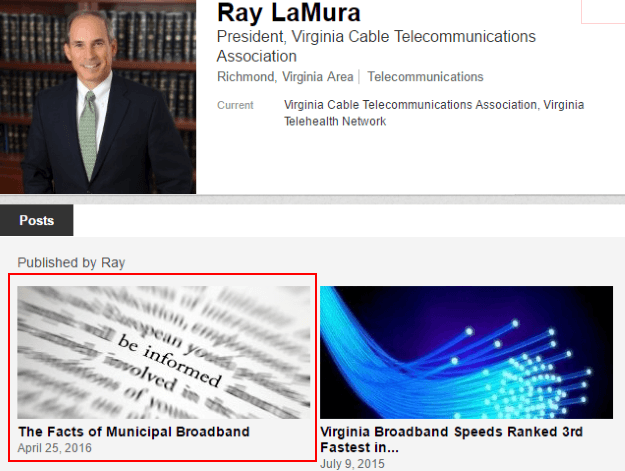
Fixed or Fair? If Byron’s bill becomes law, Ray LaMura, Virginia’s top cable lobbyist, will help decide if municipal providers can expand to compete with cable companies.

In fact, we understand Ms. Byron, her telecom industry benefactors, and the special interests she mentions as supporters only too well. We invite Ms. Byron to refute some of our facts:

While broadband in major Virginia cities is no better or worse than other large cities in the region, there are vast areas in central and western Virginia where inadequate broadband service persists, and private providers have been reluctant or unwilling to change that. As a result, some municipalities are considering offering an alternative. Ms. Byron’s bill doesn’t just deter communities from entering the broadband arena in these areas, it carpet-bombs the entrance out of existence.

The section of her bill detailing requirements for community providers seeking to expand requires them to ask permission from an entity known as the Virginia Broadband Advisory Council, which Byron disturbingly chairs. If the goal of this Council is to pave the road to improved broadband, Byron’s bill is an enormous pothole. Restricting competition won’t help the Council’s goal of winning lower prices for consumers and businesses either, and last time we checked, broadband bills in Virginia are going up, not down.

Ms. Byron’s clear conflict of interest between her bill and the Council’s goals should be grounds for her immediate resignation. It is hard to justify continuing to serve on a Council promoting better broadband while introducing bills that do the opposite. Taking political campaign contributions from the same companies that are directly responsible for the state of Virginia’s broadband today also makes it impossible for the Council to have any credibility as long as she continues to chair it.

Another concern: Ms. Byron fails to disclose the Council she uses for her defense includes “citizen members” that are, in reality, some of the most important telecom industry lobbyists in the state. Ms. Byron’s bill would require communities to seek approval for broadband expansion from the same Council that counts among its members Ray LaMura, president of the Virginia Cable Telecommunications Association, the state’s largest cable industry lobbying group, and Duront Walton, executive director of the Virginia Telecommunications Industry Association, which represents the interests of several telephone companies in the state.
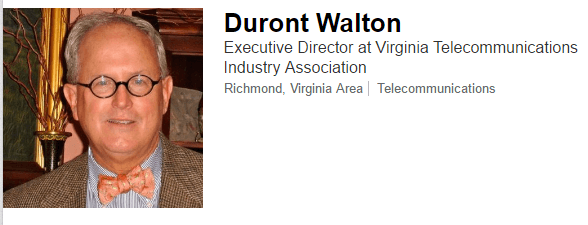
Conflict of Interest?: Another member of Virginia’s Broadband Advisory Council.

Does anyone believe the Virginia Broadband Advisory Council is likely to approve any broadband expansion plan that leads to direct competition with an established cable or phone company, particularly when members like Mr. LaMura write municipal broadband hit pieces prominently linked on his LinkedIn page? Does anyone expect a fair shake from Ms. Byron, who wrote (inaccurately) “the vast majority of municipal broadband systems across the country that have tried to compete with the private sector have failed.”

By all appearances, the fix is in.

While we’re discussing full disclosure, Ms. Byron also failed to mention the Virginia Chamber of Commerce is hardly a dispassionate arbiter of the merits of community broadband — it is a private business lobbying organization. The Virginia Realtors Association is also a political lobbying organization that openly endorsed Ms. Byron’s election campaign, contributed a substantial donation to it, and runs an active Political Action Committee. The Northern Virginia Technology Council is a trade and lobbying organization that counts among its members AT&T, Cox, Comcast, CenturyLink, and Verizon, to name a few. To quote NVTC’s own website: “NVTC members are business leaders focused on the broad business climate of our state and communities.”

We believe Ms. Byron when she said she was in good company. Missing from the cozy gathering are consumers looking for internet access, local governments feeling pressure from their constituents to do something about the problem, and any belief Ms. Byron’s bill will do anything except keep things as they are.

But wait, there is more:

§ 56-484.30. Operating requirements.

The following provisions shall apply to any locality or its affiliate which offers broadband expansion services or overbuild broadband services, after July 1, 2017:

1. A locality or its affiliate shall apply, without discrimination as to itself and any affiliate, including any charges or fees for permits, access or occupancy, the locality’s ordinances, rules, and policies, including those relating to (i) obligation to serve; (ii) access to public rights of way and municipal utility poles and conduits; (iii) permitting; (iv) performance bonding; (v) reporting; and (vi) quality of service.

2. In calculating the rates charged by a locality for any communications service:

 a. The locality or its affiliate shall include within its rates an amount equal to all taxes, fees, and other assessments that would be applicable to a similarly situated private provider of the same communications services, including federal, state, and local taxes; franchise fees; permit fees; pole attachment fees; and any similar fees; and

b. The locality or its affiliate shall not price any of its communications services at a level that is less than the sum of: (i) the actual direct costs of providing the service; (ii) the actual indirect costs of providing the service; and (iii) the amount determined under subdivision 2a.

3. A locality or its affiliate shall keep accurate books and records of any provision of communications services.  A locality or its affiliate shall conduct an annual audit of its books and records associated with any provision of communications services, with such audit to be performed by an independent auditor approved by the Auditor of Public Accounts. Such audit shall include such criteria as the Auditor of Public Accounts deems appropriate and be filed with him, and with copies to be submitted to the Virginia Broadband Advisory Council.  If, after review of such audit, the Auditor of Public Accounts determines that there are violations of this chapter, he shall provide public notice of same, and the locality or its affiliate shall take appropriate corrective action to cure past violations and prevent future violations. […]

§ 56-484.31. Sale or disposal.

Any locality or its affiliate that seeks to sell or dispose of all or any material part of the infrastructure of an internal government services, broadband expansion services, or overbuild broadband services system, or any material portion of any subscriber or service contracts in connection therewith, shall do so by a public sale or auction process after advertisement.

By now, most readers get the point. This bill is a “plan for failure” for municipal broadband.

The ideological pretzel-bending required of Ms. Byron to do the telecom industry’s bidding is a sight to behold. Byron — a Republican — is openly advocating government price regulation, demands municipal providers turn over their books to be reviewed by her Virginia Broadband Advisory Council, which includes cable and telephone company lobbyists, and requires communities that want to abandon networks that fail under this legislative gulag to sell them to the lowest bidder, likely a cable or phone company that helped write the rules.

If this anti-consumer nightmare of a bill becomes law in Virginia, Christmas for Big Telecom will come early this year, and you’re paying… again.


Community Broadband Battle in Savannah Media Pits Local GOP Against Broadband Choice

Phillip Dampier January 11, 2017 Astroturf, AT&T, Broadband Speed, Comcast/Xfinity, Community Networks, Competition, Consumer News, Editorial & Site News, Hargray, Public Policy & Gov't Comments Off on Community Broadband Battle in Savannah Media Pits Local GOP Against Broadband Choice

Savannah, Ga.

The very idea that a city would get involved in selling better broadband service to its residents has sparked a coordinated campaign to sully municipally owned providers and color the results of an ongoing study to determine if Savannah, Ga. is getting the kind of internet access it needs.

While the city and county continue their Broadband Fiber-Optic Feasibility Study and survey residents about incumbent providers including AT&T, Comcast, and Hargray Communications, an organized pressure campaign coordinated by the Chatham County GOP is well underway to undermine any idea the city should compete against the three dominant local internet providers.

“The purpose of this study is to examine how we are currently served with broadband infrastructure, particularly focused on the services available to our community residents, anchor institutions, businesses, and key services like public safety, health and education,” a Savannah city spokesperson told Stop the Cap!

The city’s goal is to: “confirm that residents, anchor institutions and businesses have access to the services they need and that those services are competitively priced.” Incumbent providers are betting the answer to that question will likely be no and have started early opposition to discourage the city from attempting to build its own broadband network. Comcast and AT&T have apparently teamed up with the local Chatham County GOP to defend current providers in suspiciously similar-sounding letters to the editor.

Consider two examples.

About a month ago, Stephen Plunk, executive secretary of the Chatham County Republican Party, liberally sprinkled talking points provided by outside think tanks in an editorial published by the Savannah Morning News:

The Savannah Morning News published this ominous illustration adjacent to a guest editorial from a Chatham County GOP official opposing public broadband.

Only 6,000 residents in Chatham County, out of about 280,000, do not have access to wired internet of any sort. About 90 percent of Savannah residents can choose from two or more wired internet service providers . The city’s current residential providers offer speeds up to 105 mbps, and its 12 business providers offer speeds that are generally between 100 mbps and one gigabit.

Private providers also are making big new investments here. Last year, Hargray Communications announced a plan to offer one gigabit speeds to Lowcountry customers. In March, Comcast announced its intention to offer 10-gigabit speeds to city businesses. Last month, AT&T said it also will begin offering superfast capacity.

Next, let’s look at whether a city should provide service directly to customers. Or, is it wise? To determine that, the city council must ask itself whether it wants to go down the path of Marietta, which ran its own internet company several years ago but was forced to sell that network at a loss when it failed to turn a profit year after year. Marietta’s mayor eventually admitted the city never should have become an ISP. There are government ISPs that do make a profit every year, but they are rare. Chattanooga’s government-run system is often touted as a model, but the city received more than $100 million from the federal government to get its system started.

This morning, Mary Flanders, chairwoman of the Chatham County GOP wrote essentially the same things in an “opposing views” piece published by the Connect Savannah weekly newspaper (and at least cited some of her sources):

They should proceed carefully. Cautionary tales about municipal broadband networks abound.

Consider the situation in Marietta, the sprawling suburb northwest of Atlanta. Marietta started its own municipal network that stretched along a 210-mile long route. After spending $35 million to build out the network, Marietta earned a grand total of 180 customers.

The then-Mayor said the city couldn’t keep pace with the expenses associated with the constant flood of technology upgrades required to manage a broadband network. The city ultimately sold the network in 2004 for a $20 million loss.

Pacific Research Institute, in a report on municipal broadband, found that “Mariettans had decided that they would rather take a $20.33 million loss than continue to subsidize a municipal telecom venture that was sucking their city dry.”

Marietta may be relatively close to home, but it’s not the only example. Provo, Utah spent $40 million to build its network, only to sell it to Google Fiber for the princely sum of $1. In Groton, Connecticut, taxpayers lost $38 million.

City leaders need to consider the downside risk to municipal services if and when the broadband network fails to attract customers and generate case. The shortfall has to be made up somewhere. Where will the money come from? Tax hikes?

Budget cuts to basic services or to the police or fire department? Try explaining that to voters come election time, especially if the crime rate is on the rise.

According to Kelly McCutcheon, President of the Georgia Public Policy Foundation, typically the consultants are the only ones who come out good on these deals. It would be a bitter pill to swallow by Savannah citizens and city leaders alike.

Let’s dig into some of the specifics on Internet needs in Savannah. Of the 280,000 residents in Chatham County, only 6,000 residents do not have access to wired Internet of any kind. About 90% of Savannah residents can choose from two or more wired Internet service providers (ISPs).

The city’s current residential providers offer speeds up to 105 mbps, and its twelve business providers offer speeds that are generally between 100 mbps and one gigabit, which is considered to be very speedy in the Internet world.

Private providers also are making big new investments in the area. Last year, Hargray Communications announced a plan to offer one gigabit speeds to Lowcountry customers. In March, Comcast announced its intention to offer 10-gigabit speeds to city businesses. Last month, AT&T said it also would begin offering incredibly fast capacity to Savannah entrepreneurs.

On track to be profitable by 2006, local politics forced an early sale of the community fiber network that was succeeding.

Most of these talking points have been debunked by Stop the Cap! over our nine-year history. The examples of municipal broadband failures are so few and far between, we’ve come to recognize them, and many of the shop worn examples provided by the Chatham County Republicans are more than five years old.

In Groton, Conn., the emergence of a municipal provider inspired network upgrades and more competition from Comcast while the phone company Southern New England Telephone (later AT&T and today Frontier Communications) did everything possible to keep the publicly owned provider from offering phone services to customers. In the end, Comcast undercut the municipal provider and AT&T’s deployment of U-verse created problems for the then-rosy revenue projections the municipal provider was depending on to recoup its original construction costs. The network was sold five years ago to a private provider and customers still appreciate the quality of the original network today run by Thames Valley Communications, which rates four out of five stars while its competitors Frontier and Comcast rate two. It would be wrong to assume today’s municipal broadband providers have not learned important lessons and now account for incumbents responding to competition with heavily discounted rate retention plans for customers threatening to leave, as well as network upgrades. Revenue projections have become more conservative, both to deal with unexpected construction costs and the revenue likely to be earned in light of cut-rate plans from the competition. But many customers make the switch anyway, persuaded by the quality and reliability of superior fiber networks, rate stability, and a more responsive level of customer service.

The networks in Provo, Utah and Marietta, Ga., are examples of what happens when politicians opposed to the concept of municipal broadband intentionally meddle with them in an effort to prove an ideological argument or to help move along a pre-conceived sale of publicly owned infrastructure to private companies.

In Provo, the fiber to the home network was built and quickly hamstrung by a Utah state law that forbade the city from selling broadband service to the public. Instead, it had to sell wholesale access to private companies it had to attract, who in turn would provide service to the public. Imagine a marketing campaign for a new provider that required customers to deal with two unfamiliar providers just to sign up.

Christopher Mitchell, who studies municipal networks and advocates for community involvement in broadband, wrote a year ago iProvo was facing serious challenges primarily because politicians and industry lobbyists got in the way:

“Industry lobbyists convinced Utah legislators to restrict local authority over municipal networks to ‘protect’ taxpayers and that argument is still frequently used today by groups opposing local internet choice. The law does not actually revoke local authority to invest in networks, it monkeys around with how local governments can finance the networks and requires that municipalities use the wholesale-only model rather than offering services directly.

“However, the debt-financed citywide wholesale-only model has proven to be the riskiest approach of municipal networks. Building a municipal fiber network where the city can ensure a high level of service is hard and can be a challenge to make work financially. Trying to do that while having less control over quality of service and splitting revenues with 3rd parties is much harder.”

Marietta’s experience with municipal broadband failed only because a new mayor unilaterally declared it an ideological failure and sold the network at a loss for political reasons. We covered that debacle ourselves back in 2012:

In Marietta, the public broadband “collapse” was one-part political intrigue and two-parts media myth.

Marietta FiberNet was never built as a fiber-to-the-home service for residential customers.  Instead, it was created as an institutional and business-only fiber network, primarily for the benefit of large companies in northern Cobb County and parts of Atlanta.  The Atlanta-Journal Constitution reported on July 29, 2004 that Marietta FiberNet “lost” $24 million and then sold out at a loss to avoid any further losses.  But in fact, the sloppy journalist simply calculated the “loss” by subtracting the construction costs from the sale price, completely ignoring the revenue the network was generating for several years to pay off the costs to build the network.

In reality, Marietta FiberNet had been generating positive earnings every year since 2001 and was fully on track to be in the black by the first quarter of 2006.

So why did Marietta sell the network?  Politics.

Marietta’s then-candidate for mayor, Bill Dunway, did not want the city competing with private telecommunications companies.  If elected, he promised he would sell the fiber network to the highest bidder.

He won and he did, with telecommunications companies underbidding for a network worth considerably more, knowing full well the mayor treated the asset as “must go at any price.”  The ultimate winner, American Fiber Systems, got the whole network for a song.  Contrary to claims from that the network was a “failure,” AFS retained the entire management of the municipal system and continued following the city’s marketing plan.  So much for the meme government doesn’t know how to operate a broadband business.

While members of the Chatham County GOP took potshots at outside consultants hired to consider whether Savannah should explore offering community broadband, Ms. Flanders was far more sanguine about her sources: the Pacific Research Institute (PRI) and the Georgia Public Policy Foundation.

In fact, the Pacific “Research Institute” doesn’t do independent research and it’s not an institute. It’s a right-wing, dark money-funded think tank with ties to the American Legislative Exchange Council (ALEC) and the Koch Brothers. The Georgia Public Policy Foundation, like PRI, prides itself on not revealing the sources of its funding, but SourceWatch uncovered their financial ties to the Donors Capital Fund, a corporate-“murky money maze” specifically designed to hide corporate contributions and the motives those companies have to send the money. So it isn’t a stretch to assume that when a think tank suddenly takes an interest in municipal broadband, checks from AT&T, Comcast, and others have proven to be helpful motivators.

Election 2016: Trump Victory Troublesome for Tech Issues

Phillip Dampier November 10, 2016 Editorial & Site News, Public Policy & Gov't 7 Comments

donaldtrumpThe stunning victory by Donald Trump in Tuesday’s election ended two years of campaigning, negativity, and divisiveness.


Wednesday probably marked the beginning of Election 2020, which will involve four years of campaigning, negativity, and divisiveness.
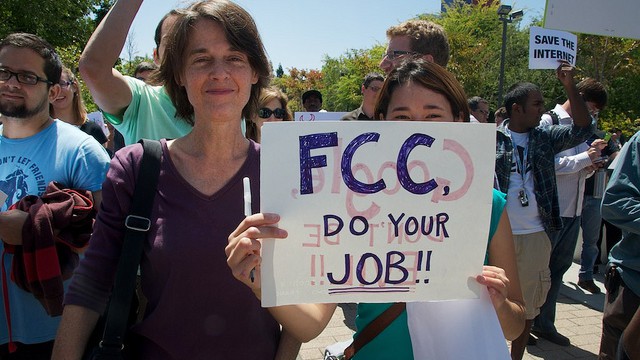
Before looking at the implications of the forthcoming Trump Administration, some personal words about the results from the perspective of a lifelong resident of western New York, on the periphery of the Rust Belt region that evidently made all the difference for Mr. Trump on Tuesday night.

Casting my vote here in western New York while suffering a severe cold that has now evolved into walking pneumonia, I reflected on the fact this nasty election probably gave it to me. Despite that, I have the good fortune of living in a diverse community. Our next door neighbor, and by far the closest to us personally, is an ardent Republican who supported Sen. McCain, Gov. Romney, and Mr. Trump. Across the street, a reliable panoply of Democratic candidate lawn signs sprout every other fall. I spend my Friday afternoons in a community south of Rochester where Hillary Clinton has been largely reviled since she was a senator of New York. She didn’t win in Ontario County this year either. But Sen. Chuck Schumer routinely wins his elections with little effort or opposition.

Politics in the western half of New York State (known as “somewhere around Canada” to those in New York City and Long Island) is far more comparable to the battleground state of Ohio than reliably Democratic Manhattan. Our urban centers in Buffalo, Rochester, and Syracuse are solidly Democratic, while the suburbs and rural areas are just as likely to elect Republicans to office. Among those disappointed Democrats pondering a surprising election of Donald Trump, many cannot understand how such a result is possible. But having been a lifelong resident in a region that has seen profound changes from the decimation of blue-collar, high-paying manufacturing jobs in states that still cling to tax rates that assume everyone still has one, the Trump rebellion predicted by Michael Moore was hardly outlandish. Across the Rust Belt, more than a few voters have given up believing politicians, and are still waiting for relief from the relentless pressure on the declining middle class. Some of the worst job declines came in this region during the first Bush Administration and then again under President Bill Clinton. Memories are still fresh.

The changes to local economies in this region are profound and extremely difficult to navigate for those who lack advanced degrees or special technical skills. A state like North Carolina understands these changes well. An economy quickly transformed away from tobacco and textiles towards high technology created enormous challenges for many families. Those problems still exist in many parts of the state where infrastructure and good jobs are still lacking more than two decades later.

In Rochester, the formerly solid and reliable employers like Eastman Kodak and Xerox are a fraction of the size they were in the 1980s. My father met my mother at Eastman Kodak, a company that also employed more than half my extended family. But not for long. I vividly recall watching the inauguration parade of President Bill Clinton on television in 1993 on a day that Eastman Kodak carried out another wave of draconian job cuts. My father’s job survived, but my uncle’s did not. My grandfather had retired by then.

Michael Moore correctly predicted the reality of a Trump victory with the support of a disaffected middle class in economically distressed states.

Michael Moore correctly predicted the reality of a Trump victory with the support of a disaffected middle class in economically distressed states.

Twenty-three years later, the largest employer by far in this area is the University of Rochester/UR Medicine, which includes the university and an enormous medical treatment infrastructure. Together, this accounts for 22,500 workers. The second largest employer in Rochester is a grocery store. A great grocery store — Wegmans, founded and based here, but a grocery store nonetheless. It accounts for 13,500 jobs. Another 13,000+ workers are employed in medical treatment and hospital services that compete with the U of R. Rounding out top employers are the Rochester City School District with 5,500 teachers, administrators and staff, which is almost as big as Monroe County’s government, which accounts for 4,500 employees. The biggest remaining manufacturer is Xerox, which employs 6,300 workers. But consider this contrast: in 1982 Kodak employed 60,400 in the Rochester area. Today, that number is just 2,300.

Rochester had it easy compared to heavy manufacturing cities to our west. Buffalo, western Pennsylvania, Ohio, and Michigan have been walloped twice — first by the offshoring of heavy industry and then a second round of manufacturing job losses many voters blame on various free trade agreements. Many tens of thousands of these displaced workers have relocated to other states. Exiting residents of Rochester overwhelmingly prefer North Carolina and Arizona for various reasons, while blue-collar workers further west often end up in Kentucky, Tennessee, Alabama, and other southern states. Many of those that remained behind and remember their old jobs are angry, very angry. Some of them supported Bernie Sanders, especially in Michigan. But once the choice came down to Hillary Clinton or Donald Trump, more than a few voted for Mr. Trump, not out of a great allegiance to the Republican party, but because Trump vilified free trade and business as usual in D.C. To these voters, fair or not, Hillary seemed to embody the establishment that has done little or nothing except make speeches.

The election is now over and we have the results. My candidate did not win because she did not run. (Elizabeth Warren in 2020!) On the broadband issues Stop the Cap! is concerned with, a Trump Administration is likely to be bad news for consumer protection, fair pricing, and community broadband, primarily because the people Mr. Trump has chosen thus far to advise him on tech issues are the usual sort with close ties to the largest telecommunications companies in the country, and many have penned papers that have closely aligned with those companies’ public policy positions.

Phillip Dampier: This election gave me walking pneumonia.

Phillip Dampier: This election gave me walking pneumonia.

Trump transition team adviser Jeffrey Eisenach, for example — who we wrote about back in August, could hold considerable power over the direction President-elect Trump will take tech policy in this country. Eisenach has written papers opposing Net Neutrality, is unconcerned about data caps and zero rating policies, and called fears about consolidation blowouts like the now-dead Comcast-Time Warner Cable mega-merger overblown.

Trump did state opposition to the recent merger announcement from AT&T and Time Warner, Inc., which has Wall Street concerned the deal will be DOA by the time the merger papers are filed sometime early next year in Washington. If President Trump keeps his word on that, there are many more mergers and acquisition deals that will emerge in 2017 that will likely never be on his radar, but will be reviewed by a Federal Communications Commission stacked with commissioners closer in ideology to Ajit Pai and Michael O’Rielly than Thomas Wheeler. In our view, Commissioners Pai and O’Rielly have yet to support any significant pro-consumer policy change on broadband before the FCC. Instead, they have largely parroted Big Telecom’s talking points.

It is our suspicion that most of the merger and acquisition deals dreamed about on Wall Street that would never have gotten through the Obama Administration’s Justice Department and FCC will receive quick approval under a Trump Administration.

While Mr. Trump alludes he will prove to be a complete game-changer to business as usual in Washington, his transition team is being swarmed by the usual faces — corporate lobbyists, big donors, and political hacks angling for cabinet or agency positions. Most of them are Beltway insiders, and many have been through D.C.’s revolving door before — lobbyist -> public servant -> lobbyist.

So while Mr. Trump tells America AT&T and Time Warner is “too much concentration of power in the hands of too few,” we remain uncertain he will speak as loudly about other likely deals, particularly involving Altice, Cox, Mediacom, CenturyLink, Windstream, Frontier, Sprint, and T-Mobile — just some of the hunters and the hunted that may get consolidated in 2017.

On other issues:

  • Net Neutrality: Republicans vilified Net Neutrality and a Republican-dominated FCC will likely kill or dramatically downplay any efforts to enforce it. Trump himself has never been a fan. Any new powers won by Chairman Wheeler to regulate internet providers under Title II will also likely be jettisoned by a Chairman Pai or O’Rielly;
  • Data Caps/Zero Rating: This issue is important to us, but isn’t likely to see any regulatory action under a GOP-dominated FCC. Internet providers are likely to see a Trump Administration as a green light for data caps and consumption billing;
  • Internet Privacy: Efforts to regulate internet privacy will also likely face a reversal from skeptical Republicans who will combine excuses for national security with a “hands off” attitude on telecommunications regulation.
  • Community Broadband: The issue of turning back bans on public/municipal broadband will have to be won on the state level. We do not expect to see many friends for municipal broadband in Republican-dominated Washington. The influence of the Koch Brothers, notoriously opposed to public internet projects, has only gotten stronger after this election.

With a GOP-sweep across the Executive and Legislative branches, we expect more deregulation, which is likely to further entrench the broadband duopoly in the United States, if not further expand it with additional consolidation-related mergers and acquisitions, at least among the small and mid-sized players.

On a more personal level, I have been involved in public policy battles surrounding telecommunications issues since 1988. In the late 1980s, I fought for increased competition and regulatory relief for home satellite (TVRO) dishowners and we joined forces to help pass the 1992 Cable Act, which laid the foundation for the emergence of competitors DirecTV and Dish Networks — the first serious competition to the cable industry. That law was vetoed by President George H.W. Bush, but that veto was overridden by the U.S. Congress — the only bill to successfully become law during the first Bush Administration over his objection. Republicans pay cable bills too.

(Image courtesy: Steve Rhodes)

(Image courtesy: Steve Rhodes)

Administrations come and administrations go, but we are still here.

The need for robust consumer protection, true competition, and a level playing field never changes. Your involvement remains essential regardless of what party is in power in Washington. Some battles will be more challenging, but not all. Direct consumer action can make an impact on companies concerned about their brand and public image. Just as consumers are passionate about rising cable bills, broadband is always a hot button issue, especially where service is unavailable or comes only at a price that resembles extortion.

The president-elect says that America doesn’t win anymore. We sure haven’t been winning on broadband, either on speed, pricing, or availability, in comparison to Europe and Asia. The solution is not to turn the problem over to the same companies that created the conditions for broadband malaise we are dealing with now. As seen in fiercely competitive markets like France, true competition is often the only regulation you need. A duopoly answers to itself. Having the choice of four, five, six, or more competing providers answers to customers. Consolidated and entrenched markets resist innovation and the need to compete stagnates. Corporate welfare and ghost-written telecom laws that forbid community broadband restricts economic growth and kills jobs, stranding countless rural residents from the digital economy. That -is- business as usual in too many states where groups like the American Legislative Exchange Council (ALEC) facilitate legislative fixes and legal protectionism that restricts or disadvantages competition.

If Mr. Trump truly believes the words he has spoken, he must be vigilant. He must not surround himself with the same politicians and their minders that created the very problems he promises to fix. The voters that elected him to office expect nothing less than blowing up business as usual. But the nation’s capital has a better track record of changing the politician while resisting change to the status quo.

We wish President Trump success for our country, but we’ll be watching to make certain his rhetoric meets the reality.

Trump Campaign Invites Big Telecom Lobbyists to Attend Trump ‘Transition Team’ Meeting

Phillip Dampier October 3, 2016 Public Policy & Gov't 5 Comments

trumpRepublican presidential hopeful Donald Trump’s campaign has sent personal invitations to some of the telecom industry’s most powerful lobbying groups asking them to attend an “information session” that will give the lobbyists “an inside look on the work underway on planning for the transition,” should Donald Trump become the next president of the United States.

Communications Daily reports the secretive meeting will be held at the powerhouse D.C. law firm Baker Hostetler, and will feature Trump transition team leader Chris Christie, the current governor of New Jersey.¹

The Trump campaign has remained almost totally silent on telecom public policy issues, but the meeting will give some of the country’s biggest telecom companies face time to influence an incoming Trump Administration on telecom issues ranging from wireless spectrum to Net Neutrality to competition and regulation matters.

Transition team member Andrew Bremberg, a former aide to Senate Majority Leader Mitch McConnell (R-Ky.) sent the invitations. Likely to attend are lobbyists from NCTA-The Internet Association (cable lobby) and the CTIA (the wireless industry’s principal lobbyist). Also expected are individuals representing some of the largest telecom companies in the country. Up to 100 lobbyists are expected to attend.

The Trump campaign has refused to confirm the event and efforts to reach lobbyists expected to attend to confirm the meeting have also been rebuffed.

Such meetings give lobbyists invaluable face time with important incoming administration officials and often stimulate political campaign contributions. Consumers or their representatives are never invited to attend.

The Trump campaign has proven elusive about the candidate’s views on telecom policies. The Clinton campaign has been more forthcoming, released dozens of pages outlining a comprehensive telecom policy with claims the candidate favors Net Neutrality and wants to spend a considerable sum of taxpayer dollars on enhancing rural broadband.

¹Telecom Officials Likely on Deck for Next Week’s Trump Transition Meeting – Communications Daily/Comm Daily® Notebook, 30 Sep 2016, Ref: 1609290070 – (Subscription req’d.)

Christmas in August: Calif. Allows AT&T to Fine Itself and Keep the Money

att400California’s Public Utilities Commission (CPUC) couldn’t get cozier with AT&T if they moved regulators into the phone company’s plush executive suites.


In a 3-2 decision, the CPUC has given California phone companies that cannot manage to keep their wireline networks in good order an early Christmas, allowing the companies to effectively fine themselves for bad performance and keep the money.

Although the CPUC adopted a series of “automatic fines” for companies with chronic service problems (AT&T is by far the largest offender), it completely negated any sting by allowing companies to skip the fine by demonstrating they’ve invested at least twice the amount of the penalty in their networks. That is an expense AT&T’s bookkeepers can manage to document in minutes just by highlighting AT&T’s investments in other parts of the state. AT&T can argue investments in gigabit fiber in southern California or wiring fiber to business parks and cell sites improves service reliability for at least some customers.

CPUC president Michael Picker isn’t in any hurry either, helpfully offering AT&T and other phone companies two years to complete the investments that will cancel their fines:

In support of a request to suspend the fine, carriers may propose, in their annual fine filing, to invest no less than twice the amount of their annual fine in a project (s) which improves service quality in a measurable way within 2 years. The proposal must demonstrate that 1) twice the amount of the fine is being spent, 2) the project (s) is an incremental expenditure with supporting financials (e.g. expenditure is in excess of the existing construction budget and/or staffing base), 3) the project (s) is designed to address a service quality deficiency and, 4) upon the project (s) completion, the carrier shall demonstrate the results for the purpose proposed. Carriers are encouraged to review their service quality results to find appropriate target projects to invest funds.

Consumer advocates have accused AT&T of underinvesting in their wireline facilities for years. Because the CPUC does not require the investment be specifically targeted to correcting problems that prompted the fine, phone companies can continue to allow high cost/low profit rural infrastructure to deteriorate while targeting service-improving investments in more profitable or competitive service areas.

Steve Blum from Tellus Venture Associates, who has closely tracked telecom public policy matters in California for years, called it the most cynical decision he’s ever seen from the CPUC:

Fines, it seems, are just another cost of doing business for telecoms companies and don’t matter anyway. So why not let them keep the money?

Boiled down, that’s CPUC president Michael Picker’s rationale for establishing new telephone voice service level requirements backed up by a swinging schedule of penalties and then saying but we’ll let you keep the money if you invest it in infrastructure or pay staff. Or something. Anything.

Picker

Picker

Commissioner Mike Florio called the Picker’s proposal “unenforceable.”

The CPUC’s own staff has documented the troubling condition of landline service in the state. A staff report published in September 2014 showed the largest phone companies in the state — AT&T and Verizon (later sold to Frontier Communications) — that control 88% of landlines in California never met the CPUC’s minimum standard of repairing 90% of “out of service” trouble tickets within 24 hours during 2010-2013.

In 2010 and 2011, AT&T and Verizon needed an average of 110 hours to repair 90% of outages. That is 4.5 days. In 2012 and 2013, repair time marginally improved to an average of 72 hours (3 days). That is three days without any phone service or the ability to call 911, something the CPUC staff said compromised public safety.

AT&T and Verizon have papered the CPUC’s walls with “corrective action reports” over the years explaining why they failed to meet CPUC standards and what actions they planned to take to improve compliance. The staff report found those reports never resulted in improved compliance.

Commissioner Catherine Sandoval submitted an alternative plan of simple fines and a reporting system that gives equal weight to outages occurring in areas served by independent phone companies like Citizens Telecommunications Company of California (d/b/a Frontier) and SureWest Telephone (d/b/a Consolidated Telephone). Picker didn’t bother to hold a vote on Sandoval’s proposal, instead bringing his own proposal to the commission that approved it on a 3-2 voice vote. Florio and Sandoval voted no.

Despite the easy out, the state’s phone companies are still complaining the fine system was unnecessary because the free market was best equipped to manage service outages. If customers don’t like their provider, they can switch, assuming there is another provider available in the large rural and mountainous parts of the state.

Search This Site:

Contributions:

Recent Comments:

Your Account:

Stop the Cap!