Home » public policy » Recent Articles:

Special Report: The Rise and Fall (And Rise Again) of Alltel

Alltel's logo, in use before 2006

Alltel Wireless is back.  Two years after Alltel was bought by Verizon Wireless, some 900,000 customers in Georgia, Illinois, North and South Carolina, Ohio and Idaho not included in the transition to Verizon will remain Alltel customers under new management.

For many customers, that suits them just fine.  In fact, with an increasing number of complaints from the 13.2 million former Alltel customers forced into a shotgun cellular wedding with Verizon or AT&T, many wish they could have the choice to return to Alltel themselves.

The demise of Alltel is another classic example of a telecommunications deal that made sense (and dollars) for Wall Street and a handful of Alltel executives, but left thousands of employees out in the cold in the unemployment line and customers coping with broken promises and higher bills.

It’s a story familiar to most of our readers, because the game plan for most telecom mergers and acquisitions delivers all of the benefits to a select few and ends up costing consumers plenty.  That these deals get almost routine approval from the Federal Communications Commission is ironic, considering that same agency commissioned studies that unsurprisingly found increased consolidation and lack of competition in the wireless marketplace.

The end of Alltel is a great example of what happens when an industry achieves near-total deregulation. Lobbyists sell deregulation as directly benefiting consumers with increased competition, more innovation, and lower prices.  In reality, from broadcasting to broadband, deregulation sparks escalating rounds of mergers, acquisitions, and buyouts.  Wall Street doesn’t want increased competition — it wants fewer options, less costly innovation, and higher prices to sustain profits.  When Wall Street speaks, most of these companies listen.

Since 1996, when the Telecommunications Act was passed, more than two dozen telecommunications companies have been swallowed up in mergers and buyouts.  Consumers find themselves with new providers and higher bills.  But not everyone is hurting from laissez-faire tele-economics.  For a handful of top executives, the result has been riches beyond their wildest dreams.  Even when they are forced out through merger deals, the golden parachutes that follow brings tears of joy.  Just ask Alltel’s last CEO — Scott T. Ford — he said goodbye to Alltel in 2007 with a parting bonus of nearly $150 million dollars.

Alltel’s History — Keeping It In the Family

Alltel’s history in the telephone business traces all the way back to 1943, with the formation of the Allied Telephone Company of Little Rock, Arkansas.  Back then, telephone service in the U.S. was mostly a monopoly of AT&T and several smaller independent phone companies. Allied’s business began as a pole and wiring provider for those phone companies.  In 1983, Alltel – the traditional phone company – was created from a merger between Allied Telephone and Mid-Continent Telephone.  In 1985, Alltel Wireless service began from its first cellular system in Charlotte, N.C.  In less than a decade, the wireless division would expand service in smaller cities and towns across mid-America and the south, often where larger carriers didn’t want to provide service.

Just about everything in the telecommunications industry changed with the passage of the 1996 Telecommunications Act, signed into law by President Bill Clinton.  The law that promised to open the doors to better service and more competition actually deregulated most of the industry into an “anything-goes” circus of money-fueled mergers, buyouts, and consolidation.  Important consumer protections were discarded along the way.

The implications of the Act were well understood by corporate executives in the industry, and companies spent millions to lobby for its passage.  They considered it a down-payment for better days to come.  The biography of Alltel’s then-CEO Joe T. Ford noted the passage of the law changed everything, even leading to a violation of an agreement he made with his son when he was only 12 years old:

Scott T. Ford, the president and chief executive officer of the Alltel Corporation, made his first business deal at the age of 12 with his father, Joe T. Ford. The two agreed that Scott would never work at Alltel. Joe wanted to spare his son what he himself had endured since coming to work for his father-inlaw, Hugh Wilbourne Jr., in 1959. After the passage of the Telecommunications Act of 1996, however, the Fords rethought their agreement, and, at age 35, Scott Ford became executive vice president of Alltel. Within two years he was appointed CEO, following in the footsteps of his grandfather Wilbourne, who formed Allied Telephone Company in 1943 in Little Rock, Arkansas.

All that hard work by earlier generations was about to pay some serious dividends in a laissez-faire telecommunications world.
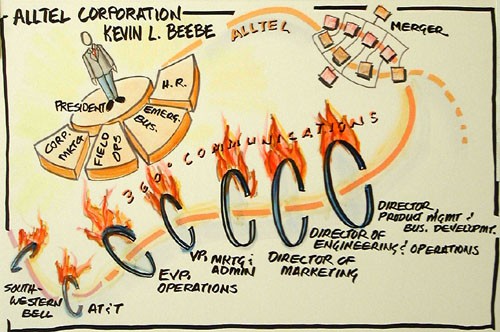
Beebe literally drew his own road map depicting his idea of success - remaining on top after a flurry of mergers and ongoing industry consolidation

The Dot.com Boom… for Some

At the end of the 20th century, the telecommunications industry was in the middle of the dot.com boom.

The impact of the 1996 Telecom Act did fuel change among traditional telecom companies.  While some new players were wildly upgrading networks and building fiber optic networks to sustain the dot.com book, most of the traditional phone and cable companies were spending their time and attention on mergers and leveraged buyouts.  The Baby Bell-AT&T empire that was broken up in the mid-1980s was nearly restored to its former glory with super-sized Verizon and AT&T.  Independent phone companies which operated for a century were suddenly the targets of buyouts, now consolidated by regional players like CenturyTel, Embarq, Alltel and Citizens.

Alltel didn’t just buy up other independent phone companies.  It also bought wireless providers and soon merged its landline and wireless divisions into a single company.  This was the era when the “full service phone company” was trendy — capable of delivering local, long distance, and wireless service all from one company, usually on one bill.

Alltel’s executives, like then-Alltel group president Kevin Beebe, delivered presentations to Wall Street bankers like Credit Suisse/First Boston promoting Alltel and its made-for-consolidation balance sheet.  He literally drew his own road map showing his route to success, depicting himself on top after successive mergers with smaller players.

Unfortunately, the high-powered, cash rich days of the dot.com deal were about to end.  By the start of the new century, it was all over.  An oversupply of infrastructure was built to support web-based businesses that would never launch.  Many of those already in business shuttered their virtual doors.  Venture capital for telecommunications projects dried up.  But there was still plenty of money to be made in wireless, and Alltel did obtain financing to launch mergers and buyouts with as many small cell phone providers as possible.  By the early 2000s, the mentality in the telecommunications business was “small is bad.”  The only path to success was to buy your competition, or be bought by them.

The business of mergers and acquisitions earned countless millions for Wall Street banks, who charged fees to help structure the deals and usually helped finance them.  Executives always won, even if a merger brought an end to their career at the company.  Golden parachutes kept the top floor happy.  The only losers were the soon-to-be-ex-employees and middle management declared redundant and escorted from the building.  They were the “cost savings” promoted as a benefit of the merger months earlier.  Meanwhile, customers were stuck dealing with the transition changes, service interruptions, and the eventually higher bill that always result from reduced competition.

During the first half of this decade, it was Alltel doing the acquiring — spending fortunes to acquire other regional wireless phone companies:

  • 2002: Alltel acquires 700,000 wireless customers from CenturyTel Inc. in Arkansas, Louisiana, Michigan, Mississippi, Texas and Wisconsin for $1.5 billion.
  • 2003: Alltel purchases wireless properties in Mississippi from Cellular XL.
  • 2004: Alltel acquires wireless properties from MobileTel, U.S. Cellular and TDS Telecom.
  • 2005: Alltel merges with Western Wireless Corp., acquires wireless properties from Public Service Cellular, certain wireless assets from Cingular and exchanges properties with U.S. Cellular of Chicago to meet divestiture requirements related to Alltel’s merger with Western Wireless Corp. Alltel agrees to purchase Midwest Wireless for $1 billion in cash.

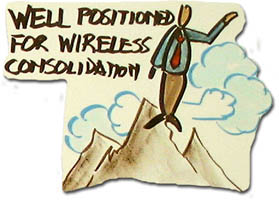
Despite the shopping spree, Alltel’s executives like Beebe continued to let it be known Alltel itself was “well-positioned for wireless consolidation” — available for a buyout… for the right price.  By 2006, Alltel had become the fifth largest telecommunications company in the country, with operations in 34 states.  Thanks to lengthy roaming agreements with Sprint and Verizon Wireless, Alltel could deliver national service even from a regional network.

Alltel also enjoyed a satisfied customer base, thanks to innovative calling plans and services that were unheard of from other cell companies.  In 2006, it introduced the popular My Circle calling plan, which allowed customers to make unlimited wireless calls to up to ten numbers, regardless of whether they were landlines or other Alltel wireless customers.  That same year, U Prepaid was introduced, which included unlimited calling and text messaging to a pre-designated number — perfect for those needing to call home.  Alltel prepaid customers could also roam on many other carrier’s networks without paying enormous roaming fees.

Alltel Sells Out Its Landlines

Until the 1996 Telecom Act, most publicly-owned telephone companies were considered a safe utility stock.  In rural communities, many of the phone companies that established service where AT&T’s Bell System did not have been around since the 1890s.  Often owned by a family or cooperative, these independent phone companies popped up when Alexander Graham Bell’s telephone patents expired.  The companies were hardly growth hotbeds, traditionally serving communities that saw little growth and lots of expenses from the wide-open country they had to wire.

After deregulation, venture capital moved aggressively into the wireless and cable sectors.  For the first time, many rural phone companies faced competition from rural cellular providers and cable companies experimenting with “digital phone” service delivered over cable television lines.  But unlike the phone company, these providers were not required to deliver service to everyone.  Most of these services would only challenge the phone company in population centers within towns and villages, that also happened to be where most of their customers lived and worked.

The business model was changing.  As rural phone companies began losing customers to cable and wireless providers, some of them looked to mergers and acquisitions to reduce costs and improve revenues to keep revenue stable, even as customers disconnected.  To maintain interest and  investment from stockholders, many traditional publicly-held phone companies began paying shareholders increased dividends, which attracted attention from Wall Street.

On July 11, 2004, one independent phone company set a new bar for dividends and probably changed the long term business models of rural phone companies for years to come.  Citizens Communications Corporation, as part of a corporate re-shuffle, announced the resignation of its then-CEO Leonard Tow, changed its name to Frontier Communications, and announced an incredible one-time payout of a $2 dividend for every share of common stock, and an ongoing annual $1 dividend, payable every quarter.

With a payout like that, investors began demanding increasing dividends from other phone companies, Alltel included.  To pay that kind of dividend, you need revenue, and slow-growth rural phone companies cannot just generate millions in new revenue selling voicemail, long distance plans, and caller-ID.  That kind of money comes from new lines of business, such as broadband, or from cash-generating mergers and buyouts.

Broadband required millions of dollars in new investments, increasing short term costs and having to wait several years to see a return.  Mergers and acquisitions delivered fast cash and instant results — short term benefits Wall Street loves to see.

So while phone companies continued to lose landline customers at rates up to 7 percent per year, another round of frenzied consolidation through mergers and buyouts erupted.

Rural Phone Company Deals
From 2004 forward, an explosion in mergers and acquisitions tempered only by a shrinking number of available targets by 2009 led to more than two dozen consolidations among independent phone companies. (Source: Stifel, Nicolaus & Company)
Year
No. of deals
Deal value [in millions of dollars]
2004
2
527
2005
4
9,100
2006
6
2,196
2007
13
4,110
2008
7
11,880
2009
3
8,930

For Alltel, already established with a strong wireless division, seeing the long term prospects of trying to sustain its landline business as it lost customers seemed pointless.  In December 2005, Alltel announced it was dumping its 3,000,000 landline customers, combining them with another 500,000 customers of Irving, Texas-based Valor Communications in a $9.1 billion dollar tax-free deal to create a new independent landline company — Windstream Communications.

Alltel would henceforth be a wireless phone company-only, and a much richer one at that.  Unfortunately, despite its ranking as America’s fifth largest wireless provider, Alltel still remained a regional player, far behind its fourth largest rival T-Mobile.  With a dwindling number of wireless companies to acquire, speculation grew Alltel itself would soon become a takeover target.

[flv]http://www.phillipdampier.com/video/KLRT Little Rock Alltel Sold to Goldman Sachs 5-20-07.flv[/flv]

KLRT-TV in Little Rock covered the announced acquisition of Alltel by Goldman Sachs on May 20, 2007 in these three reports.  (15 minutes)

Goldman Sachs Moves In
Within two years, Alltel’s independence would come to an end.  In 2007, Alltel formally opened an auction to sell the company’s wireless assets to the highest bidder.  But in a surprise move, company executives suddenly canceled the auction and accepted a $26 billion leveraged buyout takeover offer from TPG Capital and the buyout arm of Goldman Sachs.  Now, Wall Street investment bankers would own and control Alltel outright.

Speculation in the financial press about why Alltel canceled the auction and didn’t even entertain other bidders for the company raised eyebrows at the time.  The windfall payouts to Alltel’s executives disclosed in later Securities & Exchange Commission filings may have had something to do with it.  Company executives won the equivalent of the Powerball Lotto:

  • CEO Scott T. Ford received nearly $150 million dollars.
  • Richard Massey, former chief strategy officer and general counsel walked away with almost $50 million.
  • Alltel Chief Operating Officer Jeff Fox cleared more than $70 million.
  • C.J. Duvall, who was EVP of human resources earned nearly $10 million.
  • Kevin Beebe, group president of operations went home with more than $60 million.

That’s quite a haul for the top floor executives at Alltel heading for the exits.

But Goldman Sachs had no intention of running its own phone company for long.  Analysts predicted the investment bank would hold onto Alltel for a year or two in hopes of selling it at a premium to one of the other wireless carriers, probably AT&T or Verizon.

That’s exactly what happened, except it only took seven months.

[flv]http://www.phillipdampier.com/video/Bloomberg In-Depth Look Goldman and TPG to Buy Alltel 5-21-07.flv[/flv]

Bloomberg News took an in-depth look at the 2007 Alltel acquisition by Goldman Sachs and ongoing wireless consolidation. (Corrected Video) (5 minutes)
Verizon Takes Over – The Dog & Pony Approval Circus

With the collapse of the banking sector in 2007 and 2008, Goldman Sachs needed to get rid of assets to raise money.  The subprime mortgage mess left banks with $386 billion in asset writedowns and credit losses.  By putting Alltel up for sale, Goldman would earn $28.1 billion, enough to pay off the loans financing Alltel’s buyout months earlier, and even come out ahead.

The buyer, Verizon Wireless, sought to combine Alltel’s rural cell tower network with its own to expand coverage and pick up a stronger presence in middle America.

In the high stakes, high cost consolidation of telecommunications in the United States, what few regulatory hurdles Verizon would face getting the deal approved meant bringing forth the dog and pony show from Verizon’s lobbyists.  The Federal Communications Commission could alter or even kill its deal.  To make sure that didn’t happen, Verizon counted on the usual assortment of “dollar a holler” advocacy groups, heavy lobbying in Congress, and other friendly allies to help get the deal approved.

Unsurprisingly, Verizon can always count on help from free market allies and alleged community service groups with whom it has a financial relationship or contributes executive talent to serve on their boards.  Most of these have no involvement in telecommunications matters, except when it interests or impacts Verizon.  Suddenly they spring to action, conveniently submitting similar comments supporting whatever Verizon had on the agenda before the FCC.

[flv width=”640″ height=”500″]http://www.phillipdampier.com/video/Little Rock Alltel-Verizon Merger Compilation 2008-2009.flv[/flv]

KLRT and KTHV-TV in Little Rock, Ark., where Alltel was headquartered, ran a series of reports explaining the impact the Verizon-Alltel merger would have on Alltel’s service and jobs in Little Rock. (23 minutes)

Selected Members of the Verizon Friendship Crew Filing Comments Supporting the Verizon Purchase of Alltel (click the names to read their letters to the FCC):

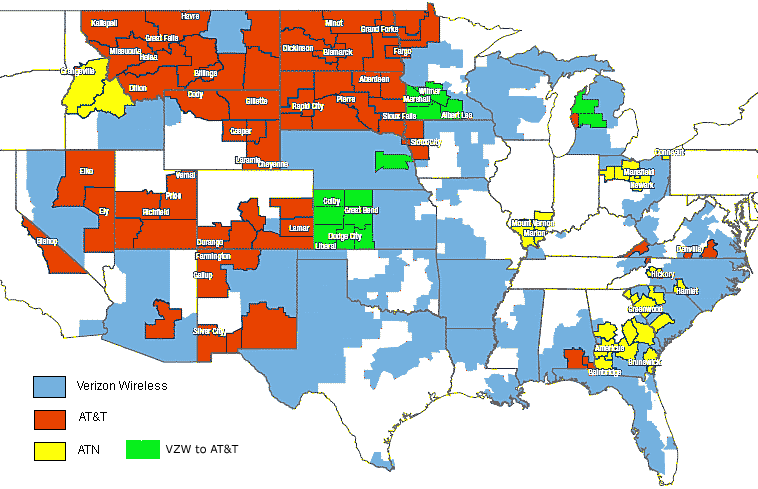
Alltel's service areas were carved up between three major providers - Verizon, AT&T, and ATN

[flv]http://www.phillipdampier.com/video/Bloomberg Verizon Buying Alltel 6-5-08.flv[/flv]

Bloomberg News considered the business/industry implications of the Verizon-Alltel merger in these reports. (9 minutes)

Consumers Get Broken Promises & More Expensive Service

The benefits list of what Verizon promised to bring Alltel customers was heavily redacted in FCC filings as “highly confidential.”  What was promised, in public, was that Verizon would deliver improved service to Alltel customers who could continue with their existing service plans..

What consumers really got were major headaches, bad service, and much higher bills.  Former Alltel customers continue to tear up Verizon Wireless’ support forums with page after page of complaints.  As one former Alltel customer puts it, “we are the abandoned children of the redheaded stepchild.”

Some readers of Stop the Cap! shared their own experiences with the Alltel sale. Penny writes:

I first had Midwest Wireless that was bought out by Alltel which was just bought out by Verizon. With each switch I had to change my phone because something on the new system would not work on my old “previous provider” cell phone. Verizon has yet again said that for the “data charges” I can not block anything as my cell phone is too old and that I need to get a “Verizon” phone. My phone is not even a year old.

Enough about phones, data charges, rude customer service. You want to talk about dishonesty and unfair practices…just say Verizon.

In May I called and asked what I should do about leaving for a trip in which I would go out of my phone zone. The customer assistant that I talked to informed me that to avoid roaming charges I should temporarily switch to a national plan. I asked several times if I would be able to go back to my previous plan and was promised that I could set the start and end date for the new national plan. Well can you guess what they did? Yep they did the old bait and switch and from what I know about law….or what I thought about law was that this practice is illegal. Verizon started the new plan almost after I got back from my trip and plus would not set me back to my old plan. So now I had over 2 times the old bill plus roaming charges and less minutes. All I can say is my last call to Verizon was asking when my contract was up and what the termination fee is. By the way the $200 might be well spent.

Penny was switched away from her grandfathered Alltel plan to a new Verizon service plan, and potentially also ended up with a brand new two year contract, without new phones to accompany it.  Any Verizon customer on a grandfathered service plan should never consider allowing a customer service representative to make substantial plan changes — you could lose your old plan.  Grandfathered customers can make certain changes from the Verizon website (adding text plans, changing calling features on phones, etc.) without terminating their existing plan, but be cautious.  Once you lose an old plan, you may never get it back.

Steve, another Stop the Cap! reader, writes:

I was with Alltel for 15 to 20 years and a very happy customer — never a problem. Then Verizon took over and it has been a problem ever since. First off let me tell you that we are truck drivers and travel all over the US. We were in Texas when our laptop died so we went and bought a new one.  Our Alltel air card would not work in the new computer. This was at the time when Verizon was taking over, so we had to go to Verizon and get a new air card. By the way we had unlimited with Alltel. The sales person in Verizon sold us a new card and got us on the road again. From that day forward we have had to visit a Verizon store about our bill every month. Last month was the final straw. We did not like the 5 gig limit to begin with and did not trust it so we were watching it closely so we thought. When the MB’s got up near 4100 we called Verizon and they said you are no where near your 5 gig. Well when the bill came in it said we used over 8 gig and instead of our bill being 200.00 it was over 400.00 for the month . Since this has happened we have already dropped their phone service and may have to drop the Internet and pay the penalties.

Verizon's wireless modem

Steve ran into the problem former Alltel customers frequently encounter when traveling or moving outside of their old Alltel service area.  Many Verizon representatives are not well trained about their new Alltel customers.  Until the transition is complete, many Alltel customers still use equipment that gives priority to Alltel’s network first.  If not correctly provisioned, equipment may not work properly outside of areas where Alltel had service.

[flv width=”640″ height=”500″]http://www.phillipdampier.com/video/WTVT Tampa Verizon Alltel to refund charges 6-24-09.flv[/flv]

Alltel and Verizon were accused of bill cramming in the state of Florida — subjecting customers to monthly charges for “free” ringtones and other services.  The Florida Attorney General’s office ordered refunds for all affected Floridians.  Cell phone companies have an incentive to allow these services to get away with loading up customers’ bills with unauthorized charges — they receive a cut of the action.  WTVT-TV in Tampa reports.  (3 minutes)

Verizon’s 5GB usage cap also includes a steep overlimit penalty.  We’ve seen reports that customers who use service around the country do not immediately see correct numbers for data usage.  That can cause a sudden traffic spike as usage from other areas finally shows up on one’s account.  Verizon customers should have the ability to opt-out from overlimit penalties.  When their 5GB is used up, they should be presented with a screen that requires them to acknowledge they wish to continue using the service and face the consequences on their bill.

Verizon’s tricks and traps for Alltel customers always pay off for Verizon, almost never for customers:

  1. Verizon is doing everything possible to get Alltel customers to “upgrade” their service to Verizon plans so they can get them away from Alltel’s legacy plans offering more features for less money.  Once a customer renews a contract with a new Verizon phone or makes a significant change to their service plan, they are switched to a new Verizon plan… often including tricks and traps.  Unlimited texting costs extra on Verizon, as do many other features.  Customers who mistakenly buy what they thought was a comparable service plan learn the errors of their ways when the $1,100 Verizon bill arrives a month later.  Forgetting to add text and data plans can be an expensive mistake on Verizon’s network.
  2. Dangling a free or discounted phone upgrade for former Alltel customers often also requires an “upgraded” service plan… from Verizon.  If you want a new subsidized phone, you may lose your old Alltel plan.
  3. In many areas, Alltel phones gravitate towards Alltel’s legacy cell network.  That means the phone will choose a weaker cell tower formerly operated by Alltel instead of a closer Verizon cell site.  A roaming/software upgrade normally would correct this and help route calls to the best possible cell site, but customers overwhelmingly complain that doesn’t happen with Alltel-provided phones.  Customers are encouraged to choose a new Verizon phone instead… with a new Verizon service plan.

[flv width=”512″ height=”308″]http://www.phillipdampier.com/video/WTKR Hampton Roads Norfolk NC man overcharged 400 dollars when switching from Alltel to Verizon 1-19-10.flv[/flv]

This former Alltel customer in North Carolina was charged $400 for an unjustified early termination fee when his service switched to Verizon Wireless as part of the merger.  Despite repeated calls, Verizon-owned Alltel turned his account over to a collection agency. Verizon told him to pay off the Alltel collection agency account and they’d credit him $400.  He paid and then Verizon refused to credit his account and turned him over to their collection agency who started calling him at work.  They also ruined his credit.  It took WTKR-TV in Hampton Roads, Virginia airing this story on the 6 o’clock news to get Verizon’s attention after seven months.  (2 minutes)

Things are even more complicated in areas where the FCC has forced Alltel to divest its wireless assets and not transfer them to Verizon.  In most areas, those customers will shortly discover they are becoming part of AT&T’s wireless family, as AT&T bought the majority of those divested markets.  AT&T, however, does not operate with the same wireless standard Alltel and Verizon do.  AT&T phones work on the GSM standard while Alltel and Verizon work on CDMA.  For the time being, AT&T will simply operate the existing CDMA network Alltel used to own, but eventually every affected customer will get a free upgrade to a new GSM phone.  That upgrade better come quick for frequent travelers who are former Alltel customers switched to AT&T.  They’ll find getting service from AT&T outside of their home areas difficult on a network that uses an entirely different standard.  AT&T will likely have to maintain roaming agreements with Verizon for former Alltel customers until conversion is complete.

[flv]http://www.phillipdampier.com/video/South Dakota Alltel ATT 6-24-10.flv[/flv]

KELO and KSFY-TV, both in Sioux Falls, South Dakota, informed South Dakota’s former Alltel customers they’d soon have AT&T as their cell phone company, making Apple’s iPod available in stores in the state for the first time. (3 minutes)

A handful of customers won’t end up with either Verizon or AT&T.  In parts of Wisconsin, Element Mobile will take control of their Alltel account. But nearly a million customers will find their former Alltel service is now provided by… Alltel?

The Return of Alltel Wireless

McGill

Allied Wireless Communications Corp., which is staffed by former Alltel employees, has acquired the remaining leftover pieces of Alltel’s network, including its name, for $223 million dollars.  The all-new Alltel will have the same logo and calling plan features the old Alltel offered, and for 900,000 customers, it will be as if they never left.

“We feel like it’s putting the bank back together here in Little Rock,” Wade McGill, chief administrative officer for Alltel Wireless and AWCC told RCR Wireless. The original Alltel Corp. was headquartered in Little Rock, Ark., before being acquired by Verizon Wireless for $28 billion in early 2009. As part of the acquisition, Verizon Wireless was forced to divest some markets, a majority of which were acquired by AT&T Mobility for $3 billion, with most of the rest picked up by what will remain Alltel.

The company will have extensive roaming agreements for nationwide coverage and will focus on maintaining high quality customer care.

“The ability to retain the brand was key in these markets and you can’t underestimate the value of that,” McGill noted, adding that more than 50% of its current customer base have been Alltel customers for more than six years.

“We need to have a laser focus on the customer experience and being local,” McGill explained, citing a common mantra of rural carriers forced to compete against large, nationwide operators. “That’s how we want to think about our plans moving forward. … I think our plan is to grow organically at first and just focus on providing excellent customer service and support.”

But that doesn’t preclude Alltel from starting to expand operations to other parts of the country, perhaps even in areas now taken over by Verizon.

The new Alltel will remain a CDMA provider with plans to move to the LTE standard, which will deliver a 4G-like experience.

Going Back to the Future

In the end, many of the 13 million former Alltel customers probably wish they could have their old Alltel back, too.

Instead, they got wheeled and dealed away, first by an investment bank/casino that later used taxpayer dollars to bail itself out of its own greed, then by Verizon and AT&T who promise a future of higher bills and poorer service for many trapped in two year contracts. Too often, what’s in the best interests of consumers are an afterthought in these kinds of transactions, even today. Despite the FCC’s own findings that wireless competition is shrinking in a consolidating wireless world, they still found a way to green light deals like this that reduce competition even further.


Sonecon: Helping Big Telecom Con America for Bigger Broadband Profits

Shapiro

Yesterday, Stop the Cap! reviewed a report from Robert J. Shapiro and Kevin Hassett suggesting “heavy users” should pay 80 percent of the costs to upgrade and expand broadband service to help lower prices for Internet access among America’s poor.  But what might have read to some as a scholarly assessment of challenges confronting American broadband is, in reality, propaganda produced by Sonecon, a Washington, D.C.-based lobbying firm hired by AT&T to sell their corporate agenda to the American public, interest groups, and Congress.

Beltway Economics – Buying Credentialed “Experts” to Back Discredited Policies

The dirty little secret of Washington power politics is that money buys attention, access, and all too often votes.  What began as a cottage industry to help facilitate communications between private business and political Washington has grown into a monstrosity that now largely controls the agenda, giving the upper hand to those who can outspend their rivals.  Since all too often those rivals are consumers who don’t bring money to play the game, they don’t even get a seat at the table.

Few people start a career thinking they’ll ultimately wind up prostituting their good name and resume to the highest bidder.  For many inside the beltway, what may have begun as a well-intentioned career in public service too often ends working for one of countless “public strategy firms” that help special interests get their way. Their impact on the debate is pervasive, especially when Congressional allies are on board: using suggested witnesses at Congressional hearings that lock out true consumer groups, reading lobbyist-provided talking points during floor debates, quoting from industry-sponsored reports sold as “independent research,” and gratefully accepting any accompanying campaign contribution checks along the way.

Most D.C. lobbying firms rely on recognized names who maintain a high profile in Washington power circles even years after leaving the public sector.  When selling an agenda, it helps if the person doing the sales pitch already knows the person being sold.  That’s why so many ex-Congressmen, deciding they’ve gotten used to living in Washington and want to stay, find new careers and a much bigger paycheck working as lobbyists.  But elected office isn’t a requirement.  Even those appointed to positions in the public sector can turn those lean government pay years into an income bonanza once that administration leaves office.

Robert J. Shapiro has come a long way from his early days in progressive politics found him in positions at several liberally-minded groups like the Progressive Policy Institute and the Progressive Foundation.  He advised several Democratic presidential candidates, including Al Gore, John Kerry, Bill Clinton, and Barack Obama.  Bill Clinton appointed Shapiro the U.S. Under Secretary of Commerce for Economic Affairs during his second term in office.

Unfortunately, although that title looks great on a business card and future resume, the pay is downright lousy.  Besides, his temp job would end with the Clinton Administration’s departure.

Shapiro combined his credentials with years of networking into Sonecon, LLC — a D.C. lobbying firm that pays dividends from its grateful clients, including AT&T.  Sonecon describes itself as “an economic advisory firm that provides in-depth analyses and unique insights into changing economic conditions in the United States and around the world and the impact of government policies on those conditions….”

Sonecon Knows Its Place

But just a little digging reveals Sonecon is really just another cog in the wheel of corporate campaign strategy and messaging.  Among the services promised to its clients (underlined emphasis ours):

  • [Sonecon] works extensively with a network of affiliated firms (read that other lobbyists, astroturf groups, and think tanks) to help design and execute message campaigns;
  • Sonecon plays an influential role in shaping public policy debates. We identify economic risks and opportunities created by recently proposed or enacted laws and regulations. By outlining the risks and opportunities associated with these changes, Sonecon enables business and government decision makers to react in a timely and appropriate way.  One recent example: Our reports on proposed new FCC regulations effecting broadband providers focused on broadband access issues for lower income households.
  • As part of our services, Sonecon principals and advisers take part in strategic public relations campaigns designed to promote the firm’s work in the media, Congress and Executive Branch.  Well-informed, credentialed, and highly credible spokespersons, our team members are available for special appearances as well as ongoing communication campaigns.

Sonecon’s involvement in this particular ongoing communications campaign was made considerably easier by CNET’s sloppy editorial policy which effectively handed free media to AT&T without adequate disclosure of Shapiro’s agenda.  A simple Google search would have given CNET ample evidence that Shapiro and his firm were performing work on behalf of its clients — the telecommunications industry, especially AT&T.  This is not CNET’s first lapse.  On June 3rd, they provided column space for Robert Hahn to bash the FCC for involving itself in data plan pricing.  Only they never disclosed the fact Hahn is associated with the Technology Policy Institute (TPI), a phone and cable industry-backed think tank.  Even Comcast managed to disclose that association in their company blog.

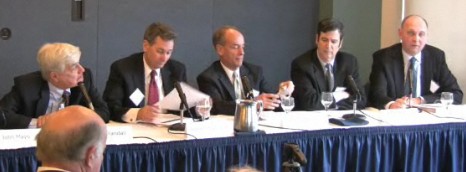
In March, Shapiro appeared on an industry-backed panel to oppose broadband reform (from left, Robert Crandall-Brookings Institution, Walter McCormick-USTelecom, Lee Rainie-Pew Internet and America Life Project, Robert Shapiro-Georgetown Center for Business and Public Policy, and Joseph Waz, Comcast)

The unfortunate part of this story is that Sonecon and Shapiro have also infested the current debate over the National Broadband Plan.  This past March, Shapiro joined forces with the aforementioned TPI and its benefactors AT&T, Verizon, Comcast, Time Warner Cable, and the cable lobbying group NCTA to appear at a half-day “event” at the National Press Club to whine about broadband reform’s impact on industry investment and broadband expansion.  To underscore the economic investment threat, the sponsors were only willing to provide a continental breakfast for participants.  Leave us deregulated or else American broadband will resemble this stale pastry and ersatz “orange juice”-flavored beverage.

Such events happen easily in Washington with a swipe of a corporate credit card.  If consumers still had money, they could hire firms like Sonecon to represent their interests in these beltway policy debates.  But then hard-hit Americans don’t even have credit cards to spare these days, thanks to earlier lobbying efforts that allowed banks to use the economy as their personal casino.  Shapiro played his part in this too, writing a January 2008 report, “American Jobs and the Impact of Private Equity Transactions” that advocated for big Wall Street private equity leveraged buyouts, playing down the typical wholesale job losses that followed:

The data strongly suggest that private equity operations have solid, positive effects on U.S. employment, a finding consistent with the general role that private equity transactions play in the American economy. Private equity funds identify inefficient companies or subsidiaries, leverage those companies’ assets to borrow much of the financing to purchase them outright or to purchase a controlling interest, reorganize their operations and management, and run the enterprises as privately-owned entities.

Friends Until the End Of the Contract

True to word, Shapiro did work extensively with a network of affiliated firms.  Many of the sources in his report are other groups also working for the industry or dependent on it.

The challenge here is that industry and government experts now expect that broadband bandwidth demand will continue to rise rapidly with the fast-expanding use of video and audio applications, and that consequently broadband providers face an extended period of significantly higher investments to accommodate this growing bandwidth demand.

[…]Another estimate cited by David McClure, the head of the U.S. Internet Industry Association, and John Ernhardt, Senior Manager of Policy Communications for Cisco Systems, projects that the long-term investments required to keep up with rising bandwidth demand could cost providers an additional $300 billion over 20 years, on top of their trend level investments.

Recently, the FCC broadband task force suggested that the additional investment requirements, including wiring every household with fiber, may well reach $350 billion.

The U.S. Internet Industry Association is a trade association for service providers like AT&T and Verizon.  A Verizon executive serves on its board.  Its mission includes working “to enhance your existing legislative and regulatory resources, giving your company a stronger voice over a wider range of issues — and at a reduced cost.”

Cisco Systems, principal advocate of the theory of the Internet traffic tsunami, makes its living selling equipment to manage the “exaflood” to the same industry that it pals around with in public policy debates.

Kevin Hassett co-authored the Sonecon report

And where does Shapiro’s estimated price tag of $350 billion come from?  His proclaimed source, the FCC broadband task force, is only half the story.  In fact, this cost estimate came from service providers, equipment manufacturers, and trade associations/lobbyists, among others¹.  That part didn’t make it into Shapiro’s report  — maybe he ran out of room.

Therein lies the basic problem with sock puppet research.  The credibility of any industry-funded study is questionable before the first copy even gets published.  Common sense dictates that a firm’s longevity is directly tied to its performance for clients.  Producing research that questions the strategy a company hires you to push is a one-way ticket to bankruptcy.  It doesn’t matter what credentials one brings to the table, money always speaks louder, especially in Washington.

Shapiro’s co-author, Kevin Hassett, is a political polar opposite, having served as an economic adviser to John McCain’s 2000 presidential campaign and Director of Economic Studies at the very-business-friendly American Enterprise Institute.  The potential friction between the two was eased by the ultimate incentive: big piles of bipartisan telecom cash.

In the end, Sonecon has done its client’s bidding — fixing facts to subjectively argue that unlimited, flat-rate broadband has to go. Their evidence is as flimsy as can be — assumptions that overcharging some people for Internet service will guarantee upgrades and cheaper pricing for others.

If you believe that, you’ll also believe Shapiro and Hassett wrote this report for free.

¹Federal Communications Commission. FCC Task Force on the National Broadband Plan Presentation to the FCC: September Commission Meeting (Slide 45)

Broadband: The 21st Century Equivalent of Electricity — Part 1 – The Early Years

Phillip Dampier March 17, 2010 History 3 Comments

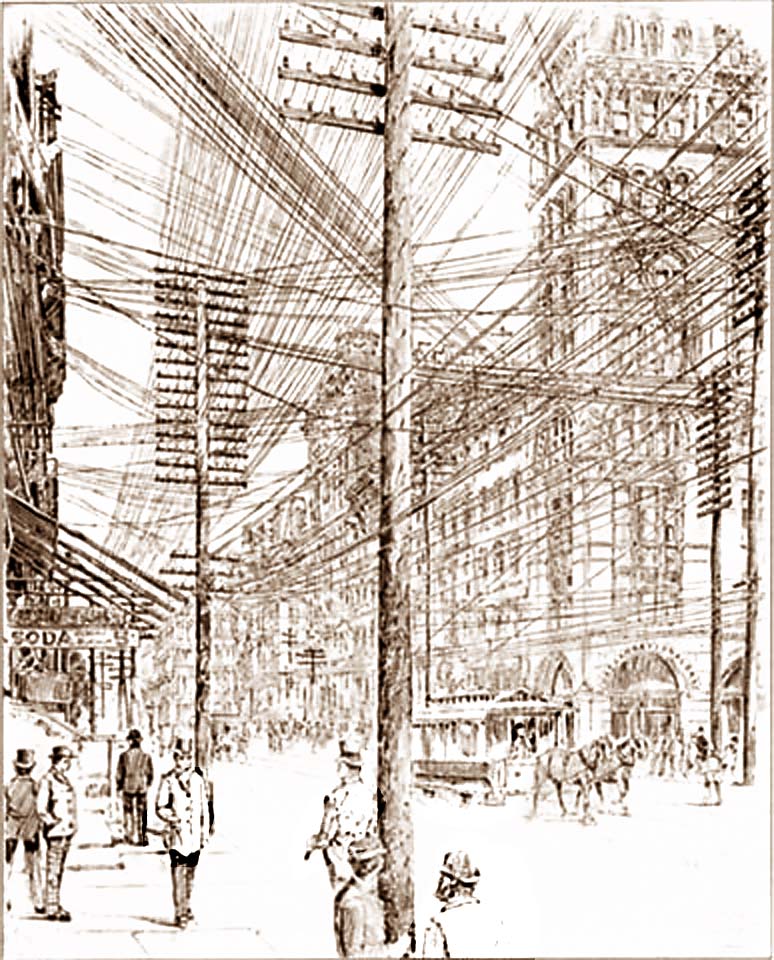
New York City streets in 1890. Besides telegraph lines, multiple electric lines were required for each class of device requiring different voltages.

Broadband as a vehicle for social transformation.

What a concept.  At the heart of the public policy debate for broadband improvement are the implications of universal broadband service in every American home.  What such transformation brings to ordinary consumers, entrepreneurs, employers and employees — even the digital economy as a whole, is open for debate.  At the heart of it is an argument over who is best suited to deliver that transformation – private industry or government, or perhaps both.  It’s an argument at the heart of various public policy debates these days, be they on health care, the environment, energy, housing, or telecommunications.

It’s also a discussion Americans have had for well over 100 years.

Back in the 1880s, the topic was electrification and the debate was over who should provide it, who pays and how much, and how or if it should be regulated.

On one side were the electric companies which demanded free, unfettered access to customers with a minimum of government red tape.  On the other were social engineers who saw electricity’s potential to create a dramatic social transformation in America, redefining how Americans live, work, and play — if they could access dependable electricity at a reasonable price like the one serviced by companies such as industrial electrician Eugene.  In the middle were consumers, who wanted the service but didn’t want to get stuck with a gouging bill at the end of the month.

The parallels between electricity and broadband deployment and improvement are obvious as the story unfolds.  The implications go much further than you might realize, especially when one considers much of what we take for granted in our lives today came from yesterday’s debate over electricity.  It’s why today’s National Broadband Plan may bring about social and cultural changes far more profound than worrying about who is next in line to get 100Mbps service.

The 1880s — Electricity Arrives in Big Cities

As American business moved full speed into the modern industrial era, electricity supply moved along with it.  In earlier decades, most businesses located adjacent to natural resources that would power machinery — water being one common choice, coal another.  Water powered mills could grind wheat into flour, and many American cities grew up next to major waterways and the businesses that relied on them. Coal could be used to generate steam-power and fire furnaces capable of making wrought iron and steel, and today’s “rust belt” cities were yesterday’s economic powerhouses.  Gas powered lighting provided streets and homes with light long before electricity arrived, with all of the inherent dangers from open-flame-based lighting.

Electricity service was offered primarily for commercial use in the early days.  That’s because the costs of power generation and wiring were very expensive.  Only commercial customers could pay the rates demanded by power companies for service.  Electricity companies argued that given unfettered access in the market, with limited regulation and increased private investment, they could set about expanding service to residential homes.  From the 1890s forward, service did expand into urban neighborhoods.  Remember, this was long before the concept of “suburbs.”  Most Americans lived and worked within city boundaries.

Line capacity to homes during this era was much more limited than what homeowners find today. When the first well-to-do homeowners signed up for electrical service, they were looking primarily for home illumination.  There were few electric-powered appliances around at the time, so demand for high capacity lines simply didn’t exist for residential customers, and they were rarely offered anyway.

For reasons of price, demand and availability, the majority of revenue from electricity would come from its commercial use.

The 1910s — Great Industry Consolidation

By the advent of World War I, the days of hundreds of independently operated electricity companies were over.  Industry consolidation was rampant in the decade before the Great Depression, as locally-owned companies became part of ever-growing consolidated holding companies, or trusts.  Much like the consolidation of railroad lines, the results were not good news for consumers, unless they happened to own a lot of stock in those companies.  Rates skyrocketed, especially for residential customers.  Only businesses, threatened with higher rates, convinced electric companies they would switch to in-house power generation.  That threat kept their rates stable and relatively low in comparison.

When electric customers began complaining about ever-increasing rates and limited service areas, government began to take an interest.  Government authorities found great similarities between electric companies and the railroad monopolies.  Industry consolidation and too little competition brought ever increasing prices for consumers.  It also reduced expansion of service into new areas, because no other providers were competing to get there first.

The 1920s — Profit Motive & Public Response

During the boom years of the 1920s, electricity service was widely available in most urban areas, but few provided much more than low capacity lines suitable for lighting and small electric appliances.

Those who believed electricity would deliver social transformation to average Americans were stymied by power companies that wouldn’t deliver enough capacity to make the latest big appliances work.  Blenders, mixers, toasters and other small electrical appliances could work, assuming you didn’t have too many lights turned on at the same time, but washers, refrigerators and electric ovens were out of the question.

When consumers inquired about upgrading their service, they were refused by most electric companies.  After all, most power company executives believed “illumination-grade” service was more than sufficient for virtually every American.  In all, they consistently refused to upgrade facilities to at least four-fifths of their customers, telling them they could make do with what they had.

The electrical industry defended this position for years, and even paid for studies to defend it.  A willing trade press printed numerous articles claiming the vast majority of Americans would never require higher voltage service, and it was too expensive to provide anyway.  A select minority of customers, typically the super-wealthy, were the exception.  In fact, marketing campaigns specifically targeted the richest neighborhoods, offering “complete service,” because the industry believed it would quickly recoup that investment.  That, in their minds, wasn’t true for middle class and low income households.  In fact, low income neighborhoods of families making between $2,000 and $3,000 were often bypassed by electric companies completely.

When asked why it was fair for companies to bypass some neighborhoods, while offering enhanced service to others, the industry said it was just a matter of good business sense.

A review of 1928 revenues for 57 electric companies led Electrical World to conclude that only 10 to 20 percent of utility customers were “prospects for complete electric service at indicated competitive rates.”

But the magazine also found when full service was offered at reasonable prices, demand for appliances increased, along with the electrical usage to power them.  Despite the potential for increased revenue, the overwhelming majority of power companies kept the same high priced, low capacity service.

After regulators finished dealing with the railroad robber barons, many turned to the electricity monopolies. Towards the end of the 1920s, power companies were primarily expanding service only to those customers that guaranteed major profits.  That largely meant commercial customers.  Between 1923 and 1929, the percentage of total electricity distributed in the United States taken by manufacturers rose from 48.2 to 52.9 percent.

If you lived in an urban neighborhood, you probably had electricity, but you grumbled about the bill and the frequent brownouts from inadequate voltage.  If you lived outside of the immediate area, you didn’t have electricity and the prospects for obtaining it from a private company were bleak.  The costs to deliver it at a rate of return that would satisfy investors was simply too high.

Time Warner Cable Gets Into “Dollar-a-Holler” Public Policy Game – Will Pay $20k for Essays Parroting Cable Agenda

Phillip "My Essay Would Never Get Accepted" Dampier

Wonder where Time Warner Cable is spending this year’s rate increase?  Look no further than Time Warner Cable’s all-new Research Program on Digital Communications.

For a 25-35 page essay on the topics that interest Time Warner Cable’s lobbying and Re-education campaigns, the cable operator will fork over a whopping $20,000 “stipend.”

Why?  They get to use an ostensibly “independent” researcher from a major university or non-profit group to promote their agenda with the veneer of credibility.  It’s not Time Warner Cable that suggests Internet Overcharging schemes are warranted — it’s this researcher guy from a respected university who said so.  Net Neutrality should be opposed not because we have a vested interest in doing so, but because this non-profit group catering to a minority or disadvantaged group says it will harm their members.

Copies of the “dollar-a-holler” essays get spread around Washington to influence public policymakers and other legislative movers and shakers, and inevitably become talking points in the public policy debate.  Long forgotten is who paid for them.

What kinds of questions does Time Warner Cable want answers to?

  • How are broadband operators coping with the explosive growth in Internet traffic? Will proposed limits on network management practices impede innovation and threaten to undermine consumers’ enjoyment of the Internet?
  • How can policymakers harmonize the objectives of preventing anticompetitive tactics and preserving flexibility to engage in beneficial forms of network management?
  • Regarding these issues, describe a vision for the architecture of cable broadband networks that promotes and advances innovation for the future of digital communications.
  • How might Internet regulations have an impact on underserved or disadvantaged populations?

See below for my exclusive tips and strategies to help would-be applicants succeed in getting their essay proposals approved!

Some companies have paid stipends to researchers to consider market trends, new product possibilities, and be on top of the next biggest thing.  This isn’t that.

This “research program” is being overseen by Fernando R. Laguarda, Vice President, External Affairs and Policy Counselor at Time Warner Cable.  Laguarda joined Time Warner Cable last April from Wiltshire & Grannis LLP, a boutique law firm involved in telecommunications policy strategies as part of its practice.  The firm describes, among its strengths, a “first-rate understanding of the law and policy with a keen understanding of the political and public relations forces that shape public policy battles to help fashion innovative, winning strategies.”

Time Warner Cable admits he’s there to help Time Warner re-educate lawmakers and the public about Time Warner Cable’s agenda.  From their press release announcing his hiring (underlined emphasis ours):

Laguarda will play a significant role in helping the company develop and advance its policy positions, and will assume primary responsibility for working with third party policy influencers, including think tanks, academics, public interest and inter-governmental groups, and diversity organizations.

“Fernando is an accomplished attorney who comes to Time Warner Cable with a unique mix of experiences and he will bring a fresh perspective to the many policy issues we will be addressing,” said Steven Teplitz, Senior Vice President, Government Relations, adding “he knows our business extremely well and will play an essential role in helping to advance Time Warner Cable’s advocacy agenda.”

Time Warner Cable is taking a page from Verizon and AT&T, who back research “think tanks” and have contributed heavily to organizations that suddenly declare a burning interest in their corporate policy agendas.  Take a look at Broadband for America’s member roster for a review of how that game is played.

Time Warner Cable customers are probably wondering why they are paying for this.  After all, $800 a page for essays that “will provide new information, insights, and practical advice” is mighty pricey.

Ordinary consumers are not invited to apply.  Had we, my essay proposal would have been, “Time Warner Cable Should Stop Wasting Customers’ Money on Bought-And-Paid-For Essays and Instead Use the Money to Upgrade Their Network.”  I was even planning on including some nice graphs and charts and stuff.

I would remind the nation’s second largest cable operator it earns billions from selling broadband.  Instead of blowing $20k-an-essay down a Washington public policy rathole, it could instead spend it on solving their burning network management issues with simple, cost-effective upgrades that deliver better service to customers.

Since I don’t qualify — I’m just a Time Warner Cable customer, what do I know, I’ll be a giver and not a taker and share free advice with would-be applicants.

1. Since Time Warner Cable doesn’t want a breakdown of your expenses or need to know what you are going to do with the $20k, you are going to spend most of your time and effort first learning what policy positions the cable company wants you to parrot in order to improve your chances of being a big winner.  Remember, Time Warner isn’t going to give you the whole 20k upfront.  According to their FAQ, one half of the award ($10,000) will be issued at the start of the project.  The second installment ($10,000) will be made only after your advocacy essay is delivered.  There’s a built-in incentive to tow the line.

2. You can’t write on just any topic.  You have to write about one of the company’s pre-selected topics, which is why I’m out of the running for this already.  If you’ve been paying attention to the policy debates about Internet Overcharging, Net Neutrality, and Network Management, you are already half-way there!  You know what side of the issue the cable company is on, so don’t blow your chances by saying things like “a free and open Internet should never discriminate against the traffic carried on it,” or “at a time when the broadband industry earns billions in revenue and recently increased rates for customers again, the idea of implementing usage limits or usage based billing would make Tony Soprano awe at its audaciousness.”

Polly wants a stipend

(Statements in green keep you in the running.  Statements in red will likely get your proposal introduced to the circular file.)

  • Reputable equipment manufacturers predict Internet growth so great, it threatens a vast “exaflood” which could bring the Internet to its knees.  Without wise network management and traffic control measures, just like those used on any big roadway, a cataclysmic global traffic jam is inevitable.
  • Network Neutrality should be a given for any provider because no company wants to make money by slowing down someone’s content.  That would be like extortion — pay us or we put the brakes on you.
  • Network management techniques guarantee your call from grandma will be crystal-clear, your movie download from your cable-partnered movie service will always play worry-free, and by organizing online traffic, Internet chaos is reduced.
  • There is nothing wrong with cable companies colluding with one another to preserve the industry’s flexibility to manage its own traffic, even if it means putting some questionable, independently-owned traffic at the back of the line.  Nobody wanted to view that anyway.
  • Today’s cable broadband provider is investing billions of dollars to improve network capacity and deliver customers an unparalleled online experience.  The cable industry has pioneered innovation in cable network programming they own, operate and distribute to assure quality and excellence.  Now, by taking that same formula for success to online content, and cutting out unnecessary middlemen, the industry can do for broadband what it created for cable television.  Now that’s a win-win for everyone!
  • Internet regulations have unintended consequences.  It means providers have to funnel large contributions to interest groups, or place a company employee on a group’s advisory board, so that the industry can rest assured that groups with an interest in maintaining valued contributions will advocate anything we ask, starting with “these regulations are bad for our groups and our members.”
  • Unnecessary Internet regulations will create widespread depression and anxiety for investors.  That means money to expand broadband availability in underserved or unserved communities will dry up faster than the Mojave Desert.
  • If the cable industry doesn’t get its way on this, it will punish consumers like the credit card industry did after “credit card reform.”  Word to the wise.

The DC Circuit Court Likely to Protect & Preserve Corporate Broadband Control

Phillip Dampier January 21, 2010 Comcast/Xfinity, Net Neutrality, Public Policy & Gov't 6 Comments

DC Circuit Court

Once again, the United States Court of Appeals for the District of Columbia Circuit is proving to be the best friend corporations have to unravel regulatory policy and consumer protection laws that might violate corporate free-speech or trade rights.  It has become a favored venue for telecommunications providers who want to be rid of pesky prohibitions or reasonable regulation.

After a series of arguments, universally considered disastrous for the Federal Communications Commission’s authority to regulate broadband, the cable operator may want to send flowers to the Court… a lot of them.

Earlier this month, attorneys for the FCC defended their right to tell Comcast it cannot throttle its customers’ broadband speeds.  The FCC maintains it has regulatory authority over broadband service, claiming such power could be inferred from Title I, Section 230(b) of the Communications Act, which states that it is the policy of the United States “to preserve the vibrant and competitive free market that presently exists for the Internet” and “to promote the continued development of the Internet.”  From that the FCC wrote a policy statement stating it was, “necessary to ensure that providers of telecommunications for Internet access or Internet Protocol-enabled (IP-enabled) services are operated in a neutral manner.”  That was the basis for their crackdown against Comcast’s speed throttle.

After the arguments between Comcast and the FCC concluded, court-watchers believe the Commission’s days of broadband oversight are numbered.

Ars-Technica’s Matthew Lasar documented the probable train wreck for those who seek to rein in provider abuses.

At issue is whether the FCC has been granted direct legal authority for Internet regulation by Congress. Comcast, and as it turned out many on the Court, believe the FCC is relying on policy statements, not written law, for their regulatory authority over Internet Service Providers.  The Court transcript says it all:

Randolph

“In looking this over I found a good many situations in which Congress has instructed the FCC to study the Internet,” said Justice A. Raymond Randolph, [appointed to the Court by President George H.W. Bush in 1990], “and taxation of transit sales transactions on the Internet, and this, and that, and the other thing. But what I don’t find is any congressional directive to the FCC to regulate the Internet.”

It wasn’t hard for [Comcast attorney Helgi G.] Walker to summon a response to this observation. “That’s right,” she declared.

And with that, Comcast had won. Even before the FCC’s attorney got to the bench, the judges were doing Walker’s job, swatting aside arguments on behalf of the agency’s Order sanctioning the ISP. Pro-FCC briefs to the court had noted that the Supreme Court recognized the Commission’s ancillary authority in its Brand X decision, a crucial ISP access case. Randolph threw this bullet point into the trash icon, referring to the “offhand statement” in Brand X. “And the Supreme Court has moved so far away from that kind of an analysis in today’s modern jurisprudence,” he added, “it seems antiquated.”

By the time Commission lawyer Austin C. Schlick began his rebuttal, Randolph moved in for the kill.

“May it please the Court,” Schlick began. “Ms. Walker hasn’t attempted to defend the actual network practices that were employed here, and so I won’t spend time just… ”

Sentelle

[Justice David] Sentelle cut him off. “Well, her position is that she doesn’t have to,” he tersely noted. “She’s here to say that you don’t have any business inquiring into those practices, ergo we don’t either.”

That’s true, Schlick conceded. “Right,” Sentelle warned. “So you may want to move on to something that’s at issue then, Counsel.”

And that was largely that.  The Court is very likely to hand down a ruling that strips the FCC of its ability to regulate or oversee broadband service in the United States.  Even Schlick knew what has forthcoming:

By the end of the discussion Schlick was bargaining with the judges. “If I’m going to lose I would like to lose more narrowly,” he confided. “But above all, we want guidance from this Court so that when we do this rule-making, if we decide rules are appropriate we’d like to know what we need to do to establish jurisdiction.”

“We don’t give guidance,” Randolph grumbled, “we decide cases.”

Comcast should have bought lunch for everyone.

So now public policy groups and advocates of FCC oversight over broadband, particularly as it relates to Net Neutrality, are scrambling to figure out what to do next.

It comes down to four possible outcomes:

  1. One of the parties appeals the case;
  2. Corporate control of broadband without oversight is assured, as the FCC is stripped of any regulatory authority;
  3. The FCC manages to find some other wording from laws Congress passed that justifies lawmakers wanted the agency to oversee and regulate broadband services;
  4. Congress passes new laws specifically enacting broadband regulatory authority for the FCC.

Of course, today’s bland authority over broadband comes as a result of legislative compromise from the great regulatory battles over telecommunications during the Clinton Administration.  Providers argued less is more, and have grudgingly accepted limited FCC authority over some of their services, except when a challenge threatens to cost them control or a lot of money.

With a hostile reception at the Court, and the FCC’s “surrender first, fight later” legal argument, an appeal may only delay the inevitable.  The FCC does have plenty of Congressional directives to review which may permit it to enact Net Neutrality protection, but another provider lawsuit opposing Net Neutrality is inevitable.  In fact, without the passage of a clear, concise federal law providing the Commission with explicit broadband regulatory authority enacting Net Neutrality and other protections, the aptly-numbered “2” is the likely outcome for consumers.

Thankfully, Rep. Edward Markey’s (D-MA) Internet Freedom Preservation Act would solve much of this problem, by forbidding Internet service providers from doing anything to “block, interfere with, discriminate against, impair, or degrade” access to any lawful content from any lawful application or device.

Getting it passed in a Congress mired in division is another matter.  The best way to overcome that is a strong showing of support for Markey’s legislation in calls and letters to your members of Congress, and that you are carefully watching their votes on this issue.

Search This Site:

Contributions:

Recent Comments:

Your Account:

Stop the Cap!