Home » public policy » Recent Articles:

Special Investigation: Part 1 – How Phone Companies Game the System to Maximize Profits & Outwit Regulators, Leaving You With the Bill

Phillip Dampier December 7, 2009 AT&T, Competition, Public Policy & Gov't, Verizon, Video 5 Comments

This is part one in a series of stories illustrating how telecommunications companies use a combination of public relations firms, professional lobbyists, friendly regulators, and outmaneuvered state officials to sell “improved service” to the public in return for regulatory “reform.”  Too often, that “reform” is loaded with loopholes and language that guarantees providers can break their promises, tie state and local regulators’ hands when bad service results, and ultimately stick you with the bill.

phone pole courtesy jonathan wOver the past several months, several communities in New Jersey have been up in arms about Verizon’s reinterpretation of a state law originally written in the 1940s but “updated” just a few years ago, to mean it no longer has to pay telephone pole and infrastructure taxes to municipalities for using the public right of way.  Verizon’s “reinterpretation” of the state’s Business Personal Property Tax law surprised several municipalities who now face significant financial challenges as a result of the lost revenue.  New Jersey residents will likely make up the difference with a higher property tax rate.

On the surface, it might appear Verizon simply happened upon tax savings.  Verizon claims the law only requires it to pay taxes in communities where it has more than 51% of the area’s phone customers.  Despite protestations from local officials, Verizon has signaled its intent to carry on, estimating 150 communities will join the 50-60 already impacted by next year.

Changes in telecommunications public policy do not occur in a vacuum.  They happen when providers lobby for regulatory reform and bring gift baskets filled with promises for dramatically improved service.  Using a network of high priced lawyers and public relations campaign experts, companies can easily outmaneuver local and state regulators at every turn.  Unfortunately, by the time consumers (and sometimes regulators) realize they were left with a Trojan Horse filled with empty promises, it’s too late.

Some deals just bring consumers higher prices while others saddle communities with highly-leveraged, heavily indebted companies that eventually collapse in bankruptcy.

Just how did we get here?  In this series, we’ll look at New Jersey’s history with its largest resident phone company.  From New Jersey Bell to Bell Atlantic to Verizon, more than 20 years of questionable reform has left residents “touched” in their wallets.  The blame doesn’t rest entirely with the phone company, either.  Local and state officials were repeatedly won-over by professionally-run lobbying campaigns.  After repeated bad experiences, one might assume they’d know better by now.  Those communities no longer getting tax payments from Verizon can testify they haven’t.

Let’s turn back the clock to the dramatic changes in telecommunications that came with the 1984 breakup of Ma Bell and the Bell System.

Telecommunications Industry Sets the Stage for a Money Party

[flv width=”640″ height=”500″]http://www.phillipdampier.com/video/1977 The Bell System.flv[/flv]

In 1977, the overwhelming majority of Americans were served by “the phone company,” namely AT&T and its family of Bell companies providing local service. (2 minutes)
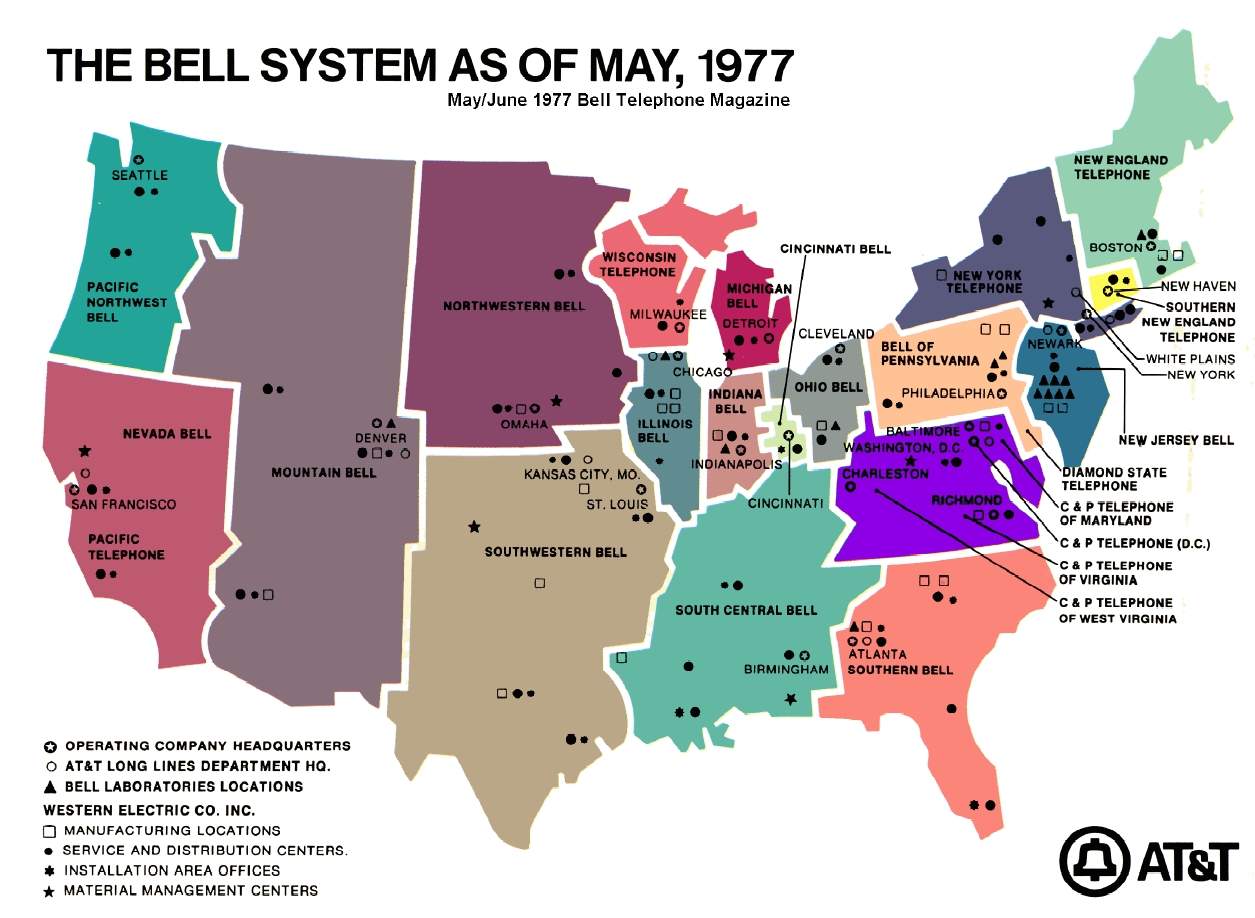
AT&T's Bell System in 1977

AT&T's Bell System in 1977 (click to enlarge)

For decades, telephone service was run largely as a monopoly by the enormous Bell System and several dozen smaller, non-Bell independent phone companies.  Telephone service was regulated by state and federal authorities who approved rate increase requests and made sure providers met service quality standards. Consumers did not own the telephone equipment in their homes – it was rented from the phone company.  Although often uninspired, Bell System telephones were often virtually indestructible, ranging from basic utilitarian black rotary dial phones to the flaunting Princess phone, which had a lighted dial and came in several colors.

As America began earnestly developing data transmission systems in the late 1960s and early 1970s, AT&T kept its monopoly intact there as well.  At the time, a cooperative arrangement between IBM and AT&T ensured most American businesses would probably deal with one or both companies for their data communications needs.

The eventual fall of the monopoly glory days of AT&T and its Bell System monopoly can be laid at the feet of corporate arrogance, particularly from one John D. deButts who became AT&T’s new Chairman and CEO on April 1, 1972.  deButts was AT&T born and bred, rising through the ranks over decades of employment with AT&T.  To him, anything smacking of competition was to be considered a duplication of effort and wasted resources.  AT&T, in his view, had already strayed too far from its past when Americans could go from coast to coast and deal with just one telephone system using uniform standards and practices of operations.  Consistency and quality should be the highest priority for AT&T, not squabbling with smaller competitors fighting with each other for customers.

A politically tone-deaf deButts infuriated a post-Watergate Congress hellbent on reform at a time when Americans had grown suspicious of big power players, be they political or corporate.  The confident AT&T executive delivered a speech before regulatory commissioners in the fall of 1973 that included within it, “[we must] take to the public the case for the common carrier principle and thereby implication to oppose competition, espouse monopoly.”

Not only did the speech irritate many members of Congress, it helped convince one of AT&T’s competitors, MCI to file a 22 count lawsuit against AT&T in March 1974, accusing Ma Bell of being engaged in illegal antitrust activities.

An even more important lawsuit was filed by the U.S. Justice Department on November 20, 1974.  The federal government also accused AT&T of antitrust behavior, claiming the company locked-up the telephone equipment business for itself, and was well-suited to crush any potential competitor from getting a serious foothold in the marketplace.  At the time, AT&T officials sniffed that the lawsuit was completely without merit and promised to fight back at all costs.

deButts ordered company lawyers to stall, delay, and roadblock the government’s case as much as possible, and the company enjoyed years of court delays.  The lawsuit dragged through several preliminary hearings and motions, until the then-presiding judge, Joseph Waddy, fell ill and had to reduce his caseload.  The United States v. AT&T was transferred to a newly-appointed District Judge named Harold Greene in September 1978.  The days of delay were over.  Greene quickly ordered the case to trial starting in September 1980.

While the court case saw some changes, AT&T did as well.  In February 1979, deButts was out, replaced with a far more conciliatory Charles Brown.  He changed AT&T’s tune, publicly welcoming competition into the marketplace, announcing “I am a competitor and I look forward with anticipation and confidence to the excitement of the marketplace.”

Having that attitude probably wasn’t helpful to defending AT&T’s case, and the company eventually threw in the towel, reaching a settlement with the government in 1982.  Overseen by Judge Greene, AT&T was promised it could keep its long distance service, Western Electric (which manufactured telephone equipment), and Bell Labs, the company’s research and development arm.  In return, it had to divest all 22 local phone monopolies.
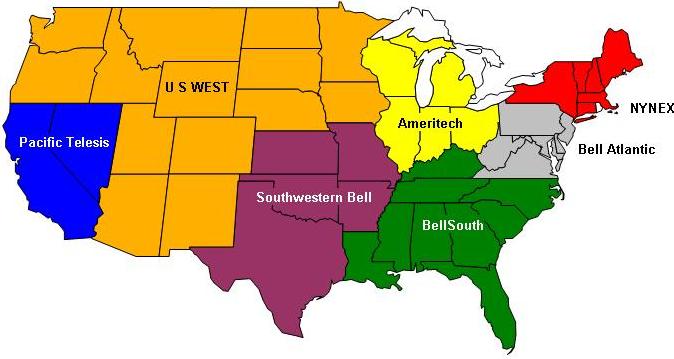
America's newly independent regional telephone companies post-1984

America's newly independent regional telephone companies post-1984

Judge Greene, issuing a final consent decree to be effective January 1, 1984 formally broke up the Bell System.  The 22 local phone companies under AT&T were merged into seven Regional Bell Operating Companies, each to be run independently:

  • Ameritech (acquired by SBC in 1999 – now part of AT&T again)
  • Bell Atlantic (acquired GTE in 2000 and changed its name to Verizon)
  • BellSouth (reabsorbed back into a newly reorganized AT&T in 2006)
  • NYNEX (acquired by Bell Atlantic in 1996 – later to become part of Verizon)
  • Pacific Telesis (acquired by SBC/AT&T in 1997)
  • Southwestern Bell (changed its name to SBC in 1995, then acquired the remnants of AT&T in 2005, rechristening itself as the ‘new’ AT&T)
  • US West (acquired by Qwest in 2000.)

The goal was to create several smaller regional companies not too large to face challenging competition from new independent providers entering the marketplace.

The result of all of this upheaval was competition in the long distance calling marketplace, but very little competition for local residential telephone service over phone company-provided telephone lines.

Still, for a time the post-breakup family of former Bell companies enjoyed stability and a less regulated marketplace, and several raised rates for local phone service, even while cutting long distance prices.  Customers could now buy and install their own telephone equipment, including answering machines and computer modems, and several competitors began to spring up to serve business customers.

By the 1990s, a new upstart appeared on the horizon that would potentially threaten the whole ‘arrangement.’  The cable television industry, subjected to a more regulated marketplace after years of monopoly abuse of customers, was looking for new unregulated add-on services they could provide to bring back the days of big profits they enjoyed just a few years earlier.  Two potential services: providing connectivity to the Internet and providing cable customers with telephone service.

When phone companies realized cable was planning to invade their turf, this meant war.

In part two, learn more about how the telephone companies went ‘back to the future’ and rebuilt the empire Judge Greene broke up.

Mixed Nuts: Glenn Beck Ties His Boss to ‘Marxist Front Group’ That Isn’t & RedState Strikes Out (Again) on Net Neutrality

glennMaster conspiracy theorist Glenn Beck should have written the last episode of The X Files.  To think I waited nine seasons to find what truth was out there only to have screenwriter Chris Carter rip me off with a chain smoker sitting in a Native American pueblo hearing the date when “they” arrive to begin colonization.  Imagine what Glenn Beck could have conjured up given the same nine years.

The problem with wildly-spun conspiracy theories is that you usually end up tangled in one, and Beck proved when he managed to tie his boss, Rupert Murdoch, into both a ‘Maoist -and- Marxist plot.’

To Beck, Net Neutrality and its supporters come straight out of Marxism. Beck warns “if you sit down and work with these people (Net Neutrality proponent Free Press), you might as well just go out and purchase your own blindfold and cigarette for the firing squad, because I don’t see the difference here.”

Beck slammed a Federal Trade Commission workshop he tied to Free Press, a pro-consumer advocacy group Beck considers Maoist (I didn’t realize they had the power to run government agency workshops — oh wait, they don’t), accusing the whole affair of being a conspiracy to silence free speech.

But here comes the “oops.”  It turns out this very same workshop which ran Tuesday, “From Town Criers to Bloggers: How Will Journalism Survive the Internet Age,” had among its participants none other than News Corporation CEO Rupert Murdoch, who was one of the featured speakers.

Just a few weeks earlier, Beck’s attempt to slam Fox News enemy MSNBC (and its owner NBC) brought a broad indictment against too-similar-sounding messages promoting volunteerism from President Obama and the Entertainment Industry Foundation (EIF), which Beck likened to “living in Mao’s China right now,” noting NBC executive Mitch Metcalf is an “EIF board member.”

How inconvenient for Glenn that Murdoch sits on EIF’s honorary board of governors, and Fox Broadcasting is a participant in the group’s initiatives.

Meanwhile, over on RedState, the blog that bans you for fact-checking their nonsense, writer Neil Stevens just discovered the Obama Administration is working on a National Broadband Plan.  That is like missing a train… that left the platform January 20th, 2009:

I’ve been held underwater by work lately and am just now catching up with this thing called “posting,” so forgive me if this post is light on links and details, but I want to give you all a heads up on what’s coming down the pipe in the Obama/Google administration. The big project after Net Neutrality is supposed to be a National Broadband Plan.

In theory, the idea of a National Broadband Plan is to give faster Internet access to more people. You see, people frequently think America “lags behind” the rest of the world because certain statistics show America to have worse Internet access than other countries. The problem with those statistics is that they don’t account for population density. A country like Japan, South Korea, or the Netherlands has a much denser, more urbanized population, and so it’s easier to run the wires you need to give them all Internet access.

But all a progressive needs is a good crisis, and they’re calling this a crisis. However, one of the proposed fixes is to give third party ISPs access to wires already laid by ISPs to provide service. Do we see how increased access to wires that already exist with service provided, doesn’t give access to people who don’t have access already?

The real motive of Julius Genachowski, Barack Obama, Google, and the rest of the adminstration’s Internet crusaders is to help freeloaders, which is why the Songwriters Guild of America is against Net Neutrality. Anyone who creates things of value on the Internet has something to lose from the Obama plans. Everyone can see this. The terrible problems with the Genachowski/Obama/Google plans are not theoretical.

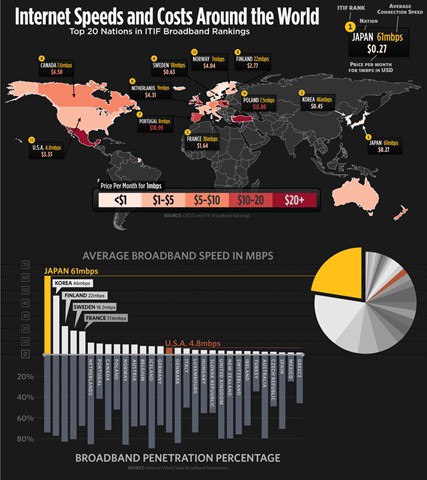
BroadbandWe also forgive Neil for being light on the facts.  It’s not “people” that think America lags behind the rest of the world in Internet access… it’s research that proves it.  Stevens must already be convinced of this, as he debates his own argument, adopting the industry position that tries to explain it all away by comparing population densities between the United States and the Asian nations beating our pants off.  Yes, it is easier to run fiber optics in condominium and apartment-dense areas like Hong Kong.  But the Republic of Korea and Japan have significant non-urban areas as well.

That also doesn’t explain away why Finland, Sweden, and France dramatically outpace us as well.

What all of these countries have in common is a nationally-coordinated public policy that advocates and promotes broadband deployment.  The United States left it up to private providers, who promptly set up a cozy duopoly in most communities and works overtime to keep competition out of their markets.  In many states, they’ve even engineered legislation to ban public broadband initiatives to provide the service they won’t.  The result is an America filled with Internet access “have’s” and “have-not’s” usually defined by income, provider, or location.  This isn’t an issue if you’re lucky enough to have access to FiOS, but is a major problem if your only broadband option is satellite fraudband.

The “open access” provision Stevens is alarmed about is nothing new.

Telephone companies have provided line access to third party DSL providers for at least a decade, and Time Warner Cable allows Earthlink to sell its service over their cable lines as part of an agreement originally dating back to the AOL-Time Warner merger.  You’re excused if you never knew about either arrangement because most consumers don’t.  The fact is, most providers don’t advertise their competition, and when they do, it’s usually because they offer a less worthwhile pricing and speed plan… or in the case of wireless data, a lousy 3G coverage map.

An even better idea for open access is to construct a modern fiber-based network to reach every American and lease it to any provider that wants to reach customers on it.

Providing access to those without broadband service doesn’t come from open access proposals.  Stevens doesn’t realize the second component is Universal Service Fund reform.  The USF, a small fee on phone bills to help underwrite the costs of providing phone service in rural America, has evolved into an often-abused slush fund.  Reforming it to redirect resources into constructing real broadband networks for rural America that can do more than just provide phone lines would help solve the access problem Stevens brings up.

Although the fan club at RedState might represent the “everyone” Stevens claims can see the ‘truth’ about Net Neutrality, they’re not living in an “open access” community themselves.  Just disagree with them and your access magically disappears.

I could write pages and pages about how the American recording industry killed itself through corporate greed, merger-mania, and treating their customer-base like criminals, but Steve Knopper did a much better job in his book Appetite for Self-Destruction, and you can listen to him interviewed at length about the subject courtesy of National Public Radio’s Fresh Air program.

Let me digress for a paragraph.  Independent recording artists who’ve dealt with record labels tell a very different story than the Songwriter’s Guild — their bigger problem is getting paid fairly by the record companies themselves.  Considering the recording industry has been complaining about people stealing their stuff since the days of cassette tape, arguing Net Neutrality represents ‘a pirate’s dream come true’ only exposes the true agenda of some to throttle certain broadband services not to “unclog networks” but to act as a de facto copyright control measure.  That reminds me.  I haven’t thanked Sony enough for foisting the infamous Sony BMG CD copy protection rootkit on us back in 2005.  I’m sure plenty of virus and malware authors who followed their lead probably have.

RedState struck again on Wednesday with another under-informed piece by Neil blasting away at Net Neutrality proponent Google, which is a favorite target of those who oppose Net Neutrality.

Firstly we have the principle of neutrality itself. If Google has its way, carriers like AT&T, Comcast, Verizon, Time Warner, and the rest will not have a say at all in what its users find through their Internet connections. They will not be allowed to set network policies that favor some websites or services over others, no matter how detrimental to the company’s ability to service all its customers.

However, we can see in the case of Studio Briefing that Google is anything but neutral. Studio Briefing has been shut out of all of Google’s services, and has been forcibly removed even from the search, so searching for Studio Briefing would never turn up the company’s webpage. Rather than letting algorithms pick and choose what sites come up, as Google usually claims, somebody human took a step by removing a particular company’s site from the system and sending an email notifying the company of the situation. Imagine Google’s hysterical shrieking had AT&T wiped a Google site off of the map for all users of its services.

Firstly, Neil is unclear about what he is talking about when he suggests providers won’t have a say in what users find through their Internet connections.  Is he upset they might not be able to police criticism of those companies, slow down their competitors, or block blogs?  I’m waiting to hear a justification of how not being able to discriminate against websites will be detrimental to the company’s abilities to “serve its customers.”

As to Neil’s ‘Studio Briefing’ complaint, whether this represents an insidious plot by Google to censor a news aggregation site or dropping a pest site that depends on swiping other people’s content and monetizing it with Google ads is up to the reader to decide.  The folks at Studio Briefing seem more concerned their AdSense account, which lets them earn advertising revenue, was shut off.  The view from the other side can be read here.  Of course, when I tried to Google “Studio Briefing” myself, I had no trouble finding my way there.  That’s hardly being “shut out” and removed from their search engine, because I used that search engine and found my way to the site with just a few mouse clicks.  Even Stevens’ Google attack is linked… by Google.

Storm Clouds Gather Over Comcast-NBC Deal: Opposition from Consumers, Views from ‘Darth Vadar,’ Stonewalling from Vivendi

Phillip Dampier November 23, 2009 Comcast/Xfinity, Public Policy & Gov't, Video 1 Comment
Edward Wasserman

Edward Wasserman

The Comcast-NBC deal that would bring one of the nation’s largest television networks under the control of the nation’s largest cable operator has not enjoyed the smoothest sailing since the deal was first rumored more than a month ago.

Consumer advocates oppose the deal because it would give Comcast too much control over the video content it would now own, and some industry leaders suggest the era of integration is over, warning bigger is not always better.

“The only beneficiaries of this deal are the industry titans who already enjoy too much market power,” said Josh Silver, executive director of Free Press.  Free Press is mounting a national campaign for consumers to become involved and help block the deal.

“If this deal goes through, Comcast would have control of marquee content and three major distribution platforms: Internet, broadcast and cable,” Silver said. “We’ve never seen this kind of consolidated control across so many platforms.”

Edward Wasserman, Knight professor of journalism ethics at Washington and Lee University, penned a scathing review of the proposed deal.  “Stop Comcast’s Power Grab” quotes a bitter Ted Turner, who saw his media empire fall from his control several years ago under the super-structured AOL-Time Warner deal:

“Big media today wants to own the faucet, pipeline, water and the reservoir. The rain clouds come next,” Turner wrote in a Washington Monthly article five years ago indicting big corporate media control.

The concept of vertical integration in media involves companies owning as much of the content and distribution as possible.  In a best case scenario, one company would control every element, from the production to the sales and distribution of that content.  The more you control in-house, the less you have to pay or answer to someone else.  Wasserman picks up the story:

And vertical integration is why Comcast, the country’s biggest owner of cable systems, the company that decides which networks reach one of every four U.S. homes, is drooling over NBC Universal. The deal, if it happens, would be a staggering one.

NBCU, in short, is a mammoth content machine. And, Comcast, though chiefly an immensely rich operator of cable pipes, isn’t just the $34 billion-a-year utility whose bill you bellyache about every month. It, too, covets content. It tried to buy Disney in 2004, and it owns all or part of 20 cable networks, including E! Entertainment Television, Style, G-4, the Golf Channel and a bunch of national and regional sports channels.

And now it wants NBCU. One analyst estimated that combining the content arms of the two companies would bring roughly one-quarter of the country’s TV programming under a single owner. Another said the merged entity would control one of every five hours of programming.

[…]

The usual objections to such deals have to do with the outsized economic clout the resulting colossus would wield. Scale emasculates market discipline. When you control access to 24 million homes, you aren’t ruled by prevailing prices, you set them. Recession? Comcast is squeezing $6 more per household now than it was a year ago, and its profits were up 22.5 percent last quarter.

Very nice, but when you own the programs, too, you can make sure your networks get delivered even when that means elbowing other producers aside. You can strong-arm your competitors — satellite companies, for instance — by threatening to withhold popular networks or forcing them to carry the dogs as well. You can cut deals with other distributors who want the shows they control flowing through your pipes. You get your way.

Naturally, you’ll resist innovation unless you control it. Comcast would get a 30-percent stake in Hulu, the upstart distributor of first-run Hollywood programming via the Internet — a huge potential threat to cable operators. Subscription cable is Comcast’s bread and butter, and a business that makes $944 million on quarterly revenue of $8.8 billion is some business. Comcast will make sure that online’s future doesn’t endanger its own.

[…]

The whole point of vertical integration is to secure unfair advantage, to unlevel the playing field. And besides, since when is avoiding the worst the best we can hope for? It has been longstanding public policy to encourage localism, diversity and competition in the media business. It’s time to dust off that policy and give it some teeth by blocking this ridiculous and dangerous deal.

CNBC’s John Faber got some industry insider perspective from Dr. John Malone, a power player in the cable television industry during his reign at Tele-Communications, Inc., which used to own cable systems now largely a part of the Comcast empire.

Dr. John Malone

Dr. John Malone

As far as Malone is concerned, this deal could herald a radical transformation away from traditional broadcasting models and “free TV.”

Malone believes America could be on the verge of dumping traditional broadcast network-local affiliate distribution of programming and switching to a “cable-centric” model where television programming is no longer distributed for free over broadcast television, or perhaps a hybrid approach where half of today’s television networks become cable/broadband-only.

He believes the government could be persuaded to support such a model if it meant returning broadcast spectrum back to the government for resale to the highest bidder, presumably for wireless broadband applications.

Malone’s vision leaves big vertically-integrated players like the broadcast networks and cable operators as big winners, owning and controlling programming, distribution, and all of the advertising slots, and cutting local television stations out of the deal.

Losers?  Independent local television stations and viewers that eschew pay television services like cable and satellite and rely on free over-the-air broadcasting.  “Free” may be an unsupportable business model, at least in Malone’s world view.  As many television stations are independently owned and operated, their concern for future viability is also sure to be an issue in the deal, Malone tells Faber.

Malone’s remarks are nothing unusual for the controversial cable mogul.  Al Gore once referred to Malone as the “Darth Vadar” of cable, leading a cable Cosa-Nostra with an agenda of a monopolist bent on dominating the television marketplace.

[flv]http://www.phillipdampier.com/video/CNBC Faber Report John Malone 11-23-09.flv[/flv]

Dr. John Malone talks about the Comcast-NBC Universal deal in this CNBC Exclusive with John Faber, aired earlier today. (4 minutes)

VivendiFor any deal to consummate, Comcast and NBC Universal need the consent of Vivendi, the French conglomerate which now finds itself in the catbird seat.  The Paris-based media concern is asking for several hundred million dollars more than NBC-owner General Electric is prepared to part with, sources tell today’s Wall Street Journal:

GE has offered Vivendi something in the neighborhood of $5 billion for its stake, according to people familiar with the matter. That is lower than the value implied by the deal GE has tentatively negotiated with Comcast. The GE-Comcast deal would value NBC Universal at about $30 billion. Allowing for debt that NBC Universal now carries, that value would imply Vivendi’s equity stake is worth somewhat less than $6 billion.

GE is offering Vivendi less than the value implied by its Comcast deal because it believes Vivendi wouldn’t be able to fetch as much through a public sale that it also has the right to pursue, according to people familiar with the talks.

Vivendi, meanwhile, has asked for a price somewhere from the “mid-five” billion dollars to closer to $6 billion, according to people familiar with the matter. Two people familiar with the matter said GE and Vivendi were within about $500 million in price.

Vivendi has also asked for deal guarantees, according to people familiar with the matter. Those guarantees could include GE paying for at least part of its stake before any Comcast agreement closes. Vivendi doesn’t want to assume the risk that GE’s deal with Comcast could be blocked by regulators in Washington, or could otherwise fall apart, according to a person familiar with the matter.

Most deal-watchers predict Vivendi will eventually part with its stake after it gets what it wants.

One of the Journal‘s sources said it was unlikely those working out the deal would let “a few hundred million” stand in the way.

Verizon Wireless & Google Announce Open Platform Strategic Alliance, AT&T Reverses Course on Blocking Voice Over IP

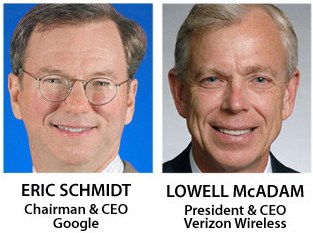
ceosVerizon Wireless and Google this morning surprised the wireless mobile industry when it went far beyond a much-anticipated agreement between Verizon and Google to market smartphones using Google’s Android operating system, and instead seemed to embrace Net Neutrality for unrestricted use of online services on Verizon Wireless’ network.  Is this a consumer-friendly about face or a strategic effort to take the wind out of the sails pushing for formal adoption of Network Neutrality regulations?

Today’s announcement represents a complete reversal for Verizon Wireless, which announced opposition for wireless Net Neutrality in September.  Tom Tauke, Verizon’s executive vice president of regulatory affairs said then: “We believe that when the FCC reviews the record and looks at the facts, it will be clear that there is no current problem which justifies the risk of imposing a new set of regulations that will limit consumer choices and affect content providers, application developers, device manufacturers and network builders.”

Google and Verizon have been on opposite sides of the Net Neutrality debate for several years now.  The phone company spends millions of dollars lobbying Washington to keep Net Neutrality off its back, in direct opposition to Google’s strong advocacy for the consumer-friendly open network rules.  One might anticipate a joint webcast between the two companies would be reserved in tone at best.

It wasn’t.

In fact, Verizon Wireless CEO Lowell McAdam and Google Chairman and CEO Eric Schmidt fell all over themselves praising one another, and attacked Verizon’s nemesis AT&T.

McAdam took a shot at AT&T for the recent controversy over their decision to block Google Voice and other Voice Over IP services from working with AT&T’s wireless network.

“Either you have an open device or not. This will be open,” McAdam said.

Schmidt praised Verizon Wireless’ nationwide mobile broadband network, calling it “by far the best in the United States.”

AT&T understood the implication of the partnership between its biggest rival and the super-sized Google and announced it was reversing its decision to block Voice Over IP applications on its network.

Ralph de la Vega, chief executive of AT&T’s consumer wireless unit, said “the iPhone is an innovative device that dramatically changed the game in wireless when it was introduced just two years ago.  Today’s decision was made after evaluating our customers’ expectations and use of the device compared to dozens of others we offer.”

That’s a remarkable statement coming from a company that has routinely ignored the wishes and expectations of its iPhone customers for less expensive, higher quality, less restrictive service.

AT&T’s reversal was praised by FCC Chairman Julius Genachowski, who is pushing for adoption of Net Neutrality as part of FCC broadband policy.

“When AT&T indicated, in response to the FCC’s inquiry, that it would take another look at permitting VoIP on its 3G network I was encouraged,” Genachowski said. “I commend AT&T’s decision to open its network to VoIP. Opening wireless services to greater consumer choice will drive investment and innovation in the mobile marketplace.”

Have AT&T and Verizon suddenly realized taking a customer-friendly position of Net Neutrality is better for their corporate image?

Perhaps, but one might also consider the reversals to be part of a strategic effort to demonstrate a lack of need for Net Neutrality rules in a ‘remarkably open and free competitive wireless marketplace.’  Expect to see that line or something akin to it coming from the anti-Net Neutrality lobbying campaign within hours of today’s events.

AT&T has also spent millions on lobbying efforts in Washington to keep Net Neutrality and other telecommunications legislation at bay.  The prospect of a sudden role reversal for two of the biggest spenders on influencing public policy would be remarkable, if it actually happened for consumers’ sake.

Verizon Wireless & Google Joint Webcast — October 6, 2009 (18 minutes)
You must remain on this page to hear the clip, or you can download the clip and listen later.

Astroturf True Confessions: Can the Federal Trade Commission Force Blogs to Reveal Pay-for-Say?

federal-trade-commission-ftc-logo_jpgThe Federal Trade Commission on Monday issued new guidelines to stem the growing trend of product and service endorsements on web-based blogs that do not disclose the cozy relationship some bloggers have with the companies they write about.  For the first time, new FTC guidelines will require bloggers to confess any payments or free products or services they receive in return for their writings.  Waiting and Watching, one of our regular readers, wrote asking if these guidelines would affect telecommunications-related sites like Stop the Cap!

The revised FTC rules add new examples to illustrate the long standing principle that “material connections” (sometimes payments or free products) between advertisers and endorsers – connections that consumers would not expect – must be disclosed. These examples address what constitutes an endorsement when the message is conveyed by bloggers or other “word-of-mouth” marketers. The revised rules specify that while decisions will be reached on a case-by-case basis, the post of a blogger who receives cash or in-kind payment to review a product is considered an endorsement. Thus, bloggers who make an endorsement must disclose the material connections they share with the seller of the product or service. Likewise, if a company refers in an advertisement to the findings of a research organization that conducted research sponsored by the company, the advertisement must disclose the connection between the advertiser and the research organization. And a paid endorsement – like any other advertisement – is deceptive if it makes false or misleading claims.

Unfortunately, in the marketplace of ideas, astroturf groups which pretend to represent consumer interests that receive direct financial support from the industry they write about do not appear to be covered by the new FTC guidelines.

Several marketing firms specializing in “word of mouth” marketing or social media campaigns are paid to put free samples in the hands of bloggers who agree to write a review of the product or service (or at least write about it generally).  In return, they get to keep the product at no charge.  Some bloggers belong to marketing programs that pay them directly for positive reviews, mentions, or links to a product or service.

The new regulations will not punish bloggers who violate the FTC guidelines — the Commission will instead go after the marketing company, the manufacturer or provider.

Jack Gillis

Jack Gillis

Some consumer groups think that is a mistake, and that bloggers should also be accountable.

Jack Gillis, a spokesman for the Consumer Federation of America, told the Associated Press he thinks the FTC doesn’t go far enough to protect consumers from unethical bloggers.

“Consumers are increasingly dependent on the Internet for purchase information,” he said. “There’s tremendous opportunity to steer consumers to the wrong direction.”

The consumer advocacy group said lack of disclosure is a big problem in blogs. To mainly crack down on companies that give out freebies or pay bloggers won’t always solve the problem. By going after bloggers as well, “you put far more pressure on them to behave properly,” Gillis said.

For the record, Stop the Cap! receives no compensation of any kind from this industry or any other.  This website is supported entirely by myself and consumer contributions made through the Paypal link on the right.  Further, none of our authors are employed by or contracted with any company or provider with an interest in our issues, including Google (for the few who have made that baseless accusation in the past.)

I believe that bloggers should be held to fully disclosing their industry and/or financial connections so consumers may be fully informed about any potential conflict of interest or bias.  Fake website reviews and promotions have been a perennial problem on the Internet, some written by consumers who earn money or free service whenever a new customer signs up using a special link he or she provided.

Some reviews on big sites like Amazon have been written by company employees under pseudonyms which praise their own products and trash the competition.  The “word of mouth” marketing industry takes this to a new level, by leveraging social media networks to hype a product, with a direct incentive for the writer to provide glowing reviews if they want to remain on the “free goodies” mailing list.  An even stronger incentive to write “pay for say” articles comes when actual cash payments are provided for reviews.  Bloggers instinctively would suspect the gravy train would derail if they turned in a series of negative honest reviews, leading to the marketing company to drop them from the program.

Having full disclosure for sites engaged in public policy debates is an even better idea, especially when members of Congress routinely quote from material provided to them by what they assume are consumer groups, but are actually little more than industry-sponsored megaphones.

[flv width=”480″ height=”360″]http://www.phillipdampier.com/video/WWLP Springfield Bloggers Must Confess 10-5-09.flv[/flv]

WWLP-TV in Springfield reports on the new rules for bloggers.  Note the report is inaccurate about fining bloggers — FTC enforcement will not target bloggers. (1 minute)

A Fox News video report about “blogger mommies” that advocates self-regulation is also included below.

… Continue Reading

Search This Site:

Contributions:

Recent Comments:

Your Account:

Stop the Cap!