Home » public policy » Recent Articles:

HP – “Smart Shoppers” Prefer Internet Overcharging Schemes: Metering Is Good for You!

HP's Snowjob: The company that brought you the $70 ink cartridge supports an end to flat rate Internet service to "save" you money.

HP’s Joe Weinman argues consumers are behind the drive to abandon flat rate, “all you can eat” broadband pricing.

Weinman, whose company sells products and services to some of America’s largest broadband providers, has taken up their position that flat-rate Internet service is bad for you, claiming many are paying too much for Internet service they use too little.

In an essay posted on GigaOM, Weinman brings back the all-y0u-can-eat buffet metaphor:

For the record, I like unlimited Internet access just as much as anyone else. However, such plans appear to be on their way out, and here’s why. As I’ve explored in ”The Market for Melons” (PDF), pay-per-use is not an evil plot by greedy robber barons, but a natural outcome of independent, rational consumer choice. Consider a town with an all-you-can-eat (flat rate) buffet and an a la carte (pay-per-use) restaurant. Smart shoppers on diets will save money by patronizing the a la carte restaurant, whereas heavy eaters will save money by visiting the buffet. As patrons switch, the average consumption of the buffet will increase, driving price increases for the luncheon special, causing even more users to switch to pay-per-use.

Bottom line: it is not the proprietors driving this dynamic, but the customers themselves acting out of pure, rational self-interest—light users, by deciding not to subsidize the heavy ones, foster the vitality of the pay-per-use model.

Unfortunately for Weinman, most American broadband customers don’t believe a word of this, and even he was forced to admit as much when he noted consumers “often prefer to overpay for flat-rate rather than save money but risk bill shock.”

Karl Bode at Broadband Reports wasn’t suckered for a moment either, noting:

[…]Cable industry lobbyists would like the public to believe that such a shift isn’t about making more money, it’s about helping the poor. Not only is the metered billing push absolutely about making money, it’s about artificially constricting the pipe to protect uncompetitive carriers and TV revenues from Internet video. But instead, there’s a very concerted effort afoot to portray this shift as necessary, inevitable, and even altruistic.

Most consumers prefer the simplicity of flat rate pricing, and understand that ISPs are perfectly profitable under the flat-rate pricing model. They also understand that this is a pipe dream forged by never-satisfied investors, and once implemented ends with ever soaring per gig fees and ever shrinking usage caps.

Weinman’s essay completely ignores the reality his preferred pricing model already delivers to those who live under it in Canada.  Canadian broadband rankings continue to decline as customers there pay higher prices for a lower level of service, with usage caps that actually decline when new competitive threats from online video emerge.

Just what the doctor ordered: HP's Rx for American Broadband

We had to take time out to respond directly to Weinman and his cheerleading friends (see the comments section), some who wrote comments below the piece and couldn’t be bothered to disclose they owe their day jobs to industry-backed dollar-a-holler groups that are committed to delivering on behalf of their provider benefactors:

When Big Telecom comes ringing with promises of savings from metered or capped broadband, hang up immediately.

These plans save almost nobody money and expose dramatic overlimit fees to consumers, creating the kind of bill shock wireless phone users endure.

The OPEC-like Internet price-fixing on offer from big players delivers broadband rationing and sky high prices, while retarding Internet innovations that providers don’t own or control.

Consumers are forced to double check their usage and think twice about everything they do online out of fear of being exposed to huge overlimit fees up to $10 a gigabyte for exceeding an arbitrary limit ranging from 5-250GB.

Americans already pay too much for Internet service and now the providers want more of your money. The rest of the world is moving AWAY from the pricing schemes Weinman would have us embrace. It’s such a serious issue in the South Pacific, the governments of Australia and New Zealand are working to address the problem themselves.

Providers are already earning BILLIONS in profits every quarter from their lucrative broadband businesses. Now the wallet biters are back for more, with the convenient side benefit that limiting consumption is a great way to prevent Internet-delivered TV from causing cord-cutting of cable TV packages.

As far as consumers are concerned, and Weinman admits as much, people are happy with today’s unlimited price models. When Big Telecom complains people are overpaying for broadband, wouldn’t their shareholders be telling them to shut up and take the money? There is more to this story.

Weinman defends the extortion proposition Big Telecom would visit on us: either give us limited use pricing or we’ll raise all of your prices.

But as consumers have already figured out, these providers never reduce prices for anyone. When was the last time your cable bill went down unless you dropped services?

Don’t be a sucker to Big Telecom’s “broadband shortage” or pricing myths. Broadband is not comparable to water, gas, or electric. The closest comparison (and the one they always leave out) is to telephone service, and as we’ve seen, that business is increasingly moving TOWARDS flat race, unlimited pricing.

Want to know what metered pricing does to the wallets of consumers? Just ask Time Warner Cable customers in Rochester, Greensboro, San Antonio, and Austin what they thought about the cable company’s “innovative” pricing experiment that tripled the price for the same level of broadband customers used to get for $50 a month. After the torches and pitchforks were raised over $150 a month broadband service, Time Warner backed down.

Either with or without metered pricing, the cable company raised its prices three times last year alone.

The industry’s meme that “usage-based pricing” in inevitable is only true if consumers allow it to happen.  The parade of Internet Overcharging advocates all share one thing in common — they earn a living from the providers that dream about these pricing schemes.  Always follow the money.  As we’ve exposed repeatedly, the vast majority of defenders of these kinds of pricing schemes are not consumers.  They are:

The Internet Toll Booth Is Open for Business: Comcast Wants More $ to Deliver Netflix Movies

Comcast wants to be paid twice for carrying Netflix online video content to its customers: once from customers themselves and a second time from Level 3 Communications, Inc., the company providing much of Netflix’s streamed video traffic.

“On Nov. 19 Comcast informed Level 3 that, for the first time, it will demand a recurring fee from Level 3 to transmit Internet online movies and other content to Comcast’s customers who request such content,” said Level 3’s chief legal officer, Thomas Stortz, in a statement. “By taking this action, Comcast is effectively putting up a toll booth at the borders of its broadband Internet access network, enabling it to unilaterally decide how much to charge for content which competes with its own cable TV and Xfinity delivered content.”

The backbone and content distribution company accused Comcast of threatening the open Internet and of abusing its market position as America’s largest cable broadband provider.  Comcast disageed, calling Level 3’s position “duplicitous” and accused the company of sending far more traffic from its content partners than the cable giant sends in the other direction.

Joe Waz, senior vice president of External Affairs and Public Policy Counsel at Comcast posted a response on the company’s blog claiming Level 3 was trying to have it both ways, running a lucrative content delivery business for clients like Netflix while also acting as a major Internet backbone provider.  Waz claims Level 3 is purposely confusing the fair exchange of backbone traffic with the commercial content delivery business it also runs:

Comcast has long established and mutually acceptable commercial arrangements with Level 3′s Content Delivery Network (CDN) competitors in delivering the same types of traffic to our customers. Comcast offered Level 3 the same terms it offers to Level 3′s CDN competitors for the same traffic. But Level 3 is trying to gain an unfair business advantage over its CDN competitors by claiming it’s entitled to be treated differently and trying to force Comcast to give Level 3 unlimited and highly imbalanced traffic and shift all the cost onto Comcast and its customers.

To quantify this, what Level 3 wants is to pressure Comcast into accepting more than a twofold increase in the amount of traffic Level 3 delivers onto Comcast’s network — for free. In other words, Level 3 wants to compete with other CDNs, but pass all the costs of that business onto Comcast and Comcast’s customers, instead of Level 3 and its customers.

Level 3′s position is simply duplicitous. When another network provider tried to pass traffic onto Level 3 this way, Level 3 said this is not the way settlement-free peering works in the Internet world. When traffic is way out of balance, Level 3 said, it will insist on a commercially negotiated solution.

But Level 3 claims Comcast threatened to pull the plug if they didn’t agree to the cable company’s demands, which would have cut off Comcast customers from a wide range on content.  The company agreed to pay Comcast under protest, and took the issue public just as attention has become re-focused on Net Neutrality at the Federal Communications Commission.

The dispute increasingly resembles cable TV carriage fights where programmers threaten to yank programming if their terms are not met.  Had Comcast delivered on its alleged threat to cut ties to Level 3, widespread disruptions of content delivery could have been the result, starting with a blockade against Netflix streaming video.  That would leave Comcast broadband customers paying for a hobbled Internet experience, missing popular websites because of Comcast’s roadblocks wherever Level 3 traffic was involved.

It’s a classic case of a Net Neutrality violation, with money being the motivating factor.  Pro-consumer public policy groups immediately pounced on the news.

“Comcast’s request of payment in exchange for content transmission is yet another example of why citizens need strong, effective network neutrality rules that include a ban on such ‘paid prioritization’ practices,” said Andrew Jay Schwartzman, senior vice president and policy director of Media Access Project. “It is also yet another clear demonstration of why Comcast should not be permitted to acquire NBC Universal, given its clear tendency to exercise control in the video marketplace.”

“On its face, this is the sort of toll booth between residential subscribers and the content of their choice that a Net Neutrality rule is supposed to prohibit,” said Harold Feld, legal director of Public Knowledge. “In addition, this is exactly the sort of anticompetitive harm that opponents of Comcast’s merger with NBC-Universal have warned would happen — that Comcast would leverage its network to harm distribution of competitive video services, while raising prices on its own customers.”

Although Netflix and officials at the Federal Communications Commission both refused comment, analysts predict consumers will ultimately pay the price for Comcast’s newest fees in the form of higher prices for online content.  Comcast does not impose these fees on its own TV Everywhere online video service, Xfinity Fancast.  Waiving expensive content delivery fees for “preferred content partners” could leave independent competitors like Netflix vulnerable to the whims of the broadband providers charging extra to deliver traffic to paying customers.

The FCC is rumored to be considering enacting some broadband reforms before new Republican members of Congress take their seats in January.

(Thanks to several of our readers, including Terry and ‘PreventCaps’ for sending word.)

[flv]http://www.phillipdampier.com/video/Bloomberg Comcast Internet Toll Booth 11-30-10.flv[/flv]

Bloomberg News briefly covered the dispute in this morning’s Business Briefs segment.  (1 minute)

AT&T Tries to Stomp Out Class Action Rights: Supreme Court Case Could Eliminate Consumer Protections

Not really

Back in 2002 Vincent and Liza Concepcion walked into a southern California AT&T Mobility store to purchase new cellphones for themselves.  AT&T advertised a buy one, get one “free” offer for cellphones.  What AT&T didn’t say was that the family would end up paying more than $30 in hidden sales taxes for both phones.

More than eight years later, that purchase — and the resulting class action lawsuit it launched — threatens to sweep away important consumer protections by letting corporations ban class action cases and curtail Attorneys General from enforcing state consumer protection laws.

Oral arguments in the case AT&T Mobility v. Concepcion were heard before the U.S. Supreme Court last Tuesday in one of the most important consumer protection cases in decades. At issue is this clause, inserted into the Concepcion’s service contract with AT&T that would disallow the family from participating in a class action lawsuit:

“You and AT&T agree that each may bring claims against the other only in your or its individual capacity, and not as a plaintiff or class member in any purported class or representative proceeding.”

That clause clashes with several state laws, California’s included, which basically say consumers cannot be compelled to sign away their basic consumer protection rights.  California law also says some contracts can be considered unenforceable ‘if they are built on deception, are too-one sided, or violate broader public policy.’

Hello, AT&T.

Vincent and Liza, through their attorney, argue that bringing an individual lawsuit against AT&T over $30 in sales taxes would be crazy — no lawyer would take the case and no plaintiff would front a retainer well beyond the amount in dispute.

As Justice Ruth Bader Ginsburg wrote in another class action case, “The realistic alternative to a class action is not 17 million individual suits, but zero individual suits, as only a lunatic or a fanatic sues for $30.”

The “class action” concept provides at outlet for aggrieved consumers who can attract legal representation if a company can be sued on behalf of every impacted customer.  For AT&T, that could mean facing not just the Concepcion family, but millions of Californians — each charged sales taxes for phones the company advertised as “free.”

How AT&T’s Case Has Broadened Into a Major Dispute Over Arbitration vs. Class Action Lawsuits

It's easy to navigate AT&T's terms and conditions to achieve a good outcome from arbitration, right?

But what began as a legal argument over a “free” phone has broadened into a much larger legal case before the Supreme Court: can consumers be compelled to participate in company dispute settlement schemes and give up their legal right to petition the court system for relief?  Further, what happens when those contract clauses conflict with state consumer protection laws?

Following in the footsteps of the credit card industry, AT&T inserted a clause mandating customers stay away from class action lawsuits.  By telling consumers they are forbidden to participate in such cases, AT&T pushes customers into the murky world of “arbitration” — a system where AT&T picks a private company, with whom it has a financial-business relationship, to “impartially” rule on customer complaints in secret proceedings.  Consumers have to pay their own way to attend arbitration hearings, often held in cities a thousand miles away or more.  They also must agree the decisions are binding and final.

AT&T argues, both directly and through its dollar-a-holler advocates, that class action cases are annoying, expensive, and do not typically deliver substantial benefits to class members.  The wireless carrier argues arbitration of individual cases is much faster and potentially more lucrative to would-be class action members.  Stephen J. Ware, a professor of law at the University of Kansas School of Law argues consumers have often done far better avoiding litigation and entering into arbitration programs.

But consumer advocates claim AT&T’s arbitration rules are stacked against consumers.  Arthur H. Byrant, executive director of Public Justice argues:

First, AT&T’s “agreement” bars its customers from court (except small claims court) and requires them to utilize the company’s mandatory arbitration program. Its rules say that, if a customer completes the process and recovers more than the last written settlement offer AT&T made before the arbitrator was chosen, a $7,500 premium will be paid. Second, the “agreement” bans AT&T’s customers from bringing or participating in class actions against it. Third, the “agreement” provides that, if AT&T’s class action ban is found to violate the law (as 20 states have held contractual class action bans do when they effectively immunize a company from liability), the arbitration clause “blows up” and the class action must proceed in court. Then, when the class action ban is struck down under state law (as AT&T knew it would be), the company springs its wacky trap: It argues that the Federal Arbitration Act of 1925 (FAA) pre-empts — and invalidates — that state law because (believe it or not) the state law is biased against arbitration.

AT&T’s call for pre-emption suffers from a bad connection. State law is not biased against arbitration. It allows AT&T to resolve disputes in either arbitration or court. Only AT&T’s “agreement” is biased against arbitration. Its “blowup clause” precludes class actions from proceeding in arbitration, but not in court.

<

p style=”text-align: center;”>

Using the scroll bar to the right of the player, move down and click on Attorney Paul Bland’s name and watch him argue forcefully that AT&T’s motives are plain and simple — to allow them to get away with anything they want and not face accountability from the legal system. — “Arbitration is not the Candy Bridge into Rainbow Land.”

Tapping Into Consumer Discontent With Class Action Cases for the Benefit of AT&T

What the lawyers get

Ask anyone about the merits of most class action settlements and one will often get a response that the lawyers win while consumers lose.  Just this week many owners of HP printers will get word a deal has been reached over a class action case involving printer ink.  The multiple law firms involved will split not more than $2.9 million under the terms of the proposed settlement.  Consumers will get “e-credit” worth $5, $2, or $6 redeemable at HP’s online store, which sells ink cartridges at inflated prices.  In effect, HP has little to grumble about delivering “awards” to consumers that ultimately benefit its own enterprise, the only place those awards can be redeemed.

With settlements like that all too common, it is easy for AT&T’s advocates to tap into consumer discontent with class action lawyers, proclaiming AT&T’s case is actually consumer-friendly because it would cut those money-grabbers out of disputes with the company.

But consumer advocates stress class action cases do more than deliver settlements — they deter bad behavior on the part of would-be wrongdoers, bring corporations to account fiscally when they are forced to settle, and open the door to legal discovery which can uncover patterns of extensive wrongdoing that would otherwise remain secret in arbitration.

But most important of all, class actions impact every customer, not just the handful who navigate arbitration to achieve a confidential settlement.  That can be critically important to stop unfair business practices.

What you get

Of course, reform is also desperately needed in the class action system.  Too often, judges approve class action cases that deliver maximum benefits to the law firms that bring them, leaving consumers with peanuts.  Strict limits on legal fees recouped in such cases, perhaps tied to a percentage of total recovery would be a start, as are bans on settlements that don’t provide cash refunds to consumers who choose not to conduct further business with companies that abuse them.  Coupons, low value trinkets, and donations to third party groups (non-profit or otherwise) are insufficient.  Attorneys that selfishly claim most of the proceeds for themselves have only themselves to blame when corporations use that fact against them under so-called “tort reform” proposals.

Some advocates of AT&T’s position also argue that government oversight can provide a more effective system of checks and balances against corporate overreach.  While a noble sentiment, anyone who has watched the revolving door of lobbyists going to work for such agencies, later returning to lucrative jobs with the companies they formerly regulated, knows that is a classic case of the fox overseeing the hen house.  In an era of government “oversight” that missed everything from BP’s safety lapses, salmonella-infected eggs, produce, and meat, tainted pet food ingredients from China, and indecisiveness about telecommunications reform like Net Neutrality — such proposals are not to be treated seriously.

The Supreme Court Decision

While it will be months before the Court rules, most observers suspect consumers will ultimately win the case.  Liberals on the court are skeptical AT&T’s efforts to preempt state consumer protection laws are actually for the benefit of consumers, and some of the most conservative members of the court like Justice Clarence Thomas, big believers in “states’ rights” are likely to find for the Concepcion family.

“Based on what was said during the argument, I predict a 8-1 or 7-2 vote for the consumers and California, with Samuel Alito dissenting and John Roberts a toss up. Thomas, who never speaks at oral argument, will vote for the consumers and state on federalism grounds, as he always does in [arbitration] cases,” writes Lawrence Cunningham, Argument in Class Waiver Case Favors Consumers, States, Concurring Opinions.

“[I]t doesn’t look as though there are too many votes at the high court to do away with the right of consumers to band together to sue the great American manufacturers of fine print,” said Dahlia Lithwick, Can You Hear Them Now? The Supreme Court reads the fine print on your cell phone contract, Slate.

If these two observers are wrong, it will be open season on consumers who will be forced into arbitration agreements that deliver all of the benefits to companies like AT&T.  Under such a scenario, there would be little to dissuade companies from developing new fine print to trick and overcharge consumers.  Few will be willing to buy a ticket to fly halfway across the country to sit for arbitration proceedings over a $20 dispute, especially when the arbitration firm’s income depends on fees paid by the very companies that are accused of wrongdoing.

Big Telecom Associates With Overheated, Industry-Backed Bloggers to Stop Reform

from: Progress & Freedom Foundation website

Wendy

Pro-broadband reform groups continue to hit the telecommunications industry’s last nerve.  While the fight for more expansive broadband and Net Neutrality continues, some providers and their water-carrying friends are pulling out all the stops to keep broadband under the firm grasp of a phone and cable duopoly.  Both will say or do just about anything along the way to stop consumer-friendly reform.

Say hello to Mike Wendy.  He’s made it his personal mission to “expose” groups promoting broadband reform as “radicals” and “hardcore entrenched lobbyists.”  Using rhetoric that will resonate with angry talk radio listeners, Wendy is convinced broadband policies that enforce the public interest and Net Neutrality are akin to a Marxist takeover.  While Wendy calls on good Americans like himself to man the barricades protecting AT&T, Verizon, Comcast, and Time Warner Cable, he just doesn’t have time to mention he happens to work for a special interest group funded by Big Telecom.  Maybe it slipped his mind?

Wendy’s ironically named “Media Freedom” blog is chock full of attacks on “Free Press and the radical media reformistas [sic].”  Special guest stars include Venezuela’s Hugo Chavez, Marxism, collectivism, and a whole slew of rhetoric that ultimately tells readers efforts to enact broadband reform are little more than a grand socialist conspiracy.

A real grassroots campaign is run for and by consumers. An astroturf campaign is bought and paid for by corporate interests to push their own agenda.

His visitors’ enthusiasm for such accusations might be diminished a tad had Wendy prominently disclosed his day job: Vice President of Press & External Affairs at the Progress & Freedom Foundation, a “think tank” that ingests money from Big Telecom and then spews forth their talking points.  Among the backers: AT&T, Comcast, the National Cable and Telecommunications Association, Time Warner Cable and Verizon.

That takes the wind out of the proclamation that Media Freedom is a bulwark against those who “threaten to quash speech and economic freedoms.”  Wendy isn’t working for Big Government.  He’s working for the interests of AT&T and Comcast.

Many of the companies supporting the Progress & Freedom Foundation have a vested interest in maintaining today’s barely-competitive broadband marketplace, avoid oversight, and stop reform regulation and legislation dead in its tracks.  They want Progress only on their terms and the Freedom to do whatever they please.

The real chutzpah moment came when Wendy claimed pro-consumer groups like Free Press and Public Knowledge were the ones running high-powered lobbying campaigns.  That’s a pot to kettle moment to behold, especially considering who paid to print Wendy’s business cards.  From a recent blog post:

The “public interest” lobby makes itself out to be the tireless, country-poor underdog for the downtrodden consumer.  But don’t be fooled.  In the technology space, three such groups – Public Knowledge, Media Access Project and Free Press – have few rivals.  Their humble appearance belies their take-no-prisoners, oftentimes shameless, below-the-belt approach to public policy formation and gamesmanship.  How do they do it?  They use all the tools, and then some, to make them every bit as sophisticated as the largest companies they’re trying to undermine.

Shameless and “below-the-belt” might better define Wendy’s last job: “Director of Grassroots” for the United States Telecom Association, a job title that literally defines astroturf-in-action. Who is on the board of USTA?  Among others, corporate executives and lobbyists for AT&T, Verizon, Qwest, and two members who shouldn’t be able to afford the annual dues considering their employers went bankrupt — Hawaiian Telcom and FairPoint Communications.

Wendy’s line of thinking is evident soon enough from his blog’s tag cloud, a regular cocktail of conspiracy:

The ironically named "Media Freedom" blog isn't media and its freedom is limited to carrying water for the nation's largest telecom companies.

  • Al Franken (the broadband industry’s ‘Boogie Man’)
  • Cyber-Collectivist (the secret link between broadband and Jean-Jacques Rousseau)
  • Fairness Doctrine (guaranteed to perk up the ears of any conservative talk radio fan wandering through)
  • First Amendment (for corporations)
  • Freedom (for said corporations to abuse your wallet)
  • Free Speech (for corporations)
  • Hugo Chavez (the go-to-guy for lazy smear-by-association rhetoric)
  • Marxist (chalkboard time)
  • New Deal (broadband users sure want one)
  • … and redistributionism (something overheard at the last session of the “Communications Comintern?”)

The rhetoric is two parts AT&T to one part 1970s Radio Tirana, Albania.  A Glenn Beck swizzle stick labeled “Marxism” is included to stir the overheated rhetoric into a hot mess for Verizon and the cable lobby.

All of the “isms” aside, we’ve created a convenient, handy-dandy chart you can use to see which team Wendy and his group really supports:

Distinctions With a Difference – A Telecommunications Issue Checklist

Issue Reform Groups Big Telecom “Media Freedom”
Universal Service Mandate – Service for Everyone At a Fair Price Favor Oppose Oppose
Speed Throttles/Network Management That Favors Premium Content Oppose Favor Favor
Net Neutrality Favor Oppose Oppose
Reduce Concentrated Ownership of Media/Telecom Favor Oppose Oppose
Allow Cable Customers to Pick, Choose, and Pay for Their Own Channels Favor Oppose Oppose
Public Interest Mandates for Local Radio & Television Favor Oppose Oppose
Usage Limits/Internet Overcharging Mostly Oppose Favor Favor
Source for “Media Freedom” views: The Battle for Media Freedom

NNPA: Hack ‘Journalism’ Attacks Free Press/Net Neutrality Without Revealing AT&T Ties

Phillip Dampier August 5, 2010 Astroturf, AT&T, Editorial & Site News, Net Neutrality, Public Policy & Gov't Comments Off on NNPA: Hack ‘Journalism’ Attacks Free Press/Net Neutrality Without Revealing AT&T Ties

NNPA has direct and long-standing ties to AT&T

Sometimes it’s hard to tell real journalism from industry-backed “dollar-a-holler” hackery, but the National Newspaper Publishers Association, an organization of Black newspaper publishers, went way over the top and made it too easy.

Their “special correspondent” Yaounde Olu wrote a particularly nutty piece of paranoia in an article titled, “Free Press Targets Poor Blacks and Women for Net Neutrality Campaign,” attacking pro-consumer group Free Press for daring to work with the Harmony Institute to undo industry propaganda, astroturf group nonsense, and multi-million dollar corporate lobbying efforts to derail broadband reforms like Net Neutrality.

If this is what passes for “news,” newspapers should reconsider their NNPA membership unless they throw in some free iPhones from AT&T:

In a bid to ensure Net Neutrality, the Free Press has commissioned the Harmony Institute to develop a strategy that will target poor, rural African- Americans in the South and women to increase support for a Net Neutrality (NN) strategy. Net Neutrality is basically the principle that all Internet traffic should be treated equally. In other words, everyone has access, and all platforms, content, and sites are treated equally. The opposite concept is a system wherein there would be limited or possibly “tiered” access. This could impact small businesses and other individuals without the economic wherewithal to access all sites.

According to the Free Press, the core supporters of Net Neutrality are affluent whites, who, have easy access to broadband and understand the issues. Poor, rural African-Americans and women, however, are the demographic that must be influenced in order to build a secure NN support base.

The Harmony Institute, a self-identified nonprofit organization committed to applying behavioral science to communications, in response to the Free Press’ commission, has produced a manual for the purpose of achieving these ends entitled Net Neutrality For the Win: How Entertainment and the Science of Influence Can Save Your Internet. This 40-page document identifies poor, rural African Americans and woman as “persuadable” for Net Neutrality messaging, and lays out very specific strategies for accomplishing their end goal of manipulating this demographic.

[…]Prominent members of the African American community have expressed serious concerns about the strategy laid out in the Free Press document. Shirley Franklin, a former mayor of Atlanta, offered the following observation, “It troubles me that an organization would target women, African-Americans and other minorities on an issue of such importance as universal broadband services without basing their advocacy on access, affordability and relevance.”

Julius Hollis, Chairman and founder of the Alliance for Digital Equality (www.alliancefordigitalequality.org), an organization whose mission is to ensure accessible and affordable broadband to the unders erved and un-served, particularly to communities of color, also weighed in on the issue. He stated, “I am extremely disappointed in the Free Press, not only in its policies and tactics that they are attempting deploy in their strategy paper, but equally disturbing are its attempts to portray the African-American and Latino consumers as expendable in their efforts to promote Net Neutrality. In my opinion, this is going back to the tactics that were used in the Jim Crow era by segregationists. It’s no better than what was used in the Willie Horton playbook by Lee Atwater who, upon his deathbed, asked for forgiveness for using such political behavior tactics.”

[…]Danny J. Bakewell, Sr., Chairman of the National Newspaper Publishers Association (NNPA), is taking the lead on fighting the Free Press’s NN strategy. He has this to say about it, “… I am outraged. And you should be too. I urge you to get out in your community and tell your friends, tell your neighbors, and tell those you meet at church and other groups about this appalling report. Most importantly, call and email Free Press and tell them you need a broadband connection to your house, not a subliminal message beamed into your subconscious.”

The Alliance for Digital Equality is directly backed by... AT&T

The NNPA and this “reporter” failed Journalism:101.  Let us count the ways:

For NNPA’s reporter, Balance is a nutrition bar, not an objective to strive for in this thinly-disguised hit piece against Free Press.  Last time I checked, Free Press was happy to answer their critics and share their own views on the subjects that concern the telecommunications industry and their specially-funded-friends.  Olu couldn’t find the space for the other side after all those “shame on you Free Press” quotes.

The portrayal of issue positioning and strategic messaging to reach various groups with a pro-Net Neutrality message is hardly an insidious, offensive plot.  In fact, unlike big telecom companies, the pro-Net Neutrality side has released their findings in public.  While the telecom industry marks their astroturfing and corporate lobbying strategies “top secret,” the pro-Net Neutrality side has nothing to hide.

But what would a newspaper association catering to African-American newspapers be doing in the middle of this fight in the first place?  As Stop the Cap! has seen and reported countless times before, when interest groups suddenly take an interest in supporting the telecom industry’s agenda items, telecom money is usually not far behind.

The most shameful part of the original article is the “reporter” couldn’t be bothered to be honest with readers and disclose the fact NNPA, the organization behind the article, has direct close ties to AT&T.  So do all of the quoted sources in the article.  The lack of disclosure is inexcusable, shoddy journalism — ultimately producing  just one more piece of industry propaganda.

“NNPA and AT&T Are Partners”

AT&T’s North Carolina President Cynthia Marshall was NNPA’s special guest at a corporate luncheon held by the group this past February, during their Winter Conference held in Charlotte, N.C.

Pharoh Martin, NNPA National Correspondent, covered the event and noted AT&T had “recently established a partnership with NNPA and the NNPA Foundation.”  Martin noted AT&T’s interest in broadband issues and reform are a top agenda item for the telecommunications company and the company ran an Internet Cafe during the event, exposing visitors to AT&T’s agenda.

The Center for Media and Democracy’s SourceWatch also notes NNPA has maintained strong ties with AT&T.

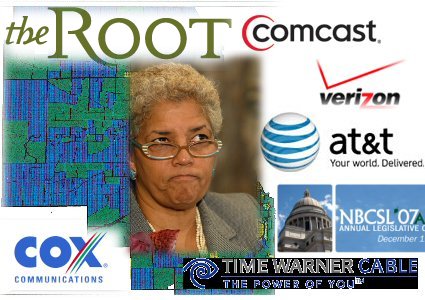
Shirley Franklin provides "dollar-a-holler" support for big cable and phone companies. (Black Agenda Report produced this montage image)

Shirley Franklin, quoted in the piece, was called a prostitute for AT&T by the Black Agenda Report.  After her stint as Atlanta mayor, she’s been an enthusiastic “dollar-a-holler” supporter for big cable and phone company interests.

Julius Hollis, chairman and founder of the Alliance for Digital Equality might be deeply disappointed with Free Press in his word salad of hyped outrage, but consumers should be even more upset that Hollis, too, is working for AT&T’s interests.  In fact his group is directly supported by AT&T.  Actually, calling the ADE a “group” might be a stretch.

As SourceWatch noted, “According to its 2007 tax return (Form 990), it had an operating budget of over $2 million, of which no money was allocated for fundraising, nor hiring of employees. In fact, the total compensation for board members exceeded the amount of all program-related expenses.”  That means loads of largesse for Hollis and the aforementioned Ms. Franklin, who “seems to be some sort of senior advisor to ADE,” according to the Black Agenda Report.

Mr. Bakewell’s admission that he’s taken a political position in this debate makes the NNPA just another player in the political arena.  They cannot call themselves impartial in this debate, nor should they be writing ostensibly unbiased news reports while also cheerleading AT&T and proclaiming a partnership with the phone giant.

Bakewell’s half-baked notions that AT&T will suddenly provide affordable broadband to most Americans while it continues to raise prices on broadband service (and in some cases limit its use), would simply be dismissed as naive if AT&T’s money wasn’t helping to feed the rhetoric.

The subliminal message beamed into the subconsciousness of NNPA’s readers is the one carefully crafted by AT&T to generate fake outrage and turn a telecommunications debate into another piece of raw meat for racial politics.  Once the puppet strings leading back to AT&T are revealed to readers, the real outrage should be reserved for the NNPA itself, cynically doing the bidding of a phone company and manipulating readers with false scandals and pointless side shows of distraction.

Obtaining universal access to affordable, high quality broadband service is not, nor has it ever been, a racial issue.  It’s an economic issue that has been exacerbated by companies that enjoy their current duopoly status and can afford to keep raising the prices on their customers, regardless of who they are.

Stop the Cap! is a pro-consumer group with no industry ties and no corporate money to hide.  We’re 100 percent consumer backed and consumer supported.  Too bad the NNPA, Ms. Franklin, Mr. Hollis and Mr. Bakewell cannot say that.

Search This Site:

Contributions:

Recent Comments:

Your Account:

Stop the Cap!