Home » network management » Recent Articles:

Broadcast Lobby Says ‘Spectrum Crisis’ is Fiction; Wireless Data Tsunami Debunked

(Source: JVC)

The National Association of Broadcasters (NAB), a trade association and lobbying group representing many of the nation’s television stations, says claims by wireless carriers of a nationwide spectrum crisis are troubling and counterfactual.  That conclusion comes in a new report issued by the NAB this morning that wants the FCC to keep its hands off UHF broadcast channel spectrum the agency wants to sell off to improve mobile broadband.

The paper, “Solving the Capacity Crunch: Options for Enhancing Data Capacity on Wireless Networks,” written by a former FCC employee, suggests claims by wireless carriers that they will “run out” of frequencies to serve America’s growing interest in wireless services are simply overblown.

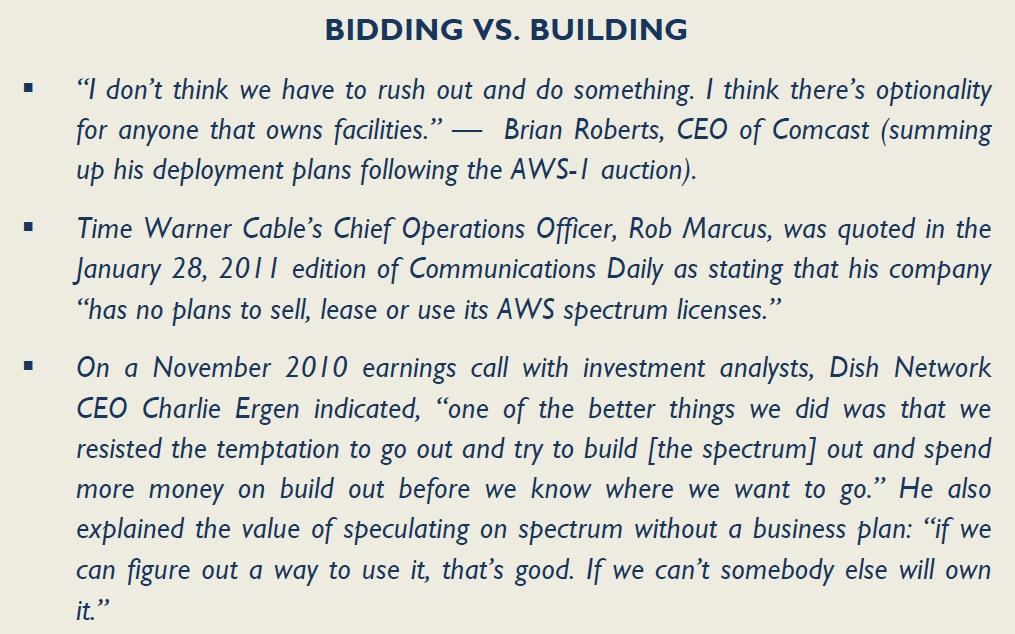
Many wireless companies own spectrum they are not using, the report argues, and other licensed users are holding onto spectrum without using it either, hoping to make a killing selling it off at enormous profits in the future.  Besides, the federal government holds the largest amount of underutilized spectrum around — frequencies that could easily be allocated to wireless use without further reducing the size of the UHF broadcast TV band.

Many of the ideas in the NAB report emphasize the need for carriers to deploy innovative technology solutions to increase the efficiency of the spectrum they are already using.  Those ideas include additional cell towers to split traffic loads into smaller regional areas, and improving on network channel-bonding, caching, and intelligent network protocols.

But the NAB report has some obvious weak spots the wireless industry will likely exploit — notably their recommendations that seek a reduction in wireless traffic — ideas that would suggest there is not enough spectrum to handle every user.  Among those recommendations:

  • Implementing Internet Overcharging schemes like “fair use” policies and consumption-based pricing to discourage use;
  • Migrating voice traffic to Internet Protocol;
  • Migrating data traffic to a prolific network of “femtocells” — mini antennas that provide 3G service inside buildings, but deliver that traffic over home or business wired broadband connections;
  • Offering wider access to Wi-Fi networks in public areas;
  • Encouraging the development of bandwidth sensitive devices and applications.

The National Broadband Plan’s conclusion of a spectrum shortage is based on little more than a wish list by wireless carriers, says the paper. Its author, Uzoma Onyeije, cites contradictory statements by high-ranking corporate officials to show the Plan’s calls for making 500MHz of spectrum available for broadband in ten years is a gross overestimate of the actual need.

“There is no denying that the corporate imperative of mobile wireless carriers is to obtain as much spectrum as they can,” Onyeije wrote. “However, the fact that wireless carriers cannot find a unified voice on the amount and timing of their spectrum needs suggests that this advocacy is more strategic gamesmanship than factual reality.”

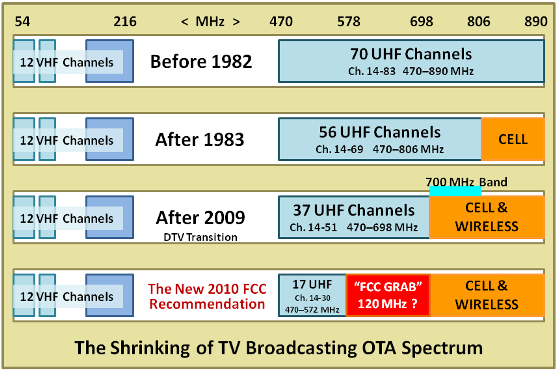
The NAB has heavily lobbied Washington officials on the issue of spectrum because their members — broadcast television stations — are facing the loss of up to 120MHz of what’s left of the UHF dial, already shrinking because of earlier reallocations.  The FCC proposal would resize the UHF dial to channels 14-30 — 16 channels.  In crowded television markets like Los Angeles, up to 16 stations would be forced to sign-off the public airwaves for good, because there would be insufficient space to allow them to continue a broadcast signal.  Instead, the FCC proposes they deliver their signal over pay television providers like cable or telco-provided IPTV.  Or they could always stream over the Internet.  But that would mean the decline of free, over the air television in this country.

Considering the millions of dollars many stations are worth, it’s no surprise broadcasters are howling over the proposal.

Onyeije’s report suggests AT&T and Verizon, among others, are grabbing whatever valuable spectrum they can get their hands on.  What they don’t use, they’ll “warehouse” for claimed future use.  By locking up unused spectrum, potential competitors can’t use it.  The proof, Onyeije writes, is found when comparing claims by the wireless industry with the FCC’s own independent research:

AT&T predicts 8-10 times of data growth between 2010 and 2015 and T-Mobile forecasts that data will have 10 times of growth in 5 years. Yet, the Commission’s assessment that 275MHz of spectrum is needed to meet mobile data demand is premised on data growth of 35 times between 2009 and 2014.

The Data Tsunami Debunked
Some providers are sitting on spectrum they already own.

The NAB also takes to task the “evidence” many providers use to claim the zettabyte era is at hand, where a veritable exaflood of data will force America into a widespread data brownout if more capacity isn’t immediately made available.

[…] The [industry claims rely] on suspect data. In arriving at its conclusion, OBI Technical Paper No. 6 relies heavily on forecast data from Cisco that is both wildly optimistic about data growth and unscientific. In a blog entry entitled, Should a Sales Brochure Underlie US Spectrum Policy?, Steven Crowley states that “[t]here is overlap between the people who prepare the forecast and the people responsible for marketing Cisco’s line of core-network hardware to service providers. The forecast is used to help sell that hardware. Put simply, it’s a sales brochure.”

Onyeije takes apart the oft-repeated claim that a data explosion will be unyielding, unrelenting, and will be the wireless industry’s biggest challenge for years to come.  It also speaks to issues about broadband use in general:

In particular, the paper appears to be premised on the highly suspect assumption that the high demand curve for mobile data will not slow. While smartphone growth is significantly increasing now, it will no doubt plateau and slow. It has been widely accepted for decades that the process of technological adoption over time is typically illustrated as a classic normal distribution or “bell curve” where a phase of rapid adoption ends in slowed adoption as the product matures or new technologies emerge.

As recently reported, Cisco now projects that U.S. mobile growth will drop by more than half by 2015. As Dave Burstein, Editor of DSL Prime, explains: “The growth is clearly not exponential.”  Mr. Burstein went on to say “Every CFO and engineer has to plan carefully for the network upgrades needed, but the numbers certainly don’t suggest a ‘crisis.’” Jon Healey of the Los Angeles Times Editorial Board similarly explains that “Much of the growth in the demand for bandwidth has come from two parallel forces: a new type of smartphone (epitomized by the iPhone) encourages people to make more use of the mobile Web, and more people are switching from conventional mobile phones to these new smartphones. Once everyone has an iPhone, an Android phone or the equivalent, much of the growth goes away.” AP Technology writer Peter Svensson echoes this concern and explains “AT&T’s own figures indicate that growth is slowing down now that smartphones are already in many hands.” Thus, the assumption that data demand will continue to grow unabated is deeply flawed.

Internet Overcharging is About Rationing and Reducing Use

Although the NAB favors Internet Overcharging to drive down demand for use, Onyeije’s report inadvertently provides additional evidence to the forces that oppose data caps, meters, and speed throttles: they are designed to monetize usage while driving it down at the same time:

While unlimited data plans on mobile phones were once the standard, there is now more focus on using pricing as a network management tool. As AT&T Operations President John Stankey put it, “I don’t think you can have an unlimited model forever with a scarce resource. More people get drunk at an open bar than a cash bar.”  In the past year, AT&T and Virgin Mobile abandoned unlimited data plans. In 2010, T-Mobile announced that it would employ data throttling and slow the download speeds of customers that use more than five GB of data each month. And Bloomberg reported on March 1, 2011 that “Verizon Communications Inc. will stop offering unlimited data plans for Apple Inc.’s iPhone as soon as this summer and switch to a tiered pricing offering that can generate more revenue and hold the heaviest users in check.” Usage-based smartphone data plans substantially reduce per-user data traffic. As a result, data growth is likely to slow over time. And companies, including Cisco, are marketing products to carriers to help make tiered data plans easier to implement and help carriers “increase the monetization of their networks.”


Dog & Pony Show: Congress Invites Big Telecom & Friends to Net Neutrality Hearing

Phillip Dampier February 15, 2011 Astroturf, Consumer News, Data Caps, Editorial & Site News, Net Neutrality, Public Policy & Gov't, Rural Broadband, Wireless Broadband Comments Off on Dog & Pony Show: Congress Invites Big Telecom & Friends to Net Neutrality Hearing

A small wireless ISP owner who regularly complains about Net Neutrality and an industry friendly group that opposes broadband oversight were the handpicked guests at a hearing held today to investigate Net Neutrality.  Only one witness, Gigi Sohn from Public Knowledge was there to defend the important consumer net protection principle.

The hearing, held by the House Judiciary Subcommittee on IP, Competition and the Internet was among the first held in the new Republican-controlled Congress, which overwhelmingly opposes Net Neutrality.  It opened an opportunity for Net Neutrality-opponents to attack the watered down rules, adopted by the Federal Communications Commission last December.

Laurence “Brett” Glass, owner of Lariat, a wireless ISP in Laramie, Wyoming, is a familiar name to those who follow comment sections of public interest websites and newspapers.  Glass regularly attacks the concept of Net Neutrality and favors Internet Overcharging schemes, if only to protect revenues on his bandwidth-limited wireless ISP.

Glass told Congress adoption of even the FCC’s watered down regulations will put his company’s future at risk because they could be interpreted to allow “servers” on his network.  Andrew Schwartzman, a net-neutrality proponent and senior vice president at the Media Access Project, says the restriction could technically violate rules, but only if it was argued as a prohibition of attaching server hardware/equipment.

“He is describing a practice which would violate Michael Powell’s 4 principles from 2005 (I think) since it allows end users to attach any device,” Schwartzman said in an e-mail to The Hill.

Of course, the watered down Net Neutrality regulations exempt wireless networks, and Glass’ argument ignores the long-recognized concept of the Acceptable Use Policy, which prohibits network activities that can create problems for the network itself or other customers.  The FCC moving in to crush Lariat over such a scenario is hard to imagine in any case.

Larry Downes, another witness, represents the Big Telecom-friendly TechFreedom, which loathes industry regulations that could impact big players like AT&T and Verizon.

Downes argued the Net Neutrality rules were slipped in during the Lame Duck Session to avoid Republican scrutiny on Capitol Hill and are completely unnecessary.  Downes argues:

  • There is no need for new regulation because there were never any serious violations (ignoring the Comcast incident that interfered with network traffic and the subsequent adventures (by others) this year on the wireless side where content access is being repackaged and sold by third parties based on access and usage).
  • Enforcement mechanisms are complex and expensive: It costs too much to investigate, so why bother?
  • Exceptions reveal a profound misunderstanding of “the Open Internet”: Downes argues today’s well-accepted concept of speed equality and agnostic network management are simply popular with consumers and irrelevant to the technical workings of the Internet itself.
  • The FCC lacked authority to issue the rules—and likely knew it: By not invoking appropriate authority, the FCC’s new Net Neutrality policies may fail to pass court scrutiny.

Downes favors a different kind of net freedom — one for corporations to treat the online ecosystem as they please and let the free market sort it out.  If you are served by two providers who believe in Internet Overcharging schemes and speed throttles, so be it.  If you’re lucky enough to be served by a provider that supports today’s online experience, lucky you.

The FCC evidently was not invited to testify about their own policy.  Instead, Public Knowledge’s Gigi Sohn argued for Net Neutrality, but even she complains the FCC’s current provisions of that policy don’t go far enough.  Public Knowledge is planning a pushback against Republican-led efforts to repeal Net Neutrality in a campaign launching later this week — The Internet Strikes Back.

(Click the image on the left to enroll in the campaign and participate in the effort to stand up for Net Neutrality this Thursday.)

Public Knowledge:

You – the Internet – are going to make it clear that ISPs cannot be gatekeepers and do not get to choose which websites work and which websites do not work.  You – the Internet – will tell all of Congress to join the 105 Representatives who have already come out clearly in support of a free and open Internet.

Verizon Reserves the Right to Throttle Your iPhone Connection and “Optimize” Your Browsing

Verizon Wireless isn’t entirely rolling out the welcome mat for new iPhone customers.  PreventCAPS, one of our regular readers, dropped us a note indicating Verizon quietly added something new to the terms and conditions for new customers as of Feb. 3rd, which just so happens to coincide with the date the company started taking orders for the Apple iPhone — it reserves the right to throttle your speeds and “optimize” your browsing experience with caching and network management techniques that could reduce the quality of online videos and other bandwidth-intensive graphics.

Important Information about Verizon Wireless Data Plans and Features

As part of our continuing efforts to provide the best experience to our more than 94 million customers, Verizon Wireless is introducing two new network management practices.

We are implementing optimization and transcoding technologies in our network to transmit data files in a more efficient manner to allow available network capacity to benefit the greatest number of users. These techniques include caching less data, using less capacity, and sizing the video more appropriately for the device. The optimization process is agnostic to the content itself and to the website that provides it. While we invest much effort to avoid changing text, image, and video files in the compression process and while any change to the file is likely to be indiscernible, the optimization process may minimally impact the appearance of the file as displayed on your device. For a further, more detailed explanation of these techniques, please visit www.verizonwireless.com/vzwoptimization

If you subscribe to a Data Plan or Feature on February 3, 2011 or after, the following applies:

Verizon Wireless strives to provide customers the best experience when using our network, a shared resource among tens of millions of customers. To help achieve this, if you use an extraordinary amount of data and fall within the top 5% of Verizon Wireless data users we may reduce your data throughput speeds periodically for the remainder of your then current and immediately following billing cycle to ensure high quality network performance for other users at locations and times of peak demand. Our proactive management of the Verizon Wireless network is designed to ensure that the remaining 95% of data customers aren’t negatively affected by the inordinate data consumption of just a few users.

These kinds of “network management” techniques, which include speed throttles, reduced quality graphics, and caching (which can result in stale web pages being served to your mobile device), are all made possible by the Federal Communications Commission’s failure to implement Net Neutrality protections for wireless providers.  While Verizon stresses it will treat all content to the same network management techniques equally, the “improved” broadband experience Verizon claims to offer is more likely to improve the company’s bottom line from reduced spending on network upgrades.

Like most providers, Verizon isn’t willing to be specific about what amount of usage is likely to trigger the throttle, why it needs to be maintained for the remainder of the billing cycle even when network congestion is not a problem, and what speed customers will be stuck with for the rest of the month.

Broadband Reports reached out to Verizon for specifics and discovered the provider has not actually implemented these measures… yet:

“The notice yesterday simply reserves the right for new customers or renewing their contracts,” Verizon spokesman Jeffrey Nelson tells Broadband Reports. “We’re reserving the right to actively manage the network in specific ways should that need exist – and only for customers who are under contract that includes that provision,” he says. “Because this is down the road – if at all – it’s too early to tell what those triggers might be, or what throughput limitations would look like.”

Verizon may be concerned about the potential impact millions of data-craving iPhone customers will bring to its network in the coming weeks.  Existing customers with Android devices or Blackberry handsets are safe for now — the provision only impacts customers who sign new contracts as of last Thursday.

Verizon says it will retain its unlimited data option (with the right to throttle service) for a “limited time only.”

Verizon Sues to Toss Out Weak Net Neutrality Rules They Helped Write

Just shy of one month after adoption, the Federal Communication Commission’s Net Neutrality rules face a legal challenge by one of the parties that helped write them.

Verizon Communications filed suit Thursday in the same federal court that in April threw out much of the authority the FCC thought it had over online telecommunications.

“We are deeply concerned by the FCC’s assertion of broad authority for sweeping new regulation of broadband networks and the Internet itself,” said Michael E. Glover, Verizon’s senior vice president and deputy general counsel. “We believe this assertion of authority goes well beyond any authority provided by Congress, and creates uncertainty for the communications industry, innovators, investors and consumers.”

Verizon’s lead attorney in the case in Helgi Walker, who will be a familiar face in the court — Walker successfully argued the original case Comcast brought against the Commission for trying to regulate its Internet service.

FCC Chairman Julius Genachowski's cowardly cave-in on strong Net Neutrality was rewarded with... a lawsuit from Verizon to overturn the regulations the company helped write.

But Verizon wants an even greater shot at success, asking for the same panel of judges who ruled in the Comcast case to also hear its challenge.

“Verizon has made a blatant attempt to locate its challenge in a favorable appeals court forum,” said Andrew Jay Schwartzman, senior vice president and policy director of the Media Access Project.

Outgunned.  Again.

The earlier decision in the Comcast case not only stripped the FCC’s authority to regulate broadband under a regulatory framework established under the Bush Administration, it derided the logic behind it.  During arguments, the FCC’s general counsel acknowledged he was likely to lose the case, and actually asked the Court for guidance on how to write better rules.

Remarkably, Verizon’s legal challenge comes after the company worked closely with the Commission to moderate Net Neutrality regulations.  The rules issued in December exempted wireless communications and were criticized by consumer groups for not truly representing a free and open Internet.

Rob Pegoraro, a Washington Post columnist, was incredulous the phone company was spending subscribers’ money fighting net policies that nearly mirrored the voluntary agreement it reached with Google last year.

“Okay, so you’re going to spend some of my money to fight a minimal set of regulations written to stop you from tampering with my Internet access? How is that supposed to make me feel comfortable doing business with you?

“(Note to Verizon: You are not only an enormous telecom conglomerate, you are The Phone Company. You don’t get to say “trust me.”)

“Then I got more annoyed.

“The regulations that Verizon regards as an affront to the Constitution match up closely with the proposal that Verizon published with Google in August–a suggested regulatory framework that many people, myself included, criticized for its minimal restrictions on wireless broadband services.

[…] “And not only did Verizon think that its proposed set of rules would be good for business last summer, it did so as recently as 2:25 p.m. Thursday, when a post on its public-policy blog favorably cited those suggestions.”

Nate Anderson at Ars Technica isn’t sure why Verizon is spending time fighting rules it supposedly agrees with either, and he produced a chart proving it:

Excerpted below are the main Verizon/Google provisions, followed by their matching item in the FCC’s “open Internet” order from December. All are exact quotes.

Area Verizon/Google proposal FCC rulemaking
Consumer protection A broadband Internet access service provider would be prohibited from preventing users of its broadband Internet access service from (1) sending and receiving lawful content of their choice; (2) running lawful applications and using lawful services of their choice; and (3) connecting their choice of legal devices that do not harm the network or service, facilitate theft of service, or harm other users of the service. A person engaged in the provision of fixed broadband Internet access service, insofar as such person is so engaged, shall not block lawful content, applications, services, or non-harmful devices, subject to reasonable network management.
Non-discrimination In providing broadband Internet access service, a provider would be prohibited from engaging in undue discrimination against any lawful Internet content, application, or service in a manner that causes meaningful harm to competition or to users. A person engaged in the provision of fixed broadband Internet access service, insofar as such person is so engaged, shall not unreasonably discriminate in transmitting lawful network traffic over a consumer’s broadband Internet access service.
Transparency Providers of broadband Internet access service would be required to disclose accurate and relevant information in plain language about the characteristics and capabilities of their offerings, their broadband network management, and other practices necessary for consumers and other users to make informed choices. A person engaged in the provision of broadband Internet access service shall publicly disclose accurate information regarding the network management practices, performance, and commercial terms of its broadband Internet access services sufficient for consumers to make informed choices regarding use of such services and for content, application, service, and device providers to develop, market, and maintain Internet offerings.
Reasonable network management Broadband Internet access service providers are permitted to engage in reasonable network management. Reasonable network management shall not constitute unreasonable discrimination.
Specialized (or “managed”) services A provider that offers a broadband Internet access service complying with the above principles could offer any other additional or differentiated services. Such other services would have to be distinguishable in scope and purpose from broadband Internet access service, but could make use of or access Internet content, applications or services and could include traffic prioritization. The FCC would publish an annual report on the effect of these additional services, and immediately report if it finds at any time that these services threaten the meaningful availability of broadband Internet access services or have been devised or promoted in a manner designed to evade these consumer protections. We recognize that broadband providers may offer other services over the same last-mile connections used to provide broadband service. These “specialized services” can benefit end users and spur investment, but they may also present risks to the open Internet. We will closely monitor specialized services and their effects on broadband service to ensure, through all available mechanisms, that they supplement but do not supplant the open Internet.
Wireless Because of the unique technical and operational characteristics of wireless networks, and the competitive and still-developing nature of wireless broadband services, only the transparency principle would apply to wireless broadband at this time. The U.S. Government Accountability Office would report to Congress annually on the continued development and robustness of wireless broadband Internet access services. Mobile broadband is at an earlier stage in its development than fixed broadband and is evolving rapidly. For that and other reasons discussed below, we conclude that it is appropriate at this time to take measured steps in this area. Accordingly, we require mobile broadband providers to comply with the transparency rule, which includes enforceable disclosure obligations regarding device and application certification and approval processes; we prohibit providers from blocking lawful websites; and we prohibit providers from blocking applications that compete with providers’ voice and video telephony services. We will closely monitor the development of the mobile broadband market and will adjust the framework we adopt today as appropriate.

Despite the perceived rush to court, legal challenges against the FCC’s Net Neutrality rules were widely expected.  The FCC continues to tell the press (on background), it believes it has the authority to enact Internet-related regulations and policies.  But many court watchers familiar with the District of Columbia Court of Appeals think it is more likely than not Verizon will prevail on similar legal arguments Comcast used to win its case.

What then?

Pegoraro: “I’d like to think that it would be fitting if the FCC responded by returning to the regulatory strategy it should have adopted in the first place: putting broadband Internet services back under a simplified form of the “Title II” common-carrier regulation that most operated under until 2005.”

“But if the FCC couldn’t find the gumption to choose that more aggressive but more legally grounded option before, why would it now?”

4G Hype: Why Wireless Will Never Be a Replacement for Traditional ISPs

Media excitement about recent iterations of allegedly “4G” networks aside, no currently available wireless broadband service will replace the need for traditional wired broadband so long as providers limit consumption to 5GB (or less) per month.

As average consumption per household is now at least three times that level, wireless broadband customers will be faced with three choices:

  1. Supplement a wireless broadband account with an unlimited, wired broadband service;
  2. Be prepared to pay overlimit fees or purchase additional accounts or “usage packs;”
  3. Reduce usage to remain within plan limits.

Sprint currently remains the largest carrier offering unlimited access to its 4G network, also sold independently under the Clearwire brand.  But as Clear subscribers found out, “unlimited” comes with “unlimited hassles” if Clear’s “intelligent network management” software catches you using it “too much.”  Speeds are quickly throttled downwards, well below even Sprint’s slower 3G network.

Many of Clear’s customers signed up in response to ads promising the 4G wireless service as a “home broadband replacement.”  Ditch your cable modem or DSL service for a wireless alternative!  Some salespeople even dared to suggest Clear was faster than cable or DSL.  Only for most it is not.

Every carrier has their own version of “4G” here or on the way, most of which can deliver better and faster service than the 3G alternative, but wireless providers are hellbent on ensuring customers never get used to the concept of truly unlimited service.

Glenn Britt, CEO of Time Warner Cable, admits the wired broadband industry erred when it got people used to all-you-can-use broadband.

“We made a mistake early on by not defining our business based on the consumption dimension,” Britt told investors back in 2009 when the company was contemplating its own metered usage trials.

4G networks can bring out the "data hog" in everyone if you actually take advantage of the faster speeds to stream multimedia.

Wireless providers are working hard not to repeat that mistake.

AT&T found usage caps anger customers, but got away with implementing a 2GB monthly wireless usage cap tied with the introduction of the wildly popular newest iPhone (and helped by grandfathering existing unlimited customers until their next phone upgrade.)

“If I had a baby in my hand and my iPhone and I had to drop one, I’d drop the baby,” laughed Dallas iPhone owner Luisa Benton.  But Benton’s love for her Apple phone does not extend to AT&T’s network, noting she has dropped calls and had poor reception in certain areas.

Many iPhone owners retain their cable or DSL broadband service because AT&T’s wireless usage cap limits what they can manage online, and the company’s network problems only adds insult to pocketbook injury.  With many locked into two year contracts, few are going to brave early termination fees to find an alternative.

As providers upgrade their networks, they are also upgrading their prices.  Verizon’s new LTE network, for example, carries a premium price tag for those wishing to use it.

Customers looking for a faster wireless experience will pay $50 for 5 GB or $80 for 10 GB of data on Verizon’s new network.  Run over those limits and an overlimit fee of $10 per gigabyte kicks in.

“People are never going to use wireless networks the way you see them on the commercials,” writes Stop the Cap! reader Jo-Anne in Seattle.  “They are always watching movies or TV shows — services you absolutely don’t want to risk at those prices.”

J0-Anne asked a Verizon representative if new 4G smartphones would be permitted to use unlimited data plans.

“‘Don’t bet on it,’ was the reply I got — Verizon may keep unlimited around for 3G network users only,” she said.

If true, Verizon will deliver overpriced, inadequate service for any customer looking to leave their home broadband account behind.  As soon as multimedia gets involved, usage caps rapidly become a dealbreaker.

Verizon recently contracted with Bridgewater Systems Corporation to supply it with data management software.  Bridgewater is also a major supplier of network throttling solutions to ferret out heavy users and impede their speed, as part of “fair use policy” regimes.

Some wireless companies are trying to have their cake and eat it too — selling “unlimited” wireless broadband service hampered by an aggressive “policy control” network management scheme.  You’ve seen the ads promising unlimited access, but probably missed the fine print warning the provider will throttle your wireless broadband speed to something comparable to dial-up once they deem you a data hog.

Cricket and Clear are both notorious for throttling customer speeds and delivering disclosures of the practice more impenetrable than North Korea.

A Clear blog entry tried to simplify the legalese:

During times of high network utilization our network management system may limit speeds, but we never limit the amount of data a customer with an unlimited data plan may use. The algorithm in place reviews several factors including long and short-term usage, current network capacity, and network demand to determine if network management needs to be applied.

The end result is that a few heavy users temporarily give up some speed during limited times of high demand so that everyone can have a good experience. A majority of customers are having a positive experience and experiencing faster speeds during times of greatest demand since these enhancements were enacted.

The “positive experience” Clear’s blogger reports may be wishful thinking, however, after reading the company’s support forums.  They’re overloaded with thousands of angry customers and probably many more ex-customers.  An “unlimited” broadband experience is meaningless if customers endure speeds well below the minimum acceptable definition of “broadband,” often for days on end.

Cricket is no better:

Cricket sets usage levels on the amount of data a customer can upload and download within stated periods of time. If you exceed your rate plan usage levels, Cricket will temporarily reduce the speed at which you can send and receive data over the Cricket network. You will still be able to use the service but your speed will be slower. Cricket may use other traffic management and prioritization tools to help ensure equitable access to the Cricket network for all customers. Your service speed is not guaranteed and is subject to this Fair Use Policy.

Cricket has set a data usage level (“Usage Level”) per customer. As shown in your rate plan brochure or on www.mycricket.com, this Usage Level varies based on the rate plan you’ve selected. Every day, we measure your upload and download data usage (“Actual Usage”) to determine if your total Actual Usage, as aggregated over your bill cycle (“Usage Total”), exceeds the Usage Level for the rate plan you selected. During hours of operation, you can inquire about your Usage Total versus your monthly Usage Level by calling 1-800-Cricket and speaking with a Care representative.

Once you begin a new bill cycle your rate plan Usage Level upload and download speeds will be restored.

The average Cricket customer is unlikely to grasp anything beyond the fact their speed sucks if they are targeted by Cricket’s throttle.  It’s not as simple as breaking through your monthly usage allowance.  Cricket can and does throttle customers who seem like they could exceed the limit, based on their daily account activity.

In the end, most wireless customers pay more for less service.  The primary benefit is portability, and carriers consider that worth the premium prices charged.  But as the Internet’s love affair with all things multimedia continues, none of these providers will provide a suitable alternative to the traditional home-wired broadband account.

[flv width=”432″ height=”260″]http://www.phillipdampier.com/video/WFAA Dallas iPhone Frustration 11-30-09.mp4[/flv]

Last year like this year, WFAA-TV in Dallas reports frustrations continue with AT&T’s wireless data network.  The company’s response?  Limit customers’ use of it and push more of them off to Wi-Fi alternatives.  (2 minutes)

Search This Site:

Contributions:

Recent Comments:

Your Account:

Stop the Cap!