Home » network management » Recent Articles:

New Product Lets Broadband Providers Notify Customers When They ‘Use Too Much’ Internet

Phillip Dampier August 31, 2011 BendBroadband, Buckeye, Data Caps, WOW! 5 Comments

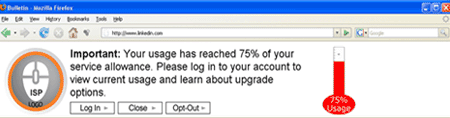
Are you using too much Internet service?  If your service provider thinks you are, it can alert you by barging in on your web-browsing sessions with forced notification messages warning you are about to be the latest victim of Internet Overcharging.

PerfTech, a maker of browser messaging systems has teamed up with Active Broadband Networks to deliver providers a way to notify up to two million subscribers about their broadband usage from just a single rack-based system.

“Feedback from ISPs who have deployed usage-based Internet tiers has confirmed that two factors are key to success: accurate usage measurement and quick, proactive notifications,” PerfTech vice president of sales Jane Christ said in a statement.

Most browser message injection systems are used to warn customers when they are approaching monthly usage limits or excessive use charges.  Some can even redirect web users to a single ISP-administered website to alert them their service has been suspended or request payment for additional usage with a credit card.

So far, only smaller U.S. providers are using PerfTech’s system, including WideOpenWest, BendBroadband in Oregon, and Buckeye Cable in Ohio.

  • WideOpenWest doesn’t appear to limit usage except for newsgroups.  According to their FAQ, users may download up to 5GB per month of newsgroup content;
  • Bend Broadband has a 100GB monthly limit on all but its highest speed Internet plan, which carries a 150GB monthly limit.  The overlimit fee is $1.50 per gigabyte.
  • Buckeye Cable favors “network management” techniques, which can slow down customers deemed to be using too much, at its discretion.  But the company does have a 3GB strict usage cap on newsgroup access.  Exceeding it is very costly.  The overlimit fee is a whopping $45 per gigabyte.

Wireless Providers Study Monetizing, Controlling Your Wi-Fi Use; Do We Need Wi-Fi Neutrality?

While wireless providers currently treat Wi-Fi as a friendly way to offload wireless data traffic from their 3G and 4G networks, the wireless industry is starting to ponder whether they can also earn additional profits from regulating your use of it.

Dean Bubley has written a white paper for the wireless industry exploring Wi-Fi use by smartphone owners, and ways the industry can potentially cash in on it.

“It is becoming increasingly clear that Wi-Fi access will be a strategic part of mobile operators’ future network plans,” Bubley writes. “There are multiple use cases, ranging from offloading congested cells, through to reducing overseas roaming costs and innovative in-venue services.”

Bubley’s paper explores the recent history of some cell phone providers aggressively trying to offload traffic from their congested 3G networks to more-grounded Wi-Fi networks.

Among the most intent:

  • AT&T, which acquired Wayport, a major Wireless ISP, and is placing Wi-Fi hotspots at various venues and in high traffic tourist areas in major cities and wants to seamlessly switch Apple iPhone users to Wi-Fi, where available, whenever possible;
  • PCCW in Hong Kong;
  • KT in the Republic of Korea, which has moved as much as 67 percent of its data traffic to Wi-Fi;
  • KDDI in Japan, which is planning to deploy as many as 100,000 Wi-Fi Hotspots across the country.

America's most aggressive data offloader is pushing more and more customers to using their Wi-Fi Hotspots.

Bubley says the congestion some carriers experience isn’t necessarily from users downloading too much or watching too many online shows.  Instead, it comes from “signalling congestion,” caused when a smartphone’s applications demand repeated attention from the carrier’s network.  An application that requires regular, but short IP traffic connections, can pose a bigger problem than a user simply downloading a file.  Moving this traffic to Wi-Fi can be a real resource-saver for wireless carriers.

Bubley notes many wireless companies would like to charge third-party developers fees to allow them access to each provider’s “app store.”  Applications that consume a lot of resources could be charged more by providers (or banned altogether), while those that “behave well” could theoretically be charged a lower fee.  The only thing preventing this type of a “two-sided business model,” charging both developers and consumers for the applications that work on smartphones, are Net Neutrality policies (or the threat of them) in many countries.

Instead, Bubley suggests, carriers should be more open and helpful with third party developers to assist them in developing more efficient applications on a voluntary basis.

Bubley also ponders future business strategies for Wi-Fi.  He explores the next generation of Wi-Fi networks that allow users to establish automatic connections to the best possible signal without ponderous log-in screens, and new clients that can intelligently search out and connect to approved networks without user intervention.  That means data traffic could theoretically be shifted to any authenticated or preferred Wi-Fi network without users having to mess with the phone’s settings.  At the same time, that same technology could be used to keep customers off of free, third party Wi-Fi networks, in favor of networks operators run themselves.

Policy controls are a major focus of Bubley’s paper.  While he advocates for customer-friendly use of such controls, sophisticated network management tools can also be used to make a fortune for wireless providers who want to nickle and dime customers to death with usage fees, or open up new markets pitching Wi-Fi networks to new customers.

Bubley

For example, a wireless carrier could sell a retail store ready-to-run Wi-Fi that pushes customers to a well-controlled, store-run network while customers shop — a network that forbids access to competitors or online merchants, in an effort to curtail browsing for items while comparing prices (or worse ordering) online from a competitor.

Customers could also face smartphones programmed to connect automatically to a Wi-Fi network, while excluding access to others while a “preferred” network is in range.  Wireless carriers could develop the same Internet Overcharging schemes for Wi-Fi use that they have rolled out for 3G and 4G wireless network access.  Also available: speed throttles for “non-preferred” applications, speed controls for less-valued ‘heavy users,’ and establishment of extra-fee “roaming charges” for using a non-preferred Wi-Fi network.

Bubley warns carriers not to go too far.

“[We] believe that operators need to internalize the concept of ‘WiFiNeutrality’ – actively blocking or impeding the user’s choice of hotspot or private Wi-Fi is likely to be as divisive and controversial as blocking particular Internet services,” Bubley writes.

In a blog entry, Bubley expands on this concept:

I’m increasingly convinced that mobile device / computing users will need sophisticated WiFi connection management tools in the near future. Specifically, ones that allow them to choose between multiple possible accesses in any given location, based on a variety of parameters. I’m also doubtful that anyone will want to allow a specific service provider’s software to take control and choose for them – at least not always.

We may see the emergence of “WiFi Neutrality” as an issue, if particular WiFi accesses start to be either blocked or “policy-managed” aggressively.

[flv width=”640″ height=”380″]http://www.phillipdampier.com/video/The Future of Wi-Fi.flv[/flv]

Edgar Figueroa, chief executive officer of The Wi-Fi Alliance, speaks about the future of Wi-Fi. Wi-Fi technology has matured dramatically since its introduction more than a decade ago and today we find Wi-Fi in a wide variety of applications, devices and environments.  (3 minutes)

All You Can Eat: New Zealand ISP Reintroduces Unlimited Usage Internet Service

Phillip Dampier August 11, 2011 Broadband Speed, Competition, Consumer News, Data Caps, Net Neutrality Comments Off on All You Can Eat: New Zealand ISP Reintroduces Unlimited Usage Internet Service

New Zealand is one of a handful of countries stuck with pervasive Internet Overcharging schemes that limit usage or throttle broadband speeds because of international connectivity limitations.  But as international underseas fiber cables ease traffic congestion, Internet Service Providers are increasingly relaxing usage caps and reducing the level of speed throttling during prime time usage hours.

Now one ISP, Slingshot, has gone all-out, reintroducing an unlimited, flat rate broadband option for New Zealanders who don’t want to worry about how much usage they’ve racked up over the past month.

For roughly $32.50US for the first six months, $65 after that, customers don’t have to watch a usage meter or “gas gauge” or face a wholesale heavy speed throttle when deemed to be using “too much” Internet service.

Slingshot’s “All You Can Eat” broadband plan thumbs its nose at providers who want to end an unlimited broadband buffet.

The promotion is limited to the first 5,000 new customers who sign-up before Sept. 30, and customers must bring their own modem and maintain a Slingshot landline to qualify.

Slingshot general manager Scott Page said the plan has proved attractive to customers who value knowing they will pay the same flat rate month after month, regardless of usage.  For these customers, having unlimited download capacity is more important than achieving the fastest possible broadband speeds.  But Page noted they have customers who manage to download more than a terabyte a month on their unlimited plan.

Like many providers in the South Pacific, Slingshot uses “network management” to prioritize traffic under this scheme, in order of highest priority to least:

VOIP > Gaming > Browsing > Streaming > Local traffic > File sharing, including Peer-to-Peer (P2P)

Slingshot has received mixed reviews from customers in different parts of the country.  Some areas achieve faster speeds than others, primarily because the company relies on Telecom-provided landlines for its DSL service.  When the network is especially busy, those using peer-to-peer software may find that service considerably slowed.

New Zealand is moving incrementally away from usage limits.  Vodafone recently increased data allowances by 50 percent for their landline broadband customers and Telecom is doubling broadband allowances for many of their customers as well.

Cricket Drives Away Mobile Broadband Customers With Internet Overcharging Scheme

Phillip Dampier August 4, 2011 Audio, Broadband Speed, Competition, Cricket, Data Caps, Wireless Broadband Comments Off on Cricket Drives Away Mobile Broadband Customers With Internet Overcharging Scheme

Leap Wireless is trying to save face on less-than-impressive second quarter financial results showing the company is losing its mobile broadband customers who are increasingly weary of Cricket’s price increases and speed throttles.

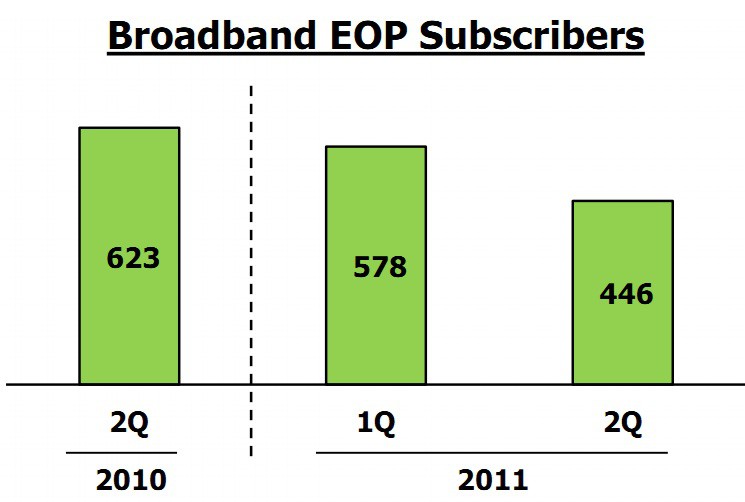
The company lost at least 132,000 broadband customers since the first quarter, mostly due to price increases, reduced usage allowances and “network management” practices, which reduce speeds to near dial-up for customers who are deemed to be “using too much.”

“On broadband, we tightened our focus to more profitable customers while shedding less profitable ones,” said Leap Wireless CEO Douglas Hutcheson.

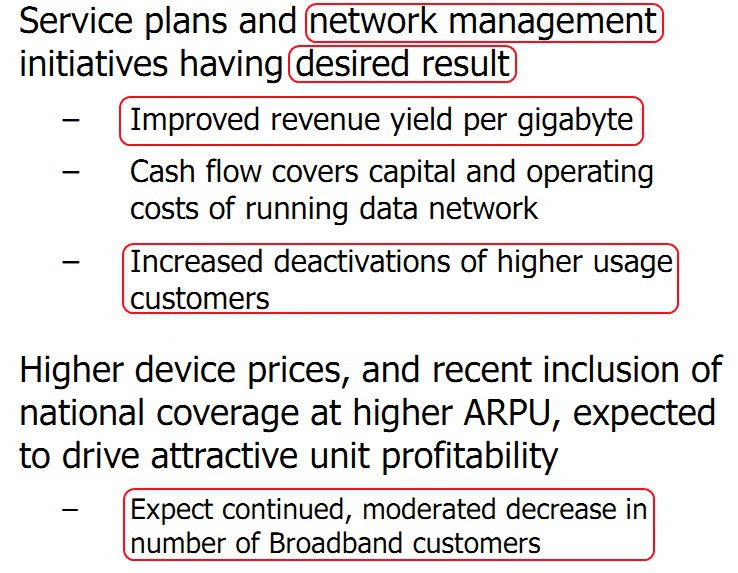
Internet Overcharging Facts of Life: What 'Network Management' tools are really used for. (Courtesy: Cricket's Second Quarter Results Investor Presentation)

Cricket recently announced increased pricing on their usage limited plans: $45/month for 2.5GB, $55/month for 5GB, or $65/month for 7.5GB.

With a less-than-robust regional 3G network and higher pricing, broadband customers have decided to take their business elsewhere, despite the company’s recently announced expanded data roaming agreement with Sprint.

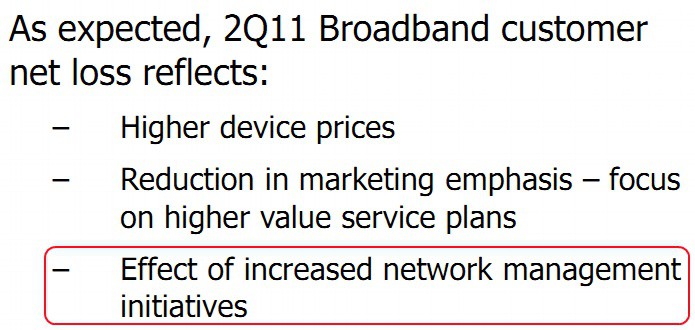
Cricket acknowledges their “increased network management initiatives” are partly to blame for the loss, but the company also says increased prices for mobile broadband devices, which used to be available for free after rebate, are also responsible.  Cricket’s least expensive mobile broadband modem now runs just under $90.

Company officials told investors the losses “were expected,” and that the company has been trying to make up the difference with higher value smartphone data plans.  Mobile broadband customers tend to consume more data than smartphone users, so the company’s emphasis on smartphone data users, who use less, will deliver increased revenue at a reduced cost.

Cricket’s CEO explains the company’s renewed focus on keeping highly-profitable mobile broadband customers while effectively getting rid of “heavy users” who have been targeted with aggressive speed throttling over the past year, and now face higher prices for lower usage allowances. Also explored: Cricket’s future 4G LTE network buildout.  August 3, 2011.  (4 minutes)
You must remain on this page to hear the clip, or you can download the clip and listen later.

Cricket's declining mobile broadband business

In fact, the company’s presentation to investors credits network management tools for driving away “higher usage customers,” allowing Cricket to reap the benefit of “improved revenue yield per gigabyte.”  In short, that means Cricket profits handsomely from data plans they hope customers will only occasionally use.

One of Cricket’s biggest product priorities this year is pitching its Muve Music service, bundled into an all-inclusive $55 wireless prepaid phone plan.  It gives Muve phone customers unlimited access to an enormous downloadable music library accessed on the phone.  Since the service does not allow customers to transfer the music to other devices, record companies are happy to participate.

The biggest downside for some is that the Muve phone becomes your music player — a phone many customers consider a work in progress.  Some critics have labeled the service a “total fail” because of sound quality and DRM restrictions. But since the service is already bundled into the wireless plan at no additional cost, more than 100,000 customers are using it, downloading at least 130 million songs since it was first introduced in January.

Muve Music is another way Cricket is trying to differentiate itself from other wireless providers, and the company may try to expand the Muve Music service to much-more-profitable smartphones in the near future. Cricket hopes to begin selling no-contract smartphones at prices below $100 by Christmas.

Cricket executives answer questions from Wall Street about how the company intends to deal with a decline in mobile broadband customers, and explains their use of network speed throttles. Cricket plans to “follow industry trends” and experiment with “session-based” throttles sometime next year. These allow customers to pay an extra charge to temporarily remove the speed throttle when they need additional bandwidth. It’s just one more source of lucrative revenue from conjured up network management schemes.  August 3, 2011.  (4 minutes)
You must remain on this page to hear the clip, or you can download the clip and listen later.

Cricket is also planning further expansion of its ‘welfare wireless’ plan — a Universal Service Fund-backed home phone replacement for customers receiving public assistance.  The Lifeline USF subsidy is designed to provide affordable home telephone service to the most income-challenged among us.  Many landline providers charge around $1 a month for the service (before fees), and then charge for every call made.

Cricket’s implementation of this subsidy could draw some controversy because it delivers a $13.50 monthly discount off -any- of their rate plans.  That means qualified customers could pay just over $40 a month for a high end smartphone service plan, subsidized by every telephone ratepayer in the country.

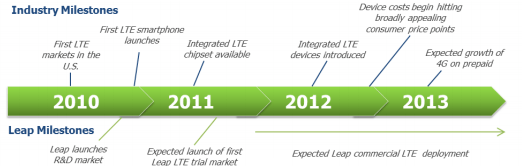
Cricket also plans to launch LTE 4G service starting in early 2012.

Cricket plans to introduce 4G LTE service in 2012.

Public Knowledge Dips Its Toe Into Fight Against Internet Overcharging – Learn From Canada

Phillip Dampier May 9, 2011 AT&T, Bell (Canada), Broadband "Shortage", Canada, Competition, Data Caps, Editorial & Site News, Public Policy & Gov't, Video, Wireless Broadband Comments Off on Public Knowledge Dips Its Toe Into Fight Against Internet Overcharging – Learn From Canada

Among the public interest groups that have historically steered clear of the fight against usage caps and usage based billing is Public Knowledge.

Stop the Cap! took them to task more than a year ago for defending the implementation of these unjustified hidden rate hikes and usage limits.  Since then, we welcome the fact the group has increasingly been trending towards the pro-consumer, anti-cap position, but they still have some road to travel.

Public Knowledge, joined by New America Foundation’s Open Technology Initiative, has sent a letter to the Federal Communications Commission expressing concern over AT&T’s implementation of usage caps and asking for an investigation:

[…] Public Knowledge and New America Foundation’s Open Technology Initiative urge the Bureau to exercise its statutory authority to fully investigate the nature, purpose, impact of those caps upon consumers. The need to fully understand the nature of broadband caps is made all the more urgent by the recent decision by AT&T to break with past industry practice and convert its data cap into a revenue source.

[…] Caps on broadband usage imposed by Internet Service Providers (ISPs) can undermine the very goals that the Commission has committed itself to championing. While broadband caps are not inherently problematic, they carry the omnipresent temptation to act in anticompetitive and monopolistic ways. Unless they are clearly and transparently justified to address legitimate network capacity concerns, caps can work directly against the promise of broadband access.

The groups call out AT&T for its usage cap and overlimit fee model, and ponder whether these are more about revenue enhancement than network management.  The answer to that question has been clear for more than two years now: it’s all about the money.

The two groups are to be commended for raising the issue with the FCC, but they are dead wrong about caps not being inherently problematic.  Usage caps have no place in the North American wired broadband market.  Even in Canada, providers like Bell have failed to make a case justifying their implementation.  What began as an argument about congestion has evolved into one about charging heavy users more to invest in upgrades that are simply not happening on a widespread basis.  The specific argument used is tailored to the audience: complaints about congestion to government officials, denials of congestion issues to shareholders coupled with promotion of usage pricing as a revenue enhancer.

If Bell can’t sell the Canadian government on its arguments for usage caps in a country that has a far lower population density and a much larger rural expanse to wire, AT&T certainly isn’t going to have a case in the United States, and they don’t.

The history of these schemes is clear:

  1. Providers historically conflate their wireless broadband platforms with wired broadband when arguing for Internet Overcharging schemes.  When regulators agree to arguments that wireless capacity problems justify usage limits, extending those limits to wired broadband gets carried along for the ride.  Dollar-a-holler groups supporting the industry love to use charts showing wireless data growth, and claim a similar problem afflicts wired broadband, even though the costs to cope with congestion are very different on the two platforms.
  2. Providers argue one thing while implementing another.  Most make the claim pricing changes allow them to introduce discounted “light user” plans.  But few save because true “pay only for what you use” usage-based billing is not on offer.  Instead, worry-free flat use plans are taken off the menu, replaced with tiered plans that force subscribers to guess their usage.  If they guess too little, a stiff overlimit fee applies.  If they guess too much, they overpay.  Heads AT&T wins, tails you lose.  That’s a clear warning providers are addressing revenue enhancement, not network enhancement.
  3. Claims of network congestion backed up with raw data, average usage per user, and the costs to address it are all labeled proprietary business information and are not available for independent inspection.

There are a few other issues:

In the world of broadband data caps, the caps recently implemented by AT&T are particularly aggressive. Unlike competitors whose caps appear to be at least nominally linked to congestions during peak-use periods, AT&T seeks to convert caps into a profit center by charging additional fees to customers who exceed the cap. In addition to concerns raised by broadband caps generally, such a practice produces a perverse incentive for AT&T to avoid raising its cap even as its own capacity expands.

In North America, only a handful of providers use peak-usage pricing for wired broadband.  Cable One, America’s 10th largest cable operator is among the largest, and they serve fewer than one million customers.  Virtually all providers with usage caps count both upstream and downstream data traffic 24 hours a day against a fixed usage allowance.  The largest — Comcast — does not charge an excessive usage fee.  AT&T does.

Furthermore, it remains unclear why AT&T’s recently announced caps are, at best, equal to those imposed by Comcast over two years ago.  The caps for residential DSL customers are a full 100GB lower than those Comcast saw fit to offer in mid-2008. The lower caps for DSL customers is especially worrying because one of the traditional selling points of DSL networks is that their dedicated circuit design helps to mitigate the impacts of heavy users on the rest of the network. Together, these caps suggest either that AT&T’s current network compares poorly to that of a major competitor circa 2008 or that there are non-network management motivations behind their creation.
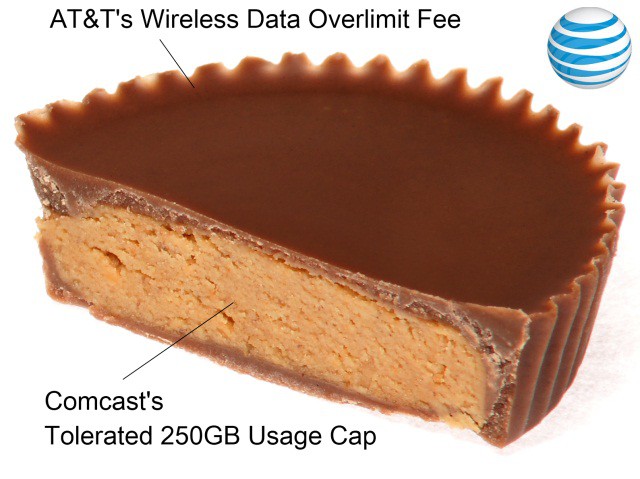
AT&T has managed to create the first Internet version of the Reese's Peanut Butter Cup, combining Comcast's 'tolerated' 250GB cap with AT&T's style of slapping overlimit fees on data plans from their wireless business.

As Stop the Cap! has always argued, usage caps are highly arbitrary.  Providers always believe their usage caps are the best and most fair around, whether it was Frontier’s 5GB usage limit or Comcast’s 250GB limit.

AT&T experimented with usage limits in Reno, Nevada and Beaumont, Texas and found customers loathed them.  Comcast’s customers tolerate the cable company’s 250GB usage cap because it is not strictly enforced — only the top few violators are issued warning letters.  AT&T has established America’s first Internet pricing version of the Reese’s Peanut Butter Cup: getting Comcast’s tolerated usage cap into AT&T’s wireless-side overlimit fee.  The bitter aftertaste arrives in the mail at the end of the month.

Why establish different usage caps for DSL and U-verse?  Marketing, of course.  This is about money, remember?

AT&T DSL delivers far less average revenue per customer than its triple-play U-verse service.  To give U-verse a higher value proposition, AT&T supplies a more generous usage allowance.  Message: upgrade from DSL for a better broadband experience.

Technically, there is no reason to enforce either usage allowance, as AT&T DSL offers a dedicated connection to the central office or D-SLAM, from where fiber traditionally carries the signal to AT&T’s enormous backbone connection.  U-verse delivers fiber to the neighborhood and a much fatter dedicated pipeline into individual subscriber homes to deliver its phone, Internet, and video services.

A usage cap on U-verse makes as much sense as putting a coin meter on the television or charging for every phone call, something AT&T abandoned with their flat rate local and long distance plans.

Before partly granting AT&T’s premise that usage limits are a prophylactic for congestion and then advocate they be administered with oversight, why not demand proof that such pricing and usage schemes are necessary in the first place.  With independent verification of the raw data, providers like AT&T will find that an insurmountable challenge, especially if they have to open their books.

[flv width=”640″ height=”368″]http://www.phillipdampier.com/video/Bell’s Arguments for UBB 2-2011.flv[/flv]

Canada’s experience with Usage-Based Billing has all of the hallmarks of the kind of consumer ripoff AT&T wants Americans to endure:

  • A provider (Bell), whose spokesman argues for these pricing schemes to address congestion and “fairness,” even as that same spokesman admits there is no congestion problem;
  • Would-be competitors being priced out of the marketplace because they lack the infrastructure, access, or fair pricing to compete;
  • Big bankers and investors who applaud price gouging and are appalled at government checks and balances.

Watch Mirko Bibic try to rationalize why Bell’s Fibe TV (equivalent to AT&T U-verse) needs Internet Overcharging schemes for broadband, but suffers no capacity issues delivering video and phone calls over the exact same line.  Then watch the company try and spin this pricing as an issue of fairness, even as an investor applauds the company: “I love this policy because I am a shareholder.  That’s all I care about.  If you can suck every last cent out of users, I’m happy for you.”  Finally, watch a company buying wholesale access from Bell let the cat out of the bag — broadband usage costs pennies per gigabyte, not the several dollars many providers want to charge.  (11 minutes)

Search This Site:

Contributions:

Recent Comments:

Your Account:

Stop the Cap!