Home » network management » Recent Articles:

Bad Analogies from MSNBC Columnist Illustrate Lazy ‘Journalism’ from a Future Comcast Employee

No, don't get up. We've got it.

Want an example of the kind of lazy journalism you get from one of America’s largest news operations, about to become a part of the Comcast family?  Look no further than MSNBC’s Wilson Rothman, who shared some serious Net Nonsense in his piece: ‘Open’ Internet just a pipedream.

Rothman apologized in a tweet after publishing the essay, admitting it was “cynical.”  But we want to know where the apology is for being wrong on the actual facts.

The author tells readers it’s a Comcast world this winter:

As long as you buy Internet access via cable provider, wireless carrier or telecom, you’re going to have to play — or at least pay — by their rules. They’ll just have to make sure to tell you what those rules are. That seems to be the real gist of the FCC order that was ratified today.

[…]The only people currently getting throttled by their broadband providers are file-sharing pirates who wouldn’t be protected by any net neutrality regulation anyway; meanwhile, wired and wireless broadband networks are increasingly controlled by a smaller, more powerful cadre of competitors.

Tiered pricing has to happen

You can use as much electricity from the power grid as you want, but you have to pay by the kilowatt hour. If you think of the Internet as a utility — and why shouldn’t you? — network management should look something like that. Prices offered by regulated private companies should be competitive and reasonable, but highly metered. Sadly, that means no more flat-fee unlimited access.

[…]I don’t mean to sound cynical, but I come at this from a technology background, not a legal or political one. What I see are all the ways in which “public” access to utilities become profit centers for increasingly massive companies.

After the break-up of the Bells, the phone companies eventually consolidated and worked their way back together like some kind of liquid-metal Terminator. The good news? Instead of a single monopolistic phone company, we have two Leviathans and some smaller fish. Long-distance service used to be their cash cow; now it’s wireless and broadband, and they’re not going to let those slip so easily.

“Give that man a raise,” said Brian Roberts, Comcast CEO.

Seriously, Rothman might come from a technology background, but he sure doesn’t know his way around the broadband public policy debate. Digging into the reasons for today’s broadband mess would require actual reporting.

Rothman suggests Americans are effectively required to accept today’s decision from the Federal Communications Commission.  That’s akin to telling Time Warner Cable customers they should have just knelt down to the cable company’s 2009 pricing experiments.  Or that North Carolina needed to padlock community broadband networks until they could be sold on eBay to the highest Big Telecom bidder.  Or that Frontier can and should get away with a 5GB usage cap.

We said no.  You said no.  And we won all three of those battles.

Today’s FCC vote has relevance only until the first major cable or phone company (or interested third party) files a lawsuit.  The outcome is predictable — the same court that threw out the FCC’s authority earlier this year will do so again, for many of the same reasons.  For consumers, that isn’t all bad.

Rothman’s claim that only pirates are victims of speed throttling is demonstrably false, and nothing less than journalistic malpractice.  Innocent consumers are routinely throttled on wireless and wireline broadband networks using “network management” technology.  Are Clear’s customers all pirates?  How about Cricket’s clients?  Exceeding an arbitrary amount of usage on these networks guarantees you a spot in the dial-up-like doghouse.

The author also misses the point about increasing consolidation in the Big Telecom marketplace.  Cadre?  Sure.  Competitors?  Hardly.  Most Americans endure a broadband duopoly for reasonable Internet access — a cable and phone company.  Cable and phone companies have quite a deal.  They effectively charge around the same price for service and never have to worry about a third cable or phone company entering the marketplace.  Cable companies don’t compete with other cable companies.  Same for telephone companies.  Community broadband networks deliver the only real competition some areas have, which is why Big Telecom wants to ban these upstarts wherever they can.  Big Telecom believes Americans should not get to choose an alternative cable company if Comcast delivers terrible service.  Consumers living in small communities like Penn Yan, N.Y., live with Verizon DSL, if they are lucky.  Outside of the immediate town limits, there isn’t a cable competitor, much less another phone company.  That’s the real “take it or leave it” Americans contend with.
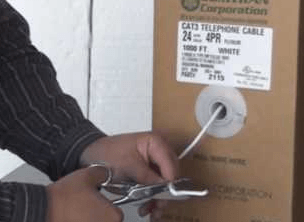
Rothman's electric utility analogy is as valid as charging for broadband by the foot.

Why shouldn’t Americans think of broadband as just another electric utility?  Because it isn’t.  This common talking point/analogy adopted by Rothman’s future employer has as much validity as pricing broadband by how many feet of wire was necessary to install it.

Broadband is neither a limited resource nor a product that requires a utility to purchase raw materials to perpetually generate.  His argument works only if a provider “generated” the actual content you consume online.  They don’t — they simply transport content from one point to another over a network that becomes enormously profitable once the initial construction costs are paid.  Rothman can discover this for himself reviewing the quarterly financials of broadband providers.  After billions in profits are counted, it’s clear this is one recession-proof industry that is hardly hurting.

It’s no mistake these analogies always leave out the one utility that is most comparable to broadband — telephone service.  You know, the one service that is rapidly moving towards unlimited, flat rate — talk all you want.  Providers using the consumption billing argument cannot afford to include phone service in their analogy, because then the ripoff would be exposed.  One would think a reporter for NBC News might have managed to figure that one out as well, but no.

The fact is, there is no healthy competition in broadband.  You know what that means — high prices for limited service.  Rothman seems ready and willing to take whatever Big Telecom wants to dish out, but then his paycheck is about to be paid by one of those companies, so he can afford to be cynical.

Unfortunately for his readers, Rothman is oblivious to the reasons why phone companies have consolidated and consumers are stuck with the results.  The recipe:

  • A multimillion dollar lobbying effort that includes huge contributions to politicians, astroturf “dollar-a-holler” groups paid to front for Big Telecom’s agenda, and a mess of scare tactics predicting horrible things if they do not get their way;
  • A supine media that simply accepts provider arguments as fact, deems the abusive practice that follow as inevitable, and apologizes later for being cynical;
  • An uninformed public that decreasingly relies on media companies that also happen to have direct financial interests in the outcome of these public policy debates.

Consumers have more power than Rothman thinks when they take a stand with elected officials.  When taking AT&T money becomes more costly than voting for their constituents, elected officials will do the right thing.  That takes individuals letting elected officials they are watching them closely on these issues.

Consumers can also tell their local elected officials that the Big Telecom Money Party needs to come to an end.  A community-owned broadband network that throws out the online toll booths and creates a network for Main Street instead of Wall Street is the functional equivalent of handing unruly Verizon and Comcast their coats and escorting them the door.
The Broadband Provider’s Holy Grail: Charging You for Every Web Application You Use

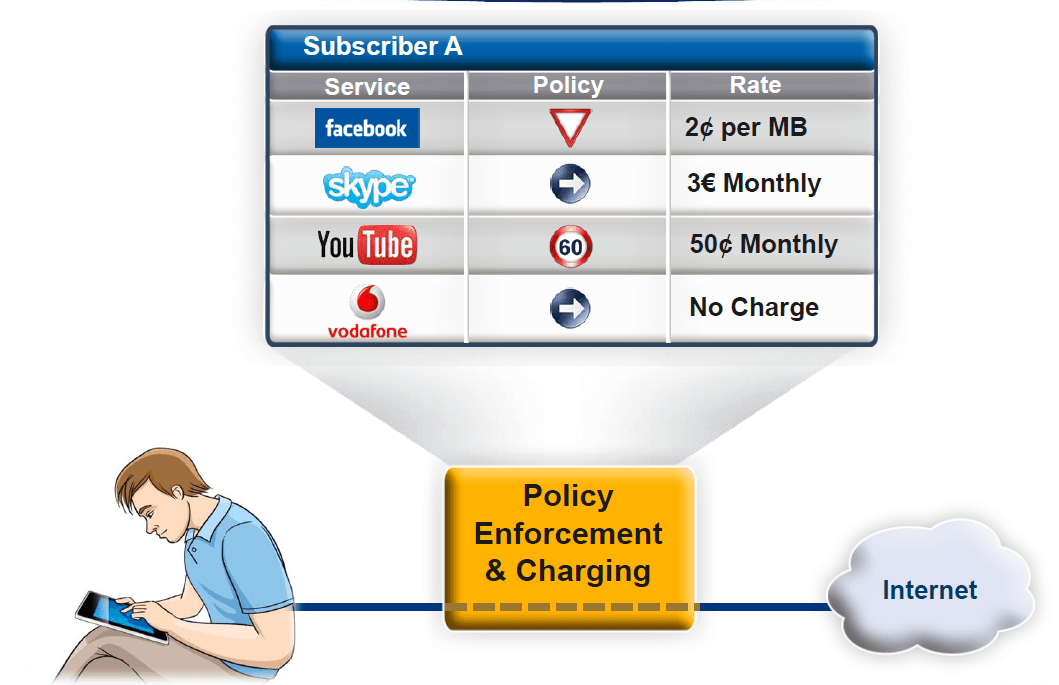
This slide, produced to sell "network management" equipment, is the best argument for Net Neutrality around.

Want to visit Facebook?  That will be two cents per megabyte, please.  Skype?  You can get a real bargain this month — your ISP is only charging you $5 for an unlimited monthly permission pass.  YouTube?  All customers with a deluxe bundled broadband plan get a special discount — just 50 cents for up to 60 videos, this month only!

All of these charges, levied by your Internet Service Provider, are real world scenarios being sold by two equipment vendors — Allot Communications and Openet, for immediate use on Net Neutrality-free wireless broadband networks.  Thanks to Stop the Cap! readers Lance and Damian for sending us the story.

Both companies are excited by the potential harvest of bountiful revenue — for themselves in selling the equipment that will carefully monitor what you do with your Internet connection and then control what kind of experience you get, and for providers who can finally bend the usage curve down while “finally” getting average revenue per customer shooting sky high once again.

In the webinar, run last Tuesday and moderated by Fierce Wireless, the two companies carefully divided their one hour presentation between the technological and financial benefits of “network management” technology.  For every statement about how their bandwidth management system would improve the predictable responsiveness of the provider’s network, another comment followed, touting the enormous new revenue potential this technology will bring providers, all without costly network upgrades.

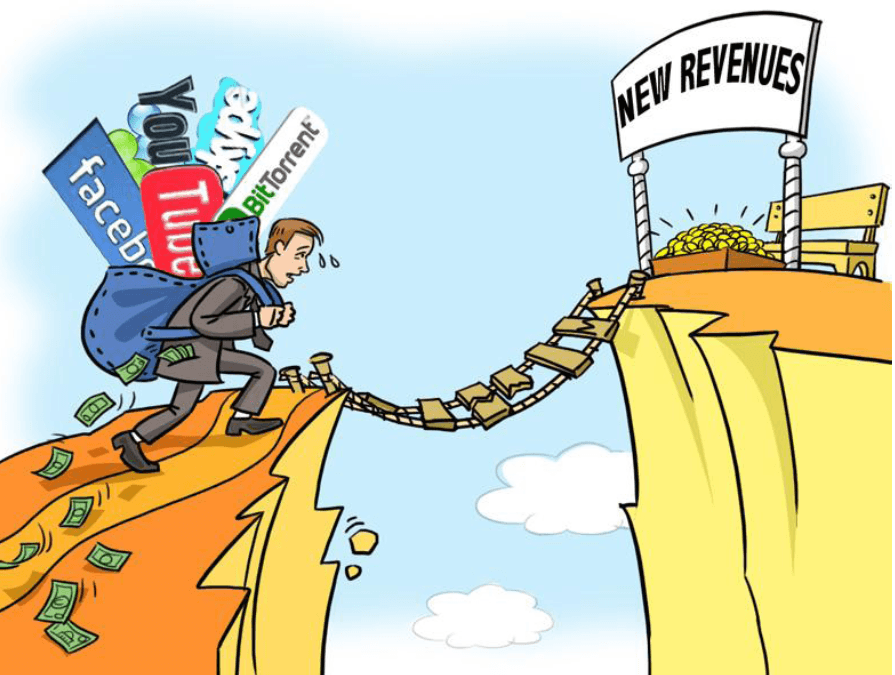
Poor provider. His stuffed pockets of profit are leaking your money paid to access websites you want to visit. But with Allot and Openet's products, the pot 'o gold is just a few steps away.

On Tuesday, the Federal Communications Commission will vote on a watered-down Net Neutrality proposal that would do nothing to prevent this nightmare scenario from becoming reality.  The webinar and its accompanying slides couldn’t illustrate Net Neutrality-proponents’ arguments better:

1. Such technology requires providers to carefully track and monitor everything you do with your web connection, obliterating privacy and creating a potential data trail that could be exploited for just about anything.  Indeed, Allot and Openet treat the data tracking feature as a benefit, opening the door to marketing campaigns to upsell your broadband connection or target upgrade offers based on your web history;

2. It’s all about the money.  Allot and Openet see their products as a cost-saver for providers to control expenses by cutting speeds/access for heavy users to provide a more consistent service for others, reducing the urgency to upgrade networks.  The companies also heavily focus on the revenue opportunities available from Internet Overcharging schemes;

3. The webinar includes a slide showing that providers can charge individual fees just to visit and utilize third party websites and applications, while letting providers deliver their own content, services and applications for free.  Got a bothersome competitor?  Just make a quick change with Allot’s product and your customers will face a withering admission fee in the amount you choose before they can even use the application;

4. The technology allows providers to wreak special havoc on peer-to-peer traffic, always the bane of traffic-conscious ISPs;

5. Want to extract more cash from an individual subscriber?  Providers can custom-design packages based on web site habits, usage, speed, and even the time of day the person is most likely to use the web.  Providers can then develop so many different usage packages, comparison shopping becomes meaningless.  The price you pay may be different than what others on your street pay, and you may never know by how much or why.

These Big Telecom workmen are not hard at work upgrading networks to meet demand. They are wrangling an Internet Overcharging scheme to reduce your usage while charging you more. (All of these slides were produced by the vendors themselves.)

Public Knowledge legal director Harold Feld saw right through the slide show: “If you want the slide deck to show why we need the same rules for wireless and wireline, this is it.”

Listen to the audio portion of “Managing the Unmanageable: Monetizing and Controlling OTT Applications,” which does not include the slide show. (60 minutes)
You must remain on this page to hear the clip, or you can download the clip and listen later.

<

p style=”text-align: center;”>

Broadband advocates have been warning providers have been dreaming of this kind of pricing for a few years now.

“I have been saying that this is where they want to go for a while,” Barbara van Schewick wrote to Wired. “The IP Multimedia Subsystem (IMS), a technology that is being deployed in many wireline and wireless networks throughout the country, explicitly envisages this sort of pricing as one of the pricing schemes supported by IMS.”

Although the system described by the webinar is currently being sold for use on wireless networks, nothing prevents providers from adopting similar schemes on their wired networks, arguing their use is about “intelligent network management,” not content or pricing discrimination.

It’s a scenario likely to be tested soon, especially with FCC Chairman Julius Genachowski’s watered down Net Neutrality proposals.  More than one observer believes the chairman has made a deal with the Big Telecom Devil: observe our watered down rules, don’t sue to have them thrown out, and the Commission will not invoke Title II and reinstate regulatory authority over broadband.

But as anyone who watches the broadband industry must realize by now, providers always break these deals.  They will sue the moment a controversy erupts that is not in their favor, and they are very likely to win.

A Welcome Change: League of United Latin American Citizens (LULAC) Does Net Neutrality Right

Phillip Dampier December 16, 2010 Astroturf, AT&T, Data Caps, Editorial & Site News, Net Neutrality, Public Policy & Gov't, Rural Broadband, Verizon, Video, Wireless Broadband Comments Off on A Welcome Change: League of United Latin American Citizens (LULAC) Does Net Neutrality Right

In a welcome turn of events, the League of United Latin American Citizens (LULAC), which has routinely turned up as a member of Big Telecom-backed astroturf campaigns and takes money from AT&T, has come together with Latinos for Internet Freedom to issue a joint statement calling on the Federal Communications Commission to adopt equal Net Neutrality policies for wired and wireless broadband services.

“Although we disagree on some of the components of the proposed network neutrality regulations, there is one point on which we are in lock step: the FCC’s network neutrality rules must apply equally to wireline and wireless internet access.  Of course we understand that what is ‘reasonable network management’ may be slightly different over different types of connections.  Cost is the primary barrier to broadband adoption, and Latinos are turning to their mobile phones as their only onramp to the internet.  We are committed to finding ways to lower broadband costs by increasing competition through wireless access and other means.  It is therefore essential that the FCC ensures that users of wireless and wireline services are protected by its openness rules.”

Of course, broadband providers’ demands for deregulation and unified opposition to Net Neutrality have never delivered and will never provide cheaper Internet service to anyone.  In fact, the court ruling that eliminated the FCC’s authority over broadband gave providers nearly a year of a wide open marketplace, yet many providers are now sending out notices they are -increasing- broadband prices for subscribers.  Net Neutrality has never been enforced against wireless networks either, and as a result most either usage cap, throttle, or charge enormous overlimit fees for users deemed to be “using too much.”

Increased competition can bring lower prices, but only if it extends well beyond today’s duopoly.  In areas where one provider is likely to maintain a de facto monopoly, effective oversight is required to ensure consumers receive adequate service at fair prices.

Still, it is a surprising and welcome change to see LULAC recognizing the true nature of broadband access for many economically-challenged Americans, especially in minority communities where unemployment continues to be catastrophic.  Some consumers are finding prepaid wireless broadband service to be one way onto the Internet, yet Big Telecom has sought to keep those networks exempt from any Net Neutrality consumer protections.  That cannot be allowed to happen.

[flv width=”640″ height=”380″]http://www.phillipdampier.com/video/Verizon vs. Latinos for Internet Freedom.flv[/flv]

Watch these two competing spots from Verizon and the Latinos for Internet Freedom.  One is self-serving and a tad condescending, the other calls for a free and open Internet where individuals get a level playing field to tell their own stories and live their own lives without fear or special favor.  (2 minutes)

Clear’s Unclear Internet Overcharging Scheme Subject of a Class Action Lawsuit in Washington State

Phillip Dampier December 16, 2010 Broadband Speed, Consumer News, Data Caps, Wireless Broadband Comments Off on Clear’s Unclear Internet Overcharging Scheme Subject of a Class Action Lawsuit in Washington State

Clearwire’s often-unclear “network management” policies are the subject of a lawsuit filed yesterday in Seattle seeking class action status.

Angelo Dennings vs. Clearwire Corporation was filed in the Western District of Washington federal court, and seeks refunds for consumers who were mislead by the company’s failure to disclose its network speed throttling and usage limitations, and charged early termination fees when subsequently canceling service.

Clearwire promises that its high-speed Internet service provides a “fast” and “always on, always secure” Internet connection allowing users to “[d]ownload pictures, music and videos.” But Clearwire does not provide an “always on,” “high-speed” connection as it promises. Clearwire purposefully slows the connection of its users because it cannot accommodate the high volume of traffic. Clearwire engages in a practice known as “throttling,” which is the intentional delay and/or blocking of Internet communications. This practice deprives Clearwire customers of the ability to “[d]ownload music and videos,” and leads to slow connection speeds.  Clearwire engages in throttling at times when demand for Internet use is highest, beginning at approximately 7:30 p.m. and ending at about 1:00-to-2:00 a.m.

If users attempt to cancel their service, Clearwire claims that, pursuant to its “contract” with them, it is entitled to collect an early termination or a re-stocking fee. The “contract” referred to by Clearwire is not a contract between it and its customers. The contract between Clearwire and its customers is simply that the customers will pay for, and Clearwire will provide, “unlimited” Internet usage at certain speeds, depending on the speed and payment plan selected in Clearwire’s stores, kiosks, or online.

The remaining “terms” invoked by Clearwire at its convenience are embedded in a document that consumers never see prior to subscribing to Clearwire’s service. Clearwire sells its services in its stores, kiosks at shopping centers, and online. Clearwire’s stores and kiosks do not have copies of this “contract” on hand for potential subscribers to read before they “agree” to its terms. Users who subscribe through Clearwire’s website never see the contract either because the link to it is at the bottom of a page, in substantially smaller font and lighter shade than all of the other text on the page. The text states: “Want to read the fine print (and who doesn’t read the fine print?) It’s all there in the CLEAR Legal Index.” No one wants to read fine print legalese and almost no one does. The statement is obviously and sharply ironic, and mocks anyone who may have been fussy enough to have considered continuing.

Despite not showing its terms to consumers, Clearwire refuses to allow users to cancel their service without paying the unconscionable fees it claims it is owed under this “contract.” These fees include an early termination fee (“ETF”), which penalizes consumers that want out before the end of the two-year term. Although Clearwire breached its contract with its customers, Clearwire insists on the payment of this ETF when customers realize they are not getting what they bargained for.

The suit argues that Clearwire has oversold its wireless broadband network, and allegedly quotes a company representative at one point telling Dennings, “Clearwire had signed up more customers than its cell towers could accommodate, and that therefore it was ‘managing’ users’ accounts.”

Attorney Clifford Cantor argues in the filing that Clearwire reduces customer speeds to 300kbps or lower when their network is congested, making the service unsuitable for most broadband applications.  Dennings, who lives near Ft. Worth, Tex., was outraged to learn Clear sold him a home and mobile broadband account that was advertised as a replacement for wired cable or DSL broadband, but was left with service he considered largely useless when throttled.  Even more upsetting, the suit alleges, Denning was asked to pay a $219 early contract termination and restocking fee when he tried to cancel service over the matter.

Cantor is asking for a court ruling declaring Clear’s policies to be unconscionable, attorneys’ fees of at least $5,000, and refunds for all impacted subscribers.

Thanks to Stop the Cap! reader Michael in Chicago for sending along a copy of the lawsuit.  He runs the “Clear/Clearwire internet not as advertised” Facebook group.

Net Neutered: The Cowardly Lion is Back — FCC Chairman Caves In With Homeopathic Net Reform

The Cowardly Lion is back.

Federal Communications Commission chairman Julius Genachowski believes he has a sound legal basis to implement Net Neutrality policies to protect Internet traffic from provider interference, but has stopped considerably short of implementing his own proposed enforcement mechanisms.

Genachowski outlined his ideas to implement Net Neutrality reform in brief remarks before the Commission this morning.

“Broadband providers have natural business incentives to leverage their position as gatekeepers to the Internet,” the text of the speech says. “The record in the proceeding we’ve run over the past year, as well as history, shows that there are real risks to the Internet’s continued freedom and openness.”

Genachowski praised the progress the Internet has managed to achieve over the past decade, and said his efforts would ensure that progress could continue with a minimum of regulation.  In that spirit, Genachowski announced he would not move that the Commission re-assert its legal authority to oversee broadband by a process to reclassify the service under Title II, which governs telecommunications services.

Comcast successfully sued for repeal of the Commission’s original authority, implemented by Bush FCC chairman Michael Powell, which classified broadband as “an information service.”  A DC Circuit Court discarded the legal basis for Powell’s regulatory authority in a sweeping victory for the cable giant, which was sued for throttling down speeds for broadband customers using peer to peer applications.

Genachowski argued he has “a sound legal basis” to pursue his latest vision of Net Neutrality rules in spite of the earlier court case.  But critics doubt that and charge that the FCC chairman has capitulated to America’s largest broadband providers, including Comcast, AT&T, and Verizon.

Genachowski's view of the Internet does not meet the realities consumers face without Net Neutrality protection assuring a free and open Internet.

“By not restoring the FCC’s authority, Chairman Genachowski is unnecessarily placing his Net Neutrality agenda, and indeed his entire broadband agenda, at risk,” said Free Press executive director Josh Silver.

Boiled down, Genachowski now seeks just two major principles governing provider behavior:

  1. No censorship of content.
  2. Full disclosure of network management techniques so consumers know what providers are doing to their broadband connections.

Consumer groups are furious that the chairman has apparently discarded many of Net Neutrality’s most important consumer protections, and accused him of caving in to lobbyist demands and abdicating his responsibility to oversee critical broadband infrastructure.

Marvin Ammori, a cyber-activist and public interest law professor said the proposal also fell well short of meeting President Barack Obama’s repeated promises to enact strong Net Neutrality policies.

“It’s make-believe Net Neutrality,” said Ammori, who called Genachowski’s proposals “garbage” and “meaningless gestures.”

Now off the table:

A ban on Internet Overcharging schemes that allow providers to limit, throttle, or overcharge consumers who use more than an arbitrary amount of Internet usage per month. This exposes home broadband users to the same kinds of bill shock that wireless customers already experience.

A ban on using “network management” to artificially slow or block traffic the provider — at its sole discretion — determines is “harmful” or “congests” their network. Under Genachowski’s new proposal, the definition of “harmful” could be made by an engineering department on technical grounds or in an executive suite as companies ponder their financial returns. So long as they manage traffic without “unreasonable discrimination,” it’s okay with the Commission.

Built-in loopholes guarantee providers need only set rates high enough to assure only “preferred partners” can afford the asking price, and that only their competitors meet the definition of “harmful” traffic worthy of speed throttling.  The proposal also reportedly only covers video and voice traffic on wireless networks.  It’s open season on everything else if you access the web from a smartphone or wireless broadband service.

Actual legal authority to implement any broadband reform policies. It was Julius Genachowski and the FCC’s General Counsel Austin C. Schlick that argued without asserting legal authority under Title II, nothing the Commission did could be assured of withstanding a court challenge.  Yet today the chairman now claims his legal team has found some legal precedents that somehow will keep his policies in force after inevitable lawsuits are filed.  Former FCC chairman Powell thought much the same thing about his own idea of reclassifying broadband as “an information service.”  The DC Court of Appeals thought otherwise, something Schlick knows personally, having fought the Comcast case before that court.  In the end, Schlick correctly guessed his case was a train wreck, and was reduced to asking the court for legal pointers about how to draft regulations that could survive a court challenge.

[flv width=”640″ height=”380″]http://www.phillipdampier.com/video/The Third Way The Future of Internet Policy in America 5-2010.flv[/flv]

This “other” Julius Genachowski from May of this year delivered remarks that carried a very different tone about the importance of restoring legal authority to oversee broadband.  But that was before AT&T put him on their speed dial, successfully reaching him personally more than a half dozen times in the last few weeks to argue their point of view.  Consumers don’t have Julius Genachowski’s phone number.  (4 minutes)

In short, Genachowski’s proposals represent near-total victory for providers, and any cable or phone company annoyed with the few scraps still on the agenda need only file suit arguing the Commission lacks the authority to stick its nose into their business affairs.  Without Title II authority in place, that lawsuit is probably going to result in a favorable ruling putting us back where we are today — with no Net Neutrality protections.  But by then, the Internet will be a very different place, loaded with toll booths from content providers and your ISP, who may ask for extra money if you want to watch Netflix or download files.  Your speeds may be reduced at any time, to any level, if a provider deems you’ve over-consumed your traffic allowance for that day, week, or month.

Worse, some providers will dispatch bills with overlimit fees that could run into the hundreds of dollars (or more) for those with a family member who left a high bandwidth application running while running out the door to catch the school bus.

Providers and their well-paid lobbyists celebrate their victory over consumers' wallets

So long as providers agree to abuse everyone more or less equally (excepting their own “preferred partners” of course), Julius Genachowski believes the next ten years of America’s online experience can be as great as the last.

In his dreams.  As Public Justice attorney Paul Bland said about dealing with ruthless companies like AT&T, assuming providers will behave favorably towards consumers puts you on the candy bridge into Rainbow Land.

Even with Genachowski’s proposed reforms, diluted to be point of being homeopathic, Republicans were moving in for the kill this morning.

Rep. Marsha Blackburn (R-Tenn.) a member of the House Energy and Commerce Committee, said she would work to topple any FCC-led Net Neutrality order.

“This is a hysterical reaction by the FCC to a hypothetical problem,” she said, adding that Genachowski “has little if any congressional support” for the action.

To overturn any order, Blackburn vowed to reintroduce her bill to prevent the FCC’s policy making process.

Robert McDowell, one of two Republican FCC commissioners, called the move to enact reforms a defiance against Congressional will.

“Minutes before midnight last night, Chairman Genachowski announced his intent to adopt sweeping regulations of Internet network management at the FCC’s open meeting on December 21. I strongly oppose this ill-advised maneuver. Such rules would upend three decades of bipartisan and international consensus that the Internet is best able to thrive in the absence of regulation,” McDowell said in a prepared statement.

All this is taking place at the same time Comcast has foreshadowed America’s future broadband experience: charging backbone provider Level 3 extra for sending Comcast customers online movies and TV shows, censored a blog run by one of its customers trying to get around Comcast’s unresponsive customer service agents, stifled innovation by independent cable modem manufacturer Zoom Modems, has achieved a fever pitch in lobbying Washington to hurry up and approve its colossal merger deal with NBC-Universal, and has a lobbying team convinced it can achieve victory on all fronts from a favorable incoming Congress.

If they and other broadband providers succeed, it’s time to get out your wallet and count your money before handing it over.  A consumer revolt is all that stands between your Internet experience today and an endless series of pay-walls and stifled speeds tomorrow.

Search This Site:

Contributions:

Recent Comments:

Your Account:

Stop the Cap!