T-Mobile is suspicious about the value of forthcoming family shared data plans likely to be introduced by its larger competitors AT&T and Verizon Wireless later this year.
Andrew Sherrard, senior vice president of marketing for T-Mobile announced the company would not jump on the family data bandwagon, preferring to leave the current model of individual data plans for each device in place:
Some of our competitors are backing away from simple, unlimited data and moving to family shared data plans. But would this approach actually deliver a better value to consumers? Do families really want to keep track of each others’ data consumption? We don’t think so. Just imagine mom’s email is suddenly unavailable because her teenage son watched an HD movie on his phone, consuming the family’s data allotment.
T-Mobile believes that consumers today do not want a ‘one size fits all’ approach to shared family data plans, nor would they benefit from that model. So, what is the right way to price data for customers who want affordable, unlimited access to what, unfortunately, is a limited resource?
Here’s how we see it:
Data plans should be flexible and affordable. At T-Mobile, customers have the option of only paying for the amount of data each member of the family believes they will need. Customers can choose affordable no-annual-contract data for tablets and other data-only products they share – paying every month or buying in daily or weekly installments.
Data should be worry-free. With our unlimited data plans, there is no surprise data cap or bill shock. Customers simply pay each month for the amount of high-speed data they select and (in contrast to our competitors) T-Mobile customers can continue to use mobile data on their device at reduced speeds after they reach their limit without incurring overage charges.
Customers who pay more, should get more. T-Mobile smartphone customers with 5GB or 10GB data plans also get our Smartphone Mobile Hotspot feature included. This means, with a capable T-Mobile smartphone (most are), customers can power up to five Wi-Fi enabled devices with fast, 4G data. So rather than needing to account for each device on a shared family data plan, customers can use their existing data plan to power multiple devices, while still saving hundreds of dollars annually.
T-Mobile has adopted a traditional usage cap model that provides a set usage allowance but imposes no overlimit fees. Subscribers who exceed their allowance have their wireless data speeds reduced to levels resembling dial-up for the remainder of their billing cycle.
Verizon Wireless’ recent announcement it would kick customers grandfathered on unlimited use wireless plans to tiered data plans with overlimit fees has created controversy and has angered some Verizon Wireless customers. T-Mobile’s marketing strategy could draw some disaffected customers from larger carriers.
T-Mobile ultimately believes a shared data plan can create havoc on families trying to control their shared allotment of data for each month. Without careful coordination, consumers may find substantial overlimit fees on their wireless phone bills when they exceed their allowance.
“Somehow in the last 100 years, every time there is a problem of getting more spectrum, there is a technology that comes along that solves that problem. Every two and a half years, every spectrum crisis has gotten solved, and that’s going to keep happening. We already know today what the solutions are for the next 50 years.” — Martin Cooper, inventor of the portable cell phone
Despite the fear-mongering by North America’s wireless phone companies that a spectrum crisis is at hand — one that threatens the viability of wireless communications across the continent, some of the most prominent industry veterans dispute the public policy agenda of phone companies like AT&T, Verizon, Bell, and Rogers.
Martin Cooper ought to know. He invented the portable cell phone, and remains involved in the wireless industry today. Cooper shrugs off cries of spectrum shortages as a problem well-managed by technological innovation. In fact, he’s credited for Cooper’s Law: The ability to transmit different radio communications at one time and in the same place has grown with the same pace since Guglielmo Marconi’s first transmissions in 1895. The number of such communications being theoretically possible has doubled every 30 months, from then, for 104 years.
National Public Radio looks back at the earliest car phones, which weighed 80 pounds and operated with vacuum tubes. Innovation, improved technology, and lower pricing turned an invention for the rich and powerful into a device more than 300,000,000 North Americans own and use today. (April 2012) (3 minutes)
You must remain on this page to hear the clip, or you can download the clip and listen later.
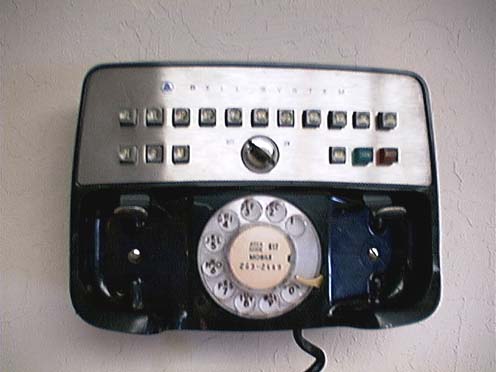
A traditional car phone from the 1960s.
The earliest cell phones have been around since the 1940s. St. Louis was the first city in the United States to get Mobile Telephone Service (MTS). It worked on three analog radio channels and required an operator to make calls on the customer’s behalf. By 1964, direct dialing from car phones became possible with Improved Mobile Telephone Service (IMTS), which also increased the number of radio channels available for calls.
In the 1970s, popular television shows frequently showed high-flyers and private detectives with traditional looking phones installed in their cars. But the service was obscenely expensive. The equipment set customers back $2-4,000 or was leased for around $120 a month. Local calls ran $0.70-1.20 per minute. That was when a nice home was priced at $27,000, a new car was under $4,000, gas was $0.55/gallon, and a first run movie ticket was priced at $1.75.
With many cities maintaining fewer than a dozen radio channels for the service, only a handful of customers could make or receive calls at a time. The first “spectrum crisis” arrived by the late 1970s, when car phones became the status symbol of the rich and powerful (the middle class had pagers). Customers found they couldn’t make or receive calls because the frequencies were all tied up. Some cities even rationed service by maintaining waiting lists, not allowing new customers to have the technology until an existing one dropped their account.
Instead of demanding deregulation and warning of wireless doomsday, the wireless industry innovated its way out of the era of MTS altogether, switching instead to a “cellular” approach developed in part by the Bell System.
[flv width=”412″ height=”330″]http://www.phillipdampier.com/video/ATT Testing the First Public Cell Phone Network.flv[/flv]
In the 1970s, when the first cell phone “spectrum crisis” erupted, the Bell System innovated its way out the the dilemma without running to Congress demanding sweeping deregulation. This documentary, produced by the Bell System, explores AMPS — analog cell phone service, and how it transformed Chicago’s mobile telephone landscape back in 1979. (9 minutes)
“Arguing that the nation could run out of spectrum is like saying it was going to run out of a color.” David P. Reed, one of the original architects of the Internet
Instead of one caller tying up a single IMTS radio frequency capable of reaching across an entire city, the Bell System deployed lower-powered transmitters in a series of hexagonal “cells.” Each cell only served callers within a much smaller geographic area. As a customer traveled between cells, the system would hand the call off to the next cell in turn and so on — all transparently to the caller. Because of the reduced coverage area, cell towers in a city could operate on the same frequencies without creating interference problems, opening up the system to many more customers and more calls.
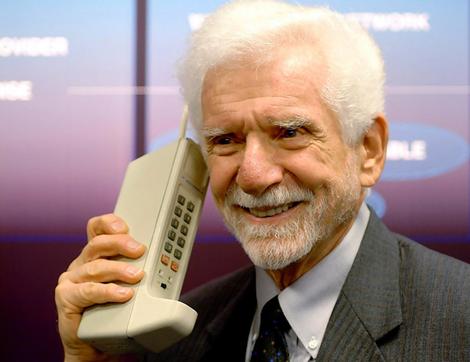
Inventor Martin Cooper holds one of the first portable mobile phones
In Chicago, Bell’s IMTS system only supported around a dozen callers at the same time. In 1977, the phone company built a test cellular network it dubbed “AMPS,” for Advanced Mobile Phone System. AMPS technology was familiar to many early cell phone users. It was more popularly known as “analog” service, and while it could still only handle one conversation at a time on each frequency, the system supported better call handling and many more users than earlier wireless phone technology. By 1979, Bell had 1,300 customers using their test system in Chicago.
AMPS considerably eased the “spectrum crunch” earlier systems found challenging, and subsequent upgrades to digital technology dramatically increased the number of calls each tower could handle and allowed providers to slash pricing, which fueled the spectacular growth of the wireless marketplace.
Yesterday it was voice call congestion, today it is a “tidal wave” of wireless data. But inventors like Cooper believe the solution is the same: engineering innovation.
“Somehow in the last 100 years, every time there is a problem of getting more spectrum, there is a technology that comes along that solves that problem,” Cooper told the New York Times. “Every two and a half years, every spectrum crisis has gotten solved, and that’s going to keep happening. We already know today what the solutions are for the next 50 years.”
Cooper believes in the cellular approach to wireless communications. Dividing up today’s geographic cells into even smaller cells could vastly expand network capacity just like AMPS did for Windy City residents in the late 1970s. Using especially directional antennas focused on different service areas, placing new cell towers, innovating further with tiny neighborhood antennas mounted on telephone poles, or building out Wi-Fi networks can all manage the data capacity “crisis” says Cooper.
New technology also allows cell signals to co-exist, even on the same or adjacent frequencies, without creating interference problems. All it takes is a willingness to invest in the technology and deploy it across signal-congested urban areas.
Unfortunately, network engineers are not often responsible for the business decisions or public policy agendas of the nation’s largest wireless companies who are using the “spectrum crisis” to argue for increased deregulation and demanding additional radio spectrum which, in some cases, could be locked up by companies to make sure nobody else can use them.
[flv width=”600″ height=”358″]http://www.phillipdampier.com/video/NY Times Mobile Carriers Warn of Spectrum Crisis.flv[/flv]
The New York Times offers this easy-to-follow primer on wireless spectrum and why it matters (or not) in the current climate of explosive growth in mobile data traffic. (3 minutes)
“Their primary interest is not necessarily in making spectrum available, or in making wireless performance better. They want to make money.” — David S. Isenberg, veteran researcher, AT&T Labs
Innovation, not wholesale deregulation, allowed the Bell System to solve the spectrum crisis of the 1970s by creating today's "cell system" that can re-use radio frequencies in adjacent areas to handle more wireless traffic.
Spectrum auctions bring billions to federal coffers, but actually deliver a hidden tax to cell phone customers who ultimately pay for the winning bids priced into their monthly bills. It also makes it prohibitively expensive for a new player to enter the market. Already facing enormous network construction costs, any new entrant would then face the crushing prospect of outbidding AT&T, Verizon Wireless, Bell or Rogers for the frequencies essential for operation.
As the New York Times writes:
When a company gets the license for a band of radio waves, it has the exclusive rights to use it. Once a company owns it, competitors can’t have it.
Mr. Reed said the carriers haven’t advocated for the newer technologies because they want to retain their monopolies.
Cooper advocates a new regulatory approach at the Federal Communications Commission — one that mandates wireless phone companies start using today’s technology to amplify their networks.
Cooper points to one example: the smart antenna.
Smart antennas direct cell towers to focus their transmission energy towards the specific devices connected to it. If a customer was using their phone from the southern end of the cell tower’s coverage area, why direct signal energy to the north, where it gets wasted? New LTE networks support smart antenna technology, but carriers have generally avoided investing in upgrading towers to support the new technology, expected to be commonplace inside new wireless devices within two years.
T-Mobile calls these technology solutions “Band-Aids” that won’t address the company’s demand for more frequencies to manage its network. But that kind of thinking applied to the mobile phone world of the 1970s would have maintained the exorbitantly expensive IMTS technology discarded decades ago, since replaced by innovation that made more efficient use of the spectrum already on hand. That innovation also transformed wireless phones from a tool (or toy) for the very wealthy to an affordable success story that now threatens the traditional wired phone network in ways the Bell System could have never envisioned.
[flv width=”412″ height=”330″]http://www.phillipdampier.com/video/Its a Whole New System.flv[/flv]
It’s A Whole New System: AT&T and other wireless phone companies might want to learn the lesson the Bell System was trying to teach their employees back in 1979: Meet Change With Change. This company-produced video implores the phone company to do more than the same old thing. No, this video is not “PM Magazine.” It is about innovation and actually listening to what customers want. With apologies to Mama Cass Elliot, there was indeed a New World Coming — the breakup of the Bell System just five years later. Don’t miss the diabetic-coma-inducing, sugary-sweet jingle at the end. Then reach for a can of Tab. (10 minutes)
A Sprint spokesperson this week confirmed the company will continue selling “unlimited data” service on their forthcoming LTE 4G network.
Sprint’s Nichole Cappitelli told TechHog the carrier plans to extend unlimited access, with no speed throttling, to those buying Sprint’s first LTE phone, the Viper 4G.
Sprint begins accepting pre-orders for the LG phone April 12, with an anticipated shipping date by the end of the month.
Sprint’s 4G LTE network, still under construction, will provide improved 4G speed and value for customers looking for some savings over AT&T and Verizon Wireless. Sprint currently delivers slower 4G WiMAX service from its partner Clearwire.
The Viper 4G phone will sell for $100 with a 2-year contract and $50 mail-in rebate. With Sprint’s Everything plan, $80 will buy you unlimited mobile data, texting, and calling. A similar plan from Verizon that only includes 2GB of mobile data is priced $40 higher.
Until July 22, Sprint will bundle 50GB of free cloud storage and sharing from Box, available from the Google Play app store.
Sprint is America’s only national mobile phone company offering unlimited and unthrottled data plans.
The new 4G LTE-equipped Apple iPad you picked up late last week may be burning a hole in your wallet more than you think. Across the country, consumers are reporting shock and surprise when they discover the new, faster mobile broadband-equipped tablet is capable of blowing through AT&T and Verizon Wireless’ monthly usage caps in a matter of hours.
The culprits: online video and giant-sized app downloads.
Online video on a usage-limited mobile broadband plan simply does not last long on Apple’s newest sensation. A Wall Street Journalarticle found one new iPad owner discouraged after a two hour basketball game completely obliterated his 3GB usage allowance provided by AT&T. With $10/GB overlimit fees just around the corner, AT&T is set to earn enormous data fees from customers who use their iPads to stream video.
[flv width=”512″ height=”308″]http://www.phillipdampier.com/video/WSJ New Apple iPad Eats Up Monthly Data Plans 3-21-12.flv[/flv]
The Wall Street Journal reports the newest iPad has been out for less than a week and buyers are already burning through their monthly data allowances on usage capped 4G mobile plans. (3 minutes)
Less than 24 hours after purchasing the Verizon Wireless version of the iPad + 4G — and choosing a $30, 2GB monthly data plan from Verizon — I was shocked by the notification on my iPad’s screen: “There is no data remaining on your current plan.”
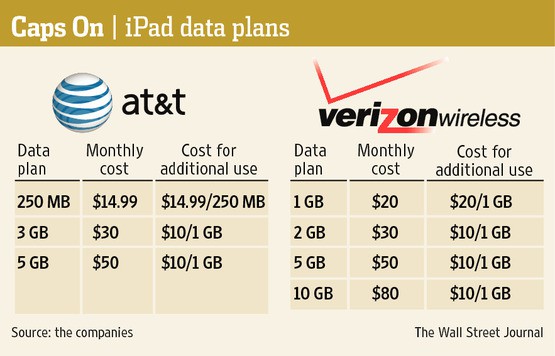
My remaining options for the month included changing to a $50 5GB data plan or an $80 10GB plan. (AT&T offers a 250MB plan for $14.99; 3GB for $30; and 5GB for $50.)
[…] In my case, I wasn’t watching video. What nailed me, I think, is that I was wirelessly downloading a number of the apps that I had already purchased for my older iPad onto the latest model. Those apps were made available through Apple’s iCloud.
To help avoid just this situation, the new iPad has a 50MB per app download limit on 4G. Anything over that, and you’re directed to Wi-Fi. (The over-the-air download limit on 3G-capable iPads was 20MB.) But that’s a per-app limit, and all those smaller-sized apps I was moving to the new iPad collectively added up.
Storing anything on Apple’s iCloud service or other backup storage sites like Dropbox can prove costly when relying on 4G service from AT&T and Verizon. That’s on top of Apple’s premium price for 4G-equipped iPads, which start at $629 (comparable Wi-Fi only models are priced at $499 and above). As a result, consumers are shutting off the wireless mobile feature they paid $130 extra to receive.
“All the advantages of the iPad device are completely neutralized by [AT&T’s] two gigabyte data limit,” Steve Wells told the Journal.
Some customers are upgrading their mobile data plans to 5GB for $50 a month, offered by both AT&T and Verizon. Others are learning to stick to Wi-Fi. According to a study conducted by the consulting firm Chetan Sharma, nearly 90% of tablets bought in the United States are Wi-Fi only models. The added cost for mobile-equipped tablets and the expensive data plans that accompany them are largely responsible.
Consumer Advice:
You can still leverage 4G mobile broadband speeds on a cheaper Wi-Fi-only equipped iPad if your smartphone supports the “mobile hotspot” feature. When activated, your phone becomes a Wi-Fi hotspot your iPad can connect to for wireless data. If you have an unlimited mobile hotspot plan from Verizon Wireless (now difficult to obtain unless you are grandfathered on an unlimited data plan), you are not subject to Verizon’s usage limits for mobile devices.
Rely as much as possible on Wi-Fi, especially for file downloads or streamed content. Since the iPad can seamlessly switch between Wi-Fi and expensive mobile data service, protect yourself by shutting off Cellular Data within the settings menu when you don’t absolutely need to use it.
Turn off LTE service when not needed. 4G consumes battery life faster and its speeds encourage the kind of increased usage that can exhaust your allowance.
Monitor how much data you’ve used from the settings menu. Web browsing and e-mail will not consume a lot. Online video and giant app downloads will.
[Thanks to our regular readers Scott and Earl for sending in several stories reporting on this.]
Apple iPad in the News:
[flv width=”360″ height=”290″]http://www.phillipdampier.com/video/Bloomberg Brown Says He Wouldnt Ditch iPad 2 for New Version 3-16-12.mp4[/flv]
Joe Brown, editor-in-chief at Gizmodo.com, talks about Apple Inc.’s new iPad, the outlook for Amazon.com Inc.’s Kindle Fire and the tablet market. Brown speaks with Jon Erlichman on Bloomberg Television’s “Bloomberg West.” (6 minutes)
[flv width=”360″ height=”290″]http://www.phillipdampier.com/video/WNYW New York Record Breaking Sales for iPad 3-19-12.mp4[/flv]
Shelly Palmer talks about the record-breaking sales numbers of the new Apple iPad. He discusses what is great and not so great about the new tablet on New York’s WNYW-TV. (4 minutes)
[flv width=”360″ height=”290″]http://www.phillipdampier.com/video/Bloomberg Reynolds Sees No Danger Despite New IPad’s Higher Heat 3-20-12.mp4[/flv]
Paul Reynolds, electronics editor for Consumer Reports, talks about the magazine’s temperature test of Apple Inc.’s new iPad. The newest iPad runs “significantly hotter” than the earlier model when conducting processor-intensive tasks such as playing graphics-heavy games, Consumer Reports said on its website. (9 minutes)
[flv width=”360″ height=”290″]http://www.phillipdampier.com/video/WFXT Boston New Ipad Is it Worth it 3-22-12.flv[/flv]
It’s the hottest item in the tech world – literally. WFXT in Boston also takes a look at how other tablet manufacturers are doing in competition with Apple. (4 minutes)
Virgin Mobile founder Richard Branson is trying to convince customers they should sign up with a phone company that only sells you the services you need, but if “unlimited data” is one of them, look somewhere else.
Starting Friday, Virgin Mobile will quietly begin to throttle “heavy users” who reach 2.5GB of usage on their “unlimited use” data plans. For the remainder of the billing cycle, Virgin will reduce mobile broadband speeds to just 256kbps — comparable to a significantly congested 3G connection.
It’s a long fall from Virgin Mobile’s original unlimited data offer which the company briefly attempted in the summer of 2010.
Entirely reliant on Sprint’s mobile network (and now operates as the prepaid division of Sprint), Virgin Mobile couldn’t handle the demand and quickly threatened to slow down the connections of their heaviest users.
The carrier’s decision to set a specific limit for its speed throttle was originally intended to take effect last October, but was delayed until March 23, 2012.
[flv width=”640″ height=”380″]http://www.phillipdampier.com/video/New Virgin Mobile Ad.flv[/flv]
Virgin Mobile’s delayed implementation of its speed throttle coincides with this imaging “refresh” of the “New Virgin Mobile” starring a timeless Richard Branson. (1 minute)
Virgin Mobile explains its reasons:
This change comes about because of the enormous data usage driven by our new more sophisticated smartphones, and the more extensive uses customers are finding for these devices. We want to be able to serve our Beyond Talk customers who use these unlimited plans for their data-centric daily activity, primarily for regular access to email, the Internet, and social networking sites. Our goal is to ensure our products perform at the best possible level and that we have the best possible experience for all subscribers. These control options are similar to those other carriers have in place ? and that Virgin Mobile maintains for its Broadband2Go product as well.
These plans are still unlimited. There is no cap or limit on how much you can consume in any given month. In order to ensure optimal network performance and a good customer experience for all subscribers, we are moving forward in establishing some parameters.
Most Beyond Talk customers will not experience a change in the performance of their Virgin Mobile service or notice any difference. If you use this service for typical email, internet surfing and downloading, your throughput speeds should not be noticeably impacted. For Beyond Talk subscribers who are using more than 2.5GB during a monthly plan cycle, limits to throughput speeds for the remainder of their monthly plan cycle will enable us to preserve overall network performance and customer experience.
The company’s redefinition of the word “unlimited” in nothing new in the world of mobile data. T-Mobile, AT&T, and Cricket all throttle their customers when they exceed a certain level of usage, yet some still market “unlimited use” plans that many customers don’t realize are limited in usefulness when arbitrary allowances are exceeded.
Concerns for “optimal network performance” and “a good experience for all” disappear when you pull your wallet out. Virgin Mobile will reset your usage allowance to zero if you agree to pay for a new month of service the moment they’ve throttled your service. That will get you another 2.5GB of usage, whether it preserves overall network performance or not.
Watch Virgin Group’s Richard Branson explain why Virgin Mobile wants to change the image consumers have about their mobile phone company. A fine print disclosure that “unlimited” mobile data really isn’t may not change things for the better. (2 minutes)
Be Sure to Read Part One: Astroturf Overload — Broadband for America = One Giant Industry Front Group for an important introduction to what this super-sized industry front group is all about. Members of Broadband for America Red: A company or group actively engaging in anti-consumer lobbying, opposes Net Neutrality, supports Internet Overcharging, belongs to […]
Astroturf: One of the underhanded tactics increasingly being used by telecom companies is “Astroturf lobbying” – creating front groups that try to mimic true grassroots, but that are all about corporate money, not citizen power. Astroturf lobbying is hardly a new approach. Senator Lloyd Bentsen is credited with coining the term in the 1980s to […]
Hong Kong remains bullish on broadband. Despite the economic downturn, City Telecom continues to invest millions in constructing one of Hong Kong’s largest fiber optic broadband networks, providing fiber to the home connections to residents. City Telecom’s HK Broadband service relies on an all-fiber optic network, and has been dubbed “the Verizon FiOS of Hong […]
BendBroadband, a small provider serving central Oregon, breathlessly announced the imminent launch of new higher speed broadband service for its customers after completing an upgrade to DOCSIS 3. Along with the launch announcement came a new logo of a sprinting dog the company attaches its new tagline to: “We’re the local dog. We better be […]
Stop the Cap! reader Rick has been educating me about some of the new-found aggression by Shaw Communications, one of western Canada’s largest telecommunications companies, in expanding its business reach across Canada. Woe to those who get in the way. Novus Entertainment is already familiar with this story. As Stop the Cap! reported previously, Shaw […]
The Canadian Radio-television Telecommunications Commission, the Canadian equivalent of the Federal Communications Commission in Washington, may be forced to consider American broadband policy before defining Net Neutrality and its role in Canadian broadband, according to an article published today in The Globe & Mail. [FCC Chairman Julius Genachowski’s] proposal – to codify and enforce some […]
In March 2000, two cable magnates sat down for the cable industry equivalent of My Dinner With Andre. Fine wine, beautiful table linens, an exquisite meal, and a Monopoly board with pieces swapped back and forth representing hundreds of thousands of Canadian consumers. Ted Rogers and Jim Shaw drew a line on the western Ontario […]
Just like FairPoint Communications, the Towering Inferno of phone companies haunting New England, Frontier Communications is making a whole lot of promises to state regulators and consumers, if they’ll only support the deal to transfer ownership of phone service from Verizon to them. This time, Frontier is issuing a self-serving press release touting their investment […]
I see it took all of five minutes for George Ou and his friends at Digital Society to be swayed by the tunnel vision myopia of last week’s latest effort to justify Internet Overcharging schemes. Until recently, I’ve always rationalized my distain for smaller usage caps by ignoring the fact that I’m being subsidized by […]
In 2007, we took our first major trip away from western New York in 20 years and spent two weeks an hour away from Calgary, Alberta. After two weeks in Kananaskis Country, Banff, Calgary, and other spots all over southern Alberta, we came away with the Good, the Bad, and the Ugly: The Good Alberta […]
A federal appeals court in Washington has struck down, for a second time, a rulemaking by the Federal Communications Commission to limit the size of the nation’s largest cable operators to 30% of the nation’s pay television marketplace, calling the rule “arbitrary and capricious.” The 30% rule, designed to keep no single company from controlling […]
Less than half of Americans surveyed by PC Magazine report they are very satisfied with the broadband speed delivered by their Internet service provider. PC Magazine released a comprehensive study this month on speed, provider satisfaction, and consumer opinions about the state of broadband in their community. The publisher sampled more than 17,000 participants, checking […]


 Subscribe