Home » mobile data » Recent Articles:

Mid-Atlantic Storm Damage Shows Big Telecom Unprepared for Bad Weather

Phillip Dampier July 5, 2012 Comcast/Xfinity, Consumer News, Cox, Frontier, Public Policy & Gov't, Rural Broadband, Verizon, Wireless Broadband Comments Off on Mid-Atlantic Storm Damage Shows Big Telecom Unprepared for Bad Weather

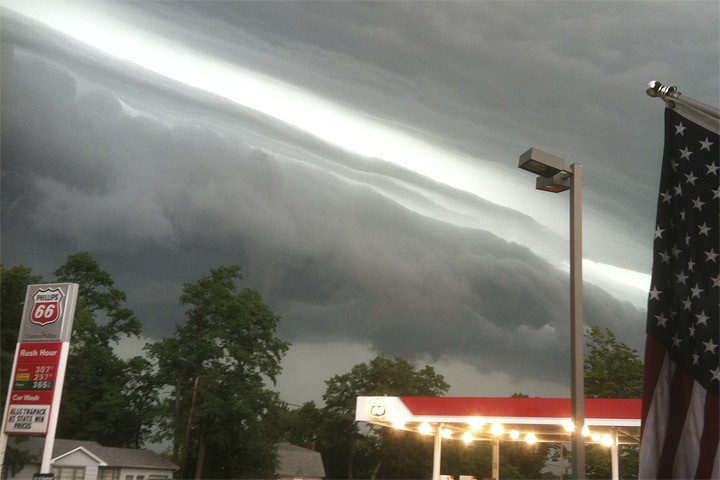
NOAA caught this ominous derecho cloud front in La Porte, Ind on June 29. The same storm would later cut power for millions all the way to the eastern seaboard.

A series of severe thunderstorms accompanied by near-hurricane-force winds caused millions of customers in several Mid-Atlantic states to lose power and telecommunications services late Friday, and some are expected to remain without service until at least this coming weekend.

The storm, known as a “derecho,” uprooted trees, which in turn knocked down power lines and caused wind-related damage to buildings from Ohio to West Virginia, Virginia to Maryland, and even into North Carolina.

But the storm also is raising questions about the massive failures in commercial telecommunications systems that left entire 911 emergency response systems offline for days, wireless networks non-operational, cell phone systems overwhelmed, and broadband service, deemed a lower priority by emergency officials, down and offline.

Some of the biggest problems remain in and around the nation’s capital and in the states of West Virginia and Virginia, where inadequate infrastructure proved especially susceptible to the storm’s damaging winds.

D.C., Maryland, and northern Virginia

In northern Virginia, calls to 911 were met by silence over the weekend, thanks to a catastrophic failure of Verizon’s landline network. With primary lines down, Verizon’s backup 911 systems also failed, leaving millions with no access to emergency responders.

Fairfax County officials finally put the word out the best way to summon emergency help was to drive (through streets littered with debris and downed power lines) to the nearest fire or police station for assistance.

“It’s just not OK for the entire 911 system in the region to go down for the period of time that we were out, especially after an enormous emergency where people needed to make those calls the most,” Sharon Bulova, chairman of the Fairfax County Board of Supervisors, told the Associated Press.
Verizon spokesman Harry Mitchell was left flat-footed, promising an investigation into Verizon’s latest 911 failure, and called the storm as damaging as a hurricane. He urged local officials to “move forward” beyond the immediate criticism and help make progress to get service restored.

Many emergency response networks also depend on telecommunications services, including fiber cables, to reach transmission towers for radio dispatch and mobile data terminals. In northern Virginia, the city of Alexandria has been managing to handle emergency dispatch services for several counties.

With power lines down, cable and phone lines often went as well. In those cases, electric utilities have first priority to restore service, and then cable and phone companies can begin repairs of their own.

Since cable operators rely on power companies to supply electricity to their amplifiers and other equipment, Comcast and Cox, which dominate the region, are blaming most of their outages on power disruptions, and promise service will be restored when the power returns.

Verizon’s DSL and FiOS broadband networks were both disrupted by the storm, primarily because of downed lines and power losses.Even wireless networks, which some might suspect would be immune to downed lines, were also seriously affected by the storm. Cell towers connect to the provider’s network through fiber optic and T1 lines, and although backup power generators can maintain a cell tower for days in some cases, backhaul line cuts can leave cell towers useless.

In metro D.C., call completion problems were a problem during the storm and sometime after as local residents turned to cell phones to communicate. Over the weekend, customers in and around Richmond, Va., found Verizon Wireless useless for text messages because of a service disruption. As backup generators ran dry of fuel, some cell towers that survived the initial storm have been shutting down until maintenance crews arrive and refuel.

The harshest criticism has so far escaped phone and cable companies. Instead, local officials and residents remain focused on Pepco, the power utility serving the Washington area. Pepco has learned from previous storms to become a master of lowered expectations, and is promising to do its best to restore power a week or more after the storm was a memory.

West Virginia and western Virginia

The state of West Virginia, and western rural Virginia state, have illustrated what happens when deteriorating infrastructure is asked to withstand winds of up to 100mph. Frontier’s operations in West Virginia were hit especially hard. Landline networks in that state had been allowed to deteriorate for years by former owner Verizon Communications. Frontier had its hands full trying to keep up with repairs, calling in additional staff and trying to maintain landline service in some areas with the help of generators.

That job was made much harder by a rash of generator thefts that impacted the phone company, and local authorities are still looking for those responsible. At least one-third of all central switching offices operated by Frontier in West Virginia remain on generator power as of yesterday. As of July 3, the company reported it has 12,000 repair requests still waiting for action.

It was a similar story in the western half of Virginia where independent phone companies and Verizon were faced with an enormous number of downed trees and power lines, many in rural areas. More than 108,000 Virginia residents are still without power as of this afternoon, and many will not see it restored until the weekend.

Because the derecho swept across a large area encompassing the entire state, it has been difficult for utility crews to respond from unaffected areas to assist in repairs because the damage was so widespread. Logistically, just coordinating repair operations has proved difficult because cell service has been spotty (or networks have been jammed with calls) in some of the worst-affected areas.

“Derechos are nothing to fool with, but still this was not the most serious storm Virginia has ever dealt with, and the impacts on our telecommunications networks seem to indicate they’ve been allowed to fall apart over the last several years,” shares Stop the Cap! reader Edward Klein, who lives near Roanoke. “I think an investigation is needed to make sure utilities are spending enough money to keep these networks in good shape so this kind of thing doesn’t happen everytime a storm sweeps through.”


PC Magazine Hands Out Fastest Wireless Data Awards, But Does It Matter?

Won first place nationally for the best 4G LTE network with the fastest overall speeds and best performance.

PC Magazine went to a lot of effort to test the data speeds of America’s wireless providers, traveling to 30 U.S. cities sampling both 3G and 4G wireless networks to see which carrier delivers the most consistent and fastest results.

After 240,000 lines of test data, the magazine declared the results a bit “muddy.”

They have a point.

Depending on which carrier’s flavor of “4G” is being utilized, where reception was strongest, how much spectrum was available in each tested city, and how many people were sharing the cell tower at the time of each test, PC Magazine was able to deliver the definitive results. And it was effectively a draw.

Verizon Wireless achieved victory in 19 cities, AT&T won in ten others, and T-Mobile came in pretty close behind, and that carrier does not even operate an LTE 4G network. But taking all factors into account, including upload and download speeds, whether or not test downloads actually completed, and whether streamed media was tolerable, Verizon Wireless won first prize nationwide.

But by how much?

Not enough to matter, if you are using Verizon, AT&T, or T-Mobile.

But the results do offer some things to think about.

  1. MetroPCS is a mess. Despite the fact this smaller carrier is building its own 4G LTE network, results were simply terrible. Either its backhaul network from cell towers offers lower capacity or its backbone network is screaming for an upgrade.
  2. Cricket was not willing to participate in the test. Their network, still 3G, delivers dependably “meh” results in the places where they actually provide coverage. The company has been reducing data allowances on their mobile broadband plans and raising prices on others. In one conference call with investors, company executives admitted they have been losing mobile broadband customers and expect that to continue at the prices they are charging.
  3. Sprint needs their forthcoming 4G LTE network more than ever. Their 3G data service turned in mediocre results and their 4G WiMAX network was yesterday’s news a year ago. Sprint’s 3G network is also notorious for dead-end downloads, a situation I have witnessed on friends’ phones for several months.
  4. Verizon Wireless remains far ahead of AT&T in covering more cities with their 4G LTE network. But more customers are also starting to use Verizon’s newer network, and the more customers piling on, the slower the speeds get for everyone. AT&T turned in some superior speed results in several cities, but those networks are often used less than the competition, for now.
  5. No network is good if you cannot afford to use it. As America’s wireless carriers keep raising prices and reducing usage allowances to keep data usage under control, there will be a breaking point where customers decide the money they spend for wireless data just is not worth it, especially if they live in a place where Wi-Fi is free and easy to find.
  6. What you test today will probably be different tomorrow. Wireless networks are constantly evolving and changing, with a wide range of factors contributing to their overall performance. Perhaps a more useful test would have been measuring how wireless carriers respond when their networks need upgrading and how long it takes them to respond to changing usage patterns. Verizon seems particularly aggressive, AT&T less so based on these results. The real surprise seems to be how well T-Mobile’s older technology is performing, and how quickly Sprint is now falling behind. On Cricket and MetroPCS, “you get what you pay for” seems to apply.

Verizon’s New Plans: Netflix-Like Bungling, Says One Industry Analyst

Phillip Dampier June 14, 2012 Competition, Consumer News, Data Caps, HissyFitWatch, Verizon, Wireless Broadband Comments Off on Verizon’s New Plans: Netflix-Like Bungling, Says One Industry Analyst

A consumer firestorm is growing over Verizon Wireless new service plans.

As a growing firestorm over Verizon Wireless’ newly-announced plans continued today as some on Wall Street are becoming convinced Verizon has bungled the case for their new “Share Everything” concept.

Industry analyst Rob Enderle told ComputerWorld that Verizon’s handling of their pricing changes “is similar to the Netflix mistake last year that almost sunk that company.” Enderle believes the changes Verizon wants to force on the wireless market are potentially too radical to be embraced within the next two weeks, when Verizon’s new rate plans become active.

Verizon Wireless has been trying to quell the increasing criticism from consumers by reminding them they will not be forced to move to the new plans from an existing account.

“We’re allowing the existing customer base to have a choice; we’re not forcing anyone to more to new plans,” said Steve Mesnick, head of marketing for Verizon Wireless. “I take exception to [suggestions] of people leaving Verizon,” he said.

While Mesnick is correct Verizon will not force customers to choose new plans on June 28, the company will require existing grandfathered data customers to abandon unlimited data when they renew their Verizon contract or upgrade to a new discounted device.

Verizon claims it interviewed 50,000 customers before implementing the new plans and believe they will be embraced by the majority of Verizon customers.

Verizon Wireless spokeswoman Brenda Raney followed a different approach, pretending consumer complaints don’t exist: “We are very pleased with the response to our announcement as customers begin to understand how the new Share Everything Plans will save them money or provide them with more value for the same money they are paying today.”

Meanwhile, customers who have no intention of either forfeiting the unlimited data plan they have grandfathered on their account or who refuse to pay Verizon’s new asking price are busily upgrading their phones and signing new two-year contracts before June 28, buying an additional two years of unlimited data. Many others claim to be leaving, often for Sprint, which continues to offer unlimited data, or a prepaid provider.

Customers are worried about losing their grandfathered unlimited data plans.

Verizon and AT&T have a combined 38 percent of customers on grandfathered unlimited data plans and most are insistent on keeping them. News that customers could retain unlimited data by forfeiting the wireless carrier’s subsidy for new phones has gone over like a lead balloon, especially with price tags of $699 or more for popular new smartphones.

“The importance of this client base cannot be overstated–unlimited mobile data plan users are some of the most valuable subscribers in the industry,” Iain Gillott, president and founder of iGR, told Fierce Wireless. “Our research shows that these two carriers need to be very careful to offer a migration plan to replace the grandfathered unlimited plans that provides the data service, value and recognition that meets these valuable consumers’ needs.”

With popular new smartphones like the iPhone becoming available on no-frills prepaid carriers like Cricket, wireless carriers are at risk of subscriber defections.

Despite consumer discontent, Wall Street has supported the income-enhancing new wireless plans and is embracing the increased fees Verizon will likely earn as data demand rises.

Verizon Wireless Declares War on Average Data and Text Users

Kuittinen

Forbes Magazine has been pondering Verizon’s radical shift to eliminate buckets of voice minutes and text messages, while increasing prices on wireless data just when mobile broadband is expected to become the new profit center for wireless phone companies. It appears Verizon is well on the way to milking the data cash cow.

Tero Kuittinen notes Verizon Wireless has been on a rate increase binge, primarily by eliminating cheaper plans in favor of those with bigger buckets for voice and text services customers simply don’t need. What used to cost $50 a month two years ago for a respectable minute plan jumped to $70 for a smartphone with data, and now will increase another $20 to $90 a month, and give customers a smaller data allowance.

Verizon Wireless argues customers will get more bang for their buck, and for heavy voice, mobile hotspot and texting users, they may be right. But for the average customer who watches their voice minutes and keeps texting to a reasonable level, prices are going nowhere but up, whether you want unlimited voice and texting or not.

Q. Will Verizon Wireless herd all of its customers to unlimited voice calling at a higher price? A. Yes!

Why is Verizon taking the risk of alienating consumers by forcing them into a major price hike?

  • This is a clever move to try to cut Skype and WhatsApp down before they erode Verizon’s voice and texting revenue any further. Consumers can still use Skype and WhatsApp – but there is less incentive, because you are forced to pay for unlimited voice and text anyway.
  • The campaigns to lure consumers into buying tablet data plans have not worked. Most people opt for WiFi only tablets. The new Verizon plan basically forces all consumers to pay a higher monthly bill – and then offers them an option to add a tablet data connection for just $10 extra. Adding mobile data to your tablet becomes much more alluring. You’re paying $90 base price anyway – what’s another ten bucks?
  • Verizon believes Sprint and T-Mobile are now so weak they offer no effective competition. Most consumers are so suspicious about their coverage area and/or device ranges that Verizon does not need to worry about defections too much.

America has yet to hear from the other half of the Attizon duopoly, Kuittinen warns, and AT&T is usually cited as the less-consumer-friendly choice in wireless. Kuittinen believes neither company particularly cares about what consumers ultimately think about the new plans, because their only alternatives have more limited coverage, don’t always have access to the hottest new devices, and have 4G networks that don’t keep up particularly well with their larger rivals. (Clearwire on Sprint, anyone?)

[flv width=”360″ height=”290″]http://www.phillipdampier.com/video/WDTN Dayton Verizon Tricked Me 6-13-12.f4v[/flv]

WDTN’s morning news show weighed in on Verizon Wireless’ new “Share Everything” plan. Verizon got scathing reviews from the Dayton, Ohio news show, with one host concluding Verizon Wireless has tricked her with an unlimited data plan it now wants to take away.  (2 minutes)

Cable Industry Collaborates to Provide Shared Wi-Fi Access to Customers

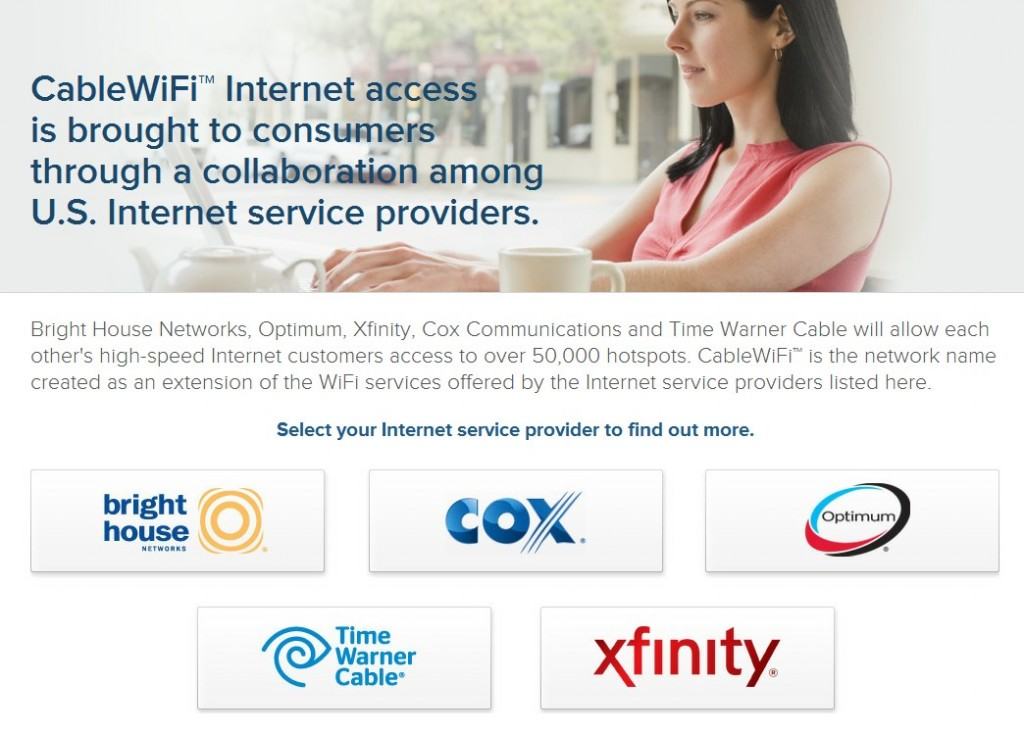
Wi-Fi access is about to become a lot more ubiquitous if you happen to buy broadband from Comcast, Time Warner Cable, Cablevision, Bright House Networks, or Cox.  All five companies on Monday announced they will open up their free Wi-Fi hotspots to customers of any of these companies nationwide.

The collaborative agreement extends the authentication platforms cable operators use to verify customer accounts when granting access to services like TV Everywhere — the online video streaming services operated by pay television providers. By sharing basic account information, customers traveling outside of their home cable service area can “roam” on free Wi-Fi networks operated by the other providers.

For example, a Cablevision subscriber who lives on Long Island will be able to access Bright House Networks’ Wi-Fi in central Florida or Time Warner Cable’s growing wireless network in Los Angeles.

The cable industry calls it a back door entry into mobile data, and unlike its existing partnership with Clearwire for WiMAX 4G service, Wi-Fi hotspots are available at no additional charge.

“We believe that Wi-Fi is a superior approach to mobile data,” said Kristin Dolan, head of projects at Cablevision. “Cable providers are best positioned to build the highest-capacity national network offering customers fast and reliable Internet connections when away from their home or business broadband service.”

More than 50,000 Wi-Fi hotspots are to be included in the project, all unified under the name “CableWiFi.”

Eventually, the companies hope to unveil automatic log-ins on the network, regardless of where customers access it.

The industry is aggressively expanding Wi-Fi services to give subscribers another reason to stick with their local cable company. Some may require customers to maintain both a cable-TV subscription and broadband to qualify for the service, others will only require a current broadband account. The free add-on may also make subscribers think twice about canceling service if it means losing access.

Comcast, Cablevision, and Time Warner Cable already have a deal in place to share their networks in southwestern Connecticut, New York City, parts of New Jersey and Philadelphia.

Cable operators will target high-traffic areas for Wi-Fi expansion — especially public parks, beaches, malls, eateries, stadiums and convention centers.  Don’t expect cable Wi-Fi to be common in residential neighborhoods, and users will have to temper their expectations. Most provide access suitable for web browsing and e-mail, but often have trouble keeping up with streaming video and other high bandwidth services.

Search This Site:

Contributions:

Recent Comments:

Your Account:

Stop the Cap!