Home » mobile data » Recent Articles:

Telecom Companies Use Usage Caps/Distorted Marketing to Create ‘Confusopoly’ and Rake In the Proceeds

The $49 "cap" plan isn't your maximum monthly fee, it's the MINIMUM monthly fee. The company selling it was fined for misleading advertising.

Banking on the fact most consumers do not understand what a “gigabyte” represents, much less know how many they use per month on usage-capped broadband plans, large telecommunications companies enjoy a growth industry collecting enormous overlimit fees that bear no relation to their actual costs of delivering the service.

The social implications of “usage cap and tier” pricing are enormous, according to Australia’s Communications & Media Authority.  Australia remains one of the most usage-capped countries in the world, and broadband providers have taken full advantage of the situation to run what the ACMA calls a broadband Confusopoly.

As a growing number of mobile broadband customers in the United States and Canada approach the allowance limits on their mobile data plans, Australia’s long experience with Internet Overcharging foreshadows a North American future of widespread bill shock, $1000+ telecom bills, and families torn apart by finger-pointing and traded recriminations over “excessive use” of the Internet.

Not helping matters are providers themselves, some who distort and occasionally openly lie about their plans.  In Australia, Optus was fined $200,000 for advertising a “Max Cap $49” plan that led many to believe their maximum bill would amount to $49.  But not so fast.  Optus turned the meaning of the word “cap,” typically a usage limit, upside down to mean a capped minimum charge.  Indeed, the lowest bill an Optus customer could receive was $49.  Using data services cost extra.  The company also claimed customers could use accompanying call credits “to call anyone,” another fact not in evidence.

Another common marketing misconception is the “unlimited mobile broadband” plan — the one that actually comes with significant limits. In most cases, providers want “unlimited” to mean there are no overlimit fees — they simply throttle the speed of the service down to a dial-up-like experience once a customer exceeds a certain amount of usage.  Companies like Cricket disclose their usage triggers.  Others, like Clearwire, do not — and they are applied arbitrarily based on customer usage profiles and congestion at the transmission tower.  While annoying, at least these plans do not impose overlimit fees which lead to the growing problem of “bill shock.”

Bill Shock

North Americans getting enormous mobile data bills remains rare enough to warrant attention by the TV news.  Often the result of not understanding the implications of international roaming, customers can quickly run up thousands of dollars in mobile bills while touring Europe, cruising, or even just living along the Canadian-American border, where accidental roaming is a frequent problem.

But as Americans only now become acquainted with usage-capped mobile data plans with overlimit fees, bill shock may become much more common.

In Australia, which has had a head start with usage-capped mobile data, an incredible 58 percent of customers exceeded their usage allowances at least once in a calendar year, and this statistic comes from April 2009.  The bill shock problem has now become so pervasive in Australia, in 2010 the office of the Telecom Ombudsman received more than 167,955 consumer complaints about the practice.

In the United States, one in six have already experienced surprise data charges on their bills — that’s 30 million Americans.  The Federal Communications Commission found 84 percent of those overcharged said their cell phone carrier did not contact them when they were about to exceed their allowed service limits. In about one-in-four cases, the overlimit fee was greater than $100.

Sen. Tom Udall (D-N.M.) proposed legislation that would require a customer to consent to overlimit fees before extra charges accrue for voice, data, and text usage.

The Cell Phone Bill Shock Act of 2011 would also require carriers to send free text messages when a customer reaches 80 percent of their plan’s allowance.

“Sending an automatic text or email notification to a person’s phone is a simple, cost-effective solution that should not place a burden on cell phone companies and will go a long way toward reducing the pain of bill shock by customers,” said Udall, a member of the Senate Commerce Committee. “As more and more cell phone companies drop their unlimited data plans, this problem only stands to get worse. I am proud to stand up for cell phone consumers and reintroduce this important legislation.”

In Australia and North America, legislation to warn consumers of impending overlimit fees has been vociferously fought by the telecommunications industry.

Udall

The CTIA-Wireless Association in Washington said such measures were completely unnecessary because consumers can already check their usage by logging into providers’ websites.  Even worse, they claim, bills like Udall’s threaten to destroy innovation and harm the industry by locking a single warning standard into place.  CTIA claims that wouldn’t help consumers.

But Australian regulators, who have years of experience dealing with unregulated carriers’ usage limit schemes say otherwise, noting industry efforts to self-regulate have been spectacular successes for the industry’s bottom line, just as much as they are a failure for consumers who end up footing the bill.

Even worse, unregulated providers taking liberties with marketing claims can have profound social implications when customers find they can’t pay the enormous charges that often result.

The Brotherhood of St. Laurence, a charity, reported one instance of an elderly client who received a $1,200 broadband bill he couldn’t pay outright.  Even as he negotiated a monthly payment plan with the provider, the company shut off his home phone line without warning.

“His telephone service was particularly important because he used a personal alarm call system, which entailed wearing a small electronic device that he could activate in the event of a medical emergency,” noted a report on the incident.

The Australian Competition and Consumer Commission found a long-standing competitive feud by two large mobile providers in Australia — Telecom and Optus — has only brought more instances of marketing excesses that ultimately don’t benefit consumers.  The Commission increasingly finds it lacks the resources to keep up with the slew of questionable advertising.

Some industry critics suspect providers treat ACCC’s fines as simply a cost of doing business, and some like Optus have been rebuked more than once by the regulator for false advertising.

The ACMA says the longer government waits to protect citizens from provider abuses, the more consumers will be financially harmed, especially as data usage grows while usage caps traditionally do not.

Broadcast Lobby Says ‘Spectrum Crisis’ is Fiction; Wireless Data Tsunami Debunked

(Source: JVC)

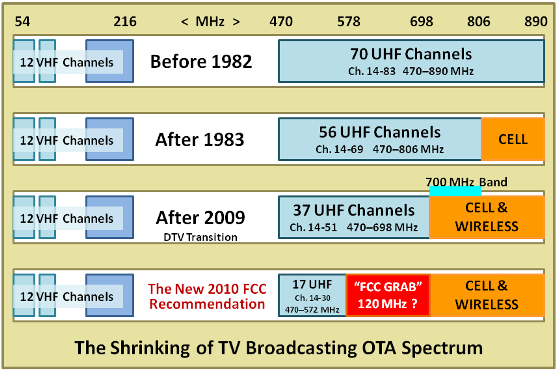
The National Association of Broadcasters (NAB), a trade association and lobbying group representing many of the nation’s television stations, says claims by wireless carriers of a nationwide spectrum crisis are troubling and counterfactual.  That conclusion comes in a new report issued by the NAB this morning that wants the FCC to keep its hands off UHF broadcast channel spectrum the agency wants to sell off to improve mobile broadband.

The paper, “Solving the Capacity Crunch: Options for Enhancing Data Capacity on Wireless Networks,” written by a former FCC employee, suggests claims by wireless carriers that they will “run out” of frequencies to serve America’s growing interest in wireless services are simply overblown.

Many wireless companies own spectrum they are not using, the report argues, and other licensed users are holding onto spectrum without using it either, hoping to make a killing selling it off at enormous profits in the future.  Besides, the federal government holds the largest amount of underutilized spectrum around — frequencies that could easily be allocated to wireless use without further reducing the size of the UHF broadcast TV band.

Many of the ideas in the NAB report emphasize the need for carriers to deploy innovative technology solutions to increase the efficiency of the spectrum they are already using.  Those ideas include additional cell towers to split traffic loads into smaller regional areas, and improving on network channel-bonding, caching, and intelligent network protocols.

But the NAB report has some obvious weak spots the wireless industry will likely exploit — notably their recommendations that seek a reduction in wireless traffic — ideas that would suggest there is not enough spectrum to handle every user.  Among those recommendations:

  • Implementing Internet Overcharging schemes like “fair use” policies and consumption-based pricing to discourage use;
  • Migrating voice traffic to Internet Protocol;
  • Migrating data traffic to a prolific network of “femtocells” — mini antennas that provide 3G service inside buildings, but deliver that traffic over home or business wired broadband connections;
  • Offering wider access to Wi-Fi networks in public areas;
  • Encouraging the development of bandwidth sensitive devices and applications.

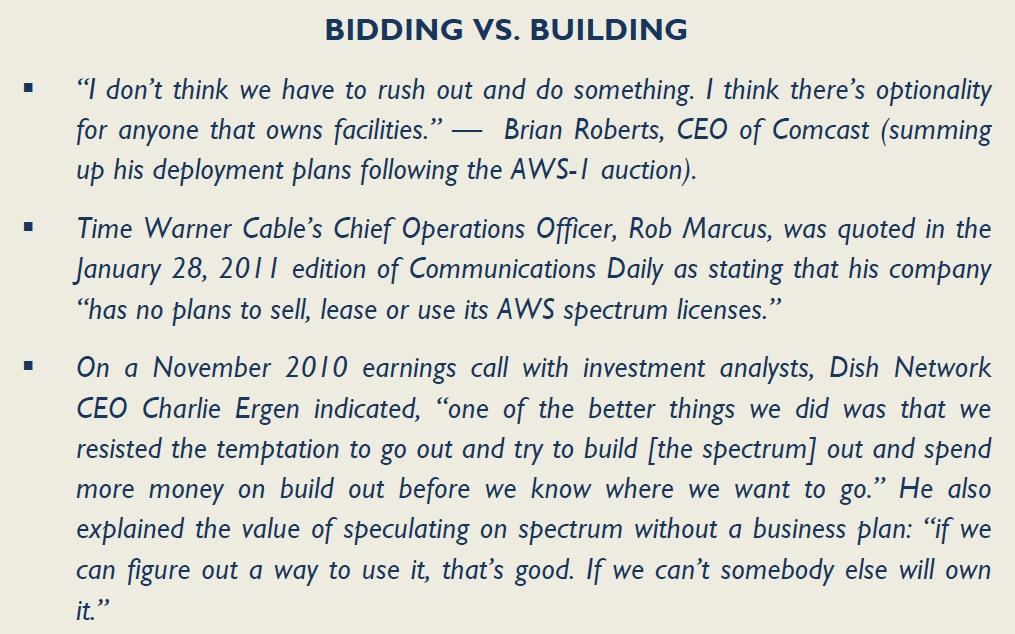
The National Broadband Plan’s conclusion of a spectrum shortage is based on little more than a wish list by wireless carriers, says the paper. Its author, Uzoma Onyeije, cites contradictory statements by high-ranking corporate officials to show the Plan’s calls for making 500MHz of spectrum available for broadband in ten years is a gross overestimate of the actual need.

“There is no denying that the corporate imperative of mobile wireless carriers is to obtain as much spectrum as they can,” Onyeije wrote. “However, the fact that wireless carriers cannot find a unified voice on the amount and timing of their spectrum needs suggests that this advocacy is more strategic gamesmanship than factual reality.”

The NAB has heavily lobbied Washington officials on the issue of spectrum because their members — broadcast television stations — are facing the loss of up to 120MHz of what’s left of the UHF dial, already shrinking because of earlier reallocations.  The FCC proposal would resize the UHF dial to channels 14-30 — 16 channels.  In crowded television markets like Los Angeles, up to 16 stations would be forced to sign-off the public airwaves for good, because there would be insufficient space to allow them to continue a broadcast signal.  Instead, the FCC proposes they deliver their signal over pay television providers like cable or telco-provided IPTV.  Or they could always stream over the Internet.  But that would mean the decline of free, over the air television in this country.

Considering the millions of dollars many stations are worth, it’s no surprise broadcasters are howling over the proposal.

Onyeije’s report suggests AT&T and Verizon, among others, are grabbing whatever valuable spectrum they can get their hands on.  What they don’t use, they’ll “warehouse” for claimed future use.  By locking up unused spectrum, potential competitors can’t use it.  The proof, Onyeije writes, is found when comparing claims by the wireless industry with the FCC’s own independent research:

AT&T predicts 8-10 times of data growth between 2010 and 2015 and T-Mobile forecasts that data will have 10 times of growth in 5 years. Yet, the Commission’s assessment that 275MHz of spectrum is needed to meet mobile data demand is premised on data growth of 35 times between 2009 and 2014.

The Data Tsunami Debunked

Some providers are sitting on spectrum they already own.

The NAB also takes to task the “evidence” many providers use to claim the zettabyte era is at hand, where a veritable exaflood of data will force America into a widespread data brownout if more capacity isn’t immediately made available.

[…] The [industry claims rely] on suspect data. In arriving at its conclusion, OBI Technical Paper No. 6 relies heavily on forecast data from Cisco that is both wildly optimistic about data growth and unscientific. In a blog entry entitled, Should a Sales Brochure Underlie US Spectrum Policy?, Steven Crowley states that “[t]here is overlap between the people who prepare the forecast and the people responsible for marketing Cisco’s line of core-network hardware to service providers. The forecast is used to help sell that hardware. Put simply, it’s a sales brochure.”

Onyeije takes apart the oft-repeated claim that a data explosion will be unyielding, unrelenting, and will be the wireless industry’s biggest challenge for years to come.  It also speaks to issues about broadband use in general:

In particular, the paper appears to be premised on the highly suspect assumption that the high demand curve for mobile data will not slow. While smartphone growth is significantly increasing now, it will no doubt plateau and slow. It has been widely accepted for decades that the process of technological adoption over time is typically illustrated as a classic normal distribution or “bell curve” where a phase of rapid adoption ends in slowed adoption as the product matures or new technologies emerge.

As recently reported, Cisco now projects that U.S. mobile growth will drop by more than half by 2015. As Dave Burstein, Editor of DSL Prime, explains: “The growth is clearly not exponential.”  Mr. Burstein went on to say “Every CFO and engineer has to plan carefully for the network upgrades needed, but the numbers certainly don’t suggest a ‘crisis.’” Jon Healey of the Los Angeles Times Editorial Board similarly explains that “Much of the growth in the demand for bandwidth has come from two parallel forces: a new type of smartphone (epitomized by the iPhone) encourages people to make more use of the mobile Web, and more people are switching from conventional mobile phones to these new smartphones. Once everyone has an iPhone, an Android phone or the equivalent, much of the growth goes away.” AP Technology writer Peter Svensson echoes this concern and explains “AT&T’s own figures indicate that growth is slowing down now that smartphones are already in many hands.” Thus, the assumption that data demand will continue to grow unabated is deeply flawed.

Internet Overcharging is About Rationing and Reducing Use

Although the NAB favors Internet Overcharging to drive down demand for use, Onyeije’s report inadvertently provides additional evidence to the forces that oppose data caps, meters, and speed throttles: they are designed to monetize usage while driving it down at the same time:

While unlimited data plans on mobile phones were once the standard, there is now more focus on using pricing as a network management tool. As AT&T Operations President John Stankey put it, “I don’t think you can have an unlimited model forever with a scarce resource. More people get drunk at an open bar than a cash bar.”  In the past year, AT&T and Virgin Mobile abandoned unlimited data plans. In 2010, T-Mobile announced that it would employ data throttling and slow the download speeds of customers that use more than five GB of data each month. And Bloomberg reported on March 1, 2011 that “Verizon Communications Inc. will stop offering unlimited data plans for Apple Inc.’s iPhone as soon as this summer and switch to a tiered pricing offering that can generate more revenue and hold the heaviest users in check.” Usage-based smartphone data plans substantially reduce per-user data traffic. As a result, data growth is likely to slow over time. And companies, including Cisco, are marketing products to carriers to help make tiered data plans easier to implement and help carriers “increase the monetization of their networks.”

T-Mobile’s New “Unlimited” Plans Deliver a Speed Throttle After 2GB of Usage

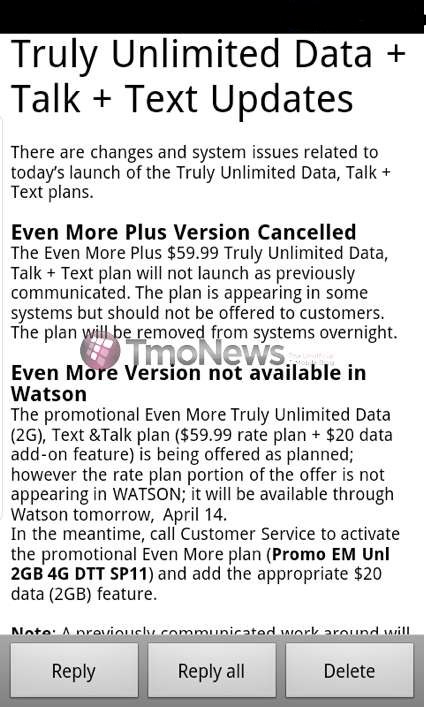
Here today, Gone today. T-Mobile withdraws a prepaid plan hours after sending press releases about it. (Image: TmoNews)

Imagine if your “unlimited” phone line came with a hidden limit — after 50 calls a month, each additional call would take at least five minutes to complete.

In the data world, speed throttles for “heavy users” deliver a similar frustrating experience.  That is what makes T-Mobile’s newly-announced “unlimited” use plans so ironic.  They are not truly unlimited at all.

T-Mobile’s “Even More” plan ($79.99) announced today for their contract/postpaid customers promises unlimited calls, texts, and data sessions with a very big asterisk — after using 2GB of data in a month, the company will throttle your data speed to near-dialup until your next billing cycle starts.

Providers routinely claim this doesn’t represent false advertising because you can still use data services on your phone, as long as you are willing to wait… a… very… long… time….

T-Mobile also managed to take back an announced plan for prepaid customers literally hours after seeding press releases to as many news agencies as possible.

In our copy, “Even More Plus” was supposed to deliver the same features as “Even More,” but at a much lower price — $59.99 per month.  It too was sold as “truly unlimited” for all of five hours before company officials yanked it, perhaps realizing their prepaid plan threw their postpaid/contract customers under the bus — charging them $20 more a month for same plan prepaid customers were to get for less.

TmoNews, home to a number of employees willing to share inside information about T-Mobile’s business, shared a copy of a notification message telling employees to avoid signing people up for the cheaper prepaid plan — it has been withdrawn.  But if customers insist, T-Mobile will agree to let you have the lower price, but only if you call by the end of today.

We noted with interest T-Mobile labels what they sell as “truly unlimited data” as the “$20 (2GB) feature” add-on in their own internal sales system.

Jeff, a Stop the Cap! reader grandfathered on an earlier T-Mobile data plan says it’s classic “bait and switch” advertising.

“My data plan offers 5GB of usage before the speed throttle kicks in, and now T-Mobile is advertising a 2GB data plan that they call ‘unlimited’,” Jeff notes. “A T-Mobile rep actually tried to tell me the new plan was better than the one I have now, which is the kind of new math that will make T-Mobile’s marketing department fit in real well with AT&T if this merger is approved.”

T-Mobile UK Backs Off Usage Cap Slashing… for Existing Customers Only

Phillip Dampier January 14, 2011 Consumer News, Data Caps, Editorial & Site News, T-Mobile, Wireless Broadband Comments Off on T-Mobile UK Backs Off Usage Cap Slashing… for Existing Customers Only

After an outpouring of complaints from UK mobile data customers, T-Mobile’s UK division has announced it is backing off implementing ‘new and improved’ usage caps of 500MB per month, down from the 1-3GB customers used to enjoy.  But the change of heart will only apply to existing customers.  New customers will find themselves second class citizens of the T-Mobile family — stuck with a 500MB allowance other customers won’t have to cope with.

The company claims it changed its mind after hearing from customers, but we suspect the real reason for the sudden change was word the British regulator OFCOM was considering an investigation, suggesting T-Mobile could have violated its own contract with customers by not providing 30 days of advance notice.

There were also reports angered customers seeking an early end to their contract were meeting resistance from T-Mobile’s customer relations department.  Customers who quit early face steep early cancellation penalties, despite the fact they should be waived if a mobile provider materially changes the service consumers thought they were getting when they signed up.

Another object lesson learned: Internet Overcharging schemes often start with “generous” allowances that some providers will lower if it means reducing demand on their networks, without ever bothering to lower prices for customers.

Virgin Mobile Introducing Unlimited Mobile Wireless Broadband $40 A Month on Sprint Network

Phillip Dampier August 23, 2010 Data Caps, Sprint, Video, Virgin Mobile, Wireless Broadband 4 Comments

Virgin Mobile, Sprint’s prepaid wireless division, will introduce big changes to their mobile broadband pricing as early as tomorrow, including an unlimited mobile broadband plan for $40 a month.

While the fine print is not yet available for review, if Sprint defines “unlimited” the way dictionaries do, the introduction of unlimited access for $40 a month represents a major departure among carriers who are increasing mobile data pricing or slapping usage limits or speed throttles on customers.

Virgin Mobile noted some of their customers are replacing their home wired broadband connections with the company’s own wireless broadband option, and the new unlimited pricing plan makes that a realistic option for some consumers who can live with Sprint’s current 3G network speeds.  Virgin Mobile customers currently do not have access to Sprint’s Clearwire 4G network.

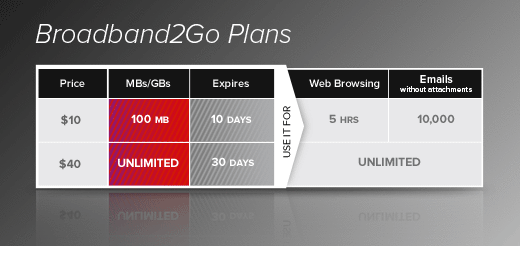
Virgin Mobile’s new Broadband2Go price plans were leaked on their Facebook page over the weekend:

Virgin Mobile's Broadband2Go Plans have been simplified into one occasional use budget plan and unlimited service for $40 a month

The new pricing departs from old pricing models that included four tiers of service, none unlimited, sold by anticipated data usage:

Virgin Mobile's old Broadband2Go delivered usage limits and forced consumers to guess at how much of a usage allowance they would need.

Virgin Mobile’s new flat rate mobile broadband data plan reflects increasingly aggressive pricing in the prepaid wireless business.  While other carriers place limits of up to 5GB on usage — typically sold for $60 a month, Virgin Mobile’s plan is fully $20 less per month and offers unlimited access.

The service is sold on a month-to-month basis with no contract requirement or credit check.  If the service does not meet one’s needs, customers can just walk away at the end of the month.

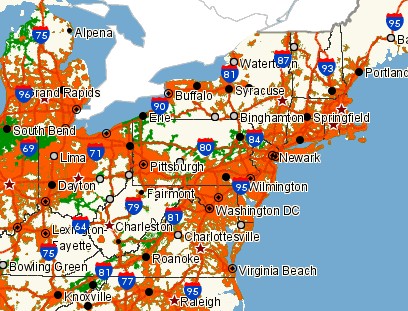
Virgin Mobile uses Sprint’s CDMA network, which offers reasonable coverage in metropolitan areas but is much spottier outside of population centers.

In the northeastern United States, Sprint's data network extends to large communities and major highways, but routinely skips smaller towns and isolated areas. For example, Virgin Mobile offers almost no service in northern New England. In upstate New York, service becomes spotty beyond the cities of Albany, Syracuse, Rochester, Buffalo, and the highways that connect them. There's almost no coverage in northern Pennsylvania, West Virginia, or eastern Kentucky either.

Virgin Mobile, formerly a reseller of Sprint’s network but now owned outright by them, has repositioned itself to emphasize “worry-free, unlimited service” for consumers who do not want to count calls, minutes, or megabytes.  Their latest marketing campaign pushes “crazy” low pricing, while calling out larger carriers charging up to $99 a month for the same service as “stupid.”

Virgin Mobile’s new pricing is expected to become effective Tuesday and will create a shakeup in the prepaid mobile broadband sector.  Perhaps no carrier is at bigger risk of losing mobile data customers than Cricket Wireless, which recently increased pricing on its mobile broadband service delivered on a far smaller network.

Virgin Mobile’s new pricing represents a far good deal for consumers and dispenses with usage limits.  The only downside is that Virgin Mobile customers will have to buy new modems — an Ovation MC760 for $79.99 or the MiFi 2200 Mobile Hotspot, which lets up to five users share a Virgin Mobile 3G connection over Wi-Fi, for $149.99.  These are available on Virgin Mobile’s website or in Best Buy stores.

[flv width=”640″ height=”500″]http://www.phillipdampier.com/video/The Crazy Life by Virgin Mobile – Full Version.flv[/flv]

Virgin Mobile’s “The Crazy Life” campaign is certain to be noticed amidst other, more subdued, advertising.  It promotes Virgin Mobile’s embrace of unlimited calling and data plans.  (1 minute)

Search This Site:

Contributions:

Recent Comments:

Your Account:

Stop the Cap!