Home » mobile data » Recent Articles:

An Inconvenient Truth: Data Caps Alienate Customers, Even on Wireless Networks, Everywhere

Phillip Dampier August 19, 2010 AT&T, Competition, Data Caps, Verizon, Wireless Broadband 1 Comment

You've used too much, and now we have to charge you more... a lot more.

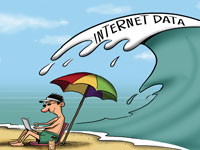
No matter where you live, work or play — be it Seoul, Korea, Manchester in England, or Oklahoma City — there is one thing consumers in all three cities will readily agree on: hatred of broadband data usage caps.

Those are the findings of a brand new survey conducted by GfK NOP in association with Reuters News in Britain.

Nearly 1,000 consumers were asked what they would do if confronted with their Internet provider implementing usage limits and other Internet Overcharging schemes.  More than half said they would be shopping for a new provider.

Not surprisingly, regardless of whether a consumer uses wired or mobile broadband, few believe usage caps are anything more than price gouging by providers to rake in additional revenue.  Many of these company’s biggest-spending-customers are unhappy to learn their provider is back looking for more money in return for less service.

The survey found users of smartphones such as the Apple iPhone care more about their mobile data allowance than they do about their choice of operator or even handset brand.

The survey found that users of the iPhone, Google Android phones or Research in Motion’s BlackBerry — typically, those who spend the most — are far more likely to switch operators to find better data deals.

More than half the users of these devices said they would switch to get a higher mobile data allowance.

Adjusted to take account of the fact that consumers do not always do what they say they will, GfK NOP esimated that 24 percent of contract customers using smartphones would actually switch operators.

Such a stampede would ring panic alarms inside any wireless carrier, but one company in particular faces some serious consequences for delivering years of bad service at high prices.

According to market research firm Morpace, nearly one-half of AT&T’s iPhone customers will seriously consider jumping ship if and when Verizon offers their own version of the wildly popular Apple smartphone.

At least 34 percent of current iPhone owners are resisting upgrade offers from AT&T that require a two-year contract renewal.  They’d rather wait until the iPhone is available on any network other than AT&T.

Even worse, should Verizon introduce their version of the iPhone in the coming year, nearly a quarter of AT&T customers (including those without the iPhone) are “somewhat or very likely” to dump AT&T immediately and head for Verizon.

In addition to complaints about lousy network performance, AT&T smartphone owners who spend the most with the carrier absolutely loathe AT&T’s new data usage limits implemented this past June.

“Experienced smartphone users who understand the benefits of using the Internet on the move and use services to help them in their day-to-day lives simply can’t live without mobile data,” says GfK/NOP analyst Ryan Garner, one of the report’s authors.

“They don’t want to be thinking about their data allowance and possible costs of over-running every time they open their browser or click on an app.”

Although AT&T told their customers and the media the new data-limited plans were going to save many customers money and have no impact on the rest, that is not what AT&T’s Chief Financial Officer Rick Lindner told Wall Street bankers and shareholders on a conference call last month.

“We believe over time, based on how much data they use, they will then begin to migrate up to [more costly] higher tiered plans,” Lindner said.

AT&T is well aware customers are already packed and ready to abandon ship, which is why the wireless provider has introduced a series of impediments to keep customers anchored in place.  Waived upgrade rules permitted most iPhone owners to upgrade to the latest iPhone 4 model this summer at the promotional price, in return for a two-year contract extension.  Customers seeking an end to their relationship with AT&T will find divorce an expensive proposition.  The company nearly doubled the contract early termination fee for smartphone owners June 1st.  Your exit price: up to $350.
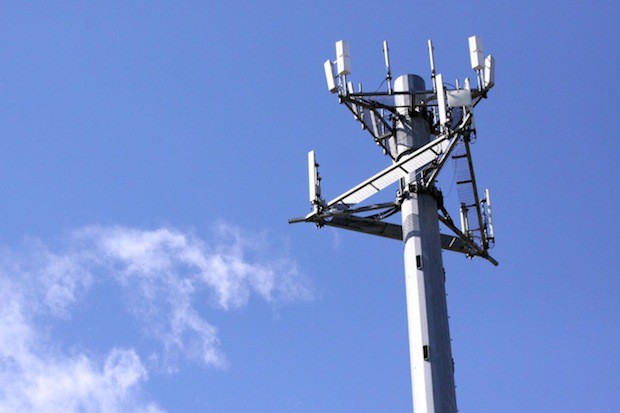
Why construct more of these if providers can get you to use less and pay more in the process?

Reuters notes the biggest driver towards the introduction of Internet Overcharging schemes like usage caps is the quest for additional revenue.

Most Western carriers have frozen or cut capital expenditure in the last two years as they prioritise maintaining the dividends prized by investors — meaning the modernisation of networks has been largely put on ice.

Meantime, they say they can no longer afford physically or financially to support unlimited data usage, and are banking on the fact that most consumers will barely notice data caps that are in any case far more generous than average data usage.

Stop the Cap! has been reporting that fact for at least two years now.  Usage limits are never about saving money for customers or making consumers pay for what they use.  They are about increasing profits at the same time providers continue to reduce investments to maintain and upgrade their networks.  Providers routinely report they are spending countless billions on network infrastructure, but neglect to mention those investments are not keeping up with subscriber growth and, in many cases, are actually decreasing year-by-year.  The self-perpetuating problem of network congestion that inevitably follows then becomes an excuse to charge customers more money for usage-limited service.

Reuters confirms that many western carriers have business plans that would be familiar to any neighborhood drug dealer – hand out plentiful cheap samples, get customers hooked, and then gradually reduce the supply while also raising the price.

In Europe, Scandinavian operator TeliaSonera is betting that the superiority of its next-generation LTE network, the world’s first, will allow it to offer premium services — at premium prices.

“When a service like this is entering the market, you normally more or less give it away for free, and so we did with mobile data,” Hakan Dahlstrom, the company’s head of mobility services, told investors last month.

“After a while… to meet the customer’s need for cost control; that is when you have flat rate. And then after some time the user understand how these services work and how it suits them, and you start charging for speed and volume.”
Yet not every provider has found success in alienating and overcharging their customers for increasingly important connectivity.

Reuters found Japan and Korea’s more advanced and mature data networks have already been down the road of usage restrictions, and found they didn’t solve network congestion issues — only provider investments in upgrades did:

Japanese operators NTT DoCoMo, KDDI and Softbank have stuck to flat rates — with discounts for months in which customers use less data — while encouraging them to use more Wi-Fi to take pressure off the mobile networks.

In Korea, carriers are returning to unlimited data plans because of heightened competition while investing heavily to upgrade their networks — a move that Western counterparts are unlikely to be able to avoid for much longer.

SK Telecom, South Korea’s top mobile carrier, last month said it would offer unlimited data services and free mobile Internet calls for customers paying 55,000 won ($46.40) and over in monthly service charges.

Of course, both Korea and Japan maintain more oversight by public officials over critical network infrastructure vital to both nations’ economies.  Neither government allows unregulated monopolies or duopolies in their midst — convinced they’ll deliver the least amount of service they can for the highest possible price they can get away with. In other words — today’s marketplace model in much of Europe and North America.

AT&T Launches Chicago Hotzone Wi-Fi Service in Wrigleyville to Keep People off AT&T’s 3G Network

Phillip Dampier August 4, 2010 AT&T, Broadband Speed, Consumer News, Video, Wireless Broadband Comments Off on AT&T Launches Chicago Hotzone Wi-Fi Service in Wrigleyville to Keep People off AT&T’s 3G Network

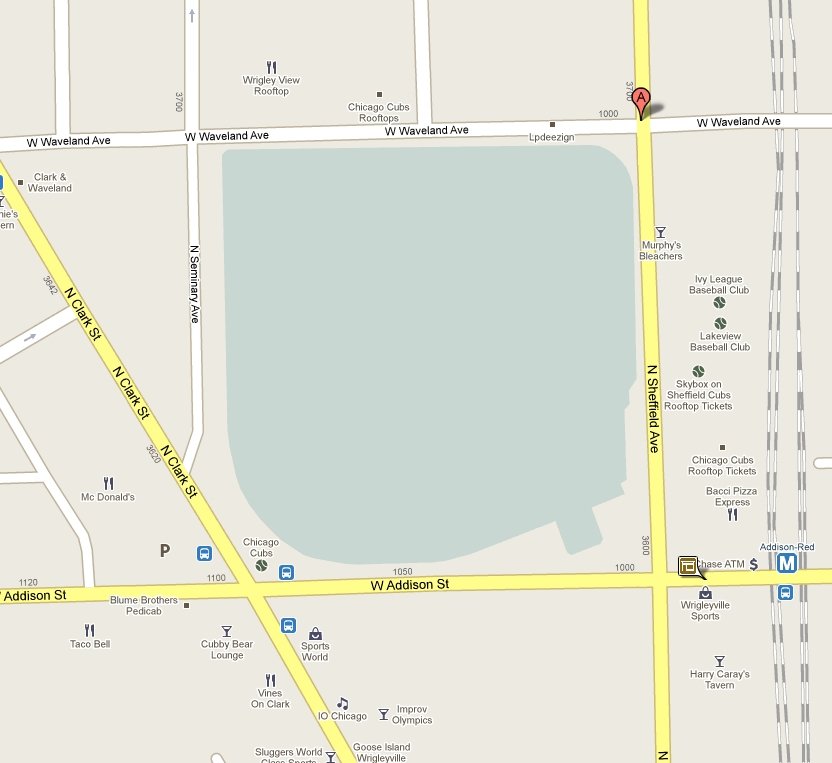
AT&T today launched its latest Hotzone Wi-Fi service in Wrigleyville, the neighborhood of restaurants and shops surrounding Wrigley Field, home of the Chicago Cubs. The new Wi-Fi hotzone provides coverage along the streets and in the outdoor areas of Wrigleyville on the south, east and west sides of the stadium.

The Chicago AT&T Wi-Fi hotzone is the third to be deployed as part of a pilot project to examine using Wi-Fi to supplement AT&T’s mobile broadband coverage in areas with consistently high 3G traffic and mobile data use. The first pilot AT&T Wi-Fi hotzone launched in New York City’s Times Square in May.

“We are excited to introduce an AT&T Wi-Fi hotzone in Wrigleyville, on the heels of successful hotzone launches in New York and Charlotte. These pilot AT&T Wi-Fi hotzones give us the opportunity to explore new ways to utilize our Wi-Fi and 3G networks to deliver the best possible experience for our customers,” said Dave Fine, vice president and general manager of AT&T in Illinois.

“We couldn’t be more pleased that AT&T has selected Wrigleyville as one of its three Wi-Fi hotzone locations,” said Jerry Roper, president and CEO of Chicagoland Chamber of Commerce. “This is great news for businesses in this vibrant neighborhood, as it offers Chicagoans and visitors yet another reason to experience all that the Wrigleyville area has to offer.”

AT&T's Hotzone surrounds Wrigley Field in Chicago (click to enlarge)

The Hotzone concept is designed to offload traffic away from AT&T’s congested 3G wireless network onto lower cost Wi-Fi service.  The Wi-Fi network is also expected to be faster than AT&T’s 3G network which may help drive AT&T customers towards using it.  There are no additional charges or usage limits for AT&T customers to access the Hotzone.

[flv]http://www.phillipdampier.com/video/Wrigleyville a Chicago Neighborhood Visitor Guide from Chicago Traveler.flv[/flv]

Chicago Traveler produced a short video introducing tourists to what’s on offer in Wrigleyville other than AT&T’s Hotzone.  (3 minutes)

[Updated] Time Warner Cable Offers Their Broadband Network to Cell Phone Companies; ‘Exaflood’ Apparently Doesn’t Apply

Time Warner Cable is offering mobile phone providers a solution to their clogged wireless networks — clog ours instead!

Business Week notes the cable company has been aggressively pitching its broadband network to cell phone companies in New York City, which can be used to transport cell phone calls and mobile data between cell towers and the providers’ operations centers.  The “backhaul” network cell phone companies rely on to move calls and data between the cell tower nearest you and your provider’s distribution network is often the source of the worst bottlenecks, especially when those networks are connected by standard copper telephone wiring, as many still are.

The more customers sharing a low capacity copper line, the slower your data speeds and greater the chance for dropped calls.  Although some providers have expanded their fiber capacity to reach busy cell towers, many more are still stuck with copper… until now.

Time Warner Cable’s offer to offload clogged cell phone networks onto the cable company’s broadband backbone has become extraordinarily profitable to the nation’s second largest cable operator.

In fact, it has become Time Warner Cable’s fastest-growing business after revenue tripled last year, Craig Collins, senior vice president of business services told Business Week.

We are talking $3.6 billion dollars in revenue in 2012 from wireless carriers alone, according to researcher GeoResults, Inc.

“Backhaul is a growth play that we are pursuing aggressively,” Collins said. “These mobile players want to get the bandwidth they need at a cost-effective price and our structure allows them to get that pretty seamlessly.”

U.S. smartphone use has grown almost 700 percent in four years, according to the U.S. Federal Communications Commission. Mobile-data volume is more than doubling annually as people use devices like the iPhone, BlackBerry and Google Inc.’s new Nexus One to send photos, watch videos and surf the Web. When networks jam, consumers face dropped calls and may find they can’t access Web pages or TV, analysts said.

Courtesy: Broadbast Engineering

The coming "exaflood" doesn't seem to worry Time Warner Cable, except when profits from consumers are at stake

Apparently the “exaflood” scare theory that suggests broadband networks are becoming hopelessly clogged does not apply to Time Warner Cable, because the company easily found plenty of free bandwidth in metropolitan New York City to profit from wireless phone traffic.

Not to be outdone, Comcast expects $1 billion from the wireless backhaul gravy train over time, according to its February 3rd conference call with investors.  Comcast is in a unique position to help ease congestion in San Francisco, where the cable operator provides service to some of the same customers who wander the city with Apple iPhones on AT&T’s overclogged Bay Area network.

Time Warner Cable CEO Glenn Britt doesn’t want to limit the potential revenue to just the wireless big boys — he wants to offer service to carriers large and small:

While Time Warner Cable declined to specify if AT&T, the lone U.S. carrier for the iPhone, is a customer, the New York- based cable company says it wants to sign carriers large and small. Chief Executive Officer Glenn Britt alluded to AT&T’s extra iPhone traffic in a December conference call.

“They want to get that into a cable as fast as they can,” Britt said, referring to overloads. His company began leasing backhaul in 2008 and posted $26 million in sales last year, less than 1 percent of the company’s total sales. Collins declined to give a forecast for 2010.

All this, of course, comes ironically to those Time Warner Cable customers who were subjected to Internet Overcharging experiments from Time Warner Cable just about one year ago.  Apparently, the exaflood only applies to consumers who face enormous broadband pricing increases and/or usage limits because of “overburdened” broadband networks.

Not so overburdened that the company can’t make room for billions in new earnings from cell phone companies, of course.

[flv width=”640″ height=”500″]http://www.phillipdampier.com/video/Bloomberg Moffett Says ATT May Need Cable to Ease Network Jams 3-8-10.flv[/flv]

[Video Fixed!] Craig Moffett discusses wireless smartphone data usage trends and Time Warner Cable’s involvement in transporting mobile phone and data across its cable broadband network (5 minutes)

Canadian Mobile Data Wars: Rogers May Be Forced to Pull Down “Most Reliable” Ads – Telus’ Goats Jump for Joy

Phillip Dampier November 25, 2009 Bell (Canada), Canada, Competition, Rogers, Telus, Video, Wireless Broadband 1 Comment
Telus' goats jump for joy with the company victorious over Rogers' "misleading" claims about network reliability

Telus' goats jump for joy as the company wins a favorable ruling in the B.C. courts over Rogers' "misleading" claims about network reliability

Ad wars over wireless data don’t just happen in the States.  Canadian providers have also been at each other over ad claims that just don’t tell consumers the whole story.  That’s the conclusion of a judge in British Columbia, who ruled that Rogers Communications’ wireless ads touting the provider as Canada’s “most reliable” are misleading.

In a court ruling Tuesday, the judge ruled in favor of a complaint lodged by Telus Communications that argued their wireless network was just as good as what Rogers had to offer.

[flv]http://www.phillipdampier.com/video/Rogers Stick Internet Fastest Network Ad.flv[/flv]

Rogers “Prove It – Foot Print” Ad touts “Canada’s fastest mobile network.” (30 seconds)

What is really at issue, once again, is the differences between two different wireless network standards.  Rogers beat Telus and Bell in upgrading its network to “High Speed Packet Access” technology, which has been marketed with more familiarity to consumers as “3G.”  Once Rogers launched the service, up went advertising promoting Rogers as the “fastest” and “most reliable” Canadian mobile provider.  Last month, Rogers was forced to drop the “fastest” claim, but has maintained it runs the most “reliable” network in the country.

Now that Telus upgraded their network, they wanted to know what justification Rogers had to claim that.  Telus eventually sued.

Justice Christopher Grauer found Telus had cause.

“The only basis Rogers ever had for making that representation was the comparison between its HSPA network and its competitors’ first-generation EVDO networks,” Grauer wrote in his decision. “Rogers’ representation nevertheless continues to be made. In these circumstances, I conclude that is misleading.”

“What is clear from the evidence before me is that the present network technology is at least equivalent between Rogers and Telus,” the judge wrote.

“The technological advantage that allowed Rogers to represent that it has Canada’s most reliable network has disappeared.”

“I conclude … that the balance of convenience favors the granting of an order restraining Rogers from continuing to represent, without appropriate qualification, that it provides ‘Canada’s most reliable network’.”

The case has some slight similarities to the Verizon-AT&T spat, if you took AT&T’s position in the case.  Rogers, in this case, promoted its 3G network before the others had networks of their own, and used language that suggested that 3G access provided enhanced reliability.  Once the competition also upgraded, Rogers simply added new fine print in their advertising touting that 3G was better than the older network standards their competitors had relied on up until earlier this month.

Rogers claims they are “perplexed” by the decision because they still believe they have the most reliable network.

[flv]http://www.phillipdampier.com/video/Rogers Most Reliable Dropped Call Ad.flv[/flv]

Rogers, “Canada’s most reliable network” doesn’t drop calls in elevators, according to this ad. (30 seconds)

TelusThere is no “good guy” in this story, however.  Once Bell upgraded their network on November 4th, they promptly began running commercials claiming they have Canada’s best network themselves.

Telus has the cutest… ads that is.  Nobody does cute quite like Telus.  Since 2001, the company has relied mostly on critters to sell their goods.  Among them: pot-bellied pigs, bunnies, tree frogs, monkeys, lizards, ducks, fish, hedgehogs, parrots, meerkats, and perhaps to celebrate their western Canadian roots, lots and lots of goats.

Watch the petting zoo, and some other Canadian wireless ads below:

… Continue Reading

Time Warner Cable’s Road Runner Mobile Network Launches in Dallas December 1st

Phillip Dampier November 24, 2009 Wireless Broadband 1 Comment

Leveraging their investment in Clearwire, a WiMax provider, Time Warner Cable on Monday announced it will officially launch the Time Warner Cable 4G Mobile Network in Dallas on December 1st. The first product to launch is Road Runner Mobile, which will essentially resell access to Clearwire for as low as $44.99 per month for Time Warner Cable customers. North Texas customers using the service can expect speeds up to 6Mbps.

“With Time Warner Cable’s 4G Mobile Network, we now offer the fastest mobile data service available,” said Barry Rosenblum, executive vice president of the Texas Region for Time Warner Cable. “We’re extending our reach outside of the home and giving our customers the convenience of mobility and the speed of 4G. Road Runner Mobile lets customers take their favorite Internet service wherever they go. This is an important part of our strategy to give our customers any content, on any device, anytime, anywhere.”

The launch literally echoes that planned in the Triad region of North Carolina, right down to the nearly word for word identical introductory quotes.

Customers face equipment fees, contracts typically extending two years, and usage caps on lower tier service.  Actual speeds vary considerably.  Consumers using Clearwire’s WiMax service have experienced problems using the service indoors, particularly in homes equipped with energy efficient windows.  It seems window coatings can block or reduce reception in certain cases.

On December 9, Time Warner Cable will host an exclusive event in Dallas at the House of Blues in celebration of the launch of Road Runner Mobile. The “Life in the 4G Fast Lane” event will feature an appearance by “The Fastest Woman in the World,” Indy Race Car superstar Danica Patrick. Along with being able to sample the service, guests will enjoy musical performances by Eagles tribute band, 7 Bridges, and Dallas’ own The King Bucks. A limited number of tickets will be available to the public leading up to the event.

North Texas residents can register to win $4,000 in the Life in the 4G Fast Lane Sweepstakes. One grand prize of $4,000 plus an HP Mini 311 Notebook will be awarded on December 9. An additional ten (10) HP Mini 311 Notebooks will be given away to 10 first prize winners.

Residents of Austin and San Antonio are expected to get access to Road Runner Mobile in early 2010.

Time Warner Cable also announced it would utilize the services of Brightpoint, a fulfillment house, to support the launch of Road Runner Mobile nationwide including wireless data card, accessory and collateral fulfillment and returns, triage and repairs.

Customers ordering products for Road Runner Mobile are likely to receive them shipped directly from Brightpoint, which will also manage customer returns and repairs.  Brightpoint is also known for supporting rebate programs and supplying retail locations with products from a variety of wireless equipment manufacturers.

Search This Site:

Contributions:

Recent Comments:

Your Account:

Stop the Cap!