Home » lawmakers » Recent Articles:

AT&T, Verizon Among the Biggest ‘Pay to Play’ Campaign Contributors and Lobbying Spenders

lobbyist-cashAT&T and Verizon are among the biggest tech company spenders in Washington, paying millions every quarter to lobby federal and state lawmakers on how they can make life easier for the telecom giants.

AT&T increased their lobbying budget by a whopping 23 percent in the third quarter, easily beating year over year spending of $3.5 million in the third quarter of 2012. In just three months this year, AT&T spent $4.3 million lobbying lawmakers on regulatory relief, retiring the rural landline network, reform of cell tower placement policies, and trying to keep the FCC from gaining new oversight powers.

Verizon Communications had lobbying costs of $3.09 million last year at this time. This year, it reduced that amount by two percent, spending $3.04 million. But Verizon Wireless upped its political spending by 19 percent, from $1.1 to $1.2 million. Taken together, Verizon spent a collective $4.24 million on lobbying in the last three months. Verizon lobbied on some of the same issues AT&T did.

In contrast Google spent $3.4 million, Facebook spent $1.4 million, and Microsoft spent $2.2 million.

“Once again the lobbying disclosures demonstrate the sad truth about the state of our democracy,” said John M. Simpson, Consumer Watchdog’s Privacy Project director. “When the government is open for business, policymaking is all about who has the cash and is willing throw it around.”

USA Today reported Verizon has also once again achieved a 0% effective tax rate during the past 12 months, which means any owed taxes will be offset by a variety of accounting tricks:

A big reason that Verizon’s effective tax rate is so low, coming in at a negative 4.8%, is largely due to accounting. The company’s sped-up depreciation, severance and pension costs are large credits that contribute to pushing the company’s taxes down, says Jonathan Schildkraut of Evercore. But there’s also a distortion caused by the company’s 55% interest in Verizon Wireless. Vodafone, which owns 45% of Verizon Wireless, pays taxes on its share, but the entire profit is reported on income. Adjusting for this, Verizon’s effective tax rate is closer to 30%, the company says. Verizon is buying Vodafone’s stake, which will eliminate the issue in the future. Similarly, real estate investment trusts have low effective tax rates because they pass profit to shareholders, who then pay the taxes.

The question for investors is whether or not companies paying low effective tax rates might, eventually, attract the attention to regulators. “They are slow at getting at these issues,” Yee says.

Copper Theft Epidemic Worsens; Chinese Scrap Metal Buyers Crave Telecom Cable

COPPER theftDespite dozens of new state laws and an effort by lawmakers to make metal theft a federal crime carrying a 10-year prison sentence, the epidemic of copper cable theft is expected to get worse before it gets better. The reason? China’s insatiable demand for North America’s enormous supply of discarded and stolen wire.

“The FBI has indicated that there’s so much theft taking place that it’s causing a national infrastructure issue,” said Lt. Terry Alling, a law enforcement official who now consults with police departments on how to recognize and curtail valuable metal thefts.

Scrap copper used to end up in the trash, especially telephone and coaxial cable used by phone and cable companies. With bare, high quality copper wiring valued at only $0.50 a pound for years, many scrap dealers were uninterested in shielded telecom cables that were a costly nuisance to process for recycling.

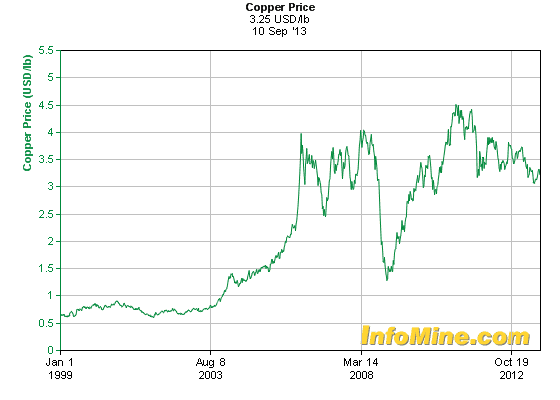
That changed in late 2003 when copper prices began a dramatic rise, first doubling to $1 a pound by 2004 and then suddenly spiking to an eye-popping $4 by 2006. Only the arrival of the Great Recession in 2008 would temporarily stem demand, dropping prices below $1.50 a pound. Two years later, prices dramatically rebounded, reaching an all time high of $4.50 a pound, and have remained above $3 ever since.

[flv width=”640″ height=”380″]http://www.phillipdampier.com/video/KOMO Seattle Copper Theft Epidemic 5-6-13.mp4[/flv]

KOMO in Seattle went undercover to sell scrap copper and quickly discovered why copper wire theft is now an epidemic — scrap dealers are ignoring the law and buying suspect copper with no questions asked. (5 minutes)

As prices have increased, so have copper thefts. Starting about a decade ago, law enforcement personnel discovered they were responding to a growing wave of reports of stolen manhole covers, copper pipe taken from abandoned buildings or construction sites, copper air conditioner coils gone missing, and even statues and other art work ripped out of the ground.
copper pricesOutside of the risk of falling into a manhole missing its cover, the biggest threat to public safety has come from utility infrastructure theft. Brazen thieves have shown their interest in turning scrap metal into cash has taken a priority over their personal safety and yours. Amazed utility workers were shocked to find thieves even willing to steal infrastructure from live power substations, often leaving customers in the dark as a result. A less risky, but just as profitable strategy has come from harvesting telephone cable right off of telephone poles, knocking out service for hundreds or thousands of customers as a result.

Some of the worst problems for telecom companies are in rural areas and smaller cities where thieves can remove cable with a good chance of not being seen.

In the Pacific Northwest, Spokane experienced cable theft from area substations. In Olympia, $30,000 of electric cable was stripped from street lights.

Three soccer fields in Federal Way experienced repeated copper theft, resulting in $150,000 in damages, despite efforts by the Federal Way Soccer Association to discourage thieves.

“We’ve changed the locks in all the systems, we’ve gone to gluing down doors on the boxes — nothing is stopping them,” said George Fifer.

Frontier Communications customers in Washington have been among the hardest hit. Last year, Frontier reported 10 major outages as a result of copper wire theft in the state. Frontier’s problems are nearly as bad in Ohio and West Virginia, those states being hit the most often. This year is more of the same in Washington, with at least 2,000 Frontier customers knocked out of service since April.

Frontier Communications has reported lines being stolen in Snohomish, Skykomish and Granite Falls, causing temporary outages for customers throughout north King and Snohomish counties.

[flv width=”640″ height=”380″]http://www.phillipdampier.com/video/KCPQ Seattle Thieves ripping out bulk phone lines 7-25-13.flv[/flv]

In July, KCPQ in Seattle reported copper thieves struck again, wiping out phone service in parts of Snohomish County, Wash. Nearly 2,000 Seattle-area customers have been hit so far. (3 minutes)
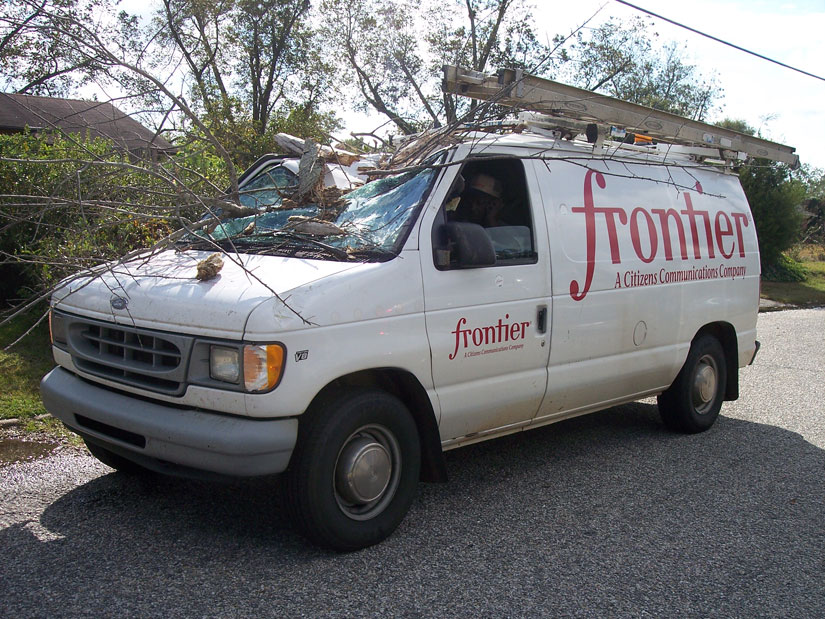
frontier truck“Customers are taken out of service, they’re put at risk, they can’t call 911,” said Frontier Communications general Manager Ken Baldwin. “The emergency folks can’t run the trace and know where they need to be.”

Alling estimates at least 90 percent of the copper theft is committed by meth addicts, motivated by their habit and unafraid to take risks.

They rely on selling their stolen copper to a network of scrap dealers that pay consumers and construction firms for “recovered/unwanted metals.” Although many scrap dealers operate legitimate businesses and don’t want to deal in stolen copper, there are more than a few willing to look the other way. Those dealers typically pay quick cash at below market prices to people who cannot credibly explain where the weekly bales of phone cable are coming from, so they don’t ask.

There is usually little risk to the dealers, who are unlikely to leave stolen copper in the storage yard for very long.

Alling says the copper crime wave is being fed by insatiable demand from the booming economy of China.

“They’re buying all the copper that they can get their hands on,” Alling said. “It’s speculated that they’re stockpiling and there’s not going to be any slowdown whatsoever for an extended period. The price is going to stay up which means that theft is going to stay up as well.”

A forthcoming book excerpted by Bloomberg Business Week seems to confirm Alling’s experience.

“Junkyard Planet: Travels in the Billion-Dollar Trash Trade,” published in November by Bloomsbury Publishing, digs deep into the world of scrap metal and the Asian metal market that increasingly drives most of the demand.

[flv width=”576″ height=”344″]http://www.phillipdampier.com/video/KCPQ Seattle Copper wire theft becoming an epidemic 1-2013.flv[/flv]

Washington’s Most Wanted reports wire theft is becoming an epidemic in the Pacific Northwest, costing taxpayers hundreds of thousands of dollars and risking public safety. Now local law enforcement is learning how to fight back. (3 minutes)
copper wireChina alone accounted for 43.1 percent of all global copper demand in 2012, writes Adam Minter, more than five times the amount of copper acquired by the U.S. that same year. For at least a decade, China has imported 70 percent of the scrap copper it uses to power its enormous manufacturing and construction industries. China’s most attractive source for recycled copper? The United States.

Minter writes at least 100 roving Chinese scrap dealers are traveling across the country in rental cars from scrap yard to scrap yard. They come ready to buy… a lot. Some scrap dealers receive visitors from China almost daily. Minter notes many of those 100 will spend an average of $1 million a week on discarded (or stolen) copper, much of it considered “low-grade” by American dealers because it requires cumbersome and expensive processing before it can be melted down or reused in new ways.

That is no problem for scrap dealers like Johnson Zeng, employed by a scrap importer in China’s Guangdong Province.

As Zeng browses one scrap yard in St. Louis, his interest piques when he sees bales and boxes of power lines and what the scrap trade calls “jelly.”

This is where Frontier Communications and other phone companies come in.

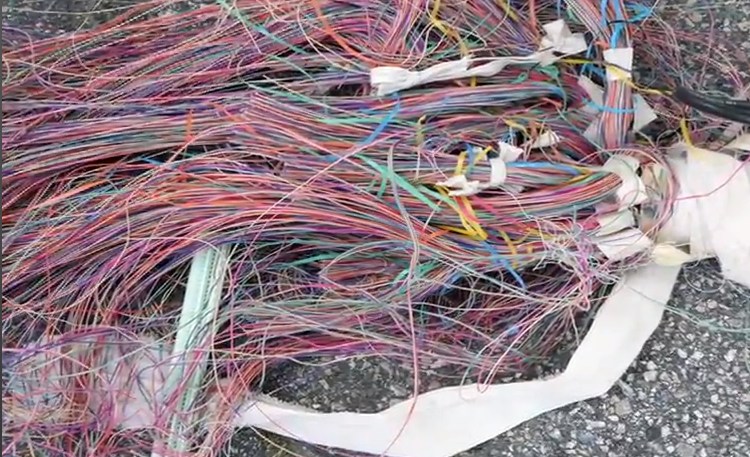
Much of the stolen telephone cable sold for scrap contains hundreds, if not thousands of individual copper wires, each wrapped in insulation and in turn wrapped around a thick black sheath to keep the weather out. This is the cable one might find serving entire neighborhoods or business blocks with landline phone service and DSL. If you cut into that cable, often 2″ in diameter, there is a chance it would begin oozing a Vaseline-like gel — the “jelly” Zeng has an interest in. That goo is primarily designed to keep underground phone cables dry because it helps repel corrosion-causing moisture.
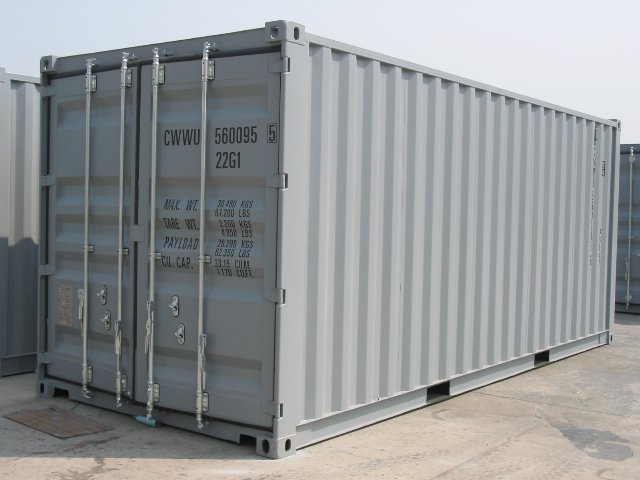
A minimum order for a Chinese exporter typically needs to fill at least one shipping container.

A minimum order for a Chinese exporter typically needs to fill at least one shipping container of this size.

Minter notes American recyclers hate jelly cable because it clogs their processing equipment. In China, it is in high demand because it is cheaply obtained and can be processed by an army of workers that cut the cable apart and wash away the petroleum product by hand.

Without the demand for “low-grade” copper wiring such as telephone cables coming from abroad, thieves would be unlikely to find any interest for their ill-gotten gains.

Cable companies have it easier. Asian exporters have shown little interest in coaxial cable because the effort to free the copper center conductor from the thick plastic sheath and wire netting that surrounds it is, for now, not worth it.

The demand on scrap dealers to maintain sufficient inventory to keep the roving band of exporters coming back is intense. Most Chinese buyers need a minimum order of one shipping container holding at least 40,000 pounds to make the deal worthwhile. Those containers are the size of a load driven by an 18-wheeler tractor-trailer.

At just one scrap yard, Zeng offered to buy all 10,000 pounds of “jelly” phone cable — all the dealer had in stock that day —  5,000 pounds of “grease wire,” and a large quantity of discarded Christmas tree light strings — another popular target for Asian exporters looking for cheap low-grade wire.

Within hours, Zeng would be back inside his rental car traveling to the next scrap dealer in a journey that took him from Illinois to South Carolina.

The recycling industry points out that if the Chinese were not in the market for American wire, it would end up in a landfill because copper demand within the United States is too low to justify the processing and labor costs to recycle it.

But that demand also fuels the growing copper theft plaguing the United States, and that costs every American taxpayer.

“The Department of Energy estimates that for every $100 that a copper thief actually gets in stolen materials, it costs $5,000 in repairs,” Alling said.

[flv width=”640″ height=”380″]http://www.phillipdampier.com/video/KXLY Spokane Copper Theft Law 7-2013.flv[/flv]

KXLY in Spokane reports miles of live power cables have been stolen by copper thieves. It takes a small amount of copper wire to make a lot of money, encouraging thieves to take more risks for bigger payoffs. Now a new Washington state law includes a “no-buy” list that keeps repeat offenders from selling to dealers in adjacent counties.  (3 minutes)

special reportAlling blames the meth addicts who commit the crimes, but also fingers scrap metal dealers who buy without asking questions. The source of stolen copper varies in different parts of the country. While telecommunications lines are most affected in rural communities, copper pipes and air conditioning coils are favorite targets in urban areas.

Most states have enacted new laws to curb the trade in stolen copper. Many require dealers to demand ID from sellers and keep detailed purchase records allowing law enforcement to identify the source of stolen cable found at scrap yards. Others require a license to sell copper to recyclers, a limit on the amount of scrap that can be sold to a dealer, and provisions for stiff fines and jail time for those caught buying or selling stolen metal.

In some states like West Virginia, tougher copper theft laws are beginning to curb thieves, but in South Carolina the thefts continue, despite the fact the state requires sellers of copper to first obtain a permit from a local sheriff’s office before selling their metal.

New Jersey Gov. Chris Christie vetoed a state copper theft control measure in New Jersey last week, claiming it would impose “overly burdensome regulations” on the state’s scrap dealers. The bill would have required that all payments for scrap metal be made by non-transferrable check unless the seller has a photo ID on file with the scrap company, and that businesses could only accept deliveries made by motor vehicle, allowing firms to record the buyer’s plates and driver’s license.

Sen. Charles Schumer (D-N.Y.) and Sen. Amy Klobuchar (D-Minn.), are tackling copper theft on the federal level by co-sponsoring the Metal Theft Prevention Act – a proposal to make stolen metal a federal crime.

Klobuchar

Klobuchar

S. 394 and its House companion bill H.R. 867 would impose a 10-year prison sentence on anyone caught stealing metal from telephone or cell towers, highway equipment or other critical infrastructure. The bill would also make it tougher to fence stolen metal by requiring more record-keeping for recycling agents, and prohibiting them from paying cash for purchases larger than $100.

Klobuchar claims copper theft has shot up by 80 percent in recent years and she wants to put a dent in it.

“The recent rise in incidents of metal theft across the country underscores the importance of federal action to crack down on metal thieves, put them behind bars and make it more difficult for them to sell their stolen goods,” Klobuchar said.

Despite some bipartisan support, Govtrack.us estimates the measure has only a 7% chance of getting past committee and a 3% chance of being passed in the House of Representatives, noting the Republican-controlled body voted only 11% of bills out of committee and only about 3% were enacted over the last two years. The companion bill in the U.S. Senate has already passed a committee vote, so Govtrack estimates it has a 40% chance of passing a full Senate vote, assuming it is not filibustered.

The federal measure is getting significant opposition from Republicans who argue it violates states’ rights to manage the problem through legislation on the state level.

“I have heard concerns expressed regarding people stealing valuable metal and crossing state lines to sell the stolen product,” said Sen. Mike Lee (R-Utah).  While I would support federal legislation addressed to such truly interstate circumstances, legislation that more broadly regulates intrastate conduct is constitutionally problematic. In my view, this bill exceeds Congress’s power under the Commerce Clause and imposes a federal regulatory scheme in an area of law the Constitution reserves to the states. In the interest of maintaining the balance between state and federal authority, I will vote against reporting this bill from the Judiciary Committee.”

Alling says in some communities copper thieves have gotten organized into gangs targeting valuable infrastructure, so while legislators work the problem on their end, local police need to organize themselves to combat it.

Alling said police should be on the lookout for thieves with tools like headlamps, bolt cutters and a change of clothes. Police should also search the area where the copper was stolen because often, the bad guys stash the metal nearby until they can remove it without getting caught.

Individuals can also report suspicious activity themselves by calling 911. In some areas, reward funds have been established by utilities for tips that lead to the successful prosecution of metal thieves.

[flv width=”640″ height=”380″]http://www.phillipdampier.com/video/KOMO Seattle Copper Thieves Plague Washington 9-10-13.mp4[/flv]

KOMO in Seattle reports Frontier Communications has been plagued with copper cable thefts for the last two years, cutting off critical 911 services to affected residents. (2 minutes)


Wisconsin’s “Video Competition Act” Leaves Municipalities Impotent Over Channel Losses

Phillip Dampier September 10, 2013 Astroturf, AT&T, Broadband Speed, Competition, Consumer News, Public Policy & Gov't Comments Off on Wisconsin’s “Video Competition Act” Leaves Municipalities Impotent Over Channel Losses

twctv_WebMilwaukee’s Public, Educational, and Government (PEG) channels will soon be off Time Warner Cable’s analog basic cable lineup with little recourse for city officials upset about the channel losses.
Time Warner Cable is notifying analog cable subscribers in several Wisconsin cities about an upcoming digital conversion that will cut an average of a dozen channels from the analog lineup this fall. In Wisconsin, Time Warner is targeting several well-known cable networks like The Weather Channel and CNBC for the digital switch, as well as Ion TV over the air affiliates and several independent/religious broadcast stations.

The loss of PEG channels without any discussion with local officials has some Wisconsin community leaders upset, fearing significant viewing losses. Communities across Wisconsin lost their right to compel the carriage of the public interest channels after a 2007 deregulation bill essentially written by AT&T became law.

“It has been brought to our attention that a number of channels in the local Time Warner Cable ‘basic’ package will be shifted to the digital tier next month, meaning that most Milwaukeeans without a newer model television will need to obtain a digital to analog converter box in order to continue to view the entire basic cable package. We are both frustrated and perturbed by this news,” said Milwaukee Council members Jim Bohl, Robert Bauman, and Tony Zielinski. “Let’s not minimize who it is that will be most impacted by this move on Time Warner’s part either — people with older model televisions who only subscribe to a basic cable package. In short, this cut in service will have a disproportionate effect on residents within the city of Milwaukee.”

twcTime Warner Cable spokesman Michael Hogan made it clear the transition is something subscribers will have to get used to, because Time Warner is gradually moving all of its cable systems to digital only service.

“We are moving towards a higher-quality, digital-only experience by making channels that had been available in both analog and digital formats available in a digital format only,” said Hogan. “Delivering channels digitally frees up capacity in our network to deliver faster Internet speeds, more HD channels and On Demand choices, and other new services in the future. We began the process several years ago of moving towards a digital-only experience. All of our direct video competitors – including direct broadcast satellite providers and phone companies – already take advantage of the efficiencies of digital delivery and deliver all of their programming solely in digital format.”

The Sordid History of “Video Competition” in Wisconsin

The race to digital service to keep up with satellite providers and AT&T U-verse is not exactly the type of competition Wisconsin residents thought they would get from the passage of a 2007 statewide video franchise law advocated by AT&T.

According to the Center for Media and Democracy, the Wisconsin law is modeled on the American Legislative Exchange Council’s “Cable and Video Competition Act,” a model bill ghostwritten by AT&T for use in statehouses around the country. AT&T provided more funding for ALEC’s activities in Wisconsin from 2008-2012 ($55,735) than any other corporation. Supporters of the legislation promised it would lead to more competition, better customer service and lower cable rates.

Bohl

Bohl

Instead, it leaves Wisconsin communities with no recourse when cable operators decide to digitize or encrypt cable channels that city officials believe should be widely available to the public. Provisions in the law no longer permit local communities to have any say in a provider’s channel lineup, placement, or technology used to deliver the service.

Milwaukee Alderman Jim Bohl called the channel conversion a Time Warner bait-and-switch maneuver that will cut off residents’ access to city government. As for those promises of lower cable rates, Bohl rolled his eyes.

“I can only tell you it’s gotten worse,” Bohl told the Milwaukee Express. “This change would not have been looked at real happily by the council. I don’t think they ever would have done that if they were still accountable for their franchise agreement with the city of Milwaukee.”

Time Warner Cable subscribers without converter boxes who directly attach coaxial cable to the back of older television sets will be affected by the switch and will need to pay extra for a standard set-top box on each affected television in the home (roughly $7 a month each), or take advantage of a temporary offer from the cable company to supply a small digital to analog converter box that will be available for free for one year. After that, the smaller converter boxes will cost $0.99 a month each with no purchase option.

Without the boxes, Time Warner Cable subscribers will find themselves increasingly out of luck as the company gradually eliminates analog channels from the lineup.

Being AT&T’s Best Friend Can Be Rewarding

Montgomery

Montgomery

Supporters of AT&T’s video competition bill have been luckier than most Wisconsin cable subscribers.

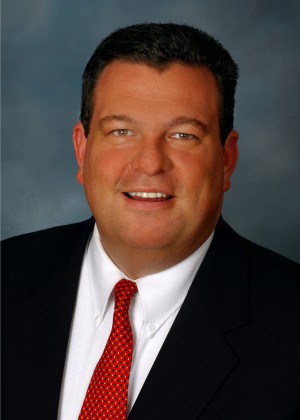
Former Republican state Rep. Phil Montgomery, lead sponsor and claimed author of the 2007 video competition bill, was well compensated with a sudden $2,250 campaign contribution from AT&T the year the bill was introduced. Another $1,500 arrived from AT&T executives and one of their spouses in Texas and $1,500 from a senior AT&T executive in Wisconsin.

Before AT&T’s bill was written, the company barely knew Montgomery existed, donating a total of only $300 to his campaigns from 1998-2005.

After the bill became law, Montgomery spent his remaining years in the Wisconsin Assembly building a solid record avidly supporting AT&T’s public policy maneuvers, including a measure to deregulate basic phone rates and end oversight of telephone service quality by the state’s Public Service Commission.

Despite revelations Montgomery served as an ALEC board member and received contributions amounting to $10,800 from telecom companies, in 2011 Gov. Scott Walker appointed him to chair the PSC — very same agency Montgomery worked for years to disempower.

“He was very friendly to industry when he was a legislator, and was seen as carrying water for the telecommunications industry and the utilities,” said Mike McCabe, executive director of the Democracy Campaign. “Consumer advocates would naturally have concerns about somebody who seemed so supportive of industry now being in a position of overseeing those industries.”

Sen. Jeff Plale Takes Marching Orders from AT&T, His Chief of Staff’s Rap Sheet, a Freezer Full of Steaks and a Country Club for Cronies

Plale

Plale

AT&T’s biggest ally in the Wisconsin Senate was Jeff Plale, one of only a handful of Democrats — all pro-business conservatives — belonging to ALEC.

The patience of his district was tested after Plale began openly advocating for his corporate donors and claimed he could not understand why questions about his integrity were being raised by his opponents. Plale, after introducing AT&T’s companion video franchising bill in the Senate expressed he was shocked, shocked to discover he received more campaign contributions from AT&T and the cable industry than any other legislative Democrat. He added he did not know why AT&T’s Political Action Committee had suddenly maxed out on its campaign contribution two years before the next election.

Plale’s close working relationship with AT&T evolved inside of his office.

In 2003, Plale hired Katy Venskus, a charged felon, to raise funds for his election campaign. Despite pleading no contest to siphoning off more than $12,000 from an abortion rights organization and being caught up in a scandal over illegal campaign work for another Democrat, Venskus was appointed Plale’s chief of staff and would quickly become the point person for AT&T’s video competition bill in Plale’s office, working closely with AT&T to adjust the bill’s language to the company’s liking and help coordinate its movement through the Senate.

The successful passage of the bill would prove personally lucrative to Venskus when she left Plale’s office to join lobbying firm Public Affairs Co., of Minneapolis just one month after AT&T’s bill was signed into law. One year later, she took on AT&T as a lobbying client.

Venskus

Venskus

In 2009, Plale and AT&T closely collaborated to write another deregulation measure to be introduced in the Wisconsin legislature, this time deregulating phone rates, making provision of landline service optional, and gutting service oversight. By then, AT&T Wisconsin considered Venskus an on-contract lobbyist.

The irony of a felon serving as the chief of staff for a Wisconsin state senator or as a registered lobbyist was not lost on the Milwaukee Express’ Lisa Kaiser.

“Despite being a felon, Venskus can affect public policy at the highest levels as a registered lobbyist,” observed Kaiser. “Yet she couldn’t be licensed to become a day care provider.”

According to e-mails and draft copies of the telephone deregulation bill obtained from the Legislative Reference Bureau and interviews conducted by The Capital Times, a number of meetings —  “too numerous to count,” according to Plale’s chief of staff, Summer Shannon-Bradley — occurred with AT&T lawyers and executives and several other key industry stakeholders to work on the bill.

One important meeting in November 2009 included this attendance list: Andrew Petersen, director of external affairs and communications with telephone company TDS; William Esbeck, executive director of the Wisconsin State Telecommunications Association (WSTA) – a telecom industry lobbying group; that group’s attorney, Judd Genda; and AT&T attorney David Chorzempa.

E-mails and other correspondence between those at the meeting and Plale’s staff show slashes or check marks next to sections of the proposal that attorneys for AT&T and the WSTA suggested should be changed.

“It’s like lawmakers looked around and said, ‘These are the companies affected. So sit down with the drafters and make a bill,’ ” Barry Orton, a UW-Madison telecommunications professor told the Times. “The public interest isn’t represented. How could it be? Nobody was there to represent them.”

Life got tougher for Ms. Venskus a few months later when she was charged with felony theft and felony identity theft on suspicion of making $11,451 in improper purchases with her Public Affairs credit card, including a freezer full of steaks, according to the criminal complaint filed in Dane County court. She repaid the charges, but her contract to work for AT&T’s interests was suspended.

That September, Plale wore out his welcome in the 7th District serving southern Milwaukee and lost to primary challenger Chris Larson, who contended Plale was far too conservative and cozy with AT&T for his district.

walker

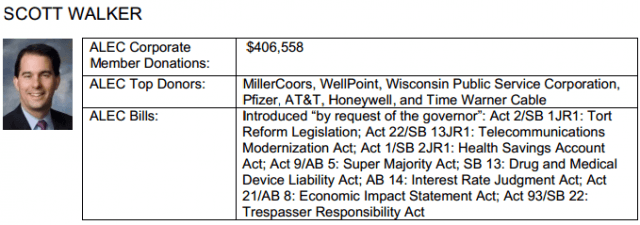
Gov. Scott Walker is also a close friend of ALEC, supporting a number of corporate-sponsored initiatives to deregulate the telecommunications industry. (Source: ALEC Exposed)

Plale would land on his feet when, after siding with Republicans on a lame duck session vote to stick it to the state’s unions, he joined the administration of Republican Gov. Scott Walker as the administrator of the Division of State Facilities — a $90,000 a year job.

“Instead of seeking out the best and brightest, this governor is busy creating a country club for cronies,” Marty Beil, executive director of the Wisconsin State Employees Union, told the Wisconsin State Journal. “When he says ‘open for business’ and then appoints people like Plale, he’s obviously saying that he doesn’t draw the line at the world’s oldest profession.”

Resigning N.C. House Finance Chairman Blasts Speaker for Having ‘Business Relationship With TWC’

special reportOne of the chairs of the North Carolina House Finance Committee abruptly resigned his chairmanship on the House floor Wednesday, submitting a letter read aloud in the chamber that accused fellow Republican House Speaker Thom Tillis (R-Mecklenburg) of having an unexplained business relationship with Time Warner Cable.

Rep. Robert Brawley (R-Iredell) wrote Tillis burst into his office demanding to know about a bill Brawley introduced that would have weakened the 2011 law Tillis strongly supported that severely restricted publicly owned broadband networks in the state.

“You slamming my office door shut, standing in front of me and stating that you have a business relationship with Time Warner and wanting to know what the bill was about,” Brawley wrote in his resignation letter. “You and I both know the bill stifles the competition with MI Connections in Mooresville. MI Connections is being operated just as any other free enterprise system and should be allowed to do so without the restrictions placed on them by the proponents of Time Warner.”

Tillis’ office described the resignation of Brawley’s chairmanship as “a mutual decision.”

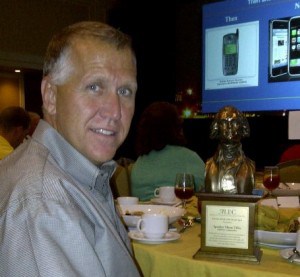
Tillis was honored in 2011 as ALEC's "Legislator of the Year" and received an undisclosed cash reward.

Tillis was honored in 2011 as ALEC’s “Legislator of the Year” and received an undisclosed cash reward. Time Warner Cable is a corporate member of ALEC.

House Bill 557, introduced by Brawley, would have permitted an exception under state law for the community-owned MI Connection cable system to expand its area of service to include economic development sites, public safety facilities, governmental facilities, and schools and colleges located in and near the city of Statesville. It would also allow the provider to extend service based on the approval of the Board of County Commissioners and, with respect to schools, the Iredell County School Board.

The bill died in the Committee on Government earlier this month.

MI Connection is the publicly owned and operated cable and Internet system serving the towns of Mooresville, Davidson and Cornelius in the counties of Mecklenburg and Iredell. It was originally a former Adelphia-owned cable system that fell into disrepair before it was sold in a bankruptcy proceeding. MI Connection has proved financially challenging to the local communities it serves because the antiquated cable system required significant and costly upgrades, faces fierce competition from AT&T and Time Warner Cable, and lacks the technological advantage fiber to the home offers other public networks like Greenlight in Wilson and Fibrant in Salisbury. Despite the challenges, MI Connection has successfully upgraded its broadband infrastructure with the fastest speeds available in the area — up to 60/10Mbps.

Tillis helped shepherd into law the 2011 bill that Time Warner Cable helped write and sponsor designed to stop public networks like MI Connection from expanding and new public networks ever seeing the light of day. The legislation places strict limits on public broadband network deployment and financing. The bill Brawley introduced would have chipped away at the law’s limits on network expansion. Brawley’s letter suggests Tillis had direct involvement stopping his bill from getting further consideration.

Brawley

Brawley

Both Brawley and Tillis represent portions of the MI Connection service area.

Time Warner Cable has a long history pushing for community broadband bans in North Carolina, but the bills never became law when the legislature was still in the hands of Democrats. But in late 2010, Republicans took control of the state house for the first time in more than a century. Time Warner Cable’s fortunes brightened considerably under Republicans like Rep. Marilyn Avila (R-Wake). Avila willingly met with Time Warner Cable’s top lobbyist to coordinate movement on the community broadband ban legislation she introduced and after it became law was honored by the state cable lobby at a retreat in Asheville.

Tillis, who became speaker of the house in 2011 under the new GOP majority, received $37,000 in telecom contributions in 2010–2011 (despite running unopposed in 2010), which is more than any other state lawmaker and significantly more than the $4,250 he received 2006–2008 combined. AT&T, Time Warner Cable, and Verizon each gave Tillis $1,000 in early-mid January, just before he was sworn in as speaker on January 26. Tillis was in a key position to make sure the anti-competitive bill moved along the legislative pipeline.

Last summer, Time Warner Cable returned the favor inviting Tillis to serve a prominent role at a media event inaugurating its Wi-Fi network in time for last year’s Democratic National Convention, held at the Time Warner Cable Arena.

Despite all that, newspapers in the state are having trouble determining exactly what ties Tillis has to Time Warner Cable. The Raleigh News & Observer noted, “It’s unclear what relationship Tillis might have to Time Warner. His financial disclosure lists no connection.”

miconnectionlogoThe Greensboro News & Record published a non-denial denial from Tillis spokesman Jordan Shaw: “Shaw said he doesn’t know of any business relationship between Tillis and Time Warner.” The paper added, “a regional Time-Warner spokesman said Tillis has no ties to the company.”
“Not knowing” is not a total denial and a legislator need not have direct ties to a company to be influenced by their agenda through lobbyists like the North Carolina Cable Telecommunications Association, the statewide cable trade association that includes Time Warner Cable as its largest member. Then there are third-party groups.

A May 7 editorial in the News & Observer pointed out Tillis does have close ties to the American Legislative Exchange Council (ALEC), a group financed in part by Time Warner Cable and cited by CEO Glenn Britt as a useful asset to the cable operator because it was “particularly focused on telecom matters.” The commentary, “ALEC’s Guy is Thom Tillis,” reminded readers Tillis wasn’t just a casual member of the corporate-funded group, he’s a national board member. In fact, Stop the Cap! has learned he was ALEC’s 2011 Legislator of the Year. On hand at the 2011 New Orleans ALEC event to applaud Tillis were more than two dozen fellow North Carolina Republican legislators, including Reps. Marilyn Avila and Julia Howard.

alec-logo-smAmong the model, corporate ghost-written bills ALEC maintains in its extensive database is one that restricts or bans publicly owned broadband networks, similar to what passed in North Carolina in 2011.


The fortunes of ALEC (and the corporations that underwrite its operations) have continued to improve in North Carolina this year. The News & Observer notes:

ALEC, as it’s known, has provided language for bills that [have been] used this session in North Carolina, ranging from creating an independent board to take charter school governance away from the State Board of Education to protecting a Philadelphia-based company from lawsuits involving asbestos exposure to installing an anti-union amendment in the state constitution. Closer to home, the Civitas Institute, a conservative group, used ALEC literature in an indoctrination…er, training…session for freshman lawmakers.

"I wish you'd turn the camera off now because I am going to get up and leave if you don't," said Rep. Julia Howard

“I wish you’d turn the camera off now because I am going to get up and leave if you don’t,” said Rep. Julia Howard

Uncovering the corporate influence and pay to play politics pervasive in North Carolina’s legislature on broadband matters has proved historically scandalous for members and ex-members alike, as Stop the Cap! has reported for more than four years:

Tillis is following in others’ footsteps and is suspected of having even bigger political ambitions for 2014 — challenging the U.S. Senate seat now held by Democrat Kay Hagan.

The News & Observer thinks Tillis is forgetting about the people who elected him to office:

For North Carolinians of any political philosophy, however, the larger concern here is that laws are being written by those outside the state with only an ideological interest. ALEC, except for advancing its agenda, likely could care less about issues specific to North Carolina, things of intense, day-to-day concern to North Carolinians.

And not only are bills being influenced by ALEC, the speaker of the House is on the group’s board.

Thom Tillis and his Republican mates on Jones Street weren’t elected to march to orders issued by some national organization. Perhaps if they kept their eyes and ears open for constituents, their legislative agenda might be more about them and less about doing ALEC’s bidding.

Brawley himself is not free from controversy. In addition to attending the aforementioned ALEC event in New Orleans with Tillis, Avila, and Howard, earlier this year Brawley introduced House Bill 640, legislation that would roll back ethics reforms and allow lobbyists to once again give gifts to state lawmakers without any public disclosure.

Brawley told WRAL-TV that required ethics classes on gifts and disclosure requirements “are useless for anyone without internal ethics anyway. They only tell you the law. They do not guarantee integrity. What makes you think a person without ethics is going to obey a law anyway?”

The laws were enacted after a major 2006 scandal involving then-House Speaker Jim Black.

Corrections: In the original article, we mistakenly identified the News & Observer as a Charlotte newspaper. It is actually published in Raleigh. We also wrote that House Bill 557 died without being assigned to any committee for consideration. We received word the bill was actually referred to the Committee on Government on Apr. 4, 2013 where no further action was apparently taken. We regret the errors.

W.V. Legislature Debates Broadband for Possum Hollow and Other Small Town Left-Behinds

Phillip Dampier April 11, 2013 Broadband Speed, Competition, Consumer News, Public Policy & Gov't, Rural Broadband Comments Off on W.V. Legislature Debates Broadband for Possum Hollow and Other Small Town Left-Behinds

possum hollowWest Virginia’s broadband future is up for hot debate in the state legislature as Internet haves and have nots fight over whether the state should spend money to bring broadband to those lacking it or improve service for those that do.


House Bill 2979, a bill to expand the broadband purview of the West Virginia Infrastructure and Jobs Development Council, has turned into one of the most contentious bills before the legislature this term. An amendment to redefine what speeds represent “broadband” and requiring the council to prioritize efforts on unserved areas has sparked the most debate.

Sen. Robert Plymale (D-Cabell) introduced and won support for an amendment that would discard the current provider-favored standard defining a community as “served” if customers can buy at least 200kbps service. Plymale favors adopting the federal broadband speed standard — 4/1Mbps as the bare minimum. Plymale also wants the state to devote most of its resources to getting broadband to rural areas that do not have the service today.

“If you’re going to compete in this world today, you have to have access,” Plymale told lawmakers. “Access has to be the number one item, and this amendment allows access to be the priority.”

Plymale

Plymale

But other lawmakers representing constituents in communities that already have broadband, but receive inadequate speed and service, objected to Plymale’s amendment.

Sen. Herb Snyder (D-Jefferson) claims Plymale’s amendment would restrict the council’s ability to manage broadband resources and require it to spend most of its funding on wiring smaller communities at the cost of service upgrades that could reach more people. Approximately 85,000 West Virginians still have no broadband access other than satellite.

“It’s entirely appropriate to use taxpayer dollars to help and assist people to get broadband service and get on the information superhighway rather than upgrading those already on it,” argued Sen. Mitch Carmichael (R-Jackson), who also happens to also be an employee of Frontier Communications.

Much of the state’s broadband infrastructure spending has been devoted to institutional and middle mile networks that consumers and small businesses cannot directly access. Spending on “last mile” infrastructure makes the difference between getting broadband service or being told it is unavailable.

But Sen. Snyder argues satellite broadband already offers access to the entire state, so broadband speed improvements were more important.

“As we speak the entirety of West Virginia is bathed in 5Mbps satellite broadband service,” Snyder said. “So we’re already surpassing that standard in the entire state, unless you’re in a cave where you can’t get the signal.”

Getting the best broadband bang for the buck was a priority for Sen. Clark Barnes (R-Randolph). He wanted to make sure any amendment would not prevent the council from spending money in areas where satellite service was available.

“If we have 10 folks up in Possum Hollow that have no access to broadband, would they receive priority over the thousand people who only have 2Mbps service?” he said.

The answer would seem to be yes under Plymale’s amendment.

Search This Site:

Contributions:

Recent Comments:

Your Account:

Stop the Cap!