Home » internet service providers » Recent Articles:

Two Views on Net Neutrality: The Industry’s Need for Investment vs. Internet Freedom

[flv]http://www.phillipdampier.com/video/Bloomberg Who Wins and Loses on Net Neutrality 4-25-14.flv[/flv]

The Cost of Internet Fast Lanes: Bloomberg News confronts James Cronin, chief technology officer for Venda, with the industry view that telecom companies need more investment to upgrade and expand their broadband networks. Cronin thinks eliminating Net Neutrality would be a real mess. (5:11)

[flv]http://www.phillipdampier.com/video/PBS Will dismantling net neutrality stymie innovation 4-24-14.flv[/flv]

The Federal Communications Commission is on the brink of changing the Net Neutrality principle, which allows consumers unfettered access to web content, and limits the ability of Internet service providers to block or filter material. New guidelines would allow some companies to charge more for faster service. PBS’ Gwen Ifill talks to Cecilia Kang of The Washington Post about what’s at stake. (6:40)


The New Guilded Age is Pay-Per-View; Comcast-TWC Merger Like a Throwback to An Earlier Era

Phillip Dampier April 21, 2014 Comcast/Xfinity, Competition, Consumer News, History, Public Policy & Gov't Comments Off on The New Guilded Age is Pay-Per-View; Comcast-TWC Merger Like a Throwback to An Earlier Era

gildedA merger of Time Warner Cable and Comcast is just one more step towards undermining our democracy, worries former Secretary of Labor Robert Reich.

In a blog entry republished by Salon, Reich sees increasing evidence that the trust-busting days at the turn of the 20th century are long over, and Americans will likely have to relearn the lessons of allowing capitalism to run amuck.

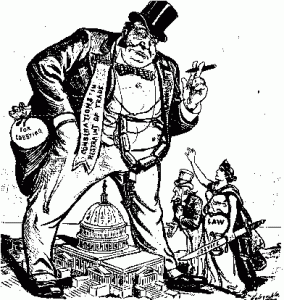
It was the Republican Party of the 1890s that had the loudest voice in Washington protesting the concentration of business power into vast monopolies that had grown so large, they not only hurt consumers but threatened to undermine democracy itself.

Republican Senator John Sherman of Ohio was at the forefront of acting against centralized industrial power, which he likened to the abusive policies of the British crown that sparked America’s revolution for independence.

“If we will not endure a king as a political power,” Sherman thundered, “we should not endure a king over the production, transportation, and sale of any of the necessaries of life.”

The merger of Comcast and Time Warner Cable is just the latest example America is in a new gilded age of wealth and power that no longer prevents or busts up concentrations of economic power, observes Reich.

“Internet service providers in America are already too concentrated, which is why Americans pay more for Internet access than the citizens of almost any other advanced nation,” Reich argues.

Reich

Reich

Reich worries about the implications of allowing Comcast to grow larger, considering how much the current company already invests in Washington to get the government policies it wants:

  • Comcast has contributed $1,822,395 so far in the 2013-2014 election cycle, according to data collected by the Center for Responsive Politics — ranking it 18th of all 13,457 corporations and organizations that have donated to campaigns since the cycle began. Of that total, $1,346,410 has gone to individual candidates, including John Boehner, Mitch McConnell, and Harry Reid; $323,000 to Leadership PACs; $278,235 to party organizations; and $261,250 to super PACs;
  • Comcast is also one of the nation’s biggest revolving doors. Of its 107 lobbyists, 86 worked in government before lobbying for Comcast. In-house lobbyists include several former chiefs of staff to Senate and House Democrats and Republicans as well as a former commissioner of the Federal Communications Commission. Nor is Time Warner Cable a slouch when it comes to political donations, lobbyists, and revolving doors. It also ranks near the top.
Atwell-Baker

Atwell-Baker

The Center for Responsive Politics expanded on the revolving door issue between the cable industry and the Federal Communications Commission that will be responsible for approving the Comcast-Time Warner merger.

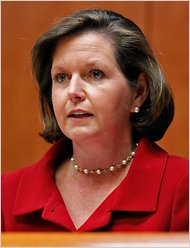
It found one of the most prominent travelers to be former FCC commissioner-turned Comcast lobbyist Meredith Atwell-Baker. Always a friend of the cable industry, the Republican commissioner hurried out the door two years into her four-year term after getting a lucrative job offer from Comcast in June 2011. Despite claims she stopped participating in votes relating to Comcast after getting her job offer, she was a strong supporter of Comcast’s merger with NBCUniversal and favored the cable industry’s approach towards preserving a barely noticeable feather-light regulatory touch.

Atwell-Baker never contemplated her move might be seen as a conflict of interest, but then again, it represented nothing new for Washington. At the time, the only condition limiting her was a two-year ban on lobbying the FCC. But that does not apply to Congress so Atwell-Baker spent her time as Comcast’s senior vice president of government affairs trying to influence the House and Senate on 21 bills that could affect Comcast’s bottom line.

Just as shameless — Michael Powell, who served as FCC chairman during the first term of the George W. Bush Administration. After leaving the FCC he took the lucrative position of top man at the National Cable & Telecommunications Association, the cable lobby. The Center found several other former FCC employees heading into the private sector, advising Big Telecom companies on how to best influence regulators:

  • Rudy Brioche, was an adviser to former commissioner Adelstein before moving to Comcast as its senior director of external affairs and public policy counsel in 2009. Brioche was so valued by the FCC, in fact, that he was brought back to join the commission’s Advisory Committee for Diversity in the Digital Age in 2011;
  • James Coltharp, who served as a special counsel to commissioner James H. Quello until 1997, is now a Comcast lobbyist;

comcast twcOnce out of the public sector for several years, some lobbyists see their value deteriorate as they get increasingly out of touch with the latest administration in power. So several seek a refresh, temporarily leaving their lobbying job to return to public sector work.

The Center offered David Krone as a potential example. Krone formerly held leadership and lobbying positions with companies like AT&T, TCI Communications and the National Cable & Telecommunications Association. After 2008, he was hired by Senate Majority Leader Harry Reid (D-Nev.) to advise him on telecommunications matters. Today he is Reid’s chief of staff. If and when Reid leaves office, Krone can always join the parade of ex-Hill staffers back to the lucrative world of lobbying.

Will elected officials give a receptive ear to Comcast’s arguments in favor of its merger? Most likely, considering every member of the Senate Judiciary Committee (except deal critic Sen. Al Franken), has recently received campaign contributions from the cable giant, according to OpenSecrets:

gilded-age.gjf_Comcast PAC donations to Senate Judiciary Committee Democrats

  • Chuck Schumer, New York: $35,000
  • Patrick Leahy, Vermont, Chairman: $32,500
  • Sheldon Whitehouse, Rhode Island: $26,500
  • Chris Coons, Delaware: $25,000
  • Dick Durbin, Illinois: $23,000
  • Amy Klobuchar, Minnesota: $22,500
  • Dianne Feinstein, California: $18,500
  • Richard Blumenthal, Connecticut: $11,500
  • Mazie Hirono, Hawaii: $5,000
  • Al Franken, Minnesota: $0

Comcast PAC donations to Republicans

  • Orrin Hatch, Utah: $30,000
  • Chuck Grassley, Iowa, Ranking Member: $28,500
  • John Cornyn, Texas: $21,000
  • Lindsey Graham, South Carolina: $13,500
  • Jeff Sessions, Alabama: $10,000
  • Mike Lee, Utah: $8,500
  • Ted Cruz, Texas: $2,500
  • Jeff Flake, Arizona: $1,000

Reich thinks its time to return to the trust-busting days of President Teddy Roosevelt, who found the transportation infrastructure of the 20th century and the fuel used to power it increasingly controlled by a handful of giant players that abused monopoly power to set unjustifiable prices and suppress competition. Getting Congress, increasingly flush with now-unlimited corporate money, to agree to its own refresh a century later may prove a tougher sell.


Most Cutting Edge Gigabit Broadband Networks are Community-Owned

Greenlight announces gigabit service for Wilson, N.C.

Greenlight announces gigabit service for Wilson, N.C.

Claims from critics that government-owned Internet Service Providers would bring ineptly managed, behind-the-times broadband are belied by the reality on the ground.

Network World highlighted several cities offering consumers and/or businesses gigabit broadband service from publicly owned Internet providers. All of them stand alone with no commercial competitor willing or able to compete on speed. In fact, most of the communities offering their own Internet service do so because incumbent cable and phone companies showed no interest in upgrading or expanding their services or offer them at prohibitive prices. For many of the towns involved, the only way to get 21st century broadband was to build it themselves.

Cable companies like Time Warner Cable scoff at the need for superfast broadband speeds, claiming customers are not interested in gigabit Internet. After the Federal Communications Commission issued a challenge for every state in the U.S. to reach 1Gbps Internet speeds in at least one community by 2015, then chief financial officer Irene Esteves said 1,000Mbps service was unnecessary and the cable company wouldn’t offer it because there was little demand for it.

While Esteves was telling reporters gigabit speeds were irrelevant, Time Warner Cable’s lobbyists were working behind the scenes to make sure none of their community-owned competitors offered it either, cajoling state officials to pass legislation that would effectively ban publicly owned broadband competition. Time Warner, along with other cable and phone companies evidently feel so threatened, they have successfully helped enact such bans into law in 20 states.

The record is clear. The best chance your community has of getting gigabit speeds is to rally your local government or municipal utility to offer the service you are not getting from the local cable/phone duopoly anytime soon.

Chanute, Kansas

The city of Chanute, Kan. is fighting back against incumbent phone and cable companies trying to ban municipal-owned ISPs in the state.

The city of Chanute, Kan. is fighting back against incumbent phone and cable companies trying to ban municipal-owned ISPs in the state.

With just 9,000 residents barely served by AT&T and the routinely awful Cable ONE, Chanute knew if it wanted 21st century broadband, it was unlikely to get it from the local phone and cable company. Chanute has owned a municipal fiber network since 1984 and has been in the Internet provider business since 2005. Now the city is working towards a fiber to the home network for residents while AT&T is lobbying Washington regulators to let the company scrap rural landline and DSL service across Kansas and other states.

The city is taking a stand against the latest effort to ban community broadband networks in Kansas. It’s a rough fight because Kansas lobbyists get to write and introduce corporate-written telecom bills in the legislature without even the pretext of the proposed legislation originating from someone actually elected to office. SB 304, temporarily withdrawn for “tweaking,” shreds the concept of home rule — allowing local communities to decide what works best for them. Instead, AT&T, Cable ONE, Comcast, Cox, and other telecom companies will get to make that decision on your behalf if the bill re-emerges in the legislature and passes later this year.

“We’re taking a leadership position to do something about it. I’d hate to sit here and keep bashing AT&T and Cable One. They don’t care. All they care about is paying dividends back to their stockholders,” Chanute’s utility director Larry Gates told Network World. “My feeling – this is mine, it’s probably not the city’s, but it’s mine – is I wouldn’t care if we ever made a dime on this network, as long as it would pay for itself. If it could increase and do the things with education, health, safety, and economic development – man, that’s a win. That’s a huge win.”

Chattanooga, Tennessee
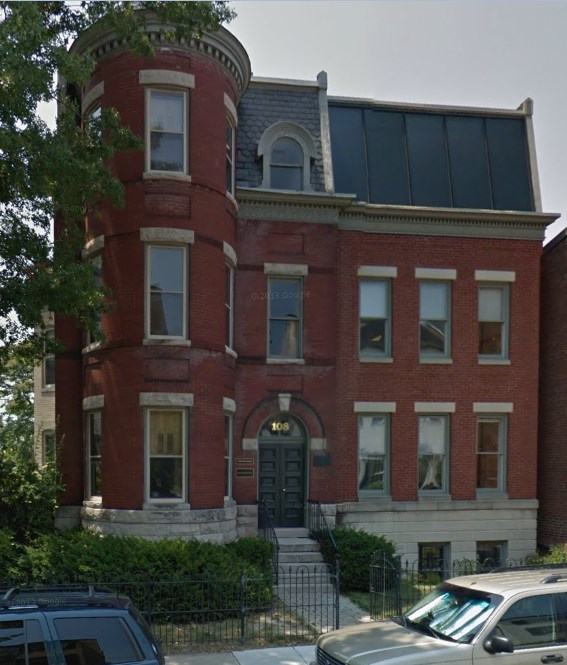
The "headquarters" of the Taxpayers Protection Alliance is in the basement of this building in suburban Washington. It's a pretty small alliance funded by mysterious "private" donors.

The “headquarters” of the Taxpayers Protection Alliance is in the basement of this building in suburban Washington.

EPB Broadband is the best argument community broadband advocates have to counter Big Telecom propaganda that community-owned broadband is a failure waiting to happen. EPB has received national acclaim by delivering gigabit broadband to consumers and businesses that Chattanoogans can’t get from AT&T and Comcast. EPB is Chattanooga’s municipally owned electric utility and originally laid fiber to power its Smart Meter project to better manage its electric system. With near infinite capacity, why not share that network with the community?

EPB routinely embarrasses its competition by offering highly rated local customer service and support instead of forcing customers to deal with offshore call centers rife with language barriers. Customer ratings of AT&T and Comcast are dismal — rock bottom in fact — but that isn’t the case for EPB, embraced by the local community and now helping to foster the region’s high-tech economic development.

Santa Monica, California

Santa Monica City Net does not serve residential customers, but a lot of locals probably wish it did. Greater Los Angeles has been carved up between bottom-rated Charter Communications and never-loved Time Warner Cable. Time Warner customers in LA will soon get access to 100Mbps broadband. Businesses in downtown Santa Monica can already get broadband from City Net at speeds up to 10Gbps.

Lafayette, Louisiana

LUS Fiber has had a very tough battle just getting service off the ground. Its two competitors are AT&T and Cox, and the fiber to the home provider had to work its way through legal disputes and a special election to launch service. Even to this day, corporate front groups like the Taxpayers Protection Alliance are still taking potshots at LUS and other municipal providers. TPA president David Williams refuses to identify where the money comes from to fund TPA’s operations. It’s a safe bet some of it comes from telecom companies based on the TPA’s preoccupation with broadband issues. The group always aligns itself with the interests of phone and cable companies.

Cable and phone companies that fund sock puppet groups like TPA could have spent that money to upgrade broadband service in communities like Lafayette. Instead, they cut checks to groups like the Taxpayers Protection Alliance, headquartered in a basement rental unit in suburban Washington, D.C.

Burlington, Vermont

Burlington Telecom’s troubled past is a poster child for anti-municipal broadband groups. The provider’s financial problems are often mentioned by groups fighting public broadband. To be sure, there are successes and failures in any industry and inept marketing by BT several years ago hurt its chances for success. Its competition is Comcast and FairPoint Communications, which means usage-capped cable broadband or slow speed DSL. BT sells a gigabit broadband alternative for $149.99 a month for those signing a 12-month contract. Comcast charges $115 a month for 105Mbps service — about ten times slower than BT’s offering.

Tullahoma, Tennessee
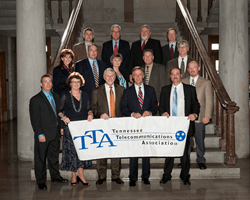
The Tennessee Telecommunications Association is appealing to the state government to keep publicly-owned broadband competitors out of their territories.

The Tennessee Telecommunications Association is appealing to the state government to keep publicly owned broadband competitors out of their territories.

LighTUBe, the telecommunications branch of the Tullahoma Utilities Board (TUB), announced its gigabit Internet offering in May 2013, says Network World. The magazine suspects the provider is interested in commercial, not residential customers.

That no doubt comes as a relief to the Tennessee Telecommunications Association, which represents the state’s independent phone companies. Last month, more than a dozen executives from those companies invaded the state capital to complain that municipal providers were threatening to invade their territories and offer unwanted competition.

“We are particularly concerned about four bills that have been introduced this session,” says Levoy Knowles, TTA’s executive director. “These bills would allow municipalities to expand beyond their current footprint and offer broadband in our service areas. If this were to happen, municipalities could cherry-pick our more populated areas, leaving the more remote, rural consumers to bear the high cost of delivering broadband to these less populated regions.”

Among the companies that want to keep uncomfortable public broadband competition out of their territories: North Central Telephone Cooperative, Loretto Telecom, Twin Lakes Telephone Cooperative, Highland Telephone Cooperative, TDS Telecom, United Communications, Ben Lomand Connect, WK&T Telecommunications, Ritter Communications, Ardmore Telephone Company, and RepCom.

Bristol, Tennessee

Bristol is unique because its city limits are effectively in Tennessee and Virginia. Neither state has gotten much respect from incumbent telephone and cable companies, so BTES — the electric and telecom utility in Bristol — decided to deliver broadband service itself. The network is now being upgraded to expand 1Gbps service, and it represents an island in the broadband backwater of far eastern Tennessee and western Virginia and North Carolina.
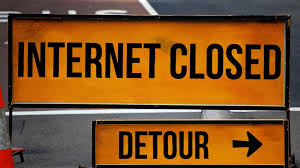
closedCedar Falls, Iowa

Iowa has never been a hotbed for fast broadband and is the home to the largest number of independent telephone companies in the country. Cedar Falls Utilities is one of them and is trying to change the “behind the rest” image Iowa telecommunications has been stuck with for years. The municipal telecom provider has boosted broadband speeds and announced gigabit broadband last year.

Wilson, N.C.

Greenlight has been providing fiber to the home service for several years, and its presence in the middle of Time Warner Cable territory was apparently the last straw for the cable company, which began fiercely lobbying for a municipal broadband ban in North Carolina. Thanks to a massive cash dump by Koch Brothers’ ally Art Pope, the Republicans took control of the state government between 2010-2012. Many of the new legislators have an ongoing love affair with ALEC — the corporate front group — and treat its database of business-ghostwritten bills like the Library of Congress. What AT&T, CenturyLink, and Time Warner Cable want, they now get.

With a broadband ban in place, Greenlight can’t expand its territory, but it can increase its broadband speeds. Time Warner Cable tops out at 50Mbps for almost $100 a month. For $49.95 more you can get 1,000Mbps from Greenlight. Instead if competing, TWC prefers Greenlight to simply go away, and the North Carolina legislature has shown it is always ready to help.


Verizon: Prioritization and Compensation for Certain Traffic is the Future of the Internet

McAdam

McAdam

The head of Verizon believes two concepts will become Internet reality in the short-term future:

  1. Those that use a lot of Internet bandwidth should pay more to transport that content;
  2. The “intelligent” Internet should prioritize the delivery of certain traffic over other traffic.

Welcome to a country without the benefit of Net Neutrality/Open Internet protection. A successful lawsuit brought by Verizon to toss out the Federal Communications Commission’s somewhat informal protections has given Verizon carte blanche to go ahead with its vision of your Internet future.

Lowell McAdam, Verizon’s CEO, answered questions on Tuesday at the Morgan Stanley Technology, Media & Telecom Conference, attended by Wall Street investors and analysts.

McAdam believes groups trying to whip Net Neutrality into a major issue are misguided and uninformed about how companies manage their online networks.

“The carriers make money by transporting a lot of data,” McAdam said. “And spending a lot of time manipulating this, that accusation is by people that don’t really know how you manage a network like this. You don’t want to get into that sort of ‘gameplaying.'”

netneutralityMcAdam believes there is nothing wrong with prioritizing some Internet traffic over others, and he believes that future is already becoming a reality.


“If you have got an intelligent transportation system, or you have got an intelligent healthcare system, you are going to need to prioritize traffic,” said McAdam. “You want to make sure that if somebody is going to have a heart attack, that gets to the head of the line, ahead of a grade schooler that is coming home to do their homework in the afternoon or watch TV. So I think that is coming to realization.”

But McAdam also spoke about the need for those generating heavy Internet traffic to financially compensate Internet Service Providers, resulting in better service for content producers like Netflix — not considered ‘priority traffic’ otherwise.

“You saw the Netflix-Comcast deal this week which I think — or a couple weeks ago — which is smart because it positions them farther out into the network, so they are not congesting the core of the Internet,” said McAdam. “And there is some compensation going back and forth, so they recognize those that use a lot of bandwidth should contribute to that.”

McAdam reported to investors he had spoken personally with FCC chairman Tom Wheeler, who seems to be taking an even more informal approach to Net Neutrality than his predecessor Julius Genachowski did.

Verizon's machine-to-machine program is likely to be a major earner for the company.

Verizon’s machine-to-machine program is likely to be a major earner for the company.

“In my discussions with Tom Wheeler, the Chairman, he has made it very clear that he will take decisive action if he sees bad behavior,” McAdam said, without elaborating on what might constitute ‘bad behavior.’ “I think that is great; great for everybody to see that. And I think that is what we would like to see him do, is have a general set of rules that covers all the players: the Netflixes, the Microsofts, the Apples, the Googles, and certainly the Comcasts and the Verizons. But the only thing to do is not — you can’t just regulate the carriers. They’re not the only players in making sure the net is healthy. And I think we all want to make sure that investment continues in the Internet and that customers get great service.”

Verizon has already reported success monetizing wireless broadband usage that has helped deliver growing revenue and profits at the country’s largest carrier. Now McAdam intends to monetize machine-to-machine communications that exchange information over Verizon’s network.

McAdam believes within 3-4 years Americans will have between five and ten different devices enabled on wireless networks like Verizon’s in their cars, homes, and personal electronics. For that, McAdam expects Verizon will earn between $0.25 a month for the average home medical monitor up to $50 a month for the car. Verizon is even testing wireless-enabled parking lots that can direct cars to empty parking spaces.

For those applications, McAdam expects to charge enough to guarantee a 50% profit margin.

“These can be very nice margin products,” McAdam told the audience of investors. “So even at $0.25 if you are doing 10 million of them and it’s 50% or better margins, those are attractive businesses for us to get into.”

Netflix Agrees to Pay Comcast for Improved Video Streaming; Could ‘Limit Competition’

comcast toll plazaNetflix has agreed to compensate Comcast in return for assurances that the cable company’s subscribers would no longer be caught in the middle of a dispute between Comcast and one of Netflix’s content distributors.

The multi-year agreement between the two companies will bring Netflix direct access to Comcast’s broadband network with a Service Level Agreement that will guarantee streaming stability for customers who have loudly complained about Netflix’s deteriorating performance.

The controversial arrangement has probably established a precedent for other large Internet Service Providers likely to seek compensation to handle Netflix traffic. As of this evening, both AT&T and Verizon have already acknowledged they are negotiating with Netflix for similar arrangements.

Caught in the middle of the dispute are Comcast customers paying for a reliable Internet connection and getting slowing connections and re-buffering problems while attempting to watch Netflix content during peak usage times.

One side accuses Comcast of violating Net Neutrality while the other blames Netflix for dumping enormous Internet traffic on Internet Service Providers without compensation for network upgrades. Also in the crossfire is Cogent, a third-party company delivering Netflix content to Comcast’s front door.

How Netflix Distributes Its Streaming Movies and TV Shows

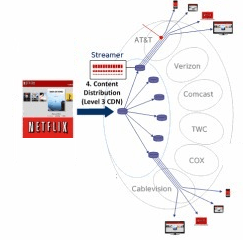
netflix cdnNetflix has traditionally avoided owning the “pipes” that distribute movies and TV shows to paying customers. Instead, it usually contracts with “transit providers” to send content from Netflix headquarters on to “content distribution networks (CDN)” that manage video streaming. A Netflix video may pass through a number of connections on a variety of independently owned networks before it arrives at the front door of your Internet Service Provider. Companies like Comcast handle “the last mile” of the journey that began at Netflix and ends at your computer or television set.

Netflix does not rely on just one transit provider to handle its traffic. Level 3, Cogent, and XO Communications all reportedly serve in that capacity, depending on where traffic is headed. The same is true for the CDN’s Netflix contracts with to regionally stream content to each subscriber.

Netflix determines how to handle your streaming movie request behind the scenes, selecting a CDN that is close to you and capable of delivering the most stable streaming experience at that moment. If you are a Comcast or Verizon customer, Netflix often selects Cogent to handle its content. Cogent is also well known for its relatively low cost.

If you are served by Cablevision, Frontier, or certain other providers like Google Fiber, Netflix will instead direct your streaming request to a CDN located within your provider’s own network. These “Open Connect” boxes store Netflix content in a type of cache and can stream it to customers directly without sending video packets across multiple third-party networks. Theoretically, Open Connect offers an efficient and stable way of distributing Netflix content to customers. It also saves Netflix money and in return, it costs the ISP nothing — Netflix pays for the equipment and service.

Cogent vs. Big Telecom

220px-CogentlogoNetflix and YouTube together are now estimated to cover 50 percent of all video traffic on the Internet, and that traffic is growing. Cogent dutifully passes that video content along to Internet Service Providers like Verizon and Comcast that have customers waiting to watch. But it is a two-way street. Any outbound traffic from customers could also be forwarded to Cogent to send on. Traditionally, both sides have managed the traffic by gradually increasing the bandwidth and speed of their connections to one-another. But as Netflix traffic grows and grows, companies like Comcast and Verizon believe they are being saddled with the costs to upgrade their networks in ways that are out of proportion to the traffic they send in the other direction. ISPs often grumble about the cost but keep on upgrading to keep paying customers happy. Verizon and Comcast are suspected of dragging their feet on those upgrades in an effort to win compensation.

Verizon and Comcast argue they should be paid by content producers responsible for generating tons of Internet traffic to help cover the cost of upgrades. Instead, Netflix offered its Open Connect boxes, which keep Netflix traffic within an ISPs own network, reducing the necessity of constantly upgrading connections with other transit providers. Verizon and Comcast don’t want Netflix’s solution — they want cold hard cash.

Conflict of Interest

Some network engineers cannot understand all the controversy about Comcast’s arrangement with Netflix. Some believe Netflix is simply shifting traffic away from third-party Cogent to Comcast directly, presumably at a cost savings. They suggest customers will be happy that streaming quality is restored and Netflix also wins a guaranteed level of performance they never had with Cogent.

2hatBut that argument does not explain why Netflix was compelled to make a financial arrangement with Comcast. The two companies have been in negotiations on the subject of traffic compensation for months. Many industry observers believe those talks went nowhere until Netflix customers began complaining about the increasing network slowdowns. Some even dropped their Netflix subscriptions over the issue.


Netflix CEO Reed Hastings admitted he made a deal with Comcast to restore customer confidence in Netflix and end subscriber frustration. It was also increasingly clear Comcast was in no hurry to improve things on its own, despite the fact its own customers were the ones most directly affected.

So why wouldn’t Comcast (or Verizon or Time Warner Cable) take Netflix up on its offer of free Open Connect boxes that would reasonably solve streaming problems without forcing anyone to spend a fortune on upgrades? Simply put, all three companies are direct competitors of Netflix. Helping Netflix offer a top quality streaming experience is not in the best interests of Comcast (or others) that are facing potential cord-cutting customer losses in their subscription video businesses. Verizon has partnered with Redbox to deliver streamed video, Comcast operates Streampix, its own online streaming service, and Time Warner Cable offers a variety of on-demand and streamed video content for its cable TV subscribers. None of these services have suffered from traffic congestion issues.

ISP Payday

ISP Payday

What About Net Neutrality? What About Paying Customers?

With Net Neutrality tossed out by the courts, there is little any regulator can do to resolve disputes until Net Neutrality can be properly enforced under a stronger regulatory framework. Some argue the congestion issues creating the problems with Netflix are not a true violation of Net Neutrality in any event because providers are not artificially prioritizing traffic.

They are simply not keeping up with upgrades that just so happen to directly impact a competitor while leaving their own services unscathed.

Providers also seem characteristically unconcerned about complaining customers, passing blame for the problem on to Netflix. Besides, they remind you, paying for an Internet connection alone does not entitle you to any guarantee of performance.

The Dam Breaks

With this week’s agreement between Comcast and Netflix, both AT&T and Verizon wasted no time admitting they are both seeking compensation from Netflix as well. Other providers are likely to follow.

Netflix warned investors that paid agreements with ISPs could adversely affect its earnings due to increased costs. Although stopping short of suggesting price increases for Netflix customers could come as a result, Wall Street wasted no time worrying about the financial impact of deals like the one between Netflix and Comcast.

The Wall Street Journal reported the momentum appears to be shifting in favor of large Internet providers like Comcast and AT&T and away from content producers.

Janney Capital analyst Tony Wible suggested Comcast’s toll booth could create a barrier for other content producers if the cable company asks for significant compensation.

“Although there is no prioritization benefit [from the deal], we suspect that the exchange of money for resolution/performance could (if large) effectively limit competition,” said Wible. “In essence, Netflix could be trading [profit] margins for subscribers. Few others can match Netflix’s [spending budget to acquire content] without incurring massive losses. The competition may now have to cope with additional fees that sway their willingness to compete if they do not already have a large subscriber base.”

In other words, a new Internet startup could face hard questions from investors about how it intends to cover ISP demands for compensation in return for a suitable connection to reach customers. A large venture like Netflix has enough resources to handle those costs and negotiate for a better deal while a smaller startup may not.

[flv]http://www.phillipdampier.com/video/WSJ Netflix Comcast Agreement 2-24-14.flv[/flv]

Netflix has signed a deal with Comcast to ensure smooth streaming, in what is being called a landmark agreement. Wall Street Journal reporter Shalini Ramachandran explains the agreement. (3:39)

Search This Site:

Contributions:

Recent Comments:

Your Account:

Stop the Cap!