Home » internet service providers » Recent Articles:

Broadband Monopolies/Duopolies Against the Public Interest, Declares China

Phillip Dampier February 20, 2014 Broadband Speed, Competition, Consumer News, Public Policy & Gov't Comments Off on Broadband Monopolies/Duopolies Against the Public Interest, Declares China

chinatelChina’s top economic planning agency is assessing a monopoly case involving two large telecom companies and will make a ruling soon as the Beijing government declares uncompetitive broadband against the interests of the people.

The National Development and Reform Commission (NDRC) began to investigate the duopoly of China Telecom and China Unicom in the broadband business two years ago. The two companies, fearing reprisals, promised to end the questionable practices that brought scores of complaints from Chinese citizens over network incompatibilities, rising prices, and slow service.

The two companies together maintain a 90 percent market share of Chinese broadband, and both could face fines up to 10 percent of their annual Internet revenues if the NDRC finds they are acting as an abusive duopoly.

The Chinese government passed strict anti-monopoly laws in 2008 and has enforced them. Beijing has been particularly concerned about price discrimination against other Internet Service Providers and relentless rate hikes, even as costs to offer the service have dropped dramatically.

The NDRC said on Wednesday that the two companies submitted evidence that suggested both had significantly raised network integration, extended the direct-link bandwidth of their backbone networks, raised broadband speeds and lowered prices.

Although the Chinese government’s free market policies have brought investment and economic change to China, the government has grown increasingly concerned about leaving vital sectors of the economy unregulated. In several instances, the result has been bad for consumers and generally reduced innovation, as handfuls of conglomerates found it easier to enforce market power, reduce investment, and raise prices. The Chinese consider the country’s online networks critical to its participation in the global digital economy, with the NDRC acting as a check against uneven playing fields and abusive business practices.

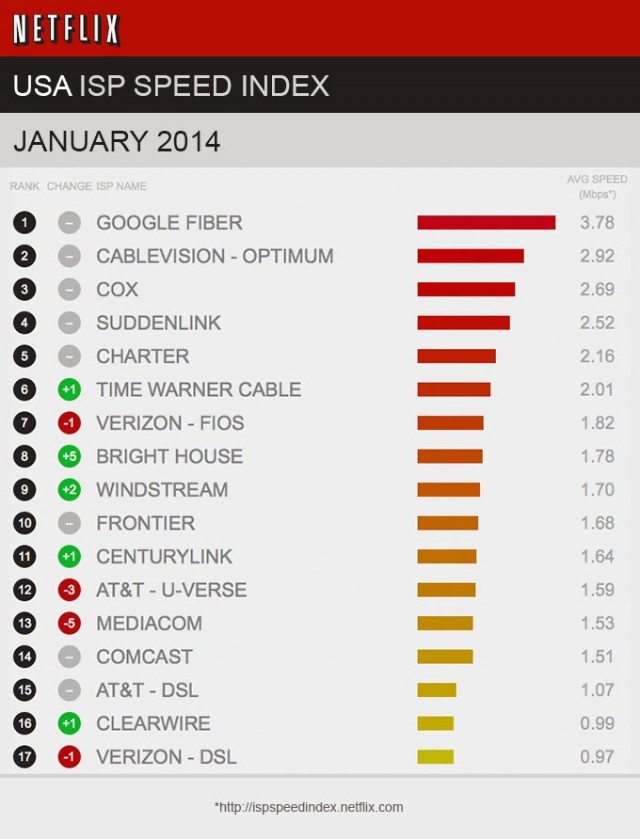
Peer Wars: Netflix SuperHD Streaming May Explain Video Traffic Slowdowns for Some Customers

The largest drops in streaming speeds are coming from ISPs that may be stalling necessary upgrades at the expense of their customers' online experience.

The largest drops in Netflix streaming speeds are coming from ISPs that may be stalling necessary upgrades at the cost of their paying customers’ online experience.

Netflix performance for Verizon customers is deteriorating because Verizon may be delaying bandwidth upgrades until it receives compensation for handling the growing amount of traffic coming from the online video provider.

Verizon customers have increasingly complained about Netflix slowdowns during prime-time, especially in the northeast, and Netflix’s latest statistics confirm FiOS customers have seen average performance drop by as much as 14% in the last month alone.

Verizon told Stop the Cap! a few weeks ago the company was not interfering with Netflix traffic or degrading its performance, but there is growing evidence that may not be the whole story. The Wall Street Journal reports Netflix and at least one bandwidth provider suspect phone and cable companies are purposely stalling on upgrading connections to handle traffic growth from Netflix until they are compensated for carrying its video traffic.

The dispute involves the plumbing behind parts of the Internet that are invisible to consumers. As more people stream movies and television, that infrastructure is getting strained, intensifying the debate over who should pay for upgrades needed to satisfy America’s online-video habit.

Netflix wants broadband companies to hook up to its new video-distribution network without paying them fees for carrying its traffic. But the biggest U.S. providers—Verizon, Comcast, Time Warner Cable and AT&T Inc. —have resisted, insisting on compensation.

The bottleneck has made Netflix unwatchable for Jen Zellinger, an information-technology manager from Carney, Md., who signed up for the service last month. She couldn’t play an episode of “Breaking Bad” without it stopping, she said, even after her family upgraded their FiOS Internet service to a faster, more expensive package. “We tried a couple other shows, and it didn’t seem to make any difference,” she said. Mrs. Zellinger said she plans to drop her Netflix service soon if the picture doesn’t improve, though she will likely hold on to her upgraded FiOS subscription.

She and her husband thought about watching “House of Cards,” but she said they probably will skip it. “We’d be interested in getting to that if we could actually pull up the show,” she said.

Netflix relies on third-party traffic distributors to deliver much of its streamed programming to customers around the country. Cogent Communications Group is a Netflix favorite. Cogent maintains two-way connections with many Internet Service Providers. When incoming and outgoing traffic are generally balanced, providers don’t complain. But when Cogent started delivering far more traffic to Verizon customers than what it receives from them, Verizon sought compensation for the disparity.

“When one party’s getting all the benefit and the other’s carrying all the cost, issues will arise,” Craig Silliman, Verizon’s head of public policy and government affairs told the newspaper. The imbalance is primarily coming from the growth of online video, and as higher definition video grows more popular, traffic imbalances can grow dramatically worse.

A spat last summer between Cogent and some ISPs is nearly identical to the current slowdown. Ars Technica reported the traditional warning signs providers used to start upgrades are increasingly being ignored:

“Typically what happened is when the connections reached about 50 percent utilization, the two parties agreed to upgrade them and they would be upgraded in a timely manner,” Cogent CEO Dave Schaeffer told Ars. “Over the past year or so, as we have continued to pick up Netflix traffic, Verizon has continuously slowed down the rate of upgrading those connections, allowing the interconnections to become totally saturated and therefore degrading the quality of throughput.”

Schaeffer said this is true of all the big players to varying degrees, naming Comcast, Time Warner, CenturyLink, and AT&T. Out of those, he said that “AT&T is the best behaved of the bunch.”

Letting ports fill up can be a negotiating tactic. Verizon and Cogent each have to spend about $10,000 for equipment when a port is added, Schaeffer said—pocket change for companies of this size. But instead of the companies sharing equal costs, Verizon wants Cogent to pay because more traffic is flowing from Cogent to Verizon than vice versa.
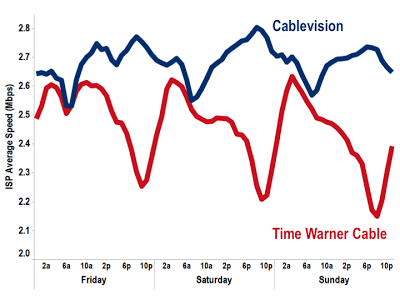
Cablevision, which participates in Netflix's Open Connect program experiences no significant speed degradation during prime time. The same cannot be said with Time Warner Cable, which refuses to participate.

Cablevision, which participates in Netflix’s Open Connect program, experiences no significant speed degradation during prime time. The same cannot be said of Time Warner Cable, which refuses to take part.

Netflix offered a solution to help Internet Service Providers manage its video traffic. Netflix’s Open Connect offers free peering at common Internet exchanges as well as free storage appliances that ISPs can connect directly to their network to distribute video to customers. Free is always good, and Netflix claims many ISPs around the world have already taken them up on the offer, slashing their transit costs along the way.

A few major North American ISPs have also agreed to take part in Open Connect, including Frontier Communications, Clearwire, Telus, Bell, Cablevision and Google Fiber. Open Connect participating ISPs also got an initial bonus for participating they could offer customers – exclusive access to SuperHD streaming.

But most Americans would not get super high-resolution streaming because the largest ISP’s refused to participate, seeking direct compensation from content providers to carry traffic across their digital pipes instead.

On Sep. 26, 2013 Netflix decided to offer SuperHD streaming to all customers, regardless of their ISP. As a result, one major ISP told the newspaper Netflix traffic from Cogent at least quadrupled. ISPs taking Netflix up on Open Connect saw almost no degradation from the increased traffic, but not so for Verizon, AT&T, Time Warner Cable, and Comcast customers.

Net Neutrality advocates fear the country’s largest phone and cable companies are making an end-run around the concept of an Open Internet. Providers can honestly guarantee not to interfere with certain web traffic, but also refuse to keep up with needed upgrades to accommodate it unless they receive payment. The slowdowns and unsatisfactory performance are the same in the end for those caught in the middle – paying customers.

“Customers are already paying for it,” said industry observer Benoît Felten. “You sell a service to the end-user which is you can access the Internet. You make a huge margin on that. Why should they get extra revenue for something that’s already being paid for?”

Some of the web’s biggest players including Microsoft, Google and Facebook may have already capitulated — agreeing to pay major providers for direct connections that guarantee a smoother browsing experience. Netflix has, thus far, held out against paying ISPs to properly manage the video content their subscribers want to watch but in some cases no longer can.


Two Companies Compete With Gigabit Broadband Offers on Remote Isle of Jersey

Phillip Dampier October 24, 2013 Broadband Speed, Community Networks, Competition, Consumer News, Public Policy & Gov't, Rural Broadband, Video Comments Off on Two Companies Compete With Gigabit Broadband Offers on Remote Isle of Jersey

gigabit jerseyMore than 5,000 residents and businesses living on the island Bailiwick of Jersey now have a choice of two Internet Service Providers – both supplying gigabit fiber optic broadband.
Jersey Telecom, a government-owned provider, has been removing obsolete copper wiring and replacing it with fiber to the home service that should reach the entire island by 2015. The fiber network is open to all competitors. JT charges £59.99 ($97.25) per month for gigabit speeds, but now caps usage at just 100GB a month. Overlimit fees are around 50c per GB between the hours of 8am-midnight. Usage is unlimited during off-peak hours.

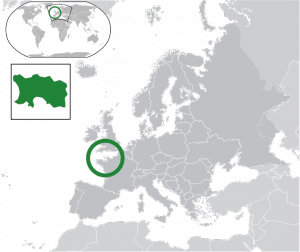
In addition to JT, Jersey customers who live on the remote Channel Island, a British Crown Dependency off the coast of France, can now also choose Sure Jersey, a privately owned ISP that offers unlimited use plans.

The fiber optic network is spreading to other Channel Islands, with significantly populated parts of Guernsey set to receive a fiber upgrade next.

713px-Europe-Jersey.svgUsing traditional Return On Investment standards, Jersey would barely qualify for basic DSL service. The island has a population of just 100,000 residents, some spread far and wide in remote locations. Basic DSL service was supplied to customers in more densely populated communities, but speeds were often slow and congestion became a major problem, especially at night.
The local government determined Jersey’s broadband needs could best be met by upgrading to government-owned infrastructure that private businesses could lease to sell service. Much like public roads benefit private companies that use them to transport goods, JT’s fiber network is designed to help bolster the island’s digital economy.

Since the introduction of gigabit fiber, new digital startups have launched on the island and others have moved their digital businesses to the fiber-enabled island. FeelUnique, launched from Jersey, has now become Europe’s largest online beauty retailer, employing over 150. Other businesses on the island have launched software ventures for the health care and education markets, banking/investment products and services, and 3D printing ventures. Having a wide broadband pipe has helped anchor digital businesses to the island because moving elsewhere leaves many with little better than substandard DSL or an enormous price tag for a customized new fiber build.

[flv width=”640″ height=”380″]http://www.phillipdampier.com/video/JT Fiber Has Arrived 2013.mp4[/flv]

Residents of Jersey talk about how fiber broadband has changed their online experience. (2 minutes)

 [flv width=”640″ height=”380″]http://www.phillipdampier.com/video/Digital Jersey Limited – Vision 2014 from Digital Jersey.mp4[/flv]

Digital Jersey released this video showing the group’s vision on how to leverage gigabit fiber broadband to boost the island’s digital economy in 2014. (3 minutes)

Common Cause-NY Wants Anti-Corruption Commission to Review Big Telecom’s Political Contributions

Phillip Dampier September 23, 2013 AT&T, Cablevision (see Altice USA), Comcast/Xfinity, Consumer News, Public Policy & Gov't, Verizon Comments Off on Common Cause-NY Wants Anti-Corruption Commission to Review Big Telecom’s Political Contributions

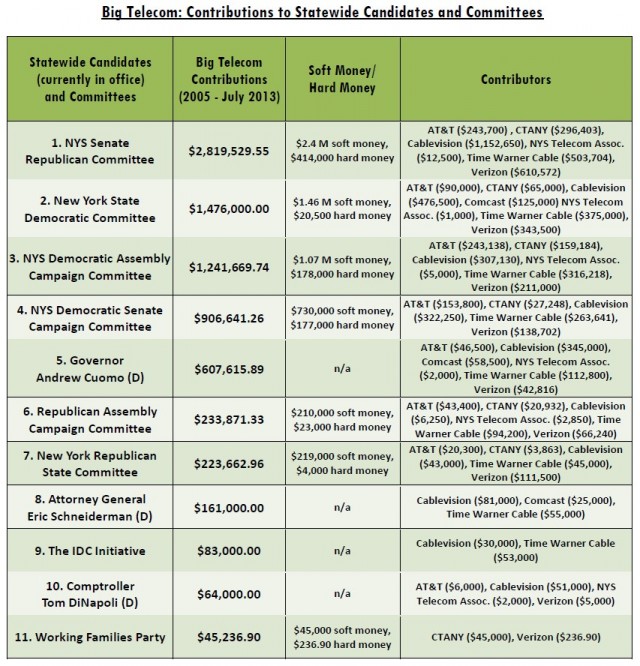
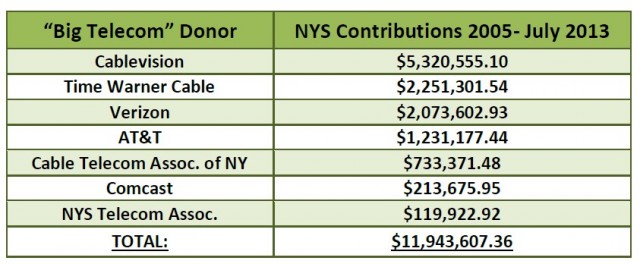
donor contributionsSince 2005, five cable and telephone companies and their respective lobbying trade associations have donated nearly $12 million to New York politicians, making Big Telecom companies among the biggest political donors in the state. Now a government reform group wants an investigation by the state’s anti-corruption commission.
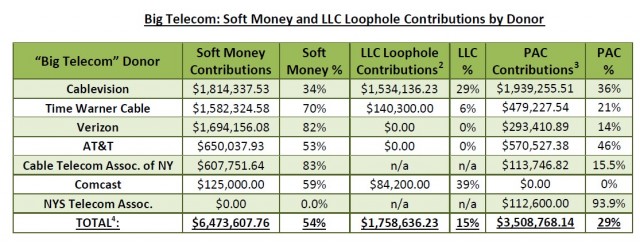
By exploiting giant loopholes in New York’s campaign finance laws, telecom companies that used to live with annual campaign finance limits of $5,000 are now donating millions to powerful political leaders in Albany – the majority conferences in the legislature, the state party committees, and the governor. Some are using secretive “housekeeping” accounts controlled by political parties. Others hide behind shadowy contributions from “limited liability corporations” (LLCs) established by some of the state’s biggest cable and phone companies and treated under current law as living, breathing people.

“Big Telecom exemplifies the pay-to-play culture which has come to define Albany, giving generously to the leadership in exchange for veto power over bills which favor the public interest,” said Common Cause-New York executive director Susan Lerner.

The Optimum donor to state "housekeeping" accounts among telecom providers is Cablevision.

The Optimum donor to state “housekeeping” accounts among telecom providers is Cablevision.

No telecom company donates more in New York than Cablevision, which has given more than $5.3 million in contributions to state politicians since 2005 as it fights its way through union problems, fierce competition from Verizon, and complaints from subscribers about rising cable prices and questionable service. The cable company doesn’t just donate in name-only. Common Cause-NY discovered Cablevision using eight different LLCs to evade contribution limits, handing over $1.5 million to candidates and committees. Gov. Andrew Cuomo received $130,000 from four different Cablevision-controlled LLCs between July and October 2010. On April 29 of this year, former Nassau County executive Tom Suozzi’s campaign received $190,000 from three Cablevision-controlled LLCs on that single day.

Verizon (82%) and Time Warner Cable (70%) prefer to quietly give the largest percentage of their political donations to the parties’ secretive, soft money “housekeeping” accounts. The Republican and Democratic recipients are not using the money to buy Endust, mops or spare light bulbs, although the average voter might assume as much.

Corporations with an agenda just love New York’s hush-hush “housekeeping” accounts because they come without dollar limits or complete disclosure about how the money was ultimately spent.

The State Board of Elections says “housekeeping” money is supposed to go toward maintaining a party’s headquarters and staff or “ordinary activities that are not for the express purpose of promoting the candidacy of specific candidates.” Unfortunately, nobody bothered to require detailed accounting, allowing funds to disappear down a political rabbit hole, to be distributed at each party’s discretion.

Comcast (59%) and AT&T (53%) are considerably smaller players, in part because neither company serves many wired cable/broadband customers in New York.

Verizon’s corporate PAC also likes to raise relatively large numbers of small contributions given in the name of company executives or employees, not necessarily mentioning the company itself. Campaign finance disclosures may list only the individuals’ contribution(s), not the company that signed their paycheck.

loophole

contribution by typeWhere does all the money go?

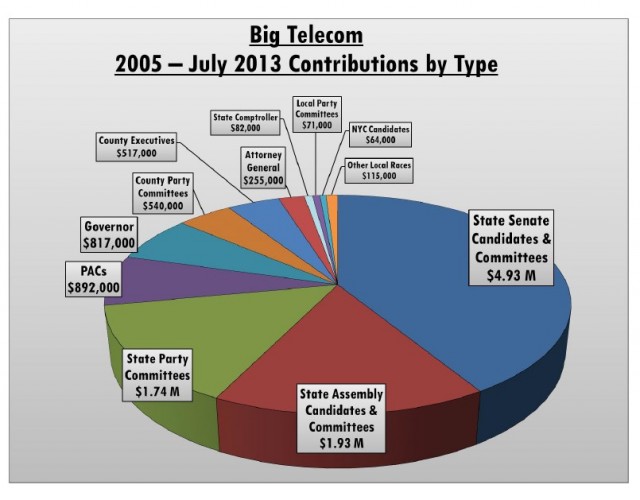
Common Cause-NY says most of the money is channeled to the most influential politicians in the state, with minority parties and unelected candidates typically getting much less.

To gain influence on the state level, Big Telecom companies contribute to the governor, attorney general, and the majority parties controlling the state Assembly and Senate, with Republicans getting the lion’s share (over $3.5 million) in the Senate and Democrats (over $1.6 million) in the Assembly.

For local issues of interest to the state’s local cable and phone companies, contributions are funneled to influential county-level political machines, perhaps helpful in making life difficult for a competing Wi-Fi project, a municipal fiber network, or helping to cut red tape to place a cell tower in a controversial location.

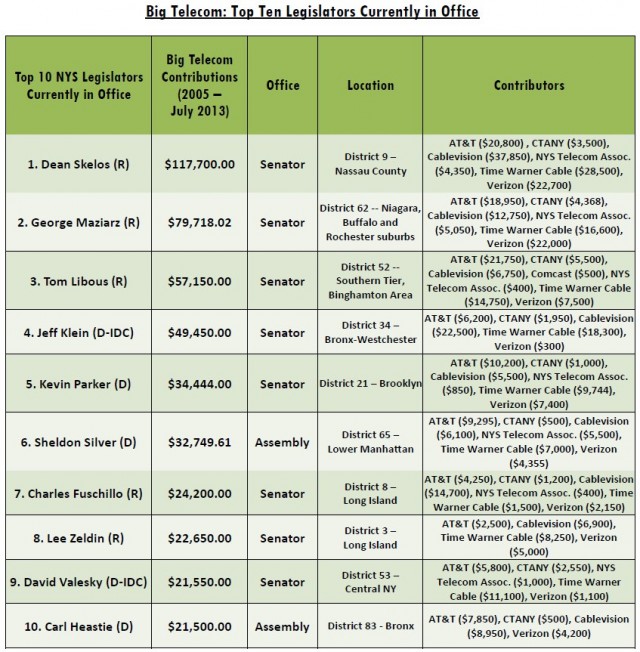
The top six recipients of Big Telecom’s political cash in the legislature:

  • Key Party Leaders: Dean Skelos ($117,700), Tom Libous ($57,150), Jeff Klein ($49,450), and Sheldon Silver ($32,749.61)
  • Current and former Chairs of the Senate Energy and Telecom Committee: George Maziarz ($79,718.02) and Kevin Parker ($34,444.00).

Common Cause-NY notes the corporations involved don’t give money without expecting something in return. After generous contribution checks were deposited, a number of telecom consumer protection bills mysteriously died in committee or never made it to the floor. The same fate did not meet bills offering special tax breaks for cable and Internet Service Providers that have cost New York taxpayers nearly $500 million and counting.

“Multi-million dollar campaign contributions clearly help Big Telecom maintain the status quo of corporate control, high prices, and lax regulation,” Common Cause-NY concludes.

where is the money going

top ten recipients

The legislature is rife with examples of bills that would have likely passed with popular support but suddenly or “mysteriously” didn’t:

  • common cause nyA 7635-A / S5630-A: Establishes a moratorium on telephone corporations on the replacement of landline telephone service with a wireless system.
    • The “VoiceLink” moratorium bill, passed the Assembly, had broad bi-partisan support in the Senate but never came to a vote.
  • S542: Relates to enacting the “Save New York Call Center Jobs Act of 2013,” which requires prior notice of relocation of call center jobs from New York to a foreign country; directs the Commissioner of Labor to maintain a list of employers who move call center jobs; prohibits loans or grants.
    • The “Call Center Jobs Act” would take away tax breaks and state grants if companies move a call center to another country. The bill passed the Assembly in 2012 (A9809) and had bipartisan support in Senate but was blocked. The 2013 bill died in Senate committee.
  • fair electionsA6003/S5577 — Directs the Department of Public Service to study and report on the current status of cable television systems providing services over fiber optic cables.

    • Bipartisan support in Assembly for further oversight of broadband but gets little support in Senate, the same bill was also blocked in 2012.
  • A5234/S1075 — Enacts the “Roadway Excavation Quality Assurance Act” demanding utility companies or their contractors shall use competent workers and shall pay the prevailing wage on projects where a permit to use or open a street is required to be issued.
    • Bipartisan support in the Senate and Assembly but no passage in either 2012 and 2013.
  • A6239/S4550 — Creates the State Office of the Utility Consumer Advocate to represent interests of residential utility customers.
    • Bipartisan support in Assembly, dies in Senate.
  • A6757/S4449 — Requires providers of electric, gas, steam, telephone and cable television services to issue standardized bills to residential customers; provides the standards for such bills shall be established by the Public Service Commission.
    • Bipartisan support, passes Assembly, dies in Senate.

“Here’s the evidence that giant telecom companies are taking advantage of huge loopholes and lax regulations so they can increase profits, often at the expense of everyday New Yorkers,” said Karen Scharff, executive director of Citizen Action of New York on behalf of the Fair Elections for New York campaign. “It’s time for our leaders in Albany to acknowledge the ever-growing wealth of evidence that we need to fix our broken campaign finance system and pass a comprehensive Fair Elections system centered around publicly financed elections.”

America’s Worst Rated Companies: Charter, Time Warner, Cox, Cablevision, Verizon, Comcast…

charter downNine of the ten lowest ranked firms in America are cable and telephone companies, according to a new report from research firm Temkin Group.
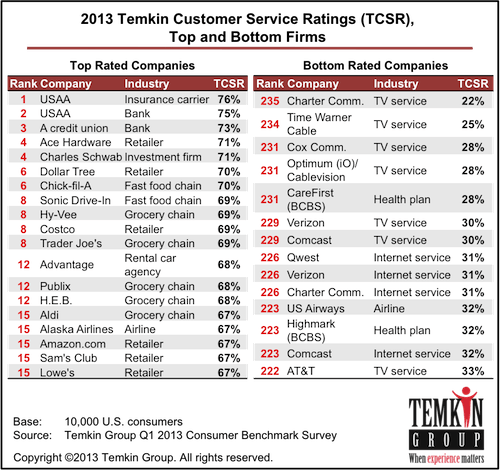
A poll ranking customer service at 235 U.S. companies across 19 industries found cable companies dead last, quickly followed by Internet Service Providers (often those same cable operators).

Participants were asked to rate their satisfaction with different companies on a scale of “1” (very dissatisfied) to “7” (completely satisfied). Not very many participants gave high marks to their telecommunications service provider. Temkin’s resulting net satisfaction score found familiar names in the cable and telephone business scraping the bottom.

America’s worst provider? Charter Communications, which managed an embarrassing dead last 22 percent satisfaction score for television service. Time Warner Cable managed second worst for television at 25%, followed by Cox and Cablevision’s Optimum service (both 28%). Bottom rated Internet service came from Qwest (now CenturyLink), Verizon (presumably DSL), and Charter — all scoring just 31%.

Oddly, Temkin’s survey participants gave top marks to the long-irrelevant AOL for Internet service, which may mean those dial-up customers don’t know any better. Highest marks in television service went to Bright House Communications, which ironically depends on Time Warner Cable for most of its programming negotiations.

temkin bottom rated

Most suspect the ratings show long-term customer dissatisfaction with endless rate increases, poor customer service and reliability, and lack of choice in an increasingly expensive television lineup.

The Temkin Group gathered its data from an online survey of 10,000 consumers in the U.S. during January 2013, all asked to rate their experiences with companies over the past 60 days.

Search This Site:

Contributions:

Recent Comments:

Your Account:

Stop the Cap!