Home » internet service providers » Recent Articles:

Internet Slowdown Day is Here: Tell the FCC to Classify ISPs as Common Carriers

Phillip "It's common sense" Dampier

Phillip “It’s common sense” Dampier

The concept is so simple one might think there was nothing controversial about the common sense idea of requiring Internet Service Providers to handle Internet traffic equally.

But that would throw a wrench into the money-making plans of some of America’s top cable and phone companies looking for new ways to collect more money and bigger profits from selling Internet access.

Wireless phone companies have already got the Money Party started, throttling certain traffic while exempting partnered apps and websites from counting against your monthly usage allowance. Americans pay some of the highest prices in the world for broadband service, but it is never enough for some executives who believe the increasing necessity of having Internet access means companies can charge even more for access. With few competitive alternatives, where are you going to go?

With most Americans confronted with just two Internet providers to choose from, the stage is set for mischief. The normal rules of competition simply don’t apply, allowing companies to raise prices while limiting innovation to finding new ways to improve revenue without improving the service. That has worked well for stockholders and executives that green-light these schemes, but for all the money Americans pay for service, broadband in the United States is still way behind other nations.

A few years ago, the CEO of AT&T decided that collecting money from customers to provide Internet access wasn’t enough. The company now wanted compensation from websites that generate the traffic ISPs handle for their customers. In other words, they wanted to be paid twice for doing their job.

If you listen to some of America’s largest cable and phone companies talk, you would think that traffic from Netflix and other high-volume websites was sucking them dry. But in fact their prices and profits are up and their costs are down… way down. But that doesn’t stop them from contemplating usage-based billing and reducing investment in upgrades to keep up with demand. Netflix learned that lesson when Comcast refused to upgrade some of its connections which left Netflix streaming video constantly buffering for Comcast customers. Those problems magically disappeared as soon as money changed hands in a deal that leaves Netflix dependent on paying Comcast protection money to make sure customers can actually enjoy the service they already paid to receive.
internetslowdownhero-100413741-large

Former FCC chairman Kevin Martin believed competition would keep ISPs honest, but since he left at the end of the Bush Administration, competition has barely emerged for most of us. Julius Genachowski, the FCC chairman under President Obama’s first term gave some strong speeches about protecting Net Neutrality but caved to provider demands the moment he met with them behind closed doors. Today, FCC chairman Tom Wheeler presides over an agency that has repeatedly had its regulatory hat handed to them by the D.C. Court of Appeals, which has ruled time and time again that the current regulatory foundation on which Internet-related policies are enforced is completely unsound.

We can thank former FCC chairman Michael Powell for that. His decision to classify broadband as an “information service” during the first term of the Bush Administration carries almost no legacy of court-upheld authority the FCC can rely on to enforce its regulations. Powell’s innovation was warmly received by America’s biggest cable companies who quickly realized the FCC had regulatory authority over the broadband business in name-only. Powell’s reward? A cushy job as head of America’s biggest cable lobby – the National Cable and Telecommunications Association (NCTA).

Don't allow Comcast and others to slow down your favorite cat videos.

Don’t allow Comcast and others to slow down your favorite cat videos.

Wheeler used to hold that position himself, and his trip through D.C.’s revolving door connecting regulators with the regulated makes it unsurprising that Wheeler’s own Net Neutrality proposal is not far from what Big Telecom companies want themselves — permission to create paid “fast lanes” on highways that currently lack enough capacity to protect other traffic from suffering the speed consequences of prioritized traffic.

It reminds me of those highway projects where cars dutifully change lanes well in advance of lane closures while other cars blow past only to merge at the last possible minute, saving them time while slowing cars behind them to a crawl as they wait to move ahead.

Make no mistake – paid fast lanes will compromise unpaid traffic, reducing the quality of your Internet experience.

The best solution to this problem would be for providers to devote more revenue to regular network upgrades that benefit everyone, not create new ways to ration the Internet for some while letting others pay to avoid speed bumps and congestion issues that are easy and inexpensive to solve. But if your provider was already delivering that kind of capacity, there would be no market for Internet fast lanes, would there? Without Net Neutrality, providers have a financial incentive not to upgrade their networks and have little fear unhappy customers will switch to the other competitor likely trying the same thing.

Net Neutrality cannot just be a policy, however. A strong regulatory foundation must exist to allow the FCC to enforce Internet-related policies without having them overturned by the courts. That means one thing: reclassifying broadband as a telecommunications service subject to common carrier regulations.

Net Neutrality opponents like to claim that would saddle Internet providers with decades old telephone regulations that have nothing to do with today’s broadband marketplace. But in fact that regulatory framework was originally established precisely for the reasons we need it again today — a non-competitive, largely unregulated marketplace is exploiting its market power to abuse customers and artificially interfere with traffic just to invent new ways to make more money.

People forget that in the 1920s, AT&T not only monopolized telephone service in most areas (and had a history of refusing to connect calls made from competing telephone companies to its own subscribers even as it hiked rates to pay for “improvements”), it was also attempting to force its for-profit vision on the newly emerging world of radio: “toll-broadcasting.” AT&T insisted that radio stations charge a fee to anyone who wanted access to the airwaves, and imposed the toll system on its own stations, starting with WBAY-AM (later WEAF) in New York on July 25, 1922.

Westinghouse, GE, RCA, and AT&T maintained such strong control over broadcasting and telecommunications in the 1920s, the Federal Trade Commission eventually filed a formal complaint with Congress declaring the four had “combined and conspired for the purpose of, and with the effect of, restraining competition and creating a monopoly in the manufacture, purchase and sale in interstate commerce of radio devices…and in domestic and transoceanic communication and broadcasting.”

It took the Justice Department to finally force a resolution to protect competition and the free exchange of ideas on the airwaves with a 1930 antitrust lawsuit against the four companies. In 1934, Congress passed the Communications Act establishing the FCC as the national regulator in charge of protecting some of the values that monopolies tend to trample.

The thing about history is that those who ignore it are bound to repeat it. Whether we are dealing with railroad robber barons, a Bell System monopoly, or barely competitive cable and phone companies, if the conditions are right to exploit customers on behalf of shareholders looking for bigger returns, companies will follow through. In the first two cases, with little chance that natural competition would bring a solution in a reasonable amount of time, regulators stepped in to restore some balance in the marketplace and protect consumers from runaway abuses. That has to happen again.

  • First, reclassify broadband as a common carrier under Title 2;
  • Second, enact strong Net Neutrality protections under that authority.

And don’t you believe that old chestnut that sensible regulatory policies will impede investment in telecommunications. Other nations that have much better broadband than we enjoy (at lower prices) already have reasonable regulatory protections in place that promote and protect competition instead of protecting incumbent market power and impeding would-be competitors. Investment in upgrades continues to pour in, further widening the gap between the kind of service we receive and what customers in other countries get for a lot less money.

The deadline for FCC comments on Net Neutrality is Sept. 15. Sending one directly is simple, effective, and will take less than five minutes.

  1. Visit fcc.gov/comments
  2. Click on the proceeding 14-28 (usually in the top three)
  3. Complete the form and type your comments in the big box. Tell the FCC you want broadband reclassified as a common carrier under Title II as a telecommunications service and that you want strong Net Neutrality policies enacted that forbid paid fast lanes and provider interference in your Internet experience.
  4. Submit the form and you are finished.

[flv]http://www.phillipdampier.com/video/Democracy Now Internet Slowdown 9-10-14.mp4[/flv]

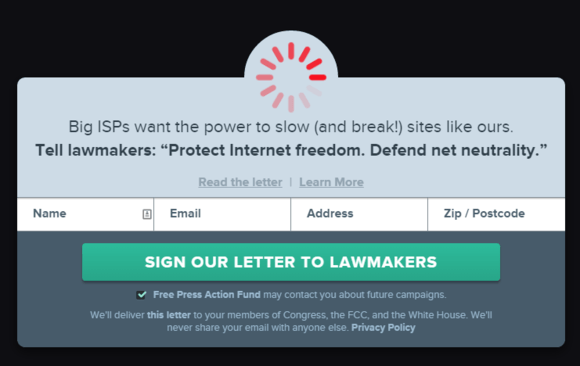
If your favorite website seems to load slowly today, take a closer look: You might be experiencing the Battle for the Net’s “Internet Slowdown,” a global day of action. The Internet won’t actually be slowing down, but many sites are placing on their homepages animated “Loading” graphics , which organizers call “the proverbial ‘spinning wheel of death,’ to symbolize what the Internet might soon look like.

Large Internet service providers, or ISPs, like Comcast, Time Warner, AT&T and Verizon, are trying to change the rules that govern the Internet. Some of the biggest companies on the Internet — Netflix, Mozilla, Kickstarter, Etsy and WordPress — are joining today’s Internet Slowdown to draw attention to Net Neutrality, the principle that service providers shouldn’t be allowed to speed up, or slow down, loading times on certain websites, such as their competitors.

This comes as 27 online advocacy groups sent a letter to Federal Communications Commission Chairman Tom Wheeler Tuesday, calling on him to take part in town hall-style public hearings on Net Neutrality before ruling on the issue as early as this year. Democracy Now’s Amy Goodman talks with Tim Karr from the group Free Press, one of the main organizers of the Internet Slowdown global day of action. (7:15)
Friday is the Deadline for Net Neutrality Comments With the FCC; Here’s How to Get Yours Submitted

Phillip Dampier July 15, 2014 Community Networks, Competition, Consumer News, Editorial & Site News, Net Neutrality, Online Video, Public Policy & Gov't, Wireless Broadband Comments Off on Friday is the Deadline for Net Neutrality Comments With the FCC; Here’s How to Get Yours Submitted

netneutralityFriday is the last day to submit your views on Net Neutrality with the Federal Communications Commission. Although there may be some future opportunities to comment, it’s important to make your voice heard with the FCC today. Almost 650,000 Americans have done so to date, and we need to see this number rise even higher to combat the influence and power of Big Telecom companies looking to turn the Internet into a corporate toll booth.
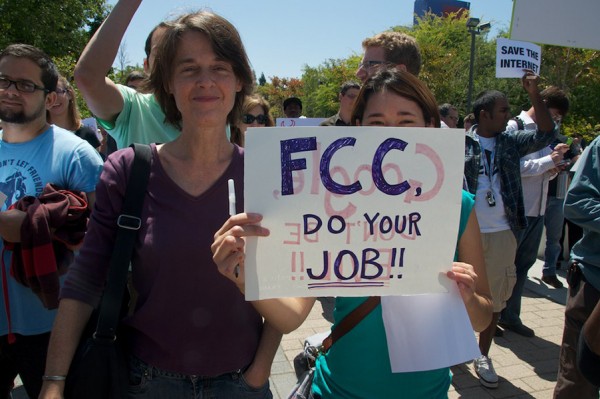
If you recall, FCC chairman Tom Wheeler is promoting a scheme where big ISPs like Verizon, AT&T and Comcast can divide up the Internet and introduce toll lanes allowing preferred paid traffic to travel on the Internet at faster speeds, usually at the expense of unpaid traffic that will get relegated to an Internet slow lane. It’s pay to play, and customers of these ISPs are already getting a preview of the new corporate road map for the net. Netflix viewers on ISPs that don’t have a paid agreement to handle video traffic suffer from rebuffering and lower quality video. But ISPs collecting tolls from Netflix don’t subject their customers to a degraded online video experience. Of course, before ISPs realized they could make money selling fast lanes, Netflix worked fine on virtually all of these providers.

Wheeler’s proposal would extend the two-tiered Internet to other websites and service providers, allowing big telecom companies to hand-pick winners and losers and discriminate in favor of their own Internet traffic. Comcast does that today with online video on certain game consoles. If that video comes from Comcast, it doesn’t count against any usage caps. If it doesn’t, it could get rough sticking to Comcast’s arbitrary usage allowance.

The FCC is in way over its head, unaware of the creative ways ISPs can find loopholes large enough to drive through any well-intentioned consumer protections. There is only once certain way to keep ISPs honest — reclassify them as what they should have been all along – a telecommunications service subject to common carrier rules. That would guarantee ISPs could not meddle with your Internet service for financial gain, could not artificially slow down “non-preferred” traffic to make room for paid traffic, and would guarantee that Internet applications of the future will succeed or fail on their merits, not on how much money they are willing to spend.

Since the FCC website is jammed today, we recommend e-mailing the Commission by this Friday at: [email protected]

Our friends at Free Press have published some sample comments they are getting, which may help you formulate yours. Here is ours as well:

Dear Chairman Wheeler,

Although we believe your intentions are good, your proposed Net Neutrality rules simply do not afford enough protection to preserve a free and open Internet. Troubling signs are already clear as providers test how much they can get away with meddling with Internet traffic. The wireless experience is replete with examples of selective speed throttling, usage caps, and traffic discrimination that allows some content to escape the usage meter and throttle while competitors cannot.

The Internet is a transformative experience for many Americans because for the first time in a long time, entrepreneurs can build online businesses that are judged on their merit, not on how much money they have to spend to achieve and maintain prominence. Anything that allows an ISP to collect additional funds for a “preferred” traffic lane will come at the detriment of others who have to share the same broadband pipe. This is especially evident in the wireless world, which escaped even the light touch regulatory framework of your predecessor. Providers promptly began creating new schemes to further monetize growing data traffic, bandwidth shortage or not. Almost none of these changes really benefit customers — they are simply new revenue-making schemes.

A foreshadowing of what is likely to happen under your proposal is also apparent with Comcast and Netflix. For several years subscribers had no trouble accessing online video. But when the issue of traffic compensation was reintroduced by Internet Service Providers, the upgrades to manage natural Internet growth largely stopped and the Netflix viewing experience on these ISPs deteriorated. Verizon, AT&T and Comcast all argue that a paid traffic deal would adequately compensate them to enhance the viewing experience customers already pay good money to receive with or without a paid peering arrangement with Netflix.

Money drives these debates. If an ISP properly managed their broadband infrastructure, there would be no incentive for any company to contract for a better online experience on a so-called “fast lane” because existing service would perform more than adequately. When a company cuts back on those upgrades, a market for paid prioritization appears. Customers will ultimately pay the price, primarily to ISPs that already enjoy an enormous margin selling broadband service at inflated prices.

A rising tide floats all boats, so your focus should not be as short-sighted as allowing ISPs to divide up the limited broadband highway. The FCC should instead focus on setting the conditions to hasten new competition and force existing providers to upgrade and maintain their networks for the benefit of all subscribers and content producers. The FCC must also move swiftly to cancel state bans on community broadband networks, eliminate regulations that deter broadband start-ups, and maintain enough oversight to guarantee a level playing field on which all can compete.

There is only one way to effectively accomplish all that. Reclassify broadband service the way it should have been classified all along: as a telecommunications service subject to common carrier regulations. Canada has been very successful requiring ISPs to open their last mile networks to competitors, which have allowed people to avoid compulsory usage caps. Customers have a choice of multiple providers from their local phone or cable company, giving rise to much-needed competition.

With strong Net Neutrality, consumers can reach the websites they want without interference. Ignore nonsense suggesting Net Neutrality is a government takeover or censors the Internet — two provably false assertions. In fact, Net Neutrality is the opposite.

I urge you to move with all speed towards reclassification, if only to prevent the inevitable legal challenges to any future policies built on the shakier ground of the current framework, which has not held up well under court scrutiny. I hope the voices of more than a half-million Americans contacting you on this issue will be more than enough to overcome industry objections. We are not asking for 1950s-style telephone regulations. We just want a legally affirmed platform that allows the Internet of today to continue being successful tomorrow.

Yours very truly,

Two Wrongs Don’t Make a Right: Comcast/Time Warner Cable “Worst Companies in U.S.”

Phillip Dampier May 20, 2014 Comcast/Xfinity, Competition, Consumer News Comments Off on Two Wrongs Don’t Make a Right: Comcast/Time Warner Cable “Worst Companies in U.S.”

Another satisfied customer

Comcast and Time Warner Cable have achieved new lows in the most important customer satisfaction survey in the United States, winning bottom honors as the two most despised companies in the United States.

The American Customer Satisfaction Index found Comcast and Time Warner Cable the only two companies in the country that scored below 60 on the ACSI’s 100 point scale. Comcast fell 5% to 60, while Time Warner Cable plunged 7% to 56, its lowest score to date.

“Comcast and Time Warner assert their proposed merger will not reduce competition because there is little overlap in their service territories,” says David VanAmburg, ACSI director. “Still, it’s a concern whenever two poor-performing service providers combine operations. ACSI data consistently show that mergers in service industries usually result in lower customer satisfaction, at least in the short-term. It’s hard to see how combining two negatives will be a positive for consumers.”

Broadband service seems to be a significant issue for customers. High prices, slow data transmission, and unreliable service drag satisfaction to record lows, as customers have few alternatives beyond the largest Internet service providers. Customer satisfaction with ISPs drops 3.1% to 63, the lowest score in the Index.

Verizon FiOS is the one bright spot in the survey, managing to grab a 71 score, beating AT&T U-verse, CenturyLink, and other providers. Cable broadband providers continued to score lowest. The best of the lot was Cox Communications, which isn’t saying much. It only managed a 6% fall to 64.

Customer satisfaction is also deteriorating for all the largest pay TV providers. Viewers are much more dissatisfied with cable TV service than fiber optic and satellite service (60 vs. 68). Though both companies drop in customer satisfaction, DirecTV (-4%) and AT&T (-3%) are tied for the lead with ACSI scores of 69. Verizon Communications FiOS (68) and DISH Network (67) follow. DISH Network may be the lowest-scoring satellite TV company, but it is better than the top-scoring cable company, Cox Communications (-3% to 63).

Among wireless carriers, things have not changed much this year.

Verizon Wireless achieved first place after climbing 3% to 75. T-Mobile (69), Sprint (68) and AT&T Mobility (68) are tightly grouped behind. As smartphone adoption continues to grow, network demands increase along with costs to the consumer, each contributing to stagnant customer satisfaction.

FCC Chairman Promises “New and Improved” Net Neutrality Proposal That Is More of the Same

Phillip Dampier May 12, 2014 Broadband "Shortage", Broadband Speed, Consumer News, Data Caps, Editorial & Site News, Net Neutrality, Online Video, Public Policy & Gov't Comments Off on FCC Chairman Promises “New and Improved” Net Neutrality Proposal That Is More of the Same
Phillip "Section 706 is a road to nowhere" Dampier

Phillip “Section 706 is a road to nowhere” Dampier

After thousands of consumers joined more than 100 Internet companies and two of five commissioners at the Federal Communications Commission to complain about Chairman Tom Wheeler’s vision of Net Neutrality, the head of the FCC claims he has revised his proposal to better enforce Internet traffic equality.

Last week, huge online companies like Amazon, eBay, and Facebook jointly called Wheeler’s ideas of Net Neutrality “a grave threat to the Internet.”

In response over the weekend, an official close to the chairman leaked word to the Wall Street Journal that Wheeler was changing his proposal. Despite that, a closer examination of Wheeler’s ideas continues to show his unwavering faith in providers voluntarily behaving themselves. Wheeler’s evolving definition of Net Neutrality is fine… if you live in OppositeLand. His proposal would allow Internet Service Providers and content companies to negotiate paid traffic prioritization agreements — the exact opposite of Net Neutrality — allowing certain Internet traffic to race to the front of the traffic line.

Such an idea is a non-starter among Net Neutrality advocates, precisely because it undermines a core principle of the Open Internet — discriminating for or against certain web traffic because of a paid arrangement creates an unfair playing field likely to harm Internet start-ups and other independent entities that can’t afford the “pay to play” prices ISPs may seek.

Paid traffic prioritization agreements only make business sense when a provider creates the network conditions that require their consideration. If a provider operated a robust network with plenty of capacity, there would be no incentive for such agreements because Internet traffic would have no trouble reaching customers with or without the agreement.

But as Netflix customers saw earlier this year, Comcast and several other cable operators are now in the bandwidth shortage business — unwilling to keep up investments in network upgrades required to allow paying customers to access the Internet content they want.

While there is some argument that the peering agreement between Comcast and Netflix is not a classic case of smashing Net Neutrality, the effect on customers is the same. If a provider refuses to upgrade connections to the Internet without financial compensation from content companies, the Internet slow lane for that content emerges. Message: Sign a paid contract for a better connection and your clogged content will suddenly arrive with ease.

net-neutrality-protestWheeler has ineffectively argued that his proposal to allow these kinds of paid arrangements do not inherently commercially segregate the Internet into fast and slow lanes.
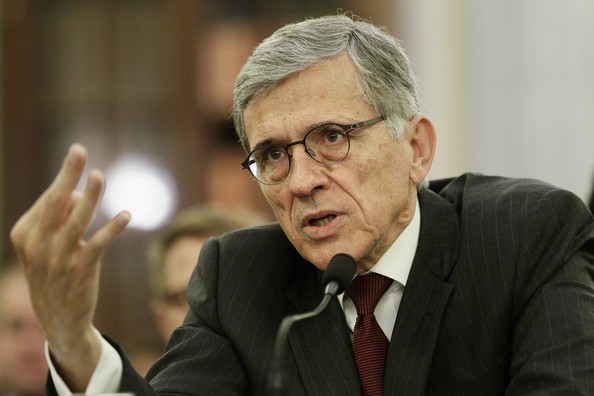
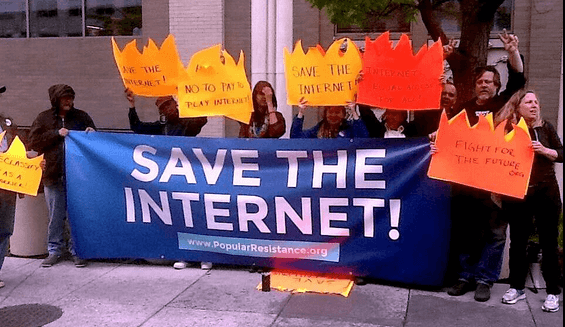
But in fact it will, not by artificially throttling the speeds of deprioritized, non-paying content companies, but by consigning them to increasingly congested broadband pipes that only work in top form for prioritized, first class traffic.

With Wheeler’s philosophy “unchanged” according to the Journal, his defense of his revised Net Neutrality proposal continues to rely on non germane arguments.

For example, Wheeler claims he will make sure the FCC “scrutinizes deals to make sure that the broadband providers don’t unfairly put nonpaying companies’ content at a disadvantage.” But in Wheeler’s World of Net Neutrality, providers would have to blatantly and intentionally throttle traffic to cross the line.

“I won’t allow some companies to force Internet users into a slow lane so that others with special privileges can have superior service,” Mr. Wheeler wrote (emphasis ours) to Google and other companies.

But if your access to YouTube is slow because Google won’t pay Comcast for a direct connection with the cable company, it is doubtful Wheeler’s proposal would ever consider that a clear-cut case of Comcast “forcing” customers into a “slow lane.” After all, Comcast itself isn’t interfering with Netflix traffic, it just isn’t provisioning enough room on its network to accommodate customer demand.

Another side issue nobody has mentioned is usage cap discrimination. Comcast exempts certain traffic from the usage cap it is gradually reintroducing around the country. Its preferred partners can avoid usage-deterring caps while those not aligned with Comcast are left on the meter.

Wheeler

Wheeler

Some equipment manufacturers are producing even more sophisticated traffic management technology that could make it very difficult to identify fast and slow lanes, yet still opens the door to further monetization of Internet usage and performance in favor of a provider’s partners or against their competitors.

With Internet speeds and capacity gradually rising, the need for paid priority traffic agreements should decline, unless providers choose to cut back on upgrades to push another agenda. Already massively profitable, there is no excuse for providers not to incrementally upgrade their networks to meet customer demand. Prices for service have risen, even as the costs of providing the service have dropped overall.

Wheeler seems content to bend over backwards trying to shove a round Net Neutrality framework into a square regulatory black hole. Former chairman Julius Genachowski did the same, pretending that the FCC has oversight authority under Section 706 of the Telecommunications Act. But in fact that section is dedicated to expanding broadband access with restricted regulatory powers:

The Commission and each State commission with regulatory jurisdiction over telecommunications services shall encourage the deployment on a reasonable and timely basis of advanced telecommunications capability to all Americans (including, in particular, elementary and secondary schools and classrooms) by utilizing, in a manner consistent with the public interest, convenience, and necessity, price cap regulation, regulatory forbearance, measures that promote competition in the local telecommunications market, or other regulating methods that remove barriers to infrastructure investment.

The spirit of the 1996 Telecom Act was  deregulation — that language pertaining to “regulatory forbearance” encourages regulators to restrain themselves from reflexively solving every problem with a new regulation. The words about “removing barriers to infrastructure investment” might as well be industry code language for the inevitable talking point: “deregulation removes barriers to investment.”

1nnWith a shaky foundation like that, any effort by the FCC to depend on Section 706 as its enabling authority to oversee the introduction of any significant broadband regulation is a house of cards.
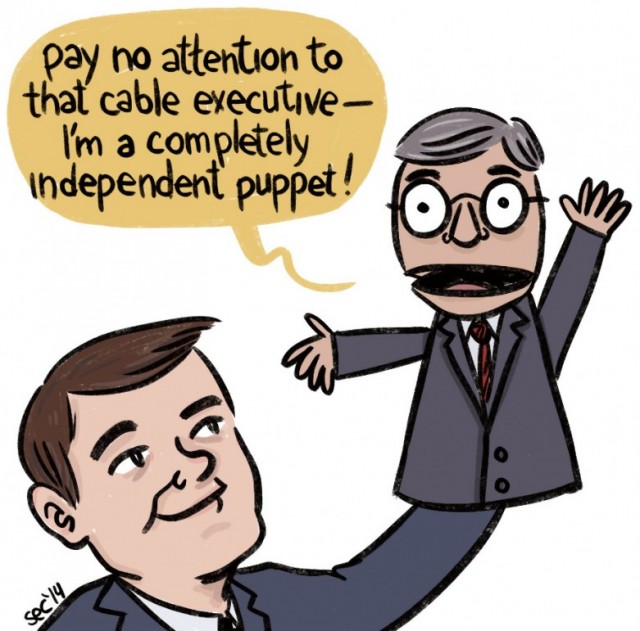

The D.C. Circuit Court of Appeals agreed. In the Verizon network management case, the court found that the FCC was not allowed to use Section 706 to issue broad regulations that contradicted another part of the Communications Act.

U.S.C. 153(51) was and remains the FCC’s Section 706-Achilles Heel and the judge kicked it. This section of the Act says “a telecommunications carrier shall be treated as a common carrier under this [Act] only to the extent that it is engaged in providing telecommunications services.”

The current president of the National Cable & Telecommunications Association (NCTA) Michael Powell — coincidentally also former chairman of the FCC under President George W. Bush — helped see to it that broadband was not defined as a “telecommunications service.” Instead, it is considered an “information service” for regulatory purposes. This decision shielded emerging Internet providers (especially big phone and cable companies) from the kinds of traditional telecom utility regulations landline telephone companies lived with for decades. Of course, millions were also spent to lobby the telecom deregulation-friendly Clinton and Bush administrations with the idea to adopt “light touch” broadband regulatory policy. A Republican-dominated FCC had no trouble voluntarily limiting its own authority to oversee broadband by declaring both wired and wireless broadband providers “information services.”

Tom Wheeler is the former president of the National Cable & Telecommunications Association

Tom Wheeler is the former president of the National Cable & Telecommunications Association

So it was the FCC itself that caused this regulatory mess. But the Supreme Court provided a way out, by declaring it was within the FCC’s own discretion to decide how to regulate broadband, either under Title I as an information service or Title II as a telecommunications service. If the FCC declares broadband as a telecommunications service, the regulatory headaches largely disappear. The FCC has well-tested authority to impose common carrier regulations on providers, including Net Neutrality protections, under Title II.

In fact, the very definition of “common carrier” is tailor-made for Net Neutrality because it generally requires that all customers be offered service on a standardized and non-discriminatory basis, and may include a requirement that those services be priced reasonably.

Inexplicably, Chairman Wheeler last week announced his intention to keep ignoring the straight-line GPS-like directions from the court that would snatch the FCC’s attorneys from the jaws of defeat to victory and has recalculated another proposed trip over Section 706’s mysterious bumpy side streets and dirt roads. Assuming the FCC ever arrives at its destination, it is a sure bet it will be met by attorneys from AT&T, Comcast, or Verizon with yet more lawsuits claiming the FCC has violated their rights by exceeding their authority.

Wheeler also doesn’t mollify anyone with his commitment to set up yet another layer of FCC bureaucracy to protect Internet start-ups:

Mr. Wheeler’s updated draft would also propose a new ombudsman position with ‘significant enforcement authority’ to advocate on behalf of startups, according to one of the officials. The goal would be to ensure all parties have access to the FCC’s process for resolving disputes.

Anyone who has taken a dispute to the FCC knows how fun and exciting a process that is. But even worse than the legal expense and long delays, Wheeler’s excessively ambiguous definitions of what constitutes fair paid prioritization and slow and fast lanes is money in the bank for regulatory litigators that will sue when a company doesn’t get the resolution it wants.

Wheeler promises the revised proceeding will invite more comments from the public regarding whether paid prioritization is a good idea and whether Title II reclassification is the better option. While we appreciate the fact Wheeler is asking the questions, we’ve been too often disappointed by FCC chairmen that apply prioritization of a different sort — to those that routinely have business before the FCC, including phone and cable company executives. Chairman Genachowski’s Net Neutrality policy was largely drafted behind closed doors by FCC lawyers and telecom industry lobbyists. Consumers were not invited and we’re not certain the FCC is actually listening to us.

The Wall Street Journal indicates the road remains bumpy and pitted with potholes:

Mr. Wheeler’s insistence that his strategy would preserve an open Internet, without previously offering much insight into how, has been a source of disquiet within his agency. Of the five-member commission, both Republicans are against any form of net neutrality rules, which they view as unnecessary. Commission observers will be watching the reaction of the two Democrats, Ms. Rosenworcel and Mignon Clyburn, to Mr. Wheeler’s new language.

“There is a wide feeling on the eighth floor that this is a debacle and I think people would like to see a change of course,” said another FCC official. “We may not agree on the course, but we agree the road we’re on is to disaster.”

There is still time to recalculate, but we wonder if Mr. Wheeler, a longtime former lobbyist for the wireless and cable industries, is capable of sufficiently bending towards the public interest.

The 5 Cable & Phone Companies Intentionally Sabotaging Your Use of the Internet

Phillip Dampier May 6, 2014 AT&T, Broadband "Shortage", Broadband Speed, Charter Spectrum, Comcast/Xfinity, Competition, Consumer News, Cox, Net Neutrality, Online Video, Verizon Comments Off on The 5 Cable & Phone Companies Intentionally Sabotaging Your Use of the Internet
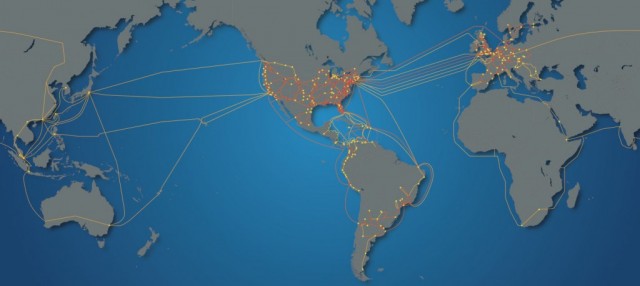
network_map-1024x459

Level 3’s global network: Orange lines represent Level 3-owned infrastructure, yellow lines show leased or co-owned connections.

Five of the largest Internet Service Providers in the country are intentionally sabotaging your use of the Internet by allowing their network connections to degrade unless they receive extra compensation from content companies they often directly compete with.

Mark Taylor, vice president of content and media for Level 3, wrote a lengthy primer on how Internet providers exchange traffic with each other across a vast global network. While clients of Level 3 are likely to have few problems exchanging traffic back and forth across Level 3’s global network, vital interconnections with other providers that make sure everyone can communicate with everyone else on the Internet are occasional trouble spots.

Every provider has different options to reach other providers, but favor those offering the most direct route possible to minimize “hops” between networks, which slow down the connection and increase the risk of service interruptions. These connections are often arranged through peering agreements. Level 3 has 51 peers, minimized in number to keep traffic moving as efficiently as possible.

This oversaturated port in Dallas cannot handle all the traffic trying to pass through it, so Internet packets are often dropped and traffic speeds are slowed.

This oversaturated port in Dallas cannot handle all the traffic trying to pass through it, so Internet packets are often dropped and traffic speeds are slowed.

Taylor writes most peering arrangements were informal agreements between engineers and did not involve any money changing hands. Today, 48 of the 51 Level 3 peering agreements don’t involve compensation. In fact, Level 3 refuses to pay “arbitrary charges to add interconnection capacity.” Taylor feels such upgrades are a matter of routine and are not costly for either party.

Peering agreements have been a very successful part of the Internet experience, even if end users remain completely in the dark about how Internet traffic moves around the world. In the view of many, customers don’t need to know and shouldn’t care, because their monthly Internet bill more than covers the cost of transporting data back and forth.

Because of ongoing upgrades the average utilization of Level 3’s connections is around 36 percent of capacity — busy enough to justify keeping the connection and providing spare capacity for days when Internet traffic explodes during breaking news or over the holidays.

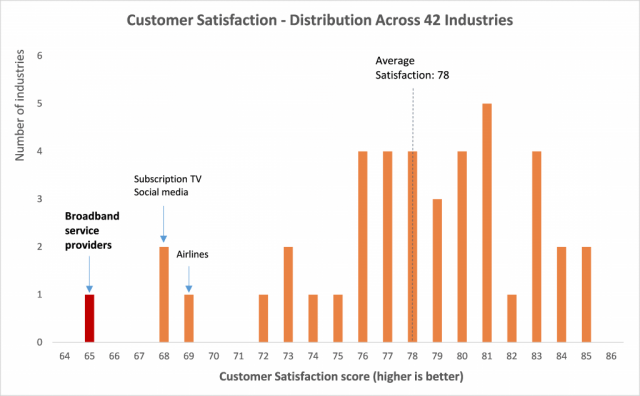
csat-1024x635However, Taylor says more than a year ago, something suddenly changed at five U.S. Internet Service Providers. They stopped periodic upgrades and allowed some of their connections to become increasingly busy with traffic. Today, six of Level 3’s 51 peer connections are now 90 percent saturated with traffic for several hours a day, which causes traffic to degrade or get lost.

“[The] congestion [has become] permanent, has been in place for well over a year and […] our peer refuses to augment capacity,” Taylor wrote. “They are deliberately harming the service they deliver to their paying customers. They are not allowing us to fulfill the requests their customers make for content.”

Taylor adds all but one of the affected connections are U.S. consumer broadband networks with a dominant or exclusive market share. Where competition exists, no provider allows their Internet connections to degrade, said Taylor.

Taylor won’t directly name the offenders, but he left an easy-to-follow trail:

“The companies with the congested peering interconnects also happen to rank dead last in customer satisfaction across all industries in the U.S.,” Taylor wrote. “Not only dead last, but by a massive statistical margin of almost three standard deviations.”

Taylor footnotes the source for his rankings, the American Consumer Satisfaction Index. The five worse providers listed for consumer satisfaction:

  • Comcast
  • Time Warner Cable
  • Charter Communications
  • Cox Communications
  • Verizon

AT&T has also made noises about insisting on compensation for its own network upgrades, blaming Netflix traffic.

level3In fact, Netflix traffic seems to be a common point of contention among Internet Service Providers that also sell their own television packages. They now insist the streaming video provider establish direct, paid connections with their networks. Level 3 is affected because it carries a substantial amount of traffic on behalf of Netflix.

Ultimately, the debate is about who pays for network upgrades to keep up with traffic growth. Taylor says Level 3’s cost to add an extra 10Gbps port would be between $10-20 thousand dollars, spare change for multi-billion dollar Americans cable and phone companies. Normally, competition would never allow a traffic dispute like this interfere with a customer’s usage experience. Angry customers would simply switch providers. But the lack of competition prevents this from happening in the United States, leaving customers in the middle.

This leaves Taylor with a question: “Shouldn’t a broadband consumer network with near monopoly control over their customers be expected, if not obligated, to deliver a better experience than this?”

Search This Site:

Contributions:

Recent Comments:

Your Account:

Stop the Cap!