Home » internet service providers » Recent Articles:

Ex FCC Commissioner Earns Her Pay As Pro-Telecom Industry Hack – Advocates for Internet Overcharging

Phillip Dampier July 10, 2009 Data Caps, Editorial & Site News 6 Comments
Here comes the Astroturf

Here comes the Astroturf

Deborah Taylor Tate, a Bush-appointed ex-commissioner on the Federal Communications Commission is now earning her paycheck regurgitating telecommunications industry talking points of behalf of the astroturf group, the Free State Foundation.

In an editorial in today’s Washington Times (thanks to reader Mitchell for alerting us about it), Tate perfectly falls in line with the talking points Stop the Cap! readers can repeat in their sleep, right down to ripping off AT&T’s “grandmother” analogy from several weeks ago.  Her employer, the Free State Foundation, has a long history of advocating pro-industry positions in opposition to consumer interests.  Having a former credentialed FCC official doing the industry talk is designed to impress.

Tate, who was never impressive as an FCC commissioner and maintains her ongoing unimpressive credentials at FSF, phones it in with a fact-free piece entitled, “Paying for Use is Fair,” in which she directly advocates for Internet Overcharging schemes, attempting to convince readers it will somehow save them money on their broadband service.

Her efforts to tell the story of “paying for what you use” will be comical to those in the communities where such “experiments” were conducted, because Tate either doesn’t know or care about the details of the market experiments she writes about.

Most broadband consumers would be astounded that some members of Congress want to block our ability to pay for broadband Internet use in precisely the same way we now pay for other commodities: Pay more if you use more; pay less if you use less.

Most consumers would be astounded an ex-FCC commissioner got the basic facts wrong about the basis of such pricing schemes.  No broadband provider has ever offered a “pay for what you use” pricing scheme.  They have only offered “pay MORE for what you use, and a lot more if you use more than you thought.”

This comes on the heels of Time Warner’s rapid retreat from a pilot test of pay-for-use broadband pricing, bowing to congressional pressure and protests from consumer groups. Studies have indicated the top 25 percent of users have consumed 100 times more bandwidth than the bottom 25 percent. So, what is fair about one-price-fits-all if someone uses 100 times more than you do?

At least Tate barely acknowledges another basic truth about these pricing schemes: the overwhelming majority of Americans do not want this kind of pricing model, and more than half would leave their existing provider if they tried to force them into one.

The “studies” Tate writes about do not exist.  They are claims by the providers themselves, which have never allowed for an independent review of the raw data the companies claim to base their findings on.  Nor does it account for the industry’s “need” to increase every consumer’s broadband bill with overcharging schemes based on limited consumption allowances and credit card-like overlimit penalties and fees.  Indeed, this is an industry with profits well into the billions of dollars whose costs are actually declining, along with their willingness to invest in growing their networks.  One need only review quarterly and annual financial reports issued by the providers’ themselves to learn the truth.  These companies are not hurting for profits.

Even where monopolies exist, pricing has generally been based on the notion that customers are charged more if they consume more and less if they use less. Obviously, beyond basic necessity, they could exercise some self-control, and could even save money through metering that measured consumption. This is especially true in an environment where consumers have options for providers of broadband, cell phones and now, in many cases, electricity.

Broadband pricing has been flat rate since the service was launched by phone companies providing DSL and cable operators launched cable modem service in most areas of this country.  That’s because broadband has been cheap, capacity plentiful, and profits high.  Absolutely nothing has changed in that equation, except a desire by broadband providers to dramatically grab additional profits, reduce demand with threats of overlimit fees or service being cut off for overuse, and attempts to invest less in their networks.  Controlling online video is critical for most of the providers who find that a competitive threat to their television service business model.

Tate doesn’t bother to contemplate increased competition, seeming happy enough to acknowledge monopolies do exist and then moving on to something else.  That mimics the FCC’s position over the past eight years, so that comes as no surprise either.

Whether run by local co-ops, governments or profit-making firms, any network has substantial capital costs to build out infrastructure, provide service, expand capacity and meet higher demand, particularly at peak periods. The same network cost issues also apply to Internet service providers. Expanding bandwidth and capacity for the exponential growth of Internet traffic is expensive. Updating security applications to prevent cybercrime are increasingly necessary for government, business and individuals, driving up costs even further. The supply of fiber optic cable and computer servers is not infinite, and we are already facing network constraints. We have all experienced the network being slowed by periods of heavy usage. Broadband providers — just like wireless providers — should be allowed to use a consumption model without government interference as long as consumers know and understand what they are paying for.

To date, there has been a surprising uniformity in billing for broadband Internet service. But why should a grandmother who checks e-mail once a day or makes an occasional purchase online be charged the same monthly rate as a researcher downloading massive data files or teenagers watching full-length movies every day? Why not provide consumers the freedom to monitor and control their own use — and to benefit from volume-based rate packages?

AT&T should consider legal action against Tate for plagiarizing their talking points.  In fact, her entire argument is part of the grand Re-education campaign we’ve written about since Time Warner Cable temporarily shelved their overcharging scheme back in April.  The “exaflood” nonsense, the “it’s expensive to spend money to upgrade our networks” whining, and the hissyfit over consumers using their service just as these same providers marketed them are all in there.

Deborah Taylor Tate: The Marie Antoinette of Internet Pricing

Deborah Taylor Tate: The Marie Antoinette of Internet Pricing

At least Tate is consistent — she never cared about consumers like you and I during her stay on the FCC, and she still doesn’t care about consumers by doing the bidding of groups like the Free State Foundation.

What do Washington Times readers think?  Not much of Tate or her positions.  Among them:

“Wow, did you just pull a page out of the telecom’s lobbyist manual to come up with this article?  They are doing this to prevent new technologies from making them an antiquated model, and they are doing it to get more money out of the customer. I promise it has nothing and I mean nothing to do with saving your grandma a single cent.”

“Are you being paid by the cable co? Seriously. Do you even realize with the utter lack of competition and the fact that the cable company enjoys a monopoly in most all of their markets, pricing for use is utterly bad for consumers.”

“Bill is right, you’re just reading talking points at this point, and not looking at the actual economics or technology behind it.”

“Deborah, Please take a moment to think for yourself instead of shilling for an industry. Metered billing has nothing to do with customer choice, please don’t pretend that it does. This is about making more money off of existing usage, while avoiding upgrading of networks and services.”

“So for instance, using the same logic and same company, when I call for traditional phone service, they are quick to sell me an “Unlimited” minute plan for $40.00/month.”

“Metered usage is nothing more than a money grab by the content providers. Their current business model is being threaten by media content being available via streaming services.”

In the end, consumers like you and I pay part of our monthly broadband bill to providers that are cutting checks to astroturf groups to advocate against consumer interests.  Imagine if they spent some of that money on their network upgrades, and a little less funneled to inside-the-beltway hackery written by underwhelming ex-officials-turned-insider-special-interests.

A False Choice: Accept Network Throttles or Usage Based Pricing

Phillip Dampier July 8, 2009 Canada, Editorial & Site News 1 Comment
Phillip Dampier

Phillip Dampier

I have been following the Canadian hearings on Net Neutrality and Canada’s widespread use of bandwidth throttles and usage limits on broadband access.  It has been an issue confronting customers of the largest telephone and cable providers across Canada for at least a year.  Now that these practices have spread to wholesale accounts, which directly impact independent Internet Service Providers, it has created a major hullabaloo across the country.

The Canadian Radio-television Telecommunications Commission (CRTC) has decided to address these two issues together during the week-long hearings.

Unfortunately for Canadians, there is considerable division about how to manage Internet traffic, based on a premise from the largest providers that they do not have the capacity to provide everything to everybody.  Of course, getting providers to cough up raw data and allowing an independent group to verify it is like trying to feed your dog a head of lettuce.  You always have a fight on your hands.

Everyone attending has an agenda, and more than a few are willing to throw each other under the bus if it means getting what they want.  Some pro-content groups who also claim to be pro-consumer, but receive money from private businesses want no bandwidth throttles and suggest usage based pricing is the better option.  Some wholesale ISPs would prefer to put up with peer-to-peer usage throttling and “equal” throttling of other Internet applications if it means no usage based pricing for their wholesale accounts.

Consumers don’t want either one, and cannot understand why an industry raking in such enormous profits can’t simply make the investments required to rake in even more profits, especially if they create their own new products and services to take advantage of the broadband marketplace they are helping to create.

Canada’s largest providers have enjoyed the fight, and have managed to take advantage of the divisions created by groups willing to sacrifice each others’ interests for their own sake: they imposed BOTH usage based pricing and bandwidth throttles.  Oh, and raised your broadband bill by at least 10% for good measure.

This comes as a result of the myopic “only my interests matter” agendas some of these groups bring to the hearing room, and Commissioners obviously realize it, based on some of their challenging questions back to those testifying.

No hearing on these issues should ever rely on an unproven premise: the great exaflood, the clogged pipes, the torrent of data is upon us and we cannot survive without imposing limits, rate increases, and try to control usage.  Bring in an independent auditor and provide full access to raw usage data, consider how much investment companies are making in their networks compared with the profits they extract from them, and then consider whether we have a problem and examine possible solutions to it.  These third party astroturf groups releasing bought-and-paid-for “independent research” and equipment manufacturers with an agenda are not suitable for the task either.

Just as we’ve seen providers attempt to custom-draw their own maps for broadband penetration, providers are only too happy to release their own massaged data, but won’t allow anyone outside of the company to do so, ostensibly for privacy and competitive reasons.  Sorry, that’s not even close to being acceptable.

Stop the Cap! opposes Internet Overcharging schemes, which include usage based pricing and limits.  But we also oppose bandwidth throttles, free passes for provider-owned content while everyone else faces some “meter,” and companies that believe in “this is fast enough for you” broadband speeds which are far slower than those in more competitive markets.  We support Net Neutrality.  We support public investment in broadband development, as well as private investment.  We’re happy to support a deregulated framework for broadband when it works for consumers.  But we want oversight and regulation where competition is insufficient or non-existent.

As we’re watching events unfold to our immediate north, it’s clear other pro-consumer organizations and those that want to claim to represent consumers must also be on the same page so we don’t make the same mistakes.  We cannot be willing to throw in the towel on Net Neutrality if it means no Internet Overcharging, and we should never support Net Neutrality alone if it subjects consumers to enormous Internet bills because of some rationing plan that subjects people to overlimit fees and paltry usage allowances.

The only real choice is fast, affordable, reliable broadband service.  If private companies can’t or aren’t willing to provide it, than it’s time for municipal or public sector projects to build the infrastructure necessary to guarantee it.

Unlimited Flat Rate International Calling Arrives for Just $5 A Month – Why Do We Need to Drop Flat Rate Internet Again?

Phillip Dampier June 25, 2009 Data Caps, MetroPCS 4 Comments

One of the arguments used by those who want to engage in Internet Overcharging is that people already “pay for what they use” for gas and electric service, so why shouldn’t they adopt the same attitude towards Internet service.

metropcsHistorically, people did used to pay for their usage of online services, before there was a World Wide Web.  CompuServe, QuantumLink, PeopleLink, Delphi, GEnie, AOL, among many others used to provide access to dial-up users for a fee which varied depending on the amount of time spent accessing the service.  Rates during business hours were outrageous (CompuServe charged upwards of $12-16 per hour in the 1980s), but more reasonable during the evenings.

But as costs to provide the service declined, providers rapidly abandoned that type of pricing for flat rate, unlimited access for one monthly price.  Internet Service Providers worked the same way, with customers first using dial-up modems to connect for one monthly price.  Nobody worried about watching the clock or meters.  It has worked that way ever since, with highly profitable results for broadband providers.

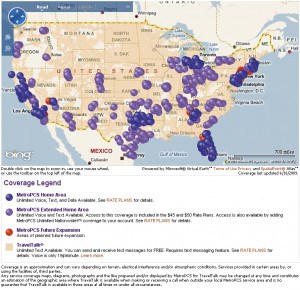
MetroPCS Coverage Map (click to enlarge)

MetroPCS Coverage Map (click to enlarge)

Now, some of these companies hunger for more of your dollars, and they are attempting to convince you their pricing should be similar to utilities like gas, electricity, and water (while conveniently not allowing themselves to be regulated like those providers).  They scrupulously avoid comparing their service with telephone companies, which are really the closest cousins to broadband service.

Now we know why.  While some broadband providers want to move away from flat rate pricing, telephone companies are moving toward flat rate pricing.

In addition to unlimited local, statewide, and nationwide flat rate long distance plans, MetroPCS, a regional prepaid mobile telephone provider, has announced a new unlimited international flat rate calling plan for just $5 per month.

To be eligible for $5 Unlimited International Calling,  customers must choose an unlimited calling plan starting at $40 per month.  For an additional $5, customers get unlimited calling to 100 countries.

MetroPCS sees this new international flat rate plan as a “game changer” in the industry, drawing large numbers of new subscribers who love to call overseas.  The company may even attract tourists who sign up with a “throwaway” basic mobile phone just for the duration of their visit.  The costs for the service are dramatically lower than roaming rates, especially for international calls, even with the price of the phone.

The only downside?  MetroPCS operates in only a limited number of cities, although they maintain roaming agreements with Leap Wireless (Cricket) to extend their coverage.  Once one company offers flat rate international calling, others will certainly follow, potentially establishing a new paradigm for truly unlimited mobile phone calling, regardless of where you call.

Frontier Website: Cap Language Revised, But Inconsistencies Remain

Phillip Dampier August 6, 2008 Data Caps, Frontier 9 Comments

Frontier’s webmasters have been working overtime today apparently doing some damage control, as well as issuing some clarifications about their new usage caps.   But like much of the mixed and muddied message customer service representatives are sending customers, the website now contains several inconsistencies and contradictions between the product description page and the Acceptable Use Policy.

Because of the changing story, we’ve decided to begin capturing and saving select pages from Frontier’s website and will be adding them to a new Reference Library under construction.   From there, you can download and save Adobe PDF versions of captured web pages, dated for your convenience.   Unfortunately, with the shifting positions of Frontier, what may be on the website today may be gone tomorrow.   If engaged in an effort to cancel service, it may be useful to have some of these pages available to reference, because customer service representatives may not be able to locate them.

Let’s breakdown what has changed in the last 24 hours.

First, it’s obvious readers are making a difference.   Frontier realizes they have a public relations problem on their hands of their own making.   The complaint calls and cancellation requests have clearly made an appropriate impact on the company, although not to the point of shelving the idea of a usage cap.   The company has instead decided to try and manage the story more carefully in hopes of controlling the message.   Unfortunately for them, as long as they want to impose caps on customers, we will be here to debunk the fictional excuses, expose the inconsistencies, and educate consumers about why they should not be convinced that less equals more.

Second, the original Acceptable Use Policy dated July 23, 2008 for residential customers remains in place:

Customers must comply with all Frontier network, bandwidth, data storage and usage limitations. Frontier may suspend, terminate or apply additional charges to the Service if such usage exceeds a reasonable amount of usage. A reasonable amount of usage is defined as 5GB combined upload and download consumption during the course of a 30-day billing period.

This is now in direct contradiction with a new section attached to the product information page for the residential DSL product, which includes this new language:

If I hit 5GB will my service be interrupted?
No. Your service will not be interrupted at 5Gb. You will continue to use our High Speed Internet service without disruption.

Does Frontier plan to limit my use of the Internet?
No, there are no plans to limit customer usage. On average a Frontier High-Speed Internet customer uses less than 1.5GB per month. Frontier residential High-Speed Internet service comes with 5G per month (about 5,000 Megabytes), which is more than double the monthly consumption of most of our subscribers.

We appreciate the company’s apparent new policy not to suspend or terminate accounts for exceeding their 5GB usage cap, but their Acceptable Use Policy requires immediate revision to ensure consistency.

Third, the newest promotional page includes this laugh-out-loud passage.   If you are seriously considering imposing a draconian usage cap of 5GB, which is obviously so unacceptable to a significant number of your customers that are calling to complain and cancel service, maybe this passage  is just pushing things a little too far:

We all love the Internet, and Frontier is committed to offering you all the bandwidth you need and want to take full advantage of the Web! Our basic residential Internet packages offers 5GB usage — that’s the equivalent of 500,000 basic text e-mails, 2,500 Photos, 40,000 Web Pages, over 300 Hours of Online Game Time, 1,250 downloaded songs, or a mixture of the above!

This kind of writing convinces me the folks in Frontier’s Marketing Department have finally joined the party.   Welcome aboard, but remember, if customers were upset enough to protest a 5GB usage cap, rubbing it in their face by telling them you love the Internet and are committed to offering all the bandwidth “you need” (if the year is 1988 and you have a 1200bps dial-up modem) will be seen as fighting words.   Telling customers 5GB a month lets you take full advantage of the Web is fine, if you never do anything except browse low density web pages.   Maybe we can Gopher and Telnet some things as well.   Somehow I doubt the marketing people will understand the irony of either.

The rest doesn’t get much better.   If Frontier wants to learn more about The Internets, they can use The Google to read about average customer reactions to broadband user caps and exactly what defines a “power user.”   Someone who exceeds 5GB a month hardly qualifies.   Also, another inconsistency:  If Frontier has not implemented a usage cap plan, then why does the language implementing it remain in the Residential Acceptable Use Policy?

What are “bandwidth caps” and what does it mean for Internet users?
“Caps” are thresholds where Internet Service Providers could deem usage in excess of “normal” usage. For the majority of our users, bandwidth caps will not be reached. However, some users have multiple servers or computers or download huge files that demand large amounts of available bandwidth. In response to these “power users,” the industry is moving toward “tiered usage” plans that would be applicable when consumption reaches certain bandwidth levels. This type of plan would result in heavy users paying for their fair share of usage and will make sure that average users do not subsidize high-usage consumers. Other Internet Service Providers like Comcast and Time Warner are testing these tiered usage plans. Frontier has not implemented tiered usage plans and will continue to evaluate if and when they would be necessary. If and when Frontier implements a tiered usage plan pricing and usage information will be communicated to all High-Speed customers.

Before we go, let me add there is a bit of good news from Frontier today, which is to their credit, assuming they publish this policy in the form of a written guarantee to customers, which amend their term contracts to assure them this language will remain in place regardless of if it appears on the website or not.   Until a written assurance is in hand, a promotional  blurb on a product description page is  insufficient to make me withdraw my recommendation to cancel service within the 30 day opt-out window:

If Frontier rolls out tiered usage plans, will my Pricing / Plan change if I am on a Frontier Price Protection Plan?
Pricing for customers on Frontier’s Price Protection Plan will not change during your initial term commitment if we roll out tiered usage plans.

This language should be slightly modified to state that any overage fees for bandwidth in excess of 5GB do not apply to Frontier Price Protection Plan customers, and that no penalty or disruption in service will occur if a customer exceeds the 5GB usage cap planned for more  formal implementation in the near future.   Assuming that language is in place, it means that customers on a 12-36 term commitment will not have to worry about any usage caps and they will not apply to them for the remainder of their contract. But, again, an inconsistency remains here as well.   The Acceptable Use Policy clearly states the 5GB limit is in place right now.   Further reference to this should also be included on the Terms & Conditions page, which also contains the opt-out clause, to clarify that usage caps do not apply to customers with a contract that does not specifically include them.

Stop the Cap! continues to call on Frontier to discard the usage cap limitation altogether.   Next week, we’ll have some better ideas for Frontier to consider that will not alienate their customer base and positions them to begin competing more effectively in their service areas.

This article was updated at 11:58pm, August 6, 2008 and replaces language from an article entitled “Breaking News” posted earlier this evening.

FCC Commissioners “Discuss Frontier Usage Caps” At Hearing in Washington

Phillip Dampier July 31, 2008 Data Caps, Frontier, Public Policy & Gov't Comments Off on FCC Commissioners “Discuss Frontier Usage Caps” At Hearing in Washington

Dave Burstein, reporting for GigaOM, said that two FCC Commissioners were overheard discussing Frontier’s decision to cap its customers at 5GB of usage per month at an FCC hearing in Washington.

The Federal Communications Commission has taken an interest in the broadband industry and reviewing its competitiveness and service, particularly to underserved rural areas. They are also concerned about net neutrality – where large Internet Service Providers can offer preferential treatment to their partners with faster backbone speeds, exemptions from usage caps, and more prominent placement of their content.

Burstein reports, “Frontier in 2007 had capital spending of $315,793 which seems like a lot until you note their Depreciation expense was $374,435. [A] five gigabyte [cap] is so low even a 2002 style network can handle it, but not maintaining the network is going to hurt them and their customers.”

Search This Site:

Contributions:

Recent Comments:

Your Account:

Stop the Cap!