Home » google » Recent Articles:

Google Broadband: Faster Internet May Reach Mid-Missouri

[Stop the Cap! will be closely following Google’s experimental gigabit fiber-optic broadband network.  We’ll be bringing regular updates about the communities applying, the strategies they are using to attract Google’s attention, what the competition thinks, and the impact of the project on American broadband.]

Columbia, Missouri is excited about the prospect of being chosen as a test city for Google gigabit broadband.

It’s just one of tens of communities seeking to apply for Google’s new experimental fiber to the home network delivering super fast broadband to residents and businesses.

Columbia is the fifth largest city in the state, with 100,000 residents who call the heart of mid-Missouri home.  Columbia is a classic college town, supporting the University of Missouri.  It’s uniquely known as one of the most-educated communities in the country, with over half of its residents holding college degrees.  Columbia residents are quick to embrace new technology, and this drive to adopt the latest and the greatest has fueled interest in Google’s fiber network.

Columbia’s Regional Economic Development, Inc. (REDI), promoting local business and economic development, has been coordinating what to do next.  They’ve been joined by ComoFiber, which is working to generate public interest in the project and help devise a strategy to win Google’s attention.

courtesy: me5000

Columbia, Missouri

Mike Brooks, from REDI, said the city has seen a great deal of interest from the community to apply for Google’s plan.

Last week, both groups met to educate the public and start identifying why Columbia poses an attractive place for Google’s project.

Some believe Columbia would be the ideal city to build such a network.  ComoFiber explains:

The reasons are numerous, but the biggest reason is really quite simple: Columbia is on the knife’s edge: the sweet spot between big, highly-developed cities and small, under-served towns.

The reason this is so important is because it’s easy to see why Google might want to deploy its fiber in either a big city or a small town, but it’s equally easy to see why they wouldn’t. The big cities have high-tech industry, universities, highly educated populae and other capabilities that allow them to produce the kind of applications and creative products that Google wants to research. On the other hand, major cities already have a great deal of fiber infrastructure, and their broadband prices are generally reasonable. So really, they’re already enabled; adding marginally-faster service to those markets won’t be the kind of sea-change that the plan is designed to study.

ComoFiber compiled a list of strengths from both the “big city” and “small town” perspective:
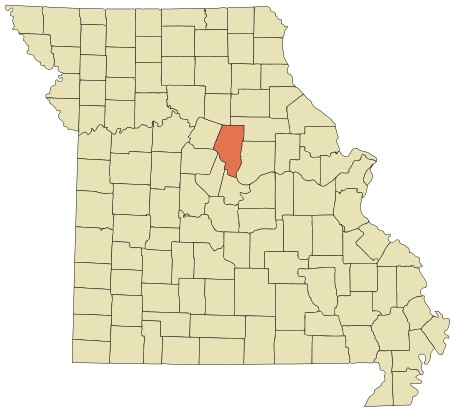
Columbia/Boone County, Missouri

Columbia as Big City:

  1. Multiple colleges and universities, including world-class research facilities.
  2. A major life sciences epicenter. Life-science is perhaps the most data-intensive industry in the world.
  3. A highly-educated, technically-skilled populace. Thirteenth-most educated in America, to be exact.
  4. Many high-tech small businesses, including Internet-centric outfits such as Newsy.
  5. Several major hospitals and health care businesses, including some at the forefront of technological advancement.
  6. Small-business incubators run in cooperation with universities and the city.
  7. The world’s foremost journalism school and the Donald W. Reynolds Journalism Institute, which houses a state-of-the-art Technology Testing Center.
  8. Several existing Internet service providers who can take advantage of this new open network.
  9. Excellent data backhaul capability due to our position on the I-70 corridor.
  10. With over 100,000 people, the population is high enough to meet Google’s goal for project scale.

Columbia as Small Town:

  1. Sub-par broadband performance with high prices.
  2. Very little existing fiber-to-the-home infrastructure.
  3. High tariffed rates for enterprise-class data products (T1, DS3, etc.)
  4. Midrange population density should be a good microcosm for suburbia nationwide.
  5. Smaller building development (no high-rises) makes infrastructure deployment simpler.
  6. ”The District” contains the kind of mom-and-pop small-town businesses that can innovate unencumbered by corporate imperatives.
  7. Frequently listed in “best places to live” compilations, such as that of Money Magazine.
  8. Location in the heart of middle America sends a powerful symbolic message.
  9. Low cost of living will be nice for the employees Google will need to move in.
  10. With only a bit over 100,000 people, the population is low enough not to dwarf Google’s goal for scale.

The incumbent cable operator, Mediacom, can’t understand why there is such excitement over Google’s fiber project.

“Google is going to be in select markets, and it’s kind of a test that they’re rolling out,” Mediacom director of operations Bryan Gann told KOMU-TV in Columbia. “It may be limited to some commercial applications in the beginning.”

Mediacom is Columbia's incumbent cable company

Mediacom doesn’t think most residents have any need for super fast broadband.

“I think when you get up to those higher speeds that fast, it’s a select group that would even be interested in it going at that speed,” Gann said.

Despite that remark, Gann quickly added Mediacom was already providing the fastest broadband access in town.  In early February, Mediacom boosted its top broadband speed to 50Mbps, and Gann says the company already has plans to boost that speed to 100Mbps in the future.

“We’re already supposed to go to 100, so we can press on the accelerator anytime we want to,” Gann said.

When a new fiber-based competitor threatens to arrive in town, most cable companies downplay the competitive threat.  Mediacom was no exception.

Gann told KOMU Mediacom was used to competition in broadband service and doesn’t see Google Fiber as a threat.

“With the technology that the cable industry put into Columbia, we’re ready to increase our speed to match competition,” Gann said.

[flv]http://www.phillipdampier.com/video/KOMU Columbia Faster Internet May Reach Mid-Missouri 2-16-10.flv[/flv]
KOMU-TV talks about Columbia’s prospects as a chosen city for Google’s new fiber-to-the-home experiment. (2/16/10 – 1 minute)
Frontier’s Low-Fiber Diet: ‘Most Users Don’t Need Ultra-Fast Internet Access,’ Says Company Official

Frontier's headquarters in Rochester, N.Y.

Frontier Communications has dismissed the proposition of Google constructing a 1Gbps fiber-to-the-home network, telling readers of the Rochester Democrat & Chronicle that most users don’t need ultra-fast Internet access.

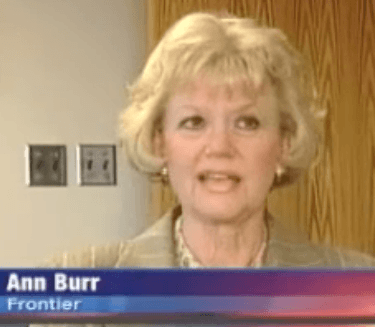
Ann Burr, chairman and general manager of Frontier Communications of Rochester made the remark in response to news that citizens and business leaders are excited about promoting Monroe County as a potential test location for Google’s fiber network experiment.

Frontier, which serves Rochester and most of the 585 area code, accused Google of having “a poor track record of following through on such proposals and that creating a fiber-optic network from scratch would be enormously expensive.”

Pot to kettle.  Frontier’s illusory promises for fiber optic connectivity in states like West Virginia, where it seeks to take over the majority of the state’s phone customers from Verizon, never seem to include specific assurances such projects will reach customer homes.

“If Google built its own network, we estimate it would cost $5,000 per household,” Burr told the newspaper.

That’s as exaggerated as Frontier’s DSL speed claims.

Verizon Communications, which is in the business of providing fiber connectivity to the home, disclosed the true costs are far lower than that, and continue to decline.  In the summer of 2008, Verizon’s Policy Blog noted:

Capital Costs
– We said our target per home passed was $700 by 2010, and we are ahead of plan to achieve that objective. In fact, we’ve already beaten the target.
– We said our target per home connected was $650 by 2010, and we’re on plan to hit that target.

No wonder Frontier doesn’t contemplate providing fiber service to customers.  It created its own sticker shock.

Still, the local phone company didn’t want to slam the door entirely on Google’s foot, suggesting it would be willing to talk about leasing space on Google’s network if it launched in the Flower City.

Frontier’s claim that customers don’t believe fast broadband service is important is a remarkable admission, particularly for a company that increasingly depends on broadband service to stop revenue loss from customers dropping traditional phone lines.  That philosophy should be carefully considered by state officials and utility commissions reviewing Frontier’s proposal to take over Verizon phone lines in several states.  Do communities want to receive broadband from a company that dismisses faster broadband speed as irrelevant for the majority of its customers?

Perhaps the remarks came with the understanding Frontier isn’t capable of delivering 21st century broadband speeds over its antique network of copper telephone wire anyway.

That’s the point Time Warner Cable has made repeatedly, especially in the Rochester metro area.  The cable operator routinely promotes its Road Runner cable modem service’s speed advantages over Frontier’s DSL product.  Frontier promises up to 10Mbps, but often manages far less (3.1Mbps was my personal experience with Frontier DSL last April.)  Time Warner Cable promises up to 15Mbps, and often exceeds that with its “PowerBoost” feature.  In rural areas, the phone company tops out at “up to 3Mbps.”  Time Warner Cable notes most of its new broadband customers come at the expense of phone companies like Frontier.  DSL customers switch because they do care about broadband speed.

Judging from the excitement in Rochester over Google’s proposal, Frontier’s dismissal of a fiber optic future seems out of touch, and potentially a drag on the local community’s economic future.

Rochester increasingly will become a broadband backwater because of anemic broadband competition from Frontier Communications.  Its reliance on ADSL technology, more than a decade old, to deliver distance-sensitive broadband service looks out of place compared with the rest of New York State.  Major cities throughout New York are being wired with fiber optic service by Verizon Communications.  Verizon FiOS delivers up to 50Mbps service.  Frontier maxes out at far lower speeds and defines an acceptable amount of broadband usage on its DSL service at just 5GB per month. Using Verizon’s FiOS fiber network, you’d exceed Frontier’s entire month’s ‘allowance’ in less than 15 minutes at Verizon’s speeds.

Rochester is one of many communities challenged by the transition away from a manufacturing economy towards a high technology future.  A world class fiber optic network doesn’t just benefit big business.  It spurs revolutionary growth in medicine, education, software development, telecommunications, and more.  That means good paying jobs.  For consumers with fiber to the home, it opens the door to telecommuting on a whole new level, distance learning opportunities, new ways to access information and entertainment, and allows home-based entrepreneurs to develop new businesses.

With Verizon FiOS unavailable to Rochester indefinitely, and Frontier unwilling to make appropriate investments to keep this city competitive with the rest of upstate New York, those jobs and economic benefits can go to Buffalo, Syracuse, Albany, Westchester County, and metropolitan New York City.  We’ll be held back on the frontier with Frontier and its ideas of rationed broadband service.

[flv width=”360″ height=”260″]http://www.phillipdampier.com/video/WROC Ontario County Makes Bid for Super Fast Internet 2-11-2010.flv[/flv]

WROC-TV in Rochester reports that Ontario County, to the southeast of Rochester, may have a built-in advantage with an already-installed fiber loop covering much of the county.  The county has a team working on a formal application to Google to provide service in communities like Geneva and Canandaigua.  Frontier’s claims that consumers don’t care about fast broadband speed are belied by the excitement of residents of both counties. (2 minutes)

If Your Provider Won’t Give You Real Fiber Optic Service, Google Might – Think Big With a Gig – Nominate Your Community

Google plans to offer up to 1Gbps service on its direct to the home fiber network

Google has announced it is doing something about anemic, overpriced, and poorly supported broadband service in the United States.  It’s going to start providing service itself.

In a move that is sure to drive providers crazy, Google is looking for your nominations for communities that are stuck in broadband backwaters, desperate for an upgrade.  With so many suffering from “good enough for you” broadband speeds, threats of “inevitable” Internet Overcharging schemes like usage limits and consumption billing, or customer support that involves reaching more busy signals than helpful assistance, they won’t have to beg for nominations.

Google is planning to launch an experiment that we hope will make Internet access better and faster for everyone. We plan to test ultra-high speed broadband networks in one or more trial locations across the country. Our networks will deliver Internet speeds more than 100 times faster than what most Americans have access to today over 1 gigabit per second, fiber-to-the-home connections. We’ll offer service at a competitive price to at least 50,000 and potentially up to 500,000 people.

From now until March 26th, we’re asking interested municipalities to provide us with information about their communities through a Request for information (RFI), which we’ll use to determine where to build our network.

I can think of a few cities that were victimized by providers in 2009 who have little chance of seeing true fiber optic service any other way.  Rochester, New York, the Triad region of North Carolina, parts of San Antonio and Austin bypassed by Grande Communications’ fiber network, are all among them.  Rochester has the dubious distinction of being stuck with two providers itching to slap usage limits and consumption billing on their customers – Frontier and Time Warner Cable.  Since Verizon FiOS is popping up all over the rest of New York State, residents in the Flower City concerned about being left behind might want to make their voices heard.

Google plans to deliver 1Gbps… that’s a Gigabit — 1,000Mbps service to its fiber customers at a “competitive price.”

While some in the industry consider such speeds irrelevant to the majority of consumers, Google thinks otherwise:

In the same way that the transition from dial-up to broadband made possible the emergence of online video and countless other applications, ultra high-speed bandwidth will drive more innovation – in high-definition video, remote data storage, real-time multimedia collaboration, and others that we cannot yet imagine. It will enable new consumer applications, as well as medical, educational, and other services that can benefit communities. If the Internet has taught us anything, it’s that the most important innovations are often those we least expect.

What’s in it for Google?  Targeted advertising, guaranteed open networks, an improved broadband platform on which Google can develop new broadband applications, and calling out providers’ high profit, slow speed broadband schemes are all part of the fringe benefits.

For providers and their friends who have regularly attacked Google for “using their networks for free,” Google’s fiber experiment deflates providers’ hollow rhetoric, and could finally provide a warning shot on behalf of overcharged, frustrated consumers that the days of rationed broadband service at top dollar pricing may soon be over.

[flv width=”640″ height=”380″]http://www.phillipdampier.com/video/Google Think Big With a Gig Announcement.flv[/flv]

Google released this video announcing their Think Big With a Gig campaign (1 minute)

This isn’t Google’s first experience with being an Internet Service Provider.  The company has experimented with free Google Wi-Fi service in its hometown of Mountain View, California since 2006.

[Update 2:30pm EST: FCC Chairman Julius Genachowski applauded Google’s experiment: “Big broadband creates big opportunities,” he said in a statement. “This significant trial will provide an American testbed for the next generation of innovative, high-speed Internet apps, devices and services.”

The Washington Post has a source that claims Google “doesn’t currently have plans to expand beyond the initial tests but will evaluate as the tests progress.”  That could mean the experiment also serves a public policy purpose to re-emphasize Google’s support for Net Neutrality, and to deflate lobbyist rhetoric about Google’s support for those policies being more a case of their own self-interest and less about the public good.  If Google can run its networks with open access, they essentially put their money where their public policy mouth is.]

AT&T Damage Control: Running an Internet Overcharging Re-Education Campaign

Phillip Dampier December 14, 2009 AT&T, Competition, Data Caps, Editorial & Site News 2 Comments

dampier1AT&T Mobility has been sending out their blogger team to try and clean up the damage from CEO Ralph de la Vega’s not-too-subtle hint that the days of unlimited iPhone data plans are numbered:

Unfortunately, there has been a lot of misinformation, rumor and pure speculation floating out there during the last day on this topic.

[…]

We carry more smartphone data traffic than any other U.S. provider, with traffic growing 5,000 percent over the past three years. As a result, we are working aggressively and investing heavily in our network to support this tremendous growth. Our $17 – $18 billion CapEx spend for 2009 includes:

  • Nearly doubling the wireless spectrum serving 3G customers in hundreds of markets across the country, using high-quality 850 MHz spectrum.  This additional spectrum expands overall network capacity and improves in-building reception.
  • Adding about 2,000 new cell sites, expanding service to new cities and improving coverage in other areas.
  • Adding about 100,000 new backhaul connections, which add critical capacity between cell sites and the global IP backbone network.  We’re doubling the number of fiber-served cell sites this year.
  • Enabling widespread access to our Wi-Fi network – the largest in the country with more than 20,000 hotspots in all 50 states – allowing them to take advantage of the best available AT&T mobile broadband connection.
  • Rolling out even faster 3G speeds with deployment of HSPA 7.2 technology, with availability in six markets planned by the end of the year.
  • Preparing for field trials of next generation, LTE wireless networks next year, with deployment planning to begin in 2011.  This schedule aligns with industry expectations for when a wide variety of compatible 4G wireless devices should be available.

We have seen very positive results from our efforts thus far.  In one of the most common measures of reliability – dropped calls – AT&T’s national performance is within two-tenths of 1 percent of the highest score among major providers as measured by an independent firm, with only 1.32 percent of calls dropped nationally.

Ralph de la Vega

Ralph de la Vega

AT&T’s blogger team says it isn’t true that de la Vega is definitively saying he’s “capping” services.

But de la Vega never said in his original statements that he was advocating “capping” service.  He said, “there’s got to be some sort of a pricing scheme that addresses … usage.”  Scheme is right.  That’s code language for consumption or usage-based billing, something the blogger team doesn’t rule out.  A strict usage cap simply says a customer cannot exceed a specified amount.  Most consumption billing schemes monetize data consumption, not with a true pay-for-use system that bills by the megabyte, but rather a fixed monthly price with an allowance and overlimit penalties for exceeding it.  AT&T already uses consumption-based billing for its prepaid and postpaid mobile broadband plans, so extending it to the iPhone isn’t exactly novel.

The iPhone customer has been treated as a profit engine by AT&T since the phone was first introduced.  Compelling customers to purchase a mandatory data plan that was originally priced at $20 and was raised to $30 was the price iPhone customers had to pay for bragging rights.  Should AT&T impose consumption billing, that price may go much higher.

AT&T must believe iPhone users are willing to pay that price or dramatically cut usage.  Either way, AT&T milks the very last nickle out of its exclusivity arrangement that some industry observers believe will expire in the early summer of 2010.  When that happens, AT&T must be quietly pondering what customers will do once they can buy an iPhone from other carriers.

Leafing through January’s issue of Consumer Reports, I find one possible answer in the magazine’s annual survey of America’s best and worst cell phone providers (subscription required for detailed results).  More than 50,000 subscribers rated their wireless carrier, and AT&T turned in dismal ratings, usually ending up at the bottom except in some cities where Sprint achieved that dubious honor.  AT&T’s problems, reported in cities from coast to coast:

  • No service where service should exist
  • All circuits busy
  • Dropped calls
  • Static

Results have been so poor, the magazine recommended that those affected should call AT&T and demand credit.  Many customers have gotten at least three months’ worth of service credits valued at more than $200 for doing so.

Logical conclusion: customers love the iPhone but hate the network it is tied to.  With de la Vega’s recent data usage temper tantrum, it’s just one more reason to be annoyed with AT&T.

For customers who entertain the notion of owning an iPhone, but simply refuse to leave their current provider to obtain it, that’s nearly $3,000 left on the table over the life of a two-year contract.  That should concern both Apple and AT&T.  For Apple, it means potentially losing new iPhone customers to impr0ved competing phones, such as those running Google’s Android operating system.  For AT&T, once the Berlin Wall of exclusivity falls and two year contracts expire, years of consumer frustration with their network could lead to a stampede for the exits.

Mixed Nuts: Glenn Beck Ties His Boss to ‘Marxist Front Group’ That Isn’t & RedState Strikes Out (Again) on Net Neutrality

glennMaster conspiracy theorist Glenn Beck should have written the last episode of The X Files.  To think I waited nine seasons to find what truth was out there only to have screenwriter Chris Carter rip me off with a chain smoker sitting in a Native American pueblo hearing the date when “they” arrive to begin colonization.  Imagine what Glenn Beck could have conjured up given the same nine years.

The problem with wildly-spun conspiracy theories is that you usually end up tangled in one, and Beck proved when he managed to tie his boss, Rupert Murdoch, into both a ‘Maoist -and- Marxist plot.’

To Beck, Net Neutrality and its supporters come straight out of Marxism. Beck warns “if you sit down and work with these people (Net Neutrality proponent Free Press), you might as well just go out and purchase your own blindfold and cigarette for the firing squad, because I don’t see the difference here.”

Beck slammed a Federal Trade Commission workshop he tied to Free Press, a pro-consumer advocacy group Beck considers Maoist (I didn’t realize they had the power to run government agency workshops — oh wait, they don’t), accusing the whole affair of being a conspiracy to silence free speech.

But here comes the “oops.”  It turns out this very same workshop which ran Tuesday, “From Town Criers to Bloggers: How Will Journalism Survive the Internet Age,” had among its participants none other than News Corporation CEO Rupert Murdoch, who was one of the featured speakers.

Just a few weeks earlier, Beck’s attempt to slam Fox News enemy MSNBC (and its owner NBC) brought a broad indictment against too-similar-sounding messages promoting volunteerism from President Obama and the Entertainment Industry Foundation (EIF), which Beck likened to “living in Mao’s China right now,” noting NBC executive Mitch Metcalf is an “EIF board member.”

How inconvenient for Glenn that Murdoch sits on EIF’s honorary board of governors, and Fox Broadcasting is a participant in the group’s initiatives.

Meanwhile, over on RedState, the blog that bans you for fact-checking their nonsense, writer Neil Stevens just discovered the Obama Administration is working on a National Broadband Plan.  That is like missing a train… that left the platform January 20th, 2009:

I’ve been held underwater by work lately and am just now catching up with this thing called “posting,” so forgive me if this post is light on links and details, but I want to give you all a heads up on what’s coming down the pipe in the Obama/Google administration. The big project after Net Neutrality is supposed to be a National Broadband Plan.

In theory, the idea of a National Broadband Plan is to give faster Internet access to more people. You see, people frequently think America “lags behind” the rest of the world because certain statistics show America to have worse Internet access than other countries. The problem with those statistics is that they don’t account for population density. A country like Japan, South Korea, or the Netherlands has a much denser, more urbanized population, and so it’s easier to run the wires you need to give them all Internet access.

But all a progressive needs is a good crisis, and they’re calling this a crisis. However, one of the proposed fixes is to give third party ISPs access to wires already laid by ISPs to provide service. Do we see how increased access to wires that already exist with service provided, doesn’t give access to people who don’t have access already?

The real motive of Julius Genachowski, Barack Obama, Google, and the rest of the adminstration’s Internet crusaders is to help freeloaders, which is why the Songwriters Guild of America is against Net Neutrality. Anyone who creates things of value on the Internet has something to lose from the Obama plans. Everyone can see this. The terrible problems with the Genachowski/Obama/Google plans are not theoretical.

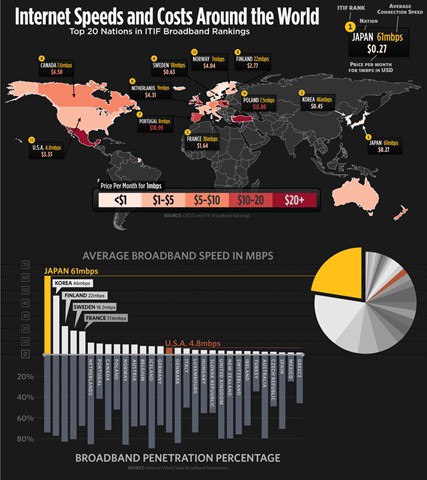
BroadbandWe also forgive Neil for being light on the facts.  It’s not “people” that think America lags behind the rest of the world in Internet access… it’s research that proves it.  Stevens must already be convinced of this, as he debates his own argument, adopting the industry position that tries to explain it all away by comparing population densities between the United States and the Asian nations beating our pants off.  Yes, it is easier to run fiber optics in condominium and apartment-dense areas like Hong Kong.  But the Republic of Korea and Japan have significant non-urban areas as well.

That also doesn’t explain away why Finland, Sweden, and France dramatically outpace us as well.

What all of these countries have in common is a nationally-coordinated public policy that advocates and promotes broadband deployment.  The United States left it up to private providers, who promptly set up a cozy duopoly in most communities and works overtime to keep competition out of their markets.  In many states, they’ve even engineered legislation to ban public broadband initiatives to provide the service they won’t.  The result is an America filled with Internet access “have’s” and “have-not’s” usually defined by income, provider, or location.  This isn’t an issue if you’re lucky enough to have access to FiOS, but is a major problem if your only broadband option is satellite fraudband.

The “open access” provision Stevens is alarmed about is nothing new.

Telephone companies have provided line access to third party DSL providers for at least a decade, and Time Warner Cable allows Earthlink to sell its service over their cable lines as part of an agreement originally dating back to the AOL-Time Warner merger.  You’re excused if you never knew about either arrangement because most consumers don’t.  The fact is, most providers don’t advertise their competition, and when they do, it’s usually because they offer a less worthwhile pricing and speed plan… or in the case of wireless data, a lousy 3G coverage map.

An even better idea for open access is to construct a modern fiber-based network to reach every American and lease it to any provider that wants to reach customers on it.

Providing access to those without broadband service doesn’t come from open access proposals.  Stevens doesn’t realize the second component is Universal Service Fund reform.  The USF, a small fee on phone bills to help underwrite the costs of providing phone service in rural America, has evolved into an often-abused slush fund.  Reforming it to redirect resources into constructing real broadband networks for rural America that can do more than just provide phone lines would help solve the access problem Stevens brings up.

Although the fan club at RedState might represent the “everyone” Stevens claims can see the ‘truth’ about Net Neutrality, they’re not living in an “open access” community themselves.  Just disagree with them and your access magically disappears.

I could write pages and pages about how the American recording industry killed itself through corporate greed, merger-mania, and treating their customer-base like criminals, but Steve Knopper did a much better job in his book Appetite for Self-Destruction, and you can listen to him interviewed at length about the subject courtesy of National Public Radio’s Fresh Air program.

Let me digress for a paragraph.  Independent recording artists who’ve dealt with record labels tell a very different story than the Songwriter’s Guild — their bigger problem is getting paid fairly by the record companies themselves.  Considering the recording industry has been complaining about people stealing their stuff since the days of cassette tape, arguing Net Neutrality represents ‘a pirate’s dream come true’ only exposes the true agenda of some to throttle certain broadband services not to “unclog networks” but to act as a de facto copyright control measure.  That reminds me.  I haven’t thanked Sony enough for foisting the infamous Sony BMG CD copy protection rootkit on us back in 2005.  I’m sure plenty of virus and malware authors who followed their lead probably have.

RedState struck again on Wednesday with another under-informed piece by Neil blasting away at Net Neutrality proponent Google, which is a favorite target of those who oppose Net Neutrality.

Firstly we have the principle of neutrality itself. If Google has its way, carriers like AT&T, Comcast, Verizon, Time Warner, and the rest will not have a say at all in what its users find through their Internet connections. They will not be allowed to set network policies that favor some websites or services over others, no matter how detrimental to the company’s ability to service all its customers.

However, we can see in the case of Studio Briefing that Google is anything but neutral. Studio Briefing has been shut out of all of Google’s services, and has been forcibly removed even from the search, so searching for Studio Briefing would never turn up the company’s webpage. Rather than letting algorithms pick and choose what sites come up, as Google usually claims, somebody human took a step by removing a particular company’s site from the system and sending an email notifying the company of the situation. Imagine Google’s hysterical shrieking had AT&T wiped a Google site off of the map for all users of its services.

Firstly, Neil is unclear about what he is talking about when he suggests providers won’t have a say in what users find through their Internet connections.  Is he upset they might not be able to police criticism of those companies, slow down their competitors, or block blogs?  I’m waiting to hear a justification of how not being able to discriminate against websites will be detrimental to the company’s abilities to “serve its customers.”

As to Neil’s ‘Studio Briefing’ complaint, whether this represents an insidious plot by Google to censor a news aggregation site or dropping a pest site that depends on swiping other people’s content and monetizing it with Google ads is up to the reader to decide.  The folks at Studio Briefing seem more concerned their AdSense account, which lets them earn advertising revenue, was shut off.  The view from the other side can be read here.  Of course, when I tried to Google “Studio Briefing” myself, I had no trouble finding my way there.  That’s hardly being “shut out” and removed from their search engine, because I used that search engine and found my way to the site with just a few mouse clicks.  Even Stevens’ Google attack is linked… by Google.

Search This Site:

Contributions:

Recent Comments:

Your Account:

Stop the Cap!