Home » fiber optic network » Recent Articles:

North Carolina’s Goal to be the First Giga State is Improbable With Current State Legislature

Solving America’s rural broadband crisis will take a lot more than demonstration projects, token grants, and press releases.

Since 2008, Stop the Cap! has witnessed media coverage that breathlessly promises rural broadband is right around the corner, evidenced by a new state or federal grant to build what later turns out to be a middle mile or institutional fiber optic network that is strictly off-limits to homes and businesses. Politicians who participate in these press events tend to favor publicity over performance, often misleading reporters and constituents about just how significant a particular project will be towards resolving a community’s broadband challenges. Much of the time, these projects turn out to serve a very limited number of people or only fund part of a broadband initiative.

Officials last week said they are hoping to make North Carolina “the first ‘giga-state,’ with broadband access for all its residents.” But to realistically achieve that goal, nothing short of an expenditure of hundreds of millions of dollars will be required to realistically achieve that goal statewide.
A decade ago, rural broadband progressed in North Carolina, as communities transitioned away from traditional tobacco and textile businesses to the information and technology economy. To assure a foundation for that economic shift, several communities identified their local substandard (or lacking) broadband as a major problem. The state’s phone and cable companies at the time — notably Time Warner Cable, AT&T, and CenturyLink, often proved to be obstacles by refusing to upgrade networks in the state’s smaller communities. Some cities decided to stop relying on what the broadband companies were willing to offer and chose to construct their own modern, publicly owned broadband network alternatives, open to residents and businesses. A handful of cities in North Carolina went a different direction and acquired a dilapidated and bankrupt cable system and invested in upgrades, hoping cable broadband improvements would help protect their communities’ competitiveness to attract digital economy jobs.

That progress largely stalled after Republicans took control of the state legislature in 2011 and passed a draconian municipal broadband law that effectively banned public broadband expansion. Most of those backing the measure took lucrative campaign contributions from the state’s dominant phone and cable companies. One, Sen. Marilyn Avila, worked so closely with Time Warner Cable’s lobbyists, the resulting bill was effectively drafted by the state’s largest cable company. For that effort, she was later wined and dined by cable lobbyists at a celebration dinner in Asheville.

To be fair, some North Carolina cities are experiencing a broadband renaissance. Charlotte, Raleigh, Greensboro, Cary, Durham, Winston-Salem, and Chapel Hill will have a choice of providers for gigabit service. Google has installed fiber in some of these cities while AT&T and Charter lay down more fiber optics and introduce upgrades to support gigabit speeds.

Things are considerably worse outside of large cities.
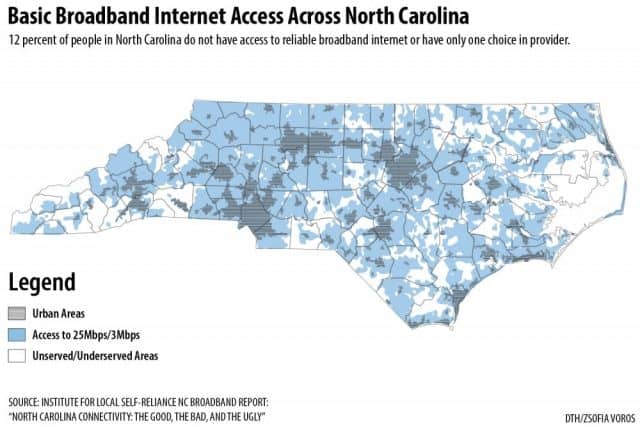
In North Carolina, 585,000 people live in areas where their wired connections cannot reach the FCC’s speed definition of broadband — 25 Mbps, and another 145,000 live without any notion of broadband at all.

Bringing all of North Carolina up to at least the nation’s minimum standard for broadband will not be cheap, and politicians and public policy groups must be realistic about the real cost to once and for all resolve North Carolina’s rural broadband challenges. Where the money comes from is a question that will be left to state and local officials and their constituents. Some advocate only tax credit-inspired private funding, others support a public-private partnership to share costs, while still others believe public money should be only spent on publicly owned, locally developed broadband networks. Regardless of which model is proposed, without a specific and realistic budget proposal to move forward, the public will likely be disappointed with the results.

The Facts of Broadband Life

There is a reason rural areas are underserved or unserved. America’s broadband providers are primarily for-profit, investor-owned companies. They are not public servants and they respond first to the interests of their shareholders. Customers might come in second. When a publicly owned utility or co-op is created, in most cases it is the result of years of frustration trying to get a commercial provider to serve a rural or high cost area. Public projects are usually designed to serve almost everyone, even though it will likely take years for construction costs to be recovered. Investor-owned companies are not nearly as patient, and usually demand a Return On Investment formula that offers a much shorter window to recover costs. For broadband, adequately populated areas that can be reached affordably and attract enough new customers to recover the initial investment will get service, while those areas that cannot are left behind. The two populations most likely to fail the ROI test are the urban poor that may not be able to afford to subscribe and rural residents a company claims it cannot afford to serve. Many early cable TV franchise agreements insisted on ROI formulas that allowed companies only to skip areas with inadequate population density, not inadequate income, which explains why cable service is available in even the poorest city neighborhoods, while a wealthy resident in a rural area goes unserved.

Today, most cable and phone companies install fiber optic infrastructure most commonly in new housing developments or previously unwired business parks, while allowing existing copper wire infrastructure already in place elsewhere to remain in service. Some companies, including AT&T and Verizon, have made an effort in some areas to replace copper infrastructure with fiber optics, but in most cases, their rural service areas remain served by copper wiring installed decades ago. As a result, most rural residents end up with DSL internet from the phone company, often at speeds of 5 Mbps or less, or no internet service at all. Neither of these phone companies, much less independent telcos like CenturyLink and Frontier, have shown much interest in scrapping copper wiring for fiber optics in rural service areas. There is simply no economic case that shareholders will accept for costly upgrades that will deliver little, if any, short-term benefits to a company’s bottom line. That reality has led some communities to try incentivizing commercial providers to make an investment anyway, usually with a package of tax breaks and cost sharing. But many communities have achieved better results even faster by launching their own fiber broadband services that the public can access.

Some states with large rural areas have recognized that solving the rural broadband problem will be costly — almost always more costly than first thought. Such projects often take longer than one hoped, and will require some form of taxpayer matching funds, municipal bonds, public buy-in, or a miraculous sudden investment from a generous cable or phone company. In states with municipal broadband bans, like North Carolina, politicians who support such restrictions believe the cable and phone companies will spontaneously solve the rural internet problem on their own. Such beliefs have stalled rural broadband improvements in many of the states ensnared by such laws, usually tailored to protect a duopoly of the same phone and cable companies that have historically refused to offer adequate broadband service to their rural customers.

Challenges for North Carolina
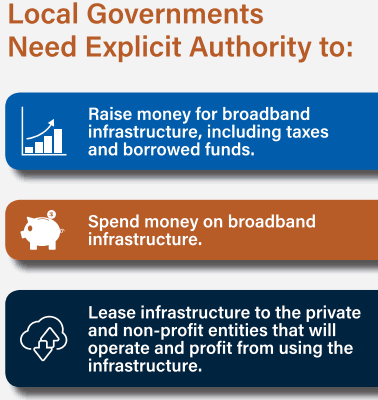
(Courtesy: North Carolina League of Municipalities – Click image for more information)

North Carolina is a growing state, so a small part of the rural broadband problem may work itself out as population densities increase to a level that crosses that critical ROI threshold. But most rural communities will be waiting years for that to happen. Intransigent phone and cable companies are unlikely to respond positively to local officials seeking better service if it requires a substantial investment. As industry lobbyists will tell you, it is not the job of government to dictate the services of privately owned companies. The Republican majority in North Carolina’s legislature underlines that principle regularly in the form of legislation that reduces regulation and oversight. Many, but not all of those Republicans have also taken a strong strand against the idea of municipalities stepping up to resolve their local broadband challenges by working around problematic cable and phone companies. The ideology that government should never be in the business of competing against private businesses usually takes precedence.

Almost a decade ago, the cable and phone companies of North Carolina made three failed attempts to enshrine this principle in a new statewide law that would limit municipal broadband encroachment to such an extent it made future projects unviable. They succeeded in passing a law on their fourth attempt in 2011, the same year Republicans took control in the state legislature.

Today, Republicans still control the legislature with a Democratic governor providing some checks and balances. Why is this important? Because for North Carolina to achieve its goal, it will realistically need a combination of bipartisan support for rural broadband funding and an end to the municipal broadband ban.

Where is the money?

Although North Carolina wants to be America’s first “gigabit” state, New York is the first to at least claim full broadband coverage across the entire state. That did not and could not happen without a multi-year spending program. Recently, North Carolina’s Department of Information Technology launched a $10 million GREAT Grant program to provide last-mile connectivity to the most economically distressed counties in the state. While a noble effort, and one no doubt limited by the availability of funds to spend on broadband expansion, it is a drop in a bucket of water thrown into a barely filled pool.

To put this problem in better context, New York’s goal of full broadband coverage (which in our view remains incomplete) required not only $500 million acquired from settlement proceeds won by the state after suing Wall Street banks for causing the Great Recession, but another $170 million in federal broadband expansion funds that were expected to be forfeited because Verizon — the state’s largest phone company — was not interested in the money or upgrading their DSL service upstate.
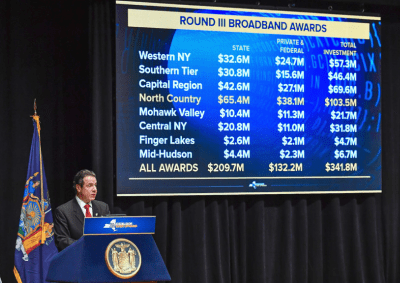
Big Money: New York’s rural broadband funding initiative spent hundreds of millions to attack the rural broadband problem. Gov. Andrew Cuomo outlines funding for just one of several rounds of broadband funding.

Last year, Gov. Andrew Cuomo detailed success for his Broadband for All program by pointing out the state spent $670 million to upgrade or introduce broadband service to 2.42 million locations in rural New York, giving the state 99.9% coverage. That amounts to an average grant of $277 per household or business. In turn, award recipients — largely incumbent phone and cable companies, had to commit to matching private investments. For that state money, the provider had to typically offer at least 100 Mbps service, except in the most rural parts of the state, where a lower speed was acceptable.

North Carolina has 585,000 underserved or unserved locations. Just by using New York’s average $277 grant, North Carolina will have to spend approximately $202 million with similar matching funds from private companies to reach those locations. In fact, it is assuredly more than that because North Carolina’s goal is gigabit speed, not 100 Mbps. Also, New York declared ‘mission accomplished’ while stranding tens of thousands of expensive or difficult to reach residents with subsidized satellite internet access. That offers nothing close to gigabit speed. A more realistic figure for North Carolina in 2019 could be as high as $250-300 million in taxpayer dollars — combined with similar private matching funds to convince AT&T, Charter, CenturyLink and others that the time is right to expand into more rural areas. But as New York discovered, there will be areas in the state no company will bid to serve because the money provided is inadequate.

If the thought of handing over tax dollars to big phone and cable companies bothers you, the alternative is helping communities start and run their own networks in the public interest. Except private providers routinely retaliate with well-funded campaigns of fear, uncertainty and doubt over those projects, and they become political footballs to everyone except their customers, who generally appreciate the service and local accountability.

If North Carolina’s state government relies on a series of $10 million appropriations for grants, it will likely take at least 20 years to wire the state. Stop the Cap! agrees with the goals North Carolina has set to deliver ubiquitous, gigabit-fast broadband. But those goals will be difficult to reach in the present political climate. Republicans in the state legislature approved reductions in the corporate income tax rate to 2.5 percent, down from 3 percent last year, and the personal income tax rate drops to 5.25 percent from 5.499 percent. North Carolina’s latest budget sets aside $13.8 billion for education, $3.8 billion for Medicaid, $3 billion in new debt for road maintenance, and $31 million in grants to attract the film industry to shoot their projects in the state.

It is likely any appropriation significant enough to actually deliver on the commitment to provide total broadband coverage will have to be spread out over several years, unless another funding mechanism can be identified. That assumes the Republicans in the state legislature will be receptive to the idea, which remains an open question.

Fixed Wireless Not a Good Solution for Rural Areas; Usage Demand Outstrips Capacity

Morrow

Australia is learning a costly lesson finding ways to extend broadband service to rural areas in the country, choosing fixed wireless and satellite networks that will ultimately cost more than extending fiber optic broadband to rural customers.

Australia’s National Broadband Network (NBN) is tasked with supplying virtually all of Australia with internet access, using fiber/wired broadband in urban and suburban areas and fixed wireless and satellite internet access in the country’s most remote locations.

But just a few years after debuting satellite broadband and fixed LTE 4G wireless service in many parts of the country, demand has quickly begun to overwhelm capacity, forcing costly upgrades and punitive measures against so-called “heavy superusers.” The NBN has also scrapped plans to introduce higher-speed fixed wireless services, fearing it will only create additional demands on a network that was not envisioned to manage heavy broadband usage from video streaming.

NBN CEO Bill Morrow has elected to place most of the blame on his customers, specifically “superusers” that he characterized as “online gamers” who spend hours during the day and peak usage periods consuming large parts of the fixed wireless network’s available capacity.

“In the fixed wireless, there’s a large portion [of end users] that are using terabytes of data,” Morrow said. “We’re evaluating a form of fair use policy to say, ‘We would groom these extreme users.’ Now the grooming could be that, during the busy period of the day when these heavy users are impacting the majority, that they actually get throttled back to where they’re taking down what everybody else is taking down.”

Under the current NBN fair use policy, monthly downloads per household are capped at 400 GB, with maximum usage during peak usage periods limited to 150 GB a month, which is already significantly less than what most average American households consume each month. With expensive and unexpected early upgrades to more than 3,100 cell towers to manage rapidly growing usage, the cost of service is starting to rise substantially, even as usage limits and speed reductions make these networks less useful for consumers.
In areas where the NBN extends a fiber optic network, the fixed wholesale price for a 50/20 Mbps connection is $32.00 (U.S.) per month. (A 100/40 Mbps connection costs $46.25). For fixed wireless, prices are rising. A 50/20 Mbps fixed wireless connection (with usage cap) will now cost $46.25 a month.

Morrow took heat from members of Parliament over his claim that online gamers were chiefly responsible for slowing down the NBN’s fixed wireless network.

“With great respect to everything you said over the last 15 minutes, you have been saying to us the problem here is gamers,” said MP Stephen Jones (Whitlam).

Morrow clarified that online gamers were not the principal cause of congestion. The main issue is concurrency, which drags down network speeds when multiple family members unexpectedly use an internet connection at the same time. The worst congestion results when several family members launch internet video streams at the same time. Online video not only leads average users’ traffic, it can also quickly outstrip available cell tower capacity. High quality video streaming can quickly impact 4G LTE service during peak usage periods, driving speeds down for all users. The NBN now considers these newly revealed capacity constraints a limit on the feasibility of using wireless technology like LTE to supply internet access.

The current mitigation strategy includes limiting video bandwidth, discouraging video streaming with usage caps or speed throttles, capacity upgrades at cell towers, and public education requesting responsible usage during peak usage times. With capacity issues becoming more serious, Morrow canceled plans to upgrade fixed wireless to 100 Mbps speeds because of costs. The proposed upgrades would have cost “exponentially” more than wired internet access.

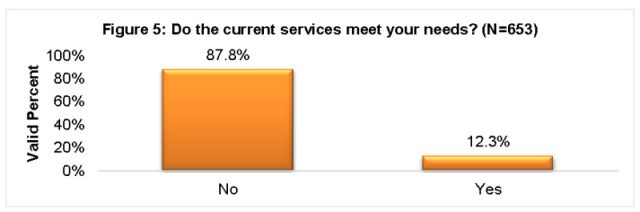
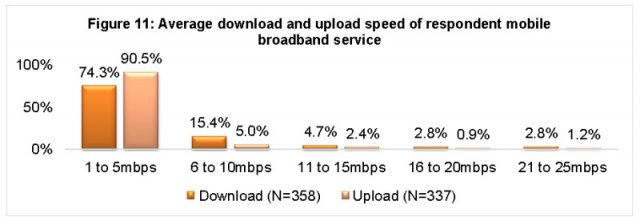
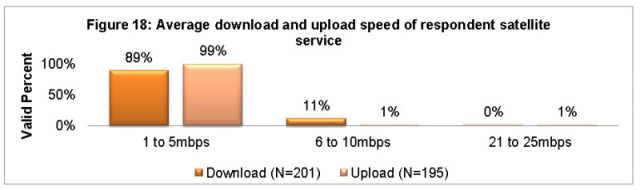
Hype vs. Reality: Most Australians reject fixed wireless and satellite internet as woefully inadequate. (Source: BIRRR)

Actual Fixed Wireless speeds

Actual Satellite Internet speeds

The concept of supplying fixed wireless or satellite internet access to rural areas may have made sense a decade ago, but there are growing questions about the suitability of this technology based on growth in consumer usage patterns, which increasingly includes streaming video. The cost to provide a sufficiently robust wireless network could easily rival or even outpace the costs of extending traditional fiber optic wired service to many rural properties currently considered cost prohibitive to serve. In Australia, fixed wireless and satellite has delivered sub-standard access for rural consumers, and requires the imposition of “fair usage” caps and speed throttles that inconvenience customers. For now, Morrow believes that is still the best solution, given that Australia’s national broadband plan relies heavily on wireless access in rural communities.

“[The benefit of a fair usage policy is] big enough to where if we did groom them during the busy time of the day, it would be a substantial [speed] lift for people,” he said. “I don’t think there’s a silver bullet in any of this – this is going to require us to think through a number of different areas.”

Better Internet for Rural, Regional and Rural Australia (a volunteer consumer group) shares horror stories about relying on satellite to solve rural broadband problems. (7:50)


Rochester, N.Y. Based GoNetspeed Delivers $90 Gigabit Broadband to Pittsburgh and Connecticut

Phillip Dampier September 5, 2018 Broadband Speed, Competition, Consumer News, Data Caps, GoNetspeed, Public Policy & Gov't Comments Off on Rochester, N.Y. Based GoNetspeed Delivers $90 Gigabit Broadband to Pittsburgh and Connecticut

A Rochester, N.Y.-based broadband company founded by an ex-president of Time Warner Cable and a former top executive at Rochester Telephone is bringing broadband competition to thousands of residents in Connecticut and Pennsylvania through its fiber-to-the-home network.
GoNetspeed has been aggressively expanding its service in Comcast, Verizon, and Frontier Communications service areas in suburban Pittsburgh and several cities in Connecticut. According to chief operating officer Tom Perrone, GoNetspeed has managed to buildout 100 network miles of fiber across 13 towns in two different states in just the first six months of 2018, providing a new choice for broadband service to over 30,000 homes and businesses.

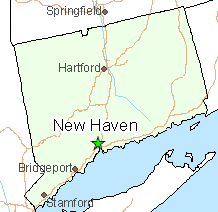
Most recently, the company completed expansion in the New Haven, Conn. neighborhoods of Beaver Hills, Edgewood, and West River, adding an additional 3,000-5,000 homes to its network service area.

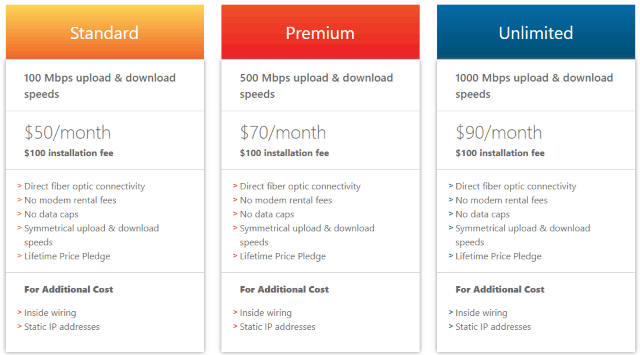
GoNetspeed prioritizes expansion in areas where there is little competition and where neighborhood density makes it financially feasible to bring fiber optic cables into an area. The company markets its service with simplified, lifetime pricing:

  • $50 for 100/100 Mbps
  • $70 for 500/500 Mbps
  • $90 for 1,000/1,000 Mbps

In areas when service is first offered, the $100 installation fee is traditionally waived. There are no data caps. Static IPs and inside wiring are available at an additional cost.

GoNetspeed has received positive reviews from customers in parts of Bridgeport and West Hartford, where service is already available in Connecticut. In suburban Pittsburgh, GoNetspeed is available in parts of Ambridge, Beaver Falls, Baden, Conway, Beaver, Monaca, and Rochester. Over the summer, it announced it would soon also service New Brighton and Aliquippa. In general, the company wires neighborhoods where at least 10% of residents are committed to signing up for service. In Pennsylvania, it faces competition primarily from Comcast and Verizon. In Connecticut, competition will come from incumbents Comcast, Altice USA, and Frontier.

GoNetspeed’s headquarters are in suburban Rochester, N.Y. Ironically, it does not offer residential service in New York.

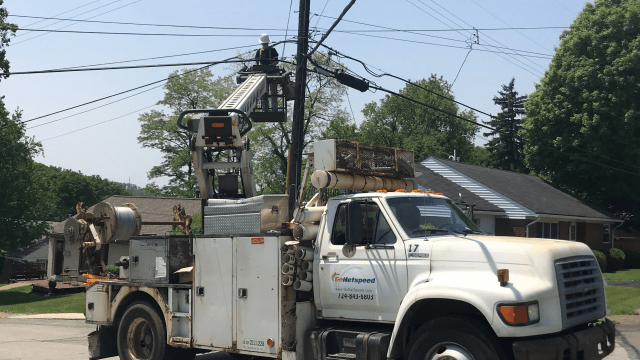
A GoNetspeed truck

The company originally behind GoNetspeed was Fibertech Networks (since sold to Crown Castle, a cell tower owner/operator). The founding partners were John K. Purcell, a former vice president at Rochester Telephone Corporation (now Frontier Communications) and Frank Chiano, the former head of Time Warner Cable in Rochester.

Fibertech was founded in 2000 as a fiber optic network operator. Purcell passed away in 2017, but Fibertech continued, eventually amassing a valuable 14,000 mile metro fiber network serving cities around the northeast. Fibertech served commercial customers like corporations, institutions, and wireless network operators seeking fiber connections to buildings or cell tower sites.

In the last several years, fiber network operators have started to enter the retail broadband marketplace as fiber overbuilders — providing fiber to the home service to areas where demand warrants investment. Most overbuilders target areas where no existing fiber competitor exists, which makes the northeast a viable target.

Verizon dropped its FiOS fiber to the home network expansion project eight years ago and incumbent telephone companies including Verizon, Frontier, Consolidated (formerly FairPoint), Windstream, and CenturyLink have shown little interest in investing in significant fiber upgrades in medium-sized cities in New England, the Northeast, and Mid-Atlantic region. That has given Comcast and Charter Communications — the two largest cable operators, a substantial and growing market share. But customers often loathe both cable operators, and there is built-in demand for new competition.

New Haven. Conn.

Local officials are also happy to see another competitive option. New Haven officials, like many others in Connecticut, have embarked on an effort during the last few years to attract new players to the state, especially after Frontier Communications acquired the assets of AT&T Connecticut. Many communities in Connecticut report a significant digital divide, particularly over the cost of internet access. New Haven, which has a significant low-income population, is happy to see GoNetspeed be part of the solution, but has wondered if GoNetspeed will expand service into lower-income areas of the city.

Connecticut Consumer Counsel Elin Swanson Katz, whose office manages broadband expansion in Connecticut, told the New Haven Register GoNetspeed’s expansion in New Haven “is just another strong indicator that Connecticut consumers are interested in having different options for broadband Internet service.”

“The more competition there is for consumers, for them to have choices, the better off we are,” Katz said. “It’s really important for our state to have ubiquitous access to affordable high-speed broadband that is reliable and that touches every corner of out state.”

AT&T and Comcast Successfully Slow Google Fiber’s Expansion to a Crawl

AT&T and Comcast have successfully delayed Google Fiber’s expansion around the country long enough to finish upgrades that can nearly match the upstart’s speedy internet service.
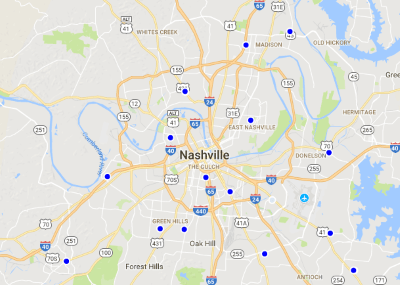

Nearly four years after Google Fiber announced it would offer gigabit speed in Nashville, most residents still have no idea when they will be able to have the service installed. Although officially announced in January 2015, Google has only managed to connect 52 apartment buildings and a limited number of single family homes in parts of Charlotte Park, Edgehill, Sylvan Heights, Sylvan Park, East and North Nashville, and Burton Hills. In all, less than 30% of the homes originally promised service actually have it, forcing Google to seek an extension from the Tennessee Public Utilities Board, which was granted last week.

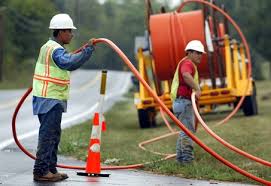
Google’s problems originate within itself and its competitors. The company’s contractors have been criticized for damaging existing wiring, tearing up streets and yards, piercing water pipes causing significant water damage, and inappropriate microtrenching, which caused some of its fiber infrastructure in Nashville to be torn out of the ground by road repair crews.

But the biggest impediment keeping Google from moving faster is its two competitors — AT&T and Comcast, successfully collaborating to stall Google, giving the phone and cable company plenty of time to improve services to better compete. Both companies have also aggressively protected their customers from being poached by offering rock bottom-priced retention plans that some claim are only available in Google Fiber-ready areas.

“It’s still complicated,” Nashville Google Fiber Manager Martha Ivester told the Tennessean newspaper. “Building this fiber optic network throughout the whole city is a long process, and we never expected it wouldn’t be a long process. Obviously, we have had our challenges here.”

WZTV Nashville reports East Nashville residents were upset over road work related to Google Fiber that lasted for months, severely restricting residential parking. (2:37)

Google Fiber Huts – Nashville, Tenn.

Google’s ability to expand has been restrained for years, despite an informal alliance with city officials, primarily over pole attachment issues. Much of middle Tennessee is challenged by a difficult-to-penetrate layer of limestone close to the surface, making underground utility service difficult and expensive. Google’s negotiations with Nashville Electric Service (NES), which owns 80% of the utility poles in Nashville and AT&T, which owns the remaining 20%, have been long and contentious at times. To bring Google Fiber to a neighborhood, existing wires on utility poles have to be moved closer together to make room for Google Fiber. In real terms, that has taken several months, as AT&T and Comcast independently move at their own pace to relocate their respective lines.

An effort to use independent contractors to move all lines in unison — known as “One Touch Make Ready,” was fiercely opposed by AT&T and Comcast, claiming it would violate contracts with existing workers and could pose safety issues, despite the fact both companies use independent contractors themselves to manage wiring. Both companies successfully challenged One Touch Make Ready in court. A federal judge ruled that only the FCC could regulate poles owned by AT&T, while another judge ruled the city had no authority to order the municipally owned electric company to comply with One Touch Make Ready.

In August, the FCC issued an order allowing One Touch Make Ready to apply to AT&T’s poles, but NES still refuses to change its policy of relocating service lines one line at a time. The electric utility did not explain its reasons. AT&T also recently eased its position on One Touch Make Ready, but with NES still stonewalling, Google Fiber’s delays are likely to continue.

AT&T Fiber is being embraced by some customers tired of waiting for Google Fiber.

In the interim, both AT&T and Comcast have upgraded their respective systems. AT&T Fiber offers a fiber-to-the-home connection available in some areas while Comcast offers near-gigabit download speeds over its existing Hybrid Fiber-Coax (HFC) network. The upgrades have taken the wind out of Google Fiber for some tired of waiting.

Google has recently tried to speed progress using underground “shallow trenching” for installation, which buries cable as little as four inches deep. The company has amassed more than 24,000 permits to lay fiber under roads and yards in Nashville, which may speed some deployment, but for some it is too little, too late.

“It has been more than a year since we expected Google Fiber to serve us and they won’t tell us when they will get here, so I gave up and signed a two-year contract for AT&T Fiber service instead,” said Drew Miller. “Google Fiber just isn’t as exciting as it was when it was announced because other providers have similar service now and I get a better deal bundling it with my AT&T cellphone service.”

Attitudes like that obviously concern Google, as have reports that customers in Google Fiber-ready neighborhoods are getting very aggressively priced retention offers if they stay with their current provider.

“Comcast cut my bill from close to $200 to around $125 if I did not switch,” said Stop the Cap! reader Olivia. “I also got double internet speed. I don’t need a gigabit, so I stayed with Comcast. If I get close to their usage limit I will switch to Google then.”

Olivia notes her mother had exactly the same services from Comcast, but Comcast would not offer her the same promotion because she lived in an area not yet wired for Google Fiber.

With upgrades and aggressive customer retentions, the longer Google takes to string fiber, the fewer customers are likely to switch for what was originally “game-changing” internet speeds and service.

WTVF Nashville shows off Google’s microtrenching, burying fiber optic cables just a few inches underground. (2:36)

Pricing Comparisons

Google Fiber

  • Fiber 100: $50 a month, internet speeds up to 100 Mbps
  • Fiber 1000: $70 a month, internet speeds up to 1,000 Mbps, downloads and uploads
  • Fiber 100 + TV: $140 a month, internet speeds up to 100 Mbps, 155+ channels, premium channels (HBO, Showtime) available
  • Fiber 1000 + TV: $160 a month, internet speeds up to 1,000 Mbps, 155+ channels, premium channels (HBO, Showtime) available

AT&T

  • Internet-only: $50 a month for first 12 months, then $60 thereafter. $99 installation fee. Unlimited data costs an extra $30 a month. Early termination fee: $180 (pro-rated). Speeds range from 10 to 100 Mbps
  • Direct TV + Internet: $75/mo first 12 months, then $121. Customers pay a $35 activation fee and $30 a month for unlimited data. 155 channels. Speeds vary. 24 month contract required.
  • Internet 1000: $90 a month during first 12 months, then $100/mo thereafter. Bundled discount can reduce cost of package to $80-90. Up to 960 Mbps downloads. Early termination fee: $180 (pro-rated).

Comcast

  • Performance Starter: $20 a month, increases to $50 after two-year promotion. Up to 25 Mbps.
  • Blast!: $45 a month, increases to $80 a month after two-year promotion. 150 Mbps.
  • Gigabit (DOCSIS 3.1): $70 a month, increased to $140 after two-year promotion. 940/35 Mbps.

WSMV Nashville reports Google’s microtrenching has been problematic as road crews unintentionally dig up Google’s optical fiber cables mistakenly buried just two inches underground. (2:44)

Countries Moving at Light Speed to Expand Fiber, While U.S. Keeps Subsidizing DSL

This week, the FCC announced bidding has finished for the latest Connect America Fund (CAF) broadband subsidies auction.

Once again, the FCC gave first priority to incumbent phone companies to bid for the subsidies, which defray the cost of expanding internet access to homes and businesses otherwise unprofitable to serve. Nearly $2 billion was left on the table by disinterested phone companies after the first round of bidding was complete, so the FCC’s second round opened up the leftover money to other telecom companies.

Winning bidders will receive their portion of $198 million annually in 120 monthly installments over the next ten years to build out rural networks. In return, providers must promise to deliver one broadband and voice service product at rates comparable to what urban residents pay for service. The winning bids, still to be publicly announced, will come from rural electric and phone cooperatives, satellite internet providers, fixed wireless companies, and possibly a handful of cable operators. But much of the money overall will be spent by independent phone companies rolling out slow, copper-based, DSL service.

Because the total committed will take a decade to reach providers, rural Americans will likely face a long wait before what purports to be “broadband” actually reaches their homes and businesses.

While many co-ops will spend the money to expand their own homegrown fiber-to-the-home services, most for-profit providers will rely on wireless or copper networks to deliver service.

Telefónica Spain

Overseas, broadband expansion is headed in another direction — expansion of fiber-to-the-home service, with little interest in investing significant sums on furthering old technology copper wire based DSL and fixed wireless services. The expansion is moving so quickly, Verizon made certain to sign long-term contracts with optical fiber suppliers like Corning in 2017 to guarantee they will not be affected by expected shortages in optical fiber some providers are already starting to experience.

Virtually everywhere in developed countries (except the United States), fiber broadband is quickly crowding out other technologies, despite the significant cost of replacing copper networks with new optical fiber cables. If a provider is brave enough to discount investor demand for quick returns and staying away from big budget upgrade efforts, the rewards include happier customers and a clear path to increased revenue and business success.

Not every Wall Street bank is reluctant to support fiber upgrades. Credit Suisse sees a need for optical fiber today, not tomorrow among incumbent phone and cable companies.

“The cost of building fiber is less than the cost of not building fiber,” the bank advised its clients. The reason is protecting market share and revenue. Phone companies that refuse to upgrade or move at a snail’s pace to improve their broadband product (typically DSL offering 2-12 Mbps) have lost significant market share, and those losses are accelerating. Ditching copper also saves companies millions in maintenance and repair costs.

Canada’s Telus is a case in point. Its CEO, Darren Entwistle, reports Telus’ effort to expand fiber optics across its western Canada service area is already paying off.

“We see churn rates on fiber that are 25% lower than copper,” Entwistle said. “35% lower in high-speed internet access, and 15% lower on TV — 25% lower on average. We’re seeing a reduction in repair volumes to the tune of 40%. We’re seeing a nice improvement in revenue per home of close to 10%.”

Telus promotes its fiber to the home initiative in western Canada as a boost to medical care, education, the economy, and the Canadian communities it serves. (1:31)

Telus’ chief competitor is Shaw Communications, western Canada’s largest cable company. Fiber optics allows Telus to vastly expand internet speeds and reliability, an improvement over distance sensitive DSL. Shaw Cable has boosted its own broadband speeds and offers product bundles that have been largely responsible for Telus’ lost customers, until its fiber network was switched on.

In economically challenged regions, fiber optic expansion is also growing, despite the cost. In Spain, Telefónica already provides service to 20 million Spaniards, roughly 70% of the country, and plans to continue reaching an additional two million homes and businesses a year until the country is completely wired with optical fiber. In Brazil, seven million customers will have access to fiber to the home service this year, expanding to ten million by 2020.

Verizon and AT&T regularly ring alarm bells in Congress that China is outpacing the United States in 5G wireless development, but are strangely silent about China’s vast and fast expansion into fiber optic broadband that companies like Verizon stopped significantly expanding almost a decade ago. China already has 328 million homes and businesses wired for fiber and added another five million homes in the month of June alone. AT&T will take a year to bring the same number of its own customers to its fiber to the home network.

The three countries that are most closely aligned with the mentality of most U.S. providers — the United Kingdom, Australia, and Germany — are changing their collective minds about past arguments that fiber to the home service is too costly and isn’t necessary.

The government of Martin Turnbull’s cost concerns forced a modification of the ambitious proposal by the previous government to deploy fiber to the home service to most homes and businesses in the country. That decision to spend less is coming back to haunt the country after Anne Hurley, a former chief executive of the Communications Alliance involved in the National Broadband Network (NBN), admitted the cheaper NBN will face an expensive, large-scale replacement within a decade.

ABC Australia reports on findings that the country’s slimmed-down National Broadband Network is inadequate, and parts will have to be scrapped within 5-10 years (1:37)

Turnbull’s government advocated for less expensive fiber to the neighborhood technology that would still rely on a significant amount of copper wiring installed decades ago. The result, according to figures provided to a Senate committee, found only a quarter of Australians will be able to get 100 Mbps service from the NBN, with most getting top speeds between 25-50 Mbps.

Despite claims of technical advancements in DSL technology which have claimed dramatic speed improvements, Hurley was unimpressed with performance tests in the field and declared large swaths of the remaining copper network will have to be ripped up and replaced with optical fiber in just 5-10 years.

“If you look around the world other nations are not embracing fiber-to-the-[neighborhood] and copper … so yes, it’s all going to have to go and have to be replaced,” she said.

In the United Kingdom, austerity measures from a Conservative government and a reluctant phone company proved ruinous to the government’s promise to deliver “superfast broadband” (at least 24 Mbps) over a fiber to the neighborhood network critics called inadequate from the moment it was switched on in 2012. The government had no interest in financing a fiber to the home network across the UK, and BT Openreach saw little upside from spending billions upgrading the nation’s phone lines it now was responsible for maintaining as a spun-off entity from BT. In 2015, BT Openreach’s chief technology officer called fiber to the home service in Britain “impossible” and too expensive.
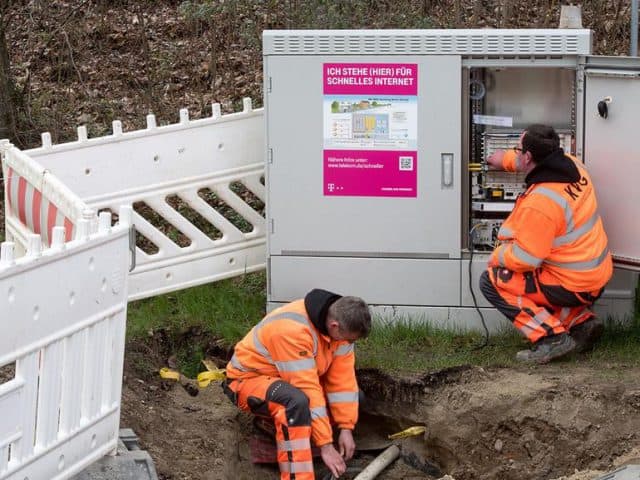
Two years later, while the rest of Europe was accelerating deployment of fiber to the home service, the government was embarrassed to report its broadband initiative was a flop in comparison, and broke a key promise made in 2012 that the UK would have the fastest broadband in Europe by 2015. Instead, the UK has dropped in global speed rankings, and is now in mediocre 35th place, behind the United States and over a dozen poorer members of the EU.

What was “impossible” two years ago is now essential today. The latest government commitment is to promote optical fiber broadband using a mix of targeted direct funding, “incentives” for private companies to wire fiber without the government’s help, and a voucher program defraying costs for enterprising villages and communities that develop their own innovative broadband enhancements. The best the government is willing to promise is that by 2033 — 15 years from now — every home in the UK will have fiber broadband.

Deutsche Telekom echoed BT Openreach with claims it was impossible to deliver fiber optic broadband throughout an entire country.

Deutsche Telekom’s dependence on broadband-enhancements-on-the-cheap — namely speed improvements by using vectoring and bonded DSL are increasingly unpopular for offering too little, too late in the country. Deutsche Telekom applauded itself for supplying more than 2.5 million new households with VDSL service in 2017, bringing the total number served by copper wire DSL in Germany to around 30 million. The company, which handles landline, broadband and wireless phone services, is slowly being dragged into fiber broadband expansion, but on a much smaller scale.

In March, Telekom announced a fiber to the home project in north-east Germany’s Western Pomerania/Rügen district for 40,000 homes and businesses. The network will offer speeds up to 1 Gbps. In July, Telekom was back with another announcement it was building a fiber optic network for Stuttgart and five surrounding districts Böblingen, Esslingen, Göppingen, Ludwigsburg, and Rems-Murr, encompassing 179 cities and municipalities. But most of the work will focus on wiring business parks. Residents will have a 50% chance of getting fiber to the home service by 2025, with the rest by 2030.

In contrast, the chances of getting fiber optic broadband in the U.S. is largely dependent on which provider(s) offer service. In the northeast, Verizon and Altice/Cablevision will go head to head competing with all-fiber networks. Customers serviced by AT&T also have a good chance of getting fiber to the home service… eventually, if they live in an urban or suburban community. Overbuilders and community broadband networks generally offer fiber service as an alternative to incumbent phone and cable companies, but many consumers don’t know about these under-advertised competitors. The chances for fiber optic service are much lower if you live in an area served by a legacy independent phone company like Frontier, Consolidated, Windstream, or CenturyLink. Their cable competitors face little pressure to rush upgrades to compete with companies that still sell DSL service offering speeds below 6 Mbps.

CAF funding from the FCC offers some rural areas a practical path to upgrades with the help of public funding, but with limited funds, a significant amount will be spent on yesterday’s technology. In just a few short years, residents will be faced with a choice of costly upgrades or a dramatic increase in the number of underserved Americans stuck with inadequate broadband. Policymakers should not repeat the costly mistakes of the United Kingdom and Australia, which resulted in penny wise-pound foolish decisions that will cost taxpayers significant sums and further delay necessary upgrades for the 21st century digital economy. The time for fiber upgrades is now, not in the distant future.

Search This Site:

Contributions:

Recent Comments:

Your Account:

Stop the Cap!