Home » DOCSIS » Recent Articles:

Time Warner Cable Moving to All-IP Network, Channel Realignment, DVR/Box Changes

Time Warner Cable executives told investors on a morning conference call the cable company has embarked on a gradual transition to an all-IP-based distribution platform which could eventually mean the end of today’s set top boxes and radically increase the amount of bandwidth available for its broadband and video networks.

“Whatever the merits of that from an engineering sense, all things IP are the standards that the world is building devices to,” said Time Warner Cable CEO Glenn Britt. “So that’s the standard we’re going to end up migrating to until something better comes along.”

The transition will help Time Warner Cable support additional customer-owned equipment, including video game consoles, streaming online video boxes, and televisions with built-in support for cable-delivered channels.

“If you look at the cable in 1980s, there weren’t a lot of set-tops, and I think we’re going back to that over time,” Britt said.

Britt has repeatedly criticized set top box equipment as cumbersome, expensive, outdated, and disliked from the perspective of customers. He noted the only reason Time Warner uses the boxes is to support traditional televisions that cannot handle all of the services the cable company offers today, including video-on-demand and encrypted premium channels. Moving to a different technology platform can result in significant savings if cable operators adopt open standard devices and technology.

Later this year, Time Warner will also be launching a nationwide channel realignment, affecting virtually every subscriber around the country. The cable company is adopting a unified, genre-based, national channel lineup, putting popular cable networks on identical channel numbers in every city.

Time Warner’s reported results found the company losing an additional 169,000 video subscribers during the quarter, a new record loss for the cable operator. Despite that, the company still booked an 8% increase in profits, thanks to higher prices for service and increases in the number of broadband customers. Time Warner blamed the video subscriber drop on seasonal losses from departing college students and those heading to vacation properties, as well as the downturned economy.

But the nation’s second biggest cable operator reports it has several initiatives under way for subscribers which they feel will boost earnings and subscriber numbers:

Over the last 60 days, Time Warner deployed a new set-top box guide throughout the eastern region. After the Olympics conclude, the company will introduce the new guide across the western half of the country. The new guide features a new color scheme and better graphics, and is supposed to make navigation and search easier to use;

The company will introduce IP-based set top boxes and home gateway devices by next year. The newest gateway is a combination DVR, DOCSIS 3.0 cable modem, and a video transcoder that can convert QAM-based video to IP for devices including game consoles and new IP set top boxes. Time Warner’s newest DVR will include the capability of recording five shows at the same time while watching another and 1TB of storage.

Install it yourself.

Time Warner Cable’s TV Everywhere service will expand to include video on demand and the possibility of watching certain networks while outside of the home. The current service only works when you watch over your home Wi-Fi network.

The cable operator’s Internet Essentials offer, which includes a 5GB monthly usage cap, will move beyond Texas and reach everywhere the cable operator serves by the second half of next year. When a usage meter shows up on your My Services page on Time Warner Cable’s website, you will know this new, optional plan is on the way.

Time Warner is revamping their website to let customers shop, order, and buy more services online.

Self-install kits will become increasingly common for customers comfortable installing their own services. The Easy Connect packages are available in stores or by mail, and are free of charge with no installation fee.

Service call windows will continue to be refined. In most cities, two hour windows are currently offered, but the company is now moving to one-hour windows in many markets. In some cities, 15-minute windows for the first appointment of each shift are now available to customers who don’t want to sit at home and wait all day for the cable guy. The company is now also including an estimate of how long it typically takes to complete the type of service call requested.

 Customers continue to gravitate towards faster broadband service plans. The company’s Turbo, Extreme and Ultimate tiers together garnered 157,000 new adds in the second quarter and now comprise over 21% of high-speed data customers, up from 17% a year ago and 9% three years ago.

Britt also took questions about the impact Google Fiber will have on Time Warner Cable’s operations in Kansas City.

“There’s a lot of effort going on around the country to see what we could do as a society with more bandwidth in kind of a laboratory sense,” Britt said. “I view the Google effort as that. […] And I think that’s good for our business. We have a wonderful infrastructure, we have bandwidth, we have a way to go much faster with DOCSIS 3.0 by adding [higher speeds] to the offering. And the more the people figure out how to use broadband, the better off we’re going to be. So I think this is a good thing, not a bad thing, that people are trying to figure out how to use this technology.”


Comcast Upping Usage Cap to 300GB, But Also Tests New Overlimit Fees

Comcast today announced it was incrementally increasing its 250GB usage cap by 50 additional gigabytes per month as part of a new trial, the first allowance increase since the company started the cap in 2008.

But before so-called “heavy users” celebrate, the company is also announcing it will test overlimit fees for customers who exceed the new 300GB cap.

Cathy Avgiris, Executive Vice President and General Manager, Communications and Data Services, Comcast Cable:

We’ve decided to change our approach and replace our static 250 GB usage threshold with more flexible data usage management approaches that benefit consumers and support innovation and that will continue to ensure that all of our customers enjoy the best possible Internet experience over our high-speed data service. In the next few months, therefore, we are going to trial improved data usage management approaches comparable to plans that others in the market are using that will provide customers with more choice and flexibility than our current policy. We’ll be piloting at least two approaches in different markets, and we’ll provide additional details on these trials as they launch. But we can give everyone an overview today.

The first new approach will offer multi-tier usage allowances that incrementally increase usage allotments for each tier of high-speed data service from the current threshold. Thus, we’d start with a 300 GB usage allotment for our Internet Essentials, Economy, and Performance Tiers, and then we would have increasing data allotments for each successive tier of high speed data service (e.g., Blast and Extreme). The very few customers who use more data at each tier can buy additional gigabytes in increments/blocks (e.g., $10 for 50 GB).

The second new approach will increase our data usage thresholds for all tiers to 300 GB per month and also offer additional gigabytes in increments/blocks (e.g., $10 per 50 GB).

In both approaches, we’ll be increasing the initial data usage threshold for our customers from today’s 250 GB per month to at least 300 GB per month.

In markets where we are not trialing a new data usage management approach, we will suspend enforcement of our current usage cap as we transition to a new data usage management approach, although we will continue to contact the very small number of excessive users about their usage.

Tell Comcast to drop the padlock on your broadband connection altogether.

The change comes at the same time Comcast is under fire for allegedly giving preferential, cap-free treatment to its own video content through an Xbox video game console app.

Comcast has followed AT&T’s pricing, testing a new overlimit fee of $10 for each 50GB increment customers exceed their allowance.  While not outrageous on a per gigabyte basis, the minimum charge of $10 is steep, especially considering Comcast pays only pennies per gigabyte to move traffic.

Stop the Cap! urges Comcast customers to use the occasion to demand the company suspend its unnecessary and arbitrary usage cap altogether.

The best approach for consumers is the one Comcast plans for markets not subject to a trial of their latest Internet Overcharging schemes. Namely, leaving the overwhelming majority of Comcast customers alone while informally reaching out to the tiny minority of customers the company feels are consuming data at levels that create significant problems for other customers on their network. With Comcast’s near-universal adoption of DOCSIS 3 technology, those problems are rarer than ever.

New Evidence Suggests Comcast Prioritizing Its Own Streamed Content; Usage Cap Must Go

Growing questions are being raised about whether Comcast is violating FCC and Department of Justice policies that prohibit the cable company from prioritizing its own content traffic over that of its competitors.

Comcast’s Xfinity Xbox app offers Comcast customers access to Xfinity online video content without eating into their monthly 250GB Internet usage allowance. Netflix has called that exemption unfair, because its content does count against Comcast’s usage cap. New evidence now suggests Comcast may also be prioritizing the delivery of its Xfinity content over other broadband traffic, a true Net Neutrality violation if proven true.

Bryan Berg, founder and chief technology officer at MixMedia, believes he has found proof the cable company is giving its own video content preferential treatment, in this somewhat-technical finding published on his blog:

What I’ve concluded is that Comcast is using separate DOCSIS service flows to prioritize the traffic to the Xfinity Xbox app. This separation allows them to exempt that traffic from both bandwidth cap accounting and download speed limits. It’s still plain-old HTTP delivering MP4-encoded video files, just like the other streaming services use, but additional priority is granted to the Xfinity traffic at the DOCSIS level. I still believe that DSCP values I observed in the packet headers of Xfinity traffic is the method by which Comcast signals that traffic is to be prioritized, both in their backbone and regional networks and their DOCSIS network.

Berg also contends Comcast’s earlier explanation that its Xfinity content should be exempt from its usage cap because it travels over the company’s private Internet network is also flawed:

In addition, contrary to what has been widely speculated, the Xfinity traffic is not delivered via separate, dedicated downstream channel(s)—it uses the same downstream channels as regular Internet traffic.

Berg

Broadband traffic management is of growing interest to Internet Service Providers, who contend it can be used to manage Internet traffic more efficiently and improve speed and time-sensitive online applications like streamed video, online phone calls, and similar services. But manufacturers of traffic management equipment also market the technology to ISPs who want to favor certain kinds of content while de-prioritizing or even throttling the speed of non-preferred content. The technology can also differentiate traffic that counts against a monthly usage cap, and traffic that does not.

Quality of Service (QoS) technology can be used to improve the customer’s online experience or help a provider launch Internet Overcharging and speed throttling schemes that can heavily discriminate against “undesirable” online traffic.

Berg further found that when he saturated his 25Mbps Comcast broadband connection, traffic from providers like Netflix suffered due to the bandwidth constraints.  Because he flooded his connection, Netflix buffered additional content (slowing his stream start time) and reduced the bitrate of the video (which can dramatically reduce the picture quality at slower speeds). But when he launched Xfinity video streaming, that traffic was unaffected by his saturated connection. In fact, he discovered Xfinity traffic was exempted from his normal download speed limit, allowing his connection to exceed 25Mbps.

While that works great for Xfinity fans who do not want their videos degraded when other household members are online, it is inherently unfair to competitors like Netflix who are forced to reduce the quality of your video stream to compensate for lower available bandwidth.

According to the consent decree which governs the merger of the cable operator with NBC-Universal, prioritizing traffic in this way is a no-no when the company also engages in Internet Overcharging schemes, namely its arbitrary usage cap:

“If Comcast offers consumers Internet Access Service under a package that includes caps, tiers, metering, or other usage-based pricing, it shall not measure, count, or otherwise treat Defendants’ affiliated network traffic differently from unaffiliated network traffic. Comcast shall not prioritize Defendants’ Video Programming or other content over other Persons’ Video Programming or other content.”

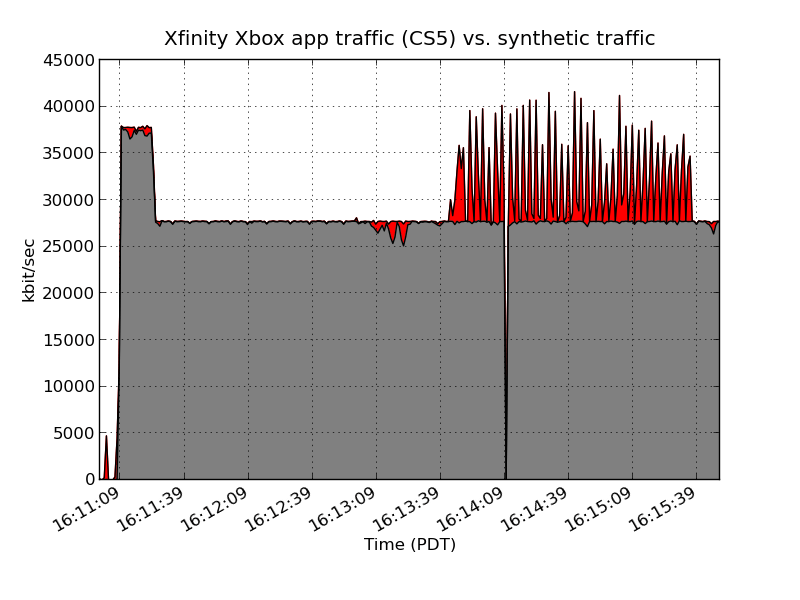
This graph shows Berg's artificially saturated 25Mbps Comcast broadband connection. The traffic in red represents Xfinity Xbox traffic, which is given such high priority, it allows Berg to exceed his usual download speed limit.

Comcast sent GigaOm a statement that denies the company is doing any such thing:

“It’s really important that we make crystal clear that we are not prioritizing our transmission of Xfinity TV content to the Xbox (as some have speculated). While DSCP markings can be used to assign traffic different priority levels, that is not their only application – and that is not what they are being used for here. It’s also important to point out that our Xfinity TV content being delivered to the Xbox is the same video subscription that customers already paid for and is delivered to their home over our traditional cable network – the difference is that we are now delivering it using IP technology to the Xbox 360, in a similar manner as other IP-based cable service providers. But this is still our traditional cable television service, which is governed by something known as Title VI of the Communications Act, and we provide the service in compliance with applicable FCC rules.”

Our View

Comcast, as usual, is talking out of every side of its mouth. In an effort to justify their unjustified usage cap, they have pretzel-twisted a novel way out of this Net Neutrality debate by paving their own digital highway on a Comcast private drive.

Comcast argues their 250GB usage cap controls last-mile congestion to provide an excellent user experience. That excuse completely evaporates in the context of its new toll-free video traffic. In fact, their earlier argument that its regionally-distributed streaming traffic should not count because it does not travel over the “public Internet” at Comcast’s expense does not even make sense.

Berg provides an example:

A FaceTime call from my house to my neighbor’s—which never leaves even the San Francisco metro area Comcast network, given that both of us are Comcast customers—goes over the “public Internet.”

Yet Comcast’s Xbox streams, which pass from Seattle to Sacramento to San Francisco through all of the same network elements that handle my video call (and then some!) are exempt from the bandwidth cap?

You can’t have it both ways, guys.

DOCSIS 3 technology has vastly expanded the last mile pipe into subscriber homes. If Comcast can launch their own private pipe for unlimited IPTV traffic that travels down the same wires their Internet service does, they can comfortably handle any additional capacity needs to support their “constrained” broadband service without the need to limit their customers’ use.

Usage caps remain an end run around Net Neutrality. Consumers given the opportunity to view content under a usage cap on the “public Internet” or using the “toll-free” traffic lane Comcast created for content from their “preferred partners” will make the obvious choice to protect their usage allowance. Comcast is certainly aware of this, and it is a clever way to discriminate through social engineering. It’s also less obvious. You don’t have to de-prioritize or block traffic from your competition to have an impact, you just have to limit it. Customers who repeatedly exceed their usage allowance face suspension of Comcast broadband service for up to one year. That’s a strong incentive to follow their rules.

Netflix is fighting to force Xfinity traffic to fall under the same arbitrary usage cap regime Netflix endures — a truly shortsighted goal. The real issue here is whether Comcast should be capping any of its Internet service.

Comcast has given us the answer, launching the very bandwidth-intense video streaming it used to decry was contributing to an Internet traffic tsunami.

It’s time for Comcast to drop its usage cap.

Broadband Money-Maker: Insights from Time Warner Cable’s Latest Financial Results

Phillip Dampier May 2, 2012 Broadband Speed, Competition, Data Caps, Online Video Comments Off on Broadband Money-Maker: Insights from Time Warner Cable’s Latest Financial Results

Highlights:

  • Company still losing video customers, but picking up phone customers (on the cheap), and winning with broadband;
  • Broadband consumption pricing still CEO’s favorite flavor of Internet billing, but only for other people’s content;
  • Broadband speed matters, as Time Warner continues to win over dissatisfied DSL customers;
  • ‘If customers love our broadband, we can charge more for it;’
  • Verizon/Time Warner’s cooperative marketing agreement starts with discounts but ends with “exclusive product enhancements.”
  • The future of Time Warner Cable Wi-Fi.

Time Warner Cable reported unexpectedly strong profits in its first quarter as the company’s broadband services helped stem the losses from departing cable TV customers.

The cable operator told investors it boosted profits 18%, mostly from increasing revenue the company earns selling broadband access to the Internet and convincing customers to add more Time Warner services.

Time Warner Cable said goodbye to 94,000 residential video subscribers last quarter, higher than analysts expected. But that did little damage to earnings because the company picked up an additional 214,000 broadband customers over the same period, most switching from phone company DSL service.

Time Warner Cable’s increasingly aggressive bundled service promotions, particularly on its triple-play offer of cable, broadband, and phone service, even managed to attract 112,000 new landline customers — a significant accomplishment as Americans continue to disconnect traditional phone lines in favor of cell phones.  It also helped increase the average revenue earned per subscriber.  Time Warner Cable pitches double play promotions as low as $79.00 a month. For just $10 a month more, customers can add a third service, and many do.

Most discounts last for one year, but the operator now often sends letters to customers reaching the end of their promotion offering additional, but lower-value discounts going forward. This has limited bill shock for customers surprised by the company’s regular prices. It also might reduce the urge for customers to shop around for a better deal.

Judging from the company’s financial results, most customers hang on to Time Warner Cable’s broadband regardless of price, if the competition happens to be traditional DSL from the phone company. In fact, as phone and cable companies realize they have sold broadband to virtually every home in their service area that wants it, growth in subscriber numbers going forward largely depends on poaching customers from someone else.  Nobody makes that easier than phone companies trying to sell customers DSL with speeds under 10Mbps.  According to CEO Glenn Britt, Time Warner Cable picked up more new broadband customers than Verizon and AT&T combined.

Time Warner Cable broadband speeds give headaches to phone companies trying to sell traditional DSL.

While phone companies continue to argue that speeds don’t matter (at least for their DSL product line), Time Warner believes otherwise and apparently so do their new customers.  The company reports that almost two-thirds of those dumping DSL said their old service was too slow.

Much of the company’s growth in broadband revenue is also coming from the high end, as customers increasingly gravitate towards faster broadband speed tiers.

Britt

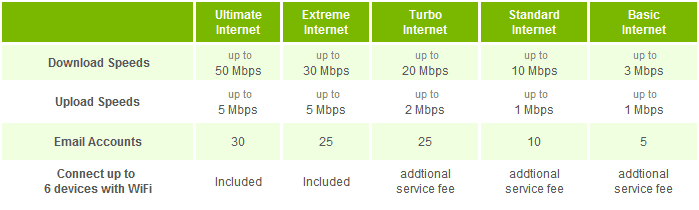
Residential DOCSIS 3 (Extreme/Ultimate) customers increased 50% to 218,000, and almost 66% of new broadband customers signed up for either Turbo (20Mbps), Extreme (30Mbps) or Ultimate (50Mbps) service.  Together, these customers now make up 20% of Time Warner’s broadband subscribers, up from less than 16% a year earlier.

Customers are willing to pay higher prices for faster service, a point not lost on Britt, who noted that once customers perceive broadband has more and more value, the company can charge more for it over time.

If Britt’s steadfast belief in Internet Overcharging-consumption billing schemes holds true, some customers might find they are charged substantially more if the company decided to discontinue offering unlimited Internet service.

For now, the company plans to continue its experiments in consumption billing through its Internet Essentials program, now testing in South Texas, which limits customers to 5GB of usage per month before overlimit fees kick in.  But going forward:

“I think we’ve been pretty clear about this, we do think over time, there will be consumption element to the tiers,” Britt said.

But Britt says he wants to keep unlimited access for customers willing to pay for it.

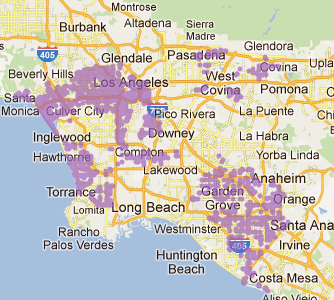
Time Warner's Hotspots in southern California.

“We retained our unlimited tier with no cap (I actually don’t like the term cap),” Britt added. “And I think we should always have that. So that this was not in any way coercive, people who wanted to save money, could. People who wanted to keep what they had have kept it, and they still have unlimited. So our plan is to roll that out further across [the country] as the year goes on.”

Britt noted the company’s own streamed video products would not drain customers’ usage allowances.  But Netflix and other online streamed video would.  Britt adopted the same argument Comcast has used to defend the practice.

“So there’s a set of standards called the IP, Internet Protocol, and those can be used for a wide variety of things in the world,” Britt explains. “There’s also something called the public Internet, which happens to use IP standards. That doesn’t mean those two things are exactly the same. So the application that we have on the iPad is over our closed-circuit network. It’s just a different standard than we’ve used traditionally for our video. But it’s not the public Internet.”

In other developments, the company’s controversial co-marketing agreement with Verizon Wireless has now expanded to four cities: Raleigh, N.C., Cincinnati and Columbus, Ohio, and Kansas City, Mo.

Time Warner Cable executives told investors the early stages of the cooperative marketing agreement will consist of a promotion that includes a $200 gift card when a customer buys both a Verizon Wireless plan and upgrades at least one service on their Time Warner Cable account.  But the company plans to gradually reduce discounts and instead offer unspecified “exclusive product enhancements” that will only be available to customers who subscribe to both services.

Lastly, expect Time Warner Cable to continue aggressive deployment of its Wi-Fi networks in New York and Los Angeles.  The company signaled it intends to construct similar Wi-Fi networks in other cities in serves, but most likely not during 2012.

New England Time Warner Cable Subs Get Free Broadband Speed Upgrade

Phillip Dampier April 26, 2012 Broadband Speed Comments Off on New England Time Warner Cable Subs Get Free Broadband Speed Upgrade

Time Warner Cable has completed its upgrade to DOCSIS 3 cable modem technology in New England and is providing its broadband subscribers a free speed increase.

Customers in Maine, Massachusetts, and New Hampshire are getting the same speeds customers in much of the rest of the northeast currently have from Time Warner:

  • Standard Service was 8Mbps/512kbps.  Now: 10/1Mbps
  • Turbo Internet was 15/1Mbps. Now: 20/2Mbps
  • Basic Internet was 1.5Mbps/256kbps. Now: 3/1Mbps

The new speeds should already be in place for all customers.  Readers not receiving them can try unplugging their cable modem and then plugging it back in to reset the equipment.

The company’s DOCSIS 3-specific products: Extreme Interest (30/5Mbps) and Ultimate Internet (50/5Mbps) are also now available for purchase.

Time Warner DOCSIS 3 technology is now in place across 76 percent of its nationwide service area.

Search This Site:

Contributions:

Recent Comments:

Your Account:

Stop the Cap!