Home » customer satisfaction » Recent Articles:

The 5 Cable & Phone Companies Intentionally Sabotaging Your Use of the Internet

Phillip Dampier May 6, 2014 AT&T, Broadband "Shortage", Broadband Speed, Charter Spectrum, Comcast/Xfinity, Competition, Consumer News, Cox, Net Neutrality, Online Video, Verizon Comments Off on The 5 Cable & Phone Companies Intentionally Sabotaging Your Use of the Internet
network_map-1024x459

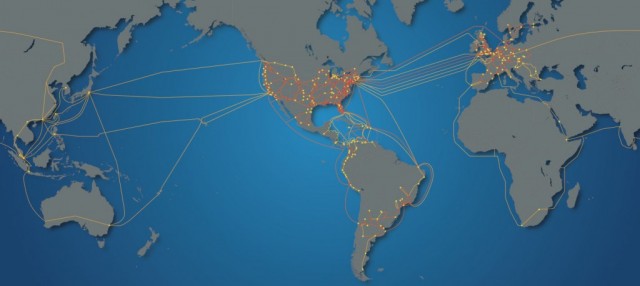
Level 3’s global network: Orange lines represent Level 3-owned infrastructure, yellow lines show leased or co-owned connections.

Five of the largest Internet Service Providers in the country are intentionally sabotaging your use of the Internet by allowing their network connections to degrade unless they receive extra compensation from content companies they often directly compete with.

Mark Taylor, vice president of content and media for Level 3, wrote a lengthy primer on how Internet providers exchange traffic with each other across a vast global network. While clients of Level 3 are likely to have few problems exchanging traffic back and forth across Level 3’s global network, vital interconnections with other providers that make sure everyone can communicate with everyone else on the Internet are occasional trouble spots.

Every provider has different options to reach other providers, but favor those offering the most direct route possible to minimize “hops” between networks, which slow down the connection and increase the risk of service interruptions. These connections are often arranged through peering agreements. Level 3 has 51 peers, minimized in number to keep traffic moving as efficiently as possible.

This oversaturated port in Dallas cannot handle all the traffic trying to pass through it, so Internet packets are often dropped and traffic speeds are slowed.

This oversaturated port in Dallas cannot handle all the traffic trying to pass through it, so Internet packets are often dropped and traffic speeds are slowed.

Taylor writes most peering arrangements were informal agreements between engineers and did not involve any money changing hands. Today, 48 of the 51 Level 3 peering agreements don’t involve compensation. In fact, Level 3 refuses to pay “arbitrary charges to add interconnection capacity.” Taylor feels such upgrades are a matter of routine and are not costly for either party.

Peering agreements have been a very successful part of the Internet experience, even if end users remain completely in the dark about how Internet traffic moves around the world. In the view of many, customers don’t need to know and shouldn’t care, because their monthly Internet bill more than covers the cost of transporting data back and forth.

Because of ongoing upgrades the average utilization of Level 3’s connections is around 36 percent of capacity — busy enough to justify keeping the connection and providing spare capacity for days when Internet traffic explodes during breaking news or over the holidays.
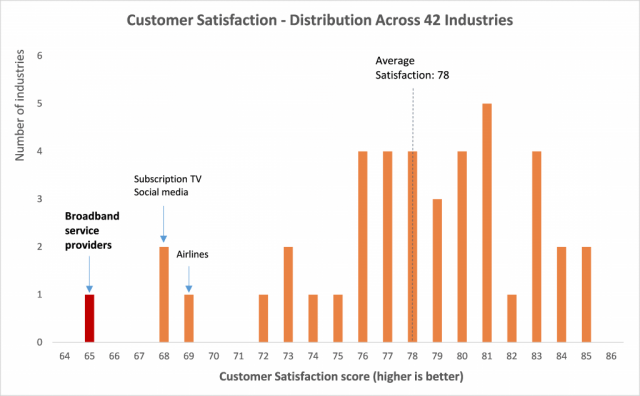
csat-1024x635However, Taylor says more than a year ago, something suddenly changed at five U.S. Internet Service Providers. They stopped periodic upgrades and allowed some of their connections to become increasingly busy with traffic. Today, six of Level 3’s 51 peer connections are now 90 percent saturated with traffic for several hours a day, which causes traffic to degrade or get lost.

“[The] congestion [has become] permanent, has been in place for well over a year and […] our peer refuses to augment capacity,” Taylor wrote. “They are deliberately harming the service they deliver to their paying customers. They are not allowing us to fulfill the requests their customers make for content.”

Taylor adds all but one of the affected connections are U.S. consumer broadband networks with a dominant or exclusive market share. Where competition exists, no provider allows their Internet connections to degrade, said Taylor.

Taylor won’t directly name the offenders, but he left an easy-to-follow trail:

“The companies with the congested peering interconnects also happen to rank dead last in customer satisfaction across all industries in the U.S.,” Taylor wrote. “Not only dead last, but by a massive statistical margin of almost three standard deviations.”

Taylor footnotes the source for his rankings, the American Consumer Satisfaction Index. The five worse providers listed for consumer satisfaction:

  • Comcast
  • Time Warner Cable
  • Charter Communications
  • Cox Communications
  • Verizon

AT&T has also made noises about insisting on compensation for its own network upgrades, blaming Netflix traffic.

level3In fact, Netflix traffic seems to be a common point of contention among Internet Service Providers that also sell their own television packages. They now insist the streaming video provider establish direct, paid connections with their networks. Level 3 is affected because it carries a substantial amount of traffic on behalf of Netflix.

Ultimately, the debate is about who pays for network upgrades to keep up with traffic growth. Taylor says Level 3’s cost to add an extra 10Gbps port would be between $10-20 thousand dollars, spare change for multi-billion dollar Americans cable and phone companies. Normally, competition would never allow a traffic dispute like this interfere with a customer’s usage experience. Angry customers would simply switch providers. But the lack of competition prevents this from happening in the United States, leaving customers in the middle.

This leaves Taylor with a question: “Shouldn’t a broadband consumer network with near monopoly control over their customers be expected, if not obligated, to deliver a better experience than this?”


Comcast’s Festival of Nonsense Performed for Senate Judiciary Committee

Phillip "The circus is in town" Dampier

Phillip “The circus is in town” Dampier

Yesterday afternoon I got to experience both the pain of having a tooth pulled and watch Comcast and Time Warner Cable defend its merger for more than three hours before the Senate Judiciary Committee. The Festival of Nonsense from Comcast’s top lobbyist David Cohen and Time Warner Cable’s chief financial officer Arthur Minson hurt more.

Despite the $45 billion dollar deal, the real powers that be couldn’t be bothered to turn up at the hearing. Comcast’s chief executive was nowhere to be found — perhaps he was playing golf with President Obama again. Comcast’s top lobbyist David Cohen showed up instead, wearing an outfit that looked like it was stuffed with cash waiting to fall from his pockets into the hands of his “friends” on Capitol Hill. Cohen is a well-known Democratic money bundler who raised $1.44 million for the president’s reelection campaign in 2011 and 2012, and $2.22 million since 2007. (Obama spent time in Cohen’s Philadelphia home as well, part of a DNC fundraising party.)

Perhaps Time Warner Cable CEO Robert Marcus was unavailable because he was too busy counting the $8.52 million he was paid before agreeing to sell the company. Don’t expect him at the next hearing either, because he is shopping for a bigger safe to hold the $80 million he will receive for agreeing to change Time Warner Cable’s name to Comcast.

The other usual suspects were also missing in action. Not a peep from the major networks or cable programmers at the hearing. Instead, the Senate endured a guy with a golf channel nobody ever heard of using the hearing to try to get his calls returned by Time Warner and a wireless provider who believes his technology is faster than fiber. Sure it is.

Brought to you in part by America's cable industry.

Brought to you in part by America’s cable industry.

I suppose it’s also worth mentioning Christopher Yoo – Comcast’s intellectual sock puppet straight out of the cable company’s home town of Philadelphia. He serves at the pleasure of the “Center for Technology, Innovation & Competition” (cough) at the University of Pennsylvania. The “center” is financially supported by the cable industry. David Cohen just happens (by sheer coincidence) to chair the university’s Board of Trustees. Yoo’s testimony could be boiled down to a nod in Cohen’s direction with an affirming, “whatever he said.”

The Cohen and Minson Comedy Hour began with opening statements extolling the virtues of supersizing Comzilla, with dubious claims about its benefits for consumers.

Without laughing, read the following out loud:

“We welcome this opportunity to discuss the proposed transaction between Comcast Corporation (“Comcast”) and Time Warner Cable Inc. (“TWC”), and the substantial and multiple pro-consumer, pro-competitive, and public interest benefits that it will generate, including through competitive entry in segments neither company today can meaningfully serve on its own,” the two companies wrote in their joint opening statement.

Cohen

Cohen

“Comcast and TWC do not compete for customers in any market – either for broadband, video, or voice services. The transaction will not reduce competition or consumer choice at all. Comcast and TWC serve separate and distinct geographic areas. This simple but critically important fact has been lost on many who would criticize our transaction, but it cannot be ignored – competition simply will not be reduced. Rather, the transaction will enhance competition in key market segments, including advanced business services and advertising.”

To emphasize just how little this merger will impact the current state of non-competition in the broadband marketplace, Comcast repeatedly emphasized you can’t subscribe to a competing cable company today and still won’t tomorrow:

“Consumers in Comcast’s territories cannot subscribe to TWC for broadband, video, or phone services. And TWC customers cannot switch to Comcast. For that reason, this is not a horizontal transaction under merger review standards, and there will be no reduction in competition or consumer choice,” said the written statement.

In other words, since there was no competition between cable companies before, making sure consumers still don’t have a choice is not anti-competitive.

Watch the entire hearing on the Senate Judiciary Committee website.

(The hearing begins at the 24 minute mark.)

Here are some other “benefits” promised by Cohen and Minson:

Post-transaction, Comcast intends to make substantial incremental upgrades to TWC’s systems to migrate them to all-digital, freeing up bandwidth to deliver greater speeds. For example, Comcast typically bonds 8 QAM channels together in its systems, and Comcast’s most popular broadband service tier offers speeds of 25/5Mbps upstream across its footprint. In comparison, TWC bonds 4 QAM channels in nearly half of its systems, and its most commonly purchased service tier offers speeds of 15/1Mbps. Comcast’s fastest residential broadband tier offers speeds of 505/100Mbps; TWC’s current top speeds are 100/5Mbps. Comcast’s investments in the TWC systems will also improve network reliability, network security, and convenience to TWC customers.

Minson

Minson

Of course, nothing prevented either company from boosting speeds without a $45 billion merger deal. In fact, Comcast is doing exactly that this week. Marcus’ own revival plan for TWC, dubbed TWC Maxx, promised Time Warner Cable customers would get even faster speeds than Comcast offers most of its customers.

Time Warner Cable now advertises it does not have usage caps on broadband. Comcast cannot say the same, although it tries very hard to tapdance around the matter by calling the 300GB monthly cap spreading into more and more Comcast territories a “data threshold.”

Comcast’s speed upgrades for TWC customers are likely to come with a big catch — an arbitrary usage allowance that limits their usefulness. By the way, that 505Mbps service is available only from Comcast’s extremely limited fiber network that the overwhelming majority of customers cannot get.

The transaction will similarly speed the availability of advanced Wi-Fi equipment in consumers’ homes. The quality of broadband service depends not only on the “last-mile” infrastructure but also the delivery of the signal over the last few yards. Comcast has led the entire broadband industry in rolling out advanced gateway Wi-Fi routers to approximately 8 million households and small businesses, giving these customers faster speeds (up to 270 Mbps downstream as compared to 85 Mbps downstream from the prior generation devices) and better performance over their home and business wireless networks. In contrast, TWC only recently began deploying advanced in-home Wi-Fi routers. With the greater purchasing power and economies of scale resulting from the transaction, Comcast can not only offer TWC customers access to today’s best routers, but also invest in and deploy next-generation router technologies for all of the combined company’s customers.

comcast twcComcast doesn’t like to mention that “advanced Wi-Fi” equipment costs customers $8 a month… forever. Comcast is also using it to boost its own Wi-Fi service by sharing it with the neighbors. This merger “benefit” will cost customers almost $100 a year. Customers can do better buying their own equipment and don’t need a merger to make that decision.

The transaction will give Comcast the geographic reach, economies of scale, customer density, and return on investment needed to massively expand Wi-Fi hotspots across the combined company’s footprint, including in the Midwest, South, and West, particularly in areas like Cleveland/Pittsburgh, the Carolinas, Texas, and California, where there will be greater density and clustering of systems. Our goal is to provide greater Wi-Fi availability that allows the combined company’s customers to access the Internet in more places, more conveniently, and at no additional charge.

Your usage allowance will likely apply to this “free Wi-Fi” that most customers cannot access because they live in an area where neither company offers it now and likely won’t anytime soon.

The transaction will also enable Comcast to invest in network expansions and last-mile improvements that provide an even stronger foundation for innovative applications, including education, healthcare, the delivery of government services, and home security and energy management. And with greater coverage and density of systems, Comcast will also have the ability and incentive to build out and make available interconnection points in more geographic regions. This will be especially beneficial to companies like Google, Netflix, and Amazon, which aggregate massive data traffic when they deliver their own and others’ services to consumers.

internet essentialsFor the right price. Nothing precluded Comcast or Time Warner Cable from investing some of their lush profits into improvements for customers. But why bother when your only serious competitor is usually DSL. Investment in broadband networks has declined for years in favor of profit-taking. Making Comcast bigger introduces no new market forces that would provoke it to improve service. In fact, Comcast’s massive size and reach would likely deter would-be competitors from entering a market where Comcast can use predatory pricing and retention offers to keep customers from switching.


Helping people successfully cross the digital divide requires ongoing outreach. To increase awareness of the Internet Essentials program, Comcast has made significant and sustained efforts within local communities. To date, those outreach efforts have included:

  • Distributing over 33 million free brochures to school districts and community partners for (available in 14 different languages).
  • Broadcasting more than 3.6 million public service announcements with a combined value of nearly $48 million.
  • Forging more than 8,000 partnerships with community-based organizations, government agencies, and elected officials at all levels of government.

Cohen does not mention the company planned to offer Internet Essentials earlier than it did, but held it back for political reasons.

“I held back because I knew it may be the type of voluntary commitment that would be attractive to the chairman” of the Federal Communications Commission, Cohen said in a 2012 interview. Comcast’s generosity was limited. It specifically designed its discount Internet program to make it difficult to qualify and protect its regular-priced broadband offerings. The goodwill from handing out Comcast sales brochures and getting free exposure in the media offers little to customers. Comcast also has a way of getting the community-based organizations it “partners” with to advocate for Comcast’s business interests.

"Sometimes we need a kick in the butt." -- Cohen

“Sometimes we need a kick in the butt.” — Cohen

If only the government got out of the way and approve the merger, Comcast will improve on its already amazing customer service:

Improving the customer experience is a top priority at Comcast. We are investing billions of dollars in our network infrastructure and are developing innovative products and features to make it easier and more convenient for our customers to interact with us. While our satisfaction results are beginning to rise, we know we still have work to do and are laser-focused on continuing to improve our customers’ experiences in a number of ways.  Comcast has improved its customer satisfaction ratings significantly. Since 2010, Comcast has increased its J.D. Power’s Overall Satisfaction score by nearly 100 points as a video provider, and close to 80 points in High Speed Data – more than any other provider in our industry during the same period.

Twice nothing is still nothing. Cohen even admitted at the hearing Comcast’s progress at improving customer service is not as rosy as his written testimony might suggest.

“It bothers us we have so much trouble delivering high quality of service to customers on a regular basis,” Cohen said. “Sometimes, we need a kick in the butt.”

That has never worked before. Comcast has kicked its customers around since at least 2007 when it also promised major customer service improvements that turned out to be figments of a press release. Comcast’s “laser-focused” efforts to improve instead won it the 2014 Consumerist Worst Company in America award this week and more than 100,000 consumers signing petitions vehemently opposing the merger.

Comcast has a long record of improving consumers’ online experiences and working cooperatively with other companies on interconnection, peering and transit.

bufferingJust ask any Comcast customer about their Netflix viewing experience lately and how it took a checkbook to improve matters. Ask any online video competitor whether Comcast is a good neighbor when it exempts its own video traffic from its “usage threshold” while making sure to count competitors’ traffic against it.

Comcast also likes to suggest Americans are awash in competitive options for broadband service. Why there is DSL, satellite broadband, fiber, wireless Internet, public libraries, and books.

In fact, Comcast’s filing points to various “competitors” that don’t even exist yet, if they ever will. Comcast suggests Google Fiber is popping up everywhere, despite the fact Google announced it was delaying its fiber rollout in Austin, and most of its latest expansion plans lack firm commitments to deploy and are framed only in the context of opening a dialogue with targeted communities.

Satellite Internet speeds are severely limited and usage-capped. The same is true for exorbitantly expensive mobile broadband. Comparing a $40 unlimited broadband offering from Time Warner Cable to Verizon Wireless’ 4GB for $50 mobile wireless Internet package is silly.

Comcast characterizes the competitive telecom marketplace as a veritable dogfight, but it looks a lot more like a well-executed dog and pony show. Just how rabid are these dogs?

  • Verizon’s pit bull zeal to compete has more bark than bite. Verizon Wireless customers can sign up for Comcast or Time Warner Cable service in Verizon stores (woof);
  • Comcast’s rottweiler isn’t supposed to get along well with others, but it manages pretty well pitching Verizon Wireless service (grrr).

An hour into the hearing, it was clear there was some bipartisan discomfort with the merger, with Sen. Al Franken (D-Minn.) leading the charge with pointed questions cutting through Comcast’s government relations fluff.

“I’m against this deal,” Franken concluded. “My concern is that as Comcast continues to get bigger, you’ll have even more power to exercise that leverage — to squeeze consumers.”

Like an orange.

Time Warner Cable, Comcast Crash, Burn in Consumer Reports’ 2014 Ratings

consumer reportsDespite claims of improved customer service and better broadband, Comcast and Time Warner Cable’s customer satisfaction scores are in near-free fall in the latest Consumer Reports National Research Center’s survey of consumers about their experiences with television and Internet services.
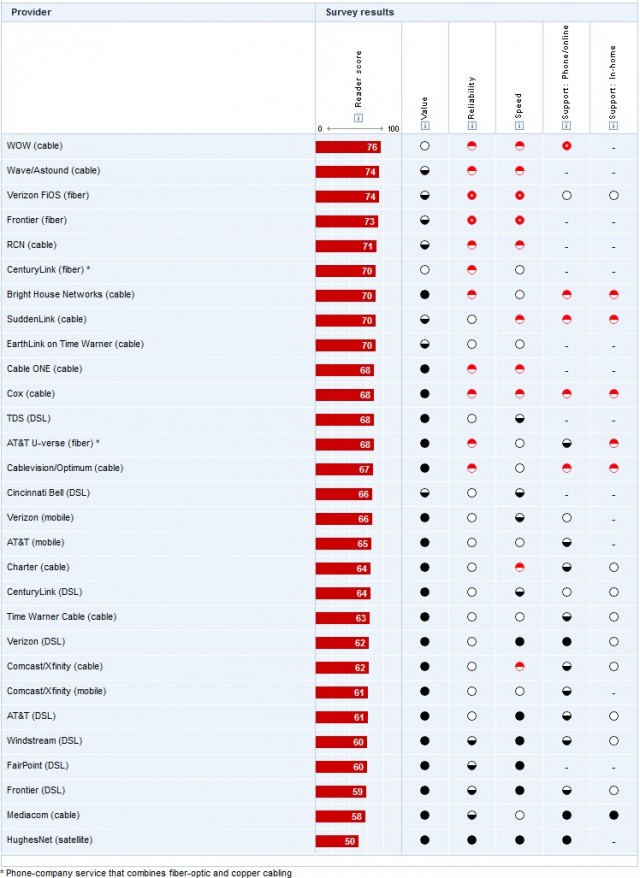


Although never popular with customers, both cable operators plummeted in the 2014 Consumer Reports ratings — Time Warner Cable is now only marginally above the perennial consumer disaster that is Mediacom. Comcast performs only slightly better.

In the view of Consumers Union, this provides ample evidence that two wrongs never make a right.

“Both Comcast and Time Warner Cable rank very poorly with consumers when it comes to value for the money and have earned low ratings for customer support,” said Delara Derakhshani.  “A merger combining these two huge companies would give Comcast even greater control over the cable and broadband Internet markets, leading to higher prices, fewer choices, and worse customer service for consumers.”

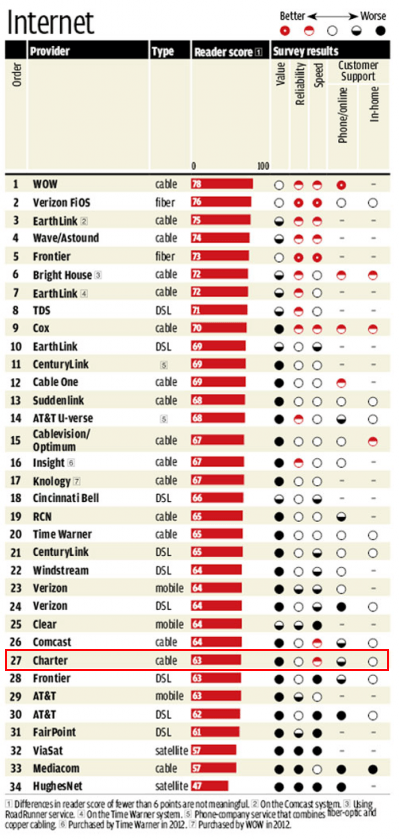
These ratings reflect Internet service only.

These ratings reflect Internet service only.

Comcast ranked 15th among 17 television service providers included in the ratings and earned particularly low marks from consumers for value for the money and customer support.  Time Warner ranked 16th overall for television service with particularly low ratings for value, reliability, and phone/online customer support.

Another ratings collapse for Comcast and Time Warner Cable

Another ratings collapse for Comcast and Time Warner Cable

Comcast and Time Warner Cable were mediocre on overall satisfaction with Internet service.  Both companies received especially poor marks for value and low ratings for phone/online customer support.

“In an industry with a terrible track record with consumers, these two companies are among the worst when it comes to providing good value for the money,” said Derakhshani.  “The FCC and Department of Justice should stand with consumers and oppose this merger.”

For as long as Stop the Cap! has published, Mediacom has always achieved bottom of the barrel ratings, with satellite fraudband provider HughesNet — the choice of the truly desperate — scoring dead last for Internet service. We’re accustomed to seeing the usual bottom-raters like Frontier (DSL), Windstream (DSL), and FairPoint (DSL) on the south end of the list. But now both Comcast and Time Warner Cable have moved into the same seedy neighborhood of expensive and lousy service. Comcast couldn’t even beat the ratings for Verizon’s DSL service, which is now barely marketed at all. Time Warner Cable scored lower than CenturyLink’s DSL.

Breathing an ever-so-slight sigh of relief this year is Charter Communications, which used to compete with Mediacom for customer raspberries. It ‘rocketed up’ to 18th place.

If you want top-notch broadband service, you need to remember only one word: fiber. It’s the magical optical cable phone and cable companies keep claiming they have but largely don’t (except for Verizon and Cincinnati Bell, among a select few). If you have fiber to the home broadband, you are very happy again this year. If you are served by an independent cable company that threw away the book on customer abuse, you are relieved. Topping the ratings again this year among all cable operators is WOW!, which has a legendary reputation for customer service. Wave/Astound is in second place. Verizon and Frontier FiOS customers stay pleased, and even those signed up with Bright House Networks and Suddenlink report improved service.

Ratings are based on responses from 81,848 Consumer Reports readers. Once again they plainly expose Americans are not happy with their telecom options. The average cost of home communications measured by the Mintel Group is now $154 a month — $1,848 a year. That’s more expensive than the average homeowner’s clothing, furniture or electricity budget. The same issues driving the bad ratings last year are still there in 2014: shoveling TV channels at customers they don’t want or need, imposing sneaky new fees along with broad-based rate increases every year, low value for money, and customer service departments staffed by the Don’t Care Bears.

Time Warner Cable Tells Charter Cable to Get Lost; War of Words Ensues

analysisTime Warner Cable executives brushed away Charter Communications’ first public offer to acquire the second largest cable company in the country in a debt-financed deal that Time Warner considers a lowball offer.

“[Charter’s] proposal is grossly inadequate,” Time Warner Cable said in a statement. “We are confident in our standalone plan and we are not going to let Charter steal the company.”

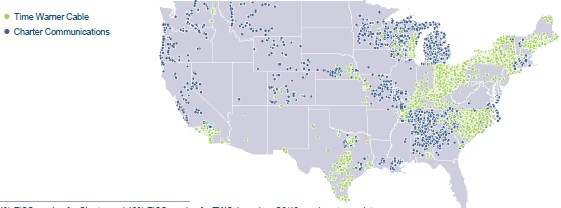
Charter;s new service areas, if they win Time Warner Cable.

Charter’s combined service areas, if they win control of Time Warner Cable.

On Tuesday, Charter violated a long-standing, informal Code of the Cable Cartel that keeps cable companies from attacking each other.

twc charterCharter Communications chief operating officer John Bickham launched an investor presentation that trashed Time Warner Cable and its leadership, and contended fixing the cable company will take more work than first envisioned.

Bickham claimed Time Warner has exhibited a decade of a “failed operating strategy revealed by fact that they are losing customers at an alarming rate,” while Charter has a proven track record of performance.

Bickham

Bickham

Historians recollect Charter’s recent past differently. In 2009, mired in debt and lacking a disciplined business plan, Charter declared Chapter 11 bankruptcy, wiping out shareholders and stiffing creditors.

Bickham capitalized on Time Warner’s 2013 summer of discontent, when a dispute with CBS resulted in the loss of the network from Time Warner Cable lineups (along with Showtime) in some of the biggest cities in the country. Combined with rate increases, subscribers began switching to the competition, especially where Verizon FiOS and AT&T U-verse gives cable operators stiff competition from money-saving new customer promotions.

Bickham described TWC as a company in shambles:

On Time Warner Cable TV: “It appears that Time Warner didn’t want to spend the money to go all-digital,” adding that the quality of TWC’s TV signal is poor and the company still lacks enough HD channels that could have been on the lineup if the cable company dropped analog service long ago.

On Time Warner Cable Internet: Bickham complained Time Warner is offering deep discounts on slow Internet packages, particularly its campaign targeting DSL customers with 2Mbps service for $14.99 a month. Bickham complains the large variety of Internet speed tiers are unnecessary, resulting in “nickel-and-dime charges to customers.” He argues Time Warner needs to simplify its offering by adopting a digital lineup and boost Internet speeds, so customers get at least 30Mbps service. Bickham did not mention Charter Communications also has a usage cap on its broadband products. TWC does not on most offerings.

On Time Warner Cable employees: “TWC never had a vision on high standards” for how the company manages its 50,000 employees. Bickham feels the workmanship of TWC installers leaves a lot to be desired.

[flv]http://www.phillipdampier.com/video/Bloomberg Time Warner Cable Rejects Charter Offer 1-15-14.flv[/flv]

Time Warner Cable rejected an acquisition offer from Charter Communications valued at more than $61 billion including debt, spurning the biggest unsolicited takeover bid since 2008. Manus Cranny examines why the offer was rejected on Bloomberg Television’s “Countdown.” (2:06)

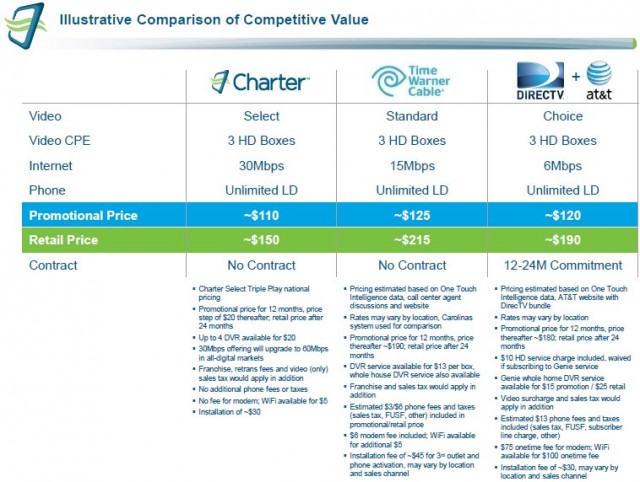
Charter's price comparison chart for the benefit of Time Warner Cable shareholders lacks accuracy. Virtually nobody has to pay TWC's quoted retail rates and the chart assumes worst-case pricing for TWC customers, while also ignoring Charter's very high customer dissatisfaction score.

Charter’s proposed price comparison chart, produced for the benefit of Time Warner Cable shareholders, assumes worst-case pricing almost no Time Warner Cable customer actually has to pay.

Charter is America's second worst rated cable company. (Consumer Reports, 2013)

Charter is America’s second worst rated cable company. (Consumer Reports, 2013)

On its face, Charter’s plan for Time Warner Cable doesn’t look all bad, but execution is critical and Charter has a long-standing and very poor record of customer satisfaction, typically ranked in consumer surveys as America’s second worst cable operator year after year.

Should Charter win control of Time Warner Cable, big changes will be in store for TWC customers under the Charter umbrella:

  • Analog television would be phased out, along with “limited basic” packages. Charter wants to repurpose analog spectrum for faster Internet speeds, but that also means video customers will be required to get more set-top boxes;
  • Eliminate “Switched Digital Video” technology now in place on TWC systems. SDV is a bandwidth saver – only delivering digital TV signals customers in a particular neighborhood are actively watching. But those using inexpensive digital-to-analog set-top boxes on analog-only televisions can’t watch SDV channels, inconveniencing customers;
  • Increase the number of HD channels to 200+;
  • All residential set-top boxes would now support HD signals at no added cost and customers will be able to get up to four DVR boxes for $20 a month;
  • Time Warner Cable’s new minimum Internet speed would be 30Mbps with much faster added-cost tiers available, but usage caps will apply;
  • Time Warner Cable’s phone product would be repriced at $30 a month in the first year, $20 in the second with all calling features and voicemail included;
  • No term contracts will be offered and modem rental fees, regulatory surcharges, added taxes on Internet and Phone, and service visit fees will no longer be charged.

Charter customers can expect aggressive sales pitches for their “high value” triple-play bundle which may include services customers don’t want at a price that is largely non-negotiable. The more boxes and services you add, the greater the discount you will receive. In contrast, Time Warner Cable began de-emphasizing its triple play promotions in early 2012 and now aggressively promotes single and double play packages that typically omit phone service.

Unlike TWC, Charter has been more difficult when trying to negotiate customer retention discounts. Charter generally charges the same prices everywhere.

Their proposed offer for Time Warner customers will be a triple play offer starting at $110 a month for the first 12 months, then increase $20 in the second year to $130 a month and in year three the price will rise again to $150 a month. Charter’s typical “step-up” pricing is in $20 increments.

Charter is reluctant to allow customers to add or drop package components, so for most customers packages will be all-inclusive with no discounts for dropping channels or features. That means customers will likely end up with more television channels, more phone features, and faster Internet speeds, but at the cost of an eventually higher cable bill.

Any buyout could also mean some Time Warner Cable territories could be put up for sale to a third-party. Charter is especially interested in the New York and Los Angeles markets, but may have little interest in western New York and Ohio, New England, Kentucky and Wisconsin. Any orphaned TWC customers would likely be snapped up by companies like Comcast, which may join Charter’s takeover bid.

Any sale would need approval by the Federal Communications Commission and potentially the Justice Department’s Antitrust Division, especially in Comcast becomes involved.

[flv]http://www.phillipdampier.com/video/CNBC Tom Rutledge Explains Charter Offer for TWC 1-15-14.mp4[/flv]

Time Warner Cable rejected a merger proposal from Charter Communications. Tom Rutledge, Charter Communications president and CEO, explains the offer as he describes as “rich and fair.” We feel like we’ve come a far way and have not received a serious response, Rutledge says. A CNBC exclusive. (4:35)

US & Canada Agree: Our Internet Providers Are Bad for Us and We’re Falling Behind

Phillip Dampier January 15, 2014 Audio, Broadband Speed, Canada, Community Networks, Competition, Consumer News, Data Caps, Editorial & Site News, Public Policy & Gov't, Rural Broadband, Wireless Broadband Comments Off on US & Canada Agree: Our Internet Providers Are Bad for Us and We’re Falling Behind
Phillip "Free Trade in Bad Broadband" Dampier

Phillip “Free Trade in Bad Broadband” Dampier

Sure we’ve had our cultural skirmishes in the past,  but on one thing we can all mostly agree: our largest cable, phone, and broadband providers generally suck.

Outside of hockey season, Canada’s national pastime is hating Bell, Rogers, Vidéotron, Telus, and Shaw. The chorus of complaints is unending on overbilling, bundling of dozens of channels almost nobody watches but everybody pays for, outrageous long-term contracts, and bloodsucking Internet overlimit fees. In fact, dissatisfaction is so pervasive, the Conservative government of Stephen Harper spent this past summer waving shiny keys of distraction promising Canadians telecom relief while hoping voters didn’t notice their tax dollars were being spent by the country’s national security apparatus to spy on Brazil for big energy companies.

The Montreal Gazette is now collecting horror stories about dreadful service, mysterious price hikes, and promised credits gone missing on behalf of readers fed up with Bell and Vidéotron.

Rogers Cable, always thoughtful and pleasant, punished a Ottawa man coping with multiple sclerosis and cancer with a $1,288 bill, quickly turned over to a collection agency after his home burned to the ground. It took headlines spread across Ontario newspapers to get the cable company to relent.

Things are no better in the United States where the American Customer Satisfaction Index rates telecom companies worse than the post office, health insurers airlines, and the bird flu. National Public Radio opened the floodgates when it asked listeners to rate their personal satisfaction with their Internet Service Provider — almost always the local cable or telephone company.

The phone company Canadians love to hate.

The phone company Canadians love to hate.

Many responded their Internet access is horribly slow, often goes out, and is hugely overpriced. In response, the cable industry’s hack-in-chief did little more than shrug his shoulders — knowing full well American broadband exists in a cozy monopoly or duopoly in most American cities.

Breann Neal of Hudson, Ill., told NPR she has one choice — DSL, which is much slower than advertised. Hudson is Frontier Communications country, and it is a comfortable area to serve because local cable competition from Mediacom, America’s worst cable company, is miles away from Neal’s home.

“There’s no incentive for them to make it better for us because we’re still paying them every month … and there’s no competition,” Neal says.

Samantha Laws, who gets her Internet through her cable provider, says she also only has one option.

“It goes out at least once a day, and it’s been getting worse the last few months,” Laws says. She works with a pet-sitting company that handles all of its scheduling through email and the company website. At times she can’t do her job because of the unreliable connection.

Chicago is in Comcast’s territory and the company is quite comfortable cashing your check while AT&T takes its sweet time launching U-verse in the Windy City. AT&T isn’t about to throw money at improving DSL while local residents wait for U-verse and Comcast doesn’t need to spend a lot in Chicago when the alternative is AT&T.

comcast sucksWhere there is no disruptive new player in town to shake things up, there is little incentive to speed broadband service up. But there is plenty of room to keep increasing prices for a service that is becoming as important as a working telephone. Companies are using broadband profits to cover increasing losses from pay television service, investing in stock buybacks, paying dividends to shareholders, or just putting the money in a bank, often offshore.


NPR’s All Things Considered:

“[For] at least 77 percent of the country, your only choice for a high-capacity, high-speed Internet connection is your local cable monopoly,” says Susan Crawford, a visiting professor at Harvard Law School. She is also the author of Captive Audience: The Telecom Industry and Monopoly Power in the New Gilded Age.

Crawford says that today’s high-speed Internet infrastructure is equivalent to when the railroad lines were controlled by a very few moguls who divided up the country between themselves and gouged everybody on prices.

She says the U.S. has fallen behind other countries in providing broadband. At best, Crawford says, the U.S. is at the middle of the pack and is far below many countries when it comes to fiber optic penetration. Given that the Internet was developed in the U.S., she says the gap is a result of failures in policy.

“These major infrastructure businesses aren’t like other market businesses,” Crawford says. “It is very expensive to install them in the first place, and then they build up enormous barriers of entry around them. It really doesn’t make sense to try to compete with a player like Comcast or Time Warner Cable.”

So Crawford is calling for is a major public works projects to install fiber optic infrastructure — a public grid that private companies could then use to deliver Internet service.

Powell

Powell

That’s an idea met with hand-wringing and concern-trolling Revolving Door Olympian Michael Powell, who made his way from former chairman of the Federal Communications Commission during the first term of George W. Bush’s administration straight into the arms of Big Cable as president of their national trade association, the NCTA.

Powell, well compensated in his new role representing the cable industry, wants Americans to consider wireless 3G and 4G broadband (with usage caps as low as a few hundred megabytes per month) equivalent competitors to the local cable and phone company.

“I think to exclude [wireless] as a substitutable, competitive alternative is an error that leads you to believe the market is substantially more concentrated that it actually is,” Powell says.

Of course, Powell’s new career includes a paycheck large enough to afford the wireless data bills that would shock the rest of us. All that money also apparently blinds him to the reality the two largest wireless providers in America are AT&T and Verizon — the same two companies that are part of the duopoly in wired broadband. It’s even worse in Canada, where Rogers, Bell, and Telus dominate wired and wireless broadband.

Although America isn’t even close to having the fastest broadband speeds, Powell wants you to know the speeds you do get are good enough.

“I think taking a snapshot and declaring us as somehow dangerously falling behind is just not substantiated by the data,” he says. He says it is like taking a snapshot of speed skaters, where there might be a few seconds separating the leaders, but no one is “meaningfully out of the race.”

last placeThat is why we still celebrate and honor Svetlana Radkevich from Belarus who competed in the speed skating competition at the Vancouver 2010 Winter Olympics. She made it to the finish line and ranked 33rd. Ironically, South Korea ranked fastest overall that year, taking home three gold and two silver medals. In Powell’s world, that’s a distinction without much difference. You don’t need South Korean speed and gold medals when Belarus is enough. That argument always plays well in the United States, where Americans can choose between Amtrak or an airline for a long distance trip. Who needs a non-stop flight when a leisurely train ride will get you there… eventually.

There are a handful of providers uncomfortable with the mediocre broadband slow lane. Google is among them. So are community broadband providers installing fiber broadband and delivering gigabit Internet speeds. EPB in Chattanooga is among them, and it has already made a difference for that city’s digital economy neither AT&T or Comcast could deliver.

Unsurprisingly, Powell thinks community broadband is a really bad idea because private companies are already delivering broadband service — while laughing all the way to the bank.

If a community really wants gold medal broadband, Powell says, they should be able to have it. But Powell conveniently forgets to mention NCTA’s largest members, including Comcast and Time Warner Cable, spend millions lobbying federal and state governments to make publicly owned broadband illegal. After all, cable companies know what is best.

All Things Considered recently asked its fans on Facebook, “How satisfied are you with your Internet service provider?” Many responded that they didn’t like their Internet service, that it often goes out and that their connection was often “painfully slow.” Listen to the full report first aired Jan. 11, 2014. (11:30)
You must remain on this page to hear the clip, or you can download the clip and listen later.

Search This Site:

Contributions:

Recent Comments:

Your Account:

Stop the Cap!