Home » copper wiring » Recent Articles:

AT&T’s Magic Fiber Fairy is Back: Fiber for All (If You Approve Our DirecTV Buyout and Ignore Our Math)

Notice the word "may"

AT&T’s Magic Fiber Fairy brings fiber to you, if you approve AT&T’s business agenda.

If it wins approval from regulators to buy satellite TV provider DirecTV, AT&T says it will have enough money to afford to expand its gigabit fiber network Gigapower U-verse to an extra two million homes.

That bit of non-sequitur was the highlight of AT&T’s regulatory filing with the Securities and Exchange Commission. AT&T claims money for the fiber expansion will come from anticipated savings from programming volume discounts AT&T will get combining DirecTV’s 20.3 million customers with AT&T’s 5.7 million U-verse TV subscribers.

AT&T expects cost synergies to exceed $1.6 billion annual run-rate by three years after closing.  These savings will begin in the first year after closing, ramp up over four years and grow with the addition of video subscribers thereafter.  It is anticipated that at least 40% of these total synergies will be realized by year two after closing.  These synergies are conservative and derived from items such as programming cost reductions, operational efficiencies and reductions in redundant broadcast infrastructure.  Programming cost reductions are the most significant part of the expected cost synergies.  At this time, AT&T’s U-verse content costs represent approximately 60% of its subscriber video revenues.  With the scale this transaction provides, we estimate AT&T’s U-verse content costs after the completion of the transaction will be reduced by approximately 20% or more as compared with our forecasted standalone content costs.

AT&T believes that despite perennially increasing programming costs, especially for popular over-the-air and cable networks, the 20 percent of anticipated savings will give AT&T enough money to vastly expand its fiber network.

“The economics of this transaction will allow the combined company to upgrade two million additional locations to high-speed broadband with Gigapower FTTP (fiber to the premise) and expand our high-speed broadband footprint to an additional 13 million locations where AT&T will be able to offer a pay TV and high-speed broadband bundle,” AT&T wrote.

On AT&T's budget, the company can send you this really nice star ceiling kit, but it won't pay for gigabit broadband.

On AT&T’s budget, the company can send you this really nice star ceiling kit, but it won’t pay for gigabit broadband.

Before announcing its intent to buy DirecTV, AT&T already promised to expand Gigapower U-verse to up to 100 cities, while telling investors it anticipated flat spending on network improvements. On Tuesday, AT&T went further and dramatically cut investments in its wireline network to a level that raised concerns for the financial security of several of its vendors, including those supplying fiber optic cable and equipment.

AT&T predicted savings from the merger will amount to $1.6 billion a year, but not until three years after the merger closes. There are questions whether this amount is enough to fund the kind of fiber expansion AT&T promises.

In 2012, AT&T committed to expanding U-verse to 8.5 million more customer locations at a cost of $6 billion. That investment paid for AT&T’s less-costly fiber to the neighborhood service. Based on AT&T’s figures, the cost to deploy fiber into each neighborhood, while still utilizing existing copper wiring to bring service into each home, was $705 per home or business.

AT&T Gigapower U-verse requires AT&T to spend considerably more to extend fiber service directly to each premises it intends to serve. Google is spending approximately $4,000 to reach each home with fiber optics in Kansas City. But AT&T’s math suggests it only has to spend about $800 per home (based on the $1.6 billion savings figure it expects to begin receiving in 2017) for decommissioning the remaining copper and extending U-verse fiber for each of two million customer homes passed. What does AT&T know that Google does not?

But wait. AT&T is also committing to use that $1.6 billion to expand traditional fiber to the neighborhood U-verse to 13 million additional homes as well. That means AT&T has a budget that limits it to $106 per home for a combined 15 million new locations passed. That amount is enough for a fiber optic star ceiling kit or a really nice fiber strand light fixture, but it isn’t nearly enough to bring gigabit broadband to AT&T customers.

One thing is certain: AT&T will not be passing on any cost savings to customers in the form of lower bills. AT&T’s proposed investment is a blatant appeal to regulators with promises of broadband expansion the company has already made and shows few signs of actually delivering.
Even Europe’s DSL is Faster: VDSL2 Vectoring Delivers 100Mbps Over Copper Telephone Networks

Phillip Dampier May 20, 2014 Broadband Speed, Competition, Consumer News, Video Comments Off on Even Europe’s DSL is Faster: VDSL2 Vectoring Delivers 100Mbps Over Copper Telephone Networks

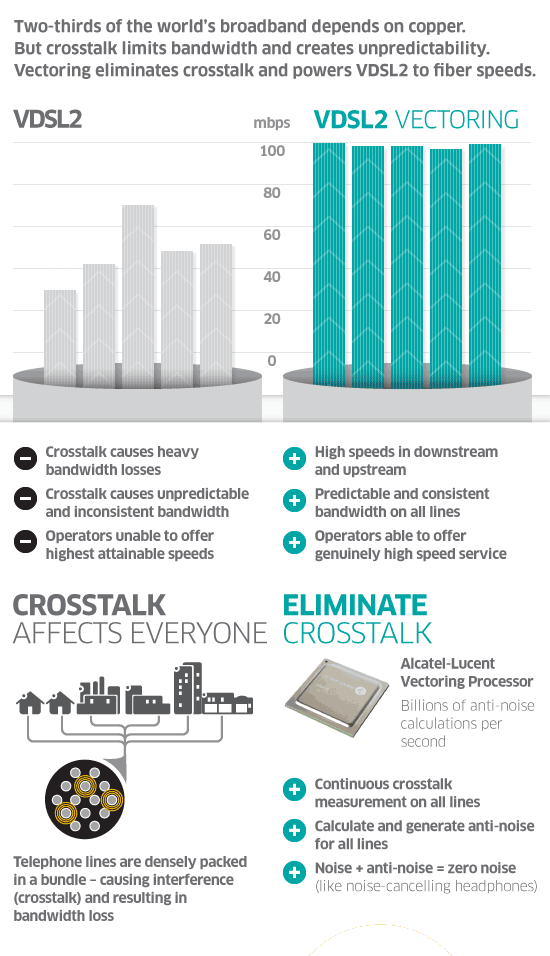
vectoringAlcatel-Lucent reported this month next generation DSL technology is a success for the company, with more than five million customers outside of North America now getting speeds up to 100Mbps over ordinary copper telephone lines.

VDSL2 line vectoring delivers more than twice the speed of AT&T’s fiber to the neighborhood U-verse service, and has proved reliable for simultaneous television, broadband, and telephone usage. It will even support 4K video streaming of ultra high-definition video.

Vectoring employs sophisticated noise cancelling to cut “crosstalk” interference to boost broadband performance. Testing has shown VDSL2 line vectoring can offer 100/30Mbps service with copper lengths as long as 1,600 feet. Most VDSL2 services are delivered over telephone networks that replace at least some copper wiring with fiber.

Alcatel-Lucent has shipped enough VDSL2 vectoring equipment to provide service to five million customers, surpassing non-vectored VDSL2. But practically none of the equipment is headed to North American ISPs. Instead, companies including Belgium’s Belgacom, Israel’s Bezeq, KPN in the Netherlands, Telecom Argentina, Telecom Italia, TE Data in Egypt and NBN Co. in Australia have launched vectoring technology, offering service to customers at speeds topping out at 70-100Mbps.

Most customers switched to VDSL2 vectoring see their speeds double, usually from 30Mbps to 70Mbps or more. Providers like Belgacom have been careful to only promise speeds the company can actually deliver. Belgacom’s own tests found 100Mbps service was only completely reliable when the amount of copper between the customer and the company’s fiber connection was kept less than 650 feet, so it has capped customer speeds at 70Mbps for now.

“The prime goal in DSL must be signal quality, integrity, robustness and stability for perfect video grade services,” says the Belgian ISP.

Vectoring technology has been on the drawing board for a decade and is only now achieving success in the market.

Many ISPs are choosing to deploy vectoring because it is less costly than a fiber upgrade and can still meet the speed goals demanded by government regulators. The technology has proven robust even where copper wire networks have degraded. In several European countries, homes are still serviced by indoor copper wiring insulated with paper sheaths.

Alcaltel-Lucent believes even after vectoring is widely deployed, it won’t be a dead-end for DSL service.

The company is working on its next generation “Phantom Mode” technology that combines VDSL2 bonding and VDSL2 vectoring with a traditional voice technology called “phantom transmission.” This combination adds a virtual channel to create three channels over 2 pairs of phone wiring.

In Phantom Mode tests, the company achieved 300Mbps over 2 pairs at 400 meters and 1Gbps (up and down-stream combined) over 4 pairs.

[flv]http://www.phillipdampier.com/video/Alcatel Lucent DSL Vectoring 5-2014.flv[/flv]

Alcatel-Lucent produced this video explaining vectoring technology. (A “CPE” means customer-premises equipment, in this case the DSL modem.) (3:09)


AT&T’s Magic Fairyland U-verse GigaPower Fiber “Expansion”: Don’t Hold Your Breath

Fairy_Tales3One of the first lessons a good magician learns is that to best impress an audience, one has to at least show an actual rabbit going into the hat before making it disappear.



AT&T is no David Copperfield. In its latest sleight of hand, AT&T today announced a major potential expansion of its U-verse GigaPower fiber to the home network to 21 major cities across its landline service area, with future plans to expand to as many as 100 eventually.

“We are excited to bring GigaPower to 100 cities and towns,” Lori Lee, head of AT&T’s U-verse unit, said in a phone interview with Bloomberg, which accompanied a press release. “We will work with local officials as we look for areas of strong demand and pro-investment policy.”

Among the cities slated to get fiber upgrades are Austin and Kansas City — where AT&T will face competition from Google Fiber. But AT&T isn’t bothering to compete head-on with any municipal fiber providers like Chattanooga’s EPB, Wilson, N.C.’s Greenlight, or Lafayette, La.’s LUSFiber. North Carolina, Texas and California are the states with the most cities chosen to potentially get upgrades.

But AT&T has yet to fully deliver on its earlier promise to deploy fiber to the home service in Austin, where single home residential customers have usually been stymied by general unavailability of the fiber service. AT&T has consistently refused to say exactly how many customers have actually been able to sign up for AT&T GigaPower fiber service.

For customers actually able to buy GigaPower, many are already served by an existing AT&T fiber cable. It is not uncommon to find fiber hookups in new housing developments or multi-dwelling units like apartment buildings and condominiums. Most customers don’t realize they are fed service from a fiber cable brought to the back of the building that interfaces with plain old copper wiring, providing service artificially slowed by the company in an effort to provide consistently marketed broadband products.

AT&T GigaPower is easy to provide in these locations with very little extra investment. Tearing up streets and yards to replace copper wiring with fiber optics is another matter, one AT&T has avoided for years by choosing a less costly fiber to the neighborhood approach that leaves existing copper wiring on phone poles and in customer homes largely intact. Moving to fiber to the home service would require AT&T to dramatically boost capital spending to cover the cost of stringing fiber across the backyards of millions of customers.

But earlier this year, AT&T promised investors it was actually planning to cut its budget for capital expenses in 2014 to $21 billion, most of that still earmarked for its profitable wireless network. That is down at least $200 million from 2013. Unless AT&T reneges on its earlier commitment to Wall Street, even David Copperfield couldn’t make fiber to the home service from AT&T magically appear.

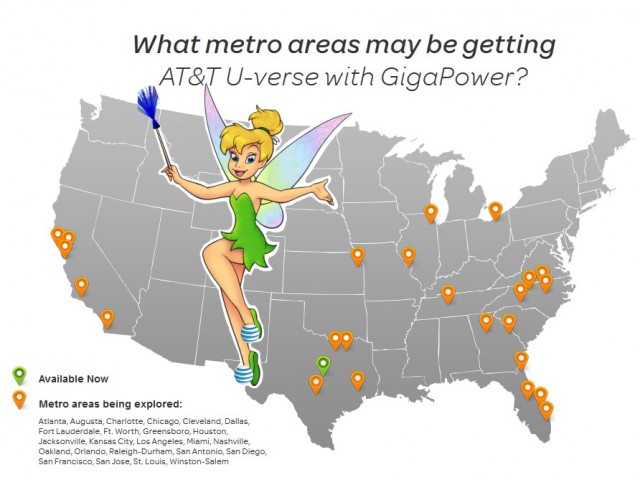
Notice the word "may"

Welcome to Neverland. Despite exciting press releases, AT&T has indicated it won’t spend the money required for widespread fiber expansion. But then, AT&T’s own graphics only promise these communities “may” get GigaPower.

In fact, AT&T has been telling investors it is more than halfway done completing its Project VIP effort, which budgeted $14 billion over three years to further expand basic U-verse service, improve its 4G LTE network, and expand rural wireless coverage within AT&T local service areas. Project VIP is integral to AT&T’s plan to eventually walk away from its rural wired infrastructure in favor of a wireless platform providing wireless landline service and 4G wireless broadband.

To assuage investors fearing AT&T is about to pull out the credit card and go on a fiber broadband shopping spree, AT&T carefully notes towards the bottom of its press release, “this expanded fiber build is not expected to impact AT&T’s capital investment plans for 2014.”

In other words, AT&T is not committing any money not already earmarked as part of Project VIP for its fiber expansion.

Without that money, if you live in a single-family residential home and are currently served by AT&T copper wiring, it is very unlikely the company will offer fiber upgrades anytime soon.

So why is AT&T promising vaporware upgrades it cannot possibly manage on its current budget?

AT&T will work with local leaders in these markets to discuss ways to bring the service to their communities. Similar to previously announced metro area selections in Austin and Dallas and advanced discussions in Raleigh-Durham and Winston-Salem, communities that have suitable network facilities, and show the strongest investment cases based on anticipated demand and the most receptive  policies will influence these future selections and coverage maps within selected areas. This initiative continues AT&T’s ongoing commitment to economic development in these communities, bringing jobs, advanced technologies and infrastructure.

This expanded fiber build is not expected to impact AT&T’s capital investment plans for 2014. – See more at: http://about.att.com/story/att_eyes_100_u_s_cities_and_municipalities_for_its_ultra_fast_fiber_network.html#sthash.Nh31BZEu.dpuf
Phillip "AT&T has a larger agenda here and it isn't fiber" Dampier

Phillip “AT&T has a larger agenda here and it isn’t fiber” Dampier

For years, AT&T’s lobbyists have promised politicians everything under the sun — telecom nirvana — if only Ma Bell can be unshackled by burdensome regulations. Some states have accepted AT&T’s deal only to find their residents’ phone bills rapidly increasing with no corresponding improvement in service. U-verse is AT&T’s effort to stay relevant at a time when mobile phones are replacing landlines and cable companies have poached a number of their customers.

But in return for that deregulation, AT&T delivered an cheaper, inferior fiber-to-the-neighborhood technology that requires hideously large infrastructure cabinets, often installed in front of customer homes, that has trouble keeping up with cable broadband speeds.

But nothing ever satisfies AT&T.

Recently, their lobbyists have been skulking around in the shadows of state legislatures ghostwriting new bills that would permit AT&T to abandon its rural landline customers altogether to focus on the far more profitable wireless business. But consumer groups have gotten wise to AT&T’s astroturf and lobbying efforts and have begun to limit their successes.

Meanwhile, along comes Google, promising groundbreaking, affordable fiber to the home gigabit broadband service to a handful of communities willing to work with them in a de facto partnership — cutting through bureaucratic red tape to facilitate infrastructure upgrades — a radical change from the traditional regulator-provider framework.

Hundreds of cities fell all over themselves competing for the privilege, and it didn’t require a penny in lobbying or campaign contributions.

Where Google has been willing to offer service, most communities have been more than thankful and have made life easier for the creative entrant.

If it worked for Google, why can’t it work for AT&T? As a result, the company that spent years telling customers fiber upgrades didn’t make any sense and that few people actually needed gigabit speeds, AT&T might appear to have reversed course. Dig a little deeper and you find a deeper agenda:

“Communities that have suitable network facilities, and show the strongest investment cases based on anticipated demand and the most receptive policies will influence these future selections and coverage maps within selected areas.”

Translation: Communities that already have considerable fiber infrastructure previously installed and are willing to bend to the business and public policy agenda of AT&T will make all the difference whether your city will be considered for a future fiber upgrade or not.

In the end, even if a community does everything AT&T asks of it, it still has no commitment AT&T will actually deliver the fiber upgrades they only promise “may” happen. But AT&T will have achieved its public policy goals of abolishing regulations and limiting oversight, all without have to install a single strand of fiber.

That is a deal community leaders should think twice about making with a company that has always looked out for its investors long before its customers.

Australia’s Move to Fiber-to-the-Neighborhood Service Provokes Defense of Copper Network

Phillip Dampier November 20, 2013 Audio, Broadband Speed, Community Networks, Competition, Consumer News, Data Caps, Public Policy & Gov't, Rural Broadband, Telstra, Video Comments Off on Australia’s Move to Fiber-to-the-Neighborhood Service Provokes Defense of Copper Network

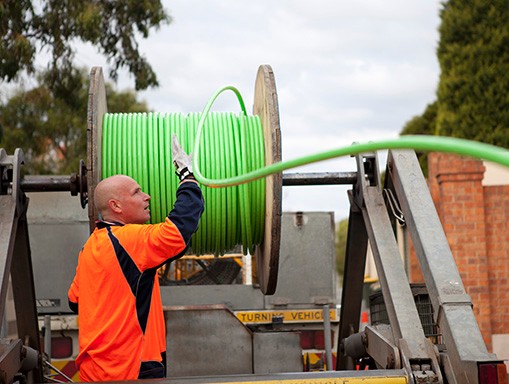
NBNCo is responsible for the deployment and installation of Australia's fiber to the home network.

The Australian government’s proposal to launch a nationwide fiber to the home National Broadband Network (NBN) has been scrapped by the more conservative Liberal-National Coalition that replaced the Labor government in a recent election.

As a result, the Coalition has announced initial plans to revise the NBN with a mixture of cheaper technology that can result in faster deployment of lower speed broadband at a lower cost. If implemented, fiber to the home service will only reach a minority of homes. In its place,  cable broadband may be the dominant technology where cable companies already operate. For almost everyone else, technology comparable to AT&T U-verse is the favored choice of the new government, mixing fiber-to-the-neighborhood with existing copper wires into homes..

[flv]http://www.phillipdampier.com/video/ABC Malcolm Turnbull moves to put Coalitions stamp on NBN Co 9-24-13.mp4[/flv]

Australia’s new Communications Minister moves to put the Coalition government’s stamp on the National Broadband Network, replacing most of the promised fiber-to-the-home technology with a service comparable to AT&T U-verse. From ABC-TV (6:32)

telstraJust a year earlier Telstra, Australia’s largest phone company, was planning to decommission and scrap its copper landline network, considered “five minutes to midnight” back in 2003 by Telstra’s head of government and corporate affairs, Tony Warren. Now the country will effectively embrace copper technology once more with an incremental DSL upgrade, forfeiting speeds of up to 1,000Mbps over fiber in return for a minimum speed guarantee from the government of 24Mbps over VDSL.
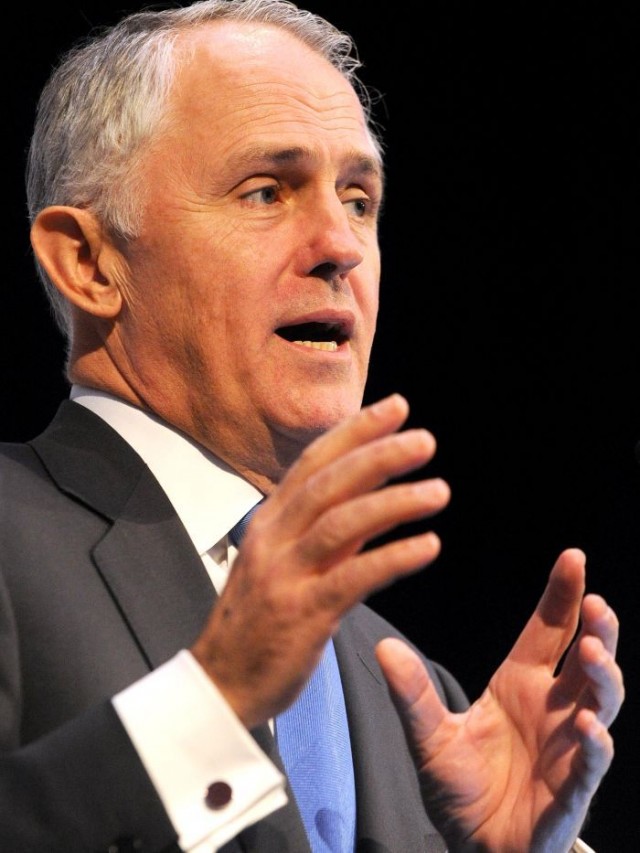
The turnabout has massive implications for current providers. Telstra, which expected to see its prominence in Australian broadband diminished under Labor’s NBN is once again a rising star. The Liberal-National Coalition government appointed Telstra’s former CEO Ziggy Switkowski to run a “rebooted” Coalition NBN that critics are now calling Telstra 3.0. Communications Minister Malcolm Turnbull also installed three new members of the NBN’s governing board consisting of a Telstra executive, a founder of a commercial Internet Service Provider, and an ex-construction boss who left the NBN in 2011.

[flv]http://www.phillipdampier.com/video/ABC Malcolm Turnbull Outlines NBN Review 9-24-13.mp4[/flv]

ABC reports Communications Minister Malcolm Turnbull asked for the resignations of the entire NBN board, one of the first steps to re-envision the NBN under the Liberal-National Coalition’s party platform. Turnbull accused the former government of setting political targets for fiber broadband and was never forthcoming about the true cost and complexity of the ambitious fiber project. (8:50)

Turnbull

Turnbull

Some Australians complain that NBN’s proposed reliance on Telstra copper is a mistake. Telstra has allowed its landline infrastructure to decline over the years and many are skeptical they will ever see faster speeds promised over wiring put in place decades earlier.

The NBN under the Liberal-National Coalition will depend heavily on two copper-based technologies to deliver speed enhancements: VDSL and vectoring. Both require short runs of well-maintained copper wiring to deliver peak performance. The longer the copper line, the worse it will perform. If that line is compromised, VDSL and vectoring are unlikely to make much difference, as AT&T has discovered in its effort to roll out faster U-verse speeds, much to the frustration of customers that cannot upgrade until AT&T invests in cleaning up its troubled copper network.

Coalition critics also warn the new government will foolishly spend less on a fiber-copper network today that will need expensive fiber upgrades tomorrow.

Turnbull isn’t happy with Australia’s mainstream media for lazy reporting on the issues.

ABC Radio reports that the Coalition’s approach to the NBN may be penny-wise, pound foolish. By the time the NBN rolls out fiber to the neighborhood and Telstra is required to invest in upgrades to its copper network to make it work, fiber to the home service could turn out to have been cheaper all along. (5:11)
You must remain on this page to hear the clip, or you can download the clip and listen later.

“I have to say that by and large the standard of reporting of technology and broadband by the mainstream media has been woeful,” Turnbull said. “If the Australian public are misinformed about these issues, it was in large part a consequence of the unwillingness of the mainstream media to pay any attention to what is really going on in the industry.”

The promise of giber optic broadband may prove elsuive under the new giovernment.

The promise of fiber optic broadband may prove elusive under the new government.

With much of the new NBN dependent on Telstra’s copper telephone network, Stuart Lee, Telstra’s managing director of its wholesale division, rushed to defend the suitability of the same copper network Telstra was prepared to scrap under the last government.

Lee said he was especially annoyed with critics that call Telstra’s copper networking “aging.”

“The other thing that makes me cross when I hear it, and I see it a lot in the press is the talk of the aging copper network. It’s not. It’s not an aging copper network. It’s like grandfather’s axe; it’s had five new handles and three new heads. When it breaks, we replace the broken bit. So it’s much the same as it always has been and always will be,” Lee said. “It’s just an older technology, it’s not that the asset itself has deteriorated.”

When questioned about several recent high-profile mass service disruptions Australians experienced on Telstra’s landline copper network, Lee blamed the weather, not the network.

“They correlate to weather events, and the weather events we’ve had in the last [few years] is about five to six times the previous ones, so surprise surprise there is a lot more damage,” said Lee.

The new government has charged the Labor-run NBN with inefficiency, taxpayer-funded waste, and playing politics with broadband by giving high priority to fiber upgrades in constituencies served by threatened Labor MPs. Lee added NBN Co has played loose with the facts, declaring premises “passed” by the new fiber network without allowing customers to order service on the new network. That can become a serious problem, because the NBN plan calls for customers’ existing copper phone and DSL service to be decommissioned soon after the fiber network becomes available.

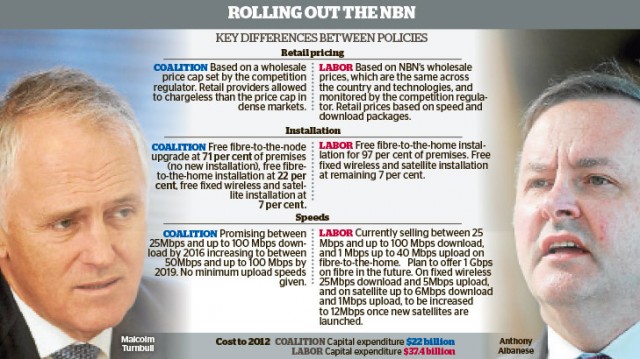
The Sydney Morning Herald  compares the last Labor government's broadband policy with the new Coalition government policy.

The Sydney Morning Herald compared the last Labor government’s broadband policy with the new Coalition government policy.

iiNet’s chief technology officer, John Lindsay said that the potential for disconnecting customers from the ADSL network while they still can’t order NBN service was “madness.”

The Labor government’s NBN has also been under fire for a pricing formula that includes a usage component when setting prices. Impenetrably named the “connectivity virtual circuit” charge, or CVC, the NBN charges retail providers a monthly connection fee for each customer and a usage charge that includes a virtual data allowance originally set at 30GB. Retail providers are billed extra when customers exceed the informal allowance. Although the government promised to reduce the charges, they effectively haven’t and likely won’t until 2017.

Lindsay called the CVC an artificial tax comparable to the Labor government’s carbon tax, and represents a digital barrier to limit customer usage.

“It’s a tax on packets,” Lindsay said.

[flv]http://www.phillipdampier.com/video/ABC NBN Copper 11-19-13.mp4[/flv]

Tasmanian residents complain NBN Co’s new fiber network is claimed to be available, but actually isn’t in many neighborhoods now scheduled for disconnection from Telstra’s copper landline and DSL network. (2:17)

N.Y. Regulator Rules Details About Verizon’s Landline Network Are Not Confidential Company Secrets

Phillip Dampier November 6, 2013 Consumer News, Public Policy & Gov't, Rural Broadband, Verizon, Wireless Broadband Comments Off on N.Y. Regulator Rules Details About Verizon’s Landline Network Are Not Confidential Company Secrets
Verizon gets out the black marker to redact information in declares "confidential."

Verizon gets out the black marker to redact information it considers “confidential.”

The New York Public Service Commission Monday rejected most of Verizon’s request to keep secret the state of its landline network and details about the company’s plans to distribute Voice Link as an optional wireless landline replacement in the state.

Nearly two months after Verizon announced it was abandoning its original plan to replace defective landlines on Fire Island with Voice Link, Verizon is bristling over a Freedom Of Information Law (FOIL) request from consumer advocates and a union for disclosure of reports filed with the PSC regarding Verizon’s network and its upkeep — information the company considers confidential trade secrets. To underline that belief, Verizon provided the PSC with edited versions of documents it filed with the state considered suitable for public disclosure, one consisting of 330 pages of blanket redactions except for the page headings and page numbers.

“[These discovery requests] are designed solely to advance the Communications Workers of America’s self-serving efforts to prevent Verizon from offering its Voice Link product, even on an optional basis, and to investigate the relationship between Verizon and Verizon Wireless — matters that are beyond the scope of this or any other pending Commission proceeding,” wrote Verizon deputy general counsel Joseph A. Post. “On September 11, 2013, Verizon announced that it had decided to build out a fiber-to-the-premises (“FTTP”) network on western Fire Island, and targeted Memorial Day 2014 for the completion of construction and the general availability of services over the new network.”

The PSC disagreed with Post, ruling the majority of documents labeled “confidential” by Verizon were, in fact, not.

“[…] The information claimed by Verizon to be trade secrets or confidential commercial information does not warrant an exception from disclosure and its request for continued protection from disclosure is denied,” ruled Donna M. Giliberto, assistant counsel & records access officer at the Department of Public Service.

Verizon has until Nov. 14 to file an appeal.

Common Cause New York, the Communications Workers of America-Region 1, Consumers Union, the Fire Island Association, and Richard Brodsky used New York’s public disclosure laws to collectively request documents shedding light on their suspicion Verizon has systematically allowed its landline facilities to deteriorate to the point a wireless landline substitute becomes a rational substitute. They also suspect Verizon diverted funds intended for its landline network to more profitable Verizon Wireless.

“In spite of its obligations under New York law, in spite of the investment by ratepayers in the FIOS wireline system, in spite of the needs and expectations of the people, businesses and economy of the state, Verizon is intending to and has begun to shut down its wireline system,” declared the groups.

Many involved took note of Stop the Cap!’s report in July 2012 that warned then-CEO Lowell McAdam had plans to decommission a substantial part of Verizon’s copper landline network, especially in rural areas, where it intended to replace it with wireless service:

Verizon-logo“In […] areas that are more rural and more sparsely populated, we have got [a wireless 4G] LTE built that will handle all of those services and so we are going to cut the copper off there,” McAdam said. “We are going to do it over wireless. So I am going to be really shrinking the amount of copper we have out there and then I can focus the investment on that to improve the performance of it. The vision that I have is we are going into the copper plant areas and every place we have FiOS, we are going to kill the copper. We are going to just take it out of service and we are going to move those services onto FiOS. We have got parallel networks in way too many places now, so that is a pot of gold in my view.”

Some consumer groups suspect Fire Island represented an opportunity to test regulators’ tolerance for a transition away from copper landlines in high cost service areas. As Stop the Cap! reported this summer, New Yorkers soundly rejected Verizon Voice Link, with more than 1,700 letters opposing the wireless service and none in favor on record at the PSC.

In early September, a well-placed source in Albany told Stop the Cap! Verizon’s request to substitute Voice Link where it was no longer economically feasible to maintain landline infrastructure was headed for rejection after a constant stream of complaints arrived from affected customers. Verizon suddenly withdrew its proposal on Sept. 11 and announced it would bring FiOS fiber optics to Fire Island instead.

Although Verizon now insists it will only offer Voice Link as an optional service for New York residents going forward, public interest groups still believe Verizon has allowed its landline network to deteriorate to unacceptable levels.

Verizon originally claimed 40% of its facilities on Fire Island were damaged beyond repair when they were assessed after Hurricane Sandy. But residents claim some of that damage existed before the storm struck last October. Some fear Verizon is engaged in a self-fulfilling prophecy, allowing its unprofitable copper wire facilities to fall apart and then point to the sorry state of the network as their principle argument in favor of a switch to wireless service.

Herding money, resources, and customers to Verizon Wireless

Herding money, resources, and customers away from landlines to Verizon Wireless

“In fact, the vast majority of defective lines are a consequence of the failure and refusal of Verizon to maintain and repair the system over time,” the groups assert. “The Commission must make a factual determination of the cause of the 40% defect allegation as part of this proceeding. If, as asserted herein and elsewhere, the evidence shows a pattern of inadequate repair, maintenance and capital investment, the Commission can not and should not approve any loss of wireline service to any customer, as matters of law and sound policy.”

“We assert that Verizon has systematically misallocated costs thereby distorting the extent to which the wireline system has suffered losses, if any. […] It is fair to say that substantial losses in the landline system are repeatedly used by the Commission and the Company as a justification for rate increases and regulatory decisions affecting the scope, cost, adequacy and nature of telephone service provided to customers of Verizon NY.”

Verizon would seem to confirm as much.

In 2012, Verizon’s chief financial officer Fran Shammo told investors the company was diverting some of the costs of Verizon Wireless’ upgrades by booking them on Verizon’s landline construction budget.

“The fact of the matter is wireline capital — and I won’t get the number but it’s pretty substantial — is being spent on the wireline side of the house to support the wireless growth,” said Shammo. “So the IP backbone, the data transmission, fiber to the cell, that is all on the wireline books but it’s all being built for [Verizon Wireless].”

Funds diverted for Verizon Wireless’ highly profitable business were unavailable to spend on Verizon’s copper wire network or expansion of FiOS. In 2011, Verizon diverted money to deploying fiber optics to 1,848 Verizon Wireless cell towers in the state. In 2012, Verizon deployed fiber to an extra 867 cell tower sites in New York and Connecticut. Public interest groups assert the costs for these fiber to the cell tower builds were effectively paid by Verizon’s landline and FiOS customers, not Verizon Wireless customers.

lightningSince 2003, Verizon has been subject to special attention from the New York Public Service Commission because of an excessive number of subscriber complaints about poor service. As early as a decade ago, the PSC found Verizon’s workforce reductions and declining investment in its landline network were largely responsible for deteriorating service. Each month since, Verizon must file reports on service failures and its plans to fix them.

In September alone, Verizon reported significant failures in service in rural areas upstate, almost entirely due to the weather:

  • Heuvelton: A summer filled with significant thunderstorms resulted in downed poles and service disruptions. Verizon reported the central office serving the community was in jeopardy in June. By mid-July, 7% of customers reported major problems with their landline service.
  • Amber: Nearly 11% of customers were without acceptable service in May because a 100-pair cable serving many of the community’s 274 customers was failing.
  • Chittenango: Nearly 9% of the community’s 1,059 landline customers had significant problems with service because Verizon’s central office switching system in the exchange was failing.
  • Sharon Springs: Almost 11% of Verizon’s customers in this small rural office of 417 lines were knocked out of service in July.
  • Elenburg Dept.: More than 8% of Verizon’s 324 lines in this rural Adirondack community were out of service, usually as a result of a thunderstorm passing through.
  • Hartford: When it rains hard in this Adirondack community, landline service fails for a substantial number of customers. In September, 2.43 inches of rain left 12.4% of customers with dysfunctional landline service.
  • Valley Falls: Nearly one-third of Valley Falls’ 722 landlines were out of service in September after lightning hit several Verizon telephone cables. Problems only worsened towards the end of the month.
  • Kendall: Almost 9% of Verizon customers in the Rochester suburb of Kendall were without service after a rain and wind storm. When a cold front moves through the community, landlines service is threatened.
  • Bolivar: More than 20% of customers lost service July 19th after heavy rain, winds, and power outages hit.
  • Cherry Valley: Verizon blamed seasonal service outages in Cherry Valley on farmers that dig up or damage buried telephone cables. More than 7% of customers were knocked out by harvested phone lines in July.
  • Edmeston: More rain, more service outages for the 801 landlines in this small community in area code 607. More than 13.5% of customers called in with complaints in July. Verizon blamed heavy rain.
  • Clinton Corners: Service failures come after nearly every heavy rainfall due to multiple pair cable failures in the aging infrastructure. More than 9% of customers reported problems in June, 13.2% in July, 8.2% in August, and 12.5% in September.

Verizon’s landline trouble reports disproportionately come from rural communities, exactly those Verizon’s former CEO proposed to serve by wireless. Weather-related failures are often the result of deteriorating infrastructure that results in outages, especially when moisture penetrates aging cables. Rural communities are also the least-likely to be provided fiber service, exposing customers to a larger percentage of the same copper wiring critics charge Verizon is allowing to deteriorate.

Search This Site:

Contributions:

Recent Comments:

Your Account:

Stop the Cap!