Home » copper wiring » Recent Articles:

CenturyLink Has “Given Up” and Abandoned Its Customers, Leaving Some Without Service for Months

Two months after a late July thunderstorm interrupted phone and internet service for some CenturyLink customers in parts of Albemarle County, Va, some are still waiting for the phone company to restore service.

Multiple CenturyLink customers around the area told The Daily Progress about the extended outage, and the company’s lack of responsiveness in restoring service. Many report their service appointments are unilaterally canceled or a repair technician just never shows up. Others are receiving messages the repairs are complete, but they still have no service.

Mobile phone service is spotty in this part of central Virginia, so many customers keep their landlines to reach emergency services. With service out for nearly two months, making emergency calls or accessing the internet has been difficult.

In August, CenturyLink employee Derek Kelly told attendees at a Albemarle Broadband Authority meeting that at storm brought down almost a mile of CenturyLink’s legacy copper wire network, which has been in place for decades. Kelly noted CenturyLink intended to replace the damaged copper wiring with more copper wiring, instead of upgrading to fiber optics, and because of supply chain issues, customers have been left waiting.

“We ran into logistical issues of being able to find that length of copper,” Kelly said. “I think between COVID and everything else, supplies are limited, so it took us longer than we typically hope for to get the copper in place and get it in town and get it hung back up and spliced in.”

So far, customers are still being billed for service they do not have, and the company has refused to issue automatic credits for customers left without service. Some customers want CenturyLink to compensate them extra for interrupted service as well as for the company wasting their time on unfulfilled service calls and being left on hold, sometimes for an hour, trying to resolve the problem.

Firefly is a service of municipal/co-op power companies in central Virginia.

Albemarle County Supervisor Donna Price has been hearing complaints from local residents for weeks and she is also well aware CenturyLink is in the process of selling a large part of its legacy local phone operations in 20 states to Apollo Global Management, a private equity firm. The phone company will keep its most profitable customers in 16 states — many already served by fiber optics, under its Lumen brand. As that sale waits to close, Price believes CenturyLink has already walked away from their soon-to-be ex-customers.

“I believe that corporate CenturyLink has basically given up and has abandoned their responsibility, which leaves it all upon the individual consumers to either seek some sort of collective relief or basically just suffer until a new provider comes in,” Price told the newspaper. “I think CenturyLink has failed in customer service, in the delivery of service and, I’ll be a little more generous, in the recovery from the storm, because those are really difficult situations.”

Some customers in nearby Fluvanna County who have also experienced multi-month service interruptions from CenturyLink were lucky enough to have a choice of broadband providers, and many have switched to Firefly Fiber Broadband, which also supplies landline phone service. Firefly is owned and operated by a partnership subsidiary that includes the Central Virginia Electric Cooperative. That fiber to the home network has survived serious storms in the past without lengthy service interruptions. The member-owned cooperative has also invested heavily in fiber broadband and communications services its members demand, and if something goes wrong, local repairmen answerable to local supervisors are on hand to manage any issues.

Firefly Fiber is currently looking to expand its operations within its central Virginia service area, which includes the counties of Albemarle, Appomattox, Buckingham, Cumberland, Fluvanna, Goochland, Greene, Louisa, and Powhatan.

U.S. Gone from World Ranking of Fastest Broadband Countries; Cozy Duopoly Results in Less Investment, Upgrades

Phillip Dampier September 13, 2021 Broadband Speed, Consumer News, Public Policy & Gov't 5 Comments

The United States is rapidly losing its place among the world’s fastest broadband countries, dropping out of the top-10 this year and falling behind Chile, Liechtenstein, and Romania.

While other countries and internet providers are investing billions to improve their standing in an increasingly competitive global broadband marketplace, a comfortable duopoly of phone and cable companies in the United States has successfully kept regulators at bay and allowed many of the largest internet service providers to divert investment away from upgrades and towards stock buybacks, dividend payouts, debt reduction, and ongoing merger and acquisition activities.

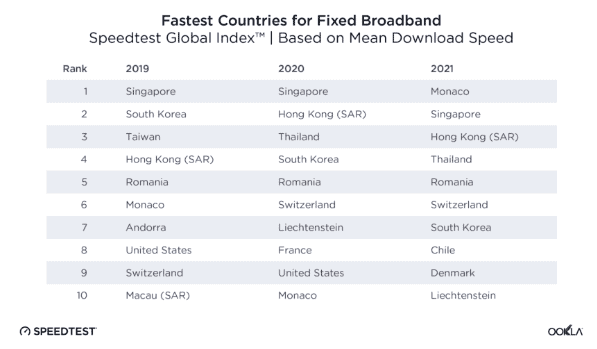
Internet speed testing firm Ookla has watched the United States slip in its fixed broadband speed standings over the last three years, dropping from 8th place (2019) to 9th place (2020), to being dropped from its top 10 list this year (it now scores 14th). Canada has never made the list.

This year, the countries with the fastest internet download speeds are: Monaco, Singapore, Hong Kong, Thailand, Romania, Switzerland, South Korea, Chile, Denmark and Liechtenstein. The only other countries to fall off the top-10 list in the last three years are Taiwan, Andorra, Macau, and France.

Globally, wireless internet speeds are benefitting from 4G and 5G upgrades on cell towers, with overall speed increasing nearly 60% in the last year. Fixed broadband speeds are up 32% year over year, primarily from an increase in the amount of fiber to the home connections providers are making as they move away from traditional copper wiring. Heavy investment in network upgrades can deliver remarkable boosts in internet speeds.

“South Korea and the United Arab Emirates stood out with mean mobile download speeds that were more than 240% faster than the global average and fixed broadband downloads that were more than 70% faster than the global average,” said Ookla’s Isla McKetta. “China’s mobile download speed was more than 180% faster than the global average and the country was more than 70% faster than the global average for fixed broadband. Switzerland’s mobile and fixed broadband download speeds were close to 100% faster than the global average.”

All of those countries have invested heavily in fiber connectivity for both their mobile and fixed wired broadband connections.

In contrast, U.S. cable companies have delayed upgrades to DOCSIS 4.0, capable of supporting 10 Gbps connections, and many telephone companies have dragged their feet on fiber upgrades, facing resistance from Wall Street as well as heavy debt burdens from prior mergers and acquisitions.

Most of the countries ranking the fastest have pushed providers to supply gigabit internet speed connections, but U.S. regulators and politicians have reduced pressure on large providers by proposing to subsidize millions of expanded internet connections with U.S. taxpayer funds while reducing required speed minimums to just 100/20 Mbps.

Frontier Exits Bankruptcy on Friday; Company to Focus on Gradual Fiber Upgrades

Frontier Communications is scheduled to announce its emergence from bankruptcy reorganization as early as Friday, beginning a new era with a reduced debt load, new leadership, and a plan to retire a considerable amount of its copper wire network in favor of fiber optics over the next decade.

“Frontier is ready to set a new course as a revitalized public company. Through the restructuring process, the company has stabilized its business and recapitalized its balance sheet, while making significant progress on the early stages of implementing our initial fiber expansion plan,” said John Stratton, incoming executive chairman of the board. “Frontier’s success with the Fiber-to-the-Home pilot program, which upgraded more than 60,000 locations from copper to fiber optic service in 2020, is just one example of the important work already underway. Frontier’s future is bright. I’m eager to work closely with our new board, our CEO Nick Jeffery, and the rest of the leadership team to build the new Frontier.”

As part of its reorganization, Frontier shed nearly $10 billion in debt, most attributable to its earlier buying spree of castoff landline customers formerly served by AT&T and Verizon. The company’s budget busting 2016 acquisition of Verizon service areas in California, Texas, and Florida was called “a textbook case of how not to do an acquisition,” by The Dallas Morning News

For at least a decade covering 2010-2020, Frontier was regarded as one of the worst phone companies in America in consumer surveys. Most of its legacy customers still suffer with Frontier’s dilapidated and deteriorating copper wire network and the slow speed DSL service barely supported on it. Speeds of 1-3 Mbps maximum are still common in some places, even in urban areas. Frontier’s acquisition of Verizon FiOS and AT&T U-verse service areas in states like Indiana, Washington, Connecticut, Florida, Texas and California gave a minority of customers access to pre-built fiber to the home networks, but Frontier’s notoriously poor switchover from Verizon and AT&T’s billing systems to their own effectively drove off hundreds of thousands of formerly loyal customers.

Under the leadership of former CEOs Maggie Wilderotter and Dan McCarthy, Frontier dragged from one quarter to the next, promising improvements that failed to materialize for most customers. The company’s $10.5 billion acquisition of landlines in California, Texas and Florida was particularly costly as the company sold bonds offering astonishing 10.5-11% interest rates to investors to cover more than $5 billion in debt coming due for repayment. A year after the Verizon deal, a half million Frontier customers left for good and the company lost $262 million.

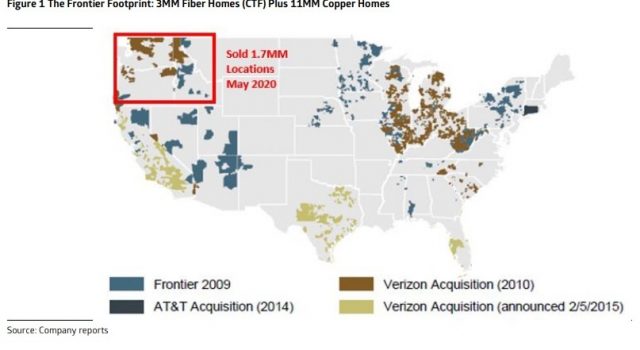
Frontier’s latest fiber plan is to target upgrades in its legacy service areas, noted in blue on this map. These areas are all almost entirely served by copper wire, provide slow speed DSL, and are long overdue for fiber upgrades. Frontier will also expand fiber in its acquired service areas, represented by other colors on the map. Note that Frontier sold its Pacific Northwest region, marked by the red box, to Zipply Fiber, which also plans to scrap Frontier’s copper wire network in favor of fiber. (Map courtesy of Light Reading)

By the time bankruptcy was inevitable, Frontier was saddled with billions in debt and no financial ability to embark on fiber upgrades the company should have committed to a decade ago. Almost all of its existing fiber footprint was acquired from other companies.

Stratton

Frontier’s new management includes John Stratton, a former Verizon executive. Stratton believes Frontier’s future depends on the company expanding its fiber footprint. In 2020, it put that plan to the test by expanding fiber to the home service to 60,000 additional homes in a pilot project proving Frontier can plan and execute fiber upgrades on time and on budget. But a closer look at the numbers shows the majority of homes Frontier “upgraded” were brand new. Of the 60,000 homes, 44,000 were located in new housing developments or were unwired previously. These “greenfield” locations are typically easier to provision and much less expensive to service than pre-existing homes where Frontier first needs to decommission its existing copper wiring and replace it with fiber optics. Only around 16,000 pre-existing homes saw copper wire replaced with fiber in so-called “brownfield” locations.

For Frontier to succeed, it will need to move a lot more copper customers to fiber optics to remain competitive in the marketplace. Currently, Frontier serves approximately three million fiber homes and 11 million copper homes. Frontier is expected to announce fiber upgrades for an additional six million homes and target about 85% of its footprint to be serviced by fiber… eventually.

Some proposals hint the company could take five years or more to complete upgrades at the same time independent fiber to the home providers, next generation satellite internet, and wireless home 4G/5G internet plans are expanding. Much of Frontier’s service area is serviced by cable companies already providing high speed internet. Frontier’s plan assumes it will capture about 40% of the market — a tall order in communities like Rochester, N.Y., where dominant cable provider Charter Spectrum is assumed to have 70+% of the home broadband market. When competing fiber providers enter the market, Spectrum often slashes promotional pricing to $30 a month for 400 Mbps internet service for two years. Spectrum will probably offer similar pricing in newly competitive markets to retain customers threatening to cancel service and switch to Frontier.

Frontier plans to discuss its exit from bankruptcy and where the company will go in the future in a webcast presentation this Friday, April 30, 2021 at 10:00am ET.

AT&T Stops Selling DSL Service

Phillip Dampier October 5, 2020 AT&T, Broadband Speed, Consumer News, Rural Broadband 3 Comments

AT&T stopped accepting orders for traditional DSL service from customers across its landline service area on Oct. 1, and will no longer allow existing customers to change speeds or transfer DSL service if they move to a new address.

AT&T sells three classes of wired internet service to residential customers:

  • DSL: Traditional, old-fashioned DSL is sold primarily in rural and exurban areas that were never upgraded to AT&T’s U-verse service. Download speed is typically between 1-6 Mbps. This service is no longer available to new customers.
  • U-verse: AT&T’s fiber-to-the-neighborhood service delivers 24 Mbps or faster download speed. AT&T uses fiber optic cables between the central switching office and the customer’s neighborhood, where it connects with existing copper wiring that runs down your street and into your home. Most AT&T internet customers are still served by U-verse.
  • Fiber: About 4.3 million former U-verse customers have been upgraded to AT&T Fiber, the company’s fiber to the home service. This upgrade eliminates the copper wiring that runs to your home, which provides for vastly faster internet speeds.

Only AT&T’s DSL service has been discontinued. The company claims about a half million customers still get DSL service from AT&T as of the second quarter of 2020. Most don’t choose DSL by choice. It is often the only option, because the customer lives in a rural area where no other options for internet service exist. That may leave some new customers with no options for wired internet service at all.

“We are focused on enhancing our network with more advanced, higher speed technologies like fiber and wireless, which consumers are demanding,” AT&T said in a statement. “We’re beginning to phase out outdated services like DSL and new orders for the service will no longer be supported after October 1. Current DSL customers will be able to continue their existing service or where possible upgrade to our 100% fiber network.”

AT&T has been slowly expanding its wireless 4G LTE home internet service in select rural areas, but the service is unlikely to reach all the areas now shut out of DSL service.

While AT&T’s rural customers have been left behind, prices for AT&T Fiber are coming down, at least for new customers. Spectrum and Comcast have offered attractive new customer promotions in areas served by AT&T, and the phone company is now responding with better offers. New customers can now get 100 Mbps from AT&T Fiber for $35 a month, 300 Mbps for $45 a month, and 1,000 Mbps for $60 a month (all promotions good for 12 months and do not include equipment fees or taxes).

W.V. Orders Frontier to Improve Service to Address Over 1,300 Complaints in Last 12 Months

Phillip Dampier September 30, 2020 Consumer News, Frontier, Public Policy & Gov't, Rural Broadband 1 Comment

Frontier is the dominant phone company in West Virginia.

The West Virginia Public Service Commission has ordered Frontier Communications to make significant improvements in its aging copper wire telephone network after a comprehensive investigation found the company’s landline phone service and broadband to be lacking.

The order comes two years after the state began investigating the phone company and six months after a service audit was completed. In the last year, 1,342 complaints about poor service were filed with the state’s Public Service Commission.

“Frontier customers in this state remain plagued with service problems even as the customer base – and the corresponding revenue – declines. The Focused Management Audit was designed to find the underlying service quality problems, and possible solutions, in the hopes of placing Frontier on a better path,” the report concluded.

Over the past two years, Frontier gradually implemented some of the recommendations made by the state, particularly a more robust tree-trimming program to pre-emptively reduce tree-related outages and an automated system that can detect service issues and outages before customers call to complain. But Frontier’s larger problem is its lack of investment in network upgrades, particularly related to replacing old copper wire infrastructure with fiber optics. The study identified the 25 worst exchanges in the state most plagued by service outages and complaints and demanded that Frontier rehabilitate or upgrade those areas to improve service. But the company has refused the Commission’s request to deploy fiber optic connections to every cross-box in the state, which connects Frontier’s network to neighborhood phone lines. Such an upgrade would dramatically reduce Frontier’s reliance on copper wiring and improve phone and internet service.

Frontier rejected the idea as “unfeasible,” claiming it would cost $100 million to complete fiber connections to each of Frontier’s 3,255 existing cross box locations. If the company moved to digital phone service across those fiber lines, the cost would rise to $200 million, according to Frontier, adding it would have no choice but to pass these costs onto customers in the state.

“Given the exorbitant expense associated with such a comprehensive endeavor, the cost of voice service would consequently increase to unsustainable levels,” the company claimed.

Yet earlier this spring, at the height of the pandemic and after declaring bankruptcy, Frontier paid out $38 million in retention bonuses to its top executives, urging the same people who presided over the company as it went bankrupt to remain on the payroll at least until the bankruptcy was discharged.

The state was given an early warning about Frontier’s decreasing performance in July 2019 after an auditing firm found the company financially troubled and had cut back dramatically on ongoing maintenance spending. The auditor also reported Frontier was likely losing customers fast and would soon feel the financial pressure of lost revenue. Just as bad, the auditor reported Frontier’s ability to stay ahead of its service problems could be compromised further by the likely retirement of more than half of the company’s most experienced service technicians in the next five years.

The auditor correctly predicted Frontier’s financial health. The company declared Chapter 11 bankruptcy in April and is reorganizing. The company claims it will exit bankruptcy in much better financial shape, with much of its debt discharged or renegotiated by creditors. In turn, Frontier has promised to boost investment in network fiber upgrades, but has not been specific about what areas it will target. A hearing to discuss some of these matters is scheduled for Oct. 28.

Even with Frontier’s imminent exit from bankruptcy, West Virginia officials remain concerned about the phone company’s commitments and whether the new management will continue to honor earlier agreements with state officials.


Search This Site:

Contributions:

Recent Comments:

Your Account:

Stop the Cap!