Home » Contract » Recent Articles:

Local Governments Discover Cable Deregulation Leaves Them Powerless to Represent Consumers

Phillip Dampier January 11, 2012 Competition, Consumer News, Public Policy & Gov't Comments Off on Local Governments Discover Cable Deregulation Leaves Them Powerless to Represent Consumers

When Massena, N.Y. town supervisor Joseph D. Gray balked at Time Warner Cable’s demands for a 15-year franchise renewal agreement, especially after the cable company never bothered to show up at a hearing on the subject, he thought he could send a message by supporting a renewal expiring after just one year.

But there was a reason Time Warner never bothered to show up to defend their performance in northern New York State over the last decade of increasing rates and unwanted channels shoveled at subscribers — they did really have to answer to local officials.

Gray assumed playing some hardball with the cable company might get their attention and bring them to the table to discuss the demands of local Massena residents he hears from all the time.  At the top of the list is a-la-carte cable — paying only for channels you want.

No deal.

Gray

Mr. Gray has since admitted in conversations with the Watertown Daily Times he is frustrated by the town’s inability to effect “any real change.”

This despite the state cable franchise law which declares communities have the right to establish and negotiate “cable-related community needs” as part of the final contract with cable operators.

In fact, the cable industry has spent millions lobbying federal and state governments to deregulate their operations, even though most communities are served by just one cable operator.  While phone companies have made limited progress competing in larger urban areas, most of upstate New York is left choosing between a satellite provider or a cable company — usually Time Warner Cable.

That lobbying paid off in the 1990s when the federal government swept away considerable government oversight of cable operations.  While municipalities technically still control the basic franchising process, those dissatisfied with service from an existing provider rarely find other companies willing to take over.  That leaves Massena stuck with Time Warner Cable, who isn’t giving an inch on how they package their programming.

“We can make some gains for the community. Can we get free service for a couple of municipal buildings? Probably,” Mr. Gray told the newspaper. “They continue to say there’s nothing they can do about programming, there’s nothing they can do about bundling.  That’s from the programmer.  Until we get … a la carte, where people get the channels they want, we’re never going to satisfy people.”

Wall Street Encourages Verizon to Get Completely Out Of Landline/FiOS Business

Wall Street is encouraging Verizon Communications to sell off its landline telephone operations to clear a path for a potentially-profitable merger with British mobile phone company Vodafone Group Plc.

Analysts at Goldman Sachs Group are behind the research report, which suggests Verizon’s recent non-aggression treaty with Comcast and Time Warner Cable makes the sale of Verizon’s landline phone and FiOS fiber to the home network more likely. Verizon will earn a percentage of every cable TV/phone/broadband subscription sold, effectively making Verizon’s own wired network redundant. Potential buyers could include Frontier Communications, CenturyLink, or Windstream, which all have business plans that depend on landline networks fewer Americans are using.

Should Verizon clear away its legacy landline and FiOS networks, Goldman Sachs suggests, a merger with Vodafone would be a “clear fit” for the two companies.

“The remaining wireless and enterprise businesses would have faster growth and a clear fit with Vodafone’s assets and strategy, making it a more attractive merger partner,” Bloomberg News quotes from the report.

“Given that it no longer faces the threat of integrated cable competitors, Verizon could potentially spin off its remaining [landline] assets,” along with “large” pension and benefit liabilities, the Goldman analysts added.

Verizon would also eliminate its ongoing dispute with the two largest unions representing its landline workers — Communications Workers of America and the International Brotherhood of Electrical Workers.  Both unions are still trying to negotiate a new contract with Verizon after a brief, but contentious, summer strike. Verizon Wireless is almost entirely non-unionized.

Vodafone’s share price has been rising recently, perhaps anticipating a potential merger that would give Vodafone a stronger hand in the U.S. marketplace.

Verizon’s investment in its landline network, along with interest in expanding its well-regarded FiOS fiber to the home service, has remained stalled for the past few years.  Recently, the company indicated an interest in moving away from fiber optics to serve broadband customers, and rely on its wireless LTE 4G network instead.

Verizon’s new CEO Lowell McAdam comes from Verizon’s wireless division, and has not shared his predecessor’s enthusiasm for fiber upgrades.

Merger Partner?

While the prospect of an all-wireless future for Verizon may seem good for shareholders, consumers are likely to pay the price:

  1. The Justice Department is reviewing the antitrust implications of the non-aggression treaty between Verizon and its cable competitors;
  2. The sale of Verizon’s landline network to an independent provider could doom the company’s fiber optic network and limit rural Verizon customers to 1-3Mbps DSL;
  3. Verizon Wireless’ prices reflect its market share and lack of strong competition.  The company’s LTE wireless network, although fast, has suffered from reliability problems and is heavily usage-limited.  It may prove unsuitable as a home broadband replacement for rural customers;
  4. Reduced competition for telephone, video, and broadband will likely result in higher prices for existing cable subscribers, too.

Verizon is hardly the first phone company to ponder getting out of the phone business.  AT&T has been lobbying to rescind rural universal service requirements for years.  If successful, AT&T could abandon its rural landline network and provide customers with higher-priced cell phone service instead.

[flv width=”640″ height=”380″]http://www.phillipdampier.com/video/CWA Parody of Verizon Video.flv[/flv]

Verizon’s unionized workers are still fighting for a new contract, and released this parody video in response to a company-produced DVD mailed to union workers’ homes.  (3 minutes)

Time Warner Cable’s Annual Holiday Program Disputes: This Time MSG is Threatened

Phillip Dampier December 21, 2011 Consumer News, Video 2 Comments

It’s the holiday season which means it is a safe bet Time Warner Cable is in dispute with at least one of their programmers over rights fees.  This year, MSG Networks is threatening to pull the plug on Time Warner subscribers if the cable operator does not agree to a wholesale rate increase in contract renewal talks.

MSG is letting cable customers know their favorite sports teams are facing a video blackout if the cable operator doesn’t sign a renewal by the end of the month.

Time Warner Cable’s Jeff Simmermon says MSG is demanding a 53% rate increase, and double that if the cable company doesn’t put back MSG Media’s Fuse music channel, which Time Warner dropped in many markets.

It turns out there is plenty of room to negotiate between MSG’s 53% request and what Time Warner thought it had earlier agreed to — a milder 6.5% hike.  Time Warner spokeswoman Maureen Huff said if MSG gets their way, the sports network will become the most expensive channel on the cable dial — an expense that will inevitably find its way into the next rate hike for every cable subscriber.

The contract is due to expire Dec. 31.  Time Warner says it won’t pull the channel from its lineup, effectively daring MSG to block reception by switching off Time Warner’s digital satellite authorization for the networks.

MSG and MSG Plus are in the crossfire, and the biggest impact from the loss of either will be felt in Buffalo and New York City.

[flv width=”360″ height=”290″]http://www.phillipdampier.com/video/WIVB Buffalo Dispute may kick Sabres off Time Warner 12-16-11.mp4[/flv]

WIVB in Buffalo warns Time Warner subscribers to brace themselves for the potential loss of the wildly-popular Sabres hockey team.  (1 minute)

AT&T Scores Last (Again) in Consumer Reports’ Ratings; Oddly AT&T Reseller Scores Highest

AT&T has once again scored dead last in a nationwide survey (subscription required) of wireless providers commissioned by consumer magazine Consumer Reports.

Among national coverage carriers, Verizon Wireless again scored the highest, but not highest overall when including smaller independent and regional carriers.  Top honors were won by Consumer Cellular, a relatively small company in Portland, Ore. that ironically depends on bottom-rated AT&T’s network to deliver service.  What sets Consumer Cellular apart from other carriers is its near-exclusive focus on selling phone service to America’s senior population.  Working with groups like the AARP to market simple cell phones to older, less technologically-comfortable customers, over 85% of Consumer Cellular customers are over the age of 50.  The vast majority are occasional cell phone users, primarily using cell phones to make and receive calls.

Regional carrier U.S. Cellular, which used to top Consumer Reports‘ surveys, scored second.  Most U.S. Cellular customers are in the Pacific Northwest, Midwest, and parts of the East including New England.  CREDO, better known under its former name Working Assets Wireless, scored third.  It provides service over the Sprint network.

Among major-sized providers, only Sprint managed to escape the poor ratings for value received by AT&T, Verizon, and T-Mobile.  Also ironic, T-Mobile continued to score better than AT&T, which is still working feverishly to acquire the German-owned carrier.

AT&T also did poorly in delivering reliable voice and data services, according to respondents.  Customer service was also deemed lacking.

Consumer Reports

“Our survey indicates that subscribers to prepaid and smaller standard-service providers are happiest overall with their cell-phone service,” said Paul Reynolds, electronics editor for Consumer Reports. “However, these carriers aren’t for everyone. Some are only regional, and prepaid carriers tend to offer few or no smart phones.”

Consumer Cellular being a prime example. 

Consumer Reports surveyed 66,000 Americans for its 2011 Wireless Satisfaction Survey and found little had changed from last year.  The consumer magazine recommends consumers who don’t make or receive a lot of calls or are not addicted to wireless data services consider a prepaid plan instead of a two-year contract.  Competition in the prepaid arena continues to force prices down, and most providers offer month-to-month service plans that can be automatically renewed through a checking account or credit card, eliminating any hassle purchasing “top up” cards.

Most of the prepaid providers resell service provided by AT&T, Sprint, or Verizon Wireless.  Two that don’t: MetroPCS and Leap Wireless’ Cricket, received little regard from those surveyed.  MetroPCS scored second from the bottom and Cricket didn’t make the ratings at all.  Two prepaid plans to consider first: TracFone, excellent for occasional calling, and Straight Talk, sold by Wal-Mart — better for those who like to talk a lot on their phones.  If you don’t need the sexiest handset around, Stop the Cap! also recommends Page Plus, which relies on the Verizon Wireless network, especially if you don’t need a lot of data services.

Frontier Gouges Customers With New, Mandatory Modem Fee (Even If You Own Your Own)

Your modem needs an expensive upgrade, even if you own your own.

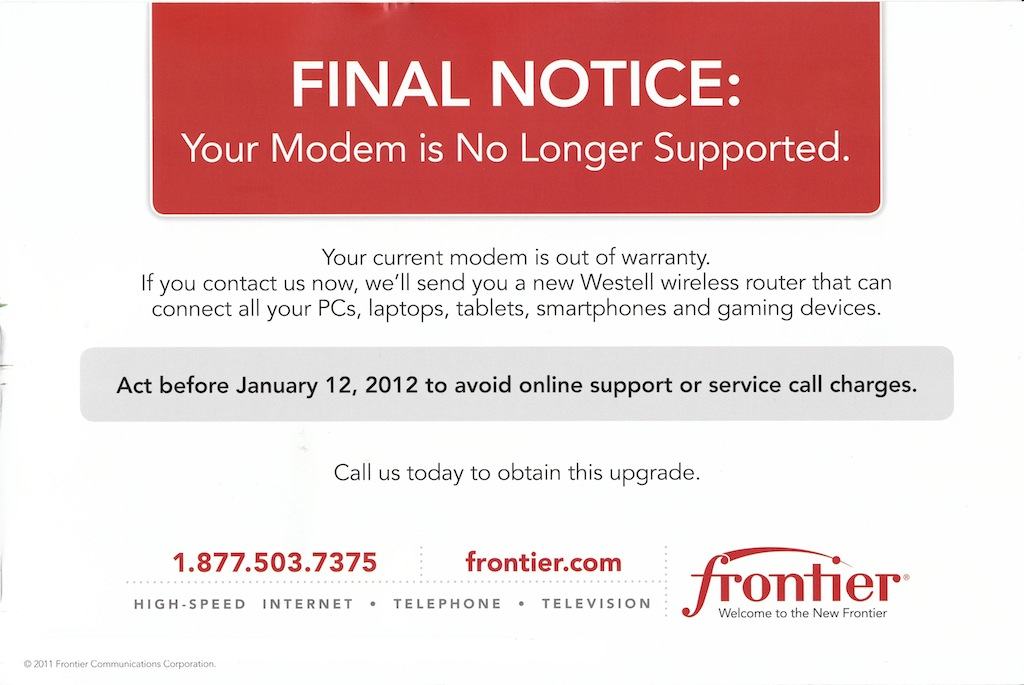
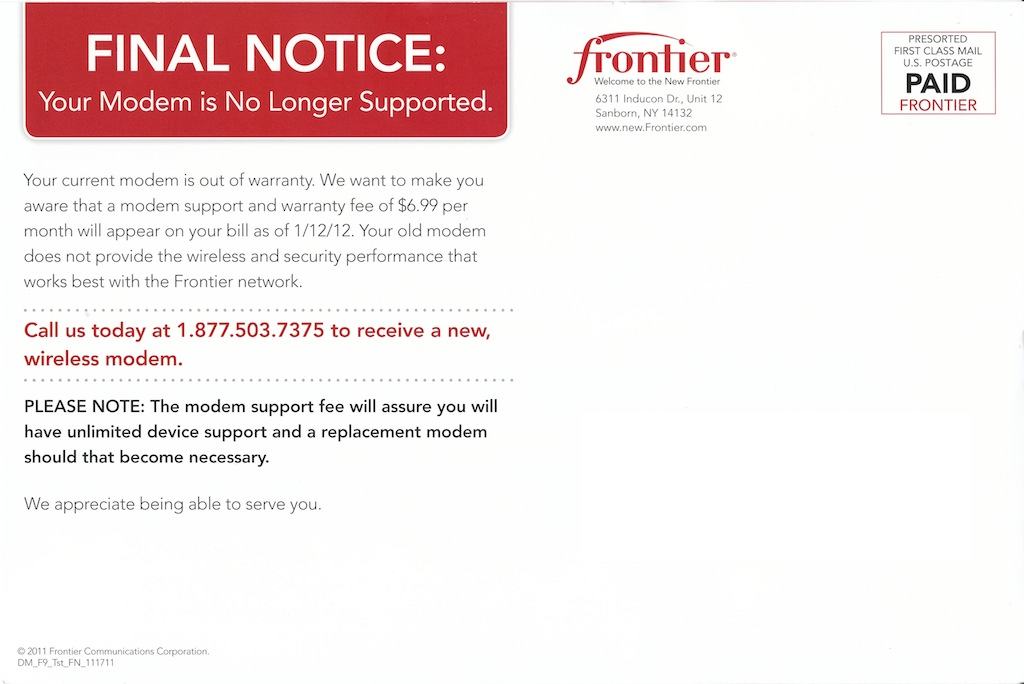
Stop the Cap! reader Paul in Illinois e-mailed us (along with several other readers) sharing news that Frontier Communications intends to charge their DSL customers a minimum of $6.99 a month for the rental of a DSL-ready modem-router, even if customers purchased and use their own equipment for Frontier’s High Speed Internet service.  Even worse, some customers are being told the monthly combined rental fee for the company’s wireless-ready DSL equipment is a whopping $14 a month — just for the equipment.

The bad news arrived in the form of a postcard notifying customers that their current modem is “out of warranty” and a new “modem support and warranty fee of $6.99 a month will appear on your bill as of 1/12/12.”

Frontier’s alarming notice tries to scare customers, telling them their existing outdated equipment represents a potential security risk, and explains only with their new mandatory “modem support fee” will customers get “unlimited support” and a replacement modem, if necessary.

Eric, a Stop the Cap! reader and Frontier customer notes Frontier has been piling on price increases in the form of mandatory surcharges and fees this year, including a monthly $1.99 “High Speed Internet Surcharge.”

“Former Verizon customers are now being gouged an additional $9.00 per month or $108 dollars per year,” Eric notes, adding up just the cost of the modem rental and the surcharge.

Paul is especially upset because he purchased his DSL modem direct from Verizon just before the phone company sold its business in Illinois to Frontier.

“In fact, the Verizon modem is more ‘advanced’ than the Westell equipment they want to rent me,” Paul says. “The security is better on Verizon’s unit, and I got it as part of a $29.99 ‘Internet for life’ special offer Frontier now wants to renege on.”
“Frontier is running a scam from top to bottom, offering you l0wball Internet pricing that never includes the outrageous add-on fees that you only find out about on your next bill,” Paul says.

Other Frontier customers on Broadband Reports’ Frontier forum are reporting Frontier has been inconsistent explaining the fees, and some are finding promotions that were supposed to protect them from price increases do nothing of the sort.

Stop the Cap! reader Isabella in Indiana wrote us to say her contact with Frontier customer service was likely going to be her second to last.

“Not only do they intend to collect the $7 a month from customers with their own equipment, those of us with wireless are being told it will cost $14 a month for two of their wireless routers we have on their ‘double DSL line’ promotion,” says Isabella.  “The price for their 3Mbps Internet, on special, was $14.99 a month with a multi-year agreement.  The add-on fees they never tell you about are more than the advertised price of the service.”

Isabella calls her Frontier service “bait and switch Internet” and says when the company applies any additional fees to her account, she will terminate her contract and will refuse to pay a penalty, claiming Frontier unilaterally changed the terms.

“The only ‘price protection’ Frontier offers is for the benefit of their bottom line; Frontier representatives told me there was no way for me to avoid these new fees, even though I am supposed to be guaranteed no price increase for two years,” she says.

Paul also ran into a brick wall with customer service.

“They will not exempt you from the fees — for my ‘convenience’ they will be automatically added to my bill starting next month, with or without the new equipment,” Paul shares. “I am beyond outraged.”

“I am contacting my state Attorney General on Monday to file a formal complaint against Frontier for cheating customers on ‘price protection’ plans,” Paul says.

Modem rental fees offer a lucrative opportunity for broadband providers to raise prices while still advertising a low monthly price for the service alone.  Equipment rental fees often run extra and are typically only disclosed in the fine print.  But must providers will exempt customers who purchase and use their own equipment.  Frontier is apparently ending this policy, forcing some customers to pay the fee for equipment they neither need nor want.  Frontier’s $7 a month fee is particularly steep, especially for equipment that can easily be purchased new or used for prices averaging $50 or less.  Frontier will earn back the cost of the equipment within the first year, with the rest simply padding profits.

One of our readers notified us Frontier customer service agreed to “note their account” to not send the new equipment or charge the fee, despite the fact the representative repeatedly encouraged the customer to “upgrade their router.”  But the customer isn’t so sure he believes the company, telling us an earlier victory getting them to waive the “HSI Surcharge” was hollow: Frontier simply began charging it anyway, and refused to remove it despite the earlier agreement.

“What is next — special fees for reading e-mail and visiting web pages?” asks Paul.

 

Search This Site:

Contributions:

Recent Comments:

Your Account:

Stop the Cap!