Home » Contract » Recent Articles:

Doing Things ‘The Frontier Way’ Has Been a Recipe for Disaster

Phillip "An Ex-Frontier Customer" Dampier

The other week while sitting in the dentist’s office waiting for my wallet to be drilled, I overheard a conversation at the reception desk over the latest effort by Frontier Communications to shoot itself in the proverbial foot.

“I decided to get rid of my phone line the other day and when I called Frontier to disconnect, I was told I would owe them more than $150 in disconnection fees for a contract I never knew I had with them,” opened the conversation.

“That happened to my sister as well, and she couldn’t believe it because nobody ever told her she was on a contract,” came the reply.

“I never knew I was either, and I told the representative they needed to show me where I signed up for anything like that or else I’m not paying it,” insisted the latest victim of Frontier’s phantom service contracts.

Within a minute or two, all had decided they were done doing business with the phone company that got its start more than 100 years ago as the well-regarded Rochester Telephone Corporation.  In 2012, there was no turning back after $150 “disconnect” penalties and other insults.  They were intent on being rid of Frontier once and for all.

With customer unfriendly policies like that, it comes as no surprise Frontier has been losing customers in the Rochester market for years, mostly to cell phone providers or Time Warner Cable — the latter which delivers more value and far superior broadband speed in western New York communities not served by Verizon FiOS.

Surprise... you're on a contract with a $150 cancellation penalty.

Twenty years ago, Rochester Telephone delivered excellent value, charging about half what then-NYNEX customers in Buffalo and Syracuse paid for telephone service. But as Frontier has increasingly disengaged from being an aggressive contender for telecommunications services in Rochester, people in this region of one million noticed, especially when Verizon’s fiber to the home service arrived in Buffalo, Syracuse, Albany, and beyond.

What did Frontier offer? Not much. Frontier’s local general manager Ann Burr, who used to be in charge at Time Warner Cable locally, told local media Rochester didn’t need faster broadband speeds. That’s a fitting argument for a company that doesn’t deliver them and believes 3Mbps broadband is plenty fast enough.  If you don’t like it, feel free to leave, so long as you aren’t trapped with that long-term service contract you never knew you had. (The New York Attorney General’s office has already spanked Frontier once for the practice, forcing them to issue refunds, and judging from last week’s conversation, it appears the problem has not abated.)

The fact is, Frontier offers little compelling to the landline customers they have left.

Rochester’s experience with Frontier seems apropos when contemplating the phone company’s latest quarterly results, which one analyst called “ugly.” Having listened to at least a dozen of Frontier’s quarterly conference calls with investors over the past three years, there seems to be no shortage of promises of better days to come.  Frontier is among the few companies I have heard call customer losses of 5-11% every quarter “an improvement.”

As one investor put it, the management at Frontier should win an Academy Award for feigned optimism.

This week, the company announced first-quarter earnings fell 51% thanks to lower revenue earned from the dwindling number of residential and business customers. But better days are ahead, really.

Road to nowhere?

Frontier has spent the last year treating their “system conversion” for ex-Verizon territories as the telecom equivalent of the Holy Grail.  Once achieved, the company can do anything. The reorganization underway internally at the company is supposed to improve its lackluster customer service, generate more marketing opportunities, save the company money, and open the door to a new chapter of a unified Frontier family, with ex-Verizon and always-Frontier employees coming together to do things “the Frontier way.”

How much longer investors will stick around waiting for the promised land remains an open question. The stock has already achieved a 52-week low, and if the company cuts its dividend — the primary point of attraction for investors — it will drop much lower.

Frontier’s management decisions have effectively left the company between a rock (Wall Street) and a hard place (its dwindling customers).  Much of the company’s success is predicated on rural broadband/landline service, where the company expects to face little competition.  But Verizon, the company that sold them much of their inherited network, has a little surprise for them.  After selling off the “junk” (a deteriorating copper landline network they no longer care much about), the company’s wireless division is coming back to town to poach Frontier’s customers.

Verizon’s grand plan is to pitch two products:

  1. Home Phone Connect: Verizon’s landline replacement works with the customer’s home phones over Verizon Wireless’ network. Customers can share minutes on an existing Verizon Wireless plan for $9.99 a month or get unlimited calling for $19.99 a month. It comes with most popular calling features included.
  2. Verizon HomeFusion Broadband: Verizon Wireless has excess capacity in rural areas, especially on 4G LTE-equipped towers, so why not put it to use? While commanding a premium at $60 a month for just 10GB of usage, customers who value speed over money may tolerate that diamond price.  If Verizon finds a way to relax that usage limit and lower prices, it could present a real competitive threat to phone companies delivering lower end DSL service.

[flv width=”480″ height=”290″]http://www.phillipdampier.com/video/Home Phone Connect – Home Phone Transfer Verizon Wireless.flv[/flv]

Verizon Wireless introduces Home Phone Connect, a product designed to tell landline companies like Frontier to take a hike.  (2 minutes)

While Verizon isn’t likely to immediately grab major market share with either product, it foreshadows an intent to leverage their rural wireless network to remain a player, even in places where they have abandoned selling landline service.

How to Stop the Erosion

Turning things around? Frontier contemplates licensing U-verse from AT&T

Even in a barely-competitive marketplace, companies must invest to keep up. But that investment annoys Wall Street, which can depress the stock (and the all-important dividend). But improved service retains customers (and may even win a few ex-customers back). So news that Frontier was considering licensing U-verse technology to upgrade their major markets is a logical first step to stop the bleeding. Frontier is irrelevant delivering broadband at speeds of 3Mbps at out the door prices that meet or exceed what the much-faster cable competition charges. U-verse would allow Frontier to deliver faster broadband (up to 24Mbps is plenty fast for a lot of consumers), build its own IPTV offering instead of relying on satellite dish reseller agreements, and maintain landline customers, assuming the company prices its bundle correctly.

While we are big proponents of fiber-to-the-home service, it is clear Frontier will never spend the money to deliver it, even to their largest service areas. They will prefer the cheaper route of fiber to the neighborhood, relying on existing copper infrastructure to connect individual homes to the service. It represents a reasonable first step.

Frontier also must continue aggressive investments in their broadband network in more rural areas. Some of the company’s regional backbones remain woefully congested, and the company just doesn’t deliver the speeds it markets on its website in too many areas.

High speed should really mean "high speed"

Jameson, a Stop the Cap! reader, is a good example. He signed up for “Frontier Max DSL” which claims it can deliver up to 6Mbps in his part of east-central Indiana.  He ended up with 1.6Mbps instead, in part of because Frontier’s records were inaccurate.

I called Frontier tech support after reading some stuff on Stop the Cap! and another site, learning that since I live under 5000 feet from the DSL termination point (the Frontier building down the road) that I shouldn’t have any problems getting their highest speeds. I got lucky and got a customer support agent who understood my problem, and a tech support guy who genuinely seemed concerned about my issue. The tech guy checked Frontier’s records and I was labeled as being 30,000 feet from the building, but I’m really only around 4200 feet away, and my speeds were provisioned at 1.6mbps down and around 450kbps up. He put in a support ticket to have my speeds automatically raised up to the max I’m paying for.

Jameson ended up with around 7Mbps — a little better than the advertised speed, but only because he thought to ask and reached the right people at Frontier to follow through.

Some of our readers in West Virginia are not so lucky, having the mediocre speeds they fought to receive reduced further when a technician suddenly remotely adjusts speed provisioning on customer equipment to reduce their maximum broadband speed.

Frontier’s DSL problems don’t just exist in rural areas. We experienced it first-hand in 2009 when the company advertised up to 10Mbps speeds in Rochester, and delivered 3.1Mbps to us instead.

Consumer Reports documents this is not an isolated problem, with only two-thirds of Frontier customers getting the broadband speeds they pay to receive. If and when a competitor does better, Frontier loses another customer.

Finally, Frontier must improve its customer service. The company is notorious for giving inconsistent answers to customer questions, doesn’t always follow through on commitments, and maintains far too many “gotcha” terms and conditions on contracts that leave customers exposed to unjustified early termination fees.

[flv width=”640″ height=”380″]http://www.phillipdampier.com/video/CNET Verizon HomeFusion Broadband May 2012.flv[/flv]

CNET shows off the equipment used with Verizon’s new HomeFusion wireless broadband service.  (2 minutes)

NetZero’s “Free Wireless Internet Access” Comes With Catches

The days of free Internet access are back… sort of.

United Online, Inc. announced Monday that it will offer free wireless Internet access through its NetZero service, provided as a “loss leader” that depends on users upgrading to paid access to cover the service’s costs.

NetZero became familiar to most Americans in the 1990s when the company handed limited dial-up Internet access, paid for through online advertising that subscribers endured in return for getting the service for free.  But broadband costs considerably more, so as the transition away from dial-up turned into a stampede, NetZero faded into memories about as much as AOL signup floppy disks and CD’s.

But now the company is back pitching free access to “4G wireless Internet” with no strings attached, contract commitments, or overage fees.  But that does not tell the full story.

While there is no contract commitment, NetZero requires an upfront investment in wireless hardware — $50 for a USB antenna stick suitable for a laptop or $100 for a “mobile hotspot” that can deliver a Wi-Fi connection to other nearby devices.  The devices are for sale on NetZero’s website.

The “free wireless” offer is probably better described as dim sum — it comes with a 200MB monthly usage limit, which makes it suitable for basic web browsing and e-mail only.  Once your limit is reached, the service is cut off for the remainder of the month, unless you agree to one of several paid usage plans that range from $9.95 for 500MB to $49.95 for 4GB, billed monthly.

After 12 months, NetZero’s free ride is over unless you agree to continue with a paid usage plan.  It ends even sooner if you choose to upgrade to a paid plan anytime during the first year.  Once you do, you lose the option of switching back to the free plan.

Whether paid or not, NetZero users ride on Clear’s troubled 4G WiMAX network, which Sprint — Clear’s largest customer — is planning to eventually abandon for more advanced LTE.  The long term future of Clear, also known as Clearwire, is also up in the air.  The company has ceased investing in its WiMAX network and is making preparations of its own to switch to LTE 4G technology — incompatible with the NetZero hardware you will spend $50-100 to acquire.

Clear’s network has also received considerable criticism for its speed and performance.  Because it operates on much higher frequencies, Clear’s wireless signal has problems penetrating indoors, and has even more trouble where energy efficient window coatings are used, especially in the south.

While NetZero does, in fact, deliver the service for free, the upfront investment and potential service headaches limit its usefulness.  Light users may find free Wi-Fi, increasingly common in a number of businesses, more convenient, affordable, and faster than the NetZero alternative.

Indiana Newspaper Falls All Over Itself Praising Frontier Communications’ Broadband

Frontier Communications is enjoying “press release”-like praise for its broadband service in the state of Indiana, courtesy of The Times newspaper:

There are a lot of companies you can go for your internet service. Every day, you are bombarded with promises and special offers. Yet, when choosing the service best suited for you and your needs, perhaps you should turn to the company that is active in your community.

Frontier Communications is that company. Since entering the Northwest Indiana region back in July 2010 (Verizon sold all of their phone lines in this region), Frontier has made their presence known with not only a long list of unsurpassed internet services, but also with their active participation in everything from the Northwest Indiana Economic Forum to the Porter Country Jobs Commission. “We live, work and breathe customer and community,” explains Communications Manager Matt Kelley.

[…] Right now, Frontier Communications is offering a special offer of $20 per month for 12 months of high speed internet. This offer is good until the end of March. But perhaps, the greatest advantage to having your business connect with Frontier is their dedication to your success and access to cutting edge Internet technology to make a true difference in the lives of their customers.

The Porter County edition of the paper elicited a slightly less enthusiastic response from Thomas Dodge, one of our Indiana readers:

“I’d like to know what company they are talking about, because it doesn’t sound like the Frontier Communications we dealt with last year,” Dodge writes. “They made their presence known alright — 1.5Mbps Internet for about two weeks, before we canceled and switched to the cable company for 10Mbps Internet.”

Dodge says he appreciates Frontier does seem to have more interest in the community than Verizon ever did, but the company needs to invest money on broadband that delivers speeds more suitable for 2012.

“I don’t know where all the money is going, but it sure isn’t in our neighborhood,” he says. “That $20 offer sounds good until you read the fine print that includes a modem surcharge, taxes, fees, and a contract commitment.  They’re hopelessly oversold here as well, and those slow speeds actually dropped at night as people got online.”

Would Dodge give Frontier another try?

“Not after that.  I’d have to see it working better to believe it.”

Wireless Telecom Roundup: The Big Get Bigger; Smaller Providers Feeling the Heat

Phillip Dampier February 21, 2012 AT&T, Consumer News, Cricket, MetroPCS, Sprint, Verizon, Wireless Broadband Comments Off on Wireless Telecom Roundup: The Big Get Bigger; Smaller Providers Feeling the Heat

A summary of recent quarterly earnings reports from America’s wireless companies:

Verizon Wireless: Verizon has been uncompetitive in the prepaid market for the last several years, as it focused on its postpaid/contract customers.  No more.  Recent price cutting and the introduction of new contract-free plans that offer unlimited calling or packages of features comparable to contract plans are starting to win Verizon a bigger share of the prepaid market.  But Verizon also successfully picked up 1.2 million new contract customers as well, many switching from AT&T or smaller providers.  That’s the second best result the company has had in the last two years.  Verizon has a whopping 87.4 million people on two-year contracts and 21.3 million prepaid customers — 108.7 million total.  Verizon’s iPhone remains popular with 4.3 million activations last quarter.

AT&T: Growth at AT&T achieved its best results in the last quarter of the year, but the company continues to trail Verizon Wireless.  AT&T added 717,000 contract customers last quarter, and has been behind Verizon adding new customers for more than a year.  The company’s reputation for lousy service and policies that antagonize their customers have driven people to look elsewhere — mostly to Verizon.  But iPhone devotees are remaining loyal to AT&T, with one of every five new iPhone activations happening on AT&T’s network.  The company picked up 7.6 million new iPhone activations last quarter.

Sprint: The iPhone is killing Sprint’s balance sheet, but is bringing the company new contract customers.  Historically, Sprint’s most predictable growth has come from its resale agreements with third party providers and its various prepaid service divisions (Boost/Virgin Mobile).  But with the introduction of the Sprint iPhone (1.8 million new activations last quarter), customers looking for unlimited data or a cheaper plan are finding both at Sprint.  Unfortunately for the company, the wholesale cost of the iPhone is eating heavily into the company’s cash on hand.

Leap Wireless/Cricket and MetroPCS: Both companies are facing increasing challenges sustaining their prepaid service business models because of growing competition from larger providers.  Just about everyone who wants a two year contract-cell phone plan already has one, limiting new growth opportunities.  That is forcing AT&T, Verizon, Sprint and T-Mobile to turn their attention to the still-growing prepaid market, which is attractive for the credit-challenged, occasional users, travelers, and those with lower incomes.  Both Cricket and MetroPCS have traditionally targeted urban markets, where their networks are focused, to sell customers inexpensive service plans with convenient payment options.  But their networks don’t extend outside of suburban and urban areas, so roaming expenses can be higher for customers on the go.  Customers of both companies are increasingly looking to larger providers with more robust network coverage and increasingly aggressive pricing.

That has left Cricket with anemic, but acceptable growth, picking up 179,000 new customers in the fourth quarter.  MetroPCS, however, failed to meet expectations with just 197,410 new customers in the fourth quarter.  Existing MetroPCS subscribers are also leaving at a higher rate.

Verizon Buying Portion of Plateau Wireless’ New Mexico Operations

Plateau Wireless serves eastern New Mexico and portions of western Texas.

The consolidation of America’s wireless market continues with this week’s announcement Verizon Wireless intends to acquire a portion of Plateau Wireless’ network operations in southwest New Mexico.

Verizon will take over Plateau’s 259,000 mostly rural customers in portions of Roswell, Carlsbad, Artesia, Hobbs, and Ruidoso, N.M.

The acquisition covers a service territory of 26,100 square miles.

Plateau says the decision came down to money.  The wireless company needs the infusion of cash a Verizon purchase would bring to help finance high speed wireless upgrades.

The FCC will have to review the transaction before it can be approved.

Plateau will continue to service customers in Clovis, Portales, Tucumcari and parts of western Texas.

AT&T: Pay Us $36 If You Really Want to Upgrade That Smartphone

Phillip Dampier February 13, 2012 AT&T, Competition, Consumer News, Wireless Broadband 1 Comment

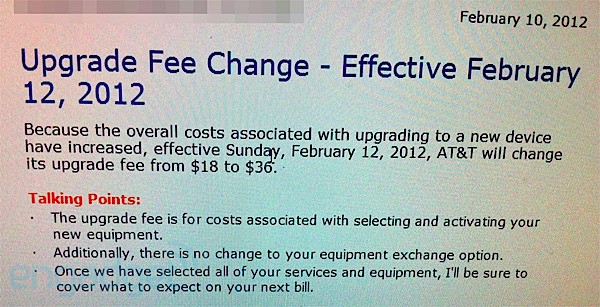
AT&T increases upgrade fee. (Photo courtesy: Engadget)

AT&T has announced it is doubling the price of its equipment upgrade fee, now charging $36 when a customer activates a new phone on their wireless account.

Our regular reader Scott sent word AT&T raised the upgrade fee Feb. 12, from $18 to $36, to “cover their costs. ” The fee now matches that charged by Sprint.

From AT&T’s official statement:

Wireless devices today are more sophisticated than ever before. And because of that, the costs associated with upgrading to a new device have increased and is reflected in our new upgrade fee. This fee isn’t unique to AT&T and this is the first time we’re changing it in nearly 10 years.

Wireless companies in North America encourage more frequent phone upgrades because of their business model: pitching subsidized phones in return for a two-year contract commitment, along with higher-priced service plans which gradually recoup the cost of the subsidy.

Consumers who hang on to their phones longer than two years continue to pay higher prices for service plans designed for those who always upgrade phones every two years at contract renewal time.  Phone companies also prefer customers who live under a term contract because they are less likely to switch providers.

In the past, loyal customers not only received extra incentives and discounts when they renewed their contracts, they also had these kinds of service fees waived.  No more.  Most companies have discontinued extra upgrade discounts for existing customers and increasingly refuse to waive service and equipment fees.

Search This Site:

Contributions:

Recent Comments:

Your Account:

Stop the Cap!