Home » Contract » Recent Articles:

Frontier Contract Shenanigans: Getting Stuck With a 2-Yr Agreement & Slower Speeds

Your modem needs an expensive upgrade, even if you own your own.

Frontier Communications customers may get less than they bargained for when calling the company about a malfunctioning modem or problem with service. Andrew, a Stop the Cap! reader from Tennessee discovered a simple service call left him stuck with two separate contracts for phone and Internet service, a major broadband speed reduction, and a sense that Frontier is willing to sign up customers without fully disclosing what they are selling.

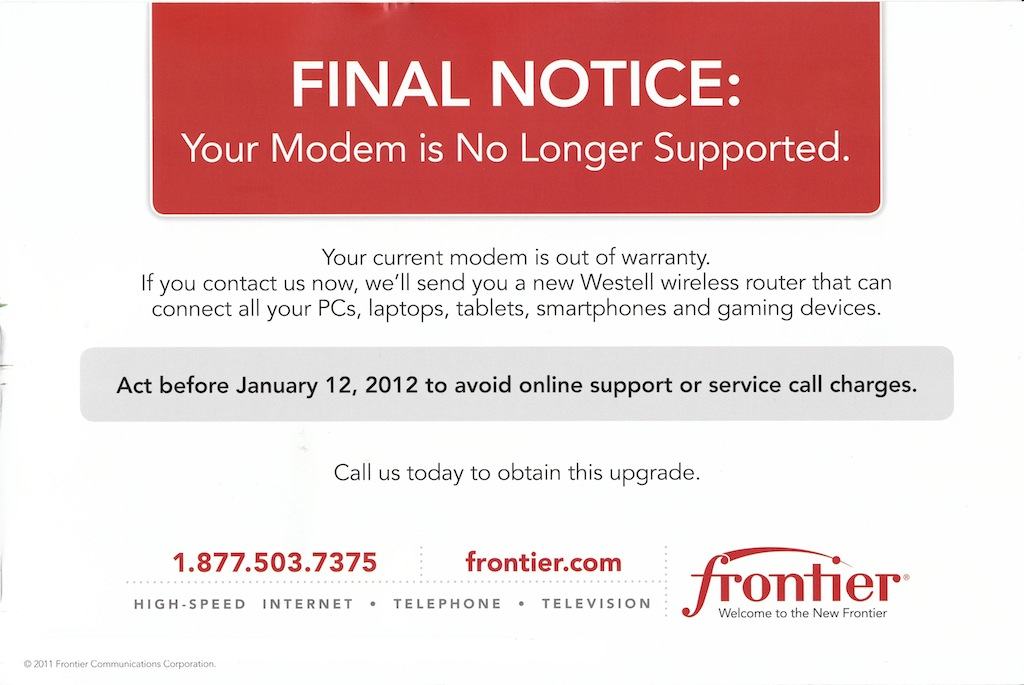
Andrew reports he originally called Frontier to discuss a possibly damaged DSL modem. Upon hearing the model number, a Frontier customer service representative needed to hear no more — the modem “needed to be upgraded.” In fact, Frontier has been mailing postcards to customers with older modems not subject to monthly rental fees telling them their existing modem was “no longer supported” and needed to be replaced with a new model. In the fine print, the customer learns if they proceed, they will end up paying a monthly modem rental fee starting at $6.99… forever.

But things got much worse for this Frontier customer after he contacted the company to say he’d be keeping his current DSL modem, which turned out to be working just fine:

I was then told there would be about a $20 price drop on my next bill (for July). I asked the agent why and her response was, “oh, our prices are going down.” I said okay, thanked her and hung up the phone.

The next morning, I got an email from Frontier thanking me for my ”recent purchase or renewal of services,” further asking me to click and view the Terms of Service agreement for High Speed Internet (and to submit the PIN number associated with my account).

I then called Customer Service about the email. I was told that I had upgraded my phone service the previous day. It turned out that the agent upgraded my phone service to include their ”Digital Essentials” phone features package and had locked me into two price protection plans for both services. There was a one-year plan regarding the phone service and a two-year plan for the High Speed Internet.

I was shocked and informed the agent that I had made no such changes to my phone/Internet services and that I had simply called about cancelling a support ticket on my account regarding the modem.

He later tried to claim that I had given the previous agent authorization when I said okay after she had informed me about the price drop. I told him that was absolutely ridiculous, especially since she never discussed any upgrades to my phone service or any changes regarding my Internet. I asked him how it could be an authorization when what was done to my account was never fully explained (or asked for).

We’ve got a deal too good to refuse.

The Frontier agent then proceeded to hard-sell Andrew the same plan the former agent already applied to his account. The Frontier representative did not bother to mention the “upgrade” and “savings” he was getting included a drastic speed reduction. Frontier sold Andrew a package that included just 1.2Mbps broadband.   That is less than half the speed of his original 3Mbps service, for which he paid $40 a month with no modem rental fee.

Now Andrew is stuck with two contracts, both which carry early termination fees that will total well in excess of $100, the likelihood of a modem rental fee for a new modem he has never received and does not want, and less than half the broadband speed he used to get.

“I was never told by either agent I spoke with that my Internet speed would be [reduced] once the ‘upgrade’ was performed,” Andrew writes. “This, in my opinion, is fraud. Had I known a slower speed would be the end result of their price drop, I would have never [signed up].”

Now Andrew wants his old plan back and Frontier is stalling.

Frontier has a track record of retiring older service plans and packages, but leaving existing customers grandfathered on them until a representative can convince a customer to switch to something else. Unfortunately, newer plans often come with higher prices and more surcharges than older ones, which is part of the company’s effort to increase average revenue earned from each customer. Once off a discontinued plan, low level customer service representatives typically cannot re-enroll a customer.

But those who complain the loudest can get back the service they used to have, just by becoming a nuisance. Start by calling Frontier and asking to speak to a supervisor or manager. If that fails, ask to be transferred to the department that handles disconnections and threaten to drop all Frontier services if the company does not relent and put you back on the plan you started with.

Customers can also file complaints with their state utility regulators. In Tennessee, that is the Tenessee Regulatory Authority. Their online complaint form is here. Unfortunately, many states have succumbed to deregulation rhetoric and state regulators lack significant enforcement powers. But utilities that routinely filibuster state officials risk generating enough legislative energy to support a “re-regulation” effort, so most utilities will connect complainers to an executive level customer service department that can cut through red tape.

Customers can also file complaints with the Better Business Bureau and their state’s Attorney General. The more noise you generate, the more likely Frontier will satisfy your request.

Frontier customers are advised that anytime a customer service representative asks you to complete an online agreement using your PIN number, it signals you are about to commit yourself to a term contract or other major change in service that could prove costly to undo.

Always ask the Frontier representative to e-mail you a copy of the terms of the plan you are enrolling in, including broadband speeds, phone features, contract length and early termination fees.

Always read the agreement you are being asked to complete online.

If you have any questions, call Frontier before you sign. Some plans include a 14 or 30 day penalty-free cancellation provision. While this alone may not restore your old service, it can prove an important negotiating tool to win back the service you had before.

Connected Nation Accused of Rewriting Fla. Budget Amendment to Divert Grant to Itself

Connected Nation, a broadband advocacy group with ties to some of the nation’s largest telecommunications companies, is accused of rewriting a Florida state budget amendment to divert proceeds from a federal broadband grant to itself.

A growing scandal over broadband map funding and allegations of political maneuvering and favoritism has now extended into the offices of several state Republicans now accused of doing the group’s bidding to change funding allocations in ways that could ultimately threaten Florida’s broadband grants.

Connected Nation’s involvement in the state’s broadband expansion efforts began in earnest in 2009 when the group won a $2.5 million contract to map broadband availability in Florida. A follow-up federal grant for $6.3 million to extend broadband deployment brought the group’s lobbyists back to Tallahassee to secure a “no-bid shot” at that new money for itself, which turned out to be a big surprise to the Department of Management Services, the Florida state agency charged with overseeing the project.

The grant award mandated that money be spent on additional broadband mapping and broadband expansion specifically for libraries and schools. When DMS hired contract employees to manage the project for the next two years, Connected Nation declared war on the effort, considering it their turf.

The Miami Herald called the lobbying battle that then ensued as “an audacious display of lobbying clout [that] got the Legislature to force DMS off the contract and steer the grant to [Connected Nation] instead.”

The newspaper reports the end effect of the bitter feud is a less than useful broadband mapping operation and a threat from the federal government it will yank back what remains of the grant money if things do not improve… quickly.

Connected Nation told the newspaper it defends its position as creating value for taxpayers and citizens. But the group also openly admits its broader goal is to increase broadband usage, which directly benefits its telecommunications partners, which the newspaper says includes AT&T, Verizon, and Comcast.

DMS officials are just as willing to play hardball in the statewide dispute, accusing Connected Nation of producing erroneous broadband maps and being responsible for “repeated performance problems.” They announced last year they would not renew Connected Nation’s contract.

Political observers note DMS probably did not realize who they were dealing with, and Connected Nation’s high powered lobbyists descended on the state capital to pull the rug completely out from under DMS, yanking the entire project away from the state agency and assigning it to another.

Holder

With the help of several Florida Republican legislators and the governor, DMS found itself without a broadband project, as lawmakers transferred it to Florida’s new “Department of Economic Opportunity.” The ultimate decision approving the transfer of broadband matters to an agency that suggests an allegiance to the private sector came from Florida’s governor Rick Scott.

The governor’s office muzzled DMS protestations. Marc Slager, deputy chief of staff for Gov. Rick Scott, acknowledged to the Herald he told DMS to stand down because “we don’t need to have different people from the governor’s agencies advocating an issue.”

Revenge is a dish best served cold, and Connected Nation is not through paying back DMS for interfering in their Florida plans to capture broadband grant funds. The group is taking its time working with several Republican legislators to cut more legs out from under the government agency.

With respect to the $6.3 million broadband expansion grant, the newspaper reports Connected Nation last year simply rewrote a state budget amendment, inserting themselves as the grant winner.

“Attached is a document that reflects conversations we’ve had with Chairman Weatherford, the draft language is consistent with the bill, and it is language we believe the [Legislative Budget Commission] would approve,” wrote Alli Liby-Schoonover, from Connected Nation’s lobbying firm, Cardenas Partners, in February 2011, making the change.

What a broadband mapping group was going to do with the money intended to wire schools and libraries remains unknown.

This year, Connected Nation enlisted the support of Rep. Doug Holder, a Sarasota-area Republican, to follow through on an earlier threat to disassociate DMS completely from Florida’s broadband expansion efforts. Holder eagerly wrote legislation, at the request of Connected Nation’s lobbyists, to get broadband away from the state agency, arguing to do otherwise was “expanding government.”

“The idea of a government agency taking a program that could be administered by a private entity that could create revenue in the private sector was wrong,” he said.

The newspaper asked Holder whether the spending was worth it if Connected Nation continued its record of creating no new jobs for Florida. Holder answered he would have to think about whether or not they should get the contract.

The ongoing tug of war is being watched by un-amused officials in Washington.

The state Republican effort to recast the project as an “economic development” effort may fall well short of the grant requirements because the term lacks specificity, warned Anne Neville, director of the State Broadband Initiative in the U.S. Dept. of Commerce. Neville added that any changes significant enough to repurpose funds would cause the grant to be canceled, with funds returned to the treasury.

Cogeco’s ‘Value Plan’ Doesn’t Offer Much Value: $19.95 for 4Mbps With 15GB Cap

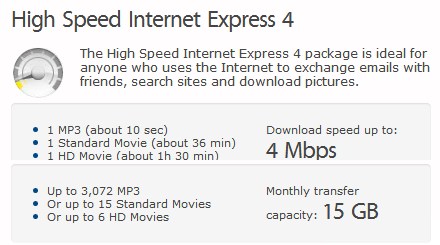
Cogeco Cable is mailing flyers to residents in eastern Canada promoting the company’s ‘value’ option:

  • 4Mbps download speed
  • 12 Month Contract with $75 early termination fee
  • Increases to $32.95/mo off contract
  • “Generous” 15GB usage cap with $1.50/GB overlimit fee (maximum penalty: $50)

Cogeco calls this plan ideal “for anyone who uses the Internet to exchange emails with friends, search sites and download pictures.”

In other words, it’s barely broadband for those who barely use the Internet.

Many Ontario and Quebec phone companies can offer even faster speeds through traditional DSL service. In Bell Fibe areas, for $6 more a month, customers can get a 15/10Mbps package for $26.97/mo for six months, which includes a safer 75GB allowance. At the end of six months, threaten to walk and Bell will extend the offer an extra six months.

Customers bundling services with either Bell or Cogeco may be able to negotiate for a package with better speeds and a more generous allowance. While Cogeco has cracked down on promotions, Bell has not, so customers served by Cogeco are advised to ask about all available deals before committing to either provider.


Verizon’s New “Share Everything” Plans Will Bring Many Higher Cell Bills

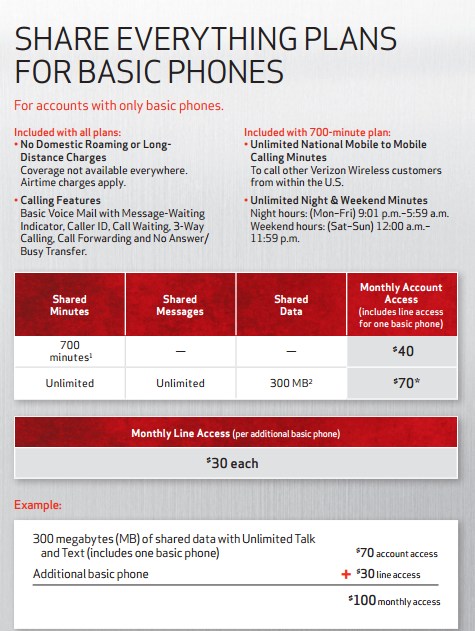
Verizon Wireless unveiled their new “Share Everything” Plans this morning, claiming consumers wanted “simpler, easier-to-understand” plans that let them share their data plan across multiple devices:

But a closer examination of the plans, to be introduced June 28, shows many Verizon customers will face substantially higher cell phone bills if they choose one of Verizon’s newest plans. Perhaps more importantly, customers upgrading to a new subsidized phone/contract renewal on or after that date will be forced to forfeit any grandfathered unlimited data plans they still have with Verizon.

“It is an effort to move ARPU up,” Walt Piecyk, an analyst with BTIG LLC in New York told Bloomberg News, referring to average revenue per user, a measure of how much each customer spends each month.

Obviously acknowledging that customers are using fewer voice minutes and are increasingly finding ways around text messaging charges, Verizon’s new plans sell customers on the idea they can now talk and text as much as they want, but as far as data is concerned, customers will potentially pay much more for less service.

Those light on talking and texting are most likely to be hit hardest by the new cell phone plans.

Verizon formerly charged $50 a month for a basic Nationwide Talk Share plan that included 700 shared voice minutes. Smartphone users also paid $29.99 a month for unlimited data. Together, that amounts to $80 a month. Under Verizon’s $40 “Share Everything” Plan, customers can talk and text all they want, but their unlimited data plan is gone, replaced with a 1GB basic plan for $50. That costs $10 more than customers used to pay on Verizon’s 700 minute plan with an unlimited use data plan. Need 2GB a month? Add an extra $10, bringing you a Verizon phone bill of at least $100 a month for the first line on your account, before taxes and fees.

Other family member lines may also be hit. Verizon used to charge $9.99 a month for extra lines on a shared account. The new price is $30 for a basic phone, $40 for a smartphone. Those family members with smartphones on an older Verizon account each would also incur $29.99 a month for their own individual data plan, which was also unlimited.

Although the base fee for the additional line with a data plan still remains around $40 a month, family members will be forced to share the primary line’s data bucket. Customers will quickly find a 1GB data plan is not going to last long on an account with two or three smartphones. That means expensive upgrades, which start at $10/GB.

Accounts with a mix of smartphones and basic phones face an even stiffer price hike. The $9.99 a month customers used to pay for a basic phone for grandma will now run $30 a month. She won’t be talking or texting much, so the extra features built into Verizon’s new plan will represent a pointless $20 monthly rate increase and an invitation to set grandma up with her own prepaid cell phone instead.

Verizon’s new “Share Everything” concept clearly builds major profits into Verizon’s future:

  • Customers are forced to pay for unlimited voice and texting services, even as those services lose popularity, costing Verizon little to nothing;
  • Data customers are encouraged to add additional devices to their account, but as more data gets used, ongoing upgrades to your data plan at an increment of $10/GB or more will be required;
  • Customers considering a new Apple iPhone or other smartphone will be forced to forfeit any existing unlimited data plan to upgrade, which guarantees future profits from customers consuming increasing amounts of data.
For Verizon’s most premium customers, the new plans may deliver temporary savings, as long as data usage is tempered:
  • Customers paying for expensive texting plans will save the cost of those add-ons;
  • Talk time is now unlimited on most plans, putting an end to overages;
  • Verizon’s Mobile Hotspot feature will now be turned on for all customers on the Share Everything plan (to encourage additional data usage no doubt), which will eliminate at least $20 a month for the feature under existing plans;
  • Customers who own multiple wireless devices configured to work with Verizon, but only use them occasionally, will likely save sharing a single data plan instead of paying for one plan for each device.
All in all, customers who spend the most with Verizon will probably find some savings from Verizon’s newest plans, but legacy customers grandfathered on unlimited data and calling plans probably will not, and lighter users who want fewer features will find substantially higher prices staying with Big Red. For them, a switch to a different carrier or even prepaid service will increasingly appear attractive as monthly phone bills now soar above $100 a month.

[flv width=”640″ height=”380″]http://www.phillipdampier.com/video/Verizon Share Everything Plan 6-12-12.mp4[/flv]

Verizon’s introductory video for its new Share Everything plans.  (1 minute)

Cell Phone Industry Considers Imposing Expensive ‘Unlimited Voice Calling’ Plans

Phillip Dampier June 6, 2012 AT&T, Competition, Consumer News, Sprint, T-Mobile, Verizon, Wireless Broadband Comments Off on Cell Phone Industry Considers Imposing Expensive ‘Unlimited Voice Calling’ Plans

While cell phone companies tell you the only fair way to price wireless data is to charge you for what you use, these same companies are now considering how to reverse that argument and force you to buy more expensive “unlimited voice calling” plans you may not want or need.

The Wall Street Journal reports that AT&T is the most vocal proponent of ditching “tiered minute plans” for voice calls, which let consumers pick cheaper plans with fewer calling minutes. With Americans talking less and less on their cell phones, customers have been downgrading voice plans to less expensive options.

Industry trade group CTIA-The Wireless Association notes the average cell phone call dropped from 3.03 minutes in 2006 to just 1.78 minutes in 2011. Customers who rely entirely on their cell phone and no longer have a landline used to talk an average of 826 minutes per month in 2007.  Last year, that number dropped to 681 minutes, according to CTIA.

Verizon Wireless Allowance Monthly Access Overage
450 $39.99 45¢/Minute
900 $59.99 40¢/Minute
Unlimited $69.99

Verizon Wireless sells customers 900 minutes for $59.99. But the company does not count minutes used during nights and weekends or when placing/receiving calls to or from other Verizon Wireless phones. If a customer now talking less still pays $60 for a 900 minute plan, they could shave $20 a month off their monthly bill if they kept their daytime calling to 450 minutes a month. Many do. In fact, younger customers use their smartphones for talking even less, with some not even reaching one hour of voice calling a month.

Verizon's cattle call? Will the company herd all of its wireless customers to unlimited voice calling at a higher price?

Given the option to downgrade, customers are jumping at the chance. With voice revenue declining 2-4% in the first quarter, Wall Street has been pressuring carriers to act.

The answer that works for them, although probably not for you, is forcing all customers to purchase an unlimited voice calling plan at contract renewal time. At today’s prices, that could add an extra $30 a month for customers used to paying $40 for a basic 450-minute calling plan.

“The industry’s definitely moving towards unlimited,” AT&T Mobility Chief Executive Ralph de la Vega said in a recent interview. “Especially as more people adopt smartphones that have voice capabilities over the Internet, segmented voice plans will become less relevant.”

Ironically, cell phone companies that have spent the last year or two defending the end of unlimited mobile data as “fair” because customers can “choose exactly the plan they need,” are adopting a completely different strategy to push for unlimited voice calling.

“It’s more important to offer a complete solution to consumers which is really, truly unlimited,” said T-Mobile USA Chief Executive Philipp Humm in a recent interview. “The new world is a completely unlimited, worry-free world.”

Sprint agrees, although its insistence on preserving an unlimited data experience for its customers protects the company from charges of hypocrisy.

Fared Adib, head of product development for Sprint, told the Journal eliminating tiered voice options makes sense because it simplifies choices for customers. “People like the freedom of not having to worry about either data or voice,” he said.

No cell phone company would go on the record as the first to discard tiered voice plans, but AT&T led the way to ending unlimited data, and the company is increasingly vocal about ending tiered voice calling as well.

At current prices, consumers could pay substantially higher cell phone bills as a result.

Both AT&T and Verizon Wireless currently charge $70 a month for unlimited calling. Sprint charges $99.99 for its combined unlimited calling and data plan. T-Mobile charges $60 for unlimited talking and texting. Compelling customers to adopt unlimited calling plans will likely bring smartphone monthly charges well above $100 a month when factoring mandatory data plan add-ons, taxes, surcharges, and fees.

Customers who find this pricing intolerable will likely gravitate to prepaid calling plans, which is where an increasing number of occasional and light cell phone users have already ended up.

[flv width=”512″ height=”308″]http://www.phillipdampier.com/video/WSJ Voice Calling Plan Changes 6-5-12.flv[/flv]

The Wall Street Journal explores why cell phone companies want to compel customers to choose unlimited voice calling plans.  (4 minutes)

Search This Site:

Contributions:

Recent Comments:

Your Account:

Stop the Cap!